Welcome to Carbon Brief’s China Briefing.
China Briefing handpicks and explains the most important climate and energy stories from China over the past fortnight. Subscribe for free here.
Key developments
Miliband in China
CLIMATE TRIP: Ed Miliband, the UK’s secretary of state for energy security and net-zero, made a three-day visit to Beijing over 15-17 March, reported the Times. Milband met Chinese vice premier Ding Xuexiang and environment minister Huang Runqiu, according to Singapore-based Chinese newspaper Lianhe Zaobao, which said he also attended the eighth “China-UK energy dialogue” with Wang Hongzhi, head of the National Energy Administration (NEA). (Ding is China’s “top decision maker” on climate policy and was the most senior Chinese politician at COP29.) While in Beijing, Miliband delivered a speech at Tsinghua University on “confronting the climate crisis”, according to one of its official WeChat accounts. The Guardian said the China trip was “the first by a UK energy secretary in eight years”.
-
Sign up to Carbon Brief’s free “China Briefing” email newsletter. All you need to know about the latest developments relating to China and climate change. Sent to your inbox every Thursday.
CLIMATE DIALOGUE: Ahead of the trip, Miliband wrote for the Guardian: “Climate action at home without pushing larger countries to do their fair share would not protect current and future generations…That is why this week I’m travelling to Beijing: to urge continued action from China.” During a meeting between Miliband and Ding, “the two sides agreed to enhance cooperation in jointly addressing climate change”, Chinese state news agency Xinhua reported. It said: “China is ready to work with the UK to…deepen cooperation in areas such as financial services, trade and investment, and low-carbon development…Ding added.” The Guardian said Miliband used the trip to announce “a new annual UK-China climate dialogue” and added that Huang is expected to attend the first event in London later this year. Chinese media has not confirmed Huang’s attendance.
DETENTE AND DISAGREEMENT? Separately, the Hong Kong-based South China Morning Post (SCMP) reported: “The European Parliament has lifted restrictions on lawmakers meeting some Chinese officials, in a fresh indication of a potential thaw in EU-China ties.” Meanwhile, Chinese foreign minister Wang Yi used a speech at the “two sessions” (see below) to call US president Donald Trump “two-faced” over rising trade tensions between the two countries, reported the Financial Times. Wang also pledged to help Africa make progress in the continent’s “green sectors”, said SCMP.
‘Two sessions’ wrapped up

‘EXTREME WEATHER’: China Briefing’s last issue covered the opening of the “two sessions” and the State Council’s work report, which confirmed that the country had missed its 2024 target for carbon intensity, the emissions per unit of GDP. Subsequently, the National Development and Reform Commission (NDRC), China’s top planner, said in its own report that the shortfall was partly due to “rapid growth in the energy consumption in industries…and frequent extreme weather events”. It also announced that China will “continue to increase coal production” and pledged to reduce steel output, as well as to encourage oil refiners to produce more petrochemical products instead of fuels. (Read Carbon Brief’s full coverage of the “two sessions” for more, including a comparison of language used in relation to coal in government work reports over 2021-25.)
‘CUTTING EDGE’: The “new three” – electric vehicles (EVs), lithium-ion battery and solar industries – will continue to be promoted, said the NDRC report. Zheng Shanjie, head of the NDRC, announced that a “national venture capital guidance fund” will be established, with a focus on “cutting-edge areas” including hydrogen and energy storage, according to state-supporting newspaper Global Times.
HUANG’S HIGHLIGHTS: In a brief speech at the political gathering, environment minister Huang said that over the past year his ministry had “promoted the development of the carbon market, resulting in a cumulative decrease of 8.78 percentage points in the country’s carbon emission intensity in the coal-fired power generation sector”, state broadcaster CGTN reported. Huang emphasised the ministry’s “efforts to cultivate and develop new quality productive forces” in “the ecological environment”, added CGTN.
Coal down, low-carbon up
COAL DIP: China’s electricity generation from thermal sources – mainly coal – fell by 5.8% year-on-year in the first two months of 2025, Reuters reported, adding that this was “one of only a handful of times it has declined during that period in more than two decades”. The newswire said the reduction in coal power output came alongside a 1.3% drop in electricity generation overall, with Bloomberg attributing this “rare early-year decline” to “milder winter temperatures”.
‘MAJOR CONTRIBUTION’: In contrast, Lauri Myllyvirta, lead analyst at the Centre for Research on Energy and Clean Air, said on LinkedIn that this 1.3% reduction only referred to “large-scale” generation, citing official statistics. Electricity generation from all sources actually increased by 1.3% in the first two months of the year, he said, with the difference explained by a “major contribution” from small-scale wind and solar. The figures showed that last year’s grid integration issues “have been resolved, at least for now”, Myllyvirta added.
NUCLEAR RISE: The government figures showed that nuclear power output increased by 7.7% year-on-year in January and February, contributing to the reduction in coal generation. Meanwhile, SCMP said Beijing had set an “ambitious target” for nuclear technology of contributing 400bn yuan ($55bn) of economic output by 2026, up from 240bn yuan in 2023. The newspaper added that the government had approved 11 new reactors in 2024, up from 10 each in 2022 and 2023. It noted that while nuclear only accounted for 4.7% of China’s total power supply in 2024, the government has said it will “intensify efforts to support the advancement of nuclear technology”, which “has taken on even greater importance as the country…pledged to achieve carbon neutrality by 2060”.
Power and carbon certificate schemes latest
CLEAN-POWER CERTIFICATES: The NDRC issued a new guiding regulation on promoting “green electricity certificates” (GECs), industry news outlet BJX News reported. GECs allow renewable electricity to be traded on China’s emissions trading scheme (ETS), the country’s mandatory carbon market. They are also linked to compliance with China’s provincial and sectoral regulations requiring minimum shares of demand to be met by renewable sources. The document said there would be a “significant” increase in demand for GECs by 2030, requiring more certificates – which also cover a wider range of low-carbon resources, such as biomass – to be issued quickly. It also urged “key” industries – such as steel, building materials, petrochemicals and data centres – to purchase more GECs, added the outlet.
CARBON CREDITS RESTART: Meanwhile, the first batch of carbon credits “completed registration” under the resumed China Certified Emission Reductions (CCERs) voluntary emissions trading scheme, reported Xinhua. The news agency added that the registered CCERs cover more than 9m tonnes of carbon dioxide equivalent (MtCO2e) and could bring emissions down by 3.5MtCO2e annually in the next 10 years. Financial publication Caixin said that this was the first approval since the CCER scheme was “revived” in January 2024, eight years after being “suspended due to a lack of uptake and regulatory issues”.
Captured

The 2025 government report delivered at this year’s “two sessions” lowered the importance of high-quality development in favour of “expanding domestic demand”, Carbon Brief found in its detailed summary of the meeting. The prioritisation of “low-carbon development” and other climate related tasks remained the same.
Spotlight
Q&A: Will China’s ‘two new’ policy help tackle climate change?
China emphasised the implementation of the “two new” (两新) policy as a means for “boosting [domestic] consumption” at its recent “two sessions” annual political meeting.
President Xi Jinping reportedly “stressed the importance” of a national recycling company as part of the policy in 2024 because it “facilitates green, low-carbon and circular development”.
In this issue, Carbon Brief explains what the policy is, how it works and what its impact will be. A full explainer on the “two new” is available on Carbon Brief’s website.
What is ‘two new’?
The “two new” policy is short for “large-scale equipment upgrades and trade-in of consumer goods”.
The policy was first introduced in 2023 and became well-known after it was reiterated by Xi in early 2024. In March 2024, the policy then became an “action plan”, a document illustrating specific methods for executing a political goal.
Prof Bai Quan, director of energy transition at the Academy of Macroeconomic Research – a research institution under the direct supervision of the State Council – told Carbon Brief in 2024 that there are four aspects of “two new”:
- Updates to equipment, such as large boilers, turbines, heat pumps and lighting used for manufacturing;
- Trade-in of consumer goods, including fridges and air conditioners;
- Recycling of old or high-emission items;
- Improving standards for product efficiency and emissions, as well as for recycling, “to prevent people from re-purchasing outdated equipment with low energy efficiency”.
The first three of these “directly promote carbon reduction”, prof Bai said. Under the policy, government subsidies are provided for manufacturers and consumers to trade-in old inefficient goods and purchase new ones. Other financial and tax support is given to recyclers to increase recycling.
In 2025, the State Council updated the “two new” policy and increased the funds available to consumers and businesses. It also expanded the range of trade-in products and pledged to release a more detailed trade-in standard by the end of the year.
How does ‘two new’ work?
A fundamental mechanism of “two new” is providing funding that enables consumers and businesses to trade-in and upgrade goods, as well as recycling the old equipment.
For example, under the policy, a consumer can trade in an old, inefficient petrol car and receive subsidies to upgrade to a new electric vehicle (EV) instead.
The government report delivered by premier Li Qiang at the “two sessions” said that “ultra-long special treasury bonds totaling 300bn yuan ($41bn) will be issued to support consumer goods trade-in programmes” in 2025.
A more detailed paper in 2024 eased the rules around low-interest loans for equipment upgrades, making it easier for small and medium-sized enterprises to access them.
The policy also allocated around 7.5bn yuan ($1bn) for the “recycling and treatment of waste electrical and electronic products”. This extends beyond the list of trade-in items.
For example, 35m tonnes of waste from decommissioned wind and solar equipment will need to be recycled in China by 2030.
Despite Beijing issuing policies in 2023 and 2024 to encourage the recycling business, a stronger recycling market is needed for “advancing” the “two new”, according to Prof Du Huanzheng, director of the circular economy research institute of Tongji University.
In 2024, a state-owned recycling company was established to support the goals of the “two new” initiative.
Meanwhile, another policy in support of the policy allowed qualified private recyclers to claim for tax deductions more easily.
In 2025, the categories of eligible trade-in goods under “two new” was expanded from eight to 12, including mobile phones and fridges.
The buyer rebates for vehicles, including EVs and petrol cars, were also extended and remained at the same level as in the second half of 2024.
In addition, more and newer types of petrol cars – including cars registered over 2012-14 rather than 2011-13 – were allowed to join the programme.
What is the impact?
Xinhua said that the trade-in scheme boosted sales of cars, with new energy vehicles (NEVs, mainly EVs and plug-in hybrids) accounting for more than 60% of the new vehicles bought under the initiative in 2024.
Meanwhile, products certified with the “highest energy-efficiency level” made up more than 90% of sales by revenue under the home appliance trade-in scheme, added the report.
An analysis by Goldman Sachs said the trade-in subsidies “accelerated” the rising share of NEVs in Chinese car sales. It said the policy would help raise the NEV share from 48% in 2024 to about 60% in 2025.
Subsidies for NEVs under “two new” have amounted to 90bn yuan ($12bn), accounting for about 60% of the total “trade-in money”, according to Goldman Sachs.
However, CREA’s Lauri Myllyvirta told Carbon Brief that even after the 2025 expansion, the policy was a “much more limited measure than the kinds of income transfers that would be needed to substantially boost the role of household consumption in driving economic growth” and “directs household spending in the most energy-intensive direction”.
Lynn Song, chief economist for Greater China from market research firm ING, told Carbon Brief that “the programme sounds a little small at first thought – under 1% of total retail sales last year – but it will boost sales beyond the 300bn [yuan] spent”. He added that it could “lead to improved demand for these categories this year”.
In his 2024 interview with Carbon Brief, Bai called the “two new” a “sign” of the government using policy support to stimulate lower-carbon consumption.
An official release said that the “two new” policy “saved about 28m tonnes of standard coal and reduced CO2 emissions by about 73m tonnes” in 2024. It said the “effect” of supporting the low-carbon transition was “obvious”.
Watch, read, listen
CARBON CAPTURE: China’s National Business Daily interviewed Zheng Guoguang, former vice minister of the Ministry of Emergency Management, who talked about carbon capture for reaching net-zero.
NORTH VS SOUTH: Dialogue Earth published an article by CREA’s Lauri Myllyvirta comparing the different levels of clean power development in north and south China.
CLIMATE LEADER: In a comment for China Daily, Lin Boqiang, director of the China Institute for Energy Studies at Xiamen University,, suggested that China takes a global leadership role in tackling climate change.
CARBON FOOTPRINT: CGTN’s latest climate podcast talked about how China’s “nationwide carbon footprint management system” works.
10,000
The amount of wind and solar capacity, in gigawatts (GW), that China needs to install to reach carbon neutrality by 2060, new Chinese government-endorsed research covered by Carbon Brief found. China’s wind and solar capacity stood at 1,408GW as of 2024.
New science
Revealing the synergy between carbon reduction and pollution control in the process of new-type urbanisation: Evidence from China’s five major urban agglomerations
Sustainable Cities and Society
A study found that China’s “new-type urbanisation” – which has a greater focus on sustainable development – “significantly drove the synergy” between carbon reduction and pollution control. The study said that the synergy level between carbon reduction and pollution control increased from 2014 to 2022. Urbanisation also “improved its relationship with carbon reduction and pollution control from the perspective of decoupling”, added the research.
Event triggers and opinion leaders shape climate change discourse on Weibo
Communications Earth & Environment
A study looked at “climate change discourse” in China by analysing 5.3m posts from Weibo, a Chinese social media platform similar to Twitter and Bluesky, over 2012–22. It developed an analytical framework that “addresses key research questions regarding the triggering events, opinion leader networks and framing strategies surrounding climate change topics”. The results showed the “attention” to climate change nearly doubled after March 2018, indicating climate discussions were “strongly driven by specific events”. It also found the public generally holds a “positive view of the country’s efforts in addressing climate change”.
Follow Carbon Brief on WeChat
Scan the QR code to follow Carbon Brief’s Chinese-translated articles
Recently published:
China Briefing is compiled by Wanyuan Song and Anika Patel. It is edited by Wanyuan Song and Dr Simon Evans. Please send tips and feedback to china@carbonbrief.org

The post China Briefing 20 March 2025: Miliband in China; ‘Two new’ promoted; ‘Two sessions’ ended appeared first on Carbon Brief.
China Briefing 20 March 2025: Miliband in China; ‘Two new’ promoted; ‘Two sessions’ ended

Drought and heatwaves occurring together – known as “compound” events – have “surged” across the world since the early 2000s, a new study shows.
Compound drought and heat events (CDHEs) can have devastating effects, creating the ideal conditions for intense wildfires, such as Australia’s “Black Summer” of 2019-20 where bushfires burned 24m hectares and killed 33 people.
The research, published in Science Advances, finds that the increase in CDHEs is predominantly being driven by events that start with a heatwave.
The global area affected by such “heatwave-led” compound events has more than doubled between 1980-2001 and 2002-23, the study says.
The rapid increase in these events over the last 23 years cannot be explained solely by global warming, the authors note.
Since the late 1990s, feedbacks between the land and the atmosphere have become stronger, making heatwaves more likely to trigger drought conditions, they explain.
One of the study authors tells Carbon Brief that societies must pay greater attention to compound events, which can “cause severe impacts on ecosystems, agriculture and society”.
Compound events
CDHEs are extreme weather events where drought and heatwave conditions occur simultaneously – or shortly after each other – in the same region.
These events are often triggered by large-scale weather patterns, such as “blocking” highs, which can produce “prolonged” hot and dry conditions, according to the study.
Prof Sang-Wook Yeh is one of the study authors and a professor at the Ewha Womans University in South Korea. He tells Carbon Brief:
“When heatwaves and droughts occur together, the two hazards reinforce each other through land-atmosphere interactions. This amplifies surface heating and soil moisture deficits, making compound events more intense and damaging than single hazards.”
CDHEs can begin with either a heatwave or a drought.
The sequence of these extremes is important, the study says, as they have different drivers and impacts.
For example, in a CDHE where the heatwave was the precursor, increased direct sunshine causes more moisture loss from soils and plants, leading to a drought.
Conversely, in an event where the drought was the precursor, the lack of soil moisture means that less of the sun’s energy goes into evaporation and more goes into warming the Earth’s surface. This produces favourable conditions for heatwaves.
The study shows that the majority of CDHEs globally start out as a drought.
In recent years, there has been increasing focus on these events due to the devastating impact they have on agriculture, ecosystems and public health.
In Russia in the summer of 2010, a compound drought-heatwave event – and the associated wildfires – caused the death of nearly 55,000 people, the study notes.

The record-breaking Pacific north-west “heat dome” in 2021 triggered extreme drought conditions that caused “significant declines” in wheat yields, as well as in barley, canola and fruit production in British Columbia and Alberta, Canada, says the study.
Increasing events
To assess how CDHEs are changing, the researchers use daily reanalysis data to identify droughts and heatwaves events. (Reanalysis data combines past observations with climate models to create a historical climate record.) Then, using an algorithm, they analyse how these events overlap in both time and space.
The study covers the period from 1980 to 2023 and the world’s land surface, excluding polar regions where CDHEs are rare.
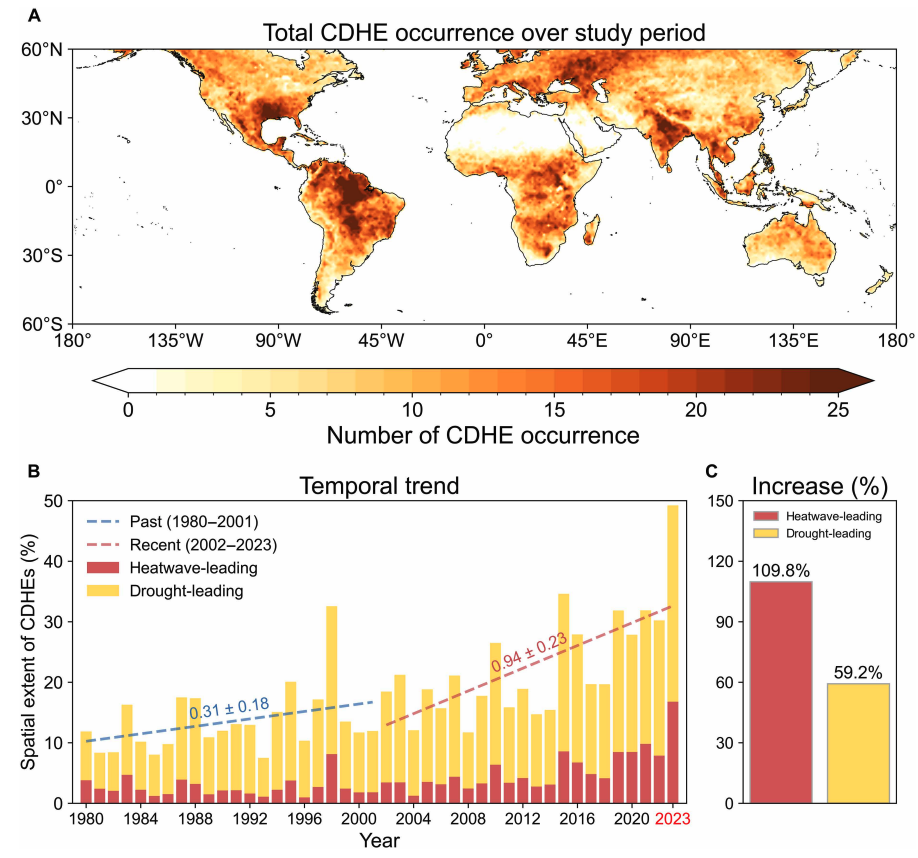
The research finds that the area of land affected by CDHEs has “increased substantially” since the early 2000s.
Heatwave-led events have been the main contributor to this increase, the study says, with their spatial extent rising 110% between 1980-2001 and 2002-23, compared to a 59% increase for drought-led events.
The map below shows the global distribution of CDHEs over 1980-2023. The charts show the percentage of the land surface affected by a heatwave-led CDHE (red) or a drought-led CDHE (yellow) in a given year (left) and relative increase in each CDHE type (right).
The study finds that CDHEs have occurred most frequently in northern South America, the southern US, eastern Europe, central Africa and south Asia.
Threshold passed
The authors explain that the increase in heatwave-led CDHEs is related to rising global temperatures, but that this does not tell the whole story.
In the earlier 22-year period of 1980-2001, the study finds that the spatial extent of heatwave-led CDHEs rises by 1.6% per 1C of global temperature rise. For the more-recent period of 2022-23, this increases “nearly eightfold” to 13.1%.
The change suggests that the rapid increase in the heatwave-led CDHEs occurred after the global average temperature “surpasse[d] a certain temperature threshold”, the paper says.
This threshold is an absolute global average temperature of 14.3C, the authors estimate (based on an 11-year average), which the world passed around the year 2000.
Investigating the recent surge in heatwave-leading CDHEs further, the researchers find a “regime shift” in land-atmosphere dynamics “toward a persistently intensified state after the late 1990s”.
In other words, the way that drier soils drive higher surface temperatures, and vice versa, is becoming stronger, resulting in more heatwave-led compound events.
Daily data
The research has some advantages over other previous studies, Yeh says. For instance, the new work uses daily estimations of CDHEs, compared to monthly data used in past research. This is “important for capturing the detailed occurrence” of these events, says Yeh.
He adds that another advantage of their study is that it distinguishes the sequence of droughts and heatwaves, which allows them to “better understand the differences” in the characteristics of CDHEs.
Dr Meryem Tanarhte is a climate scientist at the University Hassan II in Morocco, and Dr Ruth Cerezo Mota is a climatologist and a researcher at the National Autonomous University of Mexico. Both scientists, who were not involved in the study, agree that the daily estimations give a clearer picture of how CDHEs are changing.
Cerezo-Mota adds that another major contribution of the study is its global focus. She tells Carbon Brief that in some regions, such as Mexico and Africa, there is a lack of studies on CDHEs:
“Not because the events do not occur, but perhaps because [these regions] do not have all the data or the expertise to do so.”
However, she notes that the reanalysis data used by the study does have limitations with how it represents rainfall in some parts of the world.
Compound impacts
The study notes that if CDHEs continue to intensify – particularly events where heatwaves are the precursors – they could drive declining crop productivity, increased wildfire frequency and severe public health crises.
These impacts could be “much more rapid and severe as global warming continues”, Yeh tells Carbon Brief.
Tanarhte notes that these events can be forecasted up to 10 days ahead in many regions. Furthermore, she says, the strongest impacts can be prevented “through preparedness and adaptation”, including through “water management for agriculture, heatwave mitigation measures and wildfire mitigation”.
The study recommends reassessing current risk management strategies for these compound events. It also suggests incorporating the sequences of drought and heatwaves into compound event analysis frameworks “to enhance climate risk management”.
Cerezo-Mota says that it is clear that the world needs to be prepared for the increased occurrence of these events. She tells Carbon Brief:
“These [risk assessments and strategies] need to be carried out at the local level to understand the complexities of each region.”