2024年,清洁能源技术对中国经济的贡献率首次达到10%以上,相关销售和投资总额达到13.6万亿元人民币(1.9万亿美元)。
在2024年,清洁能源行业推动了四分之一的国内生产总值(GDP)增长,其市场规模已超过房地产销售。
Carbon Brief根据官方、行业数据和分析师报告进行的最新行业分析显示,清洁技术在中国经济中的作用日益增强,尤其是所谓的“新三样”行业,即太阳能、电动汽车和电池。
本篇分析对“清洁能源”行业的定义较为宽泛,涵盖可再生能源、核能、电网、储能、电动汽车和铁路。这些技术和基础设施是中国推动能源生产和使用脱碳的关键。
其他关键调研结果包括:
- 2024年清洁能源投资达到6.8万亿元人民币(9400亿美元),同比增长7%。相比2023年40%的增速,这一增长有所放缓,但符合预期趋势。
- 中国对清洁能源的投资规模接近全球对化石燃料的投资总额,其体量相当于沙特阿拉伯的经济总量。
- 作为“新三样”,电动汽车、电池和太阳能仍然是清洁能源行业的核心驱动力,三者创造了四分之三的附加值,并吸引了该行业一半以上的投资。
- 2024年,清洁能源行业经济产出的增长拉动了其对GDP的贡献,而2023年主要依靠投资增长带动。
- 若考虑整个生产链的产值,清洁能源行业对中国经济的总体贡献为 13.6万亿元人民币(1.9万亿美元),略高于GDP总量的10%。
- 该行业的增长速度是中国整体经济增速的三倍,占2024年GDP增长的26%。
- 值得注意的是,若无清洁技术的增长,中国2024年的GDP增速可能仅为3.6%,远低于官方公布的5.0%目标。
展望2025年,清洁能源投资可能会进一步增长,因为许多大型项目正加快推进,以试图在“十四五”规划(2021-2025年)结束前完工。
在此之后,清洁能源行业的发展将很大程度上取决于下一份五年规划设定的新目标和政策,该计划即于今年制定。
清洁能源达到GDP里程碑
2023年,在清洁能源行业巨大的产能投资浪潮推动下,该行业贡献了中国约40%的经济增长。
正如去年的分析所预测,超常规的投资增长率在2024年不可避免地会降温,而新的数据也证明了这一趋势。
尽管如此,2024年清洁能源行业的投资仍然保持增长,并且该行业的商品和服务产值增速依然超过20%。
因此,正如下图所示,2024年清洁能源行业占中国GDP的比重首次超过10%。
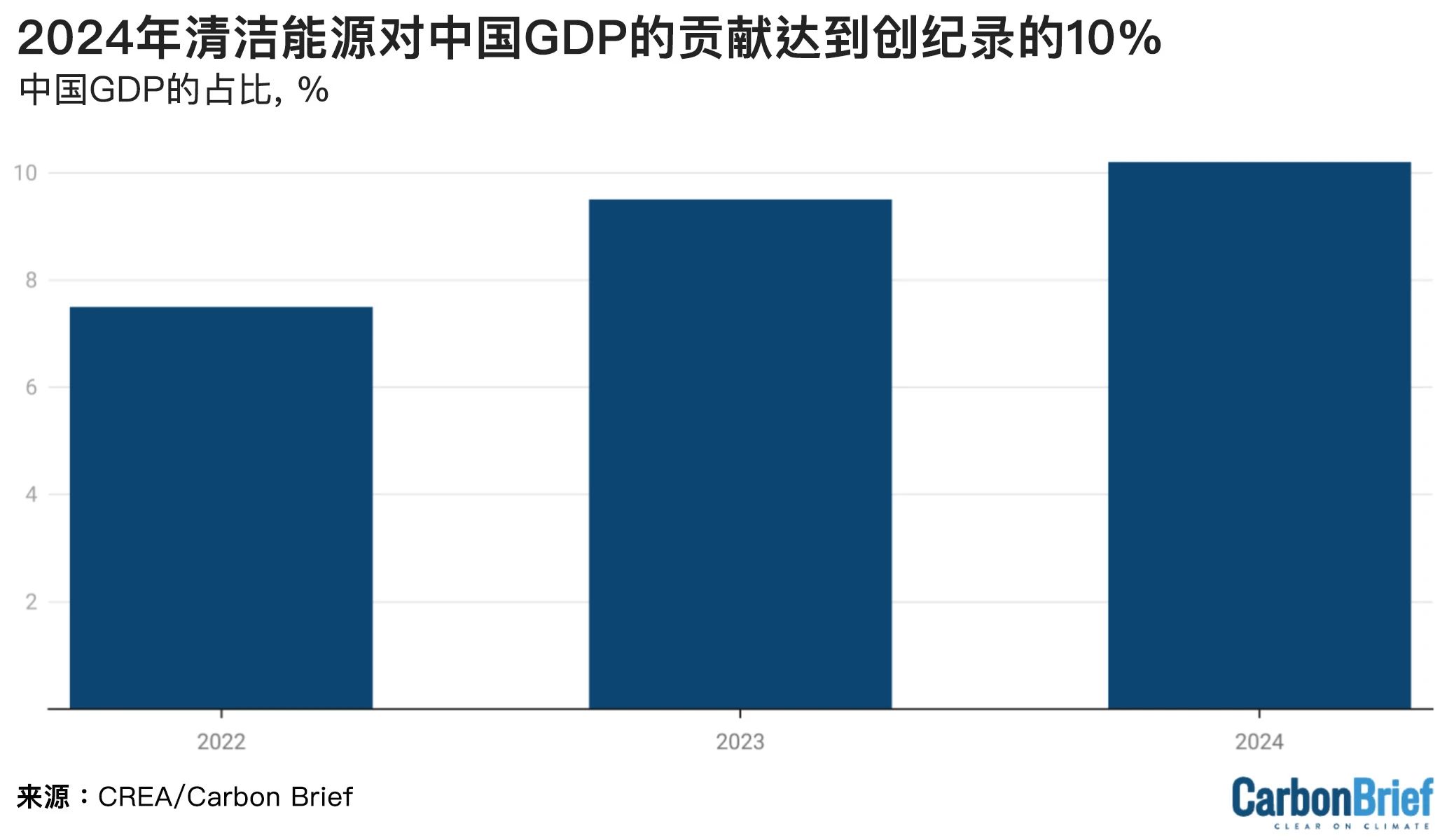
清洁能源行业对中国经济的整体贡献达到13.6万亿元人民币(1.9万亿美元),其规模与沙特阿拉伯或瑞士等主要经济体相当。
同时,该行业在中国经济中的比重已超过房地产销售(9.6万亿元人民币)和农业(9.1万亿元人民币)。
电动汽车和太阳能是增长主要驱动力
2024年清洁能源行业的生产和投资总值预计增长了13%,自2022年以来则增长了50%,如下图所示。
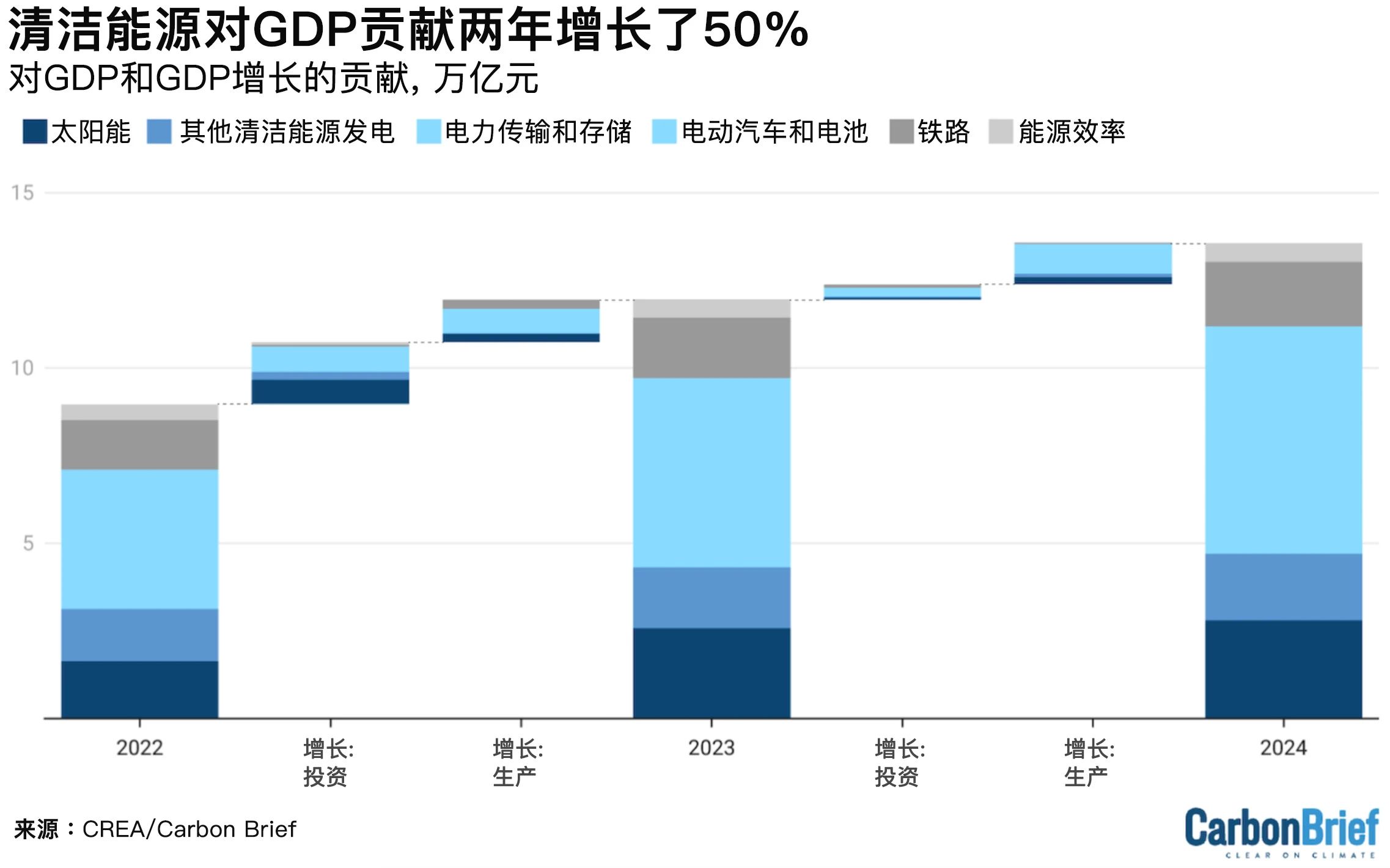
这些行业的商品和服务产值增长了21%,达到6.8万亿元人民币(9500亿美元)。
总体而言,电动汽车生产是最具价值的细分行业,其次是清洁能源生产、铁路运输、电力传输与储存,以及能源效率。
下表详细列出了各行业和活动的具体数据。

价格下跌促进采用,但对生产商构成挑战
在全球大多数经济体都在担忧高通胀之际,中国却面临通货紧缩的压力,主要原因是制造业快速扩张,而国内需求相对疲软。
多个关键清洁能源行业都受到这一趋势的影响。尽管产量不断增长,但供过于求导致收入和利润增长乏力,使该行业的实际贡献在一定程度上被忽视。
以太阳能电池板制造为例,尽管产量大幅增长,但行业名义产值下降了41%。

不过,由于项目数量激增,加上太阳能电池板成本仅占整个太阳能发电项目成本的不到三分之一,太阳能项目的投资名义价值仍保持稳定。
太阳能发电电力价值增长了40%,使得太阳能行业对名义GDP增长的总体贡献率上升至正值。
总体来看,清洁能源行业的增加值按名义计算增长了约8.5%,低于实际增长率的15%,但仍远高于GDP增速,占名义GDP增长的17%。
2024年12月,一场重要的年度经济政策会议强调,需要“积极营造绿色低碳产业健康发展生态”。这表明政府可能会采取措施解决清洁制造业供应过剩和该行业盈利能力较弱的问题。
清洁能源经济快速增长的影响
清洁能源行业连续第二年在中国经济增长目标的实现中发挥了关键作用。
供应增加和价格下降的双重因素,导致中国清洁能源部署速度远超几年前的预期,同时也促进了清洁能源在新兴海外市场的部署。
预计这一增长趋势将在2025年延续,这主要得益于多个重大项目都致力于在“十四五”规划(2021-2025年)收官前完工。
2025年以后,该行业的发展将在很大程度上取决于今年即将完成的下一个五年计划(2026-2030年)中的新目标和政策。
随着近几年清洁能源发电装机容量的闪电式扩张,该行业正陷入盈利能力下降和产能过剩的困境。
若要恢复行业盈利能力,中国既需要保持强劲的国内需求,也需要采取措施解决产能过剩问题。此外,弃电问题(尤其对太阳能发电产生限制)也亟需解决,以确保市场需求能持续释放。
根据中国主要部委提出的2030年和2035年目标所显示的初步迹象,中国难以将关键清洁能源技术需求维持在2023-2024年水平。
如果清洁能源行业在下一个五年规划时期的目标低于当前部署速度,该行业可能从拉动GDP增长的推动力转变为拖累因素,并加剧供过于求的问题。相反,更具雄心的清洁能源目标将有助于保持该行业对经济的积极贡献。
鉴于清洁能源在投资增长中发挥的重要作用,政府的经济刺激措施可能会支持清洁能源领域的投资。
此外,清洁能源现在在中国经济增长中的关键作用,也使得政策制定者更有动力确保该行业的健康发展。
The post 分析:2024年清洁能源对中国GDP的贡献将达到创纪录的10% appeared first on Carbon Brief.
Climate Change
DeBriefed 3 July 2026: US faces scorching Independence Day | Record ocean temperatures | Vietnam’s EV surge
Welcome to Carbon Brief’s DeBriefed.
An essential guide to the week’s key developments relating to climate change.
This week
Heating up
NOT FREE FROM HEAT: “Dangerous, record-breaking” heat altered plans for 4 July celebrations across the US this weekend, reported the Associated Press. New York and Boston hit 100F (37.8C) on Thursday, said the newswire. CNBC reported that temperatures of up to 105F (40.5C) are forecast in central and eastern parts of the country, with “daily, monthly and all-time records possible”.
TEMPERATURES SOAR: Heat that hit western Europe last week spread east to “scorch” Germany, Hungary, Romania, Poland and others, said Bloomberg. Red warnings for extreme heat were issued in a number of nations, noted the outlet, adding that the heat “underscores how climate change is transforming summers in the world’s fastest-warming continent”. The Independent said last month was confirmed to be England’s hottest June on record.
HEAT DEATHS: June’s extreme temperatures caused more than 2,000 excess deaths in Spain and France, reported the Guardian. The countries are bracing for further heat that “could bring temperatures of 44C (111F) over the coming days”, said the newspaper. Deaths in France rose almost 30% at the heatwave “peak” on the week of 22 June, according to Le Monde. Last week’s conditions also led to around 480 excess deaths in the Netherlands, reported Reuters.
BOILING: Global ocean temperatures reached record levels for this time of year, reported NBC News, “fuelling fears of more dangerous heatwaves this summer and fanning concerns over the escalating global climate crisis”. Scientists told the Financial Times that this could lead the world towards “uncharted territory”. The newspaper said global average sea surface temperatures reached 20.96C on 21 June, exceeding June records for 2023 and 2024.
Around the world
- GOAL DROPPED: The World Bank will “abandon” its goal to devote 45% of annual lending resources to climate-related projects, reported Reuters. Carbon Brief explored what it could mean for global climate action.
- FIVE-YEAR PLAN: China plans to invest more than 20tn yuan ($2.9tn) in “key energy projects and new business models” over the next five years, according to International Energy Net.
- DRILLING: The Guardian said UK Labour politicians “urged” the likely next prime minister Andy Burnham to ignore “deluded” calls to develop the Rosebank oil field located in the Atlantic north of Scotland.
- PLASTIC TALKS: Countries and activists feared key issues could be sidelined at “critical” talks on a global treaty to curb plastic pollution in Kenya, said Climate Home News. A treaty could have “important implications” for climate change, reported Carbon Brief in 2024.
- CANADA PIPELINE: Canadian prime minister Mark Carney announced plans to build an oil pipeline to supply Asia with up to 1m barrels per day, reported the Financial Times. Earlier this week, Carney called the previous government’s climate plans “expensive” and “divisive”, said CBC News.
63
The number of UK newspaper editorials calling for more oil and gas extraction in the North Sea so far in 2026, according to Carbon Brief analysis.
Latest climate research
- Including emissions from permafrost thaw raises the likelihood of the Arctic becoming a net-carbon source by more than 50% at 2C of warming | Earth System Dynamics
- Net-zero scenarios relying less on carbon dioxide removals lead to fewer residual emissions, which offers greater health improvements for “non-white and low-income groups” in particular | Nature Climate Change
- Agricultural plots of land in sub-Saharan Africa owned by women face heat impacts 2-2.5 times higher than those owned by men | Nature Sustainability
(For more, see Carbon Brief’s in-depth daily summaries of the top climate news stories on Monday, Tuesday, Wednesday, Thursday and Friday.)
Captured

Wind and solar were the world’s largest source of new energy in 2025, according to Carbon Brief analysis of the latest Energy Institute statistical review of world energy. Wind and solar also saw the fastest growth, up by 18% in 2025. Nevertheless, every source of energy – including coal, oil, gas, nuclear and hydro – also reached global all-time highs last year.
Spotlight
Vietnam’s EV surge
Carbon Brief explores the reasons behind soaring electric-vehicle sales in Vietnam.
Motorbikes are a constant fixture on streets across Vietnam. They pollute the air in cities and make crossing the road a feat of endurance.
But, increasingly, people are moving away from petrol-powered vehicles to save money and reduce air pollution.
Sales of electric motorbikes, scooters and mopeds more than doubled in Vietnam last year, according to a recent report from the International Energy Agency (IEA).
This identified that Vietnam has the largest electric vehicle (EV) market in south-east Asia.
Nearly one-in-five of the two-wheeled vehicles sold last year were electric, it noted, in a nation with 102 million people and 77m motorbikes.
This is “particularly impactful” given they are the main mode of transport in Vietnam, said Lam Pham, Asia energy analyst at thinktank Ember. He told Carbon Brief:
“Electrifying road transport is essential for Vietnam to achieve its net-zero target by 2050. Road transport accounted for around 86% of transport-sector emissions in 2022.”
The nation has just 6.8m cars, but this number is also climbing, partly due to EVs, with nearly 40% of new car sales being electric.

This is “above levels seen in most European countries”, noted the IEA. (The UK’s figure is around 30%.)
EV incentives
Fuel costs surged in south-east Asian countries earlier this year after the energy crisis caused by the US-Israel war on Iran.
This “accelerated” discussions from “why use EVs” to “why keep paying more for fuel”, said Dr Tham Nguyen, a lecturer at the Ho Chi Minh City campus of Australia’s Royal Melbourne Institute of Technology (RMIT) University, who has researched Vietnamese public attitudes to EVs.
But the surge is “not driven by fuel prices alone”, noted Pham.
Increased EV sales can also be attributed to a “convergence of affordability, convenience and sustainability”, Nguyen said:
“Vietnamese consumers buy EVs because they see real value with immediate personal benefits, such as cost savings and energy security, alongside long-term environmental gains.”
Government policies have also incentivised sales through registration fee exemptions and tax cuts for EVs.
Another factor is affordable EVs sold by Chinese companies and Vinfast, a Vietnamese manufacturer. The IEA report noted that Vietnam is the only country in south-east Asia with “sizeable” domestic production of accessible EVs.
Vinfast reported a 219% year-on-year increase in orders for electric motorbikes and e-bikes in the first quarter of 2026, but the company has yet to turn a profit.
Pham noted that “growing public awareness of air pollution” has also “dramatically strengthened” public support for EVs.
Future plans
Vietnam’s major cities also have plans to get drivers to go electric or turn to public transport.
The capital city Hanoi announced that it would ban fossil-fuel-powered motorbikes from a central zone this month, but this has been postponed until 2028.
Ho Chi Minh City, the nation’s largest city with more than 9.5 million people, intends to introduce low-emission zones and swap 400,000 petrol-powered motorbikes to electric by 2028.
The city’s green transport plans focus on metro lines, electric buses and e-bikes, explained RMIT associate professor Catherine Earl. She noted that walking and cycling are currently “not popular, accessible or safe for many residents in Ho Chi Minh City’s hot and humid climate”.
Looking ahead, Pham said Vietnam could focus on “purchase subsidies, financing schemes and adequate charging or battery-swapping infrastructure, to ensure lower-income riders, including delivery and ride-hailing drivers, are not negatively affected”.
Watch, read, listen
‘JUST 1%’ OF EMISSIONS: The Guardian debunked arguments that climate actions from smaller countries are “insignificant”.
DRILLING RISKS: Mongabay reported on the possible impacts oil drilling in the Amazon could have on a “little-known reef”.
HEATING UP: The BBC Climate Question podcast discussed the weather pattern El Niño and its links to climate change.
Coming up
- 7-10 July: AI for good global summit, Geneva, Switzerland
- 7-15 July: UN high-level political forum on sustainable development, New York
- 8-10 July: Ninth meeting of the board of the fund for responding to loss and damage, Manila, Philippines
Pick of the jobs
- Green Alliance, senior partnerships officer | Salary: £42,748-£47,346. Location: London
- World Vision, environment and climate action senior adviser | Salary: Unknown. Location: Kenya
- Nature Energy, interim associate or senior editor | Salary: Unknown. Location: London or Milan
- Climate Analytics, senior communications manager – climate policy (maternity cover) | Salary €60,605-€66,880. Location: Berlin
- Carbon Exchange, researcher | Salary: Unknown. Location: Hong Kong
DeBriefed is edited by Daisy Dunne. Please send any tips or feedback to debriefed@carbonbrief.org.
This is an online version of Carbon Brief’s weekly DeBriefed email newsletter. Subscribe for free here.
The post DeBriefed 3 July 2026: US faces scorching Independence Day | Record ocean temperatures | Vietnam’s EV surge appeared first on Carbon Brief.
Climate Change
Q&A: How will the World Bank’s abandoned finance goal affect climate action?
The World Bank has abandoned a target for 45% of the funding it gives developing countries to be “climate finance”, following months of pressure from the Trump administration in the US.
However, a concerted effort by developed- and developing-country shareholders has seen the bank hold onto its “action plan” for tackling climate change.
The multilateral development bank (MDB) – which is headquartered in Washington DC – is the single largest provider of climate finance globally, distributing $39.2bn in 2025 alone, primarily as loans.
Amid widespread aid cuts by developed countries, the World Bank and other MDBs have previously pledged to significantly scale up their climate finance over the next decade.
Despite scrapping its central target, the bank says it will continue to support the demands of its “clients”, many of which have explicitly stated their need for climate-related investment.
Here, Carbon Brief looks at the likely impact of the World Bank’s policy shift and whether it is – as one expert puts it – “mostly a symbolic victory” for the US.
- How does the World Bank support climate action?
- Why has the World Bank abandoned its climate-finance target?
- Why is the World Bank important for international climate finance?
- How will these changes affect global climate action?
How does the World Bank support climate action?
The World Bank is the oldest and largest MDB. It is tasked by its 189 member governments – the bank’s shareholders – with supporting development projects around the world.
The US is the bank’s largest shareholder, followed, in order, by Japan, China, Germany, France and the UK.
Every year, the bank provides billions of dollars – predominantly as loans – to developing countries.
(One part of the World Bank, the International Development Association – IDA – specifically distributes grants to lower-income nations, as well as lower-interest loans.)
Through its financing, the World Bank also has an important role in “mobilising” private investments in developing countries.
In recent years, the bank has increasingly focused on helping developing countries to cut emissions and adapt their economies for climate change.
The World Bank provided $164bn in what it calls financing with climate “co-benefits” between 2020 and 2025.
The largest share of this funding – roughly one-fifth – went to clean energy and electricity access projects. Smaller shares went to areas such as public transport, water supply and sustainable farming.
As the map below shows, the largest recipients of the bank’s climate funds since 2020 have been emerging economies, such as Turkey ($10.3bn), India ($9bn) and Nigeria ($6.3bn).
Among the largest World Bank projects in recent years are two extensive programmes in India, totalling nearly $3bn, supporting renewables and green hydrogen.
Others include $1.7bn for a Pakistan hydropower project, $926m for Iraq’s railways and $803m to boost “green development” in Colombia.
Despite the bank’s major role in providing climate finance to developing countries, it has faced heavy scrutiny from climate advocates.
In particular, they have noted the dominance of loans that push developing countries further into debt. The World Bank has also been criticised for a lack of transparency around how it classifies projects as “climate-related”, as well as “over-reporting” of climate finance.
Why has the World Bank abandoned its climate-finance target?
When World Bank president Ajay Banga – nominated by former US president Joe Biden – took over the institution in 2023, there were widespread calls for MDB reform.
Many of the bank’s shareholders wanted to see billions more dollars being channelled to support climate action. Later that year, Banga announced that the bank would ensure that 45% of the bank’s funding was climate finance by 2025.
This replaced an existing target of 35% for climate finance between 2021 and 2025, which had been set out in the bank’s second climate change action plan (CCAP).
The CCAP is intended to “mainstream” climate action in the bank’s work. With it in place, the World Bank’s climate finance more than doubled from $17.2bn in 2020 to $39.2bn in 2025.
As the chart below shows, this meant the World Bank exceeded its 2025 goal, with climate-related projects making up a 48% share of total funding that year.

When Biden was replaced by Donald Trump as president in 2025, the US administration turned against international cooperation, including climate finance.
However, the US did not walk away from the World Bank, where it exerts considerable power as the largest shareholder.
With the CCAP due to expire in July 2026, the US has spent months pressuring the bank and its shareholders to weaken or abandon the plan altogether.
US Treasury secretary Scott Bessent issued a statement during the 2026 World Bank and International Monetary Fund (IMF) spring meetings in April 2026, in which he called for “jettisoning” the 45% climate-finance target. More broadly, he said:
“We welcome the coming expiration of the CCAP and…expect the bank to immediately shift its myopic focus on climate and financing volumes to one that emphasises high-quality, durable projects.”
This vision involves a push for the World Bank to finance more fossil-fuel projects, including drilling for new gas. (The bank has committed since 2019 to stop funding upstream oil and gas projects.)
The decision on whether to continue with the CCAP was negotiated behind closed doors by the board of directors – representing national shareholders. There were reports of “deep divides”.
A joint statement from 19 of the 25 directors last year affirmed the need for both a plan and a target. The US, Russia, Kuwait and Saudi Arabia all declined to sign up, while Japan and India abstained, according to Reuters.
There were reports of European nations championing a climate plan, bolstered by support from the developing countries that would stand to receive climate finance. The US call to drop the 45% target entirely was reportedly backed by Saudi Arabia and Russia.
Ultimately, the day before the CCAP was due to lapse, the World Bank announced what appeared to be a middle ground. It would drop both the 45% target and the 35% goal it had replaced, while also “extend[ing]” the CCAP.
UK development minister Jenny Chapman told a committee hearing in the House of Commons the next day that this marked a “compromise”. She said:
“It wasn’t clear we were going to get a CCAP at all and a bank without an action plan on climate is a problem for us – so that’s a good outcome.”
Supportive shareholders had been pushing for a one-year extension of the plan. While the World Bank did not initially define the length, Chapman confirmed on LinkedIn that the plan had, in fact, been extended “indefinitely”.
The bank said it would also engage an “independent evaluation group” to assess the CCAP, in line with a board request.
Gaia Larsen, director of climate finance at the World Resources Institute (WRI), tells Carbon Brief that this evaluation will likely be “relatively free from political ideology” and could be “focused on how to make the CCAP more effective”.
Why is the World Bank important for international climate finance?
Under the Paris Agreement, developed countries – including major World Bank shareholders in Europe and elsewhere – are obliged to provide climate finance for developing countries.
This includes a target of $300bn a year by 2035, which is expected to largely come from developed countries. One significant way these nations can contribute to this goal is via their support for MDBs, particularly the World Bank.
The World Bank has described itself as “by far the largest provider of climate finance to developing countries”. Each year, it oversees half of all climate finance from MDBs and far more than any single donor country.
Many developed countries have, therefore, enthusiastically backed the World Bank’s climate efforts, as well as a “bigger” role for MDBs in development more broadly. The bank can lend sums that far exceed the amount of new public finance that individual nations are willing to commit.
This is particularly significant, given many of these nations, including the UK, Germany and France, have announced large cuts to their aid budgets in recent years.
Carbon Brief analysis suggests that roughly a fifth of the international climate finance provided and “mobilised” by developed countries in recent years can be attributed to their World Bank contributions, as the chart below shows.
(This only accounts for the World Bank financing that can be linked to developed-country shares in the bank. Developing countries, such as China, also have significant shares, which are not included in the chart below.)

MDBs – including the World Bank – have committed to providing $120bn in climate finance to developing countries by 2030.
This was set to come from greater shareholder contributions, combined with a programme of reforms to free up capital.
If the World Bank continued to provide half of the MDB total, it would need to increase its climate finance by around 50%, from $39.2bn today to $60bn in 2030.
Therefore, experts see a “key” role for the World Bank in achieving not only the $300bn target, but also the more aspirational $1.3n target that countries agreed as part of the “new collective quantified goal” (NCQG) on climate finance at COP29 in 2024. This includes the private capital it could “unlock” through its lending.
Joe Thwaites, international climate finance director at Natural Resources Defense Council (NRDC), tells Carbon Brief that these “NCQG politics” are “quite important”. He says:
“The maths of the $300bn does not work if the MDBs pull back and so I think that’s why you’re seeing developed countries taking a stand.”
How will these changes affect global climate action?
To date, the World Bank has only released minimal details about its new climate plans. As such, experts say the impact on future climate finance remains uncertain.
Jon Sward, environment project manager at the Bretton Woods Project, tells Carbon Brief:
“They have said they are going to retain all the same processes about climate-finance reporting. So, of course, there is a world in which, actually, climate finance continues to increase like it has been.”
Some of the World Bank’s internal organisations will, in fact, keep their climate-finance goals for the time being. For example, the IDA’s largely grant-based funding retains a 45% target for its current round, which will last until 2028 – the year of the next US presidential election.
However, WRI’s Larsen tells Carbon Brief that the changes, from a bank that was previously a “champion for climate action”, remain significant:
“This reality, reinforced by the elimination of the 45% goal, means that it would not be surprising to see a reduction in climate investments.”
In a statement, the World Bank said its “work on climate is and will remain firmly client driven”, noting that it supports nations undertaking their Paris Agreement climate plans.
Therefore, its climate focus may come down to whether there is demand for climate action from “client” countries receiving finance.
At an April event in discussion with the climate sceptic Bjørn Lomborg, Bessent said that global financial institutions should focus on growth, characterising climate action as an “elite belief”.
The implication from the US Treasury secretary was that recipient countries are not interested in climate action. However, as reported by Devex, a group of World Bank shareholders representing nearly 100 developing countries, wrote a letter that appeared to push back against this framing.
This “G11+” group, led by Brazil and China, said the bank “must remain firmly client-driven”, noting that countries are “following nationally determined pathways toward climate action”. NRDC’s Thwaites tells Carbon Brief:
“It’s one thing for the Europeans to talk about climate…This was the client countries [100 developing countries] saying: ‘No, we want this.’”
Recent research by the ODI thinktank found that 79% of developing-country officials polled wanted to see MDB investment in solar projects, 54% wanted hydropower and 47% wanted wind power. Only 13% wanted investment in gas-power plants.
Rishikesh Ram Bhandary, a senior development researcher at Boston University, has stressed the need for an “enhanced CCAP”, which could be supported by the bank’s new independent evaluation. Among other things, he tells Carbon Brief:
“The bank needs to make a more convincing case about how climate change is being integrated into development priorities rather than competing with them.”
Thwaites says he is hopeful that the outcome is “mostly a symbolic victory for the US”.
However, he says major shareholders from Europe and elsewhere should make it clear to the bank that it is not “the only game in town” when it comes to climate finance. He says:
“If [the World Bank] are going to cave into one shareholder, when the vast majority of the other shareholders are supportive of continuing climate action, they can take their money elsewhere.”
The post Q&A: How will the World Bank’s abandoned finance goal affect climate action? appeared first on Carbon Brief.
Q&A: How will the World Bank’s abandoned finance goal affect climate action?
Climate Change
As food shocks spread, citizens are showing more leadership than governments
Rich Wilson is CEO of the Iswe Foundation and co-founder of the Global Citizens’ Assembly.
The numbers are stark. According to the 2026 Global Report on Food Crises, 266 million people across 47 countries experienced high levels of acute food insecurity last year, nearly double the figure recorded a decade ago.
Meanwhile, disruptions to oil, gas and fertiliser flows through the Strait of Hormuz drove a 46% month-on-month spike in urea prices early this year, sending agricultural price indices up 8% and raising the spectre of a global affordability crisis.
This is not a blip. It is a new baseline. The EAT-Lancet Commission concluded that food systems now account for roughly 30% of total greenhouse gas emissions and are the largest single contributor to the climate crisis. The science has been clear for years.
Now some of the solutions to the problem are becoming socially acceptable too.
Earlier this year, people from more than 60 countries and territories, selected not by vested interest, but by lottery, spent seven weeks examining the evidence on food and climate for the latest Global Citizens’ Assembly. They heard from scientists, farmers and industry. They worked through 42 hours of structured deliberation, engaging with some difficult trade-offs.
They were not asked to endorse a predetermined conclusion. They were asked an open question: what changes, if any, should we make to how we grow, share and eat food, so that everyone has enough to nourish themselves while tackling the causes and impacts of climate change?
Phase down industrial animal farming
Their answer was unambiguous. They voted to protect forests. They voted to phase down industrial animal food production. They voted for supply chain reform and corporate accountability, explicitly rejecting the idea that the burden of change should fall on individual consumers. All 22 of their Calls to Action passed with over 85% support, a super-majority of randomly selected people from every region of the world, in agreement.
Consider what the assembly was actually being asked to decide. Industrial animal food production is the primary driver of tropical deforestation. Protecting more land as forest and ecosystem means less land available for the expansion of industrial production. That is a real trade-off, with real consequences for real livelihoods. Politicians have spent years avoiding it.
These randomly selected people looked at the evidence, deliberated across time zones and cultures, and chose the forests, with 64% in strong support and a further 20% in favour. People from livestock farming communities voted for change. Not because they were told to. Because deliberation led them there.
We estimate there have now been more than 7,000 citizen participation initiatives worldwide in the last decade. They have been organised because, as our 2025 report: People in the Lead demonstrated, people are now consistently and significantly ahead of politicians on issues ranging from climate to AI governance.
The people know best
What the research consistently shows is that ordinary people, given proper evidence and time, produce recommendations that are more effective and more aligned with public values than what emerges from elected legislatures. The gap in global governance is no longer primarily between science and the public. It is between citizens and their political leaders.
That gap matters for more than procedural reasons. When policy treats people as passive recipients rather than active participants, it leaves out the very actors whose behaviour, trust and consent the transition depends on. Institutions that speak only to other institutions, and negotiate only with state actors and industry lobbies, are missing out on the trust and energy of the people they are supposed to serve.
Governments, left to their own devices, are not moving fast enough to prove that argument wrong. At COP30 in Belém last November, countries failed to agree on a fossil fuel phaseout roadmap, and even full implementation of every submitted national climate plan still leaves the world on course for 2.3 to 2.8C of warming.


Citizens’ track at COP
But the Brazilian presidency grasped something important. Among the conference’s more significant outcomes was the formal launch of a Citizens’ Track within the UNFCCC process, a mechanism for connecting the global participation field to intergovernmental climate negotiations. Türkiye and Australia, who together hold the COP31 presidency in Antalya this November, now have the opportunity to strengthen and institutionalise what Brazil began.
In Guatemala, Indigenous women build climate resilience with old and new farming methods
The question before us is no longer whether citizens can contribute to solving these problems. Across the world, in local food networks, in community assemblies and in participatory planning processes, they already are, quietly generating more ambitious and more legitimate solutions than those emerging from formal diplomatic channels.
What is required now is the political courage to connect people to power. Not to consult citizens and file the results. Not to invite them to observe while the real decisions are made elsewhere. But to recognise the public as partners in perhaps the most consequential governance challenge of our time.
The post As food shocks spread, citizens are showing more leadership than governments appeared first on Climate Home News.
As food shocks spread, citizens are showing more leadership than governments
-
Greenhouse Gases11 months ago
Guest post: Why China is still building new coal – and when it might stop
-
Climate Change11 months ago
Guest post: Why China is still building new coal – and when it might stop
-
Greenhouse Gases2 years ago嘉宾来稿:满足中国增长的用电需求 光伏加储能“比新建煤电更实惠”
-
Climate Change2 years ago嘉宾来稿:满足中国增长的用电需求 光伏加储能“比新建煤电更实惠”
-
Renewable Energy8 months agoSending Progressive Philanthropist George Soros to Prison?
-
Climate Change2 years ago
Bill Discounting Climate Change in Florida’s Energy Policy Awaits DeSantis’ Approval
-
Carbon Footprint2 years agoUS SEC’s Climate Disclosure Rules Spur Renewed Interest in Carbon Credits
-
Greenhouse Gases12 months ago
嘉宾来稿:探究火山喷发如何影响气候预测