

Más de la mitad de los países no se han comprometido a proteger el 30% de sus tierras y mares para 2030 en sus planes de biodiversidad presentados a la ONU, a pesar de que hace menos de tres años firmaron un acuerdo global para hacerlo, según revela una investigación de Carbon Brief y the Guardian.
En diciembre de 2022, casi todas las naciones acordaron proteger “el 30% de la tierra y el mar de la Tierra por la naturaleza” a finales de la década. Este compromiso, denominado “30×30”, es el objetivo principal del Marco Mundial de Biodiversidad de Kunming-Montreal (MMB), a menudo comparado con el “Acuerdo de París para la naturaleza”.
Sin embargo, 70 de los 137 países (51%) que han presentado planes a la ONU en los que describen cómo cumplirán los objetivos del MMB no se comprometen a cumplir la meta “30×30” dentro de sus fronteras, según el análisis de estos documentos realizado por Carbon Brief y the Guardian.
Dentro de estos países, hay unos que se comprometen a proteger un porcentaje menor de su territorio para la naturaleza y otros que no se comprometen explícitamente a alcanzar un objetivo numérico.
El análisis muestra que los países que no se han comprometido a la meta “30×30” en sus planes de la ONU representan poco más de un tercio de la superficie terrestre.
La lista incluye algunas de las naciones con mayor riqueza natural del planeta, como Indonesia, Perú y Sudáfrica, además de países desarrollados como Finlandia, Noruega y Suiza.
En declaraciones para Carbon Brief y the Guardian, una nación dijo que cumplir con la meta “30×30” dentro de sus fronteras sería “extremadamente difícil” de lograr, mientras que otra dijo que los países en desarrollo, en particular, no deberían enfrentarse a una “carga innecesariamente pesada” para alcanzar la meta global.
La investigación muestra que “muchos países no han sido lo suficientemente ambiciosos con sus compromisos nacionales de conservación y, como resultado, actualmente no estamos en camino de alcanzar colectivamente la meta global de 30×30”, dijo un experto.
Un tercio de la Tierra
En la cumbre sobre la naturaleza COP15, realizada en 2022, los países acordaron el Marco Mundial de Biodiversidad Kunming-Montreal (MMB), un amplio conjunto de objetivos y metas con el propósito general de detener y revertir la pérdida de biodiversidad para 2030.
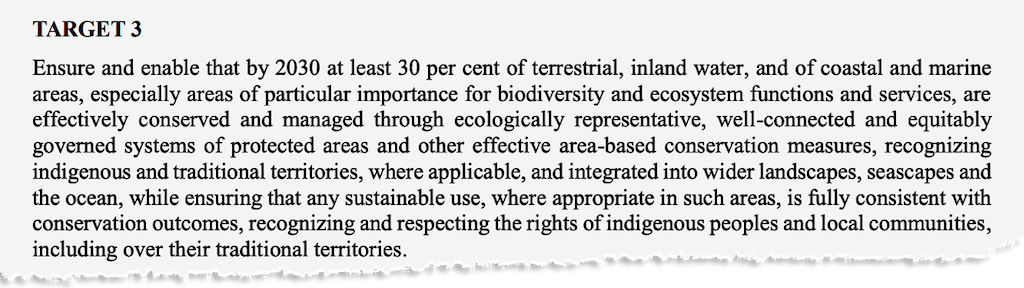
La meta 3 del MMB, que establece que los países deben garantizar que “al menos” el 30% de la Tierra esté en áreas protegidas o regida por otras medidas de conservación para 2030 “30×30”, es considerado por muchos como el objetivo insignia del acuerdo y se ha comparado con el objetivo de temperatura de 1.5°C del Acuerdo de París en artículos de prensa y discursos que subrayan su importancia.
Se pidió a todos los países que enviaran sus planes al Convenio de las Naciones Unidas sobre la Diversidad Biológica en los que se describiera cómo cumplirían los objetivos del MMB en sus territorios antes de la cumbre de la naturaleza COP16 en 2024. Dichos planes se conocen como estrategias y planes de acción nacionales en materia de diversidad biológica, o “EPANDB“.
Una investigación independiente de Carbon Brief y the Guardian realizada el pasado mes de octubre reveló que el 85% de los países no cumplieron el plazo para presentar sus EPANDB, y algunos argumentaron que el plazo era demasiado complicado o que no pudieron acceder a fondos para ayudar a preparar sus documentos.
A los países que no pudieron presentar sus EPANDB se les pidió que, en su lugar, presentaran objetivos nacionales a la ONU. Se trata de simples listas de metas que los países intentarán alcanzar sin un plan de acción que los acompañe.
Para el 24 de febrero de 2025, 44 países y la UE habían presentado sus EPANDB a la ONU, mientras que 124 partes habían presentado metas nacionales. (Dado que algunos países enviaron objetivos nacionales y EPANDB, esto significa que, en total, 137 países han presentado algún tipo de plan).
Para investigar si los países se han comprometido con la promesa “30×30” dentro de los límites de sus planes, Carbon Brief y the Guardian analizaron el texto completo de cada EPANDB, así como cualquier objetivo que fuera etiquetado como relacionado con la meta 3 del MMB.
El análisis revela que, de los 137 países que han enviado planes al CDB, más de la mitad (70 países, es decir, el 51%) no se comprometen a proteger el 30% de sus tierras y mares para 2030.
De estos, 21 países no proporcionaron un objetivo numérico para proteger su superficie terrestre, 26 establecieron objetivos de protección de la tierra inferiores al 30% y ocho establecieron objetivos de protección de la tierra iguales o superiores al 30%, pero objetivos de protección del mar inferiores al 30%.
De los países restantes, 13 no presentaron ningún objetivo relacionado con la cobertura de las áreas protegidas. Otros dos establecieron objetivos más allá de 2030.
Otros 10 países, es decir, el 7%, no dejan claro en los planes que presentaron si tienen o no un compromiso que cumpla las condiciones de “30×30”. Entre ellos se encuentran: países que especifican que protegerán el 30% de las “zonas de especial importancia”; países que dieron un objetivo de mejora, pero no proporcionaron una base de referencia; y países que entregaron solo una o dos metas.
Solo el 42% de los países (57 en total) se comprometen a proteger el 30% de la superficie terrestre y marina para 2030.
La siguiente gráfica muestra los países que han entregado sus EPANDB y/o metas nacionales a la ONU. En la gráfica, los países están agrupados según el porcentaje de tierra que se han comprometido a proteger y el tamaño de cada burbuja representa su superficie terrestre. (Los países agrupados alrededor de la línea del 30% y marcados en gris se han comprometido a proteger el 30% de la superficie terrestre).
Los países agrupados debajo de “sin objetivo” son aquellos que no se han comprometido a una meta numérica para proteger su tierra o aquellos que han elaborado un plan, pero no han incluido una meta de área protegida.
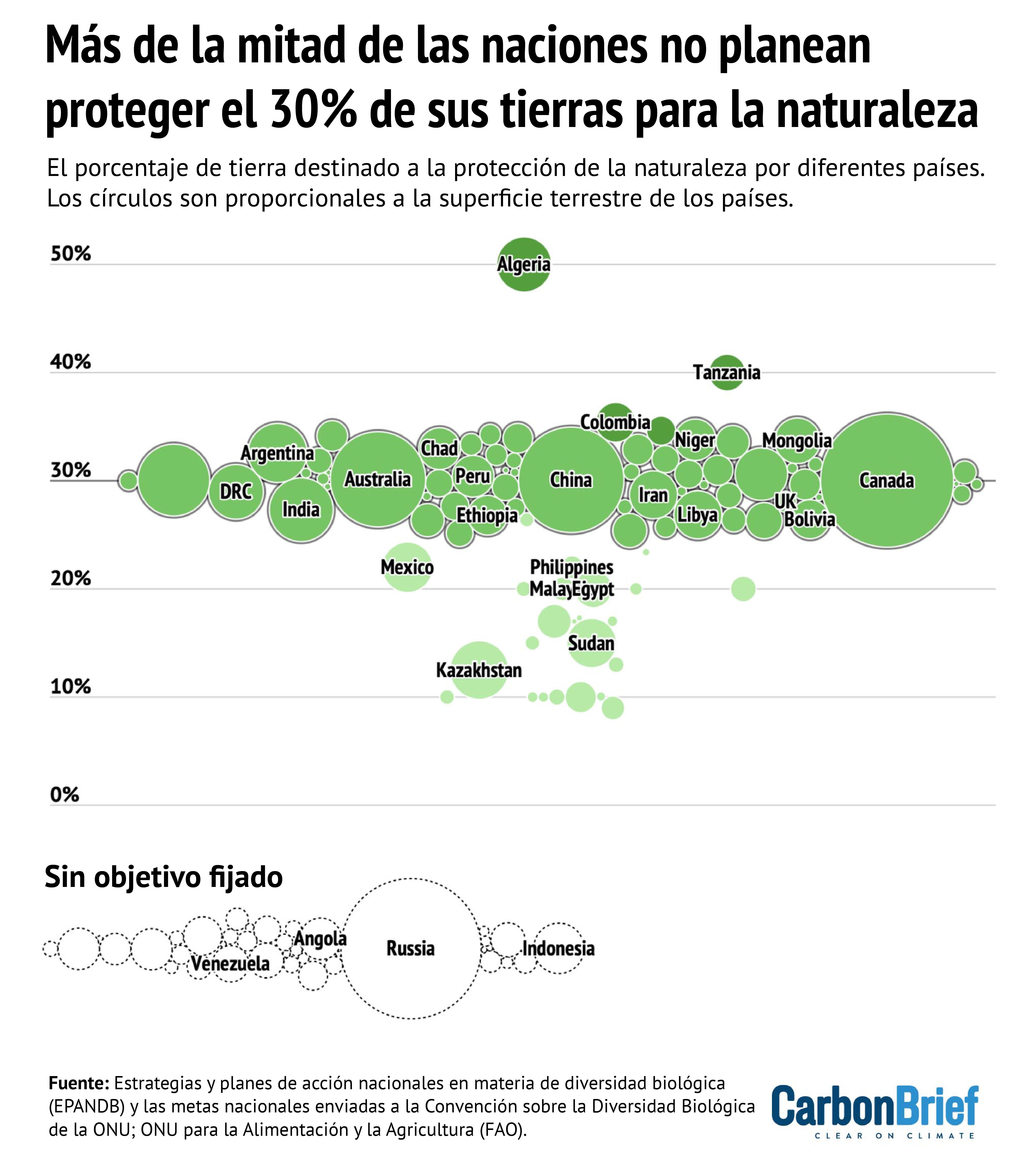
El análisis muestra que, en conjunto, más de un tercio de la superficie terrestre está cubierta por un compromiso que no cumple la meta “30×30”, mientras que alrededor de la mitad está cubierta por un compromiso “30×30”.
El análisis también revela que siete de los 17 países “megadiversos“, que en conjunto albergan el 70% de la biodiversidad mundial, no se han comprometido con la iniciativa 30×30. Entre ellos se encuentran Indonesia, Malasia, México, Perú, Filipinas, Sudáfrica y Venezuela.
Otros 61 países no han presentado una EPANDB ni metas nacionales, por lo que no se han evaluado en el análisis. Entre ellos se encuentra la nación con mayor biodiversidad del mundo, Brasil.
Las cifras tampoco incluyen a EE. UU., que, aunque es un país megadiverso, no forma parte del CDB y, por lo tanto, no está sujeto a los objetivos y metas del MMB.
El expresidente de EE. UU. Joe Biden comprometió a su país con el compromiso “30×30”. Sin embargo, el plan de políticas Proyecto 2025, que Donald Trump está siguiendo en gran medida, pide que se elimine el objetivo.
La UE entregó una EPANDB que abarca sus 27 Estados miembros y se compromete con el 30×30.
Sin embargo, los países individuales también son parte del CDB y se espera que entreguen sus propios planes nacionales. Para el propósito de este análisis, se consideró que los Estados miembros de la UE cumplían con el compromiso “30×30” solo si presentaban su propia EPANDB o su objetivo nacional que lo hiciera.
‘Extremadamente desafiante’
Carbon Brief y the Guardian contactaron a países megadiversos y naciones desarrolladas para preguntarles por qué habían optado por no comprometerse con el “30×30” en sus planes de la ONU.
Indonesia, un país megadiverso que alberga la tercera selva tropical más grande del mundo, no dio una meta numérica sobre la cantidad de su territorio que puede proteger para la naturaleza en su EPANDB.
Un portavoz del gobierno afirma que Indonesia considera que “no es esencial declarar explícitamente que el objetivo de protección del 30% es para las áreas terrestres y marinas” de su territorio, y explica:
“Indonesia considera que todos debemos entender que el Marco Mundial de la Diversidad Biológica es realmente global. Y, al ser global, es natural que este marco se aplique de forma global y colectiva, sin imponer una carga innecesariamente pesada a algunos de nosotros.
“Indonesia se ha comprometido a alcanzar objetivos ambiciosos pero prácticos para el MMB, haciendo hincapié en el hecho de que no todas las partes están al mismo nivel si los objetivos se evalúan numéricamente”.
El portavoz añade que “gestionar la biodiversidad no es una tarea fácil” y que “se debe mantener el equilibrio de los aspectos económicos, sociales y medioambientales, especialmente en países en desarrollo como Indonesia”.
En su Estrategia y Plan de Acción Nacional sobre la Diversidad Biológica, México, una nación megadiversa, se compromete a proteger el 30% de sus océanos, pero solo el 22% de su tierra.
La Dra. Andrea Cruz Angón, coordinadora de estrategias y políticas de biodiversidad de la Conabio, la comisión de biodiversidad del gobierno federal, afirma que las metas aún están “siendo revisadas y ajustadas” por las agencias federales correspondientes.
Añade que los objetivos se elaboraron tras la celebración de talleres “con gobiernos subnacionales, jóvenes, pueblos indígenas y comunidades afromexicanas” para identificar “barreras y oportunidades para que estos actores se comprometan voluntariamente con los objetivos”.
Finlandia, uno de los estados miembros de la UE, aún no ha publicado una EPANDB, pero en agosto de 2024 presentó a la ONU sus metas nacionales para cumplir los objetivos del MMB. En estos planes, Finlandia no se compromete con el “30×30”.
Un portavoz del gobierno finlandés dice que todavía estaba preparando su EPANDB y que, por lo tanto, ninguno de sus objetivos es definitivo, pero añade:
“Lograr un aumento del 30% en el área protegida para 2030 sería extremadamente difícil, ya que para alcanzar esta meta, por ejemplo, el área protegida en las zonas terrestres tendría que aumentar unas 700,000 hectáreas al año”.
En su Estrategia Nacional de Biodiversidad, Noruega se comprometió a proteger el 30% de su territorio para la naturaleza para 2030, pero afirma que todavía está evaluando su meta de protección de los océanos y “volverá con un plan sobre cómo lograr un objetivo futuro de manera que también facilite el uso sostenible de las zonas marinas noruegas”.
Un portavoz de Noruega afirma que la nación está “comprometida a contribuir al objetivo 30×30”, y añade:
“Aún no se ha establecido una meta nacional de conservación para las zonas marinas noruegas. Esto se debe a un proceso nacional en curso para evaluar qué zonas marinas pueden ser reconocidas como protegidas a través de ‘otras medidas efectivas de conservación basadas en áreas’ (OECM), de acuerdo con los criterios [de biodiversidad de la ONU].
“La conclusión de este proceso aclarará el estado actual de conservación de las aguas noruegas y, en consecuencia, nos permitirá establecer una meta nacional”.
‘Volver a empezar’
Inger Andersen, directora ejecutiva del Programa de las Naciones Unidas para el Medio Ambiente, declara a Carbon Brief y the Guardian que “30×30” es una “meta global y la forma en que los países lo asuman a nivel nacional será diferente en todo el mundo, dependiendo de las circunstancias nacionales”.
Ella refiere el Informe Planeta Protegido 2024, que muestra que solo el 17.6% de la tierra y el 8.4% del océano se conservan actualmente para la naturaleza, a solo cinco años de llegar al plazo de “30×30”, y añade:
“A medida que el mundo se enfrenta a una crisis de pérdida de naturaleza y biodiversidad, está claro que debemos ir mucho más lejos, mucho más rápido. Esto no será posible sin apoyo financiero, técnico y de capacidad para muchos países”.
En respuesta a la investigación de Carbon Brief y the Guardian, Brian O’Donnell, director de la Campaign for Nature, un grupo que aboga por la meta 30×30, dice:
“Muchos países no han sido lo suficientemente ambiciosos con sus compromisos nacionales de conservación y, como resultado, actualmente no estamos en vías de cumplir colectivamente la meta global de “30×30”. Esto es preocupante y hay que tomar medidas para poner al mundo en buen camino”.
Para encaminarse hacia el “30×30”, los países desarrollados deben “financiar directamente” la meta para permitir que los países en desarrollo protejan más de sus territorios para la naturaleza, dice, y añade que el compromiso “30×30” también debe ser defendido a un nivel superior por los líderes mundiales y la ONU.
Añade que los países que no se comprometan con “30×30” en sus planes de la ONU “deberían volver a empezar y actualizar sus planes con otros en los que la conservación esté a la altura del desafío de la pérdida de biodiversidad y las necesidades de las comunidades”.
El análisis completo de Carbon Brief y the Guardian puede encontrarse aquí.




The post Revelado: Más de la mitad de las naciones no protegen el 30% de la tierra y el mar en sus planes de biodiversidad de la ONU appeared first on Carbon Brief.

Three countries have been named by the Paris Agreement’s compliance committee for failing to submit a nationally determined contribution (NDC) and repeatedly snubbing offers of help with their climate plans.
After months of internal debate over whether to identify serial non-responders, the Paris Agreement’s Implementation and Compliance Committee (PAICC) named the three countries which have failed to engage with it over their NDCs on Friday.
It named Democratic Republic of Congo, Senegal and North Korea in a footnote of its annual report, adding that it decided to name them “with a view to facilitating engagement”, adding that representatives of the three nations had been invited to its meeting in early 2027 “with the purpose of identifying any challenges and constraints”.
“The Committee noted the importance of Parties engaging with the Committee in a timely manner, while noting that some delays may be due to the national capabilities and circumstances of the Parties”, the report said.
-
Under US pressure, World Bank says it will back gas “where appropriate”
The US wants the World Bank to expand its gas support while climate campaigners are pushing for it to end – its head spoke this week of limited backing for the fossil fuel -
IPCC scientists vow to press on with climate reports despite political deadlock
After governments again failed to agree a timeline, nearly 120 IPCC authors pledged to complete their assessment on time and with full scientific rigour -
Paris Agreement committee snubbed over missing NDC climate plans
Many governments have still not submitted a nationally determined contribution to the UN, breaching a key requirement of the Paris Agreement


In July, PAICC said 12 countries had ignored its repeated attempts to discuss why they had not published an NDC as required every five years under the 2015 Paris accord.
Members of the committee had been divided over whether to name them, but at a September meeting decided to do so in their annual report to the annual climate COP summit.
By the time the report was published on Friday, only Congo, Senegal and North Korea “had not communicated an NDC or submitted a [Biennial Transparency Report] and had not yet responded to any of the Committee’s notifications, despite several reminders issued by the Committee in this regard”.
Rainforest and renewable energy ambitions
The silence from Congo and Senegal is notable because the former is home to much of the Congo Basin rainforest while the latter has sought billions of dollars in climate finance to support its renewable energy ambitions.
After Brazil, Congo has more rainforest than any country in the world. This forest, and the country’s peatlands, absorb huge amounts of greenhouse gas but are fast being lost to expanding farmland, charcoal production, logging and mining.
Senegal signed a Just Energy Transition Partnership with Canada and wealthy European nations in 2023, to help it meet its renewable energy targets under the-then government of Macky Sall. It was chair of the Least Developed Countries group between January 2022 and December 2023.

Tejas Rao, who is researching the PAICC as part of a doctoral thesis at Cambridge University, said the governments of the three countries should engage with the committee.
“Engagement costs these governments very little and the committee has shown it will listen,” he said.
“Silence leaves the committee with no basis to help, and it leaves the [governments] exposed to the narrative that they are simply disengaged,” he told Climate Home News.
Paris Agreement requirement
The 2015 Paris Agreement requires all parties to publish an NDC every five years outlining their emissions reduction targets, with each plan meant to be more ambitious than the country’s last NDC.
The latest set – the third round of plans, with new targets for 2035 – was due in February 2025. While most countries missed this deadline, all but around 30 – mostly small emitters but including Egypt, Vietnam and Argentina – have now submitted them.
Over the year, the PAICC – which is made up of government climate officials from developed and developing countries – has been communicating with governments that have not submitted NDCs and trying to overcome barriers to them doing so.
Some nations have cited exceptional circumstances as the reason for not submitting an NDC, a process that requires a significant amount of work in tracking emissions and consulting on how to curb them across the economy. For example, a letter from a Sudanese official to the PAICC, seen by Climate Home News, said that the country’s civil war had led to the suspension of its NDC preparation.
-
IPCC scientists vow to press on with climate reports despite political deadlock
After governments again failed to agree a timeline, nearly 120 IPCC authors pledged to complete their assessment on time and with full scientific rigour -
Under US pressure, World Bank says it will back gas “where appropriate”
The US wants the World Bank to expand its gas support while climate campaigners are pushing for it to end – its head spoke this week of limited backing for the fossil fuel -
Who shapes climate science? The equity question facing the IPCC
Early completion of the next global climate science assessment reports risks excluding research from the Global South, which is key to ensuring the findings are fair
The US and Iran are not signed up to the Paris Agreement and so do not have active NDCs, nor does Taiwan, which is not a UN member state.
Rao said that because the PAICC is “facilitative and non-punitive”, naming the countries “is meant to open a door, not close one – the invited consultation is the point”.
“In recent months, governments that explained their constraints, whether capacity, finance or domestic process, have been met with follow-up and support rather than sanction, and the number of silent governments has fallen sharply,” Rao said.
The post Paris Agreement committee names three countries snubbing it over NDCs appeared first on Climate Home News.
Paris Agreement committee names three countries snubbing it over NDCs