

Welcome to Carbon Brief’s Cropped.
We handpick and explain the most important stories at the intersection of climate, land, food and nature over the past fortnight.
This is an online version of Carbon Brief’s fortnightly Cropped email newsletter. Subscribe for free here.
Key developments
Trump takes office
ENVIRONMENTAL ORDERS: In his first week in office, US president Donald Trump signed “a flurry of executive orders with implications for Earth’s climate and environment”, the Associated Press reported. Among the orders were one directing the US to withdraw once again from the Paris Agreement and another stating “that the Endangered Species Act cannot be an obstacle to energy development”. He also signed one “halting new federal leases for offshore wind projects”, citing the impacts of offshore wind projects on marine life, according to WBUR. The outlet carried an article refuting the president’s claims.
CORN CAUTION: Robert F. Kennedy, Jr., Trump’s nominee for head of the Department of Health and Human Services, is raising alarm in the country’s cornbelt, the Guardian reported. The outlet explained that “Kennedy has vowed to ban high fructose corn syrup and seed oils, a move that would significantly reduce demand for a host of crops”. Vox covered the shift in political alignment for Kennedy, who was once an environmental lawyer at the Natural Resources Defense Council. Vox wrote that “his migration to the far right…[is] part of a much broader shift in the environmental movement”.
FUNDING FREEZE: On Monday, the National Science Foundation abruptly cancelled grant-review panels, a move that “sparked confusion among panellists” and researchers alike, according to NPR. The outlet added that “delays in grant approval inevitably mean delays in funding research”. Later that day, a leaked memo from the Office of Management and Budget ordered a pause in all federal grant funding. It “specifically targeted many large federal energy and climate programmes in its sweeping freeze and review of grant funding”, Heatmap reported. The targeted programmes include conservation payments from the US Department of Agriculture and climate and atmospheric research under the National Oceanic and Atmospheric Administration. A federal judge temporarily blocked the order before it could go into effect on Tuesday, the Washington Post said.
UK’s nature decline
OFF-TARGET: A new report from the UK’s Office for Environmental Protection (OEP) found that the government “is falling short” on meeting its legally binding environmental targets, the Guardian said. The report also highlighted that “the window to stop the decline of England’s nature is swiftly closing”. Separately, the Guardian reported that UK ministers dropped a bill that would have made the country’s international commitments on climate and environment, such as those made at COP, legally binding.
OFFSETTING EXPANSION: Carbon Brief analysis found that the UK would need to plant a forest “twice the size of Greater London” to offset the emissions that would result from the proposed expansion of Heathrow, Gatwick and Luton airports. Operations at these airports would add 92m tonnes of carbon dioxide equivalent (CO2e) into the atmosphere by 2050, if companies meet their flight targets, the analysis found. The environment minister backed the expansion of the airports, saying mitigation measures can offset the environmental impacts, the Times noted.
FUNDING INFRASTRUCTURE: The UK government announced a new nature-restoration fund, aimed at accelerating new infrastructure projects by allowing developers “to meet their environmental obligations faster”. The fund will cover a range of projects, such as new wind farms, railways, roads and data centres across the country. Currently, builders must comply with their environmental obligations on a project-by-project basis, but the new fund will “[pool] contributions…to fund larger interventions for nature”, the government added. However, environmental groups are concerned about this reform’s environmental impacts, saying “high carbon infrastructure such as airport expansion” could also be covered by the bill, Business Green reported.
Spotlight
Colombia’s land reform conference
At the UN biodiversity summit in October, Carbon Brief interviewed Nury Martínez, president of the Colombian farmers’ organisation Fensuagro. She is also a member of the South America coordinating committee of Vía Campesina, a global organisation representing more than 200 million peasants in 80 countries.
Martínez told Carbon Brief about the main expectations of the peasant movement for the second conference on agrarian reform and rural development, which will address farmers’ demands to access and work larger swathes of land. It will take place in Colombia during the first quarter of 2026.
This second conference will take stock of the first one, held in 2006, which delivered a set of voluntary guidelines for governance and land tenure, and will discuss a new agrarian reform.

What does the proposed agrarian reform consist of?
Land must fulfil a social function. That’s why we say that land is for those who work it – because there are large tracts of land where the owners don’t use it, or [they] have extensive livestock where a cow has four or five hectares and we have no land to produce food.
We propose an integral and popular agrarian reform because we believe that it goes beyond access to land, [but also includes] access to the goods of nature, such as water, seeds, access to territories…[We want] to stop the hoarding [of land] in the hands of a few.
What would be the result of these agrarian reforms? Transforming the way in which food is being produced for the world?
We say strengthen peasant production because we have always produced without chemicals. We are making the transition to agroecology, to rescuing culture and ancestral knowledge. [But] you can’t do agroecology if you don’t have land, territory.
We are proposing food sovereignty because we consider food [to be] a human right. [Also] access to technical assistance, fair commercialisation and [strengthening of] local markets.
Would agrarian reform be implemented at the global level, or only in Colombia?
The second conference will be held in Colombia in the first quarter of 2026, but it is a global event, with the participation of more or less 119 countries that are part of the United Nations.
The countries supported it being in Colombia because the Colombian government is implementing the National Agrarian Reform System. Right now we are having the possibility of access to land after more than 100 years.
News and views
‘NEW PHASE’ OF BIRD FLU: Bird flu is forcing farmers to slaughter their flocks, contributing to a doubling in the price of US eggs since 2023, Associated Press reported. The current outbreak, which started in 2022, has led to the killing of more than 145m of chickens, turkeys and other birds, the newswire noted. The New York Times said the outbreak, which has worsened over the past weeks, has “enter[ed] a new phase”, with some cattle suffering from reinfection. The outlet pointed out that since the virus first struck cattle last year, more than 900 herds and dozens of people have been infected, with one person dying as a result.
TRACEABILITY IN BRAZIL: Brazil’s government will begin to implement a “cattle traceability” system that will be mandatory as of 2027 and must be fully operational by 2032, Infobae reported. The system will “monitor and record the history, location and trajectory of each identified animal” to meet “the health requirements of international markets”, the outlet added. Elsewhere, Reuters reported that the governor of Mato Grosso, one of the largest farming states in Brazil, is set to veto a bill that “sought to weaken protections for endangered biomes”, including the Amazon.
PACIFIC PROTECTION: The Pacific island nation of the Marshall Islands announced its first-ever marine protected area (MPA), Oceanographic Magazine reported. The marine sanctuary will cover 48,000 square kilometres of “the most pristine ecosystems in the Pacific Ocean”, said National Geographic Pristine Seas, an initiative focused on ocean conservation that helped provide the scientific basis for establishing the MPA. The area will “be fully protected from fishing” and will be managed with “special emphasis on traditional knowledge and Indigenous insights”, the outlet wrote.
FIRES AND FOOD: Prospect Magazine wrote that “the insidious effects [of climate change] on global food production and security are barely mentioned” in discussions of the recent LA wildfires. It added that extreme weather’s impacts on crops “can be seen the world over”. Meanwhile, Trump issued an executive order to ignore existing regulations and deliver more water from California’s Central Valley, CalMatters reported. The outlet wrote that “Trump cited the Los Angeles fires [as justification], even though the actions he is ordering…would primarily serve farms”.
COURTING CONSERVATION: Nepal’s supreme court struck down a controversial new law that would allow infrastructure development – “such as hydropower plants, hotels and railway lines” – in protected areas, Mongabay reported. The outlet called the decision “one of the most important in Nepal’s conservation history”. Paraphrasing one judge’s arguments, Mongabay wrote: “It would be wrong to pit development and environment against each other by adhering to the belief that development can take place only when there’s damage to the environment.”
Watch, read, listen
MASS MORTALITY: The New Republic looked at the growing phenomenon of mass animal die-offs and what these events can teach scientists about resilience.
UNITED FOR A RIVER: This Scroll.in video showed how people are leading conservation of southern India’s Jatari river, which is home to unique flora and fauna species.
FARMERS’ LAWSUIT: A comment piece in Nature broke down a lawsuit filed by Swiss farmers suing their government to strengthen climate action.
OLD SOLUTION: A Grist story explored how farmers in the UK and US use the ancient practice of gleaning – collecting leftover crops after the harvest – to cut food waste.
New science
- Fertiliser use has a “large and significant negative effect” on the diversity of pollinators and flowering plants in a grassland ecosystem, according to new research published in npj Biodiversity. The authors wrote that the results of the two-year study “strongly suggest that financial incentives are necessary to offset yield reductions to improve biodiversity outcomes in agricultural grasslands”.
- A study in Philosophical Transactions of the Royal Society B detailed a new metric for assessing the impact of land-use change on species extinctions. The researchers say the maps can be used to “estimate the impact on extinctions of diverse actions that affect change in land cover, from individual dietary choices through to global protected area development”.
- New research in Nature Ecology and Evolution analysed data from 2.2m records of plant species from 1921 to 2021 and found that plant collections grown in botanical gardens have significant constraints with implications for conservation, such as limited growth. The study stresses the “urgent need” for re-evaluating biodiversity management in botanical gardens to fulfil their conservation goals.
In the diary
- 2 February: World Wetlands Day
- 3-8 February: Meeting of the standing committee of the Convention on International Trade in Endangered Species of Wild Fauna and Flora (CITES) | Geneva
- 25-27 February: Resumed session of the UN biodiversity summit COP16 | Rome
Cropped is researched and written by Dr Giuliana Viglione, Aruna Chandrasekhar, Daisy Dunne, Orla Dwyer and Yanine Quiroz. Please send tips and feedback to cropped@carbonbrief.org

The post Cropped 29 January 2025: Trump takes office; UK nature ‘falling short’; Egg prices soar appeared first on Carbon Brief.
Cropped 29 January 2025: Trump takes office; UK nature ‘falling short’; Egg prices soar

After a five-year long legal battle, the Constitutional Court of South Africa has blocked Shell and local partner Impact Africa’s permit to explore for oil and gas off the country’s East Coast, in a landmark victory for local communities and civil society.
“Today’s judgment makes me feel very happy and proud that the ocean is not for profit for mining companies,” said East Coast resident and environmental campaigner Siyabonga Ndovela.
The verdict culminates a years-long process in which non-profits Sustaining the Wild Coast, Natural Justice, Greenpeace Africa, and others took legal action against Shell, Impact Africa and the South African government for failing to consult affected communities – a legal requirement in the country.
The Constitutional Court ruled that Shell and Impact Africa had not complied with resource governance law, had failed to meaningfully conduct public consultation and had failed to consider the impact on climate change, cultural rights, livelihoods and ecological harm.
The ruling references last year’s landmark advisory opinion by the International Court of Justice, which states that countries have a legal duty to prevent and repair damage to the climate system. The South African judges argued climate change “transcends borders” and that states’ obligations “must be understood within the broader framework of international law.”
“This case must also be understood against the backdrop of well-documented struggles by coastal communities to protect their land, marine resources and ways of life in the face of extractive activities that they believe threaten their very existence,” wrote Justice Narandran Kollapen.
The Constitutional Court found that the exploration right had been unlawfully granted by the Department of Mineral and Petroleum Resources.The ruling upholds a 2022 regional court decision against Shell and overturns a 2024 appeal that allowed the company to conduct fresh public consultations under the original exploration right. Today’s decision means the right, initially granted in 2014, must be set aside.
Celebrating the decision, Sherelee Odyar, oil and gas campaigner at Greenpeace Africa, told Climate Home News that the court confirmed “serious failures” in the awarding of exploration rights to Shell and Impact Africa, which “can not simply be corrected later”.
The Wild Coast is a biodiversity hotspot which has been conserved over generations by coastal communities who rely on the ocean and land. “Our land and sea are central to our livelihoods and our way of life. Over generations we have conserved them, and they have conserved us,” reads the founding statement in the case.
A Shell spokesperson said it noted the ruling, responding that “we are committed to responsible offshore exploration, meaningful stakeholder engagement and environmental stewardship.”
The Department of Mineral and Petroleum Resources did not respond to requests for comment at the time of publication.
“Renewed strength” for communities
The ruling adds to a series of legal challenges brought by civil society groups against oil companies and the government as South Africa has expanded oil and gas development since 2014 under Operation Phakisa, a plan aimed at “unlocking the economic potential of the oceans”.
On the West Coast, Walter Steenkamp, Chair of Aukotowa Fisheries Cooperative, which is involved in a separate ongoing legal action against TotalEnergies, said that “today’s court case gave me renewed strength.”
The case could also set a precedent for future oil developments, said Alessandro Mazzi, legal governance researcher at the University of Wageningen. He added that the verdict “sends a strong signal to investors that where projects affect people’s land, livelihoods and environment, meaningful consultation and genuine ecological assessment are an integral part of responsible investment”.
Janet Solomon, coordinator of advocacy group Oceans not Oil, said that the Court’s emphasis on democratic participation, culture, livelihoods and the health of future generations in handing down the verdict signals a shift in jurisprudence on environmental governance, saying that this focus “may prove to be the judgment’s most enduring legacy.”
The post South Africa’s top court blocks Shell’s offshore oil exploration right appeared first on Climate Home News.
South Africa’s top court blocks Shell’s offshore oil exploration right
China has published a new five-year plan for coal, the latest in a slew of important policy documents for the country’s energy transition.
The 15th five-year plan for the development of the coal industry was published by the National Development and Reform Commission (NDRC) and the National Energy Administration (NEA) on 10 August, covering the period 2026-2030.
This is a key period, covering the years building up to China’s pledge to peak its carbon dioxide (CO2) emissions “before 2030”.
Government-affiliated organisations had previously mooted the possibility of coal consumption peaking before 2027.
However, the new plan does not set a specific, government-endorsed year for peaking coal consumption, instead including a broader goal to peak use of the fuel in this five-year period.
It also discusses the “green and low-carbon transition” of the coal industry, coal-related methane emissions and the “clean and efficient use” of the fuel.
But, in general, the plan emphasises the importance of coal in China’s energy system and focuses on the systems underpinning its production.
Analysts tell Carbon Brief that the plan confirms a “broader trend” – driven by the conflict in the Middle East – in which coal’s role in China as a “cheap and secure” source of energy is reinforced – instead of plotting a phase-down or transition for the industry.
Nevertheless, as the deadline for peaking CO2 emissions looms, the plan does warn the sector of the need to diversify into other industries – including clean energy and chemicals – as coal consumption peaks.
Below, Carbon Brief looks closer at what the plan means for China’s use of coal over the next five years and how it relates to wider climate targets.
What does the plan say about peaking coal?
Five-year plans are a key tool in Chinese governance, used to guide economic and social development across the economy.
The plan for coal is the latest topic-specific document to address climate and energy matters within the 15th five-year plan period of 2026-30. It is subordinate to the overarching 15th five-year plan, which covers China’s broad socio-economic strategy.
Other topic-specific plans for the period cover climate change, developing a “new-type energy system” and renewable energy, among other topics.
The coal plan opens by stating that coal is a “foundational [source of] energy” for China:
“[Coal is] vital to the national economy, people’s livelihoods and national energy security, and plays a crucial role in providing foundational support and systemic regulation within the energy supply system.”
However, the plan also covers the 15th five-year plan period (2026-2030), the final five-year period before China is expected to have peaked its carbon emissions.
The 15th five-year plan period marks a time of “significant transformation” for the coal industry, the plan says.
Policy documents issued in April 2026 called for the “strict control” of fossil fuels and created a framework for local governments to be graded on coal use in their region.
Coal has traditionally been the largest source of energy in China and is responsible for around 80% of its emissions.
But its role is gradually being superseded by non-fossil energy, which accounted for more than half of the country’s power mix in 2025. In the first half of 2026, coal supplied less than 50% of power generation, while its share of total energy consumption fell to 51.4%, as shown below.
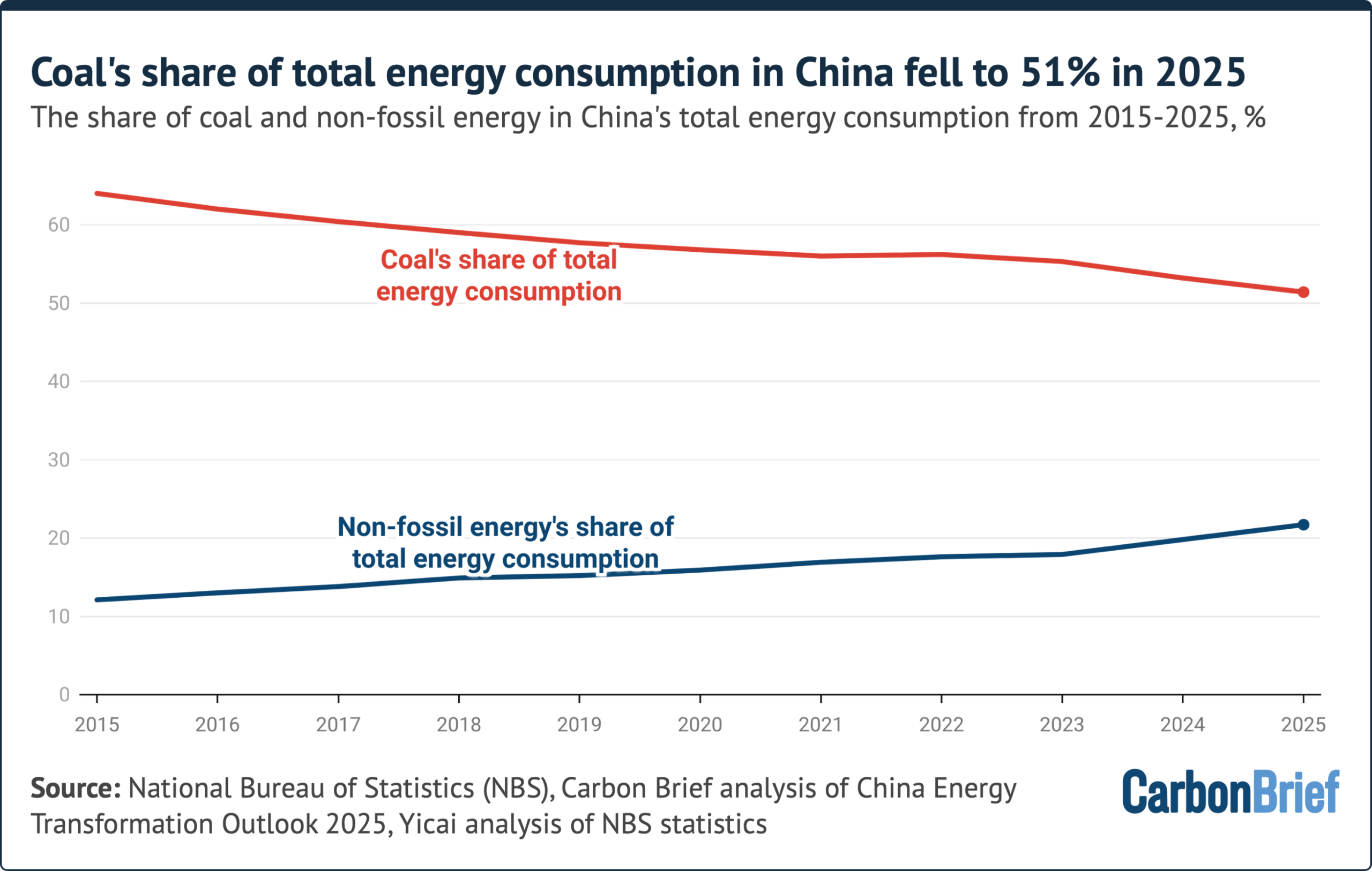
The five-year plan for coal signals “continuity” of China’s aim of “safeguarding energy security while advancing the low-carbon transition”, says Kevin Tu, non-resident fellow at Columbia University’s Center on Global Energy Policy.
Another key factor behind the plan is concerns from policymakers around energy security, exacerbated by the conflict in the Middle East.
In an article published in early August, the Communist party-affiliated People’s Daily noted the “severe volatility” the war has created in energy markets, adding that “China’s energy system has withstood these shocks”.
It quoted NEA head Wang Hongzhi stating in a press conference that “coal is [China’s] greatest source of confidence in ensuring a stable energy supply”.
The conflict will “reinforce coal’s role in China’s energy system”, both as a source of energy and as a feedstock for commodities, Li Shuo, China climate hub director at the Asia Society Policy Institute, tells Carbon Brief.
The plan outlines a number of aims to be achieved by 2030, starting with a goal to “further strengthen” the coal industry’s “ability to be a ‘bottom-line guarantee’”.
The other targets in the plan, to be achieved by 2030, include:
- Peaking coal consumption;
- “Basically establishing” a modern coal-industrial system;
- Optimising the “layout” of coal production and development;
- Increasing the proportion of “high-quality, advanced” coal-production capacity;
- “Clearly improving” levels of “safe, green development” and “clean, efficient use” of coal;
- Increasing the share of coal produced by “large-scale, modernised coal mines” to 87%;
- Developing a diversified coal-based industrial structure;
- Improving mechanisms to ensure a “dynamic balance” between supply and demand.
The large share of China’s CO2 emissions that come from coal and China’s carbon-peaking and neutrality targets are not the main focus of the five-year plan.
“This is clearly neither a coal phase-out nor phase-down plan,” Tu tells Carbon Brief. He adds that it grants China “considerable flexibility…over the pace of the transition”.
A pledge to peak coal consumption during the five-year plan period is reiterated several times in the document. Notably, the plan says that China will “promote coal consumption successfully reaching a peak”.
This, it says, is “guided” by China’s “dual-carbon” goals for peaking and neutrality, but is also based on the premise of “guaranteeing the secure supply of energy”
However, the plan does not provide a government-endorsed target year for peaking consumption.
State-affiliated organisations, such as Xinhua, have suggested that coal consumption is “expected to peak around 2027”. Independent analysis has stated that emissions from coal consumption may have already peaked.
“The absence of a 2027 deadline is significant, but I would be careful not to over-interpret it,” Tu tells Carbon Brief.
While a 2027 peak for coal remains possible, in his view, it is dependent on factors such as “electricity-demand growth, renewable generation, industrial activity, weather conditions and coal demand from the chemical sector”.
Similarly, Li believes that it will be “market and technological progress”, rather than state directives, that determine exactly when coal consumption and emissions will peak.
“Beijing’s regulatory interventions, if any, will be limited to making sure the peaking timelines do not blow past 2030,” he says.
What does the plan say about China’s coal production?
The plan does not set a concrete target for coal production during the five-year plan period. In contrast, total coal production targets for 2015 and 2020 had been set in the 12th and 13th five-year plans.
The plan also reduces a target for “reserve production” capacity, which was first announced in 2024.
The plan reiterates that, by 2030, China should “establish a coal reserve-production capacity of 100m metric tonnes or more per year”. This was first mentioned in the 15th five-year plan for building a “new-type energy system”, published in June.
Despite China’s rapid buildout of renewable energy, reserve coal capacity is necessary, argues state news agency Xinhua. It says that, to balance the variability of renewable energy, coal will shift to “playing a supporting and regulating role to safeguard energy supply”.
Nevertheless, the new reserve goal is lower than the target of 300m tonnes of coal set when China first announced the establishment of the system in 2024.
“Overall, this five-year plan is targeted at the coal industry, not the energy transition”, says Yang Biqing, energy analyst at Ember, although the energy transition and the peaking of coal consumption form the overarching context for the plan.
Provinces in northern China will continue to provide the majority of China’s coal, according to the plan.
It reiterates a pledge from the new-type energy five-year plan that China will continue building “coal-supply security bases” in the provinces of Shanxi, Inner Mongolia, Shaanxi and Xinjiang. It says these bases will supply more than 80% of China’s coal by 2030.
This does not indicate a change in direction, as coal production is already increasingly concentrated in northern China. In 2025, 82% of China’s coal came from these four provinces.
New or expanded coal mines in these provinces – with the exception of southern Xinjiang – must have a minimum annual production capacity of 1.2m tonnes, says the plan.
This is an “important signal”, Tu tells Carbon Brief. He notes that the plans suggest that “China’s coal transition is not simply about reducing the quantity consumed”, but also about creating a “more concentrated, efficient, flexible and resilient” coal system.
The plan also calls for a more centralised approach to managing coal. It states that in 2026-2030, any new production capacity must be “included in the single ledger” – essentially meaning that it must be approved by the central government – before it can be implemented.
Yang tells Carbon Brief that this could indicate that the government is trying to prevent a potential “rush” to get new capacity approved as coal consumption starts to plateau and fall.
What does the plan say about coal’s greenhouse gas emissions?
The plan includes sections on the need to “accelerate” the low-carbon transition of the industry, as well as the “clean and efficient use” of coal.
The former section largely focuses on the production and processing of coal, while the latter addresses emissions associated with its consumption.
Suggested policies include promoting energy efficiency, water conservancy and electrification, coupled with greater use of renewable-energy sources at coal mines.
In addition to promoting a successful peaking of coal consumption, the plan also re-affirms existing policies around promoting energy efficiency and carbon-emission reduction.
It calls for “accelerate energy conservation and consumption reduction in key coal-consuming industries”, largely through methods already established by existing policies.
This includes phasing out inefficient coal-fired equipment, replacing coal-fired equipment with “clean energy” alternatives, reducing use of “dispersed coal” and promoting clean heating sources such as distributed solar heating and waste heat utilisation.
Tom Wang, executive director of People of Asia for Climate Solutions, describes the plan as “more of a coal exploration plan, rather than a coal transition plan”. He tells Carbon Brief that while several policies call for “green” or “smart” development, the plan does not address the greenhouse gas emissions underpinning each step of coal extraction, processing and combustion.
Another major focus is on utilisation of coalbed methane, a significant source of China’s methane emissions.
China will “implement work plans to increase coalbed-methane reserves and production”, the plan says, including a “rapid ramp-up” of production in deep coalbed-methane sites.
Affixed to the main five-year plan is an appendix further detailing plans for coalbed methane.
It notes that utilising coalbed methane has “multiple benefits”, such as improving safety, “increasing the supply of clean energy” and reducing emissions. [Methane is a fossil fuel.]
The government is targeting 26bn cubic metres of coalbed-methane production and 6.5bn cubic metres of mine-gas utilisation by 2030, it says.
At least 18bn cubic metres will be sourced from the Ordos Basin, a region spanning several northern provinces, according to an action plan published by the NEA.
In its coverage of the Ordos action plan, the state-run newspaper China Daily said that developing coalbed methane is a “vital strategic move to optimise [China’s] energy mix and ensure domestic gas supply”.
Reporting by Xinhua and economic news outlet Jiemian said that coalbed methane could help China become an “energy powerhouse” and “secure [its] energy self-sufficiency”, respectively.
In addition, the coal industry will “steadily advance methane-emission control” and “actively participate in the reduction of non-carbon dioxide greenhouse gas emissions”, according to the appendix.
However, Sun Xiaopu, senior China counsel at the thinktank Institute For Governance and Sustainable Development, tells Carbon Brief, the plan “does not establish an absolute methane-emissions reduction target”.
She notes that the implications for emissions may only become clear as implementation frameworks for meeting the utilisation targets are released.
How does the plan tell coal companies to evolve?
Despite reaffirming the importance of coal, the plan emphasises that the overall role of the fuel in China will change. It adds that the coal industry must adapt to this changing reality.
As the coal industry “modernises”, coal companies must “strengthen management” of mine closures and exit plans. They must also plan for a “smooth transition” and “prudently handle” workforce relocation, debt resolution and ecological restoration, it says.
Companies should also be supported in expanding into industries such as “power, new energy and chemicals”, according to the plan.
A number of major coal producers, as well as at least one oil giant, have already established wings focused on “new energy”.
But the focus on the use of coal to make chemicals is one of the “most consequential parts of the plan”, says Tu.
China must promote the shift to coal being used “equally” as a fuel and a feedstock, the plan says.
The plan urges policymakers to push through “construction of strategic coal-to-oil and gas bases”
The chemicals sector is China’s fastest source of emissions growth, although it remains well behind power and other industries in terms of total emissions.
Tu notes that the plan calls on the coal-chemicals industry to decarbonise production, such as through low-carbon power, green hydrogen and carbon capture, utilisation and storage.
As such, he says, the policy signal is “not to exit coal chemicals, but to make them more efficient, higher-value and potentially less carbon-intensive”.
Li echoes this, telling Carbon Brief that the sector is “likely to receive a major boost from the conflict in Iran”. He adds:
“We will probably see further capacity expansion in the sector and I doubt environmental arguments will convince Chinese authorities to take a different approach.”
related
Q&A: What is in China’s new five-year plan for climate change?
Q&A: What does China’s 15th ‘five-year plan’ for renewables mean for climate change?
Interview: Dr Sun Yixian on his new database tracking Chinese climate ‘leadership’

Q&A: What do China’s provincial five-year plans say about climate and energy?
The post Q&A: What does China’s 15th five-year plan for coal mean for climate action? appeared first on Carbon Brief.
Q&A: What does China’s 15th five-year plan for coal mean for climate action?
The world saw the lowest amount of new coal mine capacity brought online for at least 10 years in 2025, according to a new report, as clean energy displaces coal for electricity generation in East Asia.
A report by Global Energy Monitor (GEM) found that new coal mine capacity declined by nearly 40% from 2024, the second consecutive year new mine capacity has hit a decade low. This represents an acceleration of a steady decline that began in 2019.
The slowdown in new coal mine openings was driven by China and Australia, where new additions fell by 44% and 96%, respectively. In China, the report said this was partly due to solar and wind displacing coal for electricity generation – although coal rebounded in the first half of 2026 – and the National Energy Administration implementing new rules to curb new mine openings.
In Australia, a 96% reduction in new coal mine capacity was driven by shrinking demand from the countries that import Australian coal for electricity, like Japan, South Korea and Taiwan, the report said.
This trend is likely to continue, according to GEM, as the Australian state of New South Wales recently banned new coal mines on undeveloped greenfield land. South Korea has promised to stop building coal-fired power plants that cannot capture and store the emissions produced. Meanwhile, Japan is pushing for a post-Fukushima nuclear revival to displace coal.
This Australian coal community is co-designing its own green future
Globally, growth in coal demand has slowed over the last few years and the International Energy Agency expects it to plateau through to 2030 because of the growth of renewable energy, nuclear and fossil gas.
Openings down, pipeline up
But while new coal mine openings fell, the amount of global coal mine capacity proposed increased by 11%. This was almost entirely driven by a spate of projects in the eastern Indian states of Jharkhand and Odisha.
“If built,” the GEM report says, “the projects would commit India – a country with no formal coal phaseout timeline – to years of coal expansion and would put a 1.5C-aligned transition away from fossil fuels farther out of reach”.
The Indian government says it needs to increase coal production to meet growing electricity demand from economic growth and from dealing with heatwaves. It plans to open more than 20 new coal mines to meet its coal production targets.
Because of energy security concerns, India is also aiming to produce chemicals with Indian coal rather than imported gas. China is also pursuing this strategy, although the Global Energy Monitor report said that Indian coal’s high ash content means the South Asian nation will find it harder to make chemicals from coal.
-
China’s coal-chemicals boom risks repeating the mistakes of the past
By reviving the problematic industry in the name of energy security, China runs the risk of higher emissions, stranded assets and setting back its ambitions as a clean energy leader -
South Africa’s offshore oil push meets grassroots resistance in court
Two court cases against oil majors TotalEnergies and Shell could derail South Africa’s plan to expand offshore fossil fuels -
Quarter of countries still missing UN climate plans 18 months after deadline
Egypt, Vietnam, Argentina and the Philippines are among the 45 nations that have breached the Paris Agreement by not submitting a new NDC to the UN


Nations agreed at COP26 five years ago to “phase down” coal power – a commitment that China and India successfully pushed to weaken from “phase out”. At COP28 in 2023, governments agreed to transition away from all fossil fuels in energy systems.
Since then, wealthy nations have partnered with coal-producing countries like South Africa, Vietnam and Indonesia on plans to transition from coal to clean energy. But, after preliminary talks, India and these governments did not agree a JETP.
The post New coal mine openings slow as East Asian demand plateaus appeared first on Climate Home News.



-
Climate Change1 year ago
Guest post: Why China is still building new coal – and when it might stop
-
Greenhouse Gases1 year ago
Guest post: Why China is still building new coal – and when it might stop
-

 Greenhouse Gases2 years ago
嘉宾来稿:满足中国增长的用电需求 光伏加储能“比新建煤电更实惠”
-

 Climate Change2 years ago
嘉宾来稿:满足中国增长的用电需求 光伏加储能“比新建煤电更实惠”
-
Climate Change2 years ago
Bill Discounting Climate Change in Florida’s Energy Policy Awaits DeSantis’ Approval
-

 Renewable Energy10 months ago
Sending Progressive Philanthropist George Soros to Prison?
-
Greenhouse Gases1 year ago
嘉宾来稿:探究火山喷发如何影响气候预测
-

 Carbon Footprint2 years ago
US SEC’s Climate Disclosure Rules Spur Renewed Interest in Carbon Credits