


Cryptocurrency has revolutionized the financial world, offering decentralized, secure, and borderless transactions. However, its rise has come with a significant downside—high energy consumption. The world’s most popular cryptocurrency, Bitcoin relies on energy-intensive mining processes to secure its network, emitting lots of carbon dioxide. Meanwhile, other blockchain applications also contribute to this growing energy demand.
As the crypto industry expands, so do concerns about its environmental impact. This article explores how cryptocurrency and blockchain technology affect global energy consumption and carbon emissions. It explores how Green AI enables sustainable blockchain solutions. It also explains how blockchain can help carbon markets address some of its most pressing issues.
But first, let’s unveil how energy-intensive cryptocurrency mining is and whether Bitcoin can be truly green.
Can Bitcoin Be Truly Green? The Carbon Footprint of Cryptocurrency Mining
High energy consumption in cryptocurrency mining directly translates to significant carbon emissions, especially when powered by fossil fuels.
Bitcoin mining is notorious for its immense energy consumption. Here are the facts about crypto mining’s environmental impact:
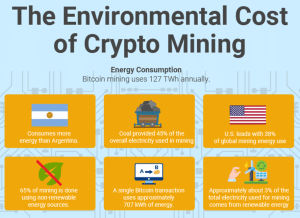
According to recent data, the Bitcoin network consumes around 127 terawatt-hours (TWh) of electricity annually—more than entire countries like Argentina and the Netherlands. This energy usage stems from the Proof-of-Work (PoW) mechanism, where miners compete to solve complex mathematical puzzles, requiring powerful hardware and vast amounts of electricity.
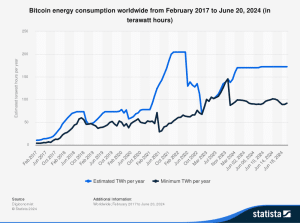
To put this into perspective, Bitcoin mining accounts for 0.55% of global electricity consumption, equivalent to the energy use of some large industrial sectors. As a result, the environmental cost of mining continues to spark debate, urging the industry to explore more sustainable practices.
Higher energy use translates into more carbon emissions…
- On average, a single Bitcoin transaction is responsible for emitting 300 to 400 kilograms of CO₂, equivalent to the carbon footprint of over 800,000 Visa transactions or 50,000 hours of YouTube streaming.
Globally, Bitcoin mining emits an estimated 69 million metric tons of CO₂ annually, comparable to the emissions of countries like Greece.

Moreover, cryptocurrency transactions, particularly those on the Bitcoin network, consume far more energy than traditional payment systems. As mentioned above, Bitcoin transactions use a lot more power than Visa processes.
- A single Bitcoin transaction = 100,000 Visa transactions.
PayPal, another widely used platform, also operates with significantly lower energy consumption, processing thousands of transactions with minimal electricity use. This stark difference underscores the inefficiency of current cryptosystems compared to traditional financial networks.
The substantial environmental cost underscores the urgent need for cleaner energy sources and innovative solutions to reduce the crypto industry’s carbon footprint.
The Growing Role of Renewable Energy in Bitcoin Mining
Recent data suggests that over 50% of Bitcoin’s mining network now uses renewable energy sources such as hydroelectric, wind, and solar power. For instance, regions like Iceland and Quebec, known for abundant renewable energy, have become hotspots for mining operations.
This transition is driven by economic and environmental incentives. Renewable energy is often cheaper than fossil fuels, reducing operational costs for miners. Furthermore, as governments introduce stricter regulations on carbon emissions, miners are motivated to adopt greener practices to avoid penalties and maintain their social license to operate.
Proof-of-Stake and Other Energy-Efficient Consensus Mechanisms
Bitcoin operates on a Proof-of-Work consensus mechanism, which is energy-intensive by design. Miners compete to solve complex mathematical problems, consuming significant electricity in the process.
In contrast, Proof-of-Stake (PoS) systems, like Ethereum’s, the second-largest blockchain, recent transition, eliminate the need for energy-hungry computations.
Instead of miners, validators are chosen based on the number of tokens they hold and are willing to “stake.” This drastically reduces energy consumption—Ethereum’s shift to PoS has cut its energy use by 99.95%, setting a benchmark for other cryptocurrencies.
Before its transition to Proof-of-Stake in 2022, Ethereum consumed around 78 TWh of electricity annually, comparable to Chile’s total energy use. Even smaller blockchains, such as Litecoin and Dogecoin, utilize PoW, albeit with lower energy requirements.
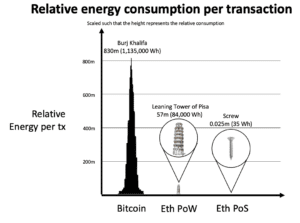
On the other hand, many altcoins, including Cardano and Solana, have adopted PoS or other less energy-intensive models. These networks drastically reduce energy consumption, making them more sustainable.
However, the cumulative impact of various blockchains still adds to the global energy demand, highlighting the need for widespread adoption of greener technologies.
Highlighting Innovative Approaches: KlimaDAO’s Tokenized Carbon Credits
Apart from changing consensus mechanisms, innovative solutions like KlimaDAO offer a new way to address crypto’s carbon footprint.
KlimaDAO allows users, including Bitcoin miners, to purchase tokenized carbon credits, effectively offsetting their emissions. These credits represent verified reductions in greenhouse gases and are retired after purchase to ensure accountability.
- One carbon credit equals one metric ton of CO₂ reduced or removed from the atmosphere.
Such initiatives align with broader climate goals, enabling the crypto industry to contribute positively to carbon neutrality. Another emerging trend that could help the industry tackle its environmental impact is Green AI (Artificial Intelligence).
Green AI: Powering Sustainable Blockchain Solutions
The concept of “Green AI” focuses on leveraging artificial intelligence to enhance sustainability and reduce environmental impact, aligning technology with climate action goals. AI can be used to optimize energy usage across various industries, minimizing emissions and maximizing efficiency.
For instance, AI-powered solutions can streamline energy grids, predict resource consumption, and identify areas for improved sustainability. It also supports the development of AI models and algorithms that optimize energy consumption in data centers, making them more energy-efficient.
Green AI includes using AI tools to track carbon emissions, forecast energy usage, and help industries transition toward renewable energy. For example, AI can optimize electricity demand response, helping utilities manage energy more efficiently while reducing carbon footprints.
By integrating AI with sustainability strategies, organizations can achieve measurable reductions in energy consumption, significantly lowering the carbon footprint of industries like manufacturing, transportation, and data management.
AI is also revolutionizing how blockchain networks manage energy. By analyzing real-time data, AI algorithms can predict network congestion, optimize transaction processing, and ensure efficient use of computing resources.
This dynamic allocation of energy minimizes waste and prevents overuse during low-demand periods. For example, predictive models powered by AI can anticipate peak activity times, enabling miners to adjust operations and reduce unnecessary energy expenditure.
AI-Driven Tools to Track and Reduce Crypto Carbon Emissions
AI also plays a critical role in monitoring and mitigating the carbon emissions of blockchain activities. Platforms equipped with AI can measure the carbon output of each transaction, offering insights into the environmental impact of specific operations. These tools provide actionable recommendations for reducing emissions, such as shifting workloads to energy-efficient times or integrating renewable energy sources.
For instance, projects like CryptoCarbonRank leverage AI to provide transparency on carbon emissions across various blockchain networks, empowering users and developers to make greener choices.
Bridging Blockchain and AI for Improved Transparency
Combining blockchain’s transparency with AI’s analytical capabilities has transformed the carbon credit market. Blockchain ensures the integrity of carbon credits by recording transactions in a tamper-proof ledger, while AI automates the verification process. This synergy prevents issues like double counting and fraud, which have historically plagued carbon markets.
AI-driven platforms also facilitate the issuance and trading of tokenized carbon credits. These innovations streamline the offset process, making it accessible to a broader audience while ensuring credibility and trust in global carbon offset initiatives.
Now, let’s consider specifically Bitcoin mining and how current efforts and innovations are helping the network become more sustainable.
The Evolution of Bitcoin Mining: Toward Sustainability
Bitcoin mining has historically depended on fossil fuels, contributing to significant carbon emissions. However, the industry is evolving as miners increasingly adopt renewable energy sources.
For example, China’s 2021 crackdown on crypto mining led many operations to relocate to countries with abundant renewable resources, such as the U.S. and Canada. In Texas, some mining companies use excess wind and solar power, stabilizing the state’s energy grid while reducing reliance on coal and natural gas.
As of 2024, nearly 40% of Bitcoin mining is powered by renewable energy sources, a significant improvement from previous years.
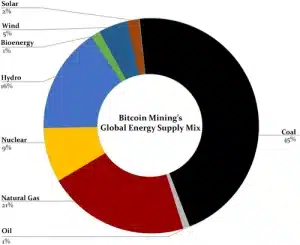
The shift toward renewables not only lowers carbon emissions but also reduces operational costs. Renewable energy, especially in regions with surplus capacity, is often cheaper than fossil fuels, creating a win-win scenario for miners and the environment.
From Proof-of-Work to Proof-of-Stake: Emerging Energy-Efficient Alternatives
Bitcoin’s PoW mechanism is the main culprit behind its high energy use and carbon pollution. By design, PoW requires miners to solve computational puzzles, consuming vast amounts of electricity. This has led to Bitcoin’s annual energy consumption surpassing that of some mid-sized countries.
Emerging alternatives like Proof-of-Stake are changing the game. PoS eliminates the need for energy-intensive computations, relying instead on validators who are selected based on their stake in the network. Ethereum’s switch to PoS has set a precedent, showcasing that major blockchains can significantly reduce energy consumption without compromising security or decentralization.
Cardano and Solana are among the leading PoS blockchains prioritizing energy efficiency. Cardano consumes only about 6 gigawatt-hours (GWh) annually, a fraction of Bitcoin’s energy use. Solana, known for its high-speed transactions, operates on a hybrid model with minimal energy requirements.
These networks demonstrate that advanced blockchain functionalities, such as smart contracts and decentralized applications (dApps), can be achieved without compromising environmental goals. Their energy efficiency also aligns with growing investor demand for greener technologies.
Crypto Projects for Nature-Based Carbon Solutions
Innovative projects like SavePlanetEarth (SPE) are tackling Bitcoin’s environmental challenges through nature-based solutions. SPE leverages blockchain technology to support reforestation and afforestation initiatives.
By tokenizing carbon credits linked to these projects, SPE provides a transparent and efficient way to offset emissions.
These initiatives not only mitigate the carbon footprint of Bitcoin mining but also contribute to broader environmental goals, such as biodiversity conservation and ecosystem restoration. Such projects demonstrate how blockchain and crypto can play a proactive role in addressing climate change.
Revolutionizing Carbon Markets with Blockchain
Talking about climate, carbon markets offer significant financial instruments that can help fund various emissions reduction initiatives.
However, traditional carbon credit systems often face challenges such as fraud and lack of transparency. Blockchain technology addresses these issues by providing a decentralized and immutable ledger for tracking and verifying carbon credits. Each credit is tokenized, representing a verified reduction or removal of greenhouse gas emissions.
By using blockchain, every transaction is transparent and traceable, ensuring the authenticity of carbon credits. This enhances accountability, especially for organizations looking to meet sustainability targets.
The Toucan Protocol is a prime example of how blockchain enhances trust in carbon markets. The platform tokenizes carbon credits, making them accessible to a broader audience. Each credit is verified and traceable, ensuring its integrity.
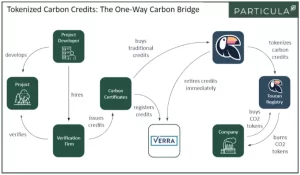
Toucan also allows users to bundle smaller carbon offsets into larger, more marketable assets. This scalability supports global efforts to reduce emissions and makes it easier for companies and individuals to participate in offsetting programs. By combining blockchain’s transparency with innovative tokenization, Toucan is driving progress in carbon markets.
Major carbon standards like Verra and Gold Standard are exploring ways to integrate decentralized systems to improve the verification process.
Blockchain in Renewable Energy Grids
Blockchain is also transforming renewable energy grids by enabling peer-to-peer energy trading. In these systems, households, and businesses with solar panels can sell excess energy directly to others. Blockchain ensures secure and transparent transactions without the need for intermediaries.
Projects such as Power Ledger in Australia and LO3 Energy in the U.S. are leveraging blockchain to create localized energy markets. These initiatives promote renewable energy adoption while increasing grid efficiency and resilience.
The Issues of Double Counting, Scalability, and Trust
One of the most significant challenges in carbon offset markets has been double counting, where the same carbon credit is sold multiple times or claimed by different entities. Blockchain technology provides an effective solution by offering a transparent and tamper-proof record of each carbon credit transaction.
With blockchain, each carbon credit is tokenized, and its transaction history is recorded on a decentralized ledger. This ensures that once a credit is sold or retired, it cannot be reused or misrepresented, drastically reducing the risk of double counting.
Platforms like CarbonX are already implementing blockchain to safeguard the integrity of carbon offset programs. It is a private blockchain ledger designed to capture IoT-based greenhouse gas data for accurate reporting, management, and conversion into carbon commodities.

As Emission Trading Systems (ETS) and Carbon Tax programs continue to roll out globally, blockchain technology is poised to play a crucial role in ensuring compliance with environmental regulations. It also offers new opportunities for carbon asset trading, enhancing transparency and efficiency in the carbon market.
Not only that. Tokenization is a game-changer for carbon credits, making them easier to trade and track across borders.
By converting carbon credits into tokens, blockchain allows for fractional ownership, lower transaction costs, and greater liquidity in carbon markets. This scalability is crucial in meeting the global demand for offsets as businesses and governments strive to achieve their net-zero goals.
As mentioned earlier, the transparency of blockchain ensures that tokenized carbon credits are traceable, improving trust among buyers and sellers.
Blockchain’s Potential for Global Carbon Market Integration
Blockchain has the potential to integrate regional carbon markets into a unified global system, enabling seamless trading of carbon credits across borders. Using blockchain to track credits from multiple countries and regions ensures that the credits are authentic and can be used toward global emissions reduction goals.
This integration not only supports international climate agreements but also fosters collaboration between countries, corporations, and environmental organizations. As such, blockchain could ultimately drive the global carbon market toward greater transparency, efficiency, and scalability. It can then provide a unified approach to tackling climate change.
Final Thoughts
Cryptocurrency and blockchain technology have transformed global finance and data systems, but their environmental impact cannot be ignored. Bitcoin and other crypto networks consume vast amounts of energy, contributing to significant carbon emissions. However, the industry is actively working toward sustainability, with renewable-powered mining, energy-efficient blockchains, and carbon offset initiatives leading the way.
As crypto adoption grows, the balance between innovation and environmental responsibility will be crucial. By embracing greener technologies, the industry can pave the way for a more sustainable digital future.
- FURTHER READING: Carbon Crypto Guide 2024: KlimaDAO, Carbon NFTs, and Carbon Tokens
The post The Energy Debate: How Bitcoin Mining, Blockchain, and Cryptocurrency Shape Our Carbon Future appeared first on Carbon Credits.


Most businesses that decide to act on their net-zero targets reach the same point of friction. Buying carbon credits has meant tracking down brokers, sitting through sales calls, and requesting a quote just to learn a price, sometimes with limited proof of what you are buying.

The earnings calls that quietly reframed climate from sustainability question to operating risk.
Three earnings calls in the last 18 months tell the story without any help from a press release.
Hershey, May 2024: cocoa price exposure compresses margin, and the company attributes part of the cost shock to West African weather. Olam, July 2024: coffee climate exposure quantified in the annual report. JBS, January 2025: supply chain climate disclosures expanded materially in response to investor pressure and regulatory expectation. None of these companies issued the announcement as climate news. They issued it as financial news. The climate-linked supply chain risk did not arrive with a sustainability framing; it arrived as a P&L line.
You are probably reading this article because you suspect the same thing is happening to your business. This piece walks through what is showing up on which earnings calls, how procurement and finance leaders are quantifying the exposure, and what serious corporates are doing about it before the regulator asks.
Where climate risk has already appeared in earnings
The pattern is consistent across resource-intensive sectors. A weather event compresses supply, the price spikes, the cost flows through the income statement, and the analyst on the call asks whether the event is anomalous or structural. Increasingly, the honest answer is the second one.
Cocoa is the cleanest example. The 2023 to 2024 West African harvest fell sharply on the back of erratic rainfall and disease. Cocoa futures more than tripled. Companies with concentrated West African sourcing absorbed the cost; companies with diversified sourcing absorbed less. The exposure was not climate as ESG topic. It was climate as cost of goods.
Coffee follows the same pattern. Brazilian and Vietnamese harvests have moved on weather more sharply across the last several seasons. Roasters with long-tenor supplier relationships and origin diversification have managed the volatility; roasters with spot-market exposure have not. Wheat, sugar, palm oil, beef: the same dynamic in different commodities, a pattern the IPCC AR6 Working Group II report projects will intensify across agricultural systems through mid-century.
What this means: climate risk is no longer a footnote in the 10-K. It is a line item the CFO has to explain on the call.
The three commodity exposures that hit margin first
For most companies with material Scope 3 exposure, three exposures dominate the near-term P&L risk.
- Concentrated single-origin sourcing in a climate-vulnerable region. If your tier-one supply for any material commodity sits in one geography, you have a concentration risk that climate amplifies. Diversification across origins is the obvious hedge, but it takes years to build and requires relationships you cannot acquire by tender.
- Supplier financial fragility under climate stress. Smallholder farmers, who supply a large share of the global cocoa, coffee, and palm oil market, do not carry the balance sheets to absorb yield shocks. When yields collapse, they exit. When they exit, your supply base shrinks, and the surviving suppliers raise prices. The risk is structural, not cyclical.
- Logistics and storage exposure to extreme weather. Hurricane disruptions to Gulf shipping, drought-driven Panama Canal restrictions, flooding in European inland waterways: each of these has moved input costs in the last three years, a pattern documented in Munich Re’s natural catastrophe data. The exposure shows up as a one-quarter event in the financial press but accumulates over time on the cost line.
TCFD and ISSB disclosure changes
The disclosure architecture has now caught up with the risk. The Task Force on Climate-related Financial Disclosures, whose recommendations are now embedded in the ISSB’s IFRS S2 climate standard, requires companies to disclose climate-related risks across physical and transition categories, with quantification where possible.
For physical risk specifically (the climate-linked supply chain risk you are reading about), the disclosure must address both acute exposures (extreme weather events) and chronic exposures (gradual changes in temperature, precipitation, and growing seasons). The disclosure must address the time horizon over which the risk is material, the parts of the value chain exposed, and the financial impact under different scenarios.
The CSRD imposes similar requirements under European law, with double materiality (both financial and impact materiality) embedded in the assessment. The practical effect: your auditors and your investor relations team now need a defensible answer to the climate-linked supply chain risk question, and the answer needs to be quantified.
What procurement and finance can do now
Three actions matter near-term.
Map your exposure. Most companies do not have a clear view of which tier-one and tier-two suppliers sit in which climate-vulnerable geographies. Without the map, you cannot quantify the risk, and without the quantification, you cannot disclose it credibly. The map is the foundation, and World Resources Institute climate risk research provides useful public tooling to start.
Diversify and deepen, in that order. Diversification across origins reduces concentration risk, but the deeper move is to invest in the resilience of the suppliers you already have. Regenerative practices, agroforestry, soil health interventions: these reduce yield volatility under climate stress and protect your input cost trajectory.
Embed the climate spend inside procurement, not outside it. Treating climate risk as a sustainability cost line subordinates it to the ESG budget. Treating it as a procurement and resilience investment puts it in the budget that matters, which is the cost-of-goods budget that the CFO defends quarterly.
Nature-based supply chain investments are the asset class designed for exactly this purpose. They sit inside the value chain, they reduce climate-linked supply risk, they generate verifiable Scope 3 reductions, and they produce the documentation an auditor and a regulator can both test.
If you are quantifying climate-linked supply chain risk in advance of the next earnings cycle or the next disclosure period, the carbon and sustainability experts at Carbon Credit Capital can help you map your exposure and structure a Dual-Value Model response that addresses reduction, resilience, and disclosure-readiness in a single program. Schedule a consultation.

More and more small and medium-sized businesses are hearing the same question from their larger customers: What is your carbon footprint? That question now travels down entire supply chains, and it arrives next to tender requirements, certification criteria, and rising customer expectations.




-
Climate Change1 year ago
Guest post: Why China is still building new coal – and when it might stop
-

 Greenhouse Gases2 years ago
嘉宾来稿:满足中国增长的用电需求 光伏加储能“比新建煤电更实惠”
-
Greenhouse Gases1 year ago
Guest post: Why China is still building new coal – and when it might stop
-

 Climate Change2 years ago
嘉宾来稿:满足中国增长的用电需求 光伏加储能“比新建煤电更实惠”
-

 Renewable Energy11 months ago
Sending Progressive Philanthropist George Soros to Prison?
-
Climate Change2 years ago
Bill Discounting Climate Change in Florida’s Energy Policy Awaits DeSantis’ Approval
-
Greenhouse Gases1 year ago
嘉宾来稿:探究火山喷发如何影响气候预测
-

 Carbon Footprint2 years ago
US SEC’s Climate Disclosure Rules Spur Renewed Interest in Carbon Credits