


Alaska Energy Metals Corporation (AEMC) has unveiled exciting findings from its 2024 inaugural exploration drilling program at the Canwell claim block which is a part of the Nikolai Project in Alaska. The Canwell area hosts three key prospects—Emerick, Odie, and Upper Canwell—located about 30 kilometers northeast of AEMC’s nickel-rich Eureka deposit.
AEMC’s Eureka Deposit: A Foundation for Growth
Exploring deeper, AEMC’s flagship Eureka deposit is a massive polymetallic resource with over 3.9 billion pounds of nickel in the Indicated category and 4.2 billion pounds in the Inferred category. This deposit also includes critical materials such as cobalt, chromium, platinum, and palladium. It also holds copper, iron, and gold which positions AEMC as a significant player in the strategic metals sector.
The advantage doesn’t end here, having such a rich resource potential aligns with U.S. government priorities for securing domestic supplies of strategic metals.
Nikolai Project – Property Location Map

Breaking Ground at Canwell: Promising Results for Nickel and Critical Metals
According to the company’s press release they used one surface diamond drill rig to drill three holes across the Emerick, Odie, and Upper Canwell prospects, covering a total of 1,047.9 meters. Each hole targeted geological, geophysical, and geochemical anomalies, providing valuable data for understanding the region’s mineralized ultramafic systems.
Alaska Energy Metals Chief Geologist Gabe Graf commented,
“After 20 years of limited exploration on the Canwell property, the information collected from these drill holes will aid our understanding of the mineralized ultramafic systems within the Wrangellia Terrane of interior Alaska. In fact, the blebby sulfides intersected at the Upper Canwell prospect is the first subsurface indication for higher-grade sulfides on the property. Furthermore, the potential for coarser-grained nickel sulfides and additional disseminated sulfide zones on the Nikolai Project is encouraging, and we are excited to continue advancing the geologic understanding of the property. We look forward to getting back into these areas in the next exploration season.”
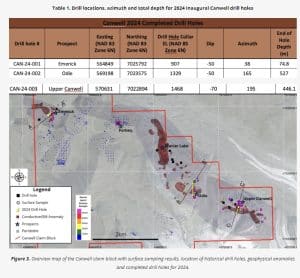
Source: AEMC
- READ MORE: Nickel Could Be the Key to U.S. Energy Independence: Alaska Energy Metals’ Strategic Role
- READ MORE: The Nickel Market is Changing Big Time: Is a Supply-Demand Shift Underway?
Key Findings from the Drill Sites
1. Emerick Prospect (CAN-24-001)
Drill hole CAN-24-001 started with 16 meters of overburden, followed by serpentinized peridotite containing 0.2–0.5% sulfide minerals. The drilling reached a depth of 72.5 meters before encountering challenging rock conditions. These included intense fracturing, clay alteration, and serpentinization, which made sulfide estimation difficult.
Non-mineralized mafic dikes were also present within the peridotite. Drilling became harder due to poor rock quality, and the hole was abandoned at 74.8 meters due to a large fault. Unfortunately, it did not reach the targeted magnetic anomaly or the base of the ultramafic intrusion.
Rather than retrying, the team decided to postpone further drilling on this target until 2025. The key findings were:
- 56.5 meters @ 0.40% nickel equivalent (NiEq) (0.26% Ni, 0.62% Cr, 7.00% Fe, 0.012% Co, 0.01% Cu, 0.019 ppm Pd, 0.032 ppm Pt & 0.007 ppm Au)

Source: AEMC
2. Odie Prospect (CAN-24-002)
Drill hole CAN-24-002 started with 12.2 meters of overburden, followed by serpentinized dunite containing 0.2–6.0% nickel sulfide and Ni-Fe alloy. This mineralized zone extended to a depth of 245.5 meters. Within the dunite, several non-mineralized gabbroic dikes were found.
At 245.5 meters, the drill hit an unmineralized diorite intrusion, which continued down to 527.0 meters. The targeted DIGHEM magnetic anomaly is believed to mark the contact between the mineralized dunite and the diorite intrusion. This area also showed increased pyrrhotite content, offering valuable clues for further exploration. The team discovered:
- 193.6 meters @ 0.42% NiEq (0.26% Ni, 0.69% Cr, 8.58% Fe, 0.01% Cu, 0.014% Co, 0.035 ppm Pd, 0.041 ppm Pt and 0.007 ppm Au)
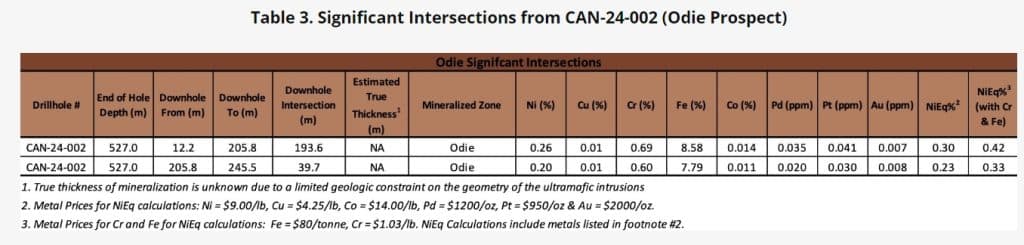
Source: AEMC
3. Upper Canwell Prospect (CAN-24-003)
Drill hole CAN-24-003 began with 16.8 meters of overburden, followed by serpentinized and faulted dunitic rocks. These rocks showed 0.5–5.0% nickel sulfide and Ni-Fe alloy mineralization. Several cross-cutting gabbroic dikes with minimal sulfide mineralization were also encountered.
Due to challenging terrain, the drill site was relocated north of the original plan. This adjustment allowed the team to test multiple geophysical targets and resulted in drilling down the dip of the intrusion.
The targeted DIGHEM magnetic anomaly showed higher sulfide content and better nickel grades, confirming its exploration potential. The key findings were:
- 429.3 meters @ 0.39% NiEq (0.24% Ni, 0.64% Cr, 8.12% Fe, 0.01% Cu, 0.013% Co, 0.031 ppm Pd, 0.035 ppm Pt and 0.007 ppm Au), including 1.4 meters @ 0.93 NiEq (0.65% Ni, 0.66% Cr, 8.90% Fe, 0.06% Cu, 0.021% Co, 0.275 ppm Pd, 0.246 ppm Pt and 0.012 ppm Au)
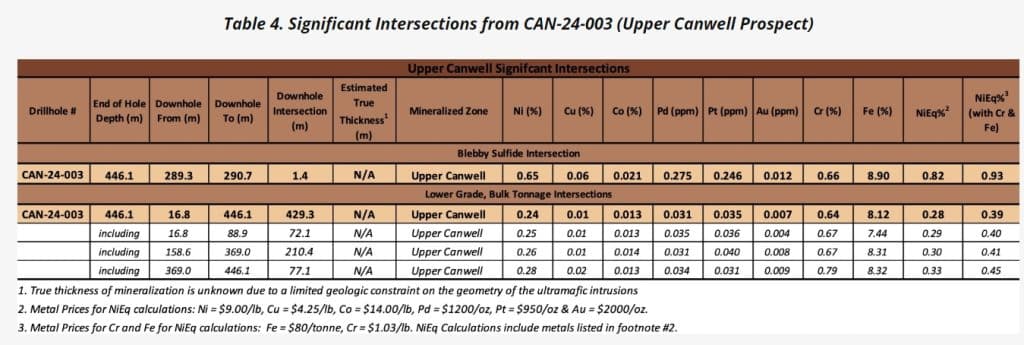
Source: AEMC
Ensuring High Standards for Exploration
AEMC upholds stringent Quality Assurance – Quality Control for its Nikolai Project to ensure the best practices for logging, sampling, and analysis of samples.
As revealed by the company,
“For every 10 core samples, geochemical blanks, coarse reject or pulp duplicates, or Ni-Cu-PGE-Au certified reference material standards (CRMs) were inserted into the sample stream.”
Furthermore, drill cores were flown daily to the McLaren River Lodge in Alaska, where they were meticulously logged, labeled, and cut. Half of each core was archived, while the other half was sent to SGS Laboratories in Burnaby, B.C., for detailed analysis using advanced geochemical methods.
This indicates that the company integrates environmental, social, and governance (ESG) principles into its operations. At the same time focusing on sustainable practices and carbon reduction. With offices in Anchorage and Vancouver, AEMC aims to supply critical materials essential for national security and clean energy.
What’s Next for AEMC?
Significantly, the recent results at Canwell strengthen the vision for district-wide exploration across the Nikolai Project. By confirming nickel mineralization and identifying promising areas for future drilling, AEMC has highlighted the potential for major discoveries in Alaska’s interior.
They plan to revisit the site in the 2025 season, targeting expanded sulfide zones and higher-grade nickel deposits. In addition to the Nikolai Project, AEMC is advancing the Angliers-Belleterre Project in Quebec, which holds potential for high-grade nickel-copper sulfides and white hydrogen.
Disclosure: Owners, members, directors, and employees of carboncredits.com have/may have stock or option positions in any of the companies mentioned: AEMC.
Carboncredits.com receives compensation for this publication and has a business relationship with any company whose stock(s) is/are mentioned in this article.
Additional disclosure: This communication serves the sole purpose of adding value to the research process and is for information only. Please do your own due diligence. Every investment in securities mentioned in publications of carboncredits.com involves risks that could lead to a total loss of the invested capital.
Please read our Full RISKS and DISCLOSURE here.
The post Alaska Energy Metals Corporation Unlocks Vast Nickel and Critical Mineral Potential at Canwell Property, Nikolai Project, Alaska appeared first on Carbon Credits.

Carbon credit providers vs marketplaces is the first comparison many buyers try to make. In this comparison, a carbon credit provider is the project developer: the company that originates credits from its own projects and sells them directly. A carbon credit marketplace is a platform that lists credits from many projects at published prices.

Carbon Footprint
Democrats who call climate change an emergency should not defend a permitting system too slow to build the clean energy that would address it.”
Democrats, Take The Deal. New York Times editorial, Nov. 12.
Insetting program design starts with your supplier map. The carbon claim comes much later.
Consider a coffee procurement team that funds a farm intervention before checking its sourcing data. The supplier aggregates coffee lots from several regions. The buyer lacks farm-level traceability. Another purchaser expects to report the same outcome. A more attractive project brochure solves none of these problems.
If the distinction between a value-chain intervention and a purchased credit is still open, read CCC’s Insetting vs Offsetting guide before you set the brief.
Insetting program design begins with the purchasing relationship and works outward. You need to decide 1) where an intervention belongs, 2) what business problem it addresses, 3) who pays for it, 4) how results will be measured, and 5) what the evidence will let you say about them. This five-step playbook turns that sequence into a procurement plan.
Step 1: Insetting program design starts with supplier mapping
Start with the commodities that matter most to your Scope 3 inventory and sourcing continuity. Ask finance for spend by supplier, sustainability for the emissions baseline, and category managers for origin and volume records. Then identify which suppliers can trace material to a jurisdiction, sourcing region, producer group, or individual land-management unit.
The level of traceability affects what you can account for. Under the GHG Protocol Land Sector and Removals Standard, the spatial boundary for purchased land-based products depends on the traceability associated with each volume. Farm-specific factors or removals require physical traceability through an acceptable chain-of-custody model. A contract with a tier-one trader, by itself, does not establish a link to the farms behind its deliveries.[1]
Build a first-pass table with five columns: commodity and annual volume; supplier and origin; current traceability level; land-use and production risks; and the business owner who can change the purchasing terms. Mark missing data plainly. A blank cell is cheaper to fix before a program starts than after a claim is drafted.
If your company sets an SBTi Forest, Land and Agriculture target (FLAG), keep its land-related target boundary separate from energy and industry emissions. The current FLAG guidance also requires relevant companies to assess primary deforestation-linked commodities in their value chains.[2]
Step 2: Choose a commodity and jurisdiction for a pilot
Select one supply corridor where the sourcing connection can be established and procurement has a reason to stay. A useful pilot has repeat purchases, suppliers willing to share records, an intervention matched to a diagnosed problem, and a defined plan to measure the result. Carbon potential alone is a poor selection rule if the supplier cannot deliver the crop your business needs.
Compare candidate regions on land-use risk, supplier concentration, local rights and tenure, the availability of baseline data, and exposure to drought, erosion, or forest conversion. Check the relevant legal requirements separately. A nature project does not satisfy a due-diligence obligation merely because it has a carbon method attached.
Consider a coffee buyer sourcing from two districts. In the first, producer-group records identify the farms, while recent dry seasons have increased rejected green coffee lots. In the second, deliveries pass through several intermediaries and farm origins are unknown. Pilot shade management in the first district, with local agronomic advice and quality checks built into the plan. The buyer can trace purchases there and test the intervention against a defined sourcing problem.
Use a short decision memo to record why the selected corridor beats the alternatives, what remains uncertain, and what would stop the pilot. That memo is the first control against a project drifting toward whatever happens to photograph well.
Step 3: Design the supplier engagement and commercial model
The intervention needs an owner on each side of the contract. Decide who supplies planting material or training, who maintains the practice, who bears the cost if a harvest disappoints, and how long the buyer expects to purchase from participating suppliers. Where smallholders participate, budget cash flow and technical support for practices that offer a later return.
Put these terms in a supplier agreement or pilot addendum. It should cover eligible farms and volumes, consent to data collection, access for monitoring, any land or carbon rights that matter, benefit sharing, and what happens if the purchasing relationship ends. Ask local counsel and producer representatives to review the arrangement. The Accountability Framework is a useful reference for supply-chain work involving forests, ecosystems, and human rights.[3]
Avoid assigning an automatic carbon benefit to the buyer. The contract should say which party has the right to report each outcome, how overlapping claims will be checked, and how any issued credits will be handled. A reduction reported in a buyer’s inventory cannot simply be sold for someone else’s offset claim without an accounting review. SBTi FLAG guidance excludes purchased credits used as offsets from near-term FLAG target achievement.[2]
Set commercial measures beside environmental ones: delivered volume, rejection rate, supplier retention, and procurement cost. They tell you whether the program works as a supply-chain investment, even if carbon accounting takes longer to resolve.
Step 4: Build monitoring, reporting, and verification before rollout
Agree on the baseline and data flow before paying for a full rollout. Identify the land units or sourcing regions in scope, the practices that change, the records suppliers already keep, and the additional measurements the program requires. Decide which data can come from field visits, transaction records, or remote sensing, and who checks each source.
For carbon, separate three questions. Did the practice happen? Did emissions or removals change under an applicable method? Can the buyer attribute a defensible share to its purchased goods without double counting? The GHG Protocol’s 2026 guidance includes dedicated chapters on spatial boundaries, data and methods, evaluating actions, credited outcomes, and assurance.[1] These are distinct jobs. A photograph of a planted tree answers only part of the first.
CCC’s MRV and Additionality article explains the separate evidence questions a project reviewer will ask.
Create an evidence file for every reporting period: dated supplier and farm records, purchase volumes, methods and emission factors, uncertainty, quality checks, and changes from the baseline. Specify who can challenge the data and how corrections are recorded. If a project also seeks credit certification, keep project accounting and corporate inventory accounting separate. The GHG Protocol says its land standard focuses on entity-level inventories and does not set the rules for credit certification.[4]
Start with the minimum viable measurement design that can survive review. Add complexity when the pilot tells you which data actually changes a decision.
Step 5: Decide what can be reported and claimed
Insetting program design needs reporting rules before the marketing copy. Procurement, sustainability, finance, and legal should agree on four distinct outputs: operational performance; observed land or nature outcomes; inventory effects, if the accounting criteria are met; and any separately issued credits. One dashboard can display them, but they should not share a single unqualified headline.
SBTi FLAG guidance allows certain land-based removals within a company’s operations or supply chain to contribute to FLAG pathways, subject to criteria including permanence, traceability, data quality, and allocation. It does not allow purchased offsets to meet near-term FLAG targets.[2] Eligibility therefore depends on evidence and the applicable target rules, not on calling an activity “insetting.”
Draft a claims register. For each proposed sentence, record the period, boundary, data owner, calculation method, reviewer, and whether the result is measured, estimated, or still a goal. If the evidence supports only “we funded a pilot with 200 farms,” say that. Do not turn a funding fact into a verified emissions reduction.
What good looks like by year three
Treat year three as a review point, not a promised payback date. A mature pilot should have mapped participating supply volumes, a stable supplier agreement, a repeatable data collection process, and a comparison of commercial and environmental results against the baseline. It should also have a documented answer for outcomes that cannot be included in the buyer’s inventory.
Scale only where the pilot improves a sourcing decision and the evidence can follow the product. If neither condition holds, redesign the intervention or change the corridor. A disciplined program can conclude that a site is unsuitable. That is useful procurement intelligence.
Discuss your insetting program with CCC
Carbon Credit Capital designs nature-based supply chain investments around sourcing needs and measurable sustainability outcomes. Schedule a consultation with our carbon and sustainability experts to map your tier-one supplier network, FLAG exposure, and first pilot decision.
Sources
[1] GHG Protocol, Land Sector and Removals Standard, version 1.1, and companion Guidance, June 2026: https://ghgprotocol.org/land-sector-and-removals-standard ; https://ghgprotocol.org/land-sector-and-removals-guidance
[2] Science Based Targets initiative, Forest, Land and Agriculture Science-Based Target-Setting Guidance, version 1.2, March 2026, especially pp. 16–17, 37, and 41: https://sciencebasedtargets.org/resources/files/SBTiFLAGGuidance.pdf
[3] Accountability Framework initiative, Accountability Framework and guidance for companies: https://accountability-framework.org/
[4] GHG Protocol, Frequently Asked Questions: Land Sector and Removals Standard, questions 10 and 18: https://ghgprotocol.org/blog/frequently-asked-questions-land-sector-and-removals-lsr-standard

‘COP-out’: COP31 fails to deliver the ambition needed to phase out fossil fuels and address climate breakdown
COP31 Bulletin Day 13: New draft retains electrification goal but delays adaptation finance and science decisions

How “Marie Antoinnete” Can We Get?

-
Climate Change1 year ago
Guest post: Why China is still building new coal – and when it might stop
-
Greenhouse Gases1 year ago
Guest post: Why China is still building new coal – and when it might stop
-

 Renewable Energy1 year ago
Sending Progressive Philanthropist George Soros to Prison?
-
Greenhouse Gases1 year ago
嘉宾来稿:探究火山喷发如何影响气候预测
-

 Climate Change2 years ago
Analysis: China’s CO2 falls 1% in Q2 2024 in first quarterly drop since Covid-19
-