England will soon introduce one of the world’s most ambitious biodiversity policies in “Biodiversity Net Gain”.
This policy effectively mandates that any new development leaves biodiversity in a better state than before it was constructed. It was initially meant to go into effect in November, but the government has pushed back its implementation until 2024.
In order to understand the potential impacts of the Biodiversity Net Gain, our team has been tracking development projects approved over the last three years in six councils across England that were early adopters of the policy.
Our latest paper, published this month, reveals several fundamental challenges that threaten the integrity of the policy’s environmental and economic outcomes.
We find that the oversight, monitoring and enforcement of biodiversity improvements supposedly delivered under the policy need urgent attention.
For example, there is a clear “governance gap”, where the system for monitoring biodiversity gains delivered on the site of new developments is weaker than for gains purchased from elsewhere. The process is overseen by local planning departments, which are typically lacking in capacity and ecological expertise.
Biodiversity Net Gain is an essential pillar of the country’s plans for attracting private finance into nature conservation to achieve its overarching environmental objectives.
Ultimately, the challenges we identify threaten the integrity of one of England’s most important environmental markets – and with it, the environmental outcomes of the government’s nature markets strategy.
Biodiversity Net Gain
Under the Biodiversity Net Gain policy, developers have three ways to offset their “biodiversity liability” – the damage their project does to nature. Biodiversity Net Gain applies to most developments, such as housing and smaller infrastructure projects. The policy will apply to major infrastructure projects from 2025 onwards.
First, they can enhance biodiversity somewhere within the development – so-called “on-site” gains. These on-site gains can take the form of, for example, sowing wildflowers along road verges or managing some of the grassland within a housing development to promote wildlife, rather than for traditional landscaping.
If developers can’t meet their liabilities on-site, their second option is to use biodiversity “units” from ecological improvements elsewhere. Under the policy, these units are supposed to mirror the habitat that is impacted by the development, so that when developers damage habitats, they must replace them with habitats that are at least as valuable, from a conservation perspective, as those lost.
Some of these units might come from the new “net-gain market”. Land managers create these units by implementing conservation actions on their land, such as converting low-productivity pasture into a field managed for wildflowers. Then, they sell these units to developers.
Alternatively, some developers are developing their own habitat banks, creating biodiversity units in one place to offset the impacts of their developments elsewhere.
Last, if no units are available through either of these pathways, developers can buy “statutory biodiversity credits” directly from the national government.
These credits loosely resemble the units sold via the market. The government holds a stock of these units as a last resort for developers who cannot offset their damage in other ways. For example, they may offset damage to particularly rare types of habitat for which there may not be suitable credits available on the standard market.
Importantly, the price levels for these statutory units have been set deliberately high, in an attempt to disincentivise developers from relying on these credits.
The ‘governance gap’
Our dataset spans around 1,600 hectares of development footprint that have been submitted or approved for development over the last three years in these six early-adopter councils: West and South Oxfordshire, Vale of White Horse, Cornwall, Leeds City and Tunbridge Wells.

Our team has been collating and analysing the biodiversity assessments submitted to these authorities for each project.
We’ve analysed the trades occurring under the policy and the rules that govern them. Additionally, we have quantified any errors embedded in the developers’ biodiversity assessments. Our research has identified several shortfalls that need addressing for this nature market to be able to deliver on its goals.
Our first key finding is that around one-quarter of all the biodiversity units delivered under the policy so far fall within a “governance gap” – meaning that they are likely to go unmonitored, and may even be legally unenforceable.
As a result, there is a very high probability that regulators will not be able to take any action if these promised gains are not delivered.
This will likely translate into a large chunk of these units not materialising in reality, as there is little incentive for developers to deliver these units in full if there is no credible enforcement mechanism.
The problem is that the standards and regulations of the three offset pathways vary considerably.
There is reasonably stringent governance to ensure that biodiversity units purchased on the offsetting market are delivered in reality. Sellers will have to submit their offsets to a national database, monitor biodiversity changes and report on the ecological development of the site at regular intervals.
Contrary to these standards, the system for monitoring, reporting and enforcing units delivered “on-site” is much weaker. The government has suggested that the existing planning enforcement system can be used to oversee on-site units.
The planning enforcement system was never designed for such a task, and in its current form, is unsuitable for fulfilling this role.
Under the current system, local authorities are explicitly advised to only take enforcement action, such as warnings or fines, if a developer’s violation of a planning condition results in “serious harm to a local public amenity”. Although it is unclear how this will apply to the Biodiversity Net Gain policy, the failure to deliver a habitat that a developer promised in a planning application a few years prior is extremely unlikely to trigger this threshold.
Developers also do not have to log their on-site gains on the national Biodiversity Net Gain register, which means that many of these projects are likely to go unmonitored. Even if they underperform relative to the original promise in the planning application, there is no credible system in place to hold developers to account for such non-delivery.
Risk of non-delivery
In our research, we have found that around one-quarter of all the units delivered under the policy are at a high risk of non-delivery because of this governance gap.
While the regulation of a specific kind of biodiversity unit within a single policy might sound unimportant, this actually has serious implications for how England’s nature markets function.
The core pillar of England’s ambitions for drawing private finance into nature conservation is the Biodiversity Net Gain market. Any biodiversity units that are delivered on-site by developers are units they will not need to purchase from the off-site market. So the less stringent the standards in the on-site system, the more this will drain demand for units from the off-site market, which is relatively more ecologically robust.
Although we recognise our data is preliminary, we estimate that if these under-regulated biodiversity units were to be delivered via the off-site market instead, the demand for biodiversity units could rise by a factor of four.
This could significantly increase the amount of conservation implemented on private land and, therefore, the amount of private finance flowing into conservation projects on private land.

There is precedent for this. The English scheme was partially informed by the US wetland mitigation markets. In 2008, those markets underwent reform to address a similar governance gap.
In the US case, the standards applied to developer-led and third-party projects diverged enormously, meaning a range of low-quality mitigation projects were being implemented by developers. The 2008 compensation rule in the US wetland mitigation system addressed this disparity by ensuring that the same standards were applied across all forms of compensation.
Lacking capacity
Our research also reveals other interesting, consequential patterns. Perhaps the most important to the integrity of this emerging market is the current lack of capacity in local authorities to be able to deliver on the Biodiversity Net Gain policy.
Local authorities do the best they can with the resources they have, but they have undergone stringent funding cuts since 2008.
At the last count, around 60% of local planning authorities have no in-house ecological expertise – which is essential for delivering biodiversity gains effectively.
In our study, we evaluated how many of the applications contained a basic error in their calculations: we checked to see if the area of the site before and after development added up to the same amount.
We found that the areas did not add up in around one-fifth of all projects. Of these, around half had already been accepted by the local planning authorities. One explanation for this oversight could be that planners were so rushed they did not have time to examine the calculations included with the application.
This suggests we have not yet addressed the serious capacity shortages in the councils – who are ultimately going to be the public bodies overseeing the delivery of Biodiversity Net Gain at local scales. This is clear evidence that further investment in local planning capacity is required.
Environmental markets have the potential to be powerful mechanisms for improving nature, but one of the fundamental features of biodiversity compensation markets is that they deliver biodiversity gains that make up for an equal and opposite loss elsewhere.
This means that every biodiversity unit that is promised by developers in order to secure planning permission, but then not delivered in reality, has legitimised the loss of biodiversity elsewhere.
Making sure that these policies lead to direct, robust gains in the quality of nature is therefore absolutely essential to ensure that the markets-focused approach to drawing private finance into nature recovery in England leaves the environment better, rather than worse, off.


The post Guest post: Fixing the gaps in England’s ‘biodiversity net-gain’ policy appeared first on Carbon Brief.
Guest post: Fixing the gaps in England’s ‘biodiversity net-gain’ policy

A temporary breach of the 1.5C global-warming limit is now “inevitable” following “decades of insufficient climate action”, says the UN Environment Programme (UNEP).
In its “sobering” annual assessment of the global “emissions gap”, UNEP says that exceeding the Paris Agreement’s 1.5C limit is “imminent and unavoidable”.
This year’s report, titled “The point of return”, says the “task now” is to minimise the size and scale of a temperature “overshoot” and to “establish a credible return path to 1.5C by the end of the century”.
Even the “lowest possible” overshoot scenario for 1.5C would first see global warming peak at around 1.7-1.8C in the middle of the century before declining, says the report.
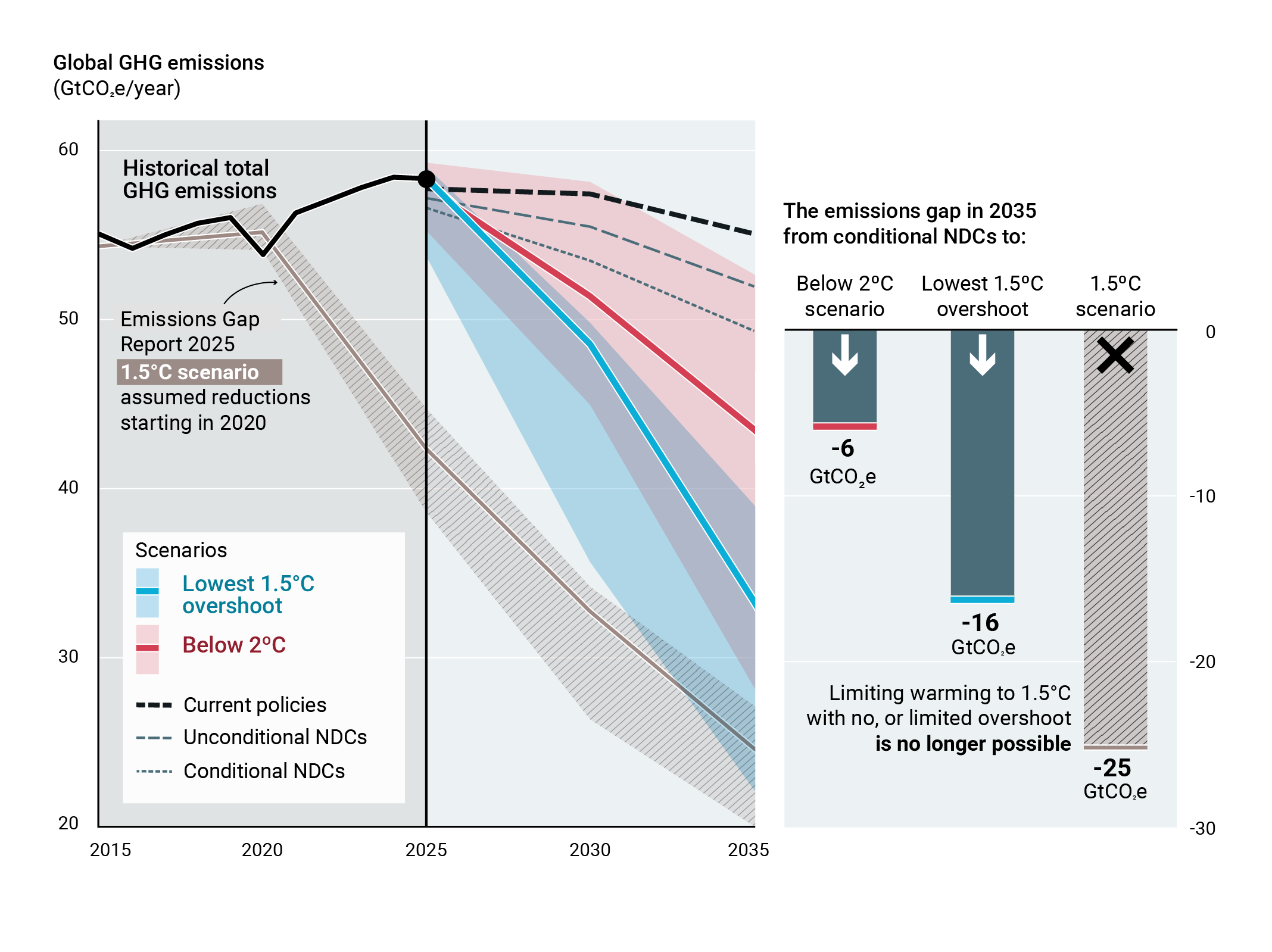
This scenario – which is “still aligned with the long-term temperature goal of the Paris Agreement” – would require global emissions cuts of 18% by 2030 and 45% by 2035, while ramping up “removals” of carbon dioxide (CO2) from the atmosphere, says UNEP.
In contrast, it notes that the current climate pledges by countries around the world – even if fully implemented – would only reduce emissions by 5-8% by 2030 and 11-15 % by 2035, relative to 2025 levels.
Nonetheless, the report identifies “ample opportunity to accelerate action”, concluding that “countries can still limit peak warming, shorten the duration of overshoot and keep the goals of the Paris Agreement within reach”.
(See Carbon Brief’s detailed coverage of previous reports in 2014, 2015, 2016, 2017, 2018, 2019, 2020, 2021, 2022, 2023, 2024 and 2025.)
Emissions ‘comparable’ between 2024 and 2025
The report says that emissions in 2025 were “comparable” to those of 2024.
Global greenhouse gas emissions in 2025 totalled 58.4bn tonnes of CO2 equivalent (GtCO2e), according to the report. This is around 0.16GtCO2e lower than 2024 levels – albeit, with high levels of uncertainty around the numbers.
In addition, because the figures presented in the 2025 report are “provisional”, the report says, it is “not possible to conclude on the overall direction of emissions in 2025”.
The emissions growth rate has been slowing down in recent decades: the growth rate over 1990-2015 was, on average, 1.7% per year, while emissions have increased by an average of 0.8% per year since 2016.
The chart below shows the total human-driven emissions between 1990 and 2025, separated by greenhouse gas: CO2 from fossil-fuel combustion (dark grey), methane (light grey), nitrous oxide (blue), fluorinated gases (orange) and CO2 from land-use change (green).
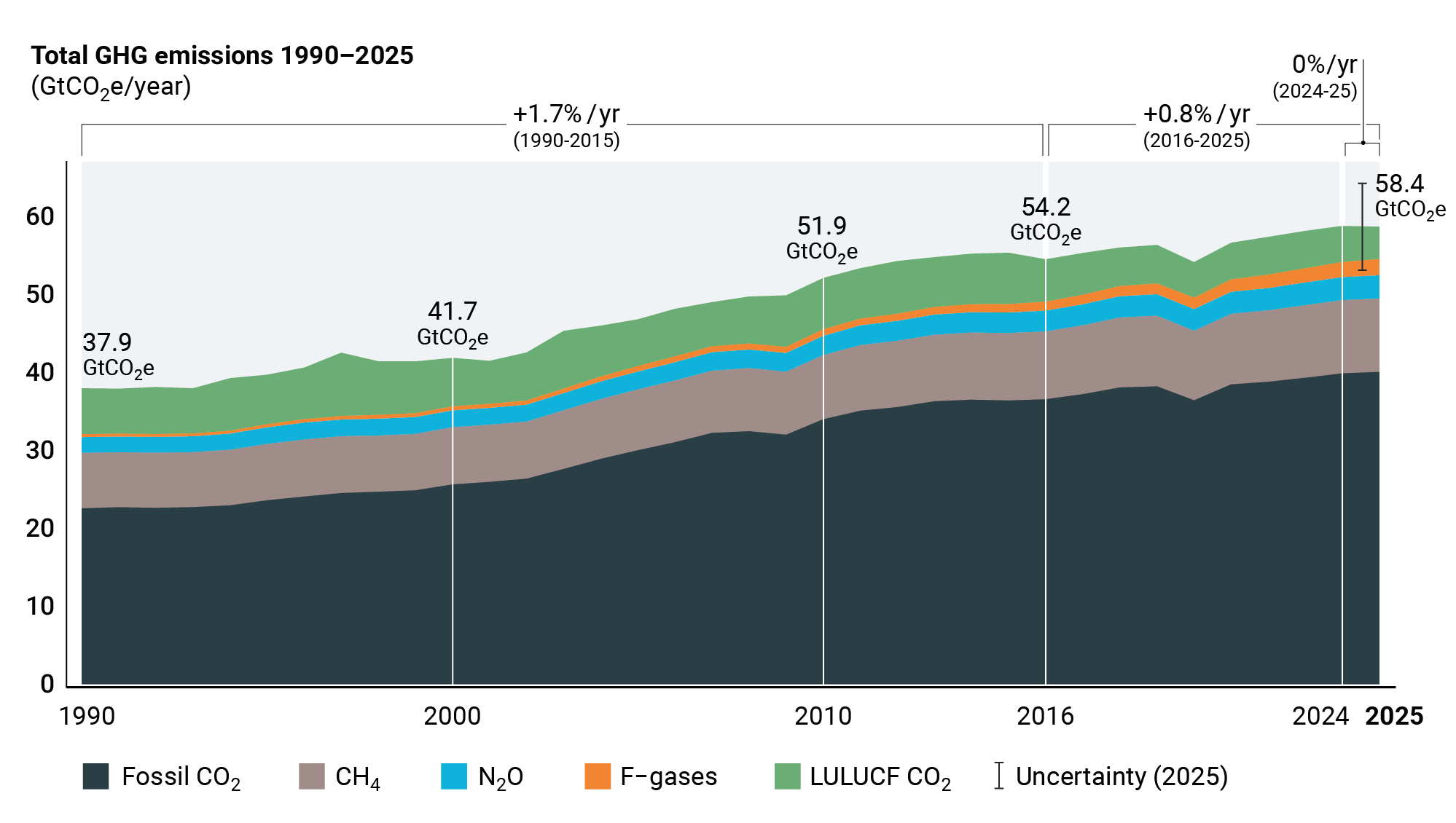
Compared to 2024, emissions from fossil fuels increased slightly, by between 0.4-1.1%, says the report. Emissions of both nitrous oxide and fluorinated gases increased by even higher rates, but since these comprise such a small part of total greenhouse gas emissions, “their contribution to the overall trend is relatively less significant”, it adds. Methane emissions remained steady over that time.
A reduction in the CO2 emissions from land use, land-use change and forestry (LULUCF) “slightly overcompensates” for the rise in emissions of fossil-fuel CO2 and other gases, according to the report. (For more on falling land-use emissions, see Carbon Brief’s explainer.)
The decrease in LULUCF emissions was “partially driven” by a decline in global wildfire emissions, particularly in Africa, South America and parts of south-east Asia. The report notes that these decreases were “likely connected to the ceasing of El Niño conditions”. The ongoing “super” El Niño is likely to cause LULUCF emissions to increase in 2026.
The report also examines countries’ contributions to the increase in greenhouse gas emissions – although here, it excludes LULUCF due to a lag in national-level emissions inventories for the sector.
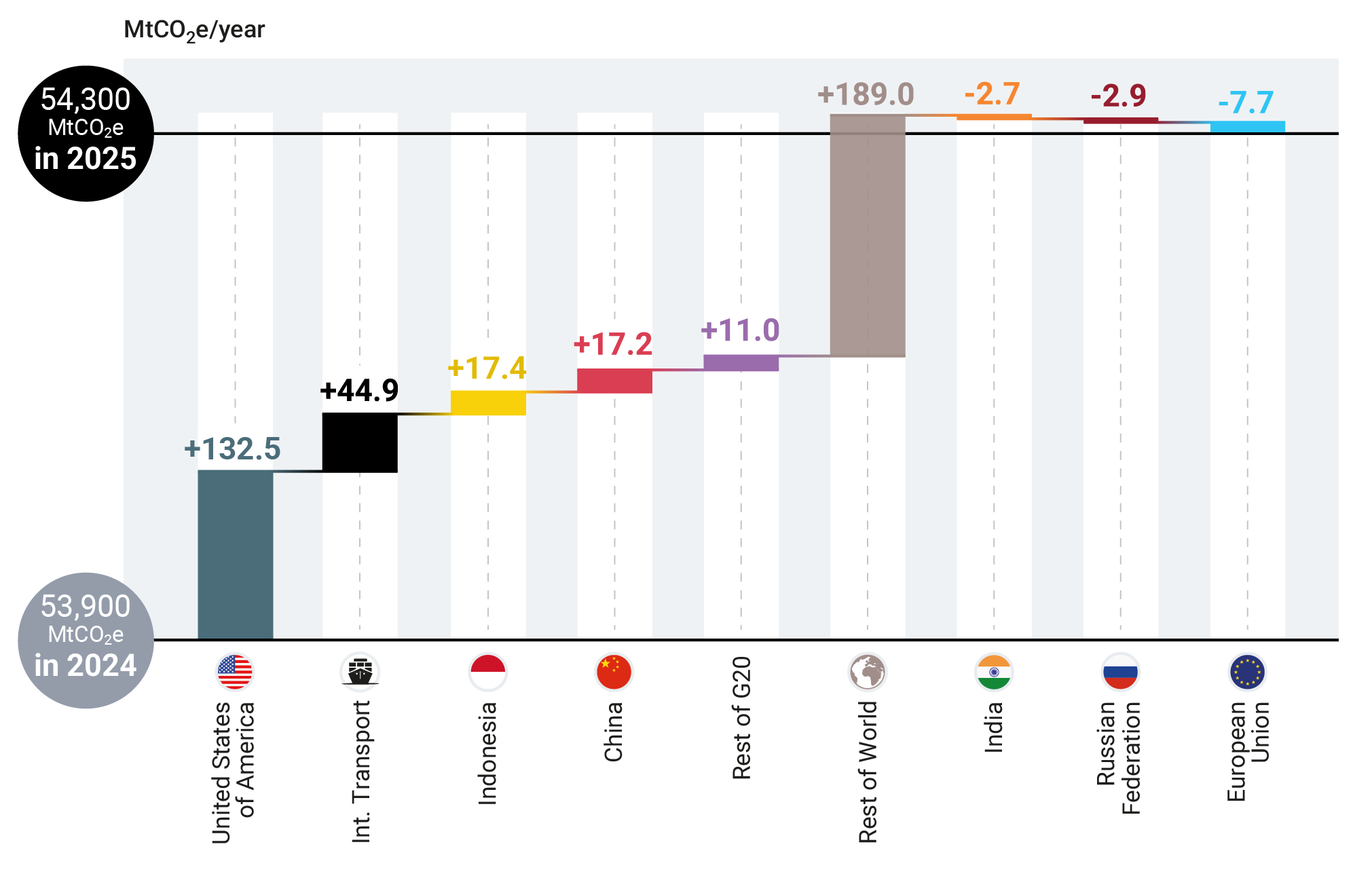
Among the top six emitters, only the US saw a notable increase in 2025, says the report, whereas emissions in China, the EU, India, Russia and Indonesia were relatively flat. Emissions in the US grew by 133m tonnes of CO2e (MtCO2e) in 2025, due to increased electricity demand and a “rebound” of coal power. This growth in US emissions is likely due to a combination of market factors, including increased heating demand due to a colder winter, higher gas prices and overall increased electricity demand.
The changes for the six largest emitters, the rest of the G20 countries, international transport and the rest of the world can be seen in the chart below.
Across most sectors, progress towards decarbonisation has been “modest”, says the report. The most notable decreases have occurred in the power sector and the transport sector, due to the growth of solar power and electric vehicles. The report notes:
“There are emerging signs of transport sector electrification and decarbonisation, but at rates and levels that are not yet sufficient to drive emissions reductions at the global level.”
However, emissions from the transport sector have continued to grow, due to increased demand for international aviation and shipping.
The report notes that while electricity demand from data centres is “projected to double” by 2030, data centres at present account for less than 1% of total emissions.
New NDCs would reduce emissions ‘far from what is needed’
All countries were meant to submit new UN climate pledges for 2035, known as the third nationally determined contributions (NDCs) to the Paris Agreement, by February 2025. However, 95% of nations missed this deadline.
Many countries came forward with their third NDCs at a UN climate summit in New York in September 2025 and at the COP30 climate summit in Brazil in November 2025.
By the end of COP30, 122 – or 63% – of countries had produced their third NDCs.
The report says that figure had risen to 124 by 1 September 2026, with pledges now covering 75% of global emissions.
This is more than double the number of third NDCs available at the time of the 2025 emissions gap report – allowing a “more robust basis for assessing collective progress and ambition toward 2035”, says the report.
Although the first global stocktake of action towards the goals of the Paris Agreement called for countries to submit targets “covering all greenhouse gases”, there has only been a “modest” increase in the number of nations to do so, according to the report.
It says that eight countries included greenhouse gas targets for the first time in their third NDCs, bringing the total number parties with such targets up to 155.
The third NDCs “increasingly use more robust and verifiable target formulations”, such as standardised baselines, says the report.
However, they have not “meaningfully broadened the scope of sectors and gases covered by the targets”, it adds.
If the third NDCs were implemented in full, it would lower global emissions in 2035 by 3.5GtCO2e, compared to 2030 targets, says the report.
It says this is “far from the global reductions needed to get on track to achieving the long-term temperature goal of the Paris Agreement”.
Compared to the 2025 report, the projections for global emissions in 2035 as a result the third NDCs are about 3GtCO2e higher.
This is down to the formal withdrawal of the US from the Paris Agreement, as well as from “harmonising” the projections with the latest historical emissions data, says the report.
The global “implementation gap” for 2030 – defined as the difference between countries’ projected emissions under current policies and the emissions expected if they implemented their NDCs in full – has narrowed compared to last year, says the report.
However, this is mainly due to the withdrawal of the US from the Paris Agreement. In other words, the narrowing of the gap is due to “policy changes, not policy progress”.
The implementation gap for both 2030 and 2035 are of a similar size – suggesting “enhanced collective ambition of 2035 NDCs is weak”, continues the report.
Some 14 of the 17 G20 nations, counting the EU as one, have submitted new NDCs with emissions targets for 2035, says the report.
However, the emissions trajectories of the majority of G20 nations remain “misaligned” with their net-zero targets, says the report.
The chart below shows the gap between nations’ current emission trajectories and their NDC targets for 2030 and 2035 (diamonds), along with their net-zero targets (circles).
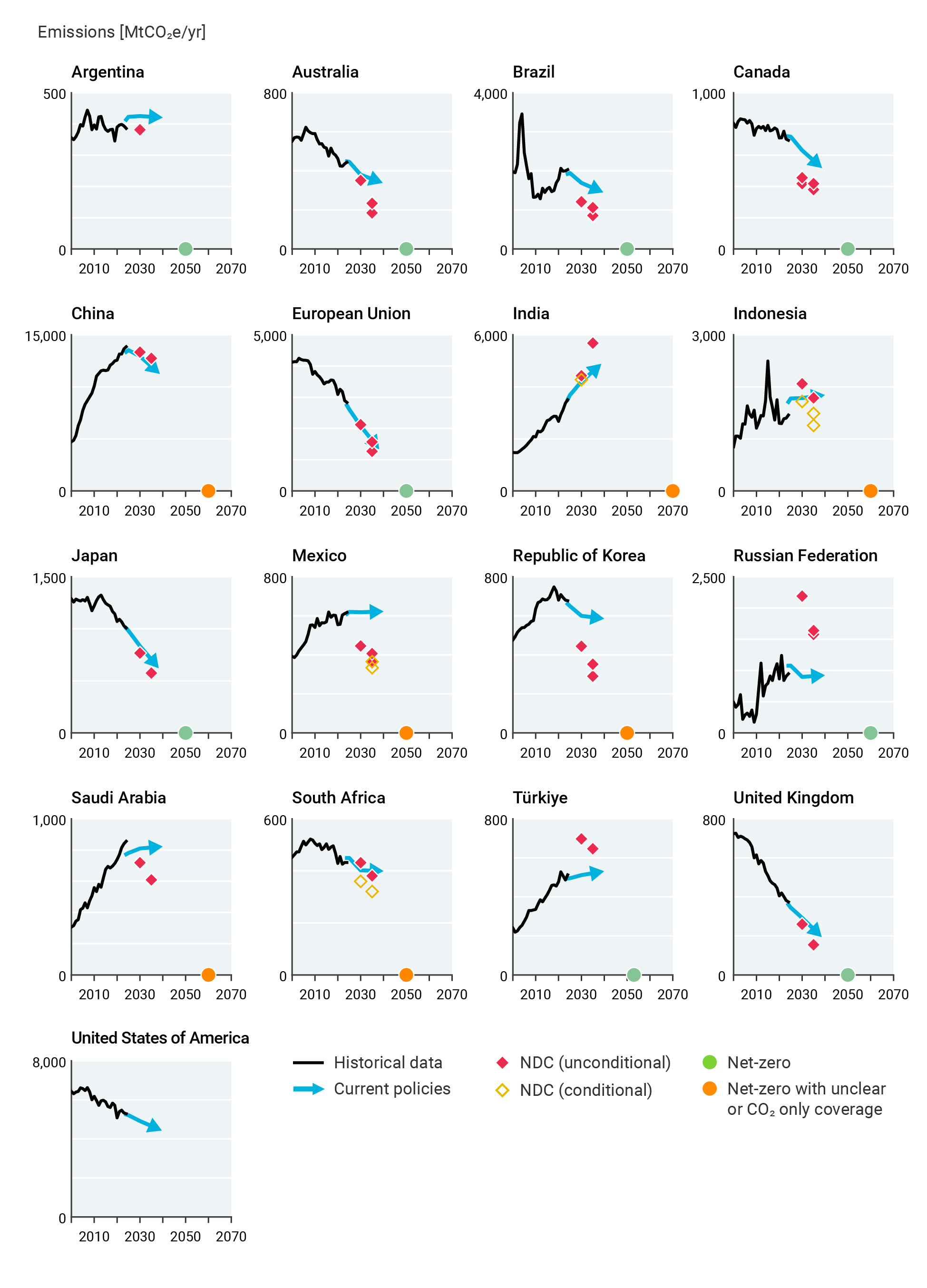
All G20 members except Japan, the EU and UK would need to “accelerate their emission reduction rates based on current policies” to achieve their net-zero targets, adds the report.
Emissions gap is ‘still large’
The report goes on to estimate the “emissions gap” – the difference between projected global emissions if all NDCs are met in full and what would be needed to achieve the long-term temperature goal of the Paris Agreement.
The report assesses a range of potential future pathways – some that have been assessed in previous reports and some new. The three core “NDC scenarios” are:
- A “current policy” scenario, which projects global greenhouse gas emissions based only on policies adopted and implemented as of November 2025.
- An “unconditional NDCs” scenario, which projects greenhouse gas emissions assuming full implementation of the most recent NDCs that do not depend on external support (with a cut-off date of 1 September 2026).
- A “conditional NDCs” scenario that further assumes that the implementation of NDCs that depend on external support, such as climate finance from wealthier countries (also with a cut-off date of 1 September 2026).
As with the 2025 report, the authors also analyse two “scenario extensions”, which explore the implications of current policies, NDCs and net-zero pledges beyond 2035:
- A “current policies continuing” scenario, which “follows current policies to 2035 and assumes a continuation of similar efforts thereafter”.
- A “conditional NDCs plus all net-zero pledges” scenario, which is “the most optimistic scenario included”. This scenario assumes the “conditional NDC” scenario is achieved until 2035 and then all net-zero or other long-term low emissions developments strategies are followed thereafter, excluding that of the US.
In previous reports, the authors have compared all of these scenarios against pathways that hold warming below 2C and 1.8C, or against 1.5C with no more than 0.1C of “overshoot”.
(Overshoot refers to pathways where global warming first exceeds the 1.5C limit and is then brought back down through techniques that remove carbon from the atmosphere.)
These three warming pathways were drawn from the scenario database for the mitigation report of the Intergovernmental Panel on Climate Change’s (IPCC) sixth assessment (AR6).
These scenarios were developed around 2015-20 and assumed that the world would pursue immediate emissions cuts from around 2020. However, in reality, emissions have continued to rise. As a result, the report says, those temperature pathways “have become outdated”.
For example, the authors explain, emissions are currently around 80% above the level that would have been needed by 2030 to limit warming to 1.5C with no or “low” overshoot.
Therefore, as a result of “decades of insufficient emission reductions”, the possibility of limiting warming to 1.5C with limited or no overshoot “has now been lost”, say the authors.
The 2026 report instead “draws on a new generation of pathways in which ambitious mitigation action starts from 2025”. These are:
- A “below 2C” scenario, which is consistent with keeping global warming below 2C throughout the 21st century, with at least a 66% chance.
- A “lowest 1.5C overshoot” scenario, which keeps warming to 1.7-1.8C throughout the entire century (with a 66% chance) and returns it to 1.5C by 2100 (with a 50% chance).
These updated scenarios “reflect the failure to cut global emissions to date”, note the authors.
The overshoot scenario “minimise[s] both the magnitude and duration of overshoot above 1.5C”, say the authors, while meeting a defined set of “feasibility and sustainability guardrails”. These include, for example, balancing the demands of bioenergy and large-scale carbon removals with biodiversity and food security needs.
The task to “minimise” overshoot reflects the wording of the “Global Mutirão” package of measures agreed at the COP30 climate summit in Brazil in 2025. This acknowledged – for the first time in a COP text – that there was likely to be an overshoot of 1.5C and urged that both its extent and duration needed to be “limit[ed]”.
The chart below, taken from the report, shows how the emissions pathways compare to each other, as well as historical emissions and the 1.5C pathway used in previous reports.
The right-hand section shows the “unbridgeable gap” to pathways that limit warming to 1.5C with overshoot of no more than 0.1C.