Welcome to Carbon Brief’s China Briefing.
China Briefing handpicks and explains the most important climate and energy stories from China over the past fortnight. Subscribe for free here.
Key developments
China released draft of long-awaited Energy Law
FULL TEXT: The latest draft of China’s long-awaited Energy Law has been issued for public comment following approval by China’s top legislative body, the National People’s Congress Standing Committee (NPCSC), economic newswire Jiemian reported, in an analysis of the text. The law, which was initially drafted in 2005, will likely be “considered at three [NPCSC] meetings before being put to a [final] vote”, the outlet said, which means it could be formally enacted “within the year”.

PRIORITISING RENEWABLES: Jiemian added that the law “clearly supports prioritising the development of renewable energy; rational development of clean and efficient use of fossil energy; and orderly promotion of non-fossil fuel energy instead of fossil fuel energy and low-carbon energy instead of high-carbon energy”. Chinese energy news site International Energy Net noted that the draft law calls on the state to “establish a mechanism to promote green energy consumption and encourage energy users to prioritise using renewable energy and other clean and low-carbon energy sources”. Elsewhere, Chen Xinghua, associate professor at North China University of Technology and deputy secretary-general of the China Law Society’s energy law research group, told China Environment News that, until now, the “development of the energy industry…has relied more on dividends from reform of the energy system”. He added that a unified Energy Law is “urgently needed” to resolve the “intricate and complex” interests of various stakeholders, as well as the challenges of a modern energy system and meeting China’s carbon neutrality goals.
LONG ROAD: The Hong Kong-based South China Morning Post said that the law “has been [on] one of the longest [journeys] for any piece of Chinese legislation”. It quoted an unnamed Tsinghua University law professor attributing the delays to staunch resistance from energy sector stakeholders, who “lobbied extensively” to “[try] to hold onto their territory”. The professor speculated that this resistance may have been broken by president Xi Jinping’s anti-corruption campaign.
Leaders and targets plot ‘realistic’ path
2024 TARGET: The Ministry of Environment and Ecology (MEE) is aiming for carbon emissions per unit of GDP – also known as carbon intensity – to fall by 3.9% in 2024, according to state broadcaster CCTV. Previous Carbon Brief analysis found that carbon intensity would need to fall by 7% per year to meet China’s 2025 climate commitments. This was echoed by consultancy Trivium China, which said in a recent newsletter that the target for 2024 “isn’t enough to get China emissions intensity reductions back on track”.
-
Sign up to Carbon Brief’s free “China Briefing” email newsletter. All you need to know about the latest developments relating to China and climate change. Sent to your inbox every Thursday.
‘BE REALISTIC’: Meanwhile, Chinese president Xi Jinping called on policymakers to both “be realistic, by not slowing the pace of green and low-carbon development, and not be too idealistic, above all guaranteeing energy supply”, International Energy Net reported. At a technology-focused forum in Beijing, National Energy Administration director Zhang Jianhua said China would “lead the innovation of the clean energy industry…further strengthen the foundation of energy security [and] continue to improve the scale and quality of non-fossil energy supply”, according to state news agency Xinhua.
COAL CAPACITY: Following an announcement that China will establish a coal production capacity reserve system by 2027, Xinhua published an analysis stating that the move will allow China to “quickly release reserve capacity in extreme situations, such as fluctuations in the international energy market, instances of severe weather and [other] drastic changes to supply and demand”. It added that this measure was not intended “to significantly increase coal production capacity”. (Read more in Carbon Brief’s China Briefing from 18 April).
US-China methane cooperation continued
BLINKEN TRIP: With US secretary of state Anthony Blinken visiting Beijing last week, the “two superpowers continued dialogue to manage a growing list of differences”, reported Bloomberg. Citing a Chinese foreign ministry statement, the outlet said Xi told Blinken that “China and the US should be partners rather than rivals”. The Chinese foreign minister Wang Yi also told Blinken that China “urged” the US “not to interfere in China’s internal affairs, not to hold China’s development back, and not to step on China’s red lines on China’s sovereignty, security, and development interests”, according to a report from the Associated Press. Blinken responded by saying that “the Biden administration places a premium on” the bilateral dialogue even “on issues of dispute”, according to the newswire.
EASIER FUTURE?: Despite several areas of disagreement, the Communist party-affiliated newspaper People’s Daily mentioned the two sides reached an agreement on further “cooperation” on climate change. China Environment published an announcement by the MEE that a US-China climate action working group held a virtual meeting, at which they pledged to “strengthen communication” and cooperation on controlling methane emissions. Meanwhile, China enacted a tariff law during Blinken’s visit to strengthen China’s “trade defence capabilities”, Reuters reported. The outlet said the law was passed amid US and EU industrial “overcapacity” concerns and outlines “a range of legal provisions related to tariffs on Chinese imports and exports”. It quoted Henry Gao, a professor at Singapore Management University, who described the law as “a nuclear weapon” to show the US and EU “that this is our prerogative: If you’re going to hit us with tariffs, we can do the same”.
Chinese climate envoy announced US visit
MAY VISIT: In an interview with Bloomberg, China’s climate envoy Liu Zhenmin announced that he plans to visit the US in May for his first formal face-to-face meeting with US counterpart John Podesta. Liu stated that China aims to “extend cooperation on issues including energy, the circular economy and efforts to curb greenhouse gases beyond carbon dioxide”. He added that the US and China “have to cooperate as far as possible” on climate, and that the two nations “also need to respect each other on all issues”. Another Bloomberg article on the Liu interview said: “Efforts by the US and Europe to stem China’s dominance in green technologies risk stalling the fight against global warming, according to [Liu].”
‘DIFFERENT LENS’: Elsewhere, Liu raised four challenges to global resilience at a forum hosted by the thinktank Center for China and Globalisation. Notably, he listed these challenges in the following order: geopolitical conflicts; setbacks to economic globalisation; climate change; and unease around artificial intelligence. In an earlier article, the Diplomat had suggested that Liu – given his Ministry of Foreign Affairs background – may see climate “more as a lever in China’s overall diplomatic strategy, rather than a critical, standalone issue to address”.
Spotlight
Media reaction: Guangdong flooding and the role of climate change
Guangdong province in southern China has been pounded by heavy rains since 19 April, causing flooding that has left at least four dead and seen more than 110,000 people evacuated.
Guangdong is China’s most populous province and an economic powerhouse driving China’s manufacturing industry and exports.
In this issue, Carbon Brief examines the impact of climate change on the flooding and the response from Chinese and international media.
How has flooding affected Guangdong?
“Intense” rainstorms began in the northern and western regions of Guangdong province on 19 April, with the ensuing rainfall breaking records for the month, according to the Hong Kong-based South China Morning Post (SCMP).
Originally, floodwaters from the Bei River, a major tributary of the Pearl River, were expected to peak on 22 April, the newspaper added.
The heavy rainstorms continued, however, and by 28 April three separate floods had been recorded, according to the Communist party-affiliated People’s Daily and regional newspaper Southern Daily.
On 30 April, state broadcaster CGTN announced that China issued a severe weather warning for further torrential rain, thunderstorms, gales and hail for parts of Guangdong, as well as five other provinces.
Four people were reported dead and 10 missing during the initial flood, BBC News said, adding that at least 110,000 people were evacuated.
The worst-hit areas included the provincial capital Guangzhou – home to almost 19 million people – as well as the cities of Zhaoqing, Shaoguan, Qingyuan, Jiangmen, Huizhou and Heyuan, according to various media outlets.
Guangzhou Daily reported that the provincial government announced a relief fund of 90m yuan ($12.4m) to be used to recover from the damage caused by the flood.
Meanwhile, Chinese vice-premier Zhang Guoqing and Guangdong governor Wang Weizhong both called on local governments to improve monitoring of extreme weather, the China Daily and Southern Daily reported.
In addition to the floods, CNN reported that a tornado, which appeared after “multiple days of heavy rains”, killed “at least five people” in Guangzhou on 27 April.
On 1 May, the collapse of a highway near Meizhou city in Guangdong killed at least 48 people, the Associated Press reported, adding that ongoing torrential rainfall was hampering rescue efforts.
Separate Associated Press coverage noted that heavy rains “pose a special risk to mountain roadways and highway bridges”, although an official cause of the accident had not yet been established.
Is climate change a contributor to the flooding?
While the Pearl River delta is prone to summer flooding, the rains this year were unusually early, according to Reuters.
Agence France-Presse reported that Yin Zhijie, chief hydrology forecaster at the Chinese Ministry of Water Resources, told state-run China National Radio that “intensifying climate change” raised the likelihood of early heavy rains.
Xu Xiaofeng, executive vice-chairman of the Chinese government’s China Meteorological Work Development Advisory Committee and president of the China Meteorological Services Association, told economic newswire Jiemian that recent warm and humid currents in the north-west Pacific Ocean and Indian Ocean have created significant water vapour in southern China, contributing to the rainfall.
According to the outlet, Xu said: “Recent record-breaking precipitation…occurred precisely against the backdrop of global warming.”
The outlet also quoted another expert, Zhang Qiang from the Gansu Meteorological Administration, saying heavy and abnormal rainfall in the region is becoming “a normal phenomenon” due to the influence of global warming.
While there is, as yet, no formal “attribution” study of whether the flooding was made worse by human-caused global warming, one rapid analysis found that the “somewhat uncommon event” was “exacerbated” by both human-caused climate change and natural variability.
It concluded that weather systems similar to those that caused the floods are 8-12% wetter over Guangdong province in the present climate than they were in the past.
Previous Carbon Brief analysis has also identified a number of attribution studies that have quantified the influence of climate change on flooding in southern China.
For example, record-breaking rainfall in the June-July period of 2020 was found by one study to be more than five times more likely in the present-day climate – “80% of which can be attributed to climate change”.
How has the Chinese media responded?
While most local media coverage focused on individual stories and local responses, several Chinese media outlets have pointed to links between the floods and climate change.
In its reporting, China Daily cited a China Meteorological Administration (CMA) interview with Chinese Academy of Engineering member Ding Yihui, who said: “The world has entered a new phase of climate change, which is characterised by an increased frequency of extreme weather events, resulting in the occurrences of sudden climate and weather-related disasters.”
The municipal newspaper Guangzhou Daily made a connection with extreme rainfall in Dubai and quoted Zhang Xingying, deputy director of the CMA’s science, technology and climate change department, saying that, due to “global warming and El Niño”, China will see more extreme weather, including floods, in 2024.
“Chinese and foreign scientists”, the Guangzhou Daily article said, “remind us that new features of extreme weather and climate events are emerging globally.”
It added that “our generation will witness more and more extreme weather…All we can do now is leave a better future for future generations.”
On 28 April, the Guangzhou Daily also reposted an article by Shanghai-based newspaper the Paper, in which China Academy of Meteorological Sciences scholar Sun Shao argued that “recent extreme weather events are closely linked to climate change”.
Sun said that, in the face of this challenge, the international community must strengthen global cooperation to combat climate change.
Meanwhile, an SCMP editorial said that both the flooding and an emerging drought in nearby hydropower-producing Yunnan province, “illustrate just how critical the climate-change issue is – not just for China but globally”.
It added: “While the flooding is a reminder to be prepared for sudden climate-linked extreme events, including fires and violent storms, the drought is a wake-up call about longer term consequences for the climate of failure to rein in carbon emissions.”
Watch, read, listen
2035 NDC: Project Syndicate published an article by the Asia Society Policy Institute’s Li Shuo and Lauri Myllyvirta about how setting ambitious commitments in its “nationally determined contribution” (NDC) for 2035 could both spur China’s energy transition and boost its profile as a climate leader.
GLOBAL COMPETITION: The substack High Capacity explored the “paradox” of how several Chinese clean-energy technology industries were able to overtake competitors in Germany, despite Germany’s significant industrial advantages.
JUST TRANSITION: Dialogue Earth reported on the need for China to give “higher priority to a just transition” in coal-producing provinces such as Inner Mongolia and Shanxi.
NAVIGATING OVERCAPACITY: Bloomberg: The China Show interviewed a representative of polysilicon producer GCL Technology on how the industry survives cycles of overcapacity.
23
The amount of battery storage capacity added in China in 2023, in gigawatts, according to a new report by the International Energy Agency. This was triple the amount added in 2022, according to the report, and accounted for 55% of global growth.
New science
Co-production of steel and chemicals to mitigate hard-to-abate carbon emissions
Nature Chemical Engineering
New research examined how co-producing steel and chemicals in China could mitigate greenhouse gases and lower costs. The study found that co-production, by itself, would cut greenhouse gas emissions for the steel and chemical sectors by 36m tonnes of CO2 equivalent (MtCO2e, 7%) and reduce costs by 1.5bn yuan ($21m, 1%), compared to independent production. However, it found that if a carbon price of 350 yuan ($48) per tonne of CO2 were enacted in addition to co-production, emissions would drop by 113 MtCO2e (22%) and costs by 25.5bn yuan ($3.5bn, 10%).
Increased harvested carbon of cropland in China
Environmental Research Letters
A new study collected statistical data on crop production for ten crop types in China from 1981 to 2020 to assess trends in carbon stored in harvested crops, which “significantly [influence] the carbon budget of the cropland ecosystem”. It revealed that harvested crop carbon increased from 0.185 gigatonnes (Gt) of carbon in 1981 to 0.423Gt in 2020. It also found that the average annual removal of carbon sink capacity through harvesting crops totalled 0.32Gt of carbon, which it said was greater than the net carbon sink of China’s entire terrestrial ecosystem – “substantially impact[ing]” calculations of China’s carbon budget.
Large methane mitigation potential through prioritised closure of gas-rich coal mines
Nature Climate Change
Methane emissions from China’s abandoned coal mines have been underestimated, according to a new study. The authors constructed a “coal mine database” to estimate China’s coal methane emissions between 2011 and 2019, and calculated future emissions based on different mine closure policies. They estimated that by 2035, abandoned mines will be China’s largest sources of coal methane emissions – larger than emissions from active coal mines. The authors also developed a “coal mine closure strategy”, which they say could “reduce cumulative methane emissions by 67m tonnes (26%) to 2050, potentially reaching 100m tonnes (39%) with improved methane recovery and utilisation practices”.
China Briefing is compiled by Wanyuan Song and Anika Patel. It is edited by Wanyuan Song and Dr Simon Evans. Please send tips and feedback to china@carbonbrief.org

The post China Briefing 2 May: Energy Law draft; 3.9% carbon intensity target; Guangdong floods appeared first on Carbon Brief.
China Briefing 2 May: Energy Law draft; 3.9% carbon intensity target; Guangdong floods

Drought and heatwaves occurring together – known as “compound” events – have “surged” across the world since the early 2000s, a new study shows.
Compound drought and heat events (CDHEs) can have devastating effects, creating the ideal conditions for intense wildfires, such as Australia’s “Black Summer” of 2019-20 where bushfires burned 24m hectares and killed 33 people.
The research, published in Science Advances, finds that the increase in CDHEs is predominantly being driven by events that start with a heatwave.
The global area affected by such “heatwave-led” compound events has more than doubled between 1980-2001 and 2002-23, the study says.
The rapid increase in these events over the last 23 years cannot be explained solely by global warming, the authors note.
Since the late 1990s, feedbacks between the land and the atmosphere have become stronger, making heatwaves more likely to trigger drought conditions, they explain.
One of the study authors tells Carbon Brief that societies must pay greater attention to compound events, which can “cause severe impacts on ecosystems, agriculture and society”.
Compound events
CDHEs are extreme weather events where drought and heatwave conditions occur simultaneously – or shortly after each other – in the same region.
These events are often triggered by large-scale weather patterns, such as “blocking” highs, which can produce “prolonged” hot and dry conditions, according to the study.
Prof Sang-Wook Yeh is one of the study authors and a professor at the Ewha Womans University in South Korea. He tells Carbon Brief:
“When heatwaves and droughts occur together, the two hazards reinforce each other through land-atmosphere interactions. This amplifies surface heating and soil moisture deficits, making compound events more intense and damaging than single hazards.”
CDHEs can begin with either a heatwave or a drought.
The sequence of these extremes is important, the study says, as they have different drivers and impacts.
For example, in a CDHE where the heatwave was the precursor, increased direct sunshine causes more moisture loss from soils and plants, leading to a drought.
Conversely, in an event where the drought was the precursor, the lack of soil moisture means that less of the sun’s energy goes into evaporation and more goes into warming the Earth’s surface. This produces favourable conditions for heatwaves.
The study shows that the majority of CDHEs globally start out as a drought.
In recent years, there has been increasing focus on these events due to the devastating impact they have on agriculture, ecosystems and public health.
In Russia in the summer of 2010, a compound drought-heatwave event – and the associated wildfires – caused the death of nearly 55,000 people, the study notes.

The record-breaking Pacific north-west “heat dome” in 2021 triggered extreme drought conditions that caused “significant declines” in wheat yields, as well as in barley, canola and fruit production in British Columbia and Alberta, Canada, says the study.
Increasing events
To assess how CDHEs are changing, the researchers use daily reanalysis data to identify droughts and heatwaves events. (Reanalysis data combines past observations with climate models to create a historical climate record.) Then, using an algorithm, they analyse how these events overlap in both time and space.
The study covers the period from 1980 to 2023 and the world’s land surface, excluding polar regions where CDHEs are rare.
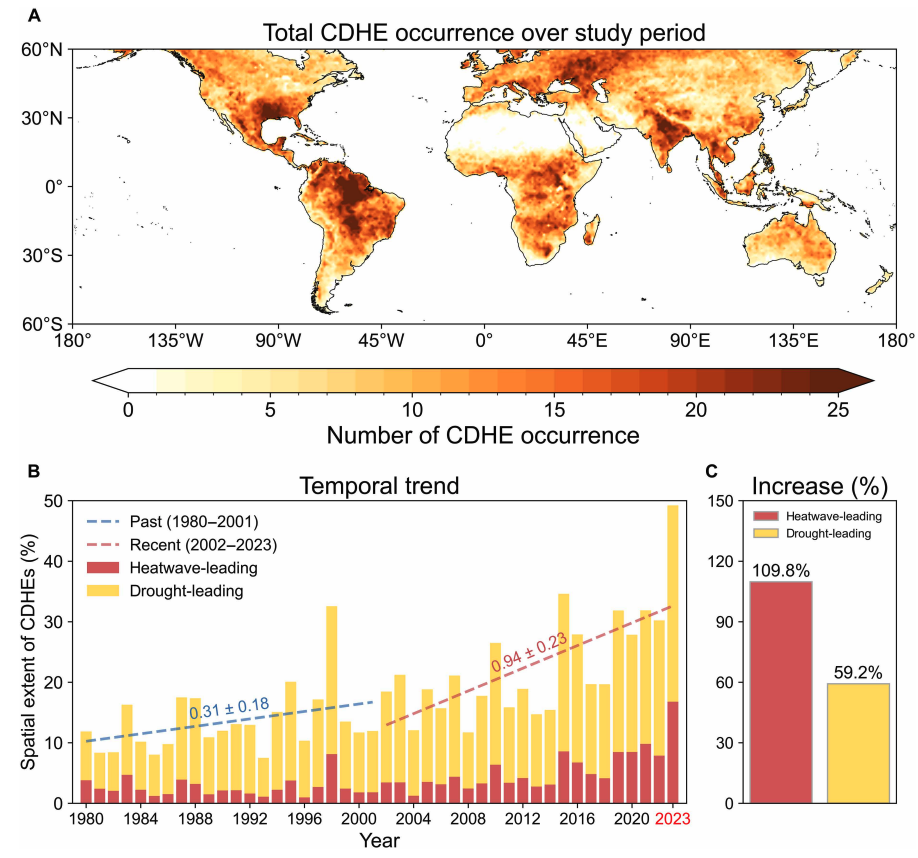
The research finds that the area of land affected by CDHEs has “increased substantially” since the early 2000s.
Heatwave-led events have been the main contributor to this increase, the study says, with their spatial extent rising 110% between 1980-2001 and 2002-23, compared to a 59% increase for drought-led events.
The map below shows the global distribution of CDHEs over 1980-2023. The charts show the percentage of the land surface affected by a heatwave-led CDHE (red) or a drought-led CDHE (yellow) in a given year (left) and relative increase in each CDHE type (right).
The study finds that CDHEs have occurred most frequently in northern South America, the southern US, eastern Europe, central Africa and south Asia.
Threshold passed
The authors explain that the increase in heatwave-led CDHEs is related to rising global temperatures, but that this does not tell the whole story.
In the earlier 22-year period of 1980-2001, the study finds that the spatial extent of heatwave-led CDHEs rises by 1.6% per 1C of global temperature rise. For the more-recent period of 2022-23, this increases “nearly eightfold” to 13.1%.
The change suggests that the rapid increase in the heatwave-led CDHEs occurred after the global average temperature “surpasse[d] a certain temperature threshold”, the paper says.
This threshold is an absolute global average temperature of 14.3C, the authors estimate (based on an 11-year average), which the world passed around the year 2000.
Investigating the recent surge in heatwave-leading CDHEs further, the researchers find a “regime shift” in land-atmosphere dynamics “toward a persistently intensified state after the late 1990s”.
In other words, the way that drier soils drive higher surface temperatures, and vice versa, is becoming stronger, resulting in more heatwave-led compound events.
Daily data
The research has some advantages over other previous studies, Yeh says. For instance, the new work uses daily estimations of CDHEs, compared to monthly data used in past research. This is “important for capturing the detailed occurrence” of these events, says Yeh.
He adds that another advantage of their study is that it distinguishes the sequence of droughts and heatwaves, which allows them to “better understand the differences” in the characteristics of CDHEs.
Dr Meryem Tanarhte is a climate scientist at the University Hassan II in Morocco, and Dr Ruth Cerezo Mota is a climatologist and a researcher at the National Autonomous University of Mexico. Both scientists, who were not involved in the study, agree that the daily estimations give a clearer picture of how CDHEs are changing.
Cerezo-Mota adds that another major contribution of the study is its global focus. She tells Carbon Brief that in some regions, such as Mexico and Africa, there is a lack of studies on CDHEs:
“Not because the events do not occur, but perhaps because [these regions] do not have all the data or the expertise to do so.”
However, she notes that the reanalysis data used by the study does have limitations with how it represents rainfall in some parts of the world.
Compound impacts
The study notes that if CDHEs continue to intensify – particularly events where heatwaves are the precursors – they could drive declining crop productivity, increased wildfire frequency and severe public health crises.
These impacts could be “much more rapid and severe as global warming continues”, Yeh tells Carbon Brief.
Tanarhte notes that these events can be forecasted up to 10 days ahead in many regions. Furthermore, she says, the strongest impacts can be prevented “through preparedness and adaptation”, including through “water management for agriculture, heatwave mitigation measures and wildfire mitigation”.
The study recommends reassessing current risk management strategies for these compound events. It also suggests incorporating the sequences of drought and heatwaves into compound event analysis frameworks “to enhance climate risk management”.
Cerezo-Mota says that it is clear that the world needs to be prepared for the increased occurrence of these events. She tells Carbon Brief:
“These [risk assessments and strategies] need to be carried out at the local level to understand the complexities of each region.”