

Welcome to Carbon Brief’s China Briefing.
China Briefing handpicks and explains the most important climate and energy stories from China over the past fortnight. Subscribe for free here.
Key developments
China released draft of long-awaited Energy Law
FULL TEXT: The latest draft of China’s long-awaited Energy Law has been issued for public comment following approval by China’s top legislative body, the National People’s Congress Standing Committee (NPCSC), economic newswire Jiemian reported, in an analysis of the text. The law, which was initially drafted in 2005, will likely be “considered at three [NPCSC] meetings before being put to a [final] vote”, the outlet said, which means it could be formally enacted “within the year”.

PRIORITISING RENEWABLES: Jiemian added that the law “clearly supports prioritising the development of renewable energy; rational development of clean and efficient use of fossil energy; and orderly promotion of non-fossil fuel energy instead of fossil fuel energy and low-carbon energy instead of high-carbon energy”. Chinese energy news site International Energy Net noted that the draft law calls on the state to “establish a mechanism to promote green energy consumption and encourage energy users to prioritise using renewable energy and other clean and low-carbon energy sources”. Elsewhere, Chen Xinghua, associate professor at North China University of Technology and deputy secretary-general of the China Law Society’s energy law research group, told China Environment News that, until now, the “development of the energy industry…has relied more on dividends from reform of the energy system”. He added that a unified Energy Law is “urgently needed” to resolve the “intricate and complex” interests of various stakeholders, as well as the challenges of a modern energy system and meeting China’s carbon neutrality goals.
LONG ROAD: The Hong Kong-based South China Morning Post said that the law “has been [on] one of the longest [journeys] for any piece of Chinese legislation”. It quoted an unnamed Tsinghua University law professor attributing the delays to staunch resistance from energy sector stakeholders, who “lobbied extensively” to “[try] to hold onto their territory”. The professor speculated that this resistance may have been broken by president Xi Jinping’s anti-corruption campaign.
Leaders and targets plot ‘realistic’ path
2024 TARGET: The Ministry of Environment and Ecology (MEE) is aiming for carbon emissions per unit of GDP – also known as carbon intensity – to fall by 3.9% in 2024, according to state broadcaster CCTV. Previous Carbon Brief analysis found that carbon intensity would need to fall by 7% per year to meet China’s 2025 climate commitments. This was echoed by consultancy Trivium China, which said in a recent newsletter that the target for 2024 “isn’t enough to get China emissions intensity reductions back on track”.
-
Sign up to Carbon Brief’s free “China Briefing” email newsletter. All you need to know about the latest developments relating to China and climate change. Sent to your inbox every Thursday.
‘BE REALISTIC’: Meanwhile, Chinese president Xi Jinping called on policymakers to both “be realistic, by not slowing the pace of green and low-carbon development, and not be too idealistic, above all guaranteeing energy supply”, International Energy Net reported. At a technology-focused forum in Beijing, National Energy Administration director Zhang Jianhua said China would “lead the innovation of the clean energy industry…further strengthen the foundation of energy security [and] continue to improve the scale and quality of non-fossil energy supply”, according to state news agency Xinhua.
COAL CAPACITY: Following an announcement that China will establish a coal production capacity reserve system by 2027, Xinhua published an analysis stating that the move will allow China to “quickly release reserve capacity in extreme situations, such as fluctuations in the international energy market, instances of severe weather and [other] drastic changes to supply and demand”. It added that this measure was not intended “to significantly increase coal production capacity”. (Read more in Carbon Brief’s China Briefing from 18 April).
US-China methane cooperation continued
BLINKEN TRIP: With US secretary of state Anthony Blinken visiting Beijing last week, the “two superpowers continued dialogue to manage a growing list of differences”, reported Bloomberg. Citing a Chinese foreign ministry statement, the outlet said Xi told Blinken that “China and the US should be partners rather than rivals”. The Chinese foreign minister Wang Yi also told Blinken that China “urged” the US “not to interfere in China’s internal affairs, not to hold China’s development back, and not to step on China’s red lines on China’s sovereignty, security, and development interests”, according to a report from the Associated Press. Blinken responded by saying that “the Biden administration places a premium on” the bilateral dialogue even “on issues of dispute”, according to the newswire.
EASIER FUTURE?: Despite several areas of disagreement, the Communist party-affiliated newspaper People’s Daily mentioned the two sides reached an agreement on further “cooperation” on climate change. China Environment published an announcement by the MEE that a US-China climate action working group held a virtual meeting, at which they pledged to “strengthen communication” and cooperation on controlling methane emissions. Meanwhile, China enacted a tariff law during Blinken’s visit to strengthen China’s “trade defence capabilities”, Reuters reported. The outlet said the law was passed amid US and EU industrial “overcapacity” concerns and outlines “a range of legal provisions related to tariffs on Chinese imports and exports”. It quoted Henry Gao, a professor at Singapore Management University, who described the law as “a nuclear weapon” to show the US and EU “that this is our prerogative: If you’re going to hit us with tariffs, we can do the same”.
Chinese climate envoy announced US visit
MAY VISIT: In an interview with Bloomberg, China’s climate envoy Liu Zhenmin announced that he plans to visit the US in May for his first formal face-to-face meeting with US counterpart John Podesta. Liu stated that China aims to “extend cooperation on issues including energy, the circular economy and efforts to curb greenhouse gases beyond carbon dioxide”. He added that the US and China “have to cooperate as far as possible” on climate, and that the two nations “also need to respect each other on all issues”. Another Bloomberg article on the Liu interview said: “Efforts by the US and Europe to stem China’s dominance in green technologies risk stalling the fight against global warming, according to [Liu].”
‘DIFFERENT LENS’: Elsewhere, Liu raised four challenges to global resilience at a forum hosted by the thinktank Center for China and Globalisation. Notably, he listed these challenges in the following order: geopolitical conflicts; setbacks to economic globalisation; climate change; and unease around artificial intelligence. In an earlier article, the Diplomat had suggested that Liu – given his Ministry of Foreign Affairs background – may see climate “more as a lever in China’s overall diplomatic strategy, rather than a critical, standalone issue to address”.
Spotlight
Media reaction: Guangdong flooding and the role of climate change
Guangdong province in southern China has been pounded by heavy rains since 19 April, causing flooding that has left at least four dead and seen more than 110,000 people evacuated.
Guangdong is China’s most populous province and an economic powerhouse driving China’s manufacturing industry and exports.
In this issue, Carbon Brief examines the impact of climate change on the flooding and the response from Chinese and international media.
How has flooding affected Guangdong?
“Intense” rainstorms began in the northern and western regions of Guangdong province on 19 April, with the ensuing rainfall breaking records for the month, according to the Hong Kong-based South China Morning Post (SCMP).
Originally, floodwaters from the Bei River, a major tributary of the Pearl River, were expected to peak on 22 April, the newspaper added.
The heavy rainstorms continued, however, and by 28 April three separate floods had been recorded, according to the Communist party-affiliated People’s Daily and regional newspaper Southern Daily.
On 30 April, state broadcaster CGTN announced that China issued a severe weather warning for further torrential rain, thunderstorms, gales and hail for parts of Guangdong, as well as five other provinces.
Four people were reported dead and 10 missing during the initial flood, BBC News said, adding that at least 110,000 people were evacuated.
The worst-hit areas included the provincial capital Guangzhou – home to almost 19 million people – as well as the cities of Zhaoqing, Shaoguan, Qingyuan, Jiangmen, Huizhou and Heyuan, according to various media outlets.
Guangzhou Daily reported that the provincial government announced a relief fund of 90m yuan ($12.4m) to be used to recover from the damage caused by the flood.
Meanwhile, Chinese vice-premier Zhang Guoqing and Guangdong governor Wang Weizhong both called on local governments to improve monitoring of extreme weather, the China Daily and Southern Daily reported.
In addition to the floods, CNN reported that a tornado, which appeared after “multiple days of heavy rains”, killed “at least five people” in Guangzhou on 27 April.
On 1 May, the collapse of a highway near Meizhou city in Guangdong killed at least 48 people, the Associated Press reported, adding that ongoing torrential rainfall was hampering rescue efforts.
Separate Associated Press coverage noted that heavy rains “pose a special risk to mountain roadways and highway bridges”, although an official cause of the accident had not yet been established.
Is climate change a contributor to the flooding?
While the Pearl River delta is prone to summer flooding, the rains this year were unusually early, according to Reuters.
Agence France-Presse reported that Yin Zhijie, chief hydrology forecaster at the Chinese Ministry of Water Resources, told state-run China National Radio that “intensifying climate change” raised the likelihood of early heavy rains.
Xu Xiaofeng, executive vice-chairman of the Chinese government’s China Meteorological Work Development Advisory Committee and president of the China Meteorological Services Association, told economic newswire Jiemian that recent warm and humid currents in the north-west Pacific Ocean and Indian Ocean have created significant water vapour in southern China, contributing to the rainfall.
According to the outlet, Xu said: “Recent record-breaking precipitation…occurred precisely against the backdrop of global warming.”
The outlet also quoted another expert, Zhang Qiang from the Gansu Meteorological Administration, saying heavy and abnormal rainfall in the region is becoming “a normal phenomenon” due to the influence of global warming.
While there is, as yet, no formal “attribution” study of whether the flooding was made worse by human-caused global warming, one rapid analysis found that the “somewhat uncommon event” was “exacerbated” by both human-caused climate change and natural variability.
It concluded that weather systems similar to those that caused the floods are 8-12% wetter over Guangdong province in the present climate than they were in the past.
Previous Carbon Brief analysis has also identified a number of attribution studies that have quantified the influence of climate change on flooding in southern China.
For example, record-breaking rainfall in the June-July period of 2020 was found by one study to be more than five times more likely in the present-day climate – “80% of which can be attributed to climate change”.
How has the Chinese media responded?
While most local media coverage focused on individual stories and local responses, several Chinese media outlets have pointed to links between the floods and climate change.
In its reporting, China Daily cited a China Meteorological Administration (CMA) interview with Chinese Academy of Engineering member Ding Yihui, who said: “The world has entered a new phase of climate change, which is characterised by an increased frequency of extreme weather events, resulting in the occurrences of sudden climate and weather-related disasters.”
The municipal newspaper Guangzhou Daily made a connection with extreme rainfall in Dubai and quoted Zhang Xingying, deputy director of the CMA’s science, technology and climate change department, saying that, due to “global warming and El Niño”, China will see more extreme weather, including floods, in 2024.
“Chinese and foreign scientists”, the Guangzhou Daily article said, “remind us that new features of extreme weather and climate events are emerging globally.”
It added that “our generation will witness more and more extreme weather…All we can do now is leave a better future for future generations.”
On 28 April, the Guangzhou Daily also reposted an article by Shanghai-based newspaper the Paper, in which China Academy of Meteorological Sciences scholar Sun Shao argued that “recent extreme weather events are closely linked to climate change”.
Sun said that, in the face of this challenge, the international community must strengthen global cooperation to combat climate change.
Meanwhile, an SCMP editorial said that both the flooding and an emerging drought in nearby hydropower-producing Yunnan province, “illustrate just how critical the climate-change issue is – not just for China but globally”.
It added: “While the flooding is a reminder to be prepared for sudden climate-linked extreme events, including fires and violent storms, the drought is a wake-up call about longer term consequences for the climate of failure to rein in carbon emissions.”
Watch, read, listen
2035 NDC: Project Syndicate published an article by the Asia Society Policy Institute’s Li Shuo and Lauri Myllyvirta about how setting ambitious commitments in its “nationally determined contribution” (NDC) for 2035 could both spur China’s energy transition and boost its profile as a climate leader.
GLOBAL COMPETITION: The substack High Capacity explored the “paradox” of how several Chinese clean-energy technology industries were able to overtake competitors in Germany, despite Germany’s significant industrial advantages.
JUST TRANSITION: Dialogue Earth reported on the need for China to give “higher priority to a just transition” in coal-producing provinces such as Inner Mongolia and Shanxi.
NAVIGATING OVERCAPACITY: Bloomberg: The China Show interviewed a representative of polysilicon producer GCL Technology on how the industry survives cycles of overcapacity.
23
The amount of battery storage capacity added in China in 2023, in gigawatts, according to a new report by the International Energy Agency. This was triple the amount added in 2022, according to the report, and accounted for 55% of global growth.
New science
Co-production of steel and chemicals to mitigate hard-to-abate carbon emissions
Nature Chemical Engineering
New research examined how co-producing steel and chemicals in China could mitigate greenhouse gases and lower costs. The study found that co-production, by itself, would cut greenhouse gas emissions for the steel and chemical sectors by 36m tonnes of CO2 equivalent (MtCO2e, 7%) and reduce costs by 1.5bn yuan ($21m, 1%), compared to independent production. However, it found that if a carbon price of 350 yuan ($48) per tonne of CO2 were enacted in addition to co-production, emissions would drop by 113 MtCO2e (22%) and costs by 25.5bn yuan ($3.5bn, 10%).
Increased harvested carbon of cropland in China
Environmental Research Letters
A new study collected statistical data on crop production for ten crop types in China from 1981 to 2020 to assess trends in carbon stored in harvested crops, which “significantly [influence] the carbon budget of the cropland ecosystem”. It revealed that harvested crop carbon increased from 0.185 gigatonnes (Gt) of carbon in 1981 to 0.423Gt in 2020. It also found that the average annual removal of carbon sink capacity through harvesting crops totalled 0.32Gt of carbon, which it said was greater than the net carbon sink of China’s entire terrestrial ecosystem – “substantially impact[ing]” calculations of China’s carbon budget.
Large methane mitigation potential through prioritised closure of gas-rich coal mines
Nature Climate Change
Methane emissions from China’s abandoned coal mines have been underestimated, according to a new study. The authors constructed a “coal mine database” to estimate China’s coal methane emissions between 2011 and 2019, and calculated future emissions based on different mine closure policies. They estimated that by 2035, abandoned mines will be China’s largest sources of coal methane emissions – larger than emissions from active coal mines. The authors also developed a “coal mine closure strategy”, which they say could “reduce cumulative methane emissions by 67m tonnes (26%) to 2050, potentially reaching 100m tonnes (39%) with improved methane recovery and utilisation practices”.
China Briefing is compiled by Wanyuan Song and Anika Patel. It is edited by Wanyuan Song and Dr Simon Evans. Please send tips and feedback to china@carbonbrief.org

The post China Briefing 2 May: Energy Law draft; 3.9% carbon intensity target; Guangdong floods appeared first on Carbon Brief.
China Briefing 2 May: Energy Law draft; 3.9% carbon intensity target; Guangdong floods

Climate Change
Climate change exposes 580 million children to 20 extra ‘heat-stress days’ every year
More than 40% of children under the age of 10 globally are already experiencing at least 20 additional “heat-stress days” due to climate change.
This is according to a new attribution study, published in Science Advances, which combines climate models with demographic data to assess the age groups and regions that are exposed to the most hot, humid days.
The study finds that children up to the age of nine already face more additional heat-stress days globally as a result of climate change than any other age group.
It adds that south Asia and west Africa are recording the greatest childhood exposure to dangerous levels of humid heat – largely because these regions have a rapidly growing population with the highest proportion of young children.
As the climate warms, children will continue to be more exposed to heat stress than any other age group, the paper warns.
The lead author of the study tells Carbon Brief that the findings should inform discussions about climate justice, noting that children in developing countries “have contributed the least to historical greenhouse gas emissions”.
Humid heat
High temperatures can be deadly. For example, the heatwaves that swept across Europe in the summer of 2026 have been linked to tens of thousands of “excess deaths”.
A prominent 2021 study found that children born in the 21st century will be exposed to more extreme weather events in their lifetimes than their parents and grandparents.
Four years later, a study conducted by scientists from the same team found that more than half of children born in 2020 – around 62 million people – will experience “unprecedented lifetime exposure” to heatwaves, even if warming is limited to 1.5C.
Now, the latest research from the same team finds that children already face greater exposure to dangerous levels of humid heat than adults as a result of human-caused climate change.
Extreme heat is particularly dangerous when combined with high humidity. In hot weather, the human body produces sweat to cool itself down. However, as humidity increases, sweating becomes less effective.
The study uses wet-bulb globe temperature – a measure of temperature that takes humidity and wind into account – to calculate heat stress. It defines a “heat-stress day” as any day with a wet-bulb globe temperature above 28C, as this is considered the threshold for “moderate heat stress”
The authors then use climate models to simulate global temperature patterns in the present-day climate. (The authors use the climate of 2023, in which human activity has caused 1.3C of warming, to represent the “present-day”.)
They then count the number of heat-stress days that each country records on average, per year. The authors then repeat this exercise, simulating a pre-industrial climate without human-caused warming.
By comparing the number of heat-stress days in the present-day climate with the number in a pre-industrial climate, the authors can determine how many extra heat-stress days were driven by climate change. They refer to these as “extra” or “attributable” heat-stress days.
The authors find that “low-latitude” countries, located in the tropics, record the most extra heat-stress days.
For example, the paper finds that people living in Côte d’Ivoire currently face 112 heat-stress days every year. It adds that around half of these are due to human-caused climate change.
In contrast, Germany sees only 0.1 heat-stress days per year in today’s climate on average, which is largely attributable to human-caused climate change.
Rosa Pietroiusti, a PhD student at Vrije Universiteit Brussel and lead author on the study, explains why this number may seem lower than expected.
She tells Carbon Brief that the paper “really focuses on humid heat, at levels that are relatively rarely felt in Europe”. She adds:
“Our data also doesn’t capture the urban heat island effect, due to the resolution of the data we use, which also would lead to underestimations of heat stress locally, and lead to a mismatch with what people are experiencing at local scales, particularly in cities.”
Inequality
Extreme heat affects some people more severely than others. Children, people over 65 and those with pre-existing medical conditions or certain disabilities are among the most vulnerable. This is because their bodies are less able to regulate their temperature.
The authors use gridded demographic data to determine the age structure of each country. From this, they calculate how many people from each age cohort are exposed to extra heat days as a result of climate change.
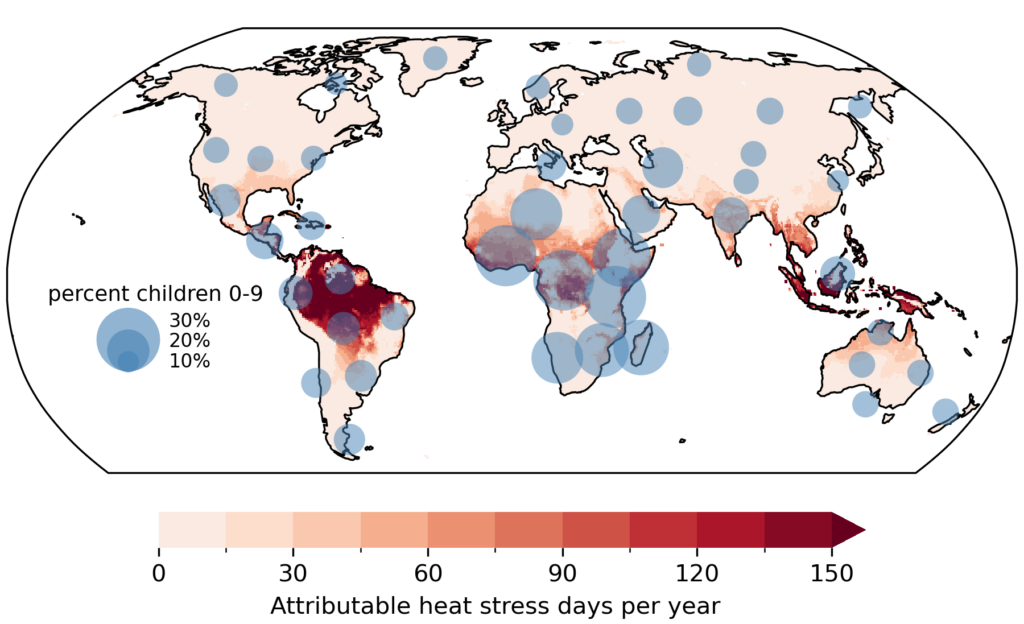
The research finds that globally, 583 million children under the age of 10 already live through at least 20 attributable heat days every year. This accounts for 44% of all children in this age bracket.
In comparison, 190 million people aged 60-69 face at least 20 attributable heat days per year, accounting for 30% of this age cohort.
The authors find that children face the greatest exposure to humid heat for two main reasons.
First, there are more young people alive today than older people, with 1.3 billion children aged under 10 in the world, compared to 0.6 billion people aged 60-69.
Second, they find that countries in Africa and Asia typically have rapidly growing populations with more young children. In contrast, many countries in the northern hemisphere – which are typically cooler – have older populations.
The map below shows how many extra stress heat days each country currently faces as a result of human-caused climate change. Darker reds indicate a higher number of attributable heat days. The blue circles show the percentage of the population under the age of 10, with larger circles indicating a higher percentage.
Warming world
The authors also repeat their analysis for a 1.5C and 2C warmer world. They use population estimates from the SSP2 scenario, which projects that the world’s population will peak at more than nine billion in the second half of the 21st century, with most growth occurring in low-latitude regions – especially in sub-Saharan Africa.
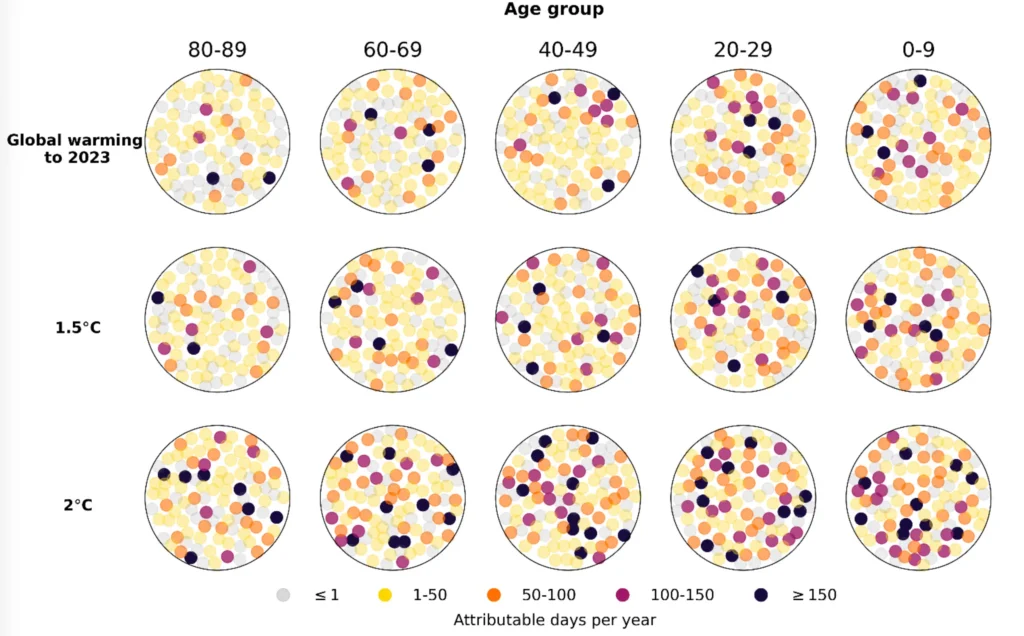
The research finds that, in today’s climate, 11% of all under 10s currently experience 100 or more extra heat-stress days per year due to climate change. In worlds warmed by 1.5C and 2C, the percentage rises to 13% and 23%, respectively.
In contrast, only 6% of all people aged 60-69 currently face 100 or more extra heat-stress days each year due to climate change. This number rises to 9% and 17% for 1.5C and 2C worlds, respectively.
These results are shown in the plot below. The three rows represent the climates of 2023 (top), a 1.5C world (middle) and a 2C world (bottom). The columns show different age cohorts, from the oldest on the left to the youngest on the right.
Each circle contains 100 coloured dots, with each dot representing 1% of the age cohort.
The colour of the dot represents exposure to annual heat-stress day, with darker dots indicating more heat-stress days. Grey dots mean that people experience fewer than one extra heat-stress day per year due to human-caused climate change, while black dots mean more than 150 extra heat-stress days due to climate change.
The figure shows that higher warming levels expose more people to heat stress and that younger cohorts tend to be worst affected.
For example, the top-right circle represents heat stress for under 10s in the present-day climate. Three of these dots are coloured black, indicating that 3% faced at least 150 attributable heat-stress days in 2023.
Pietroiusti tells Carbon Brief the study uses wet-bulb temperature because it is a “well-established heat stress metric”. However, she notes that it was not “explicitly defined to focus on children”. She continues:
“A really important step forward in the research community would be to link up climate science and health science experts to do research on what metrics are really most representative of, for example, health impacts and educational impacts that children will be suffering.”
Vulnerability
Dr Qinqin Kong, a postdoctoral researcher at the departments of medicine and health policy at Stanford University, who was not involved in the study, praises its “robust” methodology.
He tells Carbon Brief that the research provides “a timely quantitative evidence for discussions of climate justice, children’s rights and intergenerational equity”.
However, Kong suggests that the paper “may overstate the contrast between children and the elderly and underestimate the relative burden of older adults”.
He says:
“The elderly may also be more vulnerable due to their social circumstances. Children often benefit from parental supervision and caregiving, whereas many older adults live alone, have limited mobility and face barriers to accessing cooling or emergency assistance during heat events.”
Kong also notes that “people and societies in the mid-latitudes [for example, across much of Europe and North America] are less adapted to heat”, which may make them vulnerable to its impacts.
For example, he says that Europe “shows substantially stronger relative risk of heat mortality likely due to less heat-acclimatised populations, lower air conditioning prevalence and urban designs that don’t favour heat dissipation”.
Similarly, Dr Daniel Vecellio – a researcher at the University of Nebraska, who was not involved in the study – tells Carbon Brief that children are an “understudied cohort”.
However, he says there is “reason for hope” because “children are typically pretty good behavioural adapters to extreme heat” and because people who are “chronically exposed to extreme heat” will “have a better chance at better acclimatisation”.
Pietroiusti tells Carbon Brief that global reporting on heatwaves is often skewed towards wealthier nations.
For example, she notes that large-scale databases of disasters, such as EM-DAT, often underrepresent heatwaves in Africa, due in part to a lack of news coverage and formal reporting. She adds:
“Studies like this, which start from the climate data, can start to fill some of these gaps.”
She adds that the paper should inform discussions about climate justice, noting that children in developing countries, who are most severely affected by the increase in heat-stress days, “have contributed the least to historical greenhouse gas emissions”.
Pietroiusti, R. et al. (2026) Age-specific exposure to human-induced increases in humid heat, Science Advances, doi:10.1126/sciadv.aeb3232



The post Climate change exposes 580 million children to 20 extra ‘heat-stress days’ every year appeared first on Carbon Brief.
Climate change exposes 580 million children to 20 extra ‘heat-stress days’ every year
The US is expected to resume its attempt to sink measures for a greener global shipping sector at closed-door talks between governments at the International Maritime Organization (IMO) in early September.
The US and oil-producing allies like Saudi Arabia want to weaken a proposed plan for cleaner fuels that aims to reduce planet-heating emissions from the industry, which relies heavily on dirty bunker fuels. Shipping currently represents 3% of global emissions.
Those that want a softer system are likely to back a Liberian proposal which expert analysis suggests would see emissions fall by only half at most by 2050, far short of the sector’s agreed climate goals.
After several years of debate, governments provisionally agreed in April 2025 on the “Net Zero Framework” (NZF), a series of emissions reduction targets for shipowners, backed up with financial rewards for meeting the targets and fees for missing them.
But in October 2025, after a high-profile intervention from US President Donald Trump and threats of sanctions and visa restrictions, the US convinced a majority of voting nations to postpone the adoption of the NZF for a year.
Ralph Regenvanu, climate minister for the Pacific nation of Vanuatu, called the delay “unacceptable” given the urgency of accelerating climate change.
After a round of low-profile talks in May, the first of three further sets of talks on how to clean up shipping will begin at the IMO’s riverside headquarters in London on Tuesday, culminating in a final public session in November.
Em Fenton, who follows the talks as senior director of climate diplomacy at Opportunity Green, an NGO focused on aviation and shipping, said governments should not be sidetracked by alternative proposals to the NZF, calling them “a distraction from a hard-fought multilateral compromise”.
“If countries want to deliver a just and fair maritime transition, there is really only one choice: back the NZF and stand together in solidarity against those who would tear it apart,” Fenton added.
Five proposals on the table
Governments will discuss five different proposals submitted in advance of next week’s meeting. The most ambitious of these is from the Pacific island nation of Tuvalu, which has proposed a levy on the entirety of a ship’s emissions rather than just those above a certain level, as the NZF envisions.
That had been the original demand of Pacific nations before the NZF was provisionally adopted in April 2025. At the time, Tuvalu’s transport minister Simon Kofe described the NZF as disappointing and not ambitious enough.
For this reason, six Pacific countries abstained in the vote on the NZF. While they supported the original plan for its adoption in October 2025, they have used the delay to push again for more ambition.
John Kautoke, advisor to a group of Pacific nations called 6PAC+, told Climate Home News that the NZF “cannot diminish its already inadequate ambition. If anything, the NZF must increase in ambition if we are going to renegotiate its parameters.”
-
New Zealand moves to protect business with law curtailing climate litigation
A new bill prevents corporations being sued for the climate damage their emissions cause, as the government says climate action should be handled at the national level not in court -
Indonesia’s nickel production cuts are not enough to create a sustainable industry
The government is restricting nickel production to push up prices but producing more sustainable nickel for a premium requires addressing the industry’s coal issue -
As marine heat breaks records, countries seek ocean roadmap at COP31
Africa and the EU are leading a push for COP31 to deliver a roadmap that lays out measures to protect fast-warming oceans


Analysis by the Institute of Marine Engineering, Science and Technology (IMarEST) suggests that, of the five proposals, only Tuvalu’s would meet the 2030 and 2040 emissions reduction targets for global shipping that were agreed by governments in 2023. Those were for cuts of 20% between 2008 and 2030, 70% by 2040 and then reaching net zero “by or around, i.e. close to 2050”.
Despite this, the UK, Australia, Canada and South Africa have formally proposed that governments adopt the NZF, which won support in a 63-13 vote among governments at the April 2025 talks. Trump’s US walked out halfway through.
According to IMarEst’s analysis, while the NZF proposal will not be enough to meet the industry’s targets, it will reduce emissions more cheaply than the Pacific proposal.
A proposal by Brazil – which fought hard for the NZF last October – suggests tweaking the framework to make meeting targets easier in the short term and harder in the long term.
While this compromise will make it more appealing to the owners of polluting ships and countries that support them, IMarEst estimates it would lead to higher cumulative emissions than either the NZF or Pacific proposals.
The NZF stipulates that fees for high-polluting shipowners should be be put into a Net Zero Fund and used to promote clean shipping fuels and a fairer transition. The Brazilian proposal would delay raising and spending these funds by two years, from 2029 to 2031.
Liberia’s proposal weakens emissions cuts
The US and Saudi Arabia are likely to swing behind a new proposal from Liberia, whose government makes millions of dollars a year selling the right for shipowners to register their vessels in the small West African nation via a US-based company.
This proposal would weaken the emissions reduction targets. IMarEst says it would cut the industry’s emissions at most by a half by 2050, falling far short of the target agreed in 2023 for international shipping to reach net zero “close to 2050”.
It would also replace the NZF’s fees for missing targets with a carbon trading system. As a result, there would be no Net Zero Fund and therefore less money available to incentivise green fuels and make the transition more equitable for poorer nations.
Pacific advisor Kautoke said that, as well as preventing shipping from reaching zero emissions by 2050, Liberia’s proposal would mean the Pacific “will not receive any support to deal with the disproportionately negative impacts created by the cost of the transition”.
“We get a double blow if we adopt the Liberian proposal,” he warned. “We get all the cost of a transition without any support, and we have an industry that continues to burn fossil fuels to an unforeseen point.”
Japanese proposal favours shipowners
Japan has submitted a late proposal to amend the NZF so that shipowners have more control over how the fees they would pay for emitting above a set threshold are spent.
University College London professor Tristan Smith has argued that this change means there will be no central mechanism to incentivise investments in clean fuels. He wrote on LinkedIn that under the system put forward by Japan, shipowners would be able to select which green projects their fees would go to. They could choose their own or those of a sister company or other shipowners, rather than funding broader just transition projects that would benefit marine workers or developing countries hit by rising shipping costs.
Despite its flaws, Smith added that Japan’s proposal “could still get taken seriously by some, given how appealing it may seem to shipowners who have consistently demanded control of revenues, and given how the US and other member states have pushed back against the IMO Net Zero Fund and [greenhouse gas] pricing.”
Tacit or explicit approval?
Next week, governments are expected to make statements saying which proposals – or which aspects of proposals – they prefer. Another set of talks will be held from November 23-27 before a potentially final round from November 30-December 4.
A new framework to tackle shipping emissions could be adopted at those talks if two-thirds of countries that are present and signed up to a regulation called Marpol Annex VI – endorsed by just over 100 states – vote in favour of it, as they did in April 2025.
The US and its allies are also trying to change the rules to make the next stage more difficult. Decisions that have been adopted at IMO meetings usually take effect automatically unless a certain number of countries object within a certain time period decided by governments, a system known as tacit approval.
But the US wants that to require explicit approval instead, so that any new emissions standard would not come into force unless enough governments – representing a certain percentage of the world’s shipping fleet – actively indicate support for it.
Critics say this change would give a small number of countries with large shipping registries the power to block implementation. Liberia has the world’s biggest shipping registry, run by an American company, followed by Panama and the Republic of the Marshall Islands.
Liberia and Panama have supported the US at the talks on the Net Zero Framework. The Marshall Islands has long been one of the most vocal supporters of climate action in shipping but, with its officials and shipping registry income vulnerable to US retaliation, did not sign on to the recent Pacific proposal vowing to strengthen the NZF if it is re-opened.
Brazilian negotiator Adriana de Medeiros Gabinio warned in April that the NZF’s opponents are trying to change the rules by which it comes into force as a “safety net to block” it.
The post Battle over cleaning up shipping set to resume at London talks appeared first on Climate Home News.
Battle over cleaning up shipping set to resume at London talks
SYDNEY, Wednesday 26 August 2026 — New 2026 Sustainability Reports released by supermarket giants Coles and Woolworths this week demonstrate the retailers are failing on their commitments to end deforestation in their supply chains.
Adele Chasson, Nature Policy Lead at Greenpeace Australia Pacific said:
“These so-called sustainability reports are revealing. Despite their public commitments in 2024 and 2025, neither Coles nor Woolworths have taken deforestation-linked beef off their shelves. Meanwhile, bulldozers continue to tear up forests and bushland, pushing wildlife closer to extinction and causing mass toxic runoff to flow into the Great Barrier Reef. Millions of native animals like koalas are losing their homes to beef pastures each year, while the big supermarkets put off action.
“Australians would be shocked to know that beef on the shelves of our biggest supermarkets could be pushing threatened species to the brink of extinction. Collectively Coles and Woolworths have made more than $2 billion in profits in the last year, profiting from the destruction of wildlife and precious Australian nature. Coles and Woolworths owe it to shoppers to deliver on their promises and end deforestation in their supply chains now.
“As big beef buyers, Coles and Woolworths have an essential role to play in keeping Australia’s unique forests standing. They can help stop the Great Barrier Reef from being poisoned by runoff and protect iconic forest wildlife by taking deforestation off their shelves. It’s time these big companies put their money where their mouths are and follow through on their promise of sourcing and supplying deforestation-free beef.”


-
Climate Change1 year ago
Guest post: Why China is still building new coal – and when it might stop
-
Greenhouse Gases1 year ago
Guest post: Why China is still building new coal – and when it might stop
-

 Greenhouse Gases2 years ago
嘉宾来稿:满足中国增长的用电需求 光伏加储能“比新建煤电更实惠”
-

 Climate Change2 years ago
嘉宾来稿:满足中国增长的用电需求 光伏加储能“比新建煤电更实惠”
-
Climate Change2 years ago
Bill Discounting Climate Change in Florida’s Energy Policy Awaits DeSantis’ Approval
-

 Renewable Energy10 months ago
Sending Progressive Philanthropist George Soros to Prison?
-
Greenhouse Gases1 year ago
嘉宾来稿:探究火山喷发如何影响气候预测
-

 Carbon Footprint2 years ago
US SEC’s Climate Disclosure Rules Spur Renewed Interest in Carbon Credits