


Oklo Inc. gained strong market attention after announcing a strategic partnership with NVIDIA and Los Alamos National Laboratory. The collaboration aims to accelerate the development of nuclear infrastructure, expand AI-enabled research, and push forward next-generation nuclear fuel innovation.
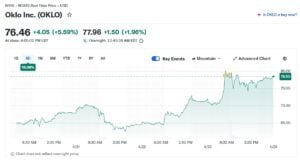
Investors reacted quickly. The company’s stock rose about 15%, closing at $72.41 and continuing to climb to $78.43 in pre-market trading. Over the past week, shares surged roughly 33%, reflecting rising optimism around the intersection of nuclear energy and artificial intelligence.
A Strategic Alliance Powering the Future
The agreement significantly brings together three complementary strengths.
- Oklo contributes its advanced sodium fast reactor technology
- NVIDIA adds its powerful AI computing systems
- Los Alamos provides deep expertise in nuclear materials science and fuel research.
This combination aims to create a new class of reliable, mission-critical energy systems designed for modern infrastructure.
Inside the Plan: AI, Fuels, and Nuclear Innovation
- Using AI to Improve Nuclear Fuel: A major focus of the partnership is applying AI to nuclear science. The companies will build AI models based on physics and chemistry to test and improve nuclear fuels, especially plutonium-based fuels. These models will help make the process faster and more accurate.
- Better Materials and Safer Fuel: The collaboration will also work to improve materials and the way nuclear fuel is made. By combining AI with lab research, the partners aim to make fuel safer and more efficient. They will also study how to produce power and keep the grid stable for large energy use.
- Connecting Nuclear Power with AI Systems: Another key goal is to connect nuclear reactors directly with high-performance computing systems. This includes early-stage testing that could change how energy and computing work together in the future.
Why AI Needs Nuclear—and Vice Versa
The idea of “nuclear-powered AI factories” sits at the center of this partnership. These facilities would run advanced AI workloads using dedicated nuclear power instead of relying on traditional electricity grids. This concept addresses a growing problem. Data centers require massive, constant energy, and demand continues to rise rapidly.
Nuclear energy offers a strong solution because it provides stable, round-the-clock power with low emissions. At the same time, AI can improve nuclear operations. It can analyze real-time data, detect anomalies, predict maintenance needs, and optimize reactor performance. These capabilities can enhance efficiency and reduce operational risks.
However, challenges remain. AI models must meet strict safety standards in nuclear environments. Data quality, cybersecurity, and model reliability are critical concerns. For now, AI will support human decision-making rather than replace it in safety-critical systems.
Oklo’s Technology and Market Position
At the center of Oklo’s strategy is its Pluto reactor, designed to use recycled nuclear material such as surplus plutonium. This approach not only produces energy but also helps reduce nuclear waste. The reactor was selected under the U.S. Department of Energy’s Reactor Pilot Program, highlighting its importance.
Oklo is also working to deploy its Aurora power plant at Idaho National Laboratory, targeting operations before the end of 2027. In the near term, the company faces key milestones, including meeting Department of Energy deadlines tied to reactor development and facility readiness.
Financially, Oklo remains in a strong position. The company holds about $2.5 billion in cash and carries no debt, giving it flexibility to invest in growth. It plans to spend around $400 million annually over the next two years to support expansion and technology development.
Rising Demand and the Bigger Energy Shift
Demand for clean, reliable power is rising quickly, especially from large technology companies. Oklo has already signed an agreement to supply 150 megawatts of electricity to a data center project backed by Meta Platforms by around 2030.
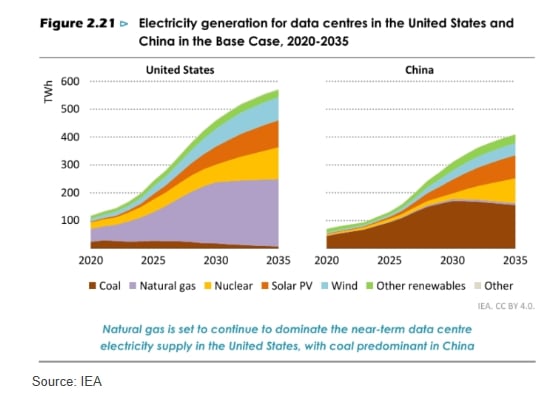
This deal shows how major tech firms are actively seeking carbon-free energy solutions to support their operations.
The partnership reflects a broader shift in the global energy landscape. Artificial intelligence is driving a surge in electricity consumption, forcing industries to rethink power generation. Nuclear energy is gaining attention as a dependable, low-carbon solution, while AI is helping modernize nuclear systems.
Despite strong momentum, challenges still exist. Regulatory approvals, technical complexity, and safety requirements could slow deployment. While market enthusiasm remains high, real-world scaling will likely take time.
In the end, the collaboration between Oklo, NVIDIA, and Los Alamos highlights a powerful trend. Clean energy and advanced computing are becoming deeply connected. If successfully executed, this partnership could play a key role in shaping the future of both industries.
The post Oklo Stock Jumps 15% as NVIDIA Partnership Sparks Nuclear-AI Momentum appeared first on Carbon Credits.

Nature-based carbon investments deserve consideration when they address a specific business dependency and produce outcomes you can measure. Imagine Moonbucks, a global coffee roaster planning next season’s espresso blend. It is considering natural Grade 4 coffee from Jimma, in southwestern Oromia, Ethiopia. Its sourcing decisions affect the roasting schedule and the cash tied up in coffee purchases. Moonbucks needs to understand which measures could protect that supply, what they would cost and how it would judge the results.
1. Define the sourcing problem before choosing a project
Moonbucks needs a dependable component for its espresso blend. Its procurement team wants continuity of volume and an agreed cup profile. Replacing a shipment at short notice could require new sample approval and changes to the blend, and given the schedules for cultivation, processing, and freight delivery, is practically impossible. Moonbucks needs to get this right, and its initial concern is inconsistent deliveries. It commissions an assessment of the supplying farms and post-harvest chain. The questions cover land condition, harvest availability and whether drying or storage problems are affecting saleable lots.
This distinction changes the investment brief. A tree-planting proposal cannot be assumed to fix drying problems. Better storage cannot restore eroded land. The team must establish which problem exists before selecting the response.
CCC’s guide to finding nature-based solutions in your supply chain explains where to look. Here, the next task is to turn a broad concern into a testable proposal.
2. Develop nature-based carbon investments around the actual supply chain
The assessment would trace Moonbucks’ purchases back through the exporter and supplying producer groups. Which farms supply the contracted lots? Who controls land-management decisions? How long does the buyer expect to maintain the purchasing relationship?
Furthermore, Jimma natural Grade 4 cannot be treated as interchangeable with every Ethiopian coffee. Moonbucks would need to test any substitute against its own blend and quality requirements.
Suppose Moonbucks’ assessment identifies an opportunity to maintain shade trees and restore vegetation along exposed streambanks. The IPCC describes agroforestry as a way to store carbon in vegetation and soil, with potential benefits for erosion control and water quality.1 Moonbucks would need local advice on species, growing conditions and maintenance before deciding how these measures fit its sourcing plan.
The proposal now has a defined sourcing connection and a candidate intervention. The next steps are to test its effect on production, assess carbon eligibility and build the financial case.
3. Compare the proposal with other ways to protect supply
WBCSD’s Nature-based Solutions Blueprint recommends comparing nature-based options with other responses across their benefits and costs.2 For Moonbucks, that means evaluating the landscape proposal alongside drying improvements, storage controls and alternative sourcing arrangements.
The product’s natural-process designation matters. Moonbucks should examine the drying and dry-milling chain alongside land conditions. Its team would check storage practices, contamination risks and incoming-lot quality to see whether problems arise before or after the coffee leaves the farms.
The revised proposal might combine land stewardship with separate post-harvest controls. Each component needs its own purpose and budget. A sustainability label should not obscure which activity is expected to solve which problem.
The project develops as the evidence improves. Its scope should follow the diagnosis rather than preserve the first idea unchanged.
4. Establish what the carbon outcome could count toward
Moonbucks’ sustainability team now tests the proposed carbon case separately from the sourcing case. Is the objective a measurable change in Moonbucks’ value-chain emissions, verified credits for separate voluntary use, or distinct outcomes under carefully defined arrangements?
Scope 3 covers value-chain emissions. A purchasing relationship alone does not prove that a farm intervention can be included in Moonbucks’ inventory. The team needs an applicable accounting method, defensible boundaries and evidence supporting attribution.
SBTi’s FLAG Guidance (forest, land and agriculture), version 1.2, says purchased credits used as offsets cannot meet near-term FLAG or energy and industry targets. Eligible land-based removals are subject to accounting requirements.3 Moonbucks needs to test its proposal against those rules before including an outcome in its targets.
For Moonbucks’ Jimma proposal, maintaining existing trees and establishing new vegetation could involve different carbon questions. Specialists must examine the baseline and additionality, meaning what changes because the project proceeds. They must also assess measurement and the risk that stored carbon is lost. CCC’s MRV and additionality article introduces those tests.
Until that work is complete, Moonbucks should not budget an assumed Scope 3 reduction or credit-sale receipt. Direct emissions reductions remain the priority.
5. Build a financial case that survives weaker assumptions
Moonbucks’ finance team would now build a multi-year budget. UNEP’s State of Finance for Nature 2023 compares current finance with the investment needed to meet climate, biodiversity and land-restoration goals.4 The company would cost its proposed activities, farmer participation and ongoing monitoring. Verification, where required, is a separate expense. Maintenance and responsibility for replacing failed plantings must remain visible after the initial establishment budget ends.
Operational benefits need equally careful treatment. If fewer rejected lots reduce emergency purchasing, count that saving once. Do not add “supply resilience” as another financial benefit when it represents the same avoided cost.
Moonbucks should compare a base case with slower benefits, higher implementation costs and no carbon revenue. It should also distinguish production outcomes from quality and shipment outcomes. A single good harvest would not prove that the landscape intervention caused better delivery performance.
A project can remain worth funding even when its carbon case needs more work. That decision must rest on the operational evidence and the company’s objectives, without unsupported environmental claims.
6. Fund a pilot with a clear expansion decision
Moonbucks’ first approval would fund a bounded pilot, rather than commit the entire sourcing program. Before spending, Moonbucks would agree on participating farms, responsibilities and the evidence needed at review.
Its scorecard could track farmer participation, implementation costs and plant survival, alongside accepted coffee volumes and lot-quality results. Carbon measurements would follow the selected method. Farm-level traceability must connect the intervention to the actual sourcing relationship.
Suppose Moonbucks’ review later finds that storage changes explain most quality improvements, while the land measures need longer observation. Those findings would shape the next decision: expand the proven component, adjust the landscape work or pause further spending. They would not justify crediting all improvements to tree planting.
This gives nature-based carbon investments a practical place in a multi-year strategy. Funding increases as the evidence supports it, and the project can change direction before a larger commitment.
Discuss a sourcing opportunity with CCC
Carbon Credit Capital’s nature-based supply-chain investment service uses its Dual-Value Model to examine supply-chain economics alongside potential sustainability outcomes.
Schedule a consultation to discuss your sourcing exposure and the questions to resolve before allocating capital.
Sources
- Intergovernmental Panel on Climate Change (IPCC), Climate Change 2022: Mitigation of Climate Change, Chapter 7, Agriculture, Forestry and Other Land Uses, section 7.4.3.3 (Agroforestry).
- World Business Council for Sustainable Development (WBCSD), Nature-based Solutions Blueprint, 5 June 2024.
- Science Based Targets initiative (SBTi), Forest, Land and Agriculture Science-Based Target-Setting Guidance, version 1.2, March 2026, section 3.1.4, pp. 37–38.
- United Nations Environment Programme (UNEP), State of Finance for Nature 2023, 2023.
A plastic credit funds the collection of plastic waste in places where no formal system exists to collect it. Each credit represents a measured, independently audited quantity of plastic taken out of the environment or returned to use, tracked on a public registry.

EU carbon credit claims changed on 27 September 2026, the day the Directive (EU) 2024/825 began to apply across the European Union. The change is narrow. It changes how a company can talk about the credits it buys. A product can no longer be called neutral on the strength of compensation alone; however, every specific, evidenced statement about what a company measured, reduced, and funded stays fully available.




-
Climate Change1 year ago
Guest post: Why China is still building new coal – and when it might stop
-

 Greenhouse Gases2 years ago
嘉宾来稿:满足中国增长的用电需求 光伏加储能“比新建煤电更实惠”
-
Greenhouse Gases1 year ago
Guest post: Why China is still building new coal – and when it might stop
-

 Climate Change2 years ago
嘉宾来稿:满足中国增长的用电需求 光伏加储能“比新建煤电更实惠”
-

 Renewable Energy1 year ago
Sending Progressive Philanthropist George Soros to Prison?
-
Greenhouse Gases1 year ago
嘉宾来稿:探究火山喷发如何影响气候预测
-

 Climate Change2 years ago
Analysis: China’s CO2 falls 1% in Q2 2024 in first quarterly drop since Covid-19
-
