

- Formal negotiations
- Turkish and Australian leadership
- Cover decision
- COP reform
- Adaptation
- Finance
- Just transition work programme
- Loss and damage
- Gender
- Article 6
- Agriculture and food security
- Mitigation work programme
- Response measures
- Action for climate empowerment
- Trade
- Second global stocktake
- Long-term goal review
- Around the COP
- Fossil fuels
- Action agenda
- Global leaders
- Electrification
- China at COP31
- Ocean
- Deforestation
- Methane
- New climate science
- Food and water
- NDCs
- Protests and access
- Road to COP32 and beyond

Governments at the COP17 nature summit in Armenia agreed on Saturday to scale up their policies to protect the planet’s shrinking biodiversity, and for the first time invited large emerging economies like China and Gulf states to take on donor responsibilities to help fund those efforts.
For the past two weeks, countries held talks in Yerevan under the UN Convention on Biological Diversity to outline a plan to ramp up currently “insufficient” policies to conserve land and marine ecosystems. A recent UN progress report found the world is off track to meet 22 out of 23 global targets aimed at reversing species loss and protecting 30% of land and seas by 2030.
While a response plan, called the “Global Review of Collective Progress”, was expected to be the main outcome of COP17, negotiations struggled to advance amid a deadlock over the controversial subject of how to finance the boost in conservation measures needed.
After an all-night session on Friday, delegates agreed to invite developing countries to voluntarily signal their interest in assuming donor funding obligations alongside developed nations. Negotiators repeatedly warned that any stronger provisions on expanding the donor base would collapse the deal.
COP president: Results beat expectations
An exhausted COP17 president Hambardzum Matevosyan, Armenia’s environment minister, told journalists in the early hours of Saturday that “we’ve achieved more than we could’ve expected” given the “importance” of the decisions being taken.
“It was 100% possible that those items did not made it through. 100% possible,” he said, adding that the conference had made progress on “all the most important items”.
Speaking at the closing plenary, the group of Pacific Islands said that, while the summit had achieved “great outcomes”, delegates are also departing Yerevan “with realities not reflected in the official text”, such as the low replenishment of the Global Environment Facility (GEF), a key funder of nature projects.
-
Lula’s election win in Brazil raises hopes for zero deforestation drive
Lula’s re-election makes it more likely Brazil can meet a key goal to end forest loss in the Amazon and builds confidence in a new fund to protect the world’s rainforests, experts say
Some observers also said the deal did not go far enough. Steven Guilbeault, a former Canadian environment minister who helped broker the Global Biodiversity Framework (GBF), said the Yerevan package of action is “an important step forward”, but still “falls short of what is needed to meet our 2030 commitments”.
An Lambrechts, biodiversity politics expert at Greenpeace International, said COP17 had kept things moving forward and set well-intentioned promises, but added that these “won’t remove major roadblocks to implementation” such as insufficient finance and debt constraints in developing countries.
WWF chief conservation officer Daudi Sumba noted that financial issues were not fully resolved. Despite the deal in Yerevan, “I fear finance will remain the key issue that continues to haunt the UN biodiversity summits,” he said in a statement.
‘Yerevan Pathway’ tackles nature plans and subsidies
In the lead-up to the summit, the UN assessment report showed countries are falling short on virtually all targets in the GBF, the 2022 global deal often referred to as the ‘Paris Agreement for nature’.
They include a landmark target to protect at least 30% of the planet’s land and sea by 2030. If countries all stick to their current national goals, about 26% of land would be protected and only about 12% of marine ecosystems would be under conservation measures.
The main COP17 decision – named the Yerevan Pathway by the presidency – calls for countries to revise their biodiversity plans, subject to available funding, with a particular focus on addressing the gap in coverage of “marine, coastal and inland water ecosystems”.
It also urges the over 60 countries who have not submitted a biodiversity plan yet to finalise them “as soon as possible” and taking into account the gaps identified by the UN progress report.
Countries also agreed to tackle the drivers of biodiversity loss by “accelerating” the reduction of subsidies for activities that damage nature. Subsidy reform, covered by Target 18 of the GBF, is where countries have made the least progress so far, according to the assessment report.
Jill Hepp, director of nature and marine policy and incentives at green group Conservation International, said singling out subsidies in the Yerevan Pathway “gives a strong signal” that closing the gap for biodiversity action requires “more urgent efforts to reform harmful incentives and scale up positive incentives”.
“Timid” steps to expand base of donors
Having failed to meet a target to channel $20 billion for biodiversity conservation by 2025 and faced with shrinking aid budgets, the EU pushed a proposal to expand the list of which countries count as donors, so that wealthy emerging economies like China and Saudi Arabia could also voluntarily contribute. The group of Arab nations strongly opposed this.
During the talks, Irish minister of state for nature, Christopher O’Sullivan, whose country holds the EU presidency, said the bloc wanted the world’s “new realities” to be reflected in the donor list.
Negotiations remained gridlocked for most of the two-week talks, until a last-day compromise was struck to invite developing countries that may want donor status “to indicate to the [Convention on Biological Diversity] secretariat their interest in being included in the corresponding list”.
Countries also asked the secretariat to send an invitation to emerging economies wanting donor status at each subsequent COP, and requested a technical report on “the implications of inclusion in the list” for emerging economies.
Swiss lead negotiator Gabriela Blatter said during one of the sessions that her country had expected greater steps towards expanding the base of contributing countries, but added that “if we’re mutually unhappy, it’s probably the closest we can get on these very delicate political compromises”. Saudi Arabia, on the other hand, also noted their dissatisfaction but said it had expected “a lot less”.
The fragile deal was approved in a package of decisions together with the Global Review, after some delegations including Brazil and China appealed to the plenary not to make further changes to the text at the risk of collapsing the whole agreement.
In a statement delivered to the closing plenary, the EU said the finance outcome had delivered “timid” progress towards fully broadening the base of donors.
Cali Fund still not operational
Adopted two years ago at COP16, the Cali Fund was seen by some observers as a way to channel private-sector finance into biodiversity conservation, as governments struggle to find public funds. But it is still struggling to get up on its feet.
The fund allows big corporations to access certificates for the use of genetic material found in biodiversity in return for a financial contribution, which experts estimate has the potential to raise up to $6.9bn for biodiversity. While voluntary, companies are encouraged to pay 1% of their profits or 0.1% of revenue into the fund.
But since its creation, the fund has received little more than $10,000, which Guilbeault argued is because the rules for disbursements to local communities and the operation of the fund had yet to be fleshed out. This was due to happen at COP17.
Yet, while the final decision on the fund laid out some of the rules – including how companies can earn “Cali Fund certificates” – some key technical details were left to the next COP in 2028 in Ecuador. This includes the issue of whether companies can pay a lower rate if they use genetic data for only a small portion of their products.
“By punting essential decisions to two years from now, parties have all but ensured the fund remains empty until then,” said Pakhi Das, a public policy advisor at NGO Plant-for-the-Planet.
The post COP17 delivers fragile deal to boost conservation and funding for nature appeared first on Climate Home News.
COP17 delivers fragile deal to boost conservation and funding for nature
Continue Reading
The COP31 climate talks in Antalya, Turkey, have failed to reach agreement on a “pact” that lacked clear references to curbing fossil fuels or scaling up climate finance.
The “Antalya pact”, proposed by the joint Turkish-Australian presidency, was rejected in the final hours by the EU, the UK and several climate-vulnerable nations.
Meanwhile, many developing countries criticised the lack of progress on climate finance and indecision on a proposed $120bn target for funding climate adaptation.
With stark divisions preventing agreement on the presidency-led pact, UNFCCC chief Simon Stiell expressed “deep disappointment”, speaking of “scope to improve, modernise and reform” the UN climate process.
Despite a chaotic endgame that saw the overrunning COP become the longest in history, it did not end in complete failure, with many items adopted in the closing plenary.
These included fairly limited or procedural outcomes on a new “mechanism” for global “just transitions”, plus support for countries struck by climate disasters.
There was some progress beyond the negotiations, though, with growing coalitions of nations championing “roadmaps” for “transitioning away” from fossil fuels.
With the presidency promoting “electrification” as a key theme, around 80 nations also signed up to a global target of securing 35% of final energy consumption from electricity by 2035.
Here, Carbon Brief provides in-depth analysis of all the key outcomes from Antalya, both inside and outside the COP31 negotiations.
(See Carbon Brief’s coverage of COP30, COP29, COP28, COP27, COP26, COP25, COP24, COP23, COP22, COP21 and COP20.)
- Formal negotiations
- Turkish and Australian leadership
- Cover decision
- COP reform
- Adaptation
- Finance
- Just transition work programme
- Loss and damage
- Gender
- Article 6
- Agriculture and food security
- Mitigation work programme
- Response measures
- Action for climate empowerment
- Trade
- Second global stocktake
- Long-term goal review
- Guidance on NDCs
- Rio synergies
- Around the COP
- Road to COP32 and beyond
Formal negotiations
Turkish and Australian leadership
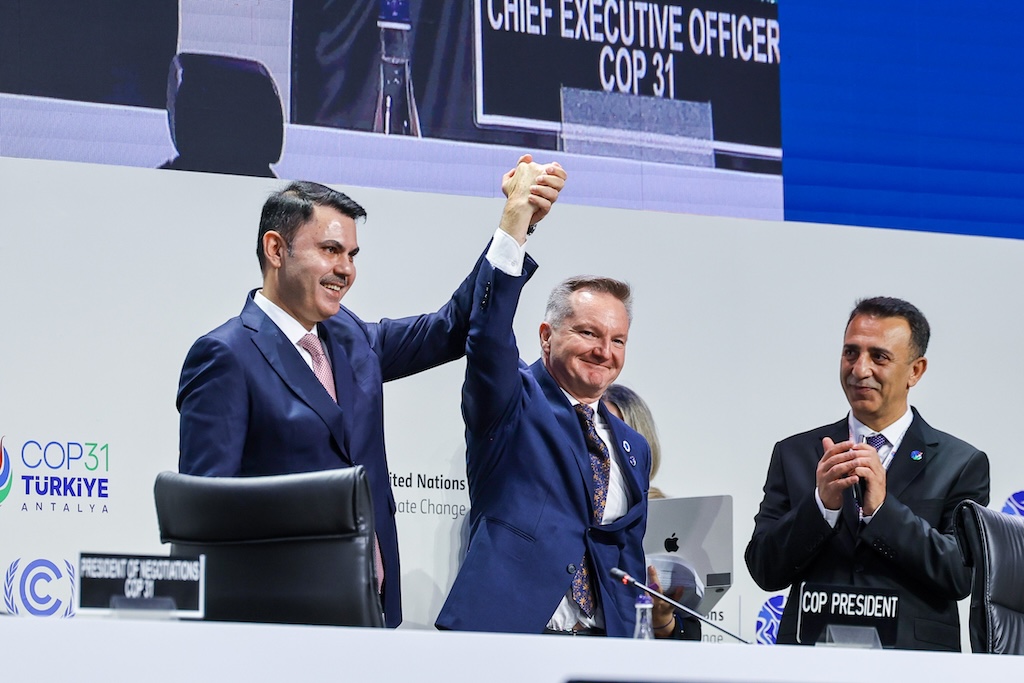
Turkey and Australia presided over the longest COP in history – and failed to find consensus on their proposed “cover decision”, exposing deep fractures between countries on key issues such as fossil fuels and the need for developed nations to meet climate-finance pledges.
Experts told Carbon Brief that, strictly, the talks did not “collapse” as several negotiated items were still adopted.
Rather, the rejection of the cover decision represented, for the first time, “those who want a higher level of ambition actively reject[ing] the lowest common denominator on offer”, said one veteran observer.
Dispute over who would host COP31 – representing the “western Europe and other states” region – had gone on for three years.
In the end, the two main rivals, Turkey and Australia, agreed to a deal last year at COP30 that the summit would take place in Antalya, Turkey, with Australia acting as “president of negotiations”.
Critics questioned whether either country was well-placed to host, given their ongoing fossil-fuel expansion.
Turkey faced criticism for announcing the discovery of two new oil fields on the eve of the summit, while recent Carbon Brief analysis found that Australia is the third-largest CO2 exporter in history because of its fossil-fuel production.
Ahead of the summit, the presidency released four official letters outlining a vision for COP31.
The first letter, written by COP31 president Murat Kurum in April 2026, confirmed the appointment of Australian climate minister Chris Bowen as “president of the negotiations” and announced that a pre-COP would be held in Fiji in October.
The second letter, authored by both Kurum and Bowen from the Copenhagen climate ministerial in May, said that “COP31 presents a vital opportunity to further accelerate…in the areas of clean energy, electrification and resilient infrastructure”.
The third letter, published in August 2026, gave more details on the presidency’s plans for the “action agenda” – the part of the UN process that mobilises coalitions of nations and non-state actors to push climate action further.
This letter also introduced a key aim from the presidency to get countries to agree to increase electricity’s share of final energy consumption to 35% by 2035 (often referred to as “35 by 35”). (See: Electrification.)
The final letter, published in October ahead of the pre-COP in Fiji, said that the presidency would centre on “delivering a COP focused on accelerating implementation, electrification and resilience in an uncertain world”.
It added that “many parties have emphasised the importance of reviewing and continuously improving UNFCCC processes, to ensure it remains fit for purpose, sustainable and focused as negotiations evolve over time”, adding:
“At COP31, we will hold presidency consultations to hear parties’ views on how to strengthen UNFCCC processes, to ensure growing demands are met and to effectively deploy resources.”
The pre-COP in Fiji was held from 5-8 October and was attended by 3,000 people.
In this somewhat intimate setting, Bowen announced that Turkey and Australia had agreed to negotiate a “presidency-led” cover decision at COP31.
He added that revealing this before COP was part of the presidency’s “upfront, transparent and consultative approach”.
Later that month, the presidency named the five ministerial pairs from developed and developing countries that would take key negotiation issues forward at COP31. These issues were mitigation, adaptation, finance, just transition and oceans.
COP31 kicked off on 9 November, with climate negotiations scholar (and Carbon Brief contributing e