

We handpick and explain the most important stories at the intersection of climate, land, food and nature over the past fortnight.
This is an online version of Carbon Brief’s fortnightly Cropped email newsletter.
Subscribe for free here.
Key developments
Iran war and food systems
PLANTING AT RISK: The war in the Middle East “has hit the epicentre of global fertiliser production”, threatening both the spring planting season in the northern hemisphere and winter planting in Australia, according to a comment by the Daily Telegraph’s world economy editor. Ambrose Evans-Pritchard noted that the supply of urea, ammonia and sulphur transported through the Persian Gulf has been “shut off” for nearly a month. The world’s two largest fertiliser producers, China and Russia, have recently reduced fertiliser exports, he added.
COMING CRISIS: Fuel costs and food prices are skyrocketing in Asia and Africa as the Iran war unfolds, reported the Financial Times, ahead of the new “two-week ceasefire”. According to the outlet, the impacts “could be even bigger than the crisis triggered by Russia’s 2022 full-scale invasion of Ukraine”. Even regions less directly exposed to the conflict, such as the US, “will feel the effects through higher [food] prices”, the outlet added.
CLIMATE FACTORS: New Scientist noted that the severity of the rise in food prices will depend on the length of the conflict and “how hard global warming-fuelled weather extremes” impact crops this year. A separate New Scientist piece pointed out that reducing farming’s dependence on fossil fuels could “prevent this from happening again [and] help slash the massive greenhouse gas emissions from farming”.
Nature talks outcomes
CONSERVATION WINS: The 15th Conference of the Parties to the UN Convention on Migratory Species ended on 29 March with an agreement to add 40 migratory species, including cheetah, striped hyena and snowy owls, to the convention’s “protected list”, reported Down To Earth. The conference in Brazil also delivered plans for conserving multiple species that live in the same ecosystems, such as the Amazon. The convention’s executive secretary said the new conservation rules are expected to be implemented “immediately”, added the outlet.
-
Sign up to Carbon Brief’s free “Cropped” email newsletter. A fortnightly digest of food, land and nature news and views. Sent to your inbox every other Wednesday.
MARINE PROTECTION: The conference was considered a “significant step forward” for marine species, as it reached a number of agreements, including commitments for reducing bycatch and a decision for countries to include “critical marine designations into their national biodiversity strategies”, reported Oceanographic. The meeting also adopted transboundary action plans for conserving the “critically endangered” European eel and the tope shark, it said.
HIGH SEAS MEETING: The final preparatory meetings for the High Seas Treaty ended on Friday with “meaningful progress in several key areas”, according to the Fishing Daily. Countries agreed on the “functioning of most subsidiary bodies” and several financial matters, but the “negotiations lost momentum toward the end of the session”, noted the outlet. The Financial Times reported that China is pushing to host the UN permanent body that will oversee High Seas Treaty talks. Earth Negotiations Bulletin reported that the treaty’s first summit will likely take place in New York in January 2027.
News and views
- FOREST LOSS: Deforestation in Indonesia surged by 66% in 2025, hitting its highest rate in eight years as a “result of weak environmental protections and an ambitious food and energy self-sufficiency drive”, said Reuters.
- DEFORESTATION REGULATION: Brazil introduced a new regulation last week requiring banks to use satellite data provided by the government to verify if borrowers of rural loans have deforested farmlands in the Amazon or other forests since July 2019, reported Folha de São Paulo.
- FACTORY FARMING: The UK government is overhauling planning rules to “make it easier to build intensive livestock farms despite concerns about water pollution, air quality and local opposition”, according to documents obtained under the freedom-of-information act by the Guardian.
- INITIATIVE ‘ABANDONED’: The European Commission has officially “abandoned” its sustainable EU food system initiative, according to the commission’s website. The framework was meant to integrate sustainability into all food-related policies, including for food labelling and public procurement.
- BLUE MILESTONE: The UN Environment Programme’s World Conservation Monitoring Centre announced that 10% of the global ocean is officially protected; however, the figure needs to triple for the world to meet its conservation commitments by 2030, according to EFE Verde.
Spotlight
Return of UK’s tallest bird
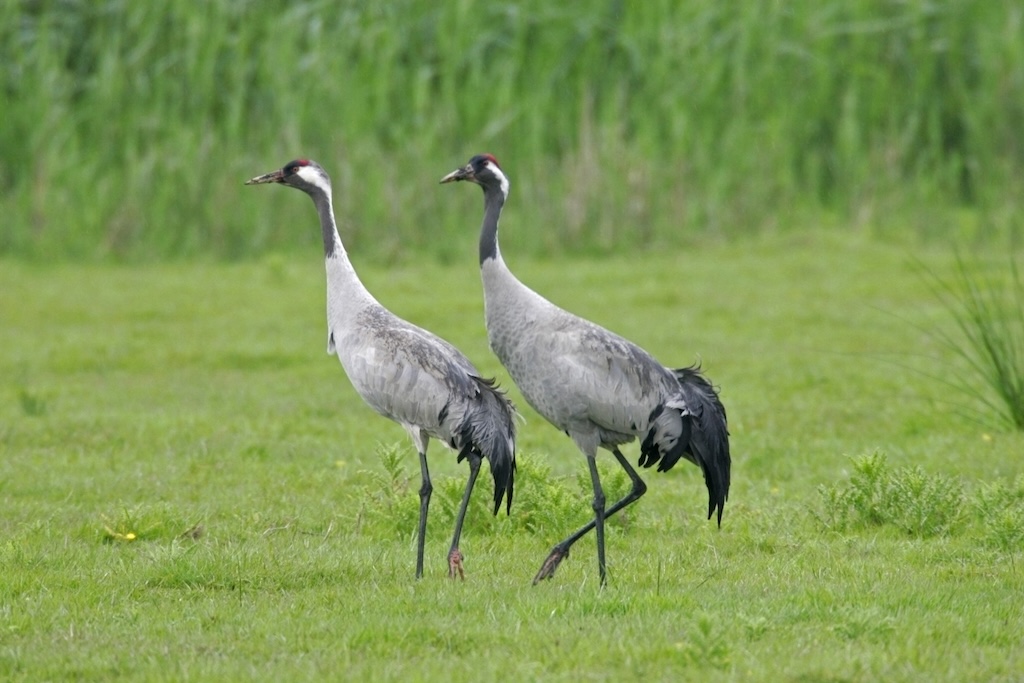
This week, Carbon Brief reports on how cranes, the UK’s tallest bird at more than 1 metre high, are making a remarkable comeback from extinction.
Standing at more than 1m with a 2m wingspan, cranes are comfortably the tallest bird in the UK.
Hundreds of years ago, they were a common sight in the UK. But, in the 1600s, they went extinct in the UK, due to overhunting and the large-scale loss of their wetland habitat. (Henry III reportedly served 115 cranes at one of his Christmas feasts in 1251.)
However, in 1979, a small number of wild cranes flew in from Europe and settled in Norfolk, eastern England. As efforts to restore and protect the UK’s wetland habitats have grown over the past few decades, so has the number of cranes.
In 2025, cranes had a record breeding season in the UK, with 87 pairs raising 37 chicks, according to data from the Royal Society for the Protection of Birds (RSPB). This has brought the total number of cranes in the country to around 250, says the charity.
Cranes and carbon
The majority of the UK’s growing crane population can be found in wetland areas that have been actively restored and protected by the RSPB and other conservation groups.
This includes Lakenheath Fen, a former carrot field in Suffolk, eastern England, that over the past 30 years has been restored into a diverse wetland habitat for birds, otters and water voles, among other species.
Cranes first arrived at Lakenheath from Europe in 2007, site manager Dave Rodgers explained to Carbon Brief:
“The conditions we created – a patchwork of developing reedbed, interspersed with shallowly flooded areas – were perfect for cranes. In 2007, there was an influx of birds from Europe. Two pairs flew over Lakenheath, landed and they’ve been nesting here ever since.”
As well as providing a home for cranes and other vulnerable water birds, the restoration of Lakenheath Fen and other sites like it is also helping to reduce the UK’s greenhouse gas emissions.
This is because Lakenheath Fen is a peatland.
Peatlands are waterlogged environments where plants decay very slowly, eventually forming a carbon-rich soil called peat. Across the world, peatlands cover just 3% of land area, but store more carbon than all of Earth’s trees combined.
In the UK, around 80% of all peatlands are degraded, with the greenhouse gases they emit accounting for around 5% of the country’s total emissions.
Rodgers explained:
“By re-wetting the peat, we’re almost completely preventing further loss of carbon from the soil.”
Flying future
According to the RSPB, cranes are now found at multiple wetland sites in the south-east and south-west of England. Some have even settled as far as Scotland.
With wetland restoration taking place across the country, including in cities such as London and Bristol, it is likely the birds will continue to spread to new areas, said Rodgers:
“There are a lot of wetlands around the country that would be suitable for cranes to nest in that are not currently occupied.
“With care, we should see cranes expand more widely across the country so that people who don’t currently have them might see them within the next 10 years.”
Watch, read, listen
NEW CHANCE FOR BEAVERS: A video from the Guardian showed the positive effects of the reintroduction of beavers into the wild in England.
INKCAP RELAUNCH: The UK online nature publication, Inkcap, headed by former Carbon Brief journalist Sophie Yeo, has relaunched with a new look.
BIRDS ARE BACK: Mongabay covered five bird species thought extinct that were rediscovered in 2025.
GREAT SHIFT: This Nature Answers podcast told the story of a community in Côte d’lvoire, where farmers moved from climate scepticism to adopting climate-adaptation measures.
New science
- Many insects in the tropics are already approaching their heat limits – the upper bound of the temperatures at which they can live | Nature
- More than 8,000 species could face increased exposure to wildfires by 2100 as a result of climate change under a moderate-warming scenario | Nature Climate Change
- Two temperate tree species, European beech and downy oak, can adapt to rising temperatures – but not when those high temperatures are accompanied by drought | Proceedings of the National Academy of Sciences
In the diary
- 10 April: Djibouti presidential election
- 12 April: Hungary presidential election
- 13-18 April: World Bank/International Monetary Fund spring meetings | Washington DC
- 21-22 April: 17th Petersberg climate dialogue | Berlin, Germany
- 21-25 April: UNFCCC climate week 1 | Yeosu, South Korea
Cropped is researched and written by Dr Giuliana Viglione, Aruna Chandrasekhar, Daisy Dunne, Orla Dwyer and Yanine Quiroz. Please send tips and feedback to cropped@carbonbrief.org
The post Cropped 8 April 2026: Iran war drives up food prices | Two nature talks conclude | Return of UK’s tallest bird appeared first on Carbon Brief.

After witnessing and hearing stories of Pacific islands’ vulnerability to climate change, senior climate officials have promised to strengthen efforts to limit global warming to 1.5C, despite an expected overshoot, and to help the region adapt to rising seas and other impacts.
More than 30 world leaders, ministers, climate negotiators and international development bankers travelled to the sinking atoll nation of Tuvalu on Tuesday before attending the pre-COP31 talks in Fiji, where schoolchildren told them about the effects warming-driven droughts, heatwaves and storms are having on their education.
Australia and the Pacific nations hoped to use the pre-COP to reinforce the urgency of tackling climate change to the officials from around 50 countries who travelled to the region. Fiji’s climate minister, Lynda Tabuya, told a closing press conference on Thursday they had wanted to “bring decision-makers to the climate frontlines”.
Many of those decision-makers said they had been moved by what they had seen and heard this week, and their speeches emphasised the importance of limiting global warming to 1.5C above pre-industrial levels, a key goal of the 2015 Paris climate agreement.
-
Pacific leaders rail at climate finance failures after pre-COP trip to Tuvalu
Island nations seek invest in their own Pacific Resilience Facility, as they struggle with the red-tape of international climate funds -
New Zealand accused of breaching EU trade deal over climate rollbacks
The EU’s climate trade rules face their first major test after a green group alleged New Zealand violated binding environmental provisions under its trade deal with the bloc

In September, a UN report acknowledged that the 1.5C threshold will be breached but said temperatures could still be brought back down to that level by the end of the century with stepped-up climate action.
A month ago, Türkiye‘s COP31 President Murat Kurum told a press conference in the northern Turkish city of Trabzon that limiting global warming to 1.5C “does not really look possible”, adding that “around 1.5C, that will be a success”.
But after seeing the “anxiety” of children and mothers in Tuvalu caused by rising sea levels, Kurum told reporters in Fiji that 1.5C is a “matter of survival – the survival of cultures, history, memories, your homeland, your homes – it’s that important.”
“The 1.5C target is in jeopardy and we do not have a single minute, a single day to lose,” he added through an interpreter.
Jacobo Ocharan, head of political strategies at Climate Action Network International, warned that “words of concern will not protect anyone”. “The Pacific has shown the world what is at stake. Now governments must show they are ready to act,” he said. “[COP31 in] Antalya must deliver decisions that change people’s lives for the better.”
$1.5 billion for 1.5C
In Fiji, Kurum echoed the call of Australia and Pacific nations for contributions to the fledgling Pacific Resilience Facility (PRF), which aims to use the returns on its investments to fund community climate adaptation projects like water storage, building sea walls and protecting homes from storms. “$1.5 billion for 1.5 degrees will save the Pacific,” he said. “It’s that easy. Life will continue in Tuvalu. Children will be smiling again.”
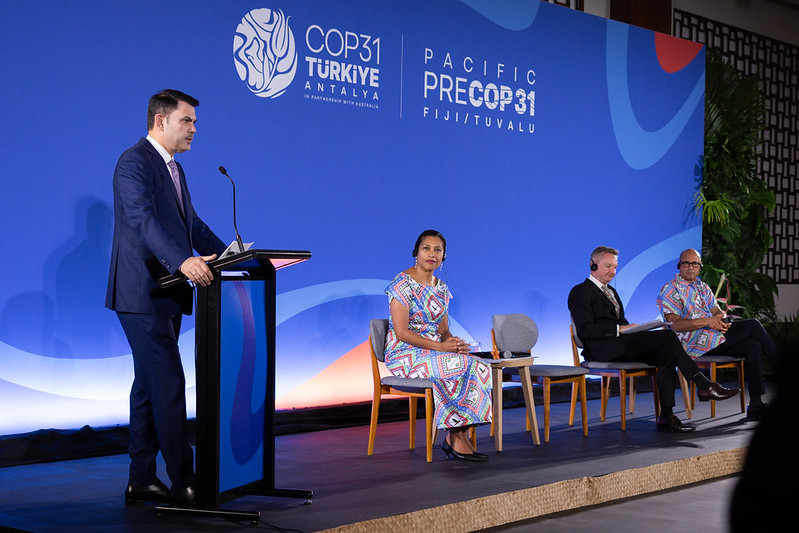
Sitting next to him, Fiji’s Tabuya said she was “encouraged” by his words. “$1.5 billion for 1.5. We will hold COP 31 to that,” she said. The PRF has been promised just under $200 million so far – including about $15 million pledged by European and Pacific governments at pre-COP – and is aiming for $500 million by COP31. It has a longer-term target of mobilising $1.5 billion in capital.
After Pacific leaders on Tuesday aired a litany of concerns about the barriers to accessing the global climate finance system, Kurum joined in at Thursday’s press conference. “Justice in climate finance is essential,” he said. “Resources must reach those in need in a timely and accessible manner, not through a lot of red-tape, and we cannot accept that the same countries should always bear the burden.”
Plan for easier access to climate finance
Australian climate and energy minister Chris Bowen, who is COP31’s president of negotiations, also lamented that “the countries that need the finance the most get it the least”. He said he would ask governments and multilateral development banks to support an access to finance plan for small island states and the world’s poorest nations, launched by Australia on Thursday.
The plan says that while there has been progress in making it easier and quicker to obtain international climate funding, “multiple persistent challenges have continued to limit access to climate finance for developing countries”.
It adds that the amounts available are insufficient to meet climate goals and stresses the need for “grant-based and highly concessional financing”, especially for adaptation and responding to loss and damage. The plan proposes an annual high-level forum on climate finance access to track implementation.
The pre-COP summit closed with an emotional plea from Fiji’s host minister Tabuya. Fighting back tears before finally succumbing, she asked delegates to “carry something of the Pacific with you”.
“Remember the people you met, the stories you heard and why we gathered. This pre-COP draws to a close tonight. Our responsibility does not,” she said to applause.
The post Pre-COP draws attention to Pacific’s climate plight and 1.5C goal appeared first on Climate Home News.
Pre-COP draws attention to Pacific’s climate plight and 1.5C goal
Climate Change
Australia’s climate credibility tested at Pacific Pre-COP talks, as High Court fossil fuel ruling puts government on notice
NADI, FIJI Thursday 8 October 2026 — As the Pacific Pre-COP talks wrap up and Australia prepares to take the reins of COP31 Negotiations in Türkiye next month, Greenpeace Australia Pacific says the government is on notice over fossil fuel expansion and exports, and must accelerate action to align with a 1.5°C pathway.
Following yesterday’s landmark High Court ruling that the climate impacts of coal and gas exports must be considered by New South Wales planning authorities, Greenpeace Australia Pacific is calling on the Albanese government to find the “courage, leadership and grit” to chart a new course away from fossil fuels.
High res images and video from yesterday’s ‘Keep 1.5C Alive’ flotilla in Nadi can be found here
Speaking from Nadi, Shiva Gounden, Head of Pacific at Greenpeace Australia Pacific, said:
“The outcomes of this week’s talks are a drop in the ocean given the scale of need, and urgency of the crisis our communities are facing. It is like taking a glass of water to a burning house if we do not urgently act to address the root cause of the existential threat facing Tuvalu, Fiji and all Pacific countries: fossil fuel expansion.
“The Electrification Pledge must end fossil fuel dependence, not be an end in itself — its ultimate success depends on ensuring electricity comes from renewable sources that displace fossil fuels and align with a 1.5°C pathway. It must be underpinned by justice and backed by finance flowing from polluters to communities.
“Limiting global warming to 1.5°C is a non-negotiable survival line for humanity and Australia must act. The landmark climate advisory ruling from the ICJ is clear — 1.5°C is the moral, the scientific and the legal limit. Continuing down the fossil fuel path, and failing to align efforts with limiting warming to 1.5°C, is a breach of our international legal obligations, and risks making Australia liable for future reparations from climate-vulnerable nations.”
Also in Nadi, Dr Simon Bradshaw, COP31 Lead and climate expert at Greenpeace Australia Pacific, said: “The Pacific was never going to be a mere backdrop for Australia in its role as incoming chair of the COP31 climate talks, but where its credibility and commitment to climate leadership would be tested.
“Here we see communities fighting for their survival and doing everything possible to hold the line on returning warming to 1.5°C. When governments profess to take their concerns seriously, only to then throw more fuel on the fire, the pain and sadness is visceral.
“This week the High Court of Australia recognised what the Federal Government refuses to — that Australia is responsible for the climate damage of our fossil fuel exports and if governments don’t act, the courts will intervene. The message is simple: this is not someone else’s problem, it is ours.
“We must now follow other countries in developing a national roadmap away from fossil fuels that ensures a managed wind-down of fossil fuel production, including exports, in line with our legal obligation to help return warming to 1.5°C.”
ENDS
Media contact: Kate O’Callaghan in Nadi on +61 406 231 892 (Whatsapp/Signal)
A Dutch NGO has filed the first climate complaint under the European Union’s trade rules, arguing that New Zealand violated the environmental provisions of its free trade agreement with the bloc by weakening its climate regulations.
The case will test whether binding climate provisions in the EU’s free trade deals can be enforced to hold governments accountable to their climate obligations, experts told Climate Home News.
The EU-New Zealand free trade agreement, which came into force in 2024, was the first in the world to include legally-binding climate provisions and possible sanctions for violating them, as the EU seeks to use its trade partnerships to advance greater environmental protection.
Under the deal, both parties committed not to weaken their environmental law to promote trade or investment and to “refrain from any action or omission that materially defeats the object and purpose of the Paris Agreement”.