

A Dutch NGO has filed the first climate complaint under the European Union’s trade rules, arguing that New Zealand violated the environmental provisions of its free trade agreement with the bloc by weakening its climate regulations.
The case will test whether binding climate provisions in the EU’s free trade deals can be enforced to hold governments accountable to their climate obligations, experts told Climate Home News.
The EU-New Zealand free trade agreement, which came into force in 2024, was the first in the world to include legally-binding climate provisions and possible sanctions for violating them, as the EU seeks to use its trade partnerships to advance greater environmental protection.
Under the deal, both parties committed not to weaken their environmental law to promote trade or investment and to “refrain from any action or omission that materially defeats the object and purpose of the Paris Agreement”.
-
International trade linked to 20% of global emissions – but imports ignored
Researchers say governments should discuss how to tackle emissions linked to globally traded goods and services, especially in large importing countries

At the time the agreement was signed, EU Commission President Ursula von der Leyen said the agreement included “unprecedented social and climate commitments”. But experts warned it was unclear how the Paris Agreement provisions would be enforced.
The EU included a similar “trade and sustainable development” clause in 14 other bilateral trade deals in recent years, with several others, including with China, awaiting ratification or being negotiated.
Climate activists at the Dutch NGO Both ENDS argue that the New Zealand government breached these terms by reopening its waters to offshore oil and gas exploration, releasing a climate plan that barely requires any emissions reductions, and passing a law that prevents corporations from getting sued over climate damages.
“Here, we have a so-called gold standard for free trade agreements with sustainability provisions but we have a trading partner that is doing exactly the opposite: regressing, as all the evidence points to, away from the Paris Agreement,” said Marius Troost, a senior policy advisor at Both ENDS.
Can the EU enforce its climate trading rules?
The Dutch environmental group filed the complaint under the EU Commission’s Single Entry Point, a mechanism that allows civil society to request enforcement of the bloc’s trade commitments.
The EU-New Zealand trade deal includes the possibility of suspending beneficial trading arrangements between the two parties in response to serious violations of its climate provisions. This, Troost said, is a “unique” tool to enforce both parties’ obligations under the deal.
“This is an opportunity for the EU and New Zealand to show that they are actually serious about these commitments,” he told Climate Home News.

A spokesperson for New Zealand’s Ministry of Foreign Affairs and Trade denied any violations of the agreement and said the government hadn’t received formal notice of the complaint. The country, they said, “takes its commitments under the NZ-EU Free Trade Agreement seriously, including the agreement’s environment and climate-related provisions”.
An EU Commission spokesperson said it will start a preliminary assessment of the complaint and engage with NGO Both ENDS. “Sustainability is a central pillar of the EU-New Zealand relationship,” they added.
The EU is New Zealand’s second-largest trading partner after China, with about 14% of the country’s exports going to the European market. Agricultural products like meat, diary, fruit and vegetables are the country’s biggest exports to Europe.
New Zealand is ‘having its cake and eating it’
Eliza Prestidge-Oldfield, a senior legal researcher at the New Zealand-based Environmental Law Initiative, which is supporting Both ENDS’s claim, told Climate Home News that if the EU upholds the complaint, both parties would begin a negotiation process.
“The idea is to try and resolve this positively with the New Zealand government acknowledging areas where it needs to change its actions in order to comply with the agreement, and get that change in place as soon as possible,” she said.
But New Zealand’s right-wing coalition government said it won’t take any directives from foreign actors regarding its policies. Trade minister Todd McClay told local media that it was “not for overseas countries, organisations or lobby groups to tell New Zealand how to meet its obligations”.
-
Coal mines and hypocrisy must not be Australia’s COP31 legacy
Still without a coal phase-out plan, Australia must course-correct to earn the mantle it has been given and do right by the Pacific nations that backed its bid for COP’s co-presidency -
Pacific leaders rail at climate finance failures after pre-COP trip to Tuvalu
Island nations seek invest in their own Pacific Resilience Facility, as they struggle with the red-tape of international climate funds -
As COP31 co-host, Australia should make its polluters pay for climate damage
With UN climate funds running short on cash, now is the time to start taxing the companies whose emissions are driving harm in the Pacific and other vulnerable parts of the world


Prestidge-Oldfield argued the complaint isn’t about “Europe telling anyone what to do at all”, but rather stressing the conditions under which they are willing to import goods from New Zealand. “The New Zealand government is trying to have its cake and eat it too,” she said.
If New Zealand refuses to adjust its policies in line with the agreement, the complaint will be assessed by an independent panel, which can require the country to make changes. If those changes are not implemented, the panel could decide that New Zealand should lose its preferential EU market access.
A negotiated resolution is more likely, however, with no prior labour-related complaints to the EU having ever reached the panel stage.
Alexander Gillespie, a law professor at the University of Waikato in New Zealand, said sanctions would be a “last resort”. “This is a test case, which will generate considerable attention – as it is not just about climate change, but how free trade and environmental sustainability have been woven together,” he said in a statement.
Trade deals as tool for climate accountability
Experts said the case could set a precedent for how trade deals can be used to hold governments accountable on climate action. The EU has enacted similar “trade and sustainable development” clauses in its trade agreements with Canada, Japan and South Korea.
While still pending ratification, the EU’s 2024 trade agreement with Mercosur – which encompasses Argentina, Brazil, Paraguay and Uruguay – also includes climate provisions, including a commitment to “effectively implement” the Paris Agreement and promote low-carbon trade.
In addition, legal researcher Prestidge-Oldfield noted that last year’s landmark advisory opinion on climate change by the International Court of Justice (ICJ) laid out stronger climate obligations for developed countries like New Zealand and could strengthen allegations of violations of the terms of the trade deal.
“It will be an interesting area to watch how the EU free trade agreement is interpreted in the light of this advisory opinion,” she said.
The post New Zealand accused of breaching EU trade deal over climate rollbacks appeared first on Climate Home News.
New Zealand accused of breaching EU trade deal over climate rollbacks

Climate Change
‘COP-out’: COP31 fails to deliver the ambition needed to phase out fossil fuels and address climate breakdown
Antalya, Türkiye, Sunday 22 November 2026 — The COP31 climate summit in Antalya has ended in disappointment and anger, as the final COP31 outcome failed to deliver on critical issues like overshooting the 1.5°C limit, fossil fuel phase out and climate finance. Greenpeace Australia Pacific says that Australia did not deliver the deal that the world needed in a time of escalating climate breakdown.
In Antalya, Dr Susie Byers, Head of Advocacy at Greenpeace Australia Pacific, said: “We need to call this COP outcome what it is: a COP-out that has failed to deliver what the world urgently needs given the scale of the crisis we’re facing. It’s a colossal lost opportunity, and one that the world won’t easily forget.
“Coming out of Belém there was momentum to phase out fossil fuels, but COP31 wasn’t able to harness that energy and drive the world forward. The failure to adopt the Cover Decision means there’s now no acknowledgement of, let alone response to, 1.5°C overshoot — the survival line for Pacific nations. Electrification, defence of science, protection for the oceans, and advances on climate finance were all casualties of cynical attempts to derail climate action with dangerous distractions like CCUS.
“Australia knew how hard this task would be and put their hand up anyway. In the end, they didn’t get it done. This outcome validates exactly why so many countries are looking towards parallel tracks like the International Court of Justice Advisory Opinion and national transition roadmaps, where we’ve seen microdiplomacy and Pacific leadership again lead the way. This spirit of multilateralism and collaboration is how we will move beyond rhetoric to concrete actions, and end the fossil fuel chokehold.”
Also in Antalya, Shiva Gounden, Head of Pacific at Greenpeace Australia Pacific, said: “They called this an ‘implementation’ COP, but implementation means nothing when the foundation is broken. The frontline communities leading this fight came to Antalya demanding the urgent, definitive action required to confront the sickening realities of 1.5°C overshoot. Instead, developed countries turned their backs on their historical responsibilities, held climate finance hostage, and treated the debt they owe as a cheap bargaining chip.
“At the exact same time, Parties and negotiating blocs deliberately blocked the bold action the world needed on mitigation, peddled toxic distractions like CCUS, and intentionally scrubbed the words ‘fossil fuels’ from the final text. A strong Presidency that understood the urgency of the situation would not have let this happen; Australia failed to deliver what it promised the Pacific.
“Billions of people across the world are fiercely defending their lives, their homes, their cultures, and their livelihoods, and we came here with their voices demanding real action. By choking off the money and refusing to name the root cause of this collapse, polluting nations made a calculated choice to protect their own interests over our shared future. The Pacific will increasingly look towards parallel paths like the ICJ climate advisory opinion, and the Santa Marta process, to continue finding solutions because that is what our people need.”
ENDS
COP31 images and video available here in Greenpeace Media Library
Media contact: Kate O’Callaghan in Antalya (GMT+3) on +61 406 231 892 (Whatsapp/Signal)
Climate Change
COP31 Bulletin Day 13: New draft retains electrification goal but delays adaptation finance and science decisions
After an evening of tense discussions, a new version of the cover text was finally released at around 2am on Sunday morning. But, with many delegates flying home, it is unclear if – and for how long – there will be the two-thirds of governments present needed to legally adopt a decision.
The latest draft, which is – as of 9.30 – scheduled to be put to a plenary session for approval at 10am – retains a goal to boost electrification and links it more strongly with clean energy and storage. It does not, however, include language on transitioning away from fossil fuels as many countries had called for.
It ditches a specific numerical target for carbon capture, use and storage (CCUS), a controversial technology that is favoured by fossil fuel producers, which is now only an aim “to achieve gigatonne scale globally by 2035 as a collective global aspiration”. The previous version had two alternative targets, a weaker one of 0.5Gt “working towards” 1.3-2.5Gt and a stronger one of 2.5Gt.
The draft cover decision has strong language on responding to an almost certain overshoot of the 1.5C warming limit, recognising that it will increase loss and damage and result “in increasingly adverse, and in some cases irreversible, impacts and risks to human and natural systems”. As President of Negotiations Chris Bowen has repeatedly drawn attention to, this is the first COP held since the UN acknowledged that overshoot is inevitable.
In pursuing efforts to limit any overshoot, the decision recognises the need for “deep, rapid and sustained reductions in greenhouse gas emissions in line with 1.5 °C pathways” – which is a push towards greater ambition.
The text also resolves to close adaptation gaps and boost action and support to help countries and communities to better cope with adverse climate impacts. But it does not put a figure to a goal agreed at COP30 last year to triple adaptation finance by 2035.
The goal did not specify a baseline year and African nations, least-developed countries and small island states had pushed for it to be a later and higher baseline and therefore a larger target number of $120 bn a year. Instead, the text launches a “roadmap” on adaptation finance to be considered at COP32.
Loss and damage finance has been cut from the roadmap’s scope, as have references to about half the money pledged to the loss and damage fund having yet to be sent to the fund’s bank account and the gap between the $2.8 billion of loss and damage funding requested by developing countries in the fund’s start-up stage and the $0.342 billion allocated to fund these projects. “Erasing the shortfall doesn’t make it disappear for families who have lost everything”, said Harjeet Singh, global convenor of Fill the Fund.
The new text drops its invitation to the Intergovernmental Panel on Climate Change (IPCC) to publish all of its next three reports in time for the 2028 global stocktake of climate progress. Instead, it just invites them to “continue to provide policy-relevant information as input to the UNFCCC processes, including outputs from the seventh assessment cycle to the next global stocktake”. It no longer specifies that all their reports, including the third on reducing emissions, are published. The IPCC will have an online meeting in December to discuss this issue but COP31 guidance will be influential in its decision.
As Climate Home News entered the venue around 7.30am, tired-looking negotiators from Saudi Arabia and from the Alliance of Small Island Developing States were seen entering the area which houses the Presidency’s offices, as others dozed on sofas. A source close to the German delegation said that negotiations had been intense and were not necessarily resolved.
If the Presidency does not think it can get agreement on a cover text, then it can withdraw it or it can issue it a Presidency declaration, which does not have much weight. Some of its provisions could be added into other agenda items and adopted seperately. Governments could also decide to reconvene COP31 at a later date – known as a bis – as happened at COP6.
The post COP31 Bulletin Day 13: New draft retains electrification goal but delays adaptation finance and science decisions appeared first on Climate Home News.
COP31 Bulletin Day 13: Germany rejects text moments before plenary meeting
On Friday night, COP31 approved a series of less controversial agenda items and then COP President Murat Kurum told governments to hang around the venue until midnight in case his team wanted to consult them on the cover text, which is still Thursday’s version.
If you don’t hear from us, Kurum said, go home and get some rest and don’t bother coming in before 9am. Governments appear to have taken his advice. Around 10am, the conference centre was ghostly and there was still no sign of a new draft cover text.
COP31 Bulletin Day 11: Countries decry cover text for omitting fossil fuels
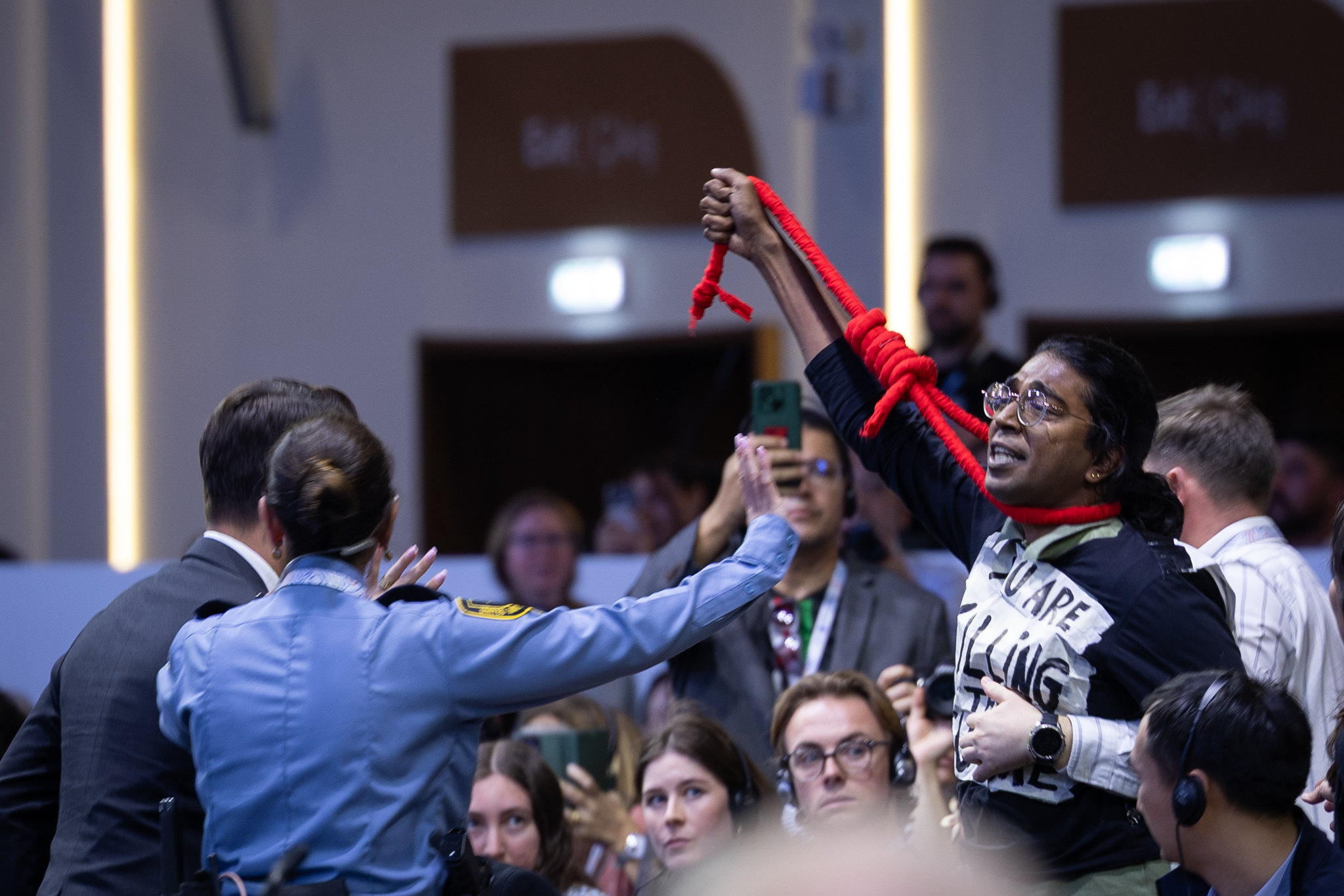
Friday night’s plenary did offer a few moments of drama. An activist was ushered out of the room by security after holding a rope around his neck and shouting “you keep doing nothing, nothing at all” and “you are killing the future, just kill me now” to a smattering of applause.
Panama’s environment minister Juan Carlos Navarro urged Kurum to ensure full respect of the rules of procedure when gavelling decisions through this weekend. Given he has led threats to object to the cover text if it is not ambitious enough, this sounded like a warning to Kurum not to ignore objections, as previous COP presidents have been accused of doing.
Another significant development on Friday night was a joint statement from Australia and China which, among other things, expressed China’s backing for the 35×35 electrification goal. More on that here.
The post COP31 Bulletin Day 12: ‘Don’t ignore us,’ Panama warns as COP31 runs into overtime appeared first on Climate Home News.
COP31 Bulletin Day 12: ‘Don’t ignore us,’ Panama warns as COP31 runs into overtime

‘COP-out’: COP31 fails to deliver the ambition needed to phase out fossil fuels and address climate breakdown
COP31 Bulletin Day 13: New draft retains electrification goal but delays adaptation finance and science decisions
