

Disseminated on behalf of Surge Battery Metals Inc.
The lithium market is experiencing a major rebound due to rising demand and tightening supply. Battery-grade lithium carbonate spot prices have jumped to about $24,086 per metric ton, based on data from Shanghai Metals Market (SMM). This marks a sharp increase from earlier lows in 2025, after a period of oversupply had weighed on the market.
What Causes Lithium Prices to Rebound
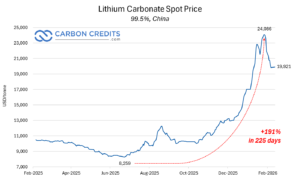
Several factors are behind the lithium price surge. First, the growth in stationary energy storage systems has been rapid. In 2025, demand for lithium in storage applications jumped about 71%, and analysts expect another 55% growth in 2026. As more utilities, data centers, and industrial players adopt battery storage, lithium demand continues to expand beyond just electric vehicles (EVs).
Second, China’s battery manufacturing sector is ramping up production to meet both domestic and global demand. Policy support for clean energy and EV adoption has helped absorb excess lithium that previously contributed to oversupply.
Meanwhile, regions like Europe and North America are boosting support for EVs and energy storage. European demand for batteries could reach 1 terawatt-hour by 2030. At the same time, U.S. incentives from the Inflation Reduction Act have already led to hundreds of new battery projects. These programs are driving additional lithium demand, putting further pressure on an already tight supply.
Third, supply constraints are becoming a concern. Forecasts for 2026 suggest a shift from surplus to a potential supply deficit of 22,000 to 80,000 metric tons, depending on how quickly new projects come online. This deficit is boosting hope among producers and investors. Prices might stay high if demand keeps outstripping supply.

Lithium’s Double Boost: AI + Data Center Batteries
Additional factors include rising interest in AI and data center batteries, which require large amounts of high-quality lithium. Emerging markets are generating new demand for battery-grade lithium. This adds to the existing need for electric vehicles. Coupled with a limited number of major lithium producers and delays in bringing new projects online, the market has become increasingly tight.
Other factors driving lithium prices up are the fast-growing need for batteries in AI data centers and energy storage systems. The global lithium-ion battery market for data centers was around $5.2 billion in 2024, per Prsedence Research. It is set to grow to nearly $17.7 billion by 2034, most of which will come from lithium batteries.
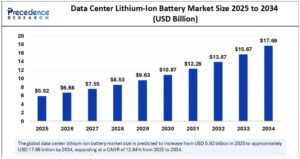
Lithium battery shipments for data center energy storage might rise over 80% in the next five years. Operators are expanding systems to support AI workloads that need steady power and load balancing. This surge in demand from new markets adds to the traditional battery needs of electric vehicles.
In short, the surge in lithium prices reflects a perfect storm of strong demand, constrained supply, and supportive policies. Investors and companies are taking note, as this environment signals higher revenues for producers. It also creates more opportunities for juniors to develop high-grade resources.
Surge Battery Metals Step Into the Spotlight
Surge Battery Metals (TSX-V: NILI | OTCQX: NILIF) is one such company advancing its position in the lithium supply chain. Surge focuses on the Nevada North Lithium Project (NNLP), which hosts the highest-grade lithium clay resource in the United States. It has a mineral resource estimate of 11.24 million tonnes of lithium carbonate equivalent (LCE) grading 3,010 ppm lithium at a 1,250 ppm cutoff.
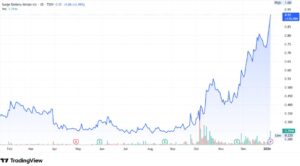
The company has also seen strong investor interest in recent trading. In early 2026, its stock rose about 35%, and over the past month, it gained nearly 46%. This rally reflects the overall optimism in the lithium market. It also matches the strong gains of major producers like Albemarle. The increase shows growing confidence in NILI’s high-grade Nevada project and its potential role in meeting rising lithium demand.
In early January 2026, Surge announced a key executive hire to strengthen its commercial leadership. The company appointed Steffen Ball as Vice President of Commercial Development for Nevada North Lithium LLC, the joint venture between Surge and Evolution Mining. Mr. Ball brings senior experience from major automakers’ battery material sourcing teams, including roles at Nissan North America and Ford.
This appointment signals Surge’s focus on preparing the project for eventual production and strategic partnerships. It also shows the company’s plan to create a team with strong industry knowledge and connections in the lithium value chain.
Alongside personnel moves, Surge has attracted increased investment from institutional groups. The Quaternary Group, for example, increased its ownership in Surge by buying shares on the open market. Now, it holds about 7.8% of the company on an undiluted basis.
Nevada North: High-Grade, High Stakes
Surge Battery Metals stands out among junior lithium miners. Its main asset, the Nevada North Lithium Project, sits in a well-established U.S. mining region with strong infrastructure.
Early exploration shows lithium clay grades up to 7,630 ppm, with updated drill intercepts as high as 8,070 ppm, considered high for clay-based deposits. A Preliminary Economic Assessment (PEA) shows an after-tax NPV of US$9.2 billion. It also has an IRR of 22.8% when lithium carbonate equivalent (LCE) is priced at US$24,000 per tonne.
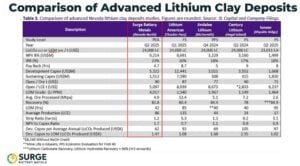
The project could produce an average of 86,300 tonnes of LCE annually, peaking at 109,100 tonnes in Year 6. Operating costs are estimated at US$5,243 per tonne of LCE, giving Surge a competitive edge.
The project is now progressing toward a Pre-Feasibility Study targeted for completion in late 2026, led by global engineering firm Fluor Corporation.
Surge is expanding its resource base through drilling across several kilometers of strike. The company recently reported additional strong drill results from Nevada North. It announced a 30.6-meter intercept grading 4,196 ppm lithium from surface in a 640-meter step-out hole to the southeast.
In infill drilling, Surge also reported 116 meters averaging 3,752 ppm lithium, including 32.1 meters grading 4,521 ppm near surface, highlighting a strong high-grade core within the deposit. These results confirm that high-grade lithium extends beyond the current resource area.
The wide step-out distance also shows strong potential for further expansion. Consistent high grades near the surface can support future resource growth and strengthen the project’s development outlook.
Moreover, Nevada’s mining-friendly environment, with access to roads, power, and skilled labor, reduces development risk. Strategic hires with experience in battery supply chains signal the company’s readiness to move toward production and partnerships.
High-grade resources, strong economics, and a strategic location put Surge in a great spot in the growing lithium market.
From Clay to Clean Energy
The recent rise in lithium prices shows how supply and demand dynamics are shifting. As energy storage and electric vehicles expand, major companies are boosting their market positions. Higher lithium prices support stronger revenue forecasts and have led analysts to raise price targets on key stocks.
At the same time, projects further upstream, including junior developers like Surge, are gaining strategic significance. Investments in early-stage lithium resources help diversify supply beyond dominant producers and geographies. Surge’s focus on commercial leadership and resource development reflects how smaller companies can play a role in meeting future demand.
If lithium prices keep rising and demand stays strong, both current producers and new developers could gain. For mining giants, this could mean the expansion of production capacity and stronger earnings. For Surge and similar companies, it could support project financing and advancement toward commercial output.
Live Nickel Spot Price
- READ MORE: Surge Battery Metals Strengthens Nevada North With High-Grade Expansion and Infill Success
DISCLAIMER
New Era Publishing Inc. and/or CarbonCredits.com (“We” or “Us”) are not securities dealers or brokers, investment advisers, or financial advisers, and you should not rely on the information herein as investment advice. Surge Battery Metals Inc. (“Company”) made a one-time payment of $75,000 to provide marketing services for a term of three months. None of the owners, members, directors, or employees of New Era Publishing Inc. and/or CarbonCredits.com currently hold, or have any beneficial ownership in, any shares, stocks, or options of the companies mentioned.
This article is informational only and is solely for use by prospective investors in determining whether to seek additional information. It does not constitute an offer to sell or a solicitation of an offer to buy any securities. Examples that we provide of share price increases pertaining to a particular issuer from one referenced date to another represent arbitrarily chosen time periods and are no indication whatsoever of future stock prices for that issuer and are of no predictive value.
Our stock profiles are intended to highlight certain companies for your further investigation; they are not stock recommendations or an offer or sale of the referenced securities. The securities issued by the companies we profile should be considered high-risk; if you do invest despite these warnings, you may lose your entire investment. Please do your own research before investing, including reviewing the companies’ SEDAR+ and SEC filings, press releases, and risk disclosures.
It is our policy that information contained in this profile was provided by the company, extracted from SEDAR+ and SEC filings, company websites, and other publicly available sources. We believe the sources and information are accurate and reliable but we cannot guarantee them.
CAUTIONARY STATEMENT AND FORWARD-LOOKING INFORMATION
Certain statements contained in this news release may constitute “forward-looking information” within the meaning of applicable securities laws. Forward-looking information generally can be identified by words such as “anticipate,” “expect,” “estimate,” “forecast,” “plan,” and similar expressions suggesting future outcomes or events. Forward-looking information is based on current expectations of management; however, it is subject to known and unknown risks, uncertainties, and other factors that may cause actual results to differ materially from those anticipated.
These factors include, without limitation, statements relating to the Company’s exploration and development plans, the potential of its mineral projects, financing activities, regulatory approvals, market conditions, and future objectives. Forward-looking information involves numerous risks and uncertainties and actual results might differ materially from results suggested in any forward-looking information. These risks and uncertainties include, among other things, market volatility, the state of financial markets for the Company’s securities, fluctuations in commodity prices, operational challenges, and changes in business plans.
Forward-looking information is based on several key expectations and assumptions, including, without limitation, that the Company will continue with its stated business objectives and will be able to raise additional capital as required. Although management of the Company has attempted to identify important factors that could cause actual results to differ materially, there may be other factors that cause results not to be as anticipated, estimated, or intended.
There can be no assurance that such forward-looking information will prove to be accurate, as actual results and future events could differ materially. Accordingly, readers should not place undue reliance on forward-looking information. Additional information about risks and uncertainties is contained in the Company’s management’s discussion and analysis and annual information form for the year ended December 31, 2025, copies of which are available on SEDAR+ at www.sedarplus.ca.
The forward-looking information contained herein is expressly qualified in its entirety by this cautionary statement. Forward-looking information reflects management’s current beliefs and is based on information currently available to the Company. The forward-looking information is made as of the date of this news release, and the Company assumes no obligation to update or revise such information to reflect new events or circumstances except as may be required by applicable law.
The post Lithium Prices Climb Again in 2026, Sending Stocks Skyward appeared first on Carbon Credits.

EU carbon credit claims changed on 27 September 2026, the day the Directive (EU) 2024/825 began to apply across the European Union. The change is narrow. It changes how a company can talk about the credits it buys. A product can no longer be called neutral on the strength of compensation alone; however, every specific, evidenced statement about what a company measured, reduced, and funded stays fully available.

The post Promoting Improved Cooking Practices in Nigeria appeared first on Terrapass.



