Connect with us

Published

on

Weather Guard Lightning Tech
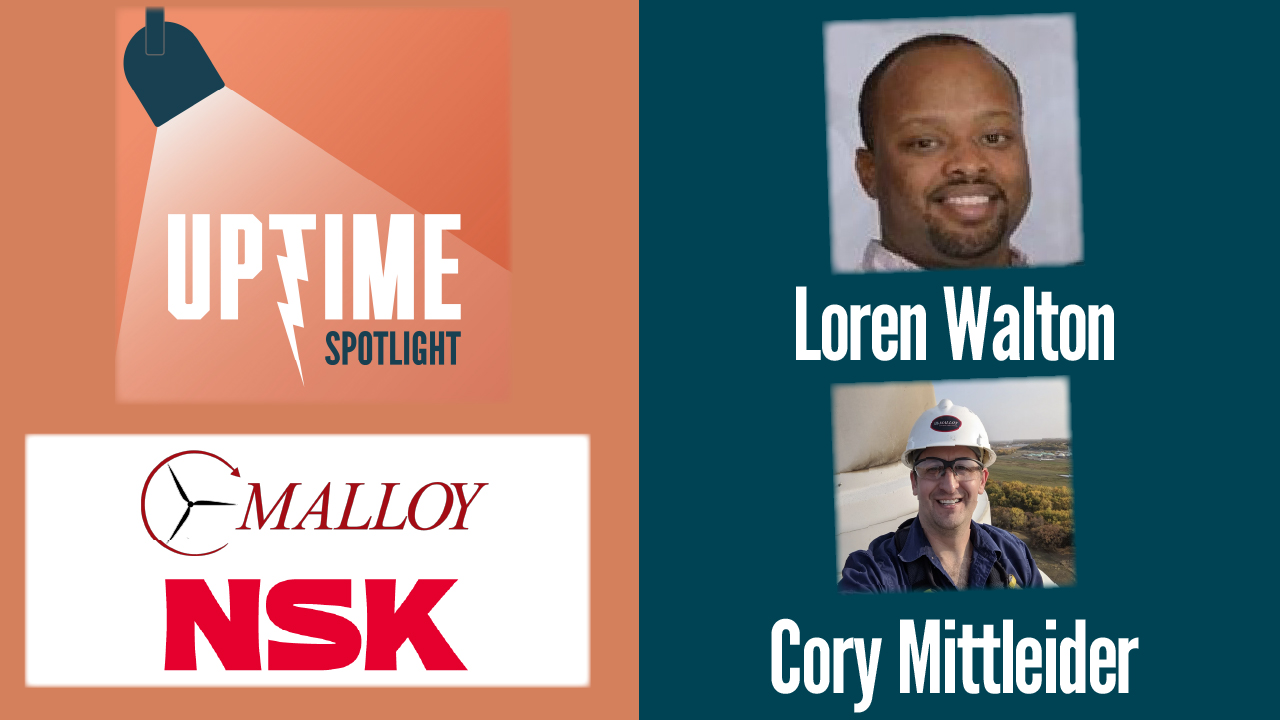
Malloy Wind and NSK on Main Bearing Failures

Cory Mittleider of Malloy Wind and Loren Walton of NSK on main bearing failures, why the industry is pulling DLC coatings, and the material changes replacing them.

Sign up now for Uptime Tech News, our weekly newsletter on all things wind technology. This episode is sponsored by Weather Guard Lightning Tech. Learn more about Weather Guard’s StrikeTape Wind Turbine LPS retrofit. Follow the show on YouTubeLinkedin and visit Weather Guard on the web. And subscribe to Rosemary’s “Engineering with Rosie” YouTube channel here. Have a question we can answer on the show? Email us!


Allen Hall: Cory and Loren, welcome back to the podcast.

Cory Mittleider: Thanks for having us.

Allen Hall: So we’ve got two bearing experts in one location, and this is the point where we start asking all of our bearing questions. Cory, you’re with Malloy Wind, and we’ve had you on the podcast two or three different times. Loren’s with NSK — we’ve had Loren on at least once before.

Loren Walton: Once, yes.

Allen Hall: Yeah, and that was good.

Loren Walton: I appreciate that. It was fun.

Allen Hall: There are a lot of bearing issues happening in the States at the moment, but also globally. Whatever happens in the States, you can pretty much find in Australia, Canada, Singapore, Mexico, South America, Brazil — everywhere. We’re hearing a lot about main bearings, and there’s a variety of things that I think you two know from being on the inside that we on the outside haven’t heard yet. I want to get some of those stories out and understand what’s going on, because operators are trying to keep their assets running, and bearings are a big issue. Let’s talk main bearings. What are you seeing in the field right now? What kinds of problems are happening?

Cory Mittleider: It seems like operators are coming to us and asking us to supply bearings that no longer have DLC. That’s a bit of a phenomenon lately. For a little over a decade we spent our time supplying bearings with DLC on the rollers to address problems found fifteen years ago.

Allen Hall: DLC is diamond-like coating.

Cory Mittleider: Correct.

Allen Hall: Which is a really hard specialty coating applied to the bearing surfaces to provide hardness and durability — or it’s supposed to provide durability.

Cory Mittleider: That’s a good point. It’s a coating that’s one to two microns thick — one to two thousandths of a millimeter — and a very hard material. The big feature was that it’s a dissimilar material to the steel. So when we break through the mixed and boundary lubrication regimes and those asperities touch each other, that dissimilar material prevents the welding and tearing that leads to the peeling damage we saw fifteen years ago. That peeling damage eventually turned into spalling, cracking, and other failures. So it made a lot of sense at the time to turn to something like this to mitigate the peeling.

Allen Hall: So the peeling damage was one of those issues where you basically had some sliding happening. In my electrical world, and from looking at these on the ground, you see things moving relative to one another instead of rolling relative to one another.

Loren Walton: It’s more of a welding and shearing of the contacts. I used a finger analogy last time: think of your asperities as fingers — one set is the roller, one set is the outer raceway. They weld under high load and high pressure, then they shear, leaving behind debris. That’s what creates the beginning of the peeling damage, and then it continues to create more debris, and the bearing starts to basically eat itself alive.

Allen Hall: The start of that process, though — is that a lack of lubrication, or a finish or hardness issue on the bearing?

Loren Walton: I love that question, because this is the crux of the whole thing, and I think it’s the part that gets missed. People immediately want to throw the whole thing out and start over with something different. Fundamentally, when we fixed the surface issue by adding the coating, the problems pretty much went away. We went from one-to-five years of life to ten-plus years, depending on the application — without changing the construction, the bearing type, or the contact angle. Just by adding the coating, we increased life significantly. The root of what you’re asking is that the bearing would operate better if it had the proper amount of separation. It’s not a fatigue issue and it’s not a loading issue. At its heart, the bearing isn’t able to create that separation. There isn’t enough speed, and there isn’t enough of a gap created by the lubricant.

Allen Hall: So ideally you have this almost molecular-scale film of lubricant between the two surfaces. If it isn’t designed properly, or you have an issue, that lubricant gets squeezed out of the space, and at that point you have trouble. That’s some of what I’m hearing on main bearings — especially when turbines have been curtailed and aren’t turning. Is that partly just the fact that there’s so much load?

Cory Mittleider: I think that’s a fundamental difficulty of the main shaft bearing. You’ve got extremely variable loads, from full load to idle, and a wide range of operating conditions — from northern North Dakota in the winter to Texas in the heat this week. High load, heavy load, incredibly slow speed, and even slower if it’s idling. It’s hard to reliably build that film. It’s not necessarily that there isn’t enough lubrication; it’s that the film isn’t building properly where it needs to be to separate the metal and the rolling elements.

Allen Hall: So the diamond-like coating was meant to solve that welding problem — you put the coated bearing in, and it worked okay until more recently, when all of a sudden we started having other issues. To me those aren’t related to the coating itself, but to other things happening up in the nacelle.

Loren Walton: If we recall some of your previous episodes, you were on the forefront of understanding and talking about DLC starting to become an accelerant to failure. I know you talked about it with Cory. Those episodes have aged very well. A lot of people now are recognizing what we were saying years ago and changing their strategy toward removing DLC — whether on bearings for newer turbines, typically two megawatts and greater, or in some cases going backwards and removing DLC as they do additional replacements, and looking for another solution, because there’s potential for additional issues you weren’t expecting by adding the coating.

Allen Hall: The coating is non-conductive, which is part of the issue, because you wouldn’t think bearings are conducting electricity. But as turbines got some of these uptower and downtower converters and inverters connected to the generator, we started seeing current levels — according to Motor Doc, where people like Howard Penrose have gone out and measured currents in the nacelles — of well over a hundred amps running through ground straps and the like, into bearings. That’s a lot of current. If you’re shoving that into a bearing that has DLC on it, you’re going to break it down and create these really hard steel bits stuck inside the bearing, which wear it like pouring sand inside a bearing. That’s what eventually happens, and it has nothing to do with the bearing. It has more to do with the electrical and control systems we stuck up top and didn’t pay much attention to, but probably should have. We created an electrical situation, and now all the upkeep comes to people like you to deal with. You haven’t seen a lot of work to eliminate it, although there are a couple of good attempts happening. The reality is: okay, we have to have a bearing, and I’ve got this current going around from the nacelle. How do I put those together in a way that removes the DLC?

Cory Mittleider: That’s what we’ve spent the last ten-plus years on. As a bearing supplier, we can’t change the whole system. We have to do the best we can to accommodate what’s happening in your system. We would absolutely encourage you, if you can identify and remove the electricity, please do that.

Allen Hall: They should. And there are a lot of people who do.

Cory Mittleider: There’s a pursuit of that, absolutely. But the turbine still needs to run.

Loren Walton: We work very closely with an owner-operator that did a lot of that work. To your point from before, it does sound like, from what they’ve investigated, the current has been there for a while. It’s been there in different models and different turbines. Maybe the way it presented, or its impact, wasn’t to the same extent as what we’re seeing now. That’s where I’d say there’s more to it than just the current. I think I said last time it’s not just a smoking gun. The bearing is sitting in front of a firing squad. You put it all together and now we’re in a tough position. But to Cory’s point, we get brought the application, we get brought the environment, and we get told, “Here, make it work.”

Allen Hall: And you don’t actually see everything that’s happened. You get all the mechanical loads, but they don’t tell you, “Hey, we’re running a hundred amps through this nacelle.”

Loren Walton: No, I don’t remember hearing that.

Cory Mittleider: No, that’s not usually disclosed.

Allen Hall: No one’s ever said that. So that’s a real troubling thing happening in the industry — we’re assigning blame to mechanical components when really it’s an electrical mistake. When you dig into it, what you find is that currents have been running up top for years, but what’s changed now is that with more focus on emissions from inverters, they’ve pushed things into higher frequencies. Higher frequency bands are harder to ground out and get rid of. When things were in the kilohertz range, we could partly ground them and they’d go away. Now we’re working at ten kilohertz and up, and that energy distributes into a lot of places, including the bearings, where it wasn’t before. That’s really hard to deal with. Some electrical designer sitting in a remote location, probably in Germany, designs the circuit, and now you bearing gurus have to go fix it.

Cory Mittleider: And that system’s probably well optimized for that particular package.

Allen Hall: For that particular package, right. It meets all the requirements and does everything they wanted — except for the effect on the bearings.

Loren Walton: You solve one problem and move it to another. That’s ultimately how it works.

Allen Hall: If you’re an electrical engineer, you’d never have thought you were destroying the bearings. The industry has moved quite quickly, though. Everybody started noticing this problem with DLC. They went out to check and figure out what the problem was, and, more importantly, to find a solution. Those solutions are unique, because the reason DLC went on in the first place was to extend lifetime. So if you’re taking the DLC out of the equation, can you still get to those lifetime numbers without it?

Loren Walton: Yeah, and that’s where our message has been that adjusting the material will get you the difference you’re looking for. I want to be very clear: I’m not saying DLC as a solution is bad. When it was applied in the right space — turbines with a lighter duty — it worked great. But once you add in additional factors, it becomes an accelerant to failure at certain points. So it definitely still has its place. But once you move away from DLC, you’re going to be right back where you started — regardless of construction — with the life that was always aided by DLC. Once you’ve removed it, you have to know for sure you’re not going right back to the peeling layers and the spalling you were seeing. From what we’ve investigated, the material changes are where you get that. Having a harder surface combats it, and having a better way to combat any additional debris introduced into the system helps.

Allen Hall: And reducing the possibility of generating that debris.

Loren Walton: Correct.

Allen Hall: So what does that mean in terms of bearing design — different alloys, different heat treats, different coatings?

Loren Walton: The first two, not the third. From the recipe of the steel, adjusting some of the alloying elements, there’s a lot you can do. A lot of people think of engineering mostly through the mechanics of it, but one part of mechanical engineering that doesn’t get talked about is material science. That’s the part we dive into extremely deeply, and it gives you the biggest bang for your buck when you’re moving away from a coating as your — I don’t want to call it a crutch, but as the thing helping you get by — toward changing the bearing from the inside so it lasts better once the coating is gone.

Cory Mittleider: I like describing it as being baked into the cake. It’s not a nice thing added afterward like a coating that’s one to two microns thick. It is the bearing.

Allen Hall: It’s hard to think about steel and a lot of the metals used in the bearing industry as unique chemistries, but they are. There are a lot of varieties of steel, just like there are a lot of varieties of copper or aluminum.

Loren Walton: Yes.

Allen Hall: You’d think steel is just steel — we make cars out of it, airplanes, whatever.

Loren Walton: I was talking to someone who’s more into gears, and even when I spoke of a carbon-nitride version of a bearing versus a carbon-nitride version of a gear, it’s not exactly the same. For all intents and purposes it’s easier for everyone to consider it as steel — one word, means the same thing. But once you get into how much chromium is in it, how much molybdenum, how much manganese —

Allen Hall: It comes down to that, and it can be very small percentages of the total.

Loren Walton: It can make a huge difference. And then you get into the heat treat — your time, your soaking, what you do for quenching. It all matters, and everyone does it differently, so you get different results.

Allen Hall: That’s the kicker. You see a lot of discussions where it’s just, “Oh, it’s been heat treated.” As an electrical engineer I used to see it that way too. But there’s heat treatment and there’s heat treatment. It depends on what you’re doing and what the result needs to be, because you’re changing the whole crystalline structure of the steel. The way you do it and the way you quench it all matters. It’s not one size fits all.

Loren Walton: That’s the part that gets glossed over so quickly, because everyone’s eyes go to what they can see. You change an angle here or there, or the bearing type, and you can see that. It’s different when you don’t have X-ray vision to tell you where all the alloying elements are and in what percentages, and then whether you carburized it, through-hardened it, or carbonitrided it. There’s so much to it that I can see people’s heads start to spin. That’s where we say there are a lot of experts out here — you two are among them, and there are others. Engage in conversations. Ask questions.

Allen Hall: That’s a great call to action — “Cory, help me understand what’s going on.” There’s a variety of bearings out there. Loren’s with NSK, a great bearing company with tremendous history. Those are a couple you can trust. But operators can feel inundated by the guy down the street trying to sell them a bearing, and you don’t know if that’s the right solution for your two-million-dollar wind turbine.

Cory Mittleider: These are critical infrastructure assets. Let’s make sure we understand what we’re doing and why. To Loren’s point, you can open three boxes and they all look the same, but what’s inside is what really matters.

Allen Hall: It’s a tremendously difficult business. With as many main bearings getting swapped out today, over the last couple of years there have been a lot of decisions made on the fly — some correct, some really wrong.

Loren Walton: I’d hesitate to say wrong, because I think people are doing the best they can. It’s not because they’re not trying.

Allen Hall: It’s because they don’t have the knowledge in front of them, or maybe they haven’t made the call to Malloy or NSK yet to get the ground truth.

Loren Walton: What you mentioned a second ago is pivotal. There’s been enough selling that we’ve kind of gotten away from the engineering. People hear “sales engineer” and they cut off at “sales.” If we can get back to the engineering, a lot more people will improve their assets. And it doesn’t have to be just listening to Cory and me — poll the audience. There are a lot of us out here. Everybody has a different background; we all know a little about this or a lot about that. Take the opportunity to learn. I’d liken it to your personal life: you wouldn’t buy a new vehicle or a stereo system without doing your own research. You wouldn’t just listen to the salesperson and buy the first thing you see. It’s the same here. If you’re making decisions without engaging at least the top three to five people in this space, you’re doing yourself a disservice.

Allen Hall: And that’s what happens a lot, because people get pushed. There’s a timeline, especially now with the repower situation — “I’ve got to put something on now.”

Cory Mittleider: Right. And new platforms — the next-generation three, four, five, six megawatt platforms, and offshore — are having their first failures. We need to learn from it. That’s where we’ve worked with operators to participate in the teardown and collect the sample. We get clues, we mark it up, and we do a lot of the investigation — metallurgy, metrology, raceway traces — to inform us on what the problem is on that specific platform.

Allen Hall: As we get to these bigger turbines, some data is coming back on O&M costs relative to a one or two megawatt machine, and it doesn’t scale linearly. It goes almost exponentially, because everything is more expensive. Replacing a bearing on a six megawatt machine is a much more expensive ordeal than on a two megawatt machine. What should we be paying attention to and monitoring more closely on these larger machines? The new shiny turbine is great, but that doesn’t mean you don’t have to monitor and maintain it.

Loren Walton: I’d start with verifying all your original fits and clearances. We’ve had cases with a four-point mount main shaft — two main bearings — where one side wasn’t installed properly from the beginning, so it didn’t actually float. It’s supposed to be a fixed side and a floating side; now you’ve got one side that’s not floating, and you get overload. So make sure you’re set from the start. A lot of machines now come already outfitted with instrumentation — vibration monitoring, oil monitoring, different ways to start trending from the beginning. Back when we got started, that wasn’t the case. You got your new turbine and in a lot of cases it had nothing on it — you were flying blind. Now that it’s there, use it.

Cory Mittleider: That’s a good point. Specifically to bearings, something earlier versions didn’t have, and newer ones mostly do, is auto-lubers.

Allen Hall: I see more of those lately.

Cory Mittleider: That’s great from a lubrication-delivery and reliability point of view, but it’s its own little machine. We’ve heard of cases where the auto-luber failed, or ran when it shouldn’t have, or for whatever reason had very large output. So you need regular assessment of the entire system, including uptower.

Allen Hall: You’ve got to monitor everything that’s uptower.

Cory Mittleider: It’s its own little machine. It requires its own maintenance. If you’re relying on it, you’ve got to check it.

Allen Hall: As we move into these larger machines and see more of them deployed, what are the useful things you should be doing in that first year to make sure your bearing is working optimally? Is it just checking vibration levels? Is it getting uptower and doing a quick sweep to confirm the grease isn’t oozing out where it shouldn’t be? Is it that simple?

Loren Walton: Having a regular maintenance interval definitely helps. Even getting grease sampling to understand your baseline levels after the first six months and the first year. In a lot of cases the turbines are under a couple-year warranty, so maybe you don’t have as much access. But as much as you can, getting a baseline is huge, because you’re going to want to compare later. You’ll want to say, “Okay, I took this grease sample — what does it mean? Does it normally run that high or not?” Same for vibration, getting the trending. For main bearings in general, more grease is better than less, because you can never quite get it all out when you’re regreasing. So a lot of that first year or two is about getting a good baseline so you know what you’re actually expecting, and what it means when you take a reading in year two or three.

Allen Hall: What does a grease sample look like in terms of the response you get back? I take a sample, send it to a lab, and it comes back with — what? Is it “good or bad,” or a bunch of chemical numbers about composition and dirt? I’ve never seen one.

Cory Mittleider: It’s a matrix. You can request different versions, but probably ten or fifteen different elements they give you numbers on, in parts per million. Iron and brass will be up there.

Allen Hall: So if you see something floating in the grease —

Cory Mittleider: Silicon, phosphorus, water.

Allen Hall: Water would not be great.

Cory Mittleider: No.

Allen Hall: So those reports come back, and I assume there’s more knowledge needed to interpret the results. What do you do?

Loren Walton: We have some guidelines we share with our partners and customers. If you see a certain amount of parts per million of copper, ferrous material, or the like, we can say, “That’s worth monitoring for a while,” or “You should probably purge it, try to get it out, and see if it stabilizes.” We get those questions and respond in kind. There’s definitely help available. If we work together, we typically have a lot more success. A lot of people right now feel like they’re trying to work in their own silos, and you don’t have to do that. You don’t have to be the subject-matter expert for lubricants, gears, bearings, and everything else. You can reach out to experts who can help, and hopefully that frees up your time to assess and work on other things.

Allen Hall: The turbines are so complex today. It used to be you could have one person on site who knew most of what was going wrong, because they’d made thousands of these things — there was a legacy. When you get to six megawatt machines, where you don’t have a lot of history, particularly in the United States, there’s really no one to ask. You’d better find somebody who knows what they’re talking about.

Cory Mittleider: And the operators are responsible for multiple systems — six or seven or eight systems they’re looking at. We can help with bearings; we’re niche and focused on that. If we can take that off your plate, now instead of six systems you’ve got five to worry about.

Allen Hall: That’s key. There are experts out there, and one thing the podcast is trying to do is give those experts a chance to talk so you know who to ask. Your phones should be ringing right about now, because it’s repower time, and it’s main-bearing repair and replace time, pitch-bearing repair and replace time. There’s a lot of bearing activity going on. I always say call Malloy Wind if you need somebody who really knows their stuff, the technology, and what’s going on internally. How do people get ahold of you two if they have questions? What’s the easiest way?

Loren Walton: I try to be at most of the industry events. We usually hold a booth. And my email, my phone number — I’m on LinkedIn, so reach out there. After our last discussion I had a few folks reach out, actually mostly from other countries. It was interesting; we heard about a few issues before they even hit the US. Some folks were having problems with the larger turbines, and we were able to get our teams in Brazil and Spain involved right away. Then once it started cropping up in the US, I could say, “Yeah, I already solved that.” We can put my email in the show notes.

Allen Hall: We’ll put it in the show notes for sure. And Cory, how do people get ahold of you?

Cory Mittleider: I’m pretty active at the events — ACP, and the Drivetrain Reliability Collaborative is another one we had a couple of months ago. Email, phone, and I’m pretty active on LinkedIn. I’ve had similar experiences to Loren, getting contacted from other countries across the globe. It’s fun to investigate problems and share results in the technical articles on our website, and have people send me a picture of an article I wrote and say, “Hey, let’s talk about this.”

Allen Hall: Your articles are great. Check out malloywind.com — just Google it and it’ll come right to the top. If you have bearing questions or something you’ve seen, that website is a great first place to get some answers. It’s very helpful. Well, Loren and Cory, I love having you on the podcast. We need to have you on more, because there’s a lot going on in the bearing world.

Loren Walton: There are things we didn’t even touch on today.

Allen Hall: You’re always welcome back.

Loren Walton: Awesome. Appreciate it.

Allen Hall: Thank you.

Malloy Wind and NSK on Main Bearing Failures

Continue Reading

Renewable Energy

What Operators Want to Hear at WOMA 2027

Published

on

Weather Guard Lightning Tech

What Operators Want to Hear at WOMA 2027

Two days of operator meetings in Melbourne shape the WOMA 2027 agenda, from performance upgrades and cable faults to foundations and bolts.

The Uptime Wind Energy Podcast is brought to you by Weather Guard Lightning Tech, creators of the StrikeTape Ultra LPS retrofit. Subscribe to Uptime’s Substack newsletter. And check out Rosemary’s “Engineering with Rosie” Youtube channel. Have a question we can answer on the show? Email us!

Allen Hall: Welcome to the Uptime Wind Energy podcast. I’m your host, Allen Hall. I’m here with Matthew Stead and Rosemary Barnes. And Rosemary, where are we?

Rosemary Barnes: We’re in Melbourne, and we have been visiting future attendees and sponsors and people interested in, in the event to see what topics that we should be talking about.

What are the hot topics of the moment?

Allen Hall: Which is a very interesting two days, Matthew, in that, uh, we h- did meet with a number of operators based in Australia, but, uh, they’re also very worldly. They have talked to companies all over about operations and, and maintenance, and there are some really eye-opening topics- Mm

that will be- Mm … at WOMA 2027 this year.

Matthew Stead: Yeah. The thing that was interesting for me was [00:01:00]that actually the topics have changed each year. So, um, they’re evolving and the industry’s continuing to, to do better, and so that, that was really interesting. Performance upgrades was probably one of the big areas of, of new interest, I think.

I think we heard with the pressure on pricing, uh, the market and so forth, you know, that, that 1% or 2% now is becoming more important. Um, so I think, uh, upgrades will definitely feature quite a lot. Um, balance of plant was also a big topic. Um, you just can’t ig- ignore the, um, transmission, you can’t ignore the transformers, you can’t ignore, uh, condensers and all these sorts of things, so yeah.

Rosemary Barnes: Cables.

Matthew Stead: Cables.

Rosemary Barnes: Terminations. Terminations of cables. Specifically raised several times.

Allen Hall: Yep. Yeah. It’s all about being more efficient, uh, getting more production, and then with the PPA prices, uh, that are changing-

Matthew Stead: Mm …

Allen Hall: rapidly, uh, everybody is paying more attention to the bottom line.

Matthew Stead: Mm, mm.

Allen Hall: Absolutely. There, there’s less cash running around, uh, chasing new development.

It’s [00:02:00] more of a focus on making sure your, at least your existing assets are performing as, as well as they can be- Mm … which then opens up the, uh, Pandora’s box of opportunity. Mm. Because there are 1%’s all around a wind turbine. More specifically, uh, all the drive train issues, the blade issues, the generator issues, and even going into the substation.

Mm. I, I was really shocked on BOP e- the, the one topic that came up, uh, yesterday and today was buried cables. Mm. Like-

Matthew Stead: Faults …

Allen Hall: faults.

Rosemary Barnes: Yeah. Junctions. Finding- Yeah … finding faults and what to do about them. Yeah. Yeah. But I think in addition to just wanting more revenue, I think people have, are getting more sophisticated about what actually matters and then the finances.

You know, everyone’s focused so much on availability, and now people- Mm … are like, okay, yeah, like once you’re at a certain level of availability, gets harder and harder to get more. And actually, you know, not all availability is equal. Is good. It, it [00:03:00] depends. Yeah. Yeah, like you wanna, um, you wanna focus on how much you’re generating at the times when electricity prices are high specifically, which usually means during lower wind speed periods.

Yeah. Which is actually good because that matches really well with what is actually possible. It’s, it’s hard to get more power out of the turbine if it’s at, you know, its rated power, then you’re not g- More efficiency is not gonna get you any more, um, power output, whereas lower in the power curve- Mm … um, when wind speeds are lower, there’s less electricity in the grid and so prices are higher.

And so- Mm … yeah, I mean, that’s, that’s why people are really asking to know more about what efficiency upgrades are possible, better ways to operate, scheduled maintenance, um, all those sorts of things. Mm. So that will be really interesting.

Matthew Stead: Raising the bar on sophistication. Um, but also life extension

Allen Hall: Yes, a lot of discussion about life extension

Rosemary Barnes: Yeah, end of life and life extension End of life Yeah, um-

Matthew Stead: Foundations, structures Which is

Allen Hall: tied to PPA.

Mm. A lot of that [00:04:00] discussion I, at least I looked at it as, uh, if I had a PPA and I can continue with that PPA with an existing turbine, I want to do that. Mm,

Matthew Stead: mm,

Allen Hall: mm. But how do I do that and how do I know that that existing turbine can last another five years? It seemed to go in five-year blocks, like can we get to another five years and then another and then, then another.

Wow.

Rosemary Barnes: Yeah. Once you get to 20, 20, 25 years, I think people like, uh, they, you know- It’s getting a little- Their original agreement might have been for 20, then they kind of just assume that there will be another five, and then after that they’re- Yeah … kind of reassessing cyclically and yeah, I know that people make plans for, you know, what components are replaceable, what would they have to get in, and I think that sometimes, uh, people doing those plans aren’t as familiar with the, you know, actual technical issues that are being faced.

Like, is a blade a replaceable component? It may be early on in the life it sort of is, not easily, but you know, like a 25-year-old wind turbine, you know, good luck trying to order 10 new blades because you’ve got a, you know, an issue that’s-

Allen Hall: Oh, well you, you need to read the news. Did you [00:05:00] see the news today about, uh, the, the wooden wind turbine blades as a replacement for aged blades?

That, that’s happening- … in real time, Rosa.

Rosemary Barnes: Okay. I know they- Yeah. Yep, yep. Okay. Okay. So that, that’s, that’s good. Making carbon new blade. E- even so, I don’t think that they’re- Okay. … gonna be, like, super-duper cheap, so you’re still gonna wanna be, um, doing a trade-off between y- you know, like, what kind of repairs.

You might be able to change the way you’re operating to reduce loads. Um, you might be able to monitor to make sure that your blades are safe. You know, if you know that there’s an issue, um, you just wanna get some advanced warning before blades start falling off your, your tower. Mm. You know, and then you can push it further.

Yeah. Whereas if you’ve got no information, then you have to be conservative and shut it down. Yeah. So yeah, I think there’s a whole lot that can be g- can be done there in that area.

Matthew Stead: There was a point that came up today, which I think was close to your heart, on, you know, if you’re going to be going for 1% or 2% or 0.5% AEP improvement, how do you actually measure that and how do you set up a proper experiment?

So-

Rosemary Barnes: Yeah …

Matthew Stead: I, I, I love that topic. [00:06:00]

Rosemary Barnes: Yeah. No, it’s one that I, um, yeah, I deal with m- my clients I, I’m often… It’s one of the things that Pablo really loves to do, is to organize trials of that nature of new technologies and see if they work. But, um, yeah, asset managers are usually very, uh, focused on fast results.

You know, they’ve got a, a big problem and they want a solution now, so they wanna just roll out the new technology over an entire wind farm. But if you do that, then it’s almost impossible. Unless you get, like, a huge benefit, like, uh, 10% gains or, you know, like reduce your failures by 50% or more, it’s really hard to actually- Mm

pick that out if you just replace everything. Mm. Whereas if you do a really, really good, um, trial plan- Systematic. Yeah … and you match pairs very well so that you have, you know, a control for each turbine and there’s- so many variables in a wind farm. It’s not, it’s not as easy as just, like, randomly choosing 50% to do and not do.

Mm. Mm. Mm. Like, you have to, you know, put some work into the trial design, and then, you know, like, do your statistical calculations ahead of time to know how long it’s gonna take you to get s- statistical [00:07:00]significance. So then you don’t just have a gut feeling about- Yep … how something went. You’ve actually got numbers, and then you can take those numbers to, you know, other wind farms that you’ve got- Yeah

and, and know what’s going on much better.

Matthew Stead: Worst study is an inconclusive study.

Rosemary Barnes: Yeah. Yeah, that’s true. Definitely.

Allen Hall: Well, that comes back to the data analysis- Mm … which a lot of operators mentioned, and how much data there is and what to do with it, and it did seem like a couple of operators have chosen some AI tools, varying degrees, all the way down from Microsoft Copilot to something much more complicated.

Uh, but I think there’s, uh, getting that d- to the last 1, 2, 3%, you’re going to need those tools- Absolutely … because what do you choose? Do you choose a blade? Do you choose a gearbox? Do you choose a generator? Do you go to the substation to get that percentage point or two Without having some really powerful tools- Mm.

you may be wasting your time [00:08:00] and money.

Matthew Stead: Mm.

Allen Hall: Which is a, a, a very interesting, uh, aspect to wind energy because it’s such an industrial business that, uh, we haven’t used heavy computational tools, uh, un- until really now.

Matthew Stead: Mm.

Allen Hall: And maybe Australia’s at the forefront because of the PPA and negative pricing is that that will, uh, actually lead an industry.

Because I haven’t seen a lot of that being used globally. Mm. So this is the first time an operator- Mm … that I’ve talked to has said, “We’re using it.”

Matthew Stead: Yeah. It’s quite a different discussion, um, I think, you know, this year compared to previous years in that I think in the past it was getting to know what’s possible, but now it’s like real case studies are coming through.

And a few of the people had some really good examples that we can talk about at the conference as to how they’ve actually been helped and how they did this and what the outcome was. I think, yeah, that would be really great content on that.

Rosemary Barnes: Yeah. I think it’s gonna be a good mix of people who have used third party tools and have experience with it, people that are doing it in-house and can share- Mm

some of the kinds of results- Mm … that, that you can get just from analyzing your own- Mm … [00:09:00] SCADA data. Um, people talking about how they get the data that they want. Mm. ‘Cause it’s not always so easy. You would think that, you know, you own a wind turbine, you have a right to have all of the data that comes through it, but it’s not.

Um, even if you do technically have a right, it’s, uh, it, it’s harder to actually get it than you might think. Mm. So yeah, sharing all, all those kinds of things. But I think also, like just as important as talking about the successes is talking about the, the gaps that– people still feel lots of gaps. Like, okay, we’ve got all the data, we’re collecting it.

We know that there’s so much potential here- Mm … but we don’t really- Mm … know what we can do, or it’s hard for us to, you know- Mm … make headway in this particular pain point. And that is really useful for companies that are developing tools to know what are the, the problems. Mm. Because then they can e- you know, they’re well placed to fix them.

Allen Hall: Mm. Which leads to the discussion we had with the operators and, uh, some of the suppliers for WOMA 2027. There’s a lot of interest. And as we’re sitting in the conference rooms, I’m thinking, we may not have enough room to [00:10:00] seat everybody. Uh, the WOMA 2027 website is up and running, and you can register now.

So just go to woma2027.com and get started there. At the same point, we’ve had a lot of contact with, uh, pretty much everybody that wants to sponsor the event, and there’s only a limited number of ways to sponsor. So if you’re interested in doing that, you, you need to go to woma2027.com and look at those, uh, part- particular packages and see what- Mm

fits your, your business. Uh- Going back to some of the, the comments we were just discussing downstairs about what we heard at 2026, like, which is only a couple of months ago, right? It’s back in February this year. Uh, there’s, they’re still discussing what happened at WOMA 2026- Mm. Which was very fascinating- Mm

because I think Rosemary, you and I have been to conferences that I have not thought an iota … about what happened at those conferences. Just nothing interesting does occur. There’s no new, new information, there’s [00:11:00] no new science, there’s no new operator approaches.

Rosemary Barnes: Mm.

Allen Hall: But we’re gonna see a number of those- Yeah.

Mm … come next March.

Rosemary Barnes: Yeah. Well, I think it’s partly because I don’t know what other conference organizers do, but, you know, we’ve had a exhausting few days here. You’ve come all the way from America, obviously, and, and Claire as well, also come over, our producer. Um, so, y- you know, like, we’re working really hard to make sure that the topics…

Like, it’s not an accident that the topics are ones that people are talking about later, because we come here to make sure that we get the right topics. And it’s not just these meetings as well. People get in touch, and- Mm … anybody watching, listening, who has, you know, something that they wanna talk about, then definitely, you know, send us a message, and yeah, we’re working on the agenda.

We’ll, we’ll have a draft agenda in the next couple of weeks based on what we’ve learned here, but then we’ve got the hard job of it’s not just that you have a really interesting topic, you need to have a really great speaker- Yeah … or several really great speakers, usually covering several different aspects of the problem.

You know, maybe it’s, uh, yeah, an asset [00:12:00] owner, an OEM, and some, some technology provider, you know, all together giving different, um, yeah, perspectives. That’s, I think, what makes a really great session. Mm. So yeah, we need the ideas for the sessions, and we also need the ideas for great speakers.

Matthew Stead: Yeah.

Rosemary Barnes: Right.

Matthew Stead: Yeah. I think we’ve, we’ve already matched a few of those dots, so- Yeah … I, we’ve heard people asking for certain topics they wanna hear about, and then we’ve heard other operators saying, “Well, this is what we could talk about.” So I think we’ve already-

Rosemary Barnes: Yeah, yeah … got some great

Matthew Stead: progress.

Rosemary Barnes: It was, it was interesting ’cause we, we built up a list of, you know-

Matthew Stead: Yeah

Rosemary Barnes: frequently raised topics, and then you’d say it to the next person that you went to- Mm … and they’re like, “Oh, that’s not a problem for us because we’ve done X, Y, Z.” And you’re like, “Okay. Well, excellent. You can, you can present the solutions that we know that other people- Yeah. Yes … are, are looking for.” Yeah.

So it has been… Yeah. Yeah. I mean, it’s definitely worthwhile coming, as, as tiring as it is. Yeah. Um, definitely worthwhile, and we’ll get a much better agenda for the- Yeah … for the effort.

Matthew Stead: And I think, I mean, it has been tiring. Um, but what, what made it for me was one of the operators said that [00:13:00] this is the only conference they will go to So I think, I think we’re doing the right thing.

Rosemary Barnes: Yeah. Yeah. I, I think so. I understand too, like, you know, all of us, we kind of are forced to go to events because that’s where our, our clients and customers are, and so you need to see them. And yeah, like I’ve even gone to the extent of some events where I don’t particularly like the event, but I know everyone’s going.

Mm. I just go and sit near the event for a couple of days and meet people at a cafe. So yeah, like we can’t get away from it. But if you’re an asset manager or, um, yeah, somebody in that kind of type of work, like you’ve got better things to do than listen to sales pitches aggressively thrown at you that aren’t relevant- Yeah

to what you’re doing. So, um, yeah. Like I, I definitely love to hear that kind of feedback- Yeah … and wanna make sure that we get it every, every year. Like that’s- It’s, it’s

Matthew Stead: encouraging.

Rosemary Barnes: Yeah … yeah, that’s, that’s the point of the conference, so.

Matthew Stead: Yeah.

Rosemary Barnes: Yeah.

Matthew Stead: The other big topic was we would really love more OEM involvement.

Um-

Rosemary Barnes: Yeah. Everybody wants more- … a lot of the operators- … OEM involvement- Yeah … all of the asset owners.

Matthew Stead: Yeah.

Rosemary Barnes: Like we want to [00:14:00] hear from OEMs more, have them there. Um, so yeah, we’re, we’ll be trying to To get those sorted

Allen Hall: Well, WOMA is a global conference, although it’s Australia-based and there’s a, a number of Australian operators.

There are Danish, Americans, uh, plenty of Europeans. Uh, we’re gonna see some from Southeast Asia, I think, this year. Mm-hmm. And, and Japan hopefully will come. Uh, because it’s a, it’s a global conference, there’s global knowledge- Mm … and wind is such a big industry. You may not have the solution in the United States, it may be sitting in Australia, and we need to exchange those ideas.

Mm. And that, that’s the point. So w- we are continuing to look for those world experts as we have received all the inputs of these are all the topics we wanna go hear about. Great. Now it’s on us three to go find some of those world experts and, and try to get them to Melbourne. Yeah. And I, I think that’s a great opportunity.

So if we do call you and ask you to participate in WOMA [00:15:00] 2027, please take it seriously because- Mm … you will be bombarded with great questions- Mm … and contacts and information. Uh, it’s an event you won’t wanna miss. Yeah. And- But I would- … there’s opportunity there.

Rosemary Barnes: Yeah. I’d say we’re, we’re prioritizing OEMs, um, to, to get more participation, ideally to speak, but at least to be there.

And we have heard from multiple asset owners in Australia that they want, they, they want to know what are some of the upgrades that they can do- Yeah … that you’re offering. They wanna know what’s coming next in terms of technology. They wanna know what are some of the non-Western options. So, you know, like it would be great to get some Chinese wind turbine, um, manufacturers as well.

Like, they want all this information. They don’t want a slick sales brochure pitch that doesn’t give them any technical information. So we’re hopeful that we’ll be able to get, you know, some technical people to speak on, yeah, what are the upgrades you offer and how does it work- Mm-hmm … and show us a case study that demonstrates the improvements.

Um, ’cause that [00:16:00] sometimes is really hard to get out of- Mm … out of OEMs. You know, that, “We’ve got this thing, it’s so amazing, you should get it.” Okay, well, what’s the business case for it? “Oh, well, we don’t have any numbers. Just trust us.”

Matthew Stead: Yeah.

Rosemary Barnes: Um, it’s so common to get a pitch like that. So yeah, any, any OEM that has any- anything like that, either for the next generation of wind turbines or for upgrading the current fleet, yeah, if you’re willing to bring the data, then people, they are desperate to hear this information.

Allen Hall: Mm.

Matthew Stead: Yeah. That came up so many times.

Rosemary Barnes: Mm.

Allen Hall: So what were the other, uh, topics that we’re… I’m just not thinking off the top of my head. I know foundations came up quite a bit- Foundations, yeah … which was an odd one, I think, because we haven’t seen that a lot in Australia. Yeah. But this year, foundations, foundations, foundations.

Basically, the health of foundations. Yeah.

Matthew Stead: Yeah. I think really there was a lifting of the maturity. Um, I think the topics were sort of showing that, you know, Maslow’s hierarchy and moving into the more of optimization rather than making do, and I think life extension around the foundations was a, a really good example of that.

Allen Hall: And bolts.

Matthew Stead: Bolts? Yeah, bolts.

Allen Hall: [00:17:00] Everybody said bolts. Bolts.

Matthew Stead: Bolts.

Allen Hall: You think the world’s simplest device, we’ve been making bolts for nearly 1,000 years or at least a couple hundred. But it does- And, you know- … come up quite often … cable, cable

Matthew Stead: terminations, again, some really

Rosemary Barnes: basic- Yeah, that, really specific ones that were raised multiple times.

Yeah. Um, yeah, which, which is great- Yeah … ’cause it gives us a good direction to go. But I do love how it changes so much every year- Yeah … ’cause it makes me feel like, okay, yeah, like we’re actually, you know, it’s worthwhile, um, putting on another event. Mm. Um, not just recording one event and then just, you know, like replaying that every year or something.

Re-educating.

Allen Hall: Yeah. Well, I, I think there’s a learning exercise that has happened over the past two years where people now are knowledgeable about those things we talked about- Mm … two years ago. Uh, was it, was it even two years ago? It was a year and a half ago when we first started this, so we’re, we’re not that deep into it.

Although our third conference will be next March, uh, you just see more energy, more industry knowledge in some of the references that I heard, uh, in terms of other companies and the approaches they’re taking clearly came from WOMA.

Matthew Stead: Yeah.

Rosemary Barnes: Mm.

Matthew Stead: Yeah,

Allen Hall: yeah. Which is, which is [00:18:00] fascinating. Yeah. That’s

Rosemary Barnes: good. I mean, we want- It, it is

Allen Hall: sticking

Rosemary Barnes: we want tech conferences to get better, right? That was the- No … the reason why we, uh, we started this conference was ’cause we didn’t think that it was sufficient, what we had available. So, you know, it’s not a bad thing if other conferences, um, get better. Yeah. Yeah. We should also mention that blades were, were raised a fair bit.

We talked so much about blades in the previous years, and we will be talking about blades a lot again, including we’ve got a master class on the Friday. Uh, it’s… Yeah, we’ll go back to some of the basics about how the composite materials work and how a blade is designed and certified and manufactured, and, um- Lightning.

Y- yeah, yeah, a little, a little bit about lightning. Um, I don’t wanna cover it too much because we did the master class on lightning- Right … last year. Mm. Um, yeah. And yeah, some of the common damage methods anyway. And of course- Mm … yeah, lightning is probably the most- … common, or I guess leading edge erosion is the most, and then lightning would be the most expensive.

Um, yeah, so we’ll be, we’ll be covering all that and just try and raise the knowledge level a little bit, um, for [00:19:00] everybody to… It’s a very complicated kind of, uh, yeah, component.

Matthew Stead: Yeah.

Rosemary Barnes: Yeah.

Matthew Stead: And workshops. So each year we’ve run sort of workshops or roundtables or whatever, so we’re still thinking about the format for them, but, um, thinking about how we’ll reintroduce them again this year.

You know, specific topics, specific questions, specific answers.

Rosemary Barnes: Mm.

Allen Hall: And the three of us will be in Hamburg in a couple of weeks at Wind Energy Hamburg, so if you see us and you’re interested in coming to Australia, that’s the place to grab us and- Yep … and shake us and say, “I wanna go to Australia. How do I do it?”

Rosemary Barnes: Mm.

Allen Hall: Uh, yeah. Yeah.

Rosemary Barnes: Especially if you’ve got a, a t- technology that addresses some of those specific issues that we’ve mentioned- Mm … then, um, yeah, just know ahead of time that Australia needs, needs more information and more, um, solutions available to them. So, yeah. And

Matthew Stead: that reminds me, we had a really discussion a- around safety and, you know, reasonable and [00:20:00] practicable, and discussion around all the lessons learned about how…

or what is best practice on a site, what is best practice about how to manage risks and-

Rosemary Barnes: Mm.

Matthew Stead: Yeah. Yeah. I know you, you, you enjoyed that one.

Rosemary Barnes: Yeah, yeah, definitely. And we’re not talking about, like, safety the- Ear muffs or hats. The, um, rou- Yeah, the routine safety that if you- The goggles, yeah … yeah, trip over and graze your knee, then you need to let the site supervisor know.

You, you know, it’s not that stuff, ’cause sites have that under control. That’s a given, yeah. Or at least the ability to get that under control. We’re talking about the bigger- Yeah … bigger things, you know. Like, uh, is there a issue that is causing blades to fall off turbines every now and then? Is there an issue that, uh, can lead to, you know, a fire?

I, I think everyone, like- Yeah … a big fear of everybody’s. There’s never been, um, in Australia at least, there’s never been a wind turbine fire that has caused a bush fire, but it is a possibility, and it would be so bad for the industry. So, you know, it’s those things- Mm … that could be just terrible, preventing those before they happen.

Mm. So that’s the kind of safety that we’re gonna mainly focus on. Mm. Although, you know, we’re not gonna [00:21:00] turn down questions on, um, some of the smaller stuff as well.

Matthew Stead: Yeah.

Rosemary Barnes: Mm.

Matthew Stead: And we even thought about getting some lawyers-

Rosemary Barnes: Yeah …

Matthew Stead: you missed out on this discussion, Rosie. Okay.

Rosemary Barnes: Yeah.

Matthew Stead: So

Rosemary Barnes: Yeah. Lawyers, this is news to me.

Well, I mean, are we talking contracts or, um-

Matthew Stead: No, no … no … it’s really operations. I mean- Right … the environmental, um, issues- Oh yeah … the operational issues. Mm. You know, there’s, there’s a few things in there that the lawyers can add.

Rosemary Barnes: Yeah. I mean- … I’ve, I constantly find myself having to interpret, you know, legal, um, legal text and also anticipate, you know, it’s one thing about what’s the right engineering, but then there is also the legal interpretation of it- Yeah

uh, as well, you know, in terms of contract law, but then also in, in terms of safety. Yeah. Um, yeah. Was this certification done correctly? You know- Yeah … that’s got some legal aspect to it. So yeah, that- Yeah … makes sense to me. Insurance is another one where I would say- Yeah, actually that came up … you know, like some, some people might think that that doesn’t sound interesting, but yeah, in- insurance is the other-

Matthew Stead: Mm

Rosemary Barnes: aspect that you [00:22:00] just can’t, um, you can’t get away from it. Like, you can’t just think that you’re, you’re doing your engineering without bothering about Mm … yeah, like finance and law and, um, and insurance. Those are things that- Mm … you spend a lot of time thinking about.

Matthew Stead: Yeah. Mm. And I guess we would also love to hear, you know, about potential speakers, but we’d also love to hear any other topics that people are attending and want to know about as well.

Rosemary Barnes: Mm-hmm.

Allen Hall: Absolutely. And if you haven’t registered for WOMA 2027, which will be March 3rd through 5th at the Pullman in East Melbourne, right? East Melbourne, yeah. They just redefined it. It’s Pullman in East Melbourne. Uh, go ahead and go to woma2027.com and register now. Uh, Matthew and Rosemary, it’s great to see you in person again, and we’ll see you in a couple of weeks, uh, hopefully in, in Germany.

Rosemary Barnes: Mm.

Allen Hall: Very [00:23:00] exciting.

What Operators Want to Hear at WOMA 2027

Continue Reading

Renewable Energy

Forcing Our Teachers to Toe the Line on Communism

Published

on

The substance of the meme here is correct; Florida public schools require comprehensive K-12 instruction on the history and dangers of communism, following a series of legislative moves and curriculum standards. The updated “History of Communism” curriculum is rolling out for the 2026–2027 school year, mandating that students learn about the “brutal realities” and (the catastrophic) global impact of communist regimes.

When I was a schoolboy in the 1960s and early 1970s, we came to learn that all efforts to establish a viable communist nation had failed, but our teachers were not shackled as to what they could teach and how they could teach it.  As a result, we came to a variety of helpful viewpoints, and these are what I offered my own kids as they were growing up, e.g.,

  • “Men are not angels,” as my sixth-grade social studies teacher explained.  Those who do not need to work in order to survive can simply goof off.
  • Yet idleness is averse to most people’s psychological needs to be an active and productive person, and member of society.
  • Power corrupts, and absolutely power corrupts absolutely.  Democracy prevents the accumulation of a pathological amount of power on the part of any one leader.  (This was assumed to be true until Donald Trump’s second term.)
  • If Lenin (a butcher) hadn’t had Trotsky (a compassionate intellectual) assassinated, the entirety of the USSR would have turned out completely differently.
  • If the U.S. hadn’t, through its embargoes, made it impossible for Cuba to offer its people a decent quality of life, their revolution may have succeeded and brought forth a new way of thinking.
  • There are examples of smaller scale societies in which the ideals of communism work out very nicely, e.g., the Israeli kibbutz.
  • We read and discussed at length a book called “Social Ideals and Ideal Societies” in which these concepts were analyzed fairly and in great depth.

Now, will the typical American schoolchild turn out better if he’s cut off from thinking critically about all this and forced to accept the mantra that “communism = evil?” The typical Florida Republican would say the answer is an obvious yes, but most intelligent people would dispute that.

Producing educated people who can think for themselves is an idea quite opposed to the ongoing control of a population.

Forcing Our Teachers to Toe the Line on Communism

Continue Reading

Renewable Energy

Trump Supporters Stupid?

Published

on

To the author of the meme here, I say: It’s safe to say that most folks in Trump’s MAGA base are stupid, though one needs more than a low IQ to fit into this segment.

In particular, we mustn’t omit mean-spiritedness.  People who are kind, compassionate, decent and tolerant of others are grossly unqualified to be rank-and-file Trumpers.

Trump Supporters Stupid?

Continue Reading

Trending

Copyright © 2022 BreakingClimateChange.com