

Forests are vital for people everywhere. They cover about 4.14 billion hectares, roughly a third of the world’s land, and store 714 gigatons of carbon. They also support 80% of land-based biodiversity. However, we are losing 11 million hectares each year to deforestation, and the World Bank expects demand for forest-based products to rise by 400% by 2050. Many industries, from construction to textiles and automotive, are turning to wood fiber to replace fossil-based materials. Yet, a 2023 Circularity Gap Report found that over 90% of materials entering the global economy come from nature and end up in landfills. This approach is not sustainable. If we do not change how we use and reuse fiber, forests will be depleted faster than they can recover.
Today’s guest, Loa Dalgaard Worm, leads the Forest Stewardship Council’s Circularity Hub. This innovation team, launched in 2023, is updating a certification system that was originally designed for a linear economy 30 years ago. Her team is working to add circular business models, like take-back, repair, and leasing, to FSC’s chain-of-custody standard, which already includes 70,000 companies worldwide. They are also creating a framework to certify agricultural leftovers, such as wheat straw, rice husks, and coffee chaff, as alternative fibers for pulp-based products. This helps reduce the need for new forest fiber.
Loa’s boldest idea is a royalty system that would pay forest owners a small fee each time fiber from their forest is reused or recycled into a new product. Currently, forest owners are paid only once, when they harvest a tree, and do not receive ongoing rewards for protecting ecosystems, conserving biodiversity, or supporting communities. Companies buying recycled fiber would pay for verified origin data, which they increasingly need to meet the EU Deforestation Regulation and other international standards. The pieces for this plan are coming together. FSC already runs FSC Trace, a blockchain-based traceability platform, and works with World Forest ID on isotope testing that can identify a fiber’s origin within about 15 kilometers. They also partner with esri to improve earth observation capabilities.
“We used to be able to do this,” Loa says about circularity, pointing out that remembering old habits, not just inventing new ones, is key to sustainability. “Our parents knew how to repair things. My grandmother knew how to mend all of her clothes.” FSC’s circularity work is focused on rebuilding the systems needed to help us relearn how to reuse and repair on a large scale. Loa hopes to test the royalty system within two years and present it to FSC’s General Assembly for discussion by 2029. The big question is whether institutions and markets will move quickly enough to protect forests. To learn more about the FSC Circularity Hub, visit fsc.org/circularity or email the team at circularity@fsc.org.
- Subscribe to Sustainability In Your Ear on iTunes
- Follow Sustainability In Your Ear on Spreaker, iHeartRadio, or YouTube
Interview Transcript
Mitch Ratcliffe 0:09
Hello, good morning, good afternoon, or good evening, wherever you are on this beautiful planet of ours. Welcome to Sustainability In Your Ear. This is the podcast conversation about accelerating the transition to a sustainable, carbon-neutral society, and I’m your host, Mitch Ratcliffe. Thanks for joining the conversation.
Today we’re going to talk forests, wood fiber, and the circular economy. The world’s forests cover about 4.14 billion hectares, which is about a third of all the land on Earth. And they store 714 gigatons of carbon, support 80% of land-based biodiversity, and supply materials for everything from buildings to delivery boxes. The World Bank projects a 400% increase in demand for forest-based products by 2050, driven by the shift away from fossil-based materials. And at the same time, the Circularity Gap Report shows that more than 90% of materials entering the global economy are still virgin. Even as we look to forests to replace plastics, steel, and concrete, we’re losing an additional 11 million hectares a year to deforestation.
The Forest Stewardship Council, or FSC, is the best-known certification program for responsible forest management. FSC-certified forests now cover more than 171 million hectares in nearly 90 countries, and the system is unique because it gives equal say to environmental groups, social organizations like indigenous peoples and trade unions, as well as economic interests such as timber companies and retailers. For 30 years, FSC has focused on one main question: Where does this wood come from?
Today’s guest, Loa Dalgaard Worm, leads the Forest Stewardship Council’s Circularity Hub. This is a new innovation team launched in 2023 that explores what happens to timber after it leaves the forest, and how we can keep it in use longer to reduce pressure on our natural ecosystems. Loa has been with the FSC for over 18 years, working in both national and global roles. As director of FSC Denmark, she grew the group from 12 members to 140 companies and NGOs, and helped raise public awareness for FSC from almost unknown to 65% recognition amongst Danish consumers. She also played a big part in FSC’s digital transformation, and now she leads a team working on what may be FSC’s most ambitious project since it first started chain-of-custody certification—that is, redesigning a system made for a linear economy so that it works in a circular one. She also hosts the Forest for the Future podcast, which I urge you to check out. She talks with experts about topics like verifying the origin of fiber products and how the EU taxonomy affects green finance.
The Circularity Hub has published two papers with new proposals that are a first for FSC. One idea is a royalty system that would pay forest owners over time as the fibers from their forest are reused and recycled through many product life cycles. Companies would fund this by paying for verified origin data to meet ESG and regulatory needs. FSC also wants to certify reused and repaired forest products—not just recycled ones—using another new label. They’re also creating a voluntary set of tools to help companies determine if they’re using high-quality wood fiber for disposable packaging that might be better used in construction or furniture, amongst other things.
We’ll talk with Loa about how certification systems created 30 years ago for responsible extraction can change to support circular material flows, and how the royalty system’s financial model will track fibers through many product life cycles and across complex supply chains involved in the modern production environment. We’ll also look at how these proposals fit with new EU circular economy laws and delays to the EU Deforestation Regulation. Finally, we’ll discuss whether FSC can ensure fair access for forest owners in the Global South, or if it might end up mainly helping larger operations in the Nordic countries and North America.
You can learn more about the FSC Circularity Hub by visiting fsc.org/circularity. And if you’d like to contact the team, you can email them at circularity@fsc.org. So, can the world’s most trusted forest certification system become the foundation for a circular bioeconomy, and can it do it quickly enough to make a big difference? Let’s find out right after this quick commercial break.
Mitch Ratcliffe 4:50
Welcome to the show, Loa. How you doing today?
Loa Dalgaard Worm 4:52
Thank you, and I’m doing really well. The sun is out for the first time in a very long time in a very frozen Nordic. I’m in Denmark, so it’s really cold here these days. And we can feel spring coming around the corner, good.
Mitch Ratcliffe 5:07
We’re in the middle of our first snow here in Southern Oregon. So I envy you that you’ve already had winter and are about to exit. I think we’re entering it.
Let me start off with this question, kind of to set the stage. The Forest Stewardship Council was built 30 years ago for a linear economy. You wanted to track responsible extraction and use of wood fiber, and you have these consumer-facing labels on paper and other products that a lot of our listeners are familiar with. But what I wanted to know is, how is the organization and its membership changing as you enter the era of circular economies of wood fiber?
Loa Dalgaard Worm 5:38
I don’t really think that I would call it changing. I would more call it evolving. Actually, the mission of FSC is the same as it’s always been. We want to safeguard the forests of this world for the present and future generations. So as consumption increases and more and more of us are looking towards forests, we need to make sure that we can still keep that promise, and that means having to add new services to the FSC systems, new business models, new tools, so that we can ensure that fiber stays in use for longer, so that we can get to a stage where we are not over-utilizing our forests, but we have healthy ecosystems, and that the people that depend on forests are thriving too.
Mitch Ratcliffe 6:23
Talk a little more about making fiber go longer. Each time we use or reuse fiber, it gets shorter and so less resilient and able to support the use. What does that look like in practice? Now, how are we reusing fiber, and where do you think we’re taking it?
Loa Dalgaard Worm 6:39
Well, there’s not one way, because reuse of fiber is going on in so many different industries. So it can be anything from the paper industry, where you would normally dissolve the pulp—so you would dissolve the paper, and then you would make it into this very wet mass that you can then add new wood fibers to, and then you can create new paper. And on average, you can do that 17 times in a row before the fiber becomes too short.
Essentially, in other areas, like in the construction sector, you could take the wood element just as it is and reuse it. So instead of recycling it and taking it through a whole manufacturing process, you could actually just reuse it as it is, especially if it’s part of a construction that has been isolated inside a construction. For example, you can easily just reuse it as it is, without making it shorter.
Then you have furniture. Furniture can have multiple lives and be repaired and refurbished and reused again. And we see that for high-quality furniture already. So it’s a question of getting more of those circular loops up and running, and then designing them so that we keep the products on as high a level of quality as we can for as long as possible. So essentially, actually setting up systems that avoid shortening the fiber. That’s what we’re after, so that we can use them for longer.
Mitch Ratcliffe 8:05
What would a system that avoided shortening fibers consist of that we aren’t potentially using today?
Loa Dalgaard Worm 8:13
Well, in essence, it’s about what are the rules? Which kinds of fibers do we allow for which types of use? For example, if you have a single-use product that you know will only have a very short lifetime—that could be food wrapping, that will be contaminated by food and therefore you can’t reuse the fiber afterwards. It could be paper straws, those kinds of things where you know it can only have one life—it’s asking ourselves, what fibers are we using for that one life? What is the quality of that fiber? What is the amount of recycled content that we require in that product?
It’s those kinds of things that I think we will need to have both regulatory rules on—so legislation, essentially—but we will also need to have systems, both in terms of what do certification systems like FSC do, but also, what does industry do? What are the industry standards? How will we circulate fiber? So it’s very big and it’s very fluffy, but it’s those kind of things that we will need to start getting this more circular setup and running.
Mitch Ratcliffe 9:22
You make an important point. This is not a clear, bright, linear explanation. It’s a fuzzy, circular system that we are seeking to evolve as we continue to become a more industrialized society. So let me ask you a question about how you’re talking with industry about this. Are you positioning circularity as a way to respond to and manage that 400% demand surge that we’re expecting over the next several decades, or is this a mechanism to, in their eyes, actually reduce total extraction?
Loa Dalgaard Worm 9:52
Oh, it’s not about reducing harvest. Actually, in reality, the hardcore reality of this is that there just will not be enough. We keep pretending that forests are this infinite resource that we can just go in and take as much out of as we want, but the reality is that we’re just using up forest resources far, far faster than the forest can actually regenerate and grow new trees. And with more and more industries pivoting towards forest-based fibers—in particular, that’s anything from the construction sector to the textile industries to even the car industry—all of them are looking towards forests because they have to replace their fossil fuel–based products. So we know that the demand is only going to go up. You’ve mentioned the number, the 400% increase. That’s the projection from the World Bank.
So we just need to be realistic about this and have ends meet, in essence, so that we don’t get to a point where we’re taking out trees so fast that the ecosystem can’t keep up. Because if we’re taking out trees from the forest faster than the ecosystem can keep up, that forest will be much more vulnerable to all of the climate-related events that it will also have to withstand. So the forest fires, the droughts, the beetle attacks, et cetera. If the ecosystem is weakened, it can’t withstand those other alternative threats that it’s going to be exposed to.
So for me, it’s just common sense. We have to get to a point where we are on a level of harvest that the forest can withstand, and we can only do that if we circulate fibers more and if we take better care of the things that we have. And the thing is, we used to be able to do this. If you look back to the ’30s, the ’20s, the ’40s, the ’50s, we knew how to repair things. Our parents knew how to do this. My grandmother knew how to mend all of her clothes. My father knew how to repair a broken radio or a bicycle or a light. And it’s an ability that we lost because of just an abundance of access to things. So we need to get back to being able to have those circular loops and being more respectful about the resources that we are getting, and that is both as individuals and as societies.
Mitch Ratcliffe 12:13
That’s such an important point—that we know how to do this, that we’ve done it before, but we’ve been trained out of this. How do you see FSC—and you mentioned this earlier—coaching people on the effective ways of making fiber last longer? Is this going to be a big messaging undertaking? Is it better labeling? How do you describe that challenge?
Loa Dalgaard Worm 12:35
Everything at once? Yeah, it’s everything at once. It’s both how we communicate, how we position the value of forest products, how we position the value of a healthy ecosystem, how we reintroduce pride in repairing stuff and keeping things in loop. But it’s also a question of, what do we have in terms of our standards? How do our standards support companies and encourage companies in setting up circular business models? How do we guide companies to moving towards more products-as-a-service, where it’s not the actual product that you sell, but it’s the service that the product gives? How do we create tools that make that transition easier?
So it’s a lot of different elements that we have to provide, and it’s for a lot of different audiences. People often come to me and say, “Well, nobody’s asking for circularity, so therefore it’s not a thing. People don’t want FSC to work on circularity.” And then I say, “Well, they want us to safeguard ecosystems. They want us to support them in upcoming regulation on extended producer responsibility, for example. They want us to help them adhere to the waste directives that are coming out, not only in Europe, but also in Latin America and North America in some states of the US, and it’s also there in Canada. They want us to help them figure out how they’re going to handle the fact that they can’t get the same amount of raw materials that they used to be able to just buy from any of their suppliers that they wanted, because all of a sudden half of it is gone in a forest fire. They want us to take care of all of that, and all of that is very closely tied to circular economy.”
Mitch Ratcliffe 14:17
An important point too is that it’s going to get more expensive as resources are strained, and that seems to be the underlying driver. But then you get back to the question of, how do you certify reuse? And you’ve got—it’s no simple task. It requires a royalty system for forest owners, recognition of non-forest bio-based fibers blended with bio-based fibers, cascading use tools—you know, in other words, things to track that fiber through multiple uses. What’s the state of the technology? What of those things are on track to have an impact in the next half decade, for instance?
Loa Dalgaard Worm 14:53
Oh, many of them are. Some are, of course, much more doable than others. So for example, the lowest-hanging fruit for companies in FSC is to introduce circular business models into our chain-of-custody standard. That standard covers 70,000 companies around the globe already. So if we enable in that standard that they are able to do take-back, or they’re able to do repair and leasing, and we guide them and give them best practices as to how they can do that—well, that’s very easy and straightforward, and in fact, we’re doing that already. It’s in consultation right now, set to be implemented by the end of this year.
The other one that we’re also already working on is, what is the role of agricultural residues in FSC-certified products? So could we enable agricultural residues? Think wheat straw. Think rice husks—so the shells around rice. Think coffee chaff—from after you’re done with producing coffee, you have all the silver skin lying back. All of that is being used right now primarily for local energy production. What if all of that could actually replace virgin forest fibers in all of the pulp-based products? What if we could require that that was certified to a credible agricultural standard, and we could then give it a different value? That’s what we’re also building a framework for right now, and we’ll be piloting so that we could enable those products to have a longer life, while also reducing the requirement or the demand for virgin forest fiber, and therefore reducing pressure on forests. So those are some of the really low-hanging fruits.
Then, of course, the whole cascading principles, which is for a lot of people a tricky word—because what does that mean? In essence, it means, how do we make sure that fibers stay in as high a quality for as long as they can possibly be? It’s quite easy when you explain it as: if you think of a wooden log, how can you keep that wooden log in long, long timber beams for as long as possible before you break them down into smaller pieces of wood, then into wood chips, potentially, then into fiber pulp? Essentially, because once you’ve broken them down, you can’t put them back together.
That is a more tricky thing, because we don’t have rules in FSC right now about what we do on this. So essentially, you could, if you wanted, take a tree straight out of the forest and make it into wood chips and burn it for energy production. So one of the things that we’re looking into is, well, how can we create incentives so that isn’t the way that it’s done? How can we create tools that would enable companies to actually communicate to their supply chain which type of fibers that they want and which kind of quality, so that it matches the type of product that they’re creating—both in terms of what are the technical specifications of that product, like what is the strength of the fiber that they actually need in the product for that product to perform well, but also, what is the expected lifetime duration for that product? Because if it’s a very short-lived product, we shouldn’t be using very high-quality fibers to produce it. And then, of course, also, what would the role be of recycled fiber in those particular products? And should there be rules? Should there be incentives for increasing the use of recycled fiber in them? So all of these things are things we’re working on right now.
Mitch Ratcliffe 18:26
Let me double-click on something that you were just talking about—this notion of the producer, the initial producer, benefiting over the course of many generations. And that royalty concept, I think, is really one of the most novel things that is called out in the papers you shared with me. It envisions a forest owner—a Weyerhaeuser or Boise Cascade, for instance—thinking of a tree as an annuity, to a degree. But then there’s this challenge of how you track it through the entire life cycle, which in my mind is a lot like some of the discussions we’re having about intellectual property in the age of AI. This stuff kind of has a tendency to disappear into the industrial economy and be forgotten. But this royalty system—how can that be implemented? And what’s the incentive for a company to pay the fee that creates the annuity for the original producer?
Loa Dalgaard Worm 19:22
So first and foremost, maybe we need to back up a second and explain what the royalty system is, because I’m assuming that the listener won’t actually know. So the royalty system is the most pie-in-the-sky concept that we have in the things that we’re working on. So this is my baby, my big dream. I don’t know whether we will ever be able to implement it, but I really want to get there.
So essentially, what the concept is, is that we are right now paying forest owners only for harvesting trees. But in reality, they’re taking care of so much more. When they’re managing their forest sustainably, they’re making sure that the ecosystem is healthy. They’re protecting biodiversity. They’re protecting wildlife. They’re taking care of a lot of social elements—for example, indigenous peoples’ rights as part of that forest management. But we don’t pay them for that. We don’t reward them for all of that work, all of what they’re doing that actually helps us fight climate change in quite a significant way.
So the whole concept is, if we imagine a world where fibers are circulating for more than one use, what would the incentive be for a forest owner to actually maintain their forest healthy, because we only pay them when they cut the tree? Well, what if we could pay them every single time that product—the fiber from their forest—goes through another use round, another recycled loop, or another reuse loop? What if they could get a small fee as a token for their continued protection of that forest ecosystem and the social safeguards? That is the big dream, the overarching concept.
You’re then asking, well, why would companies pay for that? Well, because companies are faced with increased legislative requirements, not just in the EU but globally. We see bioeconomy frameworks, we see extended producer responsibility. We see waste and resource management requirements. We see social compliance data being required from them. Green claims—which is, how are you promoting your products? We see requirements for product data and origin data as part of digital product passports. And on top of that, we see an increased amount of required data from impact investors and from sustainable finance.
So if you’re using a secondary product—something that has already been in use once—how would you know all of those core data points, unless you have some way to get access to them? So the whole theory is that these companies would be willing to pay a small fee for access to the origin data about that product. That could be data about the social compliance, pesticide use, chemical use, the origin, the status of the biodiversity where it originates from, et cetera. So that would be things that they would pay a small fee for into an automated system, and the fee that they pay then actually goes back to the forest owner as a payment for their continued protection of the forest.
Mitch Ratcliffe 22:29
So in the long term, obviously the price of wood fiber is going to increase. It just does. But by paying this fee, we can reduce the pace at which the price rises—is that the basic mechanism that we’re talking about?
Loa Dalgaard Worm 22:46
No, I don’t think so. Not necessarily, no. It doesn’t actually have to do with the first use round. What it would be doing is that you introduce this fee, and it gives an additional value for the forest owner to safeguard the forest over time, but it also removes a very big data barrier for the company who pays the fee. And we’re not talking large fees here. The whole concept is that it should be very, very small, so it should still be worthwhile for the company buying access to the data to pay that fee. So it’s similar to the FSC fees that we have for certification today, which is also only a fraction of their annual turnover for the wood-based products.
So the fee should be small enough that you would pay for access, but when you aggregate that over all of the times that the forest has harvested, then it also becomes a significant sum for the forest owner. So that’s the whole concept—that’s not actually meddling with the price for the raw material in the first instance.
Mitch Ratcliffe 23:53
Okay, we have opened—well, let’s call it an FSC-certified box—and there’s a lot inside. I think we’ve laid the foundation for the rest of the conversation, but folks, we’re going to take a quick commercial break and we’re going to be right back. Stay tuned.
Welcome back to Sustainability In Your Ear. Now, let’s get back to my conversation with Loa Dalgaard Worm. She is Circularity Hub Lead for the Forest Stewardship Council. Loa, what we’re describing is FSC acting as a central data hub and a payment facilitator in this royalty environment that you’re describing. Basically, you become a platform company as well as a certification body. So the question I’m wrestling with is, how do you make sure the platform costs don’t ultimately consume the fees that are intended to become the royalty payments for forest owners?
Loa Dalgaard Worm 24:43
Well, the truth is that we are already, as FSC, on this trajectory of becoming a platform company. So we have a lot of the infrastructure already. We already run FSC Trace, which is a blockchain that can carry all of the data points that I was talking about before. We also already do earth observation and fiber testing. So we’re already collaborating with partners like World Forest ID, who is the leading entity in the field of doing fiber testing and forensic testing of where fibers come from. We already do work with Esri, who is an earth observation company.
So what we would need to build on top is the payment system and the automated systems. And as I have pointed out before, this is just a big dream. So I don’t know whether this will be a reality, whether we will succeed in the end. And I’m very much aware that we will need the right people around the table to help us build this elegantly so that we don’t see admin costs eating up the whole thing. Because for me, this is very important, but actually that is what I’m least worried about. It’s not that cost will eat it up.
I think actually one of the things that will be more tricky is getting forests around the world mapped with isotope testing in a grid that’s fine enough for us to tell where a product likely comes from in a second or a third loop. So let me explain that a bit.
If you think about forest-based products, the easy ones are like the chairs, the tables, where it’s solid wood, and those you could just slap a barcode on, and once they’re being reused, you can scan that barcode, and it’s not that difficult to figure out where it was from. But if you have a mixed-fiber product, or if you have a pulp-based product, that means that you have reduced the fiber into being very, very short pulp segments. If you then need to figure out in the second or third loop which forest actually delivered pulp into this product, you will need to do fiber testing to figure out where it came from, and you could do that through what is called isotope testing.
Every living thing on this planet, even plants and animals, have isotopes in them. We also have them as human beings. And the beauty of isotopes is that roughly every 15 kilometers they shift slightly, which means that if you have enough samples from around the globe, that sort of creates a grid of what an isotope looks like in every single 15-kilometer grid of the globe. Then if you do a test of a product, of a fiber batch, then you can tell what isotope shows up there, and where it belongs on the globe.
And for me, getting that fine grid of the reference samples—that’s the real challenge. That’s where we will really need to roll up our sleeves, because there’s nothing even close to it. And the beauty of it is that if we manage to create that grid, we could not only implement the royalty system, we could also make that grid available for all of the competent authorities—the authorities around the globe—to help combat illegal logging, because all of a sudden you could see where forest products are coming from, and therefore whether they are from an illegally logged area.
Mitch Ratcliffe 28:01
There’s a lot of benefits in this. Are these technologies proven only in the lab, or are any of them in use in the field now?
Loa Dalgaard Worm 28:09
No, they’re already being used and have been used for quite a while. So I mentioned World Forest ID. They’re the leading entity in this. FSC helped institute them, I think five or six years back. But even before then, these technologies were being used very widely. So big companies use them to test whether the products that they’re buying, especially from some regions in the world, are actually from where they’re said to be, and that they’re actually containing the type of forest-based fiber that they’re set to contain. So for example: Is it the species that I’m thinking that I’m buying that I’m actually buying?
Then authorities are also using it for law enforcement around the world already. So that could be from the American Lacey Act, which has a lot of different wood species that you cannot import into the US. It could also be the Australian ban, which is also a ban on specific species that cannot be used in Australia. And then there’s the European Timber Regulation, which requires that you know what type of species is in your products before you place it on the EU market, and they’re already using them in their everyday operations.
Mitch Ratcliffe 29:16
That’s really good to hear. We have the technologies. It’s organizing the information, as you’ve described, that’s the key. You know, I visited the United States Forest Service Forest Products Lab last year, and one of the things that they were showing us was compressed wood products made from a lot of scrap. I can imagine the kind of tracking you’re talking about for early in the multiple-reuse life cycle being pretty easy to identify, but when things get mixed up, like the fibers in paper—will this also be applicable?
Loa Dalgaard Worm 29:47
Yeah, see, and that’s the tricky part, right? So the easy part will be for us to start out with the solid wood products, and the benefit of doing that is it would also benefit the forests of the Global South, where we really need this system up and running as fast as we can to safeguard those forests from deforestation, because a lot of those fibers end up in solid wood products.
For the fiber products that you talk about—so paper or compressed wood and fiberboard, et cetera—it’s more difficult. What we are contemplating there is, well, what if it isn’t this exact forest that we can track back to, but it’s this region, it’s this approximate area? Because we can tell that. It’s just that for paper products, it might be a thousand forests. But what if we could create a system where the fee that you get is proportional to the likelihood that part of the product was delivered from part of your forest, essentially? So that it becomes more of a credit system or a mass balance system in the end—which, and maybe we would need a combination of both—so that there’s still a better, bigger benefit for the ones who have solid wood products. But that’s a lot of the stuff that we have to figure out. Like I said, it’s early stages. We’re still in dreamland for this one.
Mitch Ratcliffe 31:05
It is, but that probabilistic analysis that you’re describing is what we’re working towards with quantum computing as a processing platform for this kind of information. It’s interesting to think about whether or not we’ve already been inventing the solutions to the problems we have and just haven’t found the applications for those solutions yet. You’re describing one that I hadn’t thought of before.
Loa Dalgaard Worm 31:26
I hadn’t thought of quantum computing in this context either, but it’s really interesting.
Mitch Ratcliffe 31:32
One of the assumptions that I hear in the conversation and in the papers that I read is that transparency requirements are going to continue to get more stringent. But the current regulatory momentum in Brussels may shift, and obviously in Washington, it already has. How robust do you see the business case for these solutions if the regulatory tailwind stalls?
Loa Dalgaard Worm 31:54
Well, there’s a very—perhaps a subtle but a very important—detail about the deregulation that’s happening right now. Because it is true that we’re seeing deregulation happening and seeing a lot of legislation being changed or pulled back or adapted. But what we’re seeing being adapted through deregulation is very much focused on what we can call the “do good” regulation—so the ambitious regulations that are pushing the world in a more sustainable direction. That is very unfortunate. They’re being impacted big time right now and being dismantled in many different regions, many different countries of the world.
But at the same time, we have a geopolitical situation which means that every single region of this world wants to become resource resilient. They want to be self-reliant, both in terms of their financial stability and in terms of their trade, but also in terms of their access to raw material and the continued ability to produce the goods that are needed in a given region. That creates a very strong push for circular business models. So that could be recycling, that could be reuse, it could be looped material, raw material handling, so you have to use products again and again. And we’re seeing more and more legislation coming up pushing for reuse.
But when you reuse the product or fiber the second time, you still need to know that it’s safe. You need to know that it’s not from illegal sources. You need to know that it hasn’t contributed to human rights violations, and you need to know which kind of pesticides and chemicals were used in it. And those are the legislations that we are actually seeing being firmed up right now and implemented faster right now, instead of being removed. So the whole transparency rollback actually isn’t happening for these types of more circular loops.
Mitch Ratcliffe 33:46
You point out in the papers I read, too, that there’s at least a dozen EU regulations or global standards that the royalty system could actually support and streamline compliance reporting for. And that, of course, is what a lot of companies are looking for—greater efficiency in that kind of reporting. But there are stalled regulations as well, like the EU Deforestation Regulation, which would require you track the wood coming into the continent. Practically speaking, what are the specific reporting burdens that you can help reduce by adding this data to the circular economy information flow that we’re trying to build?
Loa Dalgaard Worm 34:23
So the whole beauty of what we’re trying to do here, both with the royalty system but also with the circular economy module that we’re looking into—with the FSC, we have an EUDR add-on module which is called the regulatory module. And the beauty is that a lot of data points that companies need for adherence to these legislations—and it’s not just European ones. I gave European examples. It could also be the new Brazilian Circular Act. It could be the Mexican new legislation that was just enforced here in January—a lot of the data points that they’re asking for are data points which we’re already monitoring.
We already have audits in every single forest, in every single factory that is working with FSC. But what we don’t have is a system for connecting those data points with the product that is then again tied to an origin. So in other words, we don’t have a fiber test which can already prove—or, it’s not that we have the fiber test, but it’s not a systemic part of our system—that can prove automatically that this piece of timber came from that forest and has been exposed to these chemicals or to these pesticides, et cetera. And here is the audit report that shows how the workers were fairly paid or safe, and that no indigenous peoples were harmed and that they gave consent to their land management.
So that’s the piece that we’re missing—that we need to have that system. And if we have that system for the first use case, which is what we are implementing with FSC Trace and with the regulatory module, we really are very close to being able to also use that system for multiple use cycles. Which means that the admin burden for the companies is actually relatively low, because a lot of the data points are things that they’re already giving to us as part of their annual audit. We just have to use it better and put it to more uses than we’re doing today.
Mitch Ratcliffe 36:27
We’re building a very complex network. And obviously you and I are speaking halfway around the world, but in the Global North. And as I think about what you’re saying—how do we ensure that we don’t create a mechanism that primarily benefits the well-resourced forest operations in the Global North? I mean, will you have a subsidy or a low-cost onboarding solution for organizations and communities in the Global South to help them participate in this economic opportunity?
Loa Dalgaard Worm 36:54
So this is one of the key focus areas of FSC as such, and something that’s really close to our hearts—how do we constantly have alternative ways so that we don’t add a burden for the Global South, and that we give them access, and that we have something that’s attractive all around the globe, not just in the more digitally driven Global North?
The reality is that right now, most fibers actually don’t travel continents. And in the future, with the geopolitical situation, I don’t think that they will travel continents more than they do today. So there are some things that FSC won’t be able to fix. In terms of Global South–Global North, we need to have stronger legislation and stronger enforcement, especially in the Global South, to safeguard the ecosystems there even more.
But what we can do as FSC is we can make systems that automate as much of the data requirements and data gathering as we can, and that do not add on additional data elements—like the ones I was talking about before—that we need to utilize what we’re actually already out there gathering. And then I think we need to really think about the fact that we have boots on the ground every single year as part of our audits. How do we utilize those boots elegantly? How much of the data could an auditor actually contribute as part of the audit, instead of asking the forest owner or the company in the Global South to do it, unless their systems already do it?
Because let’s not stigmatize and say that everyone in the Global South is not using computers and doesn’t have elegant systems. Some of them are more advanced than we are. But for the ones that are small, the ones that are community-driven, the ones that are much more analog—and where this is difficult—well, what is the role of the auditor who’s there anyway to help ensure that that information gets on the systems that it needs to get on?
Then, of course, a lot of it is also about making it mobile-first. Because while they might not have fancy LIDAR systems and earth observations and integration with harvesting machines, et cetera, like we see in the Global North, all of them have cell phones. So how can we make sure that the cell phone, the smartphone in their hand, can be actually utilized to access the very same systems in an elegant way that does not require a lot of additional time, but gives them access to the benefits?
Mitch Ratcliffe 39:28
You’re correct. There are a lot of communities in the Global South that leapfrog the hard-wired infrastructure that the North built first, and therefore are ahead of us in a lot of ways. But could I have a couple more questions on that? They require an impressionistic answer. And the first is, can you describe a program that would support an indigenous community working to care for their forest and its biodiversity? How would that potentially be enabled by the system that you’re building?
Loa Dalgaard Worm 39:57
Well, in many senses, the indigenous communities are already doing what we’re asking for. They’re safeguarding 80% of the remaining biodiversity that we have on this globe, regardless of the fact that they’re only 10% of the population. So they are already taking care of the ecosystems in a way that all of the rest of us are not doing.
What we have in FSC is we really have an embedded adherence to the concept of free, prior, and informed consent, which is actually a human right, but we’re one of the few entities actually enforcing it—making sure that indigenous people are not only informed about what is going on on their land, but that they’re done so in advance, before something happens on their land, and that they give consent and also have the right to withdraw that consent.
Well, what if these systems could also make sure that we capitalize what they’re already doing on the ground? The way that they are protecting the biodiversity—what if we could get more of the data and the impact and learn from them, and take some of that learning and use it in other forest areas around the world, which is something that we’re not totally bad at doing? So what if we could learn from some of the data elements that they have, and that they have the exact same access as the rest of the forest owners, the rest of the stewards, to some of the fees that are being paid back? It won’t be a silver bullet, but at least we could give some more payment for the protection of ecosystems that they’re already stewarding on behalf of essentially the globe.
Mitch Ratcliffe 41:44
That’s a very forthright answer. I appreciate it. It is such a challenge to integrate the kinds of indigenous understanding of the environment that we lost because we have treated the environment as something separate from us—that these indigenous communities continue to preserve. You’ve been very generous with your time and your thinking. One last question: How would you describe a fully circular fiber economy changing global supply chains, and when do you think that becomes common?
Loa Dalgaard Worm 42:16
Well, it really depends on what we mean. Because fully circular global supply chains can come in many shapes and forms.
Okay, well, if you’re asking about the royalty system, which I know is one of the things that you’re really interested in—I do hope that we have something to pilot within the next two years and can make it into a more mature concept at our next General Assembly in FSC in three years, for debate. Because FSC is a membership-driven organization, so everything has to go to debate there before we implement at scale.
But the royalty system isn’t the only thing that can push for this shift towards circular supply chains. It’s just a small fraction of what we’re doing. So if you’re asking more broadly about the way that the world uses fibers and how we view fibers, I think if we had this conversation in five years, we would have a fundamentally different perspective on fiber use, fiber value, and how we so easily throw things out right now. I think in five years, that will be fundamentally different, both from organizations but also from consumers.
I think that global supply chains will be forced to look much more locally when they’re focusing on fiber sourcing. And they have to really both use more local fibers and look very carefully into redistributing and enabling closed-loop systems, because geopolitics is just pushing very rapidly in that direction. So it’s going much faster than anybody was expecting.
So I think if we look ahead just within a year, we will start seeing these circular business models having an uptake in FSC. If we look five years ahead, hopefully all of our different initiatives that I’ve been talking about today are either in pilot mode or implementation mode, so that we can become an enabler for a circular economy. And for me personally, that is the end goal. We have to enable a circular economy so we can reduce pressure on forests, so forests can help us fight climate change, and we have a realistic chance of having a climate that we as human beings can survive in.
Mitch Ratcliffe 44:42
Loa, I hope that all of that is something that comes to pass. Thank you for your time today. It’s been a fascinating conversation.
Loa Dalgaard Worm 44:48
Well, you’re most welcome.
Mitch Ratcliffe 44:56
Welcome back to Sustainability In Your Ear. You’ve been listening to my conversation with Loa Dalgaard Worm, who is the leader of the Circularity Hub at the Forest Stewardship Council. Her team is taking on the biggest expansion of the FSC mission since the chain-of-custody certification program it started 30 years ago. And to find out more about the Circularity Hub, you can visit fsc.org/circularity, or contact the team by email at circularity@fsc.org.
We heard one thing clearly in this conversation, something that’s reiterated by many of our guests: data can help us plan and transform the economy. We can see into the complexity that we’ve created around ourselves and, to a degree, are being carried away by. The future of materials, forests, and the circular economy depends on data platforms that can help manage information about everything that we produce and use, and that—at least until now—we throw away.
The economics of forest fiber won’t work under the current linear system, and the cost is rising. You can see it everywhere. For example, the Trump administration recently announced plans to open old-growth forests in Oregon to logging. We are literally preparing to mow down the last reserves of biodiversity in the United States. This is insanity.
Loa is right. We act as if forests are endless resources, but we’re taking fiber much faster than forests can recover. Weakened ecosystems cannot withstand the fires, droughts, and beetle outbreaks that are being made worse by climate change every year. This outdated way of thinking from past centuries is leading us toward disaster. We have to face this reality in our supply chains. If industries don’t start reusing, repairing, and recirculating fiber, they will run out of the material that they hope will replace plastics. The sad truth is that if the green transition doesn’t face up to this problem, the forest loss will actually accelerate, because we haven’t changed the basic economic models behind reuse.
Loa’s idea for a royalty system is one of the most creative approaches that I’ve seen in certification design. Right now, forest owners are paid only once, and that’s when they cut down a tree. The royalty idea would give them a small payment each time fiber from their forest is reused, whether as solid wood in construction, repaired furniture, or as paper that’s recycled many times. Loa called this her “pie-in-the-sky” idea. But tracking technology is advancing fast. FSC already uses a blockchain-based system called FSC Trace, works with the World Forest ID program to use isotope testing that can pinpoint a fiber’s origin to within about 15 kilometers, and partners with Esri to improve earth observation systems so we can predict forestry outcomes instead of just reacting to what happens.
For solid wood, tracking through several uses is fairly simple. The real shift is moving from just enforcing rules and catching illegal timber—which is always going to be needed—to actually rewarding the ongoing care that keeps forests healthy. FSC needs to make sure that incentives reach the Global South too, or the circular economy could end up mainly helping large forestry companies in the North.
Because of geopolitics, fiber sourcing is shifting toward local and regional supplies. Countries are putting up walls, so most fiber will stay within continents. FSC can support inclusion for indigenous peoples by automating data collection to avoid creating extra work for local communities, using existing auditors to gather information that small or community-run forests can’t easily digitize, and by creating mobile tools that work on smartphones. Indigenous peoples already care for 80% of the world’s remaining biodiversity, and they don’t need lessons in circular forest management, because they’ve practiced it for dozens of generations. But the royalty system Loa is developing could finally pay those communities for their stewardship, instead of treating it as a free benefit to the global economy—which corporate finance so loves to overlook.
So here’s what I want you to leave with after this conversation. Loa said something that I think we all know but too often ignore due to the industrial way of thinking: we once knew how to live in a circular way without sending so much waste to landfill every year. Our grandparents fixed clothes. They repaired radios. They kept things in use. FSC’s circularity work aims to rebuild the systems we need to relearn reuse and repair.
The question is whether FSC’s royalty system will move from idea to pilot within Loa’s two-year goal. That will show whether or not certification organizations can adapt quickly enough to help create a circular bioeconomy, instead of just recording the failure of the old, wasteful system. The ambition is there, the tools are ready, and the real question is whether institutions and markets will act fast enough for the forests.
So stay tuned. We’re going to have more discussions about this, especially about the solutions that can make a difference on Sustainability In Your Ear. And I hope you’ll take a moment to check out our archive of more than 540 episodes, because there’s something here. We’re in our sixth season, and I guarantee you that there’s an interview you’re going to want to share with one of your friends. Writing a review on your favorite podcast platform will help your neighbors find us. Because folks, you are the amplifiers that can spread more ideas to create less waste. Please tell your friends, family, and co-workers. They can find us on Apple Podcasts, Spotify, iHeartRadio, Audible, or whatever purveyor of podcast goodness they prefer.
Thank you for your support. I’m Mitch Ratcliffe. This is Sustainability In Your Ear, and we will be back with another innovator interview soon. In the meantime, folks, take care of yourself, take care of one another, and let’s all take care of this beautiful planet of ours. Have a green day.
The post Sustainability In Your Ear: The Forest Stewardship Councils’ Path to a Circular Bio-based Future with Loa Dalgaard Worm appeared first on Earth911.
https://earth911.com/podcast/sustainability-in-your-ear-the-forest-stewardship-councils-path-to-a-circular-bio-based-future-with-loa-dalgaard-worm/

Satellite dishes outlast the subscriptions that put them there. Drive through almost any American neighborhood and you will see them still bolted to fascia boards and chimney straps, aimed at satellites their owners stopped paying for years ago.
The subscriber base that installed those dishes is collapsing. Pew Research Center found in July 2025 that 36% of U.S. adults still subscribe to cable or satellite TV, while 83% watch streaming services. DIRECTV and DISH told investors in 2024 that they had collectively lost 63% of their satellite subscribers since 2016.
Every one of those canceled accounts left hardware behind, and removal and recycling still fall to the subscriber, who gets little support from the provider. For lack of clear information, a lot of that hardware ends up in a landfill.
Can You Recycle Your Satellite TV Dish?
Depending on who you ask, the proper method of disposal for a satellite TV dish can be as clear as, well, a fuzzy TV signal. So let’s tune in to what a dish system is made of, because the answer determines where each piece goes.
A residential satellite system is not one product. It is four material streams bolted together:
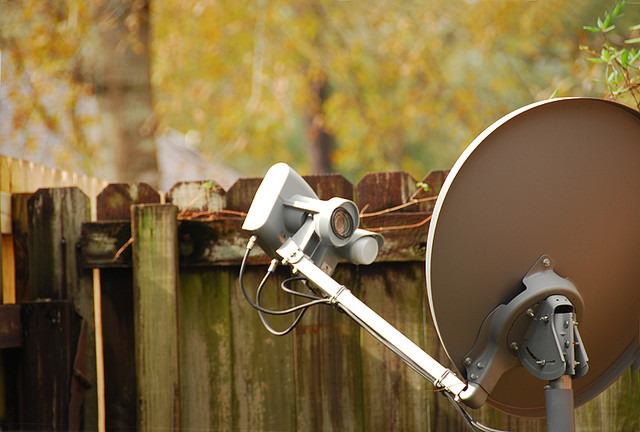
- The reflector. The curved part everyone pictures. On modern 18- to 20-inch DIRECTV and DISH installations it is thin, powder-coated steel. Older and larger dishes are often aluminum. Either way, it is scrap metal and easily recyclable in most communities.
- The LNB. The low-noise block downconverter on the end of the arm. It holds a circuit board and is the piece that makes the system electronic waste.
- The mount and hardware. Usually galvanized steel, and usually the heaviest recyclable component in the assembly.
- Coaxial cable. Copper conductor inside plastic jacketing, which scrap yards buy separately as insulated wire.
The Institute for Environmental Research and Education recommends separating those parts of the dish before you haul anything anywhere: detach the LNB, coil the coax, and sort aluminum from steel. That takes about 20 minutes with a screwdriver and a wrench, and it is the difference between a recycler accepting your load and turning it away.
The receiver, DVR, and remotes are a separate question, and an important one. Those are usually leased. If you cancel service and keep them, you will be billed for them.
Once It’s Installed, It’s Yours
This is the part that surprises people. The dish becomes the property of the homeowner at installation. Neither provider sends a technician to take it down when you cancel, and neither is obligated to. DIRECTV’s own support forums state the position plainly: the receivers go back, the dish stays, and what happens to it next is up to you.
Renters have a related wrinkle. The FCC’s Over-the-Air Reception Devices rule protects your right to install a dish under one meter in areas under your exclusive control, such as a balcony or patio, and it limits what landlords and HOAs can prohibit. It does not cover shared roofs or exterior walls, and it does not remove your responsibility to take the dish down and repair the mounting holes when you move out.
Read your lease before you install anything.
The Rules Changed in Some States, But Not Federally
U.S. federal guidelines still do not regulate circuit boards as hazardous waste, and there is no national electronics recycling law. What exists instead is a patchwork of state and local policy.
Twenty-five states plus the District of Columbia have passed electronics recycling legislation, most of it built on producer responsibility principles, and roughly two dozen states ban electronics from landfills outright. Whether your dish system is legally landfill-bound depends entirely on your ZIP code.
One change is worth flagging because it is new and relevant. Oregon’s modernized E-Cycles program took effect January 1, 2026, and the expanded list of covered devices now includes cable and satellite receivers, routers, modems, and game consoles. Oregon residents can drop those off free. The reflector itself is not a covered device, so it still goes to scrap metal, but the electronic half of the system finally has a no-cost home in one more state.
The stakes behind these rules keep climbing. The UN’s Global E-waste Monitor 2024 found the world generated a record 62 million metric tons of electronic waste in 2022 and formally collected and recycled just 22.3% of it. Generation is on track to hit 82 million metric tons by 2030, growing about five times faster than documented recycling.
Don’t Count on the Scrap Value
Earlier versions of this article suggested that local scrap vendors might be willing to pull the system down for the value of the materials. That is worth a reality check in 2026.
Scrap yards pay by weight and by grade. A modern 18-inch dish is a few pounds of thin, coated steel, which grades low and weighs almost nothing. The coax and the mount are worth more than the reflector, and the whole assembly is still unlikely to buy you lunch. Older six- to 12-foot aluminum C-band dishes are a genuinely different story and can be worth hauling. For the small dishes on most roofs, treat scrap as a disposal route rather than a payday, and do not expect a yard to send a crew for it.
Tips To Get You Started
Here at Earth911, we want your satellite TV dish handled properly at the end of its life. That is not the case. Here is the sequence that actually works:
- Check your provider’s recycling page first and know what it covers. DIRECTV’s recycling page issues a prepaid shipping label and routes equipment to R2-certified recyclers. DISH points customers to Best Buy and a UPS mail-in program that offers free recycling if you pay the shipping costs. Both programs are built around receivers, remotes, and small equipment. Neither is designed to take the dish off your roof.
- Return leased equipment on time. Providers typically give you about three weeks from the disconnect date before non-return fees land on your final bill. Get a receipt at the drop-off point and keep it.
- Search for a satellite dish removal service, a handyman, or a local roofing company. Roofers are the right call if the mount is through the shingles, because someone has to seal the penetrations afterward. Removal is a roof job, not a recycling job, and the two rarely come bundled.
- Find a certified recycler for the electronics. Look for R2 or e-Stewards certification, which tells you the downstream processing is audited. Use the Earth911 recycling search to find electronics and scrap metal locations near you.
- Take the reflector and mount to a scrap metal yard. Separate steel from aluminum before you go.
- Consider reuse before recycling. A working dish and LNB have a second life in free-to-air reception, RV and off-grid setups, and amateur satellite work. Offer it to others locally before you scrap it. There are also plenty of repurposing projects if you would rather keep it out of the waste stream entirely.
- Watch out for lead-generation sites. Several “satellite dish removal” domains are referral networks that sell your contact information to whichever contractor is paying, not recyclers. Ask any service directly where the material goes and whether they are certified.
Earth911 Does Not Remove or Recycle Dishes
We regularly receive inquiries about whether Earth911 offers removal services. We do not. Earth911 does not offer satellite TV dish removal or recycling. If a satellite TV provider or one of its representatives tells you otherwise, that is not accurate information.
What Comes Next for Satellite TV
The retirement wave is not finished. DIRECTV shed roughly 288,000 subscribers in the third quarter of 2025 alone, according to reporting by TheStreet. EchoStar reported 6.63 million pay-TV subscribers at the end of the first quarter of 2026 after a net loss of 366,000 in three months, and its Dish DBS unit filed a prepackaged Chapter 11 restructuring on June 30, 2026. The company says Dish Network and Sling TV service continues without interruption.
For subscribers, the practical takeaway is unchanged: corporate restructuring does not come with a dish removal crew. If you are canceling, plan for the disposing of the hardware. Return what is leased, get the dish down safely, split the metal from the electronics, and route each stream to somewhere that will process it. That is a Saturday afternoon’s work that can keep your dish out of a landfill.
Related Reading
Editor’s note: This article was originally published on June 10, 2015. It was most recently updated in July 2026. Feature image courtesy of Alexis Lê-Quôc.
The post Need to Recycle Your Satellite TV Dish? Read This First appeared first on Earth911.
https://earth911.com/eco-tech/looking-to-recycle-your-satellite-tv-dish-read-this-first/
Green Living
Sustainability In Your Ear: Building Solar Panel Recycling Capacity with SPR’s Brett Henderson
Glass makes up 62% to 70% of a solar panel’s weight, and as much as 80% of a bifacial module with glass on both faces. That single number explains most of what is wrong with solar panel recycling in the United States. The aluminum frame and the silver contacts are worth money. The glass mostly is not, so common practice is to pull the frame, shred everything behind it, and sell the mixed output as low-grade sandblasting grit or landfill cover. The EPA projects the country could accumulate up to 10 million metric tons of end-of-life panels by 2050, second only to China — roughly 393 million modules. And they are retiring now, not in 2050: broken during construction, shattered by hail, or pulled down in year 10 when a utility swaps a 200-watt module for an 800-watt one and quadruples output from the same land.
Our guest is Brett Henderson, co-founder and CEO of SolarPanelRecycling.com, or SPR. The company owns and operates plants in North Carolina, Georgia, and Texas, with a fourth opening in California this year, each built to run about a million panels a year and to scale to 3 million within six months when needed. SPR is a Solar Energy Industries Association-approved national recycler and partnered with SEIA on the first residential panel drop-off program in the country. Brett came to solar after 18 years in electronics recycling at Powerhouse Recycling, SPR’s parent company, and the business started in 2018 with a call from a longtime utility client that had 10,000 panels coming out of a power plant and nowhere to send them.
Brett is blunt about the economics: recycling a panel is a negative value proposition, because a panel is mostly glass and glass is cheap. What SPR sells is risk mitigation. Federal rules treat an end-of-life panel as hazardous until testing proves otherwise, most owners have no idea what is inside the modules they bought, and a utility loading thousands of them onto trucks takes on generator liability and Department of Transportation exposure. Aluminum and silver recovery subsidizes the rest. That cost has fallen 42% in 36 months at SPR, driven by rebuilt separation lines and steadier volume rather than any subsidy, and scale is what opens the end markets — a manufacturer will not retool a line for recycled glass cullet until a supplier can promise something like 160 tons of it every other week.
He is equally candid about the limits. Solar wafers require polysilicon at 6N purity, 99.9999%, and recovered silicon does not reach that grade at a price anyone will pay. The recovered glass is clean enough for foundries, but not for new module glass. A panel, in other words, does not yet close its own loop, and the discipline that matters is clean separation, sending each material to its best destination. He also points out the challenges in reusing early-retirement panels: utility-scale modules are too large for most rooftops, and a module’s UL listing lapses once it leaves its original application, which complicates putting it back on the grid.
On policy, Brett would take landfill bans plus bonding and insurance requirements at project permitting over extended producer responsibility. Washington’s producer takeback law is his cautionary example: enacted in 2017, its compliance deadline has slipped to 2031 after only one manufacturer filed an approved plan. Meanwhile SPR is financing capacity ahead of the wave, largely off its parent company’s balance sheet, so it will not have to turn away million-panel repowers while it builds. IRENA and IEA-PVPS estimate the materials in retired panels could be worth more than $15 billion globally by 2050, enough to build 2 billion new ones. Somebody has to build the receiving end of that system first. Learn more about SPR’s facilities and research at solarpanelrecycling.com — that’s all one word, no space, no dash.
- Subscribe to Sustainability In Your Ear on iTunes
- Follow Sustainability In Your Ear on Spreaker, iHeartRadio, or YouTube
Interview Transcript
Mitch Ratcliffe (0:11)
Hello. Good morning, good afternoon, or good evening, wherever you are on this beautiful planet of ours. Welcome to Sustainability In Your Ear. This is the podcast conversation about accelerating the transition to a sustainable, carbon-neutral society, and I’m your host, Mitch Ratcliffe. Today, we’re going to look at what happens when the clean energy grid ages out.
The United States has installed millions of solar panels, and we tend to treat them as though they’re all 30-year promises. Put them on a roof or in a field, reap the sun’s energy for decades, and the waste question belongs to, well, somebody who lives in the 2050s. But the data says otherwise. Panels are leaving service right now, broken during construction, shattered by hail or hurricanes, or pulled down in their first decade because the utility that owns them wants to repower. In other words, to put new, higher-efficiency modules in place because they pay better, and, in fact, it’s much more profitable than waiting to upgrade. So you swap a 200-watt panel for an 800-watt module, and you quadruple the output from the same land, which is why perfectly functional panels are coming to be retired by year 10.
And the EPA expects the country to accumulate as much as 1 million tons of solar panel waste annually by 2030, and as much as 10 million tons by 2050, the second-largest stockpile of end-of-life panels in the world. China is out front. Most of what passes for solar panel recycling today involves peeling off the aluminum frame and shredding everything else. Glass accounts for 62% to 70% of a standard panel’s weight, and as much as 80% of a two-sided module, and it is typically used as low-grade sandblasting grit or landfill cover instead of going back into a furnace and on to be reused in a new panel. The silver and silicon, while small in weight but large in value, disappear in that mix, and they’re lost for further use.
The International Energy Agency’s Photovoltaic Power Systems Programme estimates that recovering end-of-life panel materials and re-injecting them into the economy could deliver more than $15 billion in value by 2050, along with enough raw material to build 2 billion new panels. We could have a circular system that delivers consistently increasing output, that is, energy output, as panel materials are reused. And the industry we stand up over the next decade will decide whether that value is captured or ground into dust.
My guest today has spent the last eight years building the version of recycling solar panels that can capture those materials. Brett Henderson is co-founder and CEO of SolarPanelRecycling.com, known as SPR, which owns and operates recycling plants in North Carolina, Georgia, and Texas, along with a new California facility that’s slated to open this year. Each is built to process about a million panels annually and to scale toward 3 million within just six months when capacity is needed as more panels are retired. SPR is a Solar Energy Industries Association-approved national recycler, and it partnered with SEIA on the first residential solar panel drop-off program in the United States.
Brett came to solar after 18 years in electronics recycling at Powerhouse Recycling, which is SPR’s parent company, and there he built programs for Fortune 100 companies, government agencies, and universities. The company started in 2018 — that’s SPR — when a longtime utility client called with 10,000 panels coming out of a power plant and nowhere to send them. Brett draws a hard line between true recycling, that is, the clean separation of glass, aluminum, silicon, and the metals into commodities that can be remanufactured or used in remanufacturing, and the shredding and downcycling that often passes for responsible disposal, which he labels as greenwashing. He has seen the cost of recycling at the plant fall by 42% over just three years as technology improved and volume grew. He argues that the economics are approaching the point where a landfill stops being the cheap option on price alone, and getting there is a business design problem. You have to decide what to own, what to build ahead of demand, and how to turn yesterday’s clean energy into tomorrow’s raw materials.
So, let’s find out how you build that business after a brief commercial break. Stay tuned.
Brett Henderson, welcome to Sustainability In Your Ear. How are you doing today?
Brett Henderson (4:44)
Great. Thanks for having me, Mitch.
Mitch Ratcliffe (4:45)
Well, thank you for joining us, diving into solar panel recycling in anticipation of a growing wave of material that’s going to be coming down the pike. In 2018, a utility client showed up at your office with 10,000 panels and nowhere to send them. I’m wondering what made you think at that point that solar recycling could be a standalone business rather than just a service line within a larger recycling organization.
Brett Henderson (5:10)
Yeah, absolutely. So I still have a dual role at the parent company that was presented that opportunity. It’s Powerhouse Recycling. It’s been operating about two decades in the electronics recycling and IT asset disposition space. So one of our longtime utility clients at that time, in 2018 — so at that point, if I’m doing my quick math, we’d been servicing them about 15 years — did indeed come to us, and they were pulling out about 10,000 panels from a power plant they had. And they went to market and recognized at that time that there really weren’t any options, you know, locally within the state or even in the entire U.S. market at that time. And what I mean by that is aluminum harvesting was happening. You know, anything that has aluminum, a nice metal to it, you could probably present it to a metal yard, they’ll capture that, but then the other, more technical or challenging portions might just go to landfill.
So this particular utility of ours is, as most are, really under the microscope on their environmental sustainability initiatives. So they came to us and said, do you kind of want to tackle this project together? So, you know, to answer your question, when it was first presented to me, you look at everything for a client, to service them well. But, kind of in the back of my mind, and full disclosure, um, how many solar panels are really out there? So…
Mitch Ratcliffe (6:36)
Yeah, well, that’s the question. I mean, you’re way ahead of the wave.
Brett Henderson (6:40)
Yeah, right. So we started diving into this and started recognizing that, you know, maybe shift the mind from solar panels on the residential rooftops and go, how many of these utility-scale solar facilities are out there? And you start diving into the numbers and start recognizing, you know, hundreds of millions of panels, right? And then really dive back into where our flagship facility was at the time and still is, in North Carolina. I start diving into that data and recognize that North Carolina was fourth in installations in the entire country. So it really kind of intrigued us to start going down this path and looking into it, and that’s kind of when the R&D began, if you will.
Mitch Ratcliffe (7:21)
Now, most panel recycling focuses on the metal, the aluminum that you mentioned a moment ago. But there’s glass, there’s silicon, there’s silver, and other materials. What’s the value of a panel, and where does that value come from?
Brett Henderson (7:35)
Yes. So you’ll hear a lot, whether it’s us speaking at trade shows or some of our marketing materials, or if it’s even behind closed doors when we’re really doing the environmental audits with our clients — really, this whole industry, it’s all about the glass. So in any recycling medium, you really need to look at what’s the composition of that item, that widget you’re trying to recycle, right? So in the electronics recycling world, where our parent company still lives today and my entire 18 years in the recycling industry has lived, there’s a wide range of compositions depending on what that electronic is. But when you really look at the solar side of things, it’s glass, right?
So a single-sided solar panel, which means glass on one side — if you flip it upside down, you’ll see the plastic backsheet — it’s anywhere between 62% to 70% glass by weight. Bifacial modules, which are the newest technology being installed at the moment, where there’s glass on both sides — it allows them to be a bit more efficient because they could capture sun from both ways — the composition could be up to 80%.
So the aluminum frame indeed matters. It helps drive the cost per module that you’re hitting at. The silver recovery indeed matters. But really, the glass is where it all lays. If you cannot recover the glass cleanly without contaminating it with silicon and silver and other metals, or the plastic backsheet, or the encapsulant, then how can you charge yourself with the mission of being a recycler if that portion is kind of being skipped just to get the low-hanging fruit, which is aluminum? So the module value comes from the aluminum and derives from the silver that’s recovered, but that’s helping subsidize the overall cost of recycling a panel, which is typically always going to be a negative value proposition because it’s mainly glass, right?
Mitch Ratcliffe (9:30)
That’s an interesting point, that it’s a negative value proposition. It’s not the kind of pitch you would normally make for a business. So how do you describe what SPR is selling? Is it a disposal service for the asset owner? Is it a commodity that you’re providing as a feedstock to manufacturers? Or is it providing compliance information? Or all three?
Brett Henderson (9:52)
A little of all three. I mean, what we kind of present it as is risk mitigation, right? And it’s not just risk mitigation from an environmental perspective, which we’ll dive into. It’s not just risk mitigation on a project timeline occurring or staying on track. And it’s not just risk mitigation on DOT compliance when you transport panels from facility to landfill, or facility to, hopefully, a recycler like us. So all of these things are important. So that’s really what you’re selling.
I give the analogy of a cardboard box, right? Cardboard can be recycled, should be recycled. A lot of households, a lot of businesses choose not to, because there’s not a whole lot of risk if you throw it in the landfill. There’s not regulation against it. You’re not worried about hazardous waste or universal waste being transported incorrectly. You’re not really even worried from a PR perspective of someone coming to your facility and saying, “Why aren’t you recycling your cardboard?” But when you flip that on the panel side — this is the service we’re selling and what our industry is selling — solar panels have a wide range of compositions to them. Some could be classified hazardous. Most, you do not have the information. So as it stands today, from a federal level, it’s deemed hazardous until proven otherwise.
So the option and the ability to just load up thousands and thousands of solar panels from your utility site, put them on a truck, transfer them to landfill, and dump them is opening up all sorts of generator liability. It’s opening up the DOT risk on how you transport and tag waste. So these are all the things that are why this service is being presented, and why a utility or an energy company is willing to be charged for that service.
Mitch Ratcliffe (11:35)
You’re describing a lot of different panel chemistries, a lot of different physical configurations. That requires a lot of specialized equipment. How do you maintain full utilization of that so that you’re actually earning the return you’re expecting?
Brett Henderson (11:49)
Absolutely. So, quite a few different ways. You know, first and foremost, R&D has to be ongoing, right? So the way a panel is being manufactured now, or even a future panel that is still in that manufacturer’s R&D phase, could be a wildly different composition, size, and technology than what’s hitting our recycling stream now. So we have a very strong team. It’s led by Finley Collins, our circularity research analyst, and she is consistently looking at what’s in the stream now, what is upcoming, and maybe even what are some of those technologies that are currently in the lab setting, so we could really be a bit proactive on what are going to be the challenges that are upcoming.
Then that has to coordinate — and part of my role as a quarterback of all of this — coordinate with our actual operations team and our engineers that have the current technology. Okay, our current recycling technology in our North Carolina plant, our Georgia plant, our Texas plant, our California plant that’s getting set to open: how is that going to handle the current panel compositions hitting the stream now, and ones that our clients are installing? Because, again, installation breakage could put a very new technology into the recycling stream right away. So it’s this juggling act and this balancing act to continuously invest, research, and make sure that you have opportunities to offer recycling for all panel types.
Mitch Ratcliffe (13:17)
Design for recyclability is really where we need to go as an economy more broadly. But if you could sit down with panel manufacturers today and say, you know, build it this way, we can recover a lot more material, what would you advise them to do? How would you suggest simplifying the designs for better recyclability?
Brett Henderson (13:35)
Yeah, this is a question that’s asked often, not just in the solar manufacturing and recycling spaces when they merge, but really dating back to, you know, you can look at car manufacturers and the right to repair, and electronics manufacturers. And it’s always a challenge for a recycler to really have that leverage and push that manufacturer to have those discussions, mainly because they have a duty to their stakeholders and their shareholders to make sure they’re manufacturing a product that lasts, manufacturing a product that meets consumer needs and is durable, right? So we’re kind of that person on their right shoulder, in their ear, that they kind of probably want to ignore a little bit at times.
That being said, on the solar space, there has been some level of engagement from some manufacturers. But how it stands now is, the United States needs a whole lot of power. That’s no mystery, you know, with data centers and AI really driving that, and then all sorts of the building and expansions. Anyone that could produce any type of energy really is holding the cards at the moment, and they have this core focus to meet demand and get panels, in this instance, out into the field to help support power needs. So as it stands now, there’s not a whole lot of leverage or thought put into that.
And the challenging part with solar is, it needs to be durable. It’s supposed to withstand extreme hail events, wind events, hurricanes, all sorts of natural disasters, or even just regular weather events. So by design, it needs to almost be challenging to break apart, right? And now analyze the problem when it comes to a recycling facility: our whole goal is to break it apart to all raw commodities and get those back into the stream. So there’s obviously wildly opposite goals and conflicting goals there that make that a challenge. Now, that being said, what we do have quite a bit of talks with the manufacturers about, and see some willingness to, is the information of the panel, which is still lacking and could really help be proactive in recycling.
Mitch Ratcliffe (15:42)
You mean in the product passport sense?
Brett Henderson (15:44)
Yeah, in a few different senses. One is a TCLP test, right? Would manufacturers be willing to say, this particular make and model, here’s its characteristics? Now we know it needs to be classified hazardous, or it doesn’t need to be classified hazardous. Because as it stands now, we have to get a physical panel from the field from one of our clients — knowing that they’re having an upcoming event or repower, or they just have some backlog ready to recycle — and we have to bring that in, grind that down, if you will, and get it to a lab to understand how to classify it, to really be compliant with DOT rules and all sorts of regulations. So a manufacturer could really assist in allowing the recyclers, and even the asset owners, to know what this panel is comprised of. Does the lead pass TCLP? Does it not pass TCLP? So you could classify this as waste when it comes to end of life.
And a second piece of information that could be super helpful is, again, we talked at the front end of this conversation how aluminum recovery and silver recovery is really what subsidizes the recycling costs. That determines if a panel is five to $7 to recycle, or higher or lower. So understanding the silver and some of the other metals that were utilized, by parts per million or by grams per metric ton — understanding the composition of that panel could also help make recycling costs more competitive, and then also help divert more panels from landfill to the recycling stream.
Mitch Ratcliffe (17:21)
Well, SPR owns and operates all four of the facilities that you operate, and you don’t broker materials out to scrapyards or haulers or anybody. I have to say, you know, ownership is obviously capital intensive, but what does vertical integration buy you that you couldn’t get from a network model?
Brett Henderson (17:39)
Yeah, seamless service is first and foremost. And what I mean by that is, let’s talk about repowers here. Let’s talk about installations. Really, it’s the same bucket, but we’ll do this under the guise of repower. So a repower is when a utility or an energy company is going, we have 100,000 panels in our field, they’re 200-watt panels, you can now get an 800-watt panel. So the math maths out for us to pull these panels out, you know, maybe much earlier than the 25-year span that they’re kind of advertised for, so we could get a four-times power generation there.
It’s a major undertaking. They’re going to do it in stages, so a lot of times the site doesn’t have to ever completely shut down. So why does end of life matter in that instance, and why does vertical integration matter? Is, they really need seamless service. If they have 20 truckloads of new panels arriving that day, and their contractor has 20 truckloads of old panels that need to go out that day — it’s not a warehouse, there’s not loading docks — there’s a lot of seamless service from a logistical standpoint that could really have high cost to a customer for not going off seamlessly. So us controlling that logistical network is just one of four or five reasons why this owned-and-operated model is very helpful to our clients.
Mitch Ratcliffe (18:58)
Does it make sense to start thinking about this as a full lifecycle integration opportunity? Should you be part of a panel company, or panel companies be co-invested across a variety of processors like you?
Brett Henderson (19:10)
I believe that we won’t probably see it get to that point. And if I understand your question, what maybe you’re hitting at here is circularity in the sense that the commodity comes from the panel and goes directly into panel manufacturing. Is this what you’re…
Mitch Ratcliffe (19:26)
Yeah, essentially stewardship of the material over many generations.
Brett Henderson (19:30)
Yeah. So, you know, I can’t speak for manufacturers if they want to get into the recycling space or partner directly with a recycler under some sort of joint venture, but I don’t see it having value to a manufacturer in terms of cost savings of getting a material recovered from a solar panel and put back into manufacturing. And the reason for that is the polysilicon that’s used to make the wafer itself. So obviously the panel can’t work if you don’t have good solar wafers. That has to be manufactured at a 6N purity, and that basically means 99.9999%. That’s where the 6N comes from, and the recycling space can’t generate that.
When they’re getting this pure polysilicon to manufacture solar wafers, there’s other types of agents and reactors and compositions baked into this, if you will. Now it’s not pure silicon. So when the recycling industry recovers it, that silicon could be used in a lot of other applications that don’t require 6N purity, but not solar manufacturing. So one of the biggest drivers of what makes the solar panel work all of a sudden still can’t go back into it.
And then there’s an economic side to it as well. Raw polysilicon is not the most expensive raw material. So the cost of — our industry, we partnered with some very brilliant researchers that have been working on this for years, and they could get it to that 6N purity, but the economics aren’t even close.
Mitch Ratcliffe (21:09)
Yeah, right. At the cost that it’s going to take, you wouldn’t be profitable. Yeah, there’s a lot to talk about here. Let’s take a quick commercial break, folks. We’ll be right back to continue the conversation with Brett Henderson of SolarPanelRecycling.com.
Welcome back to Sustainability In Your Ear. Let’s return to my conversation with Brett Henderson. He’s the co-founder and CEO of SPR, which you can find at solarpanelrecycling.com. They’re a North Carolina-based recycling company that’s partnered with the Solar Energy Industries Association to launch the nation’s first residential solar panel drop-off recycling program. Brett, you’ve reported that your recycling costs have fallen by 42% over the last 36 months. What are the factors that are driving that cost curve down?
Brett Henderson (21:57)
So there’s several things that really drove the 42% drop in costing, but the main one is the technological advances that we’ve had. We’re consistently investing in improving our recycling lines that are separating all of the commodities cleanly from the solar panel. So we used to make this joke starting in 2018, when we were under R&D stages and putting equipment in, that if you visited any of our facilities and came back six months later, you might see a wildly different line. And that was true for the better part of 2018 to 2023. Now, when you would come back, you’d see iterations of it, some add-ons, some movements, so you might not see a complete rip-up-the-script type of deal. But really, technological advances is what’s driving these costs down.
First and foremost, how many panels could get through a machine in a given hour is a large aspect of it. But more importantly is how cleanly are you recovering the silver, the aluminum, the items that have value, to really help cut into the cost of getting clean glass cullet out into the market, you know, the negative-valued items. So those technological advances have allowed us to recover higher returns on items and go direct to foundries, direct to consumers with our glass and aluminum and silver, and then also get cleaner commodity separation for even some of those negative-valued items to make sure that they’re consumed at a better rate. So technological advances is the largest one.
Second is just economies of scale, right? You know, when we first got into this space, we might have a month where we bring in 15,000, 25,000 panels, and then you have a month where we only bring in 5,000. Then you have a month where you have 50,000. Well, fast-forward to 2026, and we have all or some involvement with the largest utilities or energy companies in the United States, the largest asset owners. You have a little bit more consistency there in your volume coming through. So that allows us to go to market to these manufacturers that consume our generated commodities and (a) get better pricing because we’re giving them more consistent volume, or (b) even open up markets together, right? So, you know, Mitch, if you wanted to use recycled glass cullet in something that you’re manufacturing, you’re probably not going to really take a serious look at that and start adjusting your manufacturing line until companies like SPR could say, I could provide you 160 tons every other week of it, right? So some of those economies of scale is really what helps bring down the pricing as well.
Mitch Ratcliffe (24:25)
Well, and that volume has allowed you to offer the residential panel recycling service, which of course then gives you another source of supply. But tell us about that program, and where can people drop stuff off?
Brett Henderson (24:36)
Yeah, absolutely. So, again, a lot of the recycling industry, really in any recycling medium, but even more so solar, is really driven around high volume, large scale. So all of the focus and the R&D and the education outreach is really toward corporations, private equity, anyone that owns these assets, utilities, energy companies. So the residential sector was kind of left behind as this industry that’s in its infancy is growing.
So SEIA, which is the largest trade association for solar in the United States, came to us two years ago and said, we’re receiving maybe 15, 20, 25 calls sometimes a week from a homeowner saying, we have one panel, we have two panels, we really like recycling, we don’t want to throw it in the landfill. So they recognized our early-mover advantage as one of the thought leaders in this industry, as well as the fact that our parent company already has municipality convenience center logistics and trucks staged throughout the country for the electronics recycling side. So they came to us and said a natural fit would be for us to partner together and kind of do this first pilot to understand how many residential panels are actually in need of being recycled. Are they willing to load that one panel in the back of their car to bring it to a convenience center?
So we partnered with Mecklenburg County, which is the county that represents Charlotte, North Carolina, for a few reasons. One, they have five collection sites that we already service. We already have trucks and infrastructure there, so it could keep costs low for the pilot. Secondly, our flagship recycling facility is 45 minutes up the road from it. And third, North Carolina is fourth in installations of solar in the entire nation. So it felt like a natural fit.
So we ran this six-month pilot program, and we found out a few pieces of key information. There is a willingness to recycle, but not a whole lot of volume yet. We received about 19 panels. And if you think about it — we talked about repowers earlier — a utility that’s trying to generate as much energy as possible for the grid, it makes sense to pull out a panel early, because you’re swapping out a 200-watt for an 800-watt, for a times-four multiplier. But when your house system is designed, it’s kind of designed to run the power that’s needed for the house. So a homeowner’s mindset is quite the opposite: I want these to last even past the 25 years. If I’m lucky, they last 50 years. So really, what you’re seeing in the residential space now would have to be a failed panel, or something quite literally dropping from the sky to crack it, or a hail event. That’s really what’s hitting the stream. So there’s not a whole lot of volume yet, but there is a willingness from those that invested in solar on the rooftop to want to actually recycle it.
Mitch Ratcliffe (27:19)
You make this point about the static needs of a home — I know I need this many kilowatt-hours to power the house overall. That suggests that there might be a reselling opportunity in taking those repowered panels you were talking about and making them available to residential buyers who do look for the 25 years that the utility is not interested in because they’re interested in maximum output. Is that a potential new direction for us to think about, repurposing some retired utility-scale solar panels?
Brett Henderson (27:52)
Yes. So we talk quite a bit on this. Finley Collins, who I mentioned earlier, our circularity research analyst, wrote a wonderful white paper on the challenges of reuse and repurpose. You know, any of the listeners are welcome to reach out on our website and request it. But there is an opportunity to reuse solar panels. Right now, in the market, though, it’s a little bit of greenwashing in the sense of really what that market could consume, and I’ll tell you why.
A solar panel isn’t plug-and-play. They’re not homogenous in their size, their width, their depth, their wattage, what inverter box, what string inverters it needs, the racking. So what happens is, when we have a utility take out 100,000 panels that still have life left on them, there could be an opportunity when you’re talking five panels, 10 panels, maybe for the DIYer to take that one panel and rig it on their RV. But this kind of notion that it’s going to put really any type of dent or percentage in panels from the recycling stream, to reuse, is quite flawed for that reason, right? And so utility-scale panels are typically heavier and larger, so the odds of it going on a rooftop application for a home is probably little to none. But that home might not have been developed yet, their system, and then they could consider something like that.
But, you know, when we’re talking about repowers — we’re under a repower right now that’s a million panels plus coming out, over the course of a few years as they’re doing it in stages — we get asked that all the time. Can’t you take these 1.2 million panels and put them overseas in an area that can’t afford it? And the challenge with that is, it has to be an engineered setup. You have to get the right racking, and then there’s a lot of interconnection rules about putting a used panel onto the grid. In the U.S., for example, the UL rating, once that panel is used and off of its initial application, the UL rating is no longer valid. So that’s just one of many problems of taking used panels and getting permitted to put a used panel back on the grid by the millions, by the hundreds of thousands — not for the DIYer that might want to put it on his or her RV.
Mitch Ratcliffe (30:14)
So 31 states have some form of decommissioning policy today. From a business design standpoint, which policies do you see actually creating functioning markets? Is it the landfill bans? The bonding requirements? Is it extended producer responsibility? And are there policies that just create paperwork?
Brett Henderson (30:33)
Yeah. So landfill bans is where we stand on this topic. We’re asked it quite often. I’ve spoken on the legislative floor in North Carolina for their economic review commission a few years back. Another partner of ours, Steven Turk, actually spoke up on Capitol Hill on this topic a little bit. But we see a landfill ban really being the one that would create the most action.
EPR is a very challenging thing to do in this space. You know, these panels might be installed for five years, 10 years, with the goal of them being 25 years, right? So how do we set up this EPR system when there could be a 25-year lifecycle for it? That creates some challenges. But even more so, we talked earlier about the leverage of this whole thing. There’s probably not going to be a tremendous amount of states willing to say to the manufacturer — which, by the way, most manufacturers are overseas still — that you’re not going to supply power to our state, even though the whole country is in need of as much power as possible, because you’re not helping fund recycling.
The state of Washington put in an EPR program for solar, and they had to extend the timeline for manufacturers to apply to it, because only one manufacturer actually went through the paperwork and applied to be compliant in it by its first deadline. So I think that’s just one example of why EPR might be a challenge.
So really, landfill bans is the largest thing that would drive it, as well as decommissioning, bonding, and insurance requirements. When we first got into the space, we would be presenting at a trade show, and someone would come up and say, hey, we’re trying to get this project permitted, and our locality needs to understand what the cost would be to return the land back to use. And they were tagging these as a positive: we’re going to take this equipment out, whether it’s five years, 10 years, 40 years down the road, and all the infrastructure is going to net positive value back, so we don’t need bonding, we don’t need insurance. And the education has kind of shifted that mentality now, where there are very few localities that aren’t onto that. So I think the landfill ban and the bonding and insurance requirements is really what would drive panels from going from landfill to recycling stream.
Mitch Ratcliffe (32:55)
Now, your bottom line is exposed to commodity price swings, like for aluminum and silver that we’ve been talking about. Can a recycler actually build a business model that survives a commodity price downturn?
Brett Henderson (33:06)
It can, because in this instance, again, it’s a service charge for that risk mitigation. So right now, the recycling industry is still in its infancy stages with solar. So we are generating our own black book, if you will, of knowing this make and model recovers X amount of grams per metric ton of silver, and this make and model has X amount of tons of aluminum, and here’s the aluminum composition. When this builds out five years, 10 years, 15 years, we might be able to get really granular with the commodity market and say, well, this particular panel, we could actually be 80% under what we normally charge because we know it has higher silver recovery, we know the aluminum frame is heavier.
But right now, unless there’s just an absolute crash in silver and aluminum, the commodity market — we have to kind of take a bearish look at it when we’re pricing, because, again, to hit on what we said before, the manufacturers don’t tell you what the composition of these are. So there’s a wide range of silver recovery. So we can’t just take the extreme side of that and say every single solar panel is going to recover X amount of silver, or you could find yourself in a challenging situation where you can’t scale.
So aluminum and silver markets do matter. Both were inflated. Silver’s back down a little bit, back down to earth. But for a while, that did cause us to be a little bit more bullish in our pricing and come down lower. But for the most part, the way the industry is set up, a little bit of volatility in that isn’t going to change the pricing, because most of that’s going to be on the transportation costs to get the panel from site to facility, as well as the processing costs.
Mitch Ratcliffe (34:45)
Now, as we’ve been talking, we’ve referred repeatedly to the future wave of material that’s coming, and you need to build capacity to get ready for that. You’re expecting that repowering, as we’ve been talking about, is going to increase from about 10% of the supply to 80% of the volume in five years. How do you get the investment, the financing, in place to build that capacity when the demand hasn’t arrived?
Brett Henderson (35:09)
The level of risk and putting the cart before the horse is probably the most simplified answer to that, and we have that. We’re very bullish on this industry. I think our background of being one of the nation’s largest electronics recyclers — it kind of has a similar arc to where that started. It was unregulated. There was sham recycling going on. Then it becomes regulated. Then you recognize how much volume of electronics are hitting. We have a little bit more of a bullish take on solar because we’ve seen that, and we think there’s a lot of synergies and similarities to that.
So we’re investing in owned-and-operated facilities and regions. As soon as we have a partner that might have only 100,000 panels that we’re contracted to take, we’re willing to maybe invest in that to build out our network ahead of all of these repowers hitting. But you are right, it is capital intensive. You have to have wonderful partners. Our parent company is what’s funding most of it. We have some other private investments at times. But again, we want to build out this infrastructure so that when that wave hits, we’re ready to absorb as many of those panels as we could be offered. We don’t want to be in that position where we’re turning down multimillion-panel repowers because we’re just building out our second facility.
The other side of that is, all of our facilities are being built with more added capacity that could get online much quicker. So the longer and more capital-intensive buildout is the actual facility, the land, the permitting, getting that first line in there, getting the training, the labor. You know, it’s a new industry. We can’t go to the industry and find someone that said, hey, I worked for a solar panel recycler the last 20 years. So there’s a lot of education and training. So once we’re having those built out — we did it in North Carolina first, then Georgia, then Texas, California slated to open in 2026 — all of these are being built where, okay, those have a capacity right now of 1 million panels a year, but it can quickly scale to 3 million panels a year within six months. So that’s the other side of, as you’re building out this network, is put the new spots, or put the new regional locations out there, but also make sure that those could quickly scale for more capacity.
Mitch Ratcliffe (37:16)
So you just described enough capacity to address what the EPA projects is going to be happening by mid-century. By 2050, they’re estimating about 10 million tons a year of panels are going to be coming back for recycling. Play this all forward to 2036. How many facilities, what policy frameworks, and what commodity markets are going to have developed as a result of this massive wave of new solar panels needing recycling?
Brett Henderson (37:42)
Yeah, a quick aside on the math of that. So the recycling world is always operating in tons or pounds when it comes to capacities, when it comes to recycling throughput and output. What I was just referring to was panel count. So, you know, 1 million panels annually, scalable to 3 million panels. And that was kind of driven off of the asset owners — you know, they speak in watts, right, how much is it per watt — so we kind of met in the middle there and kind of helped guide the industry to say, let’s do per-panel costing, let’s do per-panel quotes. The report you’re referring to, for 10 million metric tons — now you’re talking about 393 million panels.
Mitch Ratcliffe (38:29)
So, okay, so there’s plenty of room for growth.
Brett Henderson (38:30)
Yes, yeah. So, exactly. So, you know, we obviously want to capture as much of that as possible, but we’re not the only game in town. We won’t be the only game in town. But we want to build regionally to make sure that we have a competitive advantage from the logistical cost, so that client wants to push their panels through our facilities versus elsewhere. Logistics, nine times out of 10, is going to be the highest cost in recycling a panel, more so than the processing fees.
Mitch Ratcliffe (38:57)
To your point, there is no way of projecting the future value of a used panel. Should that be one of the focuses of the industry, to begin to provide the accounting to panel acquirers so that they can plan the full lifecycle? And would you share your data in order to help establish that standard?
Brett Henderson (39:16)
Yeah, the short of that is, we already have been developing that. We have some 3D mapping capabilities in all of our facilities, so anytime we get a panel in, we run these panels through so we can understand its true composition, because the manufacturers are not sharing that. So now we know this particular make and model has X amount of grams per metric ton of silver, it has this amount of weight of aluminum. So now we have this black book, if you will, that we already are developing, and, you know, R&D started in 2018, so we already have eight years of this. And we do already share that with our onboarded, signed clients.
Putting that out in the ethos would be wild for us to do at the moment, because we have that competitive advantage of doing this the right way from day one, where we could actually gather this data. At some point — whether, you know, you’re referencing 2036 — at some point there’ll be enough recyclers, I’ve been doing it long enough, that maybe that information isn’t so proprietary, that there’s value for our team to kind of be the home of that information and provide that to the public. But right now our clients are already receiving that service. And to be fair, there’s so many different makes and models that that service isn’t utilized 100% of the time, right? Like, a lot of these panels coming through, we’re going, that’s the first time we’ve had that. Let us bring this in and get you some good information on it.
Mitch Ratcliffe (40:38)
It is reminiscent of the emergence of standards across information technology as well. But in order for us to have a functioning and predictable circular economy, this information ultimately is going to become commonplace.
Brett Henderson (40:51)
Right.
Mitch Ratcliffe (40:52)
You don’t lose an advantage in that case, but you have had the opportunity to lead the industry toward those standards, and that could cement your leadership. Is that the kind of strategy that SPR is thinking about, or are you going to hunker down and keep it private in order to maintain that advantage?
Brett Henderson (41:12)
Absolutely. So we have always wanted to position ourselves as a thought leader. I think we’ve had a lot of early success in this industry due to our transparency. Here’s the issues. Here’s how you should audit a recycler. Here’s the right questions you should be asking. Because in an industry that doesn’t have any certifications or standards yet, we wanted to be the one driving it the right way. If we lose a deal because we know someone’s bringing that panel in, harvesting the aluminum frame, and landfilling the other 90%, and then they could offer free recycling or even pay back a few dollars — we’re fine losing those deals now, because we have been through this arc of what you see in our electronics recycling.
So we’re going to continuously be that thought leader and driving the industry the correct way. So, yeah, we would absolutely share that information. We do share a good bit of information publicly, you know, such as this white paper I’ve referred to that already is doing a lot of groundwork for people entering the space. But right now, as it stands today, there’s a lot of institutional knowledge that went into developing the specifics of actual panels, that we would present that to the market when it’s the right time.
Mitch Ratcliffe (42:21)
So we’re in the early chapters of this story, and people are going to want to understand what you’re learning. How can they follow your work?
Brett Henderson (42:27)
Yeah, so we’re quite active on LinkedIn. I think that’s probably the best space. We have a wonderful marketing team, as well as what we like to joke about here, that we really like to geek out on this stuff. We don’t want to market our way into recycling. We want our information to be clean, transparent, and knowledgeable. We’ll talk about what’s great about it. We’ll talk about the challenges about it. So a lot of that could be followed through that.
We’re at typically most regional and national trade shows. We speak often at them. We have a team that’s working on white papers, case studies. All these things are kind of readily available. We’re across a lot of the different social channels where those could be found, or on our website you could sign up for a newsletter that kind of guides some of these out as well. But I really would say LinkedIn and signing up for that newsletter is probably the easiest and quickest way to absorb all the information we’re putting out there.
Mitch Ratcliffe (43:21)
Well, Brett, thanks for sharing the story. It’s been a fascinating conversation.
Brett Henderson (43:25)
Yeah, thank you, Mitch. It’s always wonderful to talk about it. Anytime you’re in an industry that’s really in its infancy, the opportunities that you’re giving for this subject to come to light are equally as important. So thank you for that opportunity.
Mitch Ratcliffe (43:43)
Welcome back to Sustainability In Your Ear. You’ve been listening to my conversation with Brett Henderson, co-founder and CEO of SolarPanelRecycling.com, known in the industry as SPR, a company that owns and operates recycling plants in North Carolina, Georgia, and Texas, along with a new California facility opening this year. You can learn more about Brett and SPR at solarpanelrecycling.com. Solarpanelrecycling is all one word, no space, no dash: solarpanelrecycling.com.
So, reflecting on that conversation, the number that I’m thinking about is 42%, and that’s not just because 42 was Douglas Adams’ answer to the meaning of the universe. It represents how far the cost of recycling a panel the right way has fallen at SPR over the past 36 months, and it points to continued efficiency gains. No subsidy produced that. No mandate produced that. It came from rebuilding processing systems to separate clean glass, aluminum, and silver reliably enough to sell, and with enough steady volume to negotiate better prices with buyers who are seeking reliable material sources.
Brett’s candid that recycling a solar panel still remains a negative value proposition on the face of it, because a panel is mostly glass, and glass is cheap. The business he’s describing also sells risk mitigation to utilities that cannot afford a truckload of possibly hazardous waste ending up in the wrong place, so they take it and recycle it and get a fee for taking it away as well. The recovered materials subsidize the rest, and when revenue streams converge, that is what an industry looks like at the moment it starts to work.
The panel recycling wave is already building, and the recycling infrastructure is being built ahead of it. Brett’s plants are each built to run about a million panels a year, and to scale toward 3 million in just six months when panel retirements grow. And he’s financing that capacity before the volume arrives, largely off his parent company’s balance sheet. Now, that’s a real bet with a real downside. If repowering economics soften, that capital is just going to be sitting there not earning a return. But the alternative is an industry that turns away million-panel contracts because it was waiting for proof. Every array going up right now, including, for instance, the tribal solar power projects that Cody Two Bears of Indigenized Energy described on a recent show, is tomorrow’s feedstock for the next generation of panels and other products. Somebody has to build the receiving end of the circular economy first, and SPR is doing it, at least for solar panels.
The polysilicon in a solar wafer has to hit 6N purity. That’s 99.9999%, and recovered silicon currently can’t achieve those levels at a price anyone would pay. The glass comes back clean enough for foundries and other manufacturers, but not for new module glass. So the panel currently does not close its own loop, and Brett said so frankly. This is a most useful correction to how we think about circularity. A solar panel is an industrial object made of several materials that each have their own best destination, and the discipline that matters is clean separation, not sentimental attachment to a closed loop. So you have to take apart your thinking about circularity and reassemble it to make sense in the context that it actually exists. Amy Fernandez and Zach Lauer of Trex, the decking company, made the same case when we talked about polyethylene film recently on another show. The best source of feedstock for Trex turned out to be its retired decking, not solely collecting more polyethylene film. So for the time being, we have to judge a recycler, at least a solar panel recycler, on whether the glass they process leaves uncontaminated, not whether it goes back to where it came from — in other words, another panel.
The last idea of note is what all of this is for. Materials recovered from retired panels are materials that do not need to be mined, refined, and produced, so you don’t have to do as much damage to the environment, and you use a lot less energy. The estimated value of recoverable materials in end-of-life solar panels could exceed $15 billion by 2050. That’s enough raw material for 2 billion new panels, the basis for a robust industry, too. But that value will be realized only if someone will buy it, and that’s because end markets are built on reliability.
Mitch Ratcliffe (48:06)
Brett put this plainly: a manufacturer will not retool their line to use recycled glass until the supplier can promise 160 tons of it every other week. New rules can move that volume faster than prices. The European Union requires producers to finance collection and recycles the majority of its retired panels. On the other hand, the United States, without these regulations, recovers only 10%. The proposed EPA universal waste rule for panels has slipped again and is now expected, or rather not expected, until next year. Brett’s read on that is that landfill bans plus bonding and insurance requirements at the permitting stage of a solar project will do more than extended producer responsibility to drive recycling success. Regulation can create industries, not just destroy them, as critics often argue.
So we need to watch three things over the next 24 months: whether more states ban panels from landfills, whether decommissioning bonds become standard in project permitting, and whether the per-panel composition data — that is, what panels are made of — that recyclers are compiling privately becomes a shared standard, so everybody can begin to recognize the value in these materials based on a common understanding of that value. Those three will decide whether the next 393 million panels become raw material or just cover in a landfill. And we’re going to continue to track the story.
If this conversation changed how you think about the array on your roof or the one going up down the road, send it to someone who’s about to install solar, or leave a review wherever you’re listening. You folks are the amplifiers that can spread more ideas to create less waste. There are more than 560 episodes waiting in the Sustainability In Your Ear archive, and you’ll find us on Apple Podcasts, Spotify, iHeartRadio, Audible, or whatever purveyor of podcast goodness you prefer. Thank you for your support.
I’m Mitch Ratcliffe. This is Sustainability In Your Ear, and we will be back with another innovator interview soon. In the meantime, folks, take care of yourself, take care of one another, and let’s all take care of this beautiful planet of ours. Have a green day.
The post Sustainability In Your Ear: Building Solar Panel Recycling Capacity with SPR’s Brett Henderson appeared first on Earth911.
https://earth911.com/podcast/sustainability-in-your-ear-building-solar-panel-recycling-capacity-with-sprs-brett-henderson/
Refrigerants have posed a threat to the environment for decades. A group of chemical compounds called chlorofluorocarbons (CFCs) was responsible for the ozone hole over Antarctica, which increased the risk of health problems from exposure to extreme levels of ultraviolet radiation. The world gradually phased it out, causing the ozone layer to recover.
The collective effort to avert an environmental disaster by banning CFCs is worth celebrating. However, their long-term replacements, hydrofluorocarbons (HFCs), have proved to contribute to global warming. Learn how they worsen climate change and about the things you can do to cool your home more sustainably.
Air conditioning equipment relies on refrigerant to cool spaces. As a liquid, it flows through the unit’s evaporator coil and absorbs heat from nearby warm indoor air. Then, this fluid boils and turns into cool, low-pressure gas. The compressor converts it into a hot, high-pressure gas, raising its temperature above that of the outside air as it enters the condenser coil outside. The refrigerant releases heat inside, as the fan blows air over the coil. Next, the gas condenses back into a high-pressure liquid as it cools. It passes through an expansion valve, sharply dropping its pressure and temperature. The fluid reenters the evaporator coil to absorb more heat, repeating the process.
The refrigerant in fridges and freezers works similarly. The fluid also undergoes evaporation, compression, condensation, and expansion to cool the interior and transfer heat to the room.
Most Common Refrigerants Used Today
The most common air conditioner refrigerant is R-410A. Also known as Puron, it’s an HFC, which means it doesn’t deplete the ozone layer but has a high global warming potential (GWP). Every ton of R-410A is equivalent to 7,308 tons of carbon dioxide, making it a potent greenhouse gas.
That’s why the U.S. Environmental Protection Agency has begun phasing it out. It no longer allows contractors to install HVAC equipment with R-410A manufactured or imported before January 1, 2025, in houses. This policy mandates that the construction and home improvement industries gradually transition to more eco-friendly refrigerants.
HVAC manufacturers are gravitating toward R-454B as the new standard for central air conditioning. Also known as Puron Advance, it’s a combination of HFC and hydrofluoroolefin. This blend contributes significantly less to climate change but has a safety designation of A2L, indicating low toxicity and a mildly flammable, low-burning-velocity profile.
For ductless ACs, HVAC brands are adopting R-32, a single-component HFC with a lower GWP and better recyclability.
Refrigerator makers are following the same trend. They’re decoupling from R-134a, the long-established refrigerant standard, as authorities begin phasing it down due to its high GWP. Its alternative is R-6000a or isobutane, a naturally occurring hydrocarbon found in crude oil and natural gas. This fossil-fuel derivative is still more sustainable than its predecessor, as it poses no threat to the ozone layer and has an ultralow GWP.
How You Can Be Part of the Solution
Soon-to-be-obsolete refrigerants harm the environment only when they escape from your cooling equipment. Although some causes of refrigerant leakage are challenging to stop, you can mitigate them with these tips.
Replace Your Older Unit
Aging equipment is more prone to damage. Constant vibration causes the tubes to rub together and loosen their sealed joints. Proper AC and refrigerator care only helps if you brush the coils with appropriate tools, as hard bristles and harsh chemicals can compromise the copper tubes.
Upgrading to a model with a more eco-friendly refrigerant reduces the risk of leakage and its negative environmental impact if it does occur. A modern system is more efficient, lowering your utility bills and helping pay for itself over time.
Seal Minor Leaks
Say you can’t afford to change appliances at the moment. The least you can do is to fix the leaks before they compound.
A good way to detect small causes of refrigerant leakage on your own is to monitor your energy usage. Any refrigeration equipment running low on this fluid operates inefficiently, translating into higher electricity bills.
For instance, your AC may be leaky if your electric consumption jumped from last month, even though your thermostat setting and cooling habits remained the same. A modern fridge uses nearly 1,575 kilowatt-hours of electricity per year, so anything above that may indicate a lower refrigerant level.
Contact a qualified technician immediately if you notice that your unit underperforms. A professional should be able to identify and address the source of leakage, then recharge your appliance to restore its performance.
Embrace Preventive Maintenance
This appliance care strategy means scheduling a professional inspection at fixed intervals. It enables a credentialed technician to assess your equipment thoroughly and identify red flags early.
Learning about a potential refrigerant leak before it happens gives you time to weigh your options and make an informed decision.
In contrast, reactive maintenance risks letting your faulty appliance leak an HFC refrigerant, which has accounted for 4% of the atmosphere’s increased heating power since 1990. A full-blown leak is more expensive to repair than a minor one, so it may catch you financially unprepared.
The refrigerant crisis can accelerate global warming, but the ozone hole proves that no environmental problem is insurmountable. If you do your share, you can be a force for good and make a difference in the fight against climate change.
About the Author
Jane Marsh is the Editor-in-Chief of Environment.co, a source of sustainable living ideas.
The post Guest Idea: Why Your AC Is Leaking a Refrigerant That’s a ‘Super Greenhouse Gas’ appeared first on Earth911.
https://earth911.com/home-garden/guest-idea-why-your-ac-is-leaking-a-refrigerant-thats-a-super-greenhouse-gas/



-
Climate Change12 months ago
Guest post: Why China is still building new coal – and when it might stop
-
Greenhouse Gases12 months ago
Guest post: Why China is still building new coal – and when it might stop
-

 Greenhouse Gases2 years ago
嘉宾来稿:满足中国增长的用电需求 光伏加储能“比新建煤电更实惠”
-

 Climate Change2 years ago
嘉宾来稿:满足中国增长的用电需求 光伏加储能“比新建煤电更实惠”
-
Climate Change2 years ago
Bill Discounting Climate Change in Florida’s Energy Policy Awaits DeSantis’ Approval
-

 Renewable Energy10 months ago
Sending Progressive Philanthropist George Soros to Prison?
-

 Carbon Footprint2 years ago
US SEC’s Climate Disclosure Rules Spur Renewed Interest in Carbon Credits
-
Greenhouse Gases1 year ago
嘉宾来稿:探究火山喷发如何影响气候预测