One of the world’s most vulnerable countries, Somalia is bearing the brunt of climate extremes.
A two-year drought – its worst in decades – was followed last November by devastating floods. The double crisis is estimated to have killed tens of thousands of people, displaced millions more, destroyed livelihoods, and exacerbated severe hunger and water scarcity.
For the East African nation, this was not just a one-off, freak event. Cycles of drought and flooding are becoming more frequent, intense and unpredictable as civilians also come under attack by militants waging an ongoing civil war.
Channeling donor cash to help fragile countries cope with the growing impacts of climate change should be the core mission of the Green Climate Fund (GCF). But, since its creation nearly 14 years ago, barely a single dollar from the UN’s flagship fund has reached Somalia.
Its new head wants to change that. Mafalda Duarte marked her first semester as the fund’s executive director with a visit to Somalia where she promised a different approach to get more money to the world’s poorest.
“We have to be deliberate, be more proactive,” she told Climate Home in an exclusive interview. “We cannot operate like in other countries where we might just sit and wait for them to bring proposals to us. Because of low capacity [in vulnerable countries], we have to work hand in hand with government to put forward a plan.”
Current mandate “not enough”
The Green Climate Fund, which has received pledges of $12.8 billion for the next four years, finances 253 projects in 129 developing countries. It has a mandate to split its resources equally between emissions-cutting and adaptation activities – and to allocate at least half of the latter to the most vulnerable countries.
But Duarte told Climate Home that “those parameters are not enough” anymore. “Even though we are compliant, it is still not enough to get this to support countries like Somalia,” she said.

A Somali herder tries to keep his cows alive amid a devastating drought. Photo: UNICEF Ethiopia/2022/Mulugeta Ayene
Having listened to the priorities of ministers, business leaders and civil society in Mogadishu, the Green Climate Fund is now preparing to invest more than $100 million in Somalia over the next 12 months.
A first project – already in the pipeline before this month’s visit – should give isolated communities access to off-grid solar energy, as part of a broader pan-African effort covering 70 million people. Funding proposals to boost the climate resilience of Somalia’s agricultural sector and improve food security could be put in front of the fund’s board for approval as early as July.
Building resilience
The Portuguese executive director, who took the fund’s helm last August, said this new targeted approach would not be limited to Somalia. “You will see us do more,” she said. “We will look at the list of the most vulnerable countries, where we are doing almost nothing at the moment, and we will endeavour to do something similar.”
Welcoming the direction charted by Duarte, Liane Schalatek, associate director of the Heinrich Böll Foundation, said “pushing” the fund’s biggest partners, like the World Bank and UN agencies, to use its money for more work in vulnerable countries will be key to its success.
“A country like Somalia will depend on international access entities that often want to do the easier rather than the harder stuff, so it’s important to overcome their reluctance,” added the experienced GCF watcher.
UN climate fund axes Nicaragua forest project over human rights concerns
Duarte believes that UN agencies and multilateral development banks need to coordinate their efforts to limit the damage from future climate disasters. “We cannot keep being reactive and provide humanitarian assistance when the next mega-drought or flood hits,” she said. “We have to work collectively and build the resilience of the communities.”
The GCF’s head wants to shake up how the fund operates more widely. Setting out simpler rules and processes is the next item on her reform agenda, with the goal of moving away from “a one-size-fits-all approach”.
Poorer countries with less administrative capacity have long complained about the difficulty and time it takes to access the fund’s resources, despite a dedicated programme to help them do that.
“Whether it is a country like Somalia, or one like Brazil or India, it doesn’t matter – it is all the same [now],” Duarte said. “That, of course, does not work. We are not operating in the same environment, with the same capacity. We cannot be this onerous and demanding.”
Overcoming local challenges
Translating ambition into real dollars on the ground will not necessarily be easy, given the barriers that have traditionally kept investors away from the most fragile nations.
Conflict, weak institutions and poor governance raise the possibility of projects not achieving their objectives or, worse, seeing their precious resources squandered. For many, the risk is too much to stomach.
Is water provision in drought-hit Zambia climate ‘loss and damage’ or adaptation?
The Green Climate Fund finds itself walking a tightrope. On the one hand, it has faced criticism over the years for being too cautious. But, on the other, it recently pulled out of a forest protection project in Nicaragua over human rights concerns after a three-year complaints process.
A GCF spokesperson said the fund is now “working to better understand what the real risk is and mitigate that”. In Somalia, for example, that means learning from the World Bank which has worked extensively with local financial institutions, they added.
For Schalatek, the GCF should not be afraid of providing money to what she describes as “climate finance orphans” that have historically been ignored, working more closely in such countries with informal networks of NGOs centred on community interests.
“[The GCF] is a dedicated UN fund and not a bank,” she said, “so it needs to have the appetite to go where no one else is going.”
* This article was amended after publication to attribute the comments in paragraph 21 to a GCF spokesperson.
The post In Somalia, Green Climate Fund tests new approach for left-out communities appeared first on Climate Home News.
In Somalia, Green Climate Fund tests new approach for left-out communities

For the first time, new-energy vehicles (NEVs) made up 67% of new car sales in China in September, according to the latest data from the China Passenger Car Association (CPCA).
The figures show that NEVs, which include battery electric cars and plug-in hybrids, captured a record share of sales, even though fewer were sold than last year.
This is because sales of combustion-engine cars are falling steeply, a trend that the CPCA has attributed to rising petrol prices following the start of the Hormuz crisis.
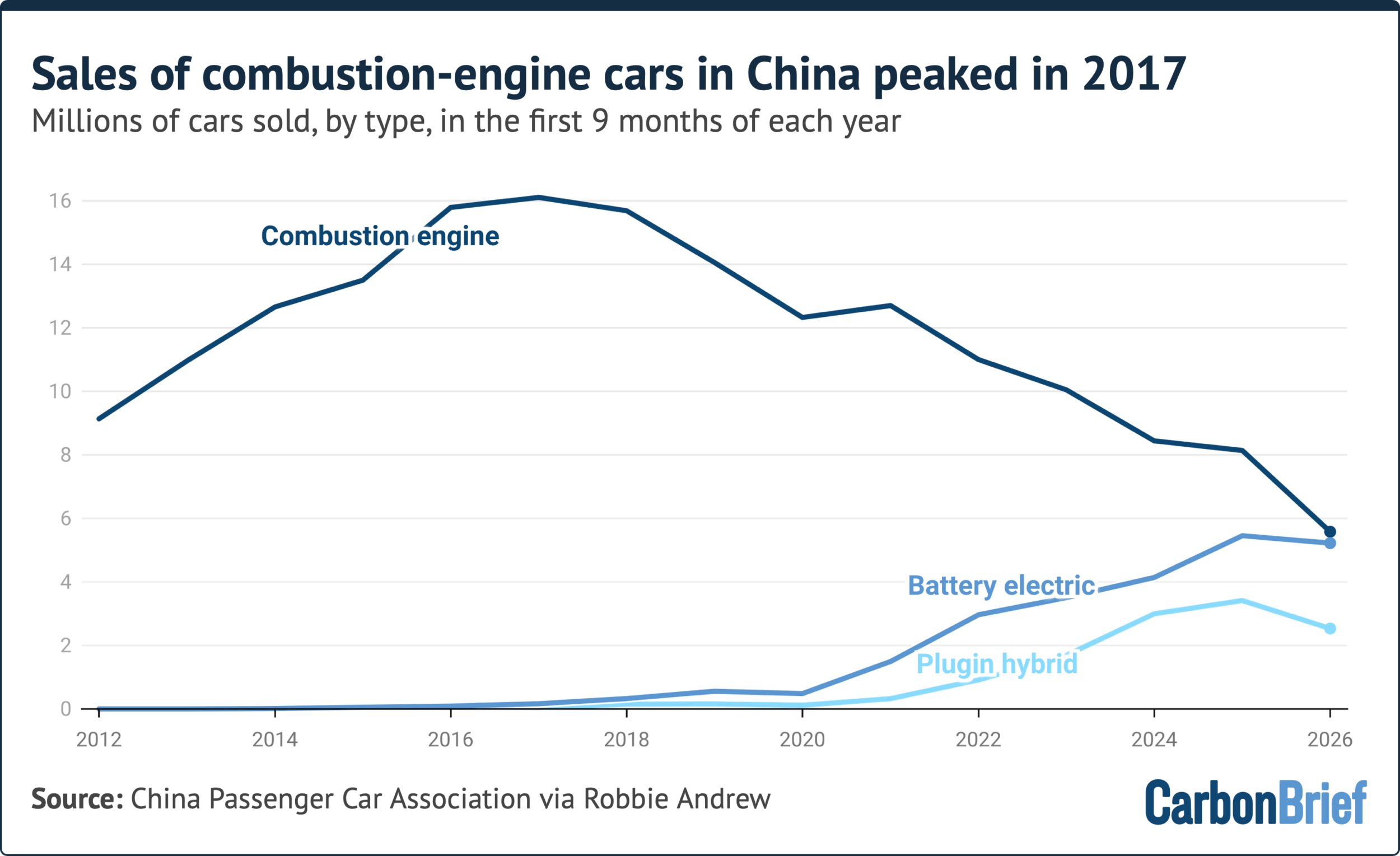
Indeed, sales of fuel-only cars were down 31% year-on-year in the first nine months of 2026, with plug-in hybrid sales down 26% – whereas battery EV sales were only down 4%.
One analyst tells Carbon Brief that China’s rapidly growing EV fleet has offset demand for 143m barrels of oil since the start of the Hormuz crisis.
Another says that the crisis is “reinforcing China’s electrification of road transport”.
Meanwhile, amid slowing domestic sales, Chinese carmakers’ exports of NEVs more than doubled [in 2026 to date / in September] from a year earlier.
NEV record
A record two out of every three cars sold in September in China were NEVs, according to CPCA data, as shown in the figure below.
(NEVs predominantly include battery electric vehicles – BEVs – and plug-in hybrids – PHEVs. BEVs only run on electricity, whereas PHEVs also have a combustion engine.)
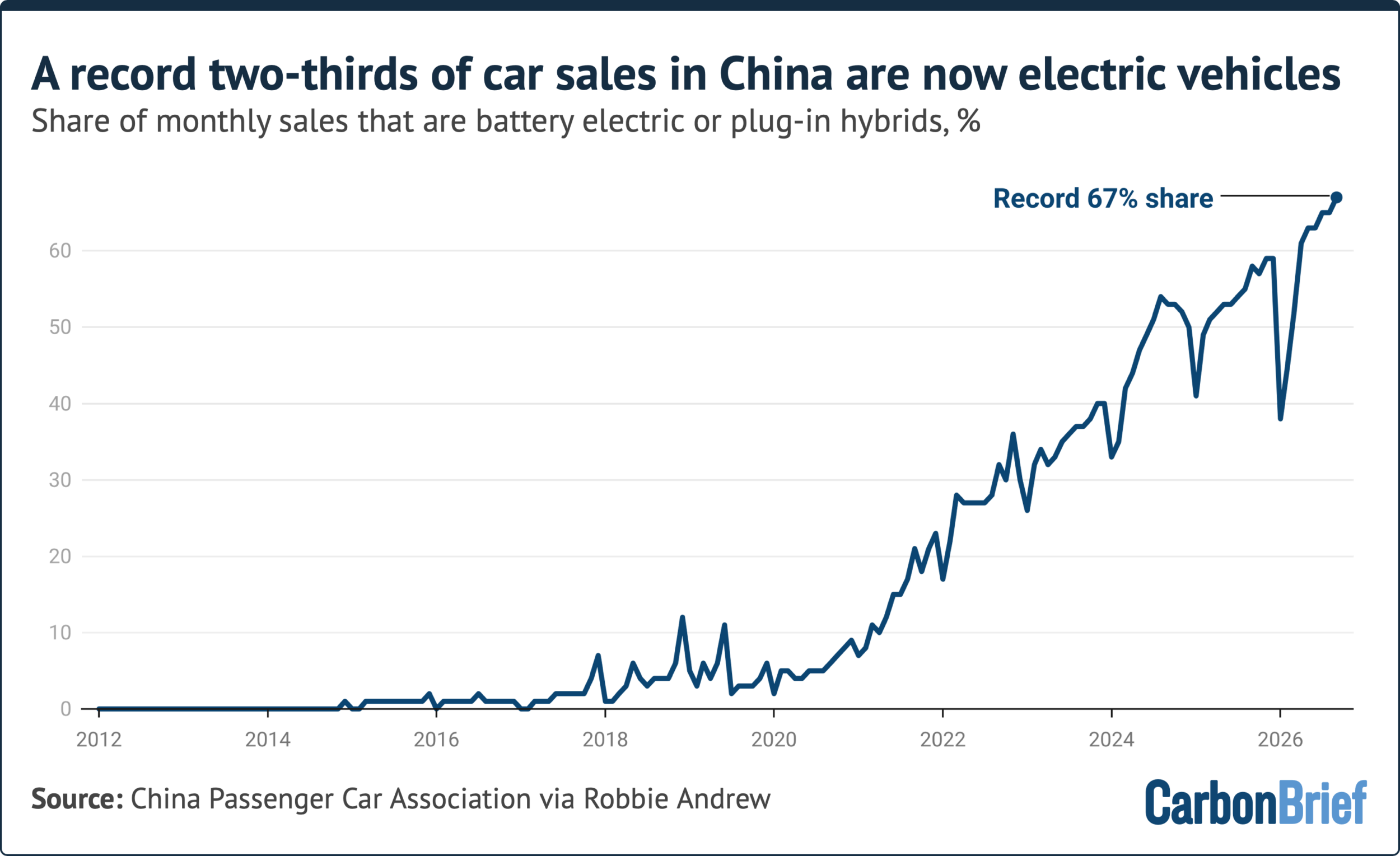
This marks a rapid rise for NEVs from just 6% of new car sales in 2020 up to 58% in 2026 to date – and a record 67% in the month of September.
This year, NEVs’ share of sales has also bounced back from a low of 39% in January, after the full purchase tax exemption that had been in place for more than a decade came to an end in December 2025.
The gain in NEV share in 2026 has come amid a slowdown across the wider domestic passenger-car market, which has hit sales of combustion-engine vehicles particularly hard.
This September, passenger-car retail sales across all categories declined, with overall sales volumes falling 28% year-on-year.
The contraction was led by combustion-engine vehicles, which saw sales fall 43% year-on-year in September and 31% in 2026 to date.
However, sales of PHEVs also fell by 36% year-on-year in September and by 26% in 2026 to date. By comparison, BEVs performed better, although sales still declined 8.5% from a year earlier in September and 4% in 2026 to date.
As a result, NEV sales overall fell by 17% in September and 13% in 2026 to date.
While the market changes in 2026 to date were particularly dramatic, they reflect a broad continuation of trends seen over the past decade.
Indeed, sales of combustion-engine cars in China peaked in 2017 and they have been declining ever since, shown in the figure below.
Impact of Hormuz
Part of the reason for the advance of NEVs in 2026, said Chinese technology news outlet OFweek, was petrol cars “giving up market share” as they were outperformed by electric alternatives.
Cui Dongshu, secretary-general of the CPCA, cited higher petrol prices as an explanation for September’s weak combustion-car sales, in comments to financial news outlet National Business Daily.
Imports of oil into China in January-September have fallen 15% compared to 2025, equivalent to 470m barrels, as ongoing conflict tightened supply and drove up prices.
China’s passenger-car NEV fleet has displaced 143m barrels of oil so far during the strait of Hormuz crisis, Euan Graham, senior energy analyst at thinktank Ember, tells Carbon Brief.
EVs “accounted for 12% of the decrease in China’s oil use post-Hormuz”, according to an estimate provided to thinktank the Brookings Institute by an unnamed analyst.
Erica Downs, a senior research scholar at Columbia University’s Center on Global Energy Policy, tells Carbon Brief that the strait of Hormuz crisis and higher oil prices are “reinforcing China’s electrification of road transport”.
She says the “world’s largest oil supply disruption” vindicates China’s early bet on EVs, which was partly driven by concerns about oil-supply security.
NEV demand down
Nevertheless, NEV sales have fallen year-on-year, albeit at a slower rate than overall car sales. The growth in NEV market share has also been decelerating.
Zhang Yichao, a partner at consulting firm AlixPartners, tells Carbon Brief that NEVs benefit from government trade-in policies and a “strong pipeline” of new models, particularly those involving innovation.
He says these factors help explain why NEVs sales have fallen at a slower rate to their combustion-car counterparts.
Cui told the state-run China National Radio that the fall for NEVs and for cars overall in September 2026, is also due to a high baseline of sales from the same month in 2025, as well as changes to trade-in policies and disruptions from the holiday period.
Other factors, says consulting firm Wood Mackenzie, are the weakened demand due to “demand pull-forward” in 2025 caused by the end of subsidies, as well as “tighter financing conditions”.
Zhang tells Carbon Brief he does not “see much more room ahead” for further growth in NEVs’ market share.
He adds that, in his view, their share in China is unlikely to exceed 80%, as some premium-market segments and specific use cases will continue to require combustion-engine vehicles.
Exports surge
Meanwhile, while domestic NEV retail sales fell 17% in September 2026, exports more than doubled, increasing 164% year-on-year, according to the CPCA.
This extends the decline in domestic sales and very strong growth in exports seen across 2026 to date, as shown in the figure below.
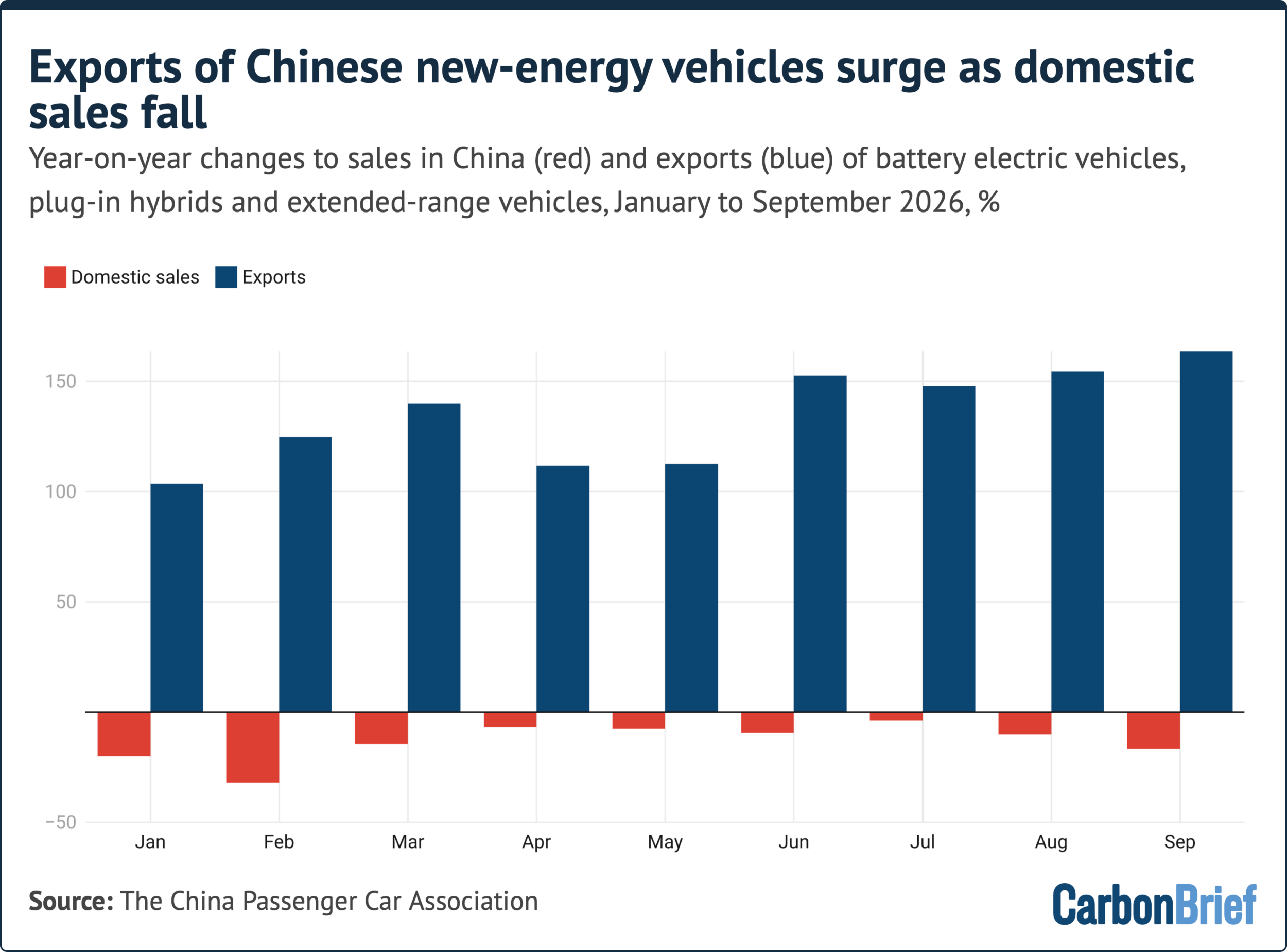
In September, 1,084,000 NEVs were sold domestically in China, while 558,000 NEVs were exported.
Exports are becoming increasingly important to Chinese carmakers, in the face of weaker domestic demand and cut-throat industrial competition.
The CPCA says exports have become “a core priority” for some carmakers.
However, the surge in exports from China has created concern in the EU, which has placed tariffs on imports of EVs from China and recently agreed plans to cut imports of hybrids.
Countries including Mexico and Turkey have also placed tariffs on Chinese EV imports.
At the same time, the Chinese government is putting policies in place that might be expected to disincentivise exports, such as cutting VAT export rebates.
Analysts differ on what impact this policy shift will have, with some saying it will be limited, while others believe it could cause the price of exported cars to rise.
Related