

Shipping negotiators for governments at UN talks this week want a proposed tax on the sector’s emissions to be spent mostly on cleaning up the industry – which could thwart international plans to use some of the money to address broader damage from climate change.
With rich countries failing to deliver promised amounts of their taxpayers’ money to help developing countries tackle warming, global attention has turned to so-called “innovative” sources of climate finance – like levies on ships, planes or fossil fuel firms – to make up the shortfall.
But at the International Maritime Organisation (IMO), the United Nations’ shipping arm, governments have made clear they want the bulk of the revenue from a shipping emissions levy to go towards making it cheaper and easier for companies to put clean fuel in their vessels.
Sitting in the 7th-floor boardroom of the IMO’s riverside London headquarters, Arsenio Dominguez, the IMO’s new head, said “we need to focus on shipping as a sector, as that is what we regulate and that’s where we need to focus the efforts”.

IMO secretary general Arsenio Dominguez (March 18/IMO)
Asked if the money could go into a new UN fund to repair and reduce loss and damage from climate change, Dominguez told Climate Home: “That’s another UN agency – we have no remit there.” The fund, set up under UN climate change talks, is set to be hosted by the World Bank.
While conversations are at an early stage, Dominguez’s view is broadly echoed by the shipping industry – as well as by most governments that have so far submitted formal proposals at the IMO, although Pacific nations want some of the funds to be used outside of shipping.
Loss and damage fund board member Avinash Persaud, from Barbados, urged finance and environment ministers to intervene at the IMO to secure a share of any future shipping levy for addressing the harm caused by worsening extreme weather and rising seas.
Big-emitting sector
As it moves goods around the world, the international shipping industry emits a similar amount of greenhouse gases to Germany but has lagged behind when it comes to setting targets to reduce that pollution.
In July last year, governments at the IMO agreed to aim for net zero emissions in the sector “by or around, i.e. close to 2050” – with interim targets for 2030 and 2040.
At the same time, they agreed to look into putting a price on the industry’s emissions. On Monday, Dominguez said he was confident such a levy would be agreed by this time next year, although the details are still to be fought over.
While nations are split on how high the charge should be – with a group of island nations arguing for the highest tax of $150 per tonne of greenhouse gas emissions – submissions from governments, industry and campaign groups all specify that the funds should be used mainly for cleaning up shipping.

Climate protesters dressed as mermaids lie on the floor at an IMO drinks reception last year (Photo credit: Guy Reece)
Kept in house?
A joint submission from the European Union, South Korea, the International Chamber of Shipping, the Environmental Defense Fund and others says a portion of the money should go to cleaning up shipping through investments, research funding and rewards for using clean fuels.
The money should also address “disproportionate negative impacts” of the transition to clean shipping through training, technical advice and finance for green investments, it adds. An impact assessment is currently being carried out by experts under the guidance of the IMO.
Another joint submission from eight Pacific nations and Belize says the funds should be collected and spent using the principle of “the polluter pays”. That would require the shipping industry as the polluter to stop burning planet-heating fossil fuels “whilst making reparation for the impact on the environment, including people and communities”, the submission specifies.
A shipping negotiator from the climate-threatened Marshall Islands, Albon Ishoda, said the money should be “reinvested in the shipping industry to trigger research, development and deployment into zero-emission maritime technologies and to address climate mitigation efforts”, as well as in “an equitable transition” for small islands and the world’s poorest countries.
How to hold shipping financially accountable for its climate impacts
A Pacific negotiator, who was not authorised to speak to the media, told Climate Home that this transition funding should go to projects both in and outside of the shipping sector according to “the priority needs of the climate most vulnerable”.
A Canadian proposal says each ship’s operator should decide, within certain limits, where the money it pays should go.
International climate finance sought
Loss and damage expert Persaud said shipping industry executives – and even maritime ministers – could not be expected to support a plan to spend money raised from the sector outside the industry. “It’s almost beyond their remit,” he said.
Rather, finance and environment ministers “would need to be part of the push to get the world’s most significant economic system – the trading system – to contribute to the loss and damage caused by current and past emissions in the production, consumption and transportation of goods”, he added.
Friederike Roder from Global Citizen, an anti-poverty campaign group, agreed it is “not surprising” that the IMO and the shipping sector “are trying to retain the proceeds for themselves”. But, she said, the polluter pays principle should apply more broadly to at least part of the proceeds raised from a shipping emissions levy.
Aoife O’Leary, head of shipping-focused environmental think-tank Opportunity Green, also called for some of the money to be spent on protection from climate impacts, such as projects to help flood-hit communities in Bangladesh or build sea walls on Pacific islands.
In Somalia, Green Climate Fund tests new approach for left-out communities
A global finance summit in Paris last year, attended by about 50 heads of state, came to a similar conclusion and led to the launch of a taskforce by France and Kenya to explore “innovative sources” of climate finance ahead of the Cop30 climate summit in late 2025.
Danish climate minister Dan Jorgensen, meanwhile, has called a shipping tax “a potential global source” of “international climate finance”.
At the IMO, a working group of government shipping negotiators has been formed to hammer out how to raise and spend the money, with a decision expected by this time next year.
The post Shipping sector pushes to keep emissions-tax cash for itself appeared first on Climate Home News.
Shipping sector pushes to keep emissions-tax cash for itself

For the first time, new-energy vehicles (NEVs) made up 67% of new car sales in China in September, according to the latest data from the China Passenger Car Association (CPCA).
The figures show that NEVs, which include battery electric cars and plug-in hybrids, captured a record share of sales, even though fewer were sold than last year.
This is because sales of combustion-engine cars are falling steeply, a trend that the CPCA has attributed to rising petrol prices following the start of the Hormuz crisis.
Indeed, sales of fuel-only cars were down 31% year-on-year in the first nine months of 2026, with plug-in hybrid sales down 26% – whereas battery EV sales were only down 4%.
One analyst tells Carbon Brief that China’s rapidly growing EV fleet has offset demand for 143m barrels of oil since the start of the Hormuz crisis.
Another says that the crisis is “reinforcing China’s electrification of road transport”.
Meanwhile, amid slowing domestic sales, Chinese carmakers’ exports of NEVs more than doubled [in 2026 to date / in September] from a year earlier.
NEV record
A record two out of every three cars sold in September in China were NEVs, according to CPCA data, as shown in the figure below.
(NEVs predominantly include battery electric vehicles – BEVs – and plug-in hybrids – PHEVs. BEVs only run on electricity, whereas PHEVs also have a combustion engine.)
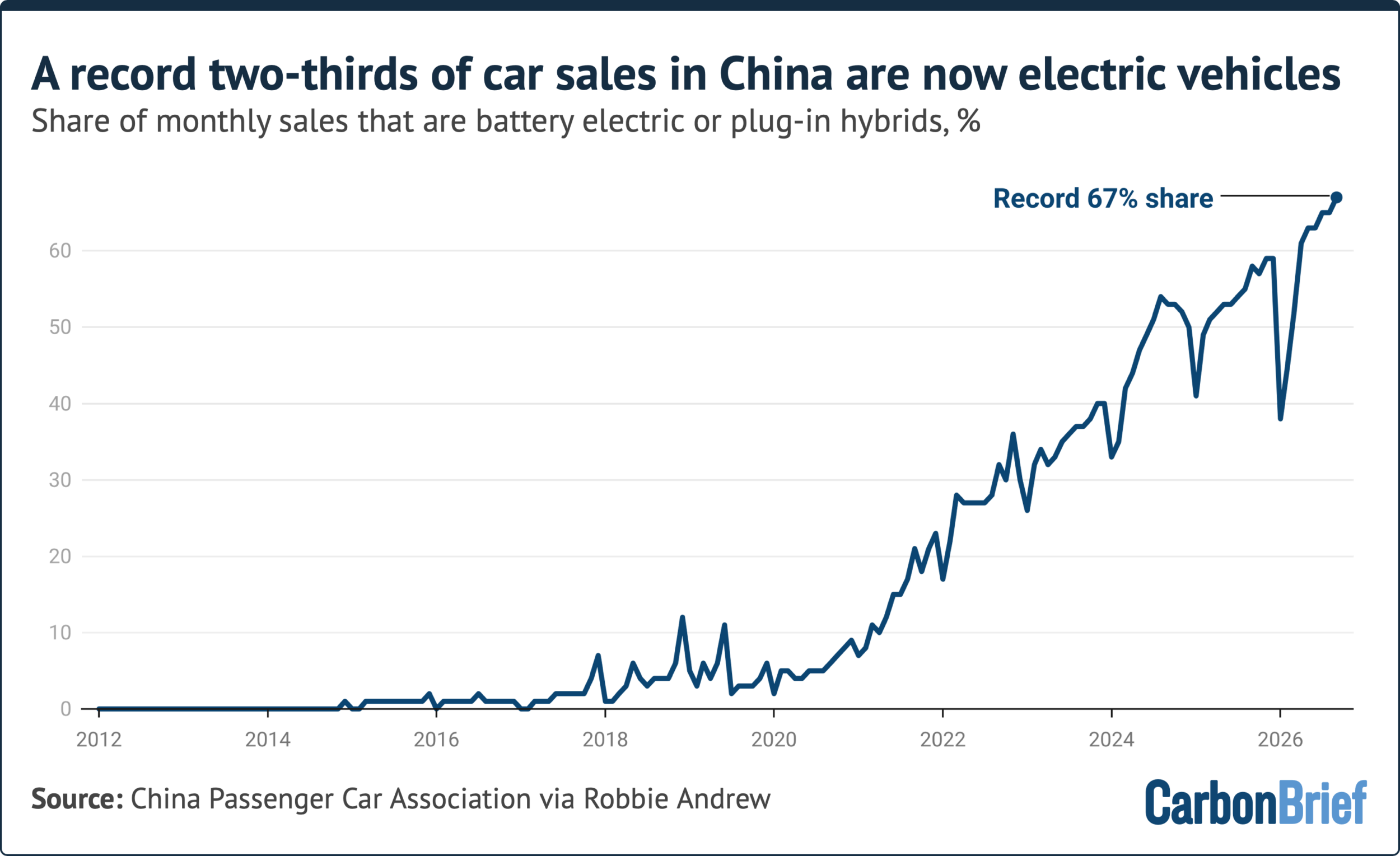
This marks a rapid rise for NEVs from just 6% of new car sales in 2020 up to 58% in 2026 to date – and a record 67% in the month of September.
This year, NEVs’ share of sales has also bounced back from a low of 39% in January, after the full purchase tax exemption that had been in place for more than a decade came to an end in December 2025.
The gain in NEV share in 2026 has come amid a slowdown across the wider domestic passenger-car market, which has hit sales of combustion-engine vehicles particularly hard.
This September, passenger-car retail sales across all categories declined, with overall sales volumes falling 28% year-on-year.
The contraction was led by combustion-engine vehicles, which saw sales fall 43% year-on-year in September and 31% in 2026 to date.
However, sales of PHEVs also fell by 36% year-on-year in September and by 26% in 2026 to date. By comparison, BEVs performed better, although sales still declined 8.5% from a year earlier in September and 4% in 2026 to date.
As a result, NEV sales overall fell by 17% in September and 13% in 2026 to date.
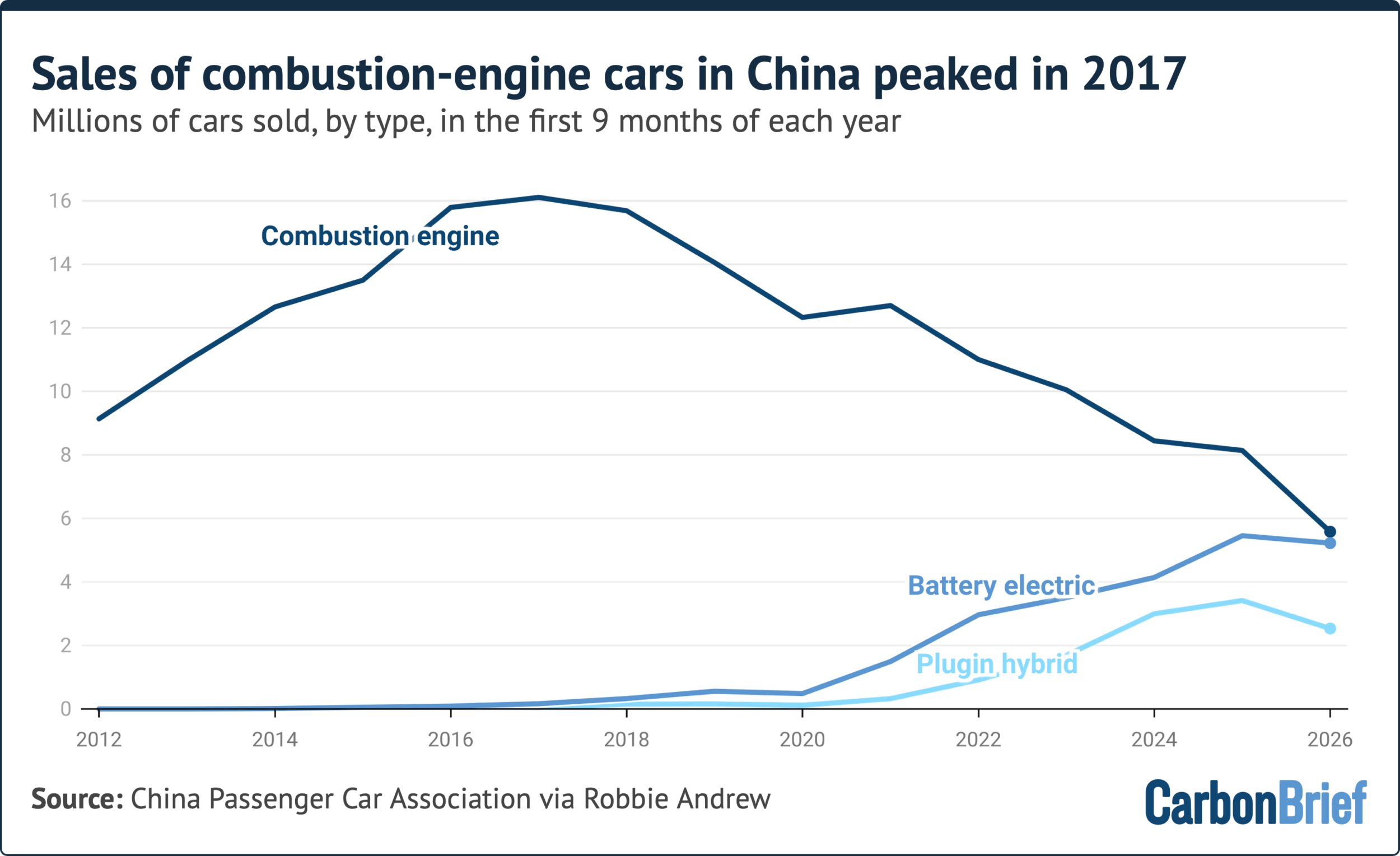
While the market changes in 2026 to date were particularly dramatic, they reflect a broad continuation of trends seen over the past decade.
Indeed, sales of combustion-engine cars in China peaked in 2017 and they have been declining ever since, shown in the figure below.
Impact of Hormuz
Part of the reason for the advance of NEVs in 2026, said Chinese technology news outlet OFweek, was petrol cars “giving up market share” as they were outperformed by electric alternatives.
Cui Dongshu, secretary-general of the CPCA, cited higher petrol prices as an explanation for September’s weak combustion-car sales, in comments to financial news outlet National Business Daily.
Imports of oil into China in January-September have fallen 15% compared to 2025, equivalent to 470m barrels, as ongoing conflict tightened supply and drove up prices.
China’s passenger-car NEV fleet has displaced 143m barrels of oil so far during the strait of Hormuz crisis, Euan Graham, senior energy analyst at thinktank Ember, tells Carbon Brief.
EVs “accounted for 12% of the decrease in China’s oil use post-Hormuz”, according to an estimate provided to thinktank the Brookings Institute by an unnamed analyst.
Erica Downs, a senior research scholar at Columbia University’s Center on Global Energy Policy, tells Carbon Brief that the strait of Hormuz crisis and higher oil prices are “reinforcing China’s electrification of road transport”.
She says the “world’s largest oil supply disruption” vindicates China’s early bet on EVs, which was partly driven by concerns about oil-supply security.
NEV demand down
Nevertheless, NEV sales have fallen year-on-year, albeit at a slower rate than overall car sales. The growth in NEV market share has also been decelerating.
Zhang Yichao, a partner at consulting firm AlixPartners, tells Carbon Brief that NEVs benefit from government trade-in policies and a “strong pipeline” of new models, particularly those involving innovation.
He says these factors help explain why NEVs sales have fallen at a slower rate to their combustion-car counterparts.
Cui told the state-run China National Radio that the fall for NEVs and for cars overall in September 2026, is also due to a high baseline of sales from the same month in 2025, as well as changes to trade-in policies and disruptions from the holiday period.
Other factors, says consulting firm Wood Mackenzie, are the weakened demand due to “demand pull-forward” in 2025 caused by the end of subsidies, as well as “tighter financing conditions”.
Zhang tells Carbon Brief he does not “see much more room ahead” for further growth in NEVs’ market share.
He adds that, in his view, their share in China is unlikely to exceed 80%, as some premium-market segments and specific use cases will continue to require combustion-engine vehicles.
Exports surge
Meanwhile, while domestic NEV retail sales fell 17% in September 2026, exports more than doubled, increasing 164% year-on-year, according to the CPCA.
This extends the decline in domestic sales and very strong growth in exports seen across 2026 to date, as shown in the figure below.
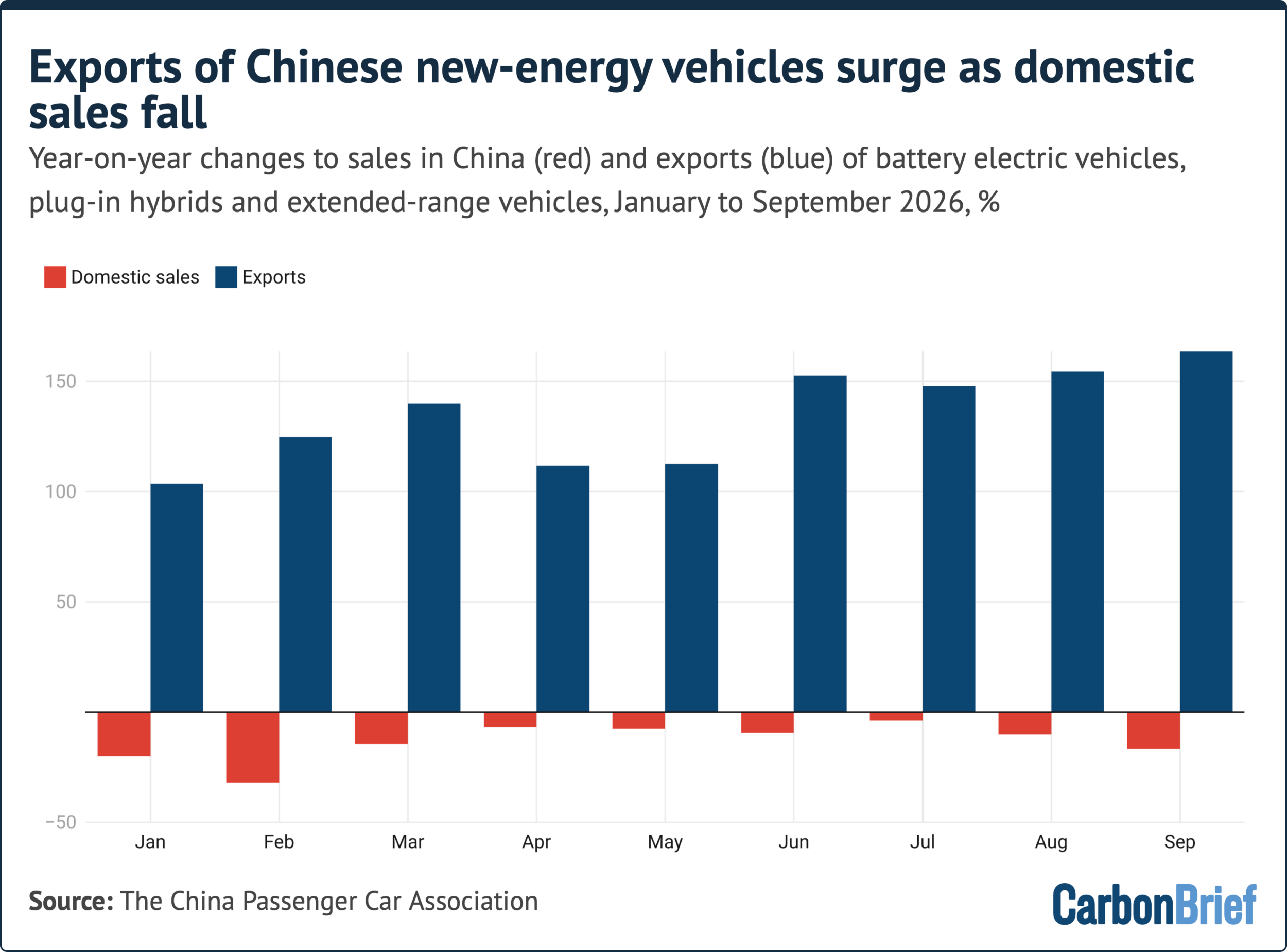
In September, 1,084,000 NEVs were sold domestically in China, while 558,000 NEVs were exported.
Exports are becoming increasingly important to Chinese carmakers, in the face of weaker domestic demand and cut-throat industrial competition.
The CPCA says exports have become “a core priority” for some carmakers.
However, the surge in exports from China has created concern in the EU, which has placed tariffs on imports of EVs from China and recently agreed plans to cut imports of hybrids.
Countries including Mexico and Turkey have also placed tariffs on Chinese EV imports.
At the same time, the Chinese government is putting policies in place that might be expected to disincentivise exports, such as cutting VAT export rebates.
Analysts differ on what impact this policy shift will have, with some saying it will be limited, while others believe it could cause the price of exported cars to rise.