Connect with us

Published

on

Solar power, electric vehicles (EVs) and other clean-energy technologies drove more than a third of the growth in China’s economy in 2025 – and more than 90% of the rise in investment.

Clean-energy sectors contributed a record 15.4tn yuan ($2.1tn) in 2025, some 11.4% of China’s gross domestic product (GDP) – comparable to the economies of Brazil or Canada.

The new analysis for Carbon Brief, based on official figures, industry data and analyst reports, shows that China’s clean-energy sectors nearly doubled in real value between 2022-25 and – if they were a country – would now be the 8th-largest economy in the world.

Other key findings from the analysis include:

  • Without clean-energy sectors, China would have missed its target for GDP growth of “around 5%”, expanding by 3.5% in 2025 instead of the reported 5.0%.
  • Clean-energy industries are expanding much more quickly than China’s economy overall, with their annual growth rate accelerating from 12% in 2024 to 18% in 2025.
  • The “new three” of EVs, batteries and solar continue to dominate the economic contribution of clean energy in China, generating two-thirds of the value added and attracting more than half of all investment in the sectors.
  • China’s investments in clean energy reached 7.2tn yuan ($1.0tn) in 2025, roughly four times the still sizable $260bn put into fossil-fuel extraction and coal power.
  • Exports of clean-energy technologies grew rapidly in 2025, but China’s domestic market still far exceeds the export market in value for Chinese firms.

These investments in clean-energy manufacturing represent a large bet on the energy transition in China and overseas, creating an incentive for the government and enterprises to keep the boom going.

However, there is uncertainty about what will happen this year and beyond, particularly for solar power, where growth has slowed in response to a new pricing system and where central government targets have been set far below the recent rate of expansion.

An ongoing slowdown could turn the sectors into a drag on GDP, while worsening industrial “overcapacity” and exacerbating trade tensions.

Yet, even if central government targets in the next five-year plan are modest, those from local governments and state-owned enterprises could still drive significant growth in clean energy.

This article updates analysis previously reported for 2023 and 2024.

Clean-energy sectors outperform wider economy

China’s clean-energy economy continues to grow far more quickly than the wider economy. This means that it is making an outsize contribution to annual economic growth.

The figure below shows that clean-energy technologies drove more than a third of the growth in China’s economy overall in 2025 and more than 90% of the net rise in investment.
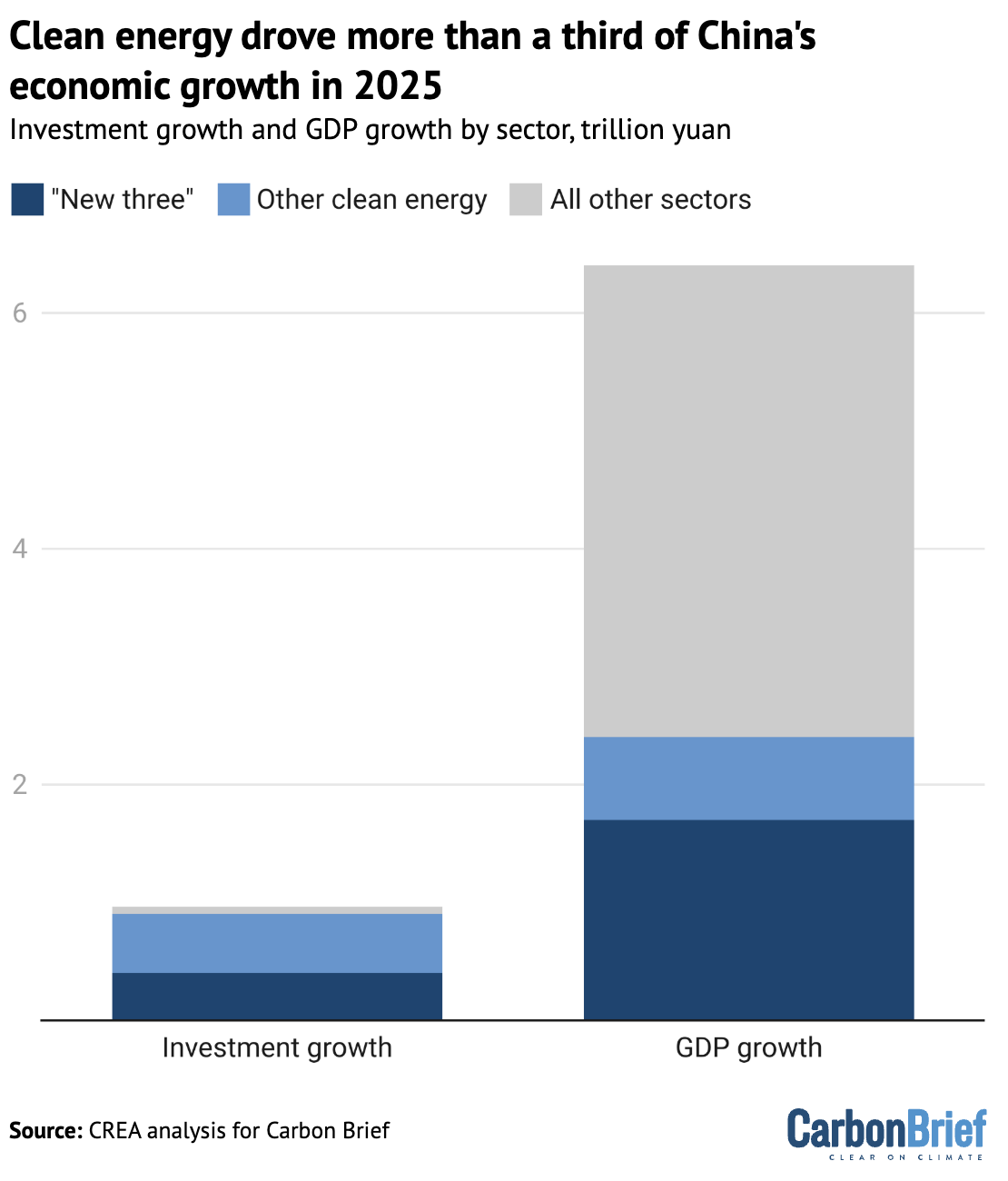
Contributions to the growth in Chinese investment (left) and GDP overall (right) in 2025 by sector, trillion yuan.
Contributions to the growth in Chinese investment (left) and GDP overall (right) in 2025 by sector, trillion yuan. Source: Centre for Research on Energy and Clean Air (CREA) analysis for Carbon Brief.

In 2022, China’s clean-energy economy was worth an estimated 8.4tn yuan ($1.2tn). By 2025, the sectors had nearly doubled in value to 15.4tn yuan ($2.1tn).

This is comparable to the entire output of Brazil or Canada and positions the Chinese clean-energy industry as the 8th-largest economy in the world. Its value is roughly half the size of the economy of India – the world’s fourth largest – or of the US state of California.

The outperformance of the clean-energy sectors means that they are also claiming a rising share of China’s economy overall, as shown in the figure below.
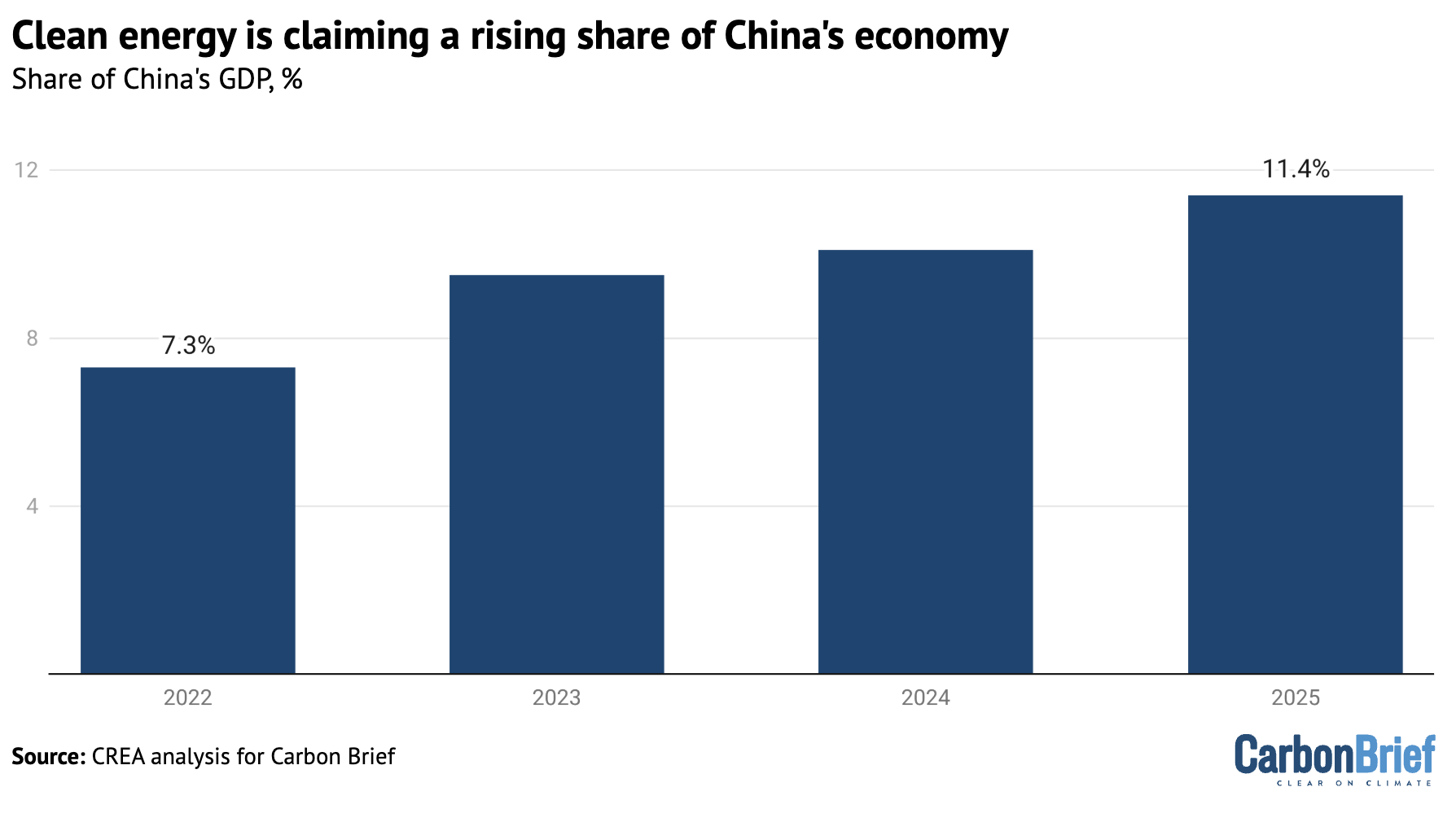
Share of China’s GDP contributed by clean-energy sectors, %.
Share of China’s GDP contributed by clean-energy sectors, %. Source: CREA analysis for Carbon Brief.

This share has risen from 7.3% of China’s GDP in 2022 to 11.4% in 2025.

Without clean-energy sectors, China’s GDP would have expanded by 3.5% in 2025 instead of the reported 5.0%, missing the target of “around 5%” growth by a wide margin.

Clean energy thus made a crucial contribution during a challenging year, when promoting economic growth was the foremost aim for policymakers.

The table below includes a detailed breakdown by sector and activity.

Sector Activity Value in 2025, CNY bln Value in 2025, USD bln Year-on-year growth Growth contribution Value contribution Value in 2025, CNY trn Value in 2024, CNY trn Value in 2023, CNY trn Value in 2022, CNY trn
EVs Investment: manufacturing capacity 1,643 228 18% 10.4% 10.7% 1.6 1.4 1.2 0.9
EVs Investment: charging infrastructure 192 27 58% 2.9% 1.2% 0.192 0.122 0.1 0.08
EVs Production of vehicles 3,940 548 29% 36.4% 25.6% 3.94 3.065 2.26 1.65
Batteries Investment: battery manufacturing 277 38 35% 3.0% 1.8% 0.277 0.205 0.32 0.15
Batteries Exports: batteries 724 101 51% 10.1% 4.7% 0.724 0.48 0.46 0.34
Solar power Investment: power generation capacity 1,182 164 15% 6.3% 7.7% 1.182 1.031 0.808 0.34
Solar power Investment: manufacturing capacity 506 70 -23% -6.5% 3.3% 0.506 0.662 0.95 0.51
Solar power Electricity generation 491 68 33% 5.1% 3.2% 0.491 0.369 0.26 0.19
Solar power Exports of components 681 95 21% 4.9% 4.4% 0.681 0.562 0.5 0.35
Wind power Investment: power generation capacity, onshore 612 85 47% 8.1% 4.0% 0.612 0.417 0.397 0.21
Wind power Investment: power generation capacity, offshore 96 13 98% 2.0% 0.6% 0.096 0.048 0.086 0.06
Wind power Electricity generation 510 71 13% 2.4% 3.3% 0.51 0.453 0.4 0.34
Nuclear power Investment: power generation capacity 173 24 18% 1.1% 1.1% 0.17 0.15 0.09 0.07
Nuclear power Electricity generation 216 30 8% 0.7% 1.4% 0.216 0.2 0.19 0.19
Hydropower Investment: power generation capacity 54 7 -7% -0.2% 0.3% 0.05 0.06 0.06 0.06
Hydropower Electricity generation 582 81 3% 0.6% 3.8% 0.582 0.567 0.51 0.51
Rail transportation Investment 902 125 6% 2.1% 5.8% 0.902 0.851 0.764 0.714
Rail transportation Transport of passengers and goods 1,020 142 3% 1.3% 6.6% 1.02 0.99 0.964 0.694
Electricity transmission Investment: transmission capacity 644 90 6% 1.5% 4.2% 0.64 0.61 0.53 0.5
Electricity transmission Transmission of clean power 52 7 14% 0.3% 0.3% 0.052 0.046 0.04 0.04
Energy storage Investment: Pumped hydro 53 7 5% 0.1% 0.3% 0.05 0.05 0.04 0.03
Energy storage Investment: Grid-connected batteries 232 32 52% 3.3% 1.5% 0.232 0.152 0.08 0.02
Energy storage Investment: Electrolysers 11 2 29% 0.1% 0.1% 0.011 0.009 0 0
Energy efficiency Revenue: Energy service companies 620 86 17% 3.8% 4.0% 0.62 0.528003 0.52 0.45
Total Investments 7,198 1001 15% 38.2% 46.7% 7.20 6.28 6.00 4.11
Total Production of goods and services 8,216 1,143 22% 61.8% 53.3% 8.22 6.73 5.58 4.32
Total Total GDP contribution 15,414 2144 18% 100.0% 100.0% 15.41 13.01 11.58 8.42

EVs and batteries were the largest drivers of GDP growth

In 2024, EVs and solar had been the largest growth drivers. In 2025, it was EVs and batteries, which delivered 44% of the economic impact and more than half of the growth of the clean-energy industries. This was due to strong growth in both output and investment.

The contribution to nominal GDP growth – unadjusted for inflation – was even larger, as EV prices held up year-on-year while the economy as a whole suffered from deflation. Investment in battery manufacturing rebounded after a fall in 2024.

The major contribution of EVs and batteries is illustrated in the figure below, which shows both the overall size of the clean-energy economy and the sectors that added the most to the rise from year to year.

Contribution of clean-energy sectors to China’s GDP and GDP growth, trillion yuan, 2022-2025.
Contribution of clean-energy sectors to China’s GDP and GDP growth, trillion yuan, 2022-2025. Source: CREA analysis for Carbon Brief.

The next largest subsector was clean-power generation, transmission and storage, which made up 40% of the contribution to GDP and 30% of the growth in 2025.

Within the electricity sector, the largest drivers were growth in investment in wind and solar power generation capacity, along with growth in power output from solar and wind, followed by the exports of solar-power equipment and materials.

Investment in solar-panel supply chains, a major growth driver in 2022-23, continued to fall for the second year. This was in line with the government’s efforts to rein in overcapacity and “irrational” price competition in the sector.

Finally, rail transportation was responsible for 12% of the total economic output of the clean-energy sectors, but saw relatively muted growth year-on-year, with revenue up 3% and investment by 6%.

Note that the International Energy Agency (IEA) world energy investment report projected that China invested $627bn in clean energy in 2025, against $257bn in fossil fuels.

For the same sectors as the IEA report, this analysis puts the value of clean-energy investment in 2025 at a significantly more conservative $430bn. The higher figures in this analysis overall are therefore the result of wider sectoral coverage.

Electric vehicles and batteries

EVs and vehicle batteries were again the largest contributors to China’s clean-energy economy in 2025, making up an estimated 44% of value overall.

Of this total, the largest share of both total value and growth came from the production of battery EVs and plug-in hybrids, which expanded 29% year-on-year. This was followed by investment into EV manufacturing, which grew 18%, after slower growth rates in 2024.

Investment in battery manufacturing also rebounded after a drop in 2024, driven by new battery technology and strong demand from both domestic and international markets. Battery manufacturing investment grew by 35% year-on-year to 277bn yuan.

The share of electric vehicles (EVs) will have reached 12% of all vehicles on the road by the end of 2025, up from 9% a year earlier and less than 2% just five years ago.

The share of EVs in the sales of all new vehicles increased to 48%, from 41% in 2024, with passenger cars crossing the 50% threshold. In November, EV sales crossed the 60% mark in total sales and they continue to drive overall automotive sales growth, as shown below.

Production of combustion-engine vehicles and EVs in China, million units. EVs include battery electric vehicles and plug-in hybrids.
Production of combustion-engine vehicles and EVs in China, million units. EVs include battery electric vehicles and plug-in hybrids. Source: China Association of Automobile Manufacturers data via Wind Financial Terminal.

Electric trucks experienced a breakthrough as their market share rose from 8% in the first nine months of 2024 to 23% in the same period in 2025.

Policy support for EVs continues, for example, with a new policy aiming to nearly double charging infrastructure in the next three years.

Exports grew even faster than the domestic market, but the vast majority of EVs continue to be sold domestically. In 2025, China produced 16.6m EVs, rising 29% year-on-year. While exports accounted for only 21% or 3.4m EVs, they grew by 86% year-on-year. Top export destinations for Chinese EVs were western Europe, the Middle East and Latin America.

The value of batteries exported also grew rapidly by 41% year-on-year, becoming the third largest growth driver of the GDP. Battery exports largely went to western Europe, north America and south-east Asia.

In contrast with deflationary trends in the price of many clean-energy technologies, average EV prices have held up in 2025, with a slight increase in average price of new models, after discounts. This also means that the contribution of the EV industry to nominal GDP growth was even more significant, given that overall producer prices across the economy fell by 2.6%. Battery prices continued to drop.

Clean-power generation

The solar power sector generated 19% of the total value of the clean-energy industries in 2025, adding 2.9tn yuan ($41bn) to the national economy.

Within this, investment in new solar power plants, at 1.2tn yuan ($160bn), was the largest driver, followed by the value of solar technology exports and by the value of the power generated from solar. Investment in manufacturing continued to fall after the wave of capacity additions in 2023, reaching 0.5tn yuan ($72bn), down 23% year-on-year.

In 2025, China achieved another new record of wind and solar capacity additions. The country installed a total of 315GW solar and 119GW wind capacity, adding more solar and two times as much wind as the rest of the world combined.

Clean energy accounted for 90% of investment in power generation, with solar alone covering 50% of that. As a result, non-fossil power made up 42% of total power generation, up from 39% in 2024.

However, a new pricing policy for new solar and wind projects and modest targets for capacity growth have created uncertainty about whether the boom will continue.

Under the new policy, new clean-power generation has to compete on price against existing coal power in markets that place it at a disadvantage in some key ways.

At the same time, the electricity markets themselves are still being introduced and developed, creating investment uncertainty.

Investment in solar power generation increased year-on-year by 15%, but experienced a strong stop-and-go cycle. Developers rushed to finish projects ahead of the new pricing policy coming into force in June and then again towards the end of the year to finalise projects ahead of the end of the current 14th five-year plan.

Investment in the solar sector as a whole was stable year-on-year, with the decline in manufacturing capacity investment balanced by continued growth in power generation capacity additions. This helped shore up the utilisation of manufacturing plants, in line with the government’s aim to reduce “disorderly” price competition.

By late 2025, China’s solar manufacturing capacity reached an estimated 1,200GW per year, well ahead of the global capacity additions of around 650GW in 2025. Manufacturers can now produce far more solar panels than the global market can absorb, with fierce competition leading to historically low profitability.

China’s policymakers have sought to address the issue since mid-2024, warning against “involution”, passing regulations and convening a sector-wide meeting to put pressure on the industry. This is starting to yield results, with losses narrowing in the third quarter of 2025.

The volume of exports of solar panels and components reached a record high in 2025, growing 19% year-on-year. In particular, exports of cells and wafers increased rapidly by 94% and 52%, while panel exports grew only by 4%.

This reflects the growing diversification of solar-supply chains in the face of tariffs and with more countries around the world building out solar panel manufacturing capacity. The nominal value of exports fell 8%, however, due to a fall in average prices and a shift to exporting upstream intermediate products instead of finished panels.

Hydropower, wind and nuclear were responsible for 15% of the total value of the clean-energy sectors in 2025, adding some 2.2tn yuan ($310bn) to China’s GDP in 2025.

Nearly two-thirds of this (1.3tn yuan, $180bn) came from the value of power generation from hydropower, wind and nuclear, with investment in new power generation projects contributing the rest.

Power generation grew 33% from solar, 13% from wind, 3% from hydropower and 8% from nuclear.

Within power generation investment, solar remained the largest segment by value – as shown in the figure below – but wind-power generation projects were the largest contributor to growth, overtaking solar for the first time since 2020.

Value of new clean-power generation capacity, billion yuan, by year added.
Value of new clean-power generation capacity, billion yuan, by year added. Source: CREA analysis for Carbon Brief.

In particular, offshore wind power capacity investment rebounded as expected, doubling in 2025 after a sharp drop in 2024.

Investment in nuclear projects continued to grow but remains smaller in total terms, at 17bn yuan. Investment in conventional hydropower continued to decline by 7%.

Electricity storage and grids

Electricity transmission and storage were responsible for 6% of the total value of the clean-energy sectors in 2025, accounting for 1.0 tn yuan ($140bn).

The most valuable sub-segment was investment in power grids, growing 6% in 2025 and reaching $90bn. This was followed by investment in energy storage, including pumped hydropower, grid-connected battery storage and hydrogen production.

Investment in grid-connected batteries saw the largest year-on-year growth, increasing by 50%, while investments in electrolysers also grew by 30%. The transmission of clean power increased an estimated 13%, due to rapid growth in clean-power generation.

China’s total electricity storage capacity reached more than 213GW, with battery storage capacity crossing 145GW and pumped hydro storage at 69GW. Some 66GW of battery storage capacity was added in 2025, up 52% year-on-year and accounting for more than 40% of global capacity additions.

Notably, capacity additions accelerated in the second half of the year, with 43GW added, compared with the first half, which saw 23GW of new capacity.

The battery storage market initially slowed after the renewable power pricing policy, which banned storage mandates after May, but this was quickly replaced by a “market-driven boom”. Provincial electricity spot markets, time-of-day tariffs and increasing curtailment of solar power all improved the economics of adding storage.

By the end of 2025, China’s top five solar manufacturers had all entered the battery storage market, making a shift in industry strategy.

Investment in pumped hydropower continued to increase, with 15GW of new capacity permitted in the first half of 2025 alone and 3GW entering operation.

Railways

Rail transportation made up 12% of the GDP contribution of the clean-energy sectors, with revenue from passenger and goods rail transportation the largest source of value. Most growth came from investment in rail infrastructure, which increased 6% year-on-year

The electrification of transport is not limited to EVs, as rail passenger, freight and investment volumes saw continued growth. The total length of China’s high-speed railway network reached 50,000km in 2025, making up more than 70% of the global high-speed total.

Energy efficiency

Investment in energy efficiency rebounded strongly in 2025. Measured by the aggregate turnover of large energy service companies (ESCOs), the market expanded by 17% year-on-year, returning to growth rates last seen during 2016-2020.

Total industry turnover has also recovered to its previous peak in 2021, signalling a clear turnaround after three years of weakness.

Industry projections now anticipate annual turnover reaching 1tn yuan in annual turnover by 2030, a target that had previously been expected to be met by 2025.

China’s ESCO market has evolved into the world’s largest. Investment within China’s ESCO market remains heavily concentrated in the buildings sector, which accounts for around 50% of total activity. Industrial applications make up a further 21%, while energy supply, demand-side flexibility and energy storage together account for approximately 16%.

Implications of China’s clean-energy bet

Ongoing investment of hundreds of billions of dollars into clean-energy manufacturing represents a gigantic economic and financial bet on a continuing global energy transition.

In addition to the domestic investment covered in this article, Chinese firms are making major investments in overseas manufacturing.

The clean-energy industries have played a crucial role in meeting China’s economic targets during the five-year period ending this year, delivering an estimated 40%, 25% and 37% of all GDP growth in 2023, 2024 and 2025, respectively.

However, the developments next year and beyond are unclear, particularly for solar power generation, with the new pricing system for renewable power generation leading to a short-term slowdown and creating major uncertainty, while central government targets have been set far below current rates of clean-electricity additions.

Investment in solar-power generation and solar manufacturing declined in the second half of the year, while investment in generation clocked growth for the full year, showing the risk to the industries under the current power market set-ups that favour coal-fired power.

The reduction in the prices of clean-energy technology has been so dramatic that when the prices for GDP statistics are updated, the sectors’ contribution to real GDP – adjusted for inflation or, in this case deflation – will be revised down.

Nevertheless, the key economic role of the industry creates a strong motivation to keep the clean-energy boom going. A slowdown in the domestic market could also undermine efforts to stem overcapacity and inflame trade tensions by increasing pressure on exports to absorb supply.

A recent CREA survey of experts working on climate and energy issues in China found that the majority believe that economic and geopolitical challenges will make the “dual carbon” goals – and with that, clean-energy industries – only more important.

Local governments and state-owned enterprises will also influence the outlook for the sector. Their previous five-year plans played a key role in creating the gigantic wind and solar power “bases” that substantially exceeded the central government’s level of ambition.

Provincial governments also have a lot of leeway in implementing the new electricity markets and contracting systems for renewable power generation. The new five-year plans, to be published this year, will therefore be of major importance.

About the data

Reported investment expenditure and sales revenue has been used where available. When this is not available, estimates are based on physical volumes – gigawatts of capacity installed, number of vehicles sold – and unit costs or prices.

The contribution to real growth is tracked by adjusting for inflation using 2022-2023 prices.

All calculations and data sources are given in a worksheet.

Estimates include the contribution of clean-energy technologies to the demand for upstream inputs such as metals and chemicals.

This approach shows the contribution of the clean-energy sectors to driving economic activity, also outside the sectors themselves, and is appropriate for estimating how much lower economic growth would have been without growth in these sectors.

Double counting is avoided by only including non-overlapping points in value chains. For example, the value of EV production and investment in battery storage of electricity is included, but not the value of battery production for the domestic market, which is predominantly an input to these activities.

Similarly, the value of solar panels produced for the domestic market is not included, as it makes up a part of the value of solar power generating capacity installed in China. However, the value of solar panel and battery exports is included.

In 2025, there was a major divergence between two different measures of investment. The first, fixed asset investment, reportedly fell by 3.8%, the first drop in 35 years. In contrast, gross capital formation saw the slowest growth in that period but still inched up by 2%.

This analysis uses gross capital formation as the measure of investment, as it is the data point used for GDP accounting. However, the analysis is unable to account for changes in inventories, so the estimate of clean-energy investment is for fixed asset investment in the sectors.

The analysis does not explicitly account for the small and declining role of imports in producing clean-energy goods and services. This means that the results slightly overstate the contribution to GDP but understate the contribution to growth.

For example, one of the most important import dependencies that China has is for advanced computing chips for EVs. The value of the chips in a typical EV is $1,000 and China’s import dependency for these chips is 90%, which suggests that imported chips represent less than 3% of the value of EV production.

The estimates are likely to be conservative in some key respects. For example, Bloomberg New Energy Finance estimates “investment in the energy transition” in China in 2024 at $800bn. This estimate covers a nearly identical list of sectors to ours, but excludes manufacturing – the comparable number from our data is $600bn.

China’s National Bureau of Statistics says that the total value generated by automobile production and sales in 2023 was 11tn yuan. The estimate in this analysis for the value of EV sales in 2023 is 2.3tn yuan, or 20% of the total value of the industry, when EVs already made up 31% of vehicle production and the average selling prices for EVs was slightly higher than for internal combustion engine vehicles.


The post Analysis: Clean energy drove more than a third of China’s GDP growth in 2025 appeared first on Carbon Brief.

Analysis: Clean energy drove more than a third of China’s GDP growth in 2025

Continue Reading

Climate Change

Cropped 25 February 2026: Food inflation strikes | El Niño looms | Biodiversity talks stagnate

Published

on

We handpick and explain the most important stories at the intersection of climate, land, food and nature over the past fortnight.

This is an online version of Carbon Brief’s fortnightly Cropped email newsletter.
Subscribe for free here.

Key developments

Food inflation on the rise

DELUGE STRIKES FOOD: Extreme rainfall and flooding across the Mediterranean and north Africa has “battered the winter growing regions that feed Europe…threatening food price rises”, reported the Financial Times. Western France has “endured more than 36 days of continuous rain”, while farmers’ associations in Spain’s Andalusia estimate that “20% of all production has been lost”, it added. Policy expert David Barmes told the paper that the “latest storms were part of a wider pattern of climate shocks feeding into food price inflation”.

Subscribe: Cropped
  • Sign up to Carbon Brief’s free “Cropped” email newsletter. A fortnightly digest of food, land and nature news and views. Sent to your inbox every other Wednesday.

NO BEEF: The UK’s beef farmers, meanwhile, “face a double blow” from climate change as “relentless rain forces them to keep cows indoors”, while last summer’s drought hit hay supplies, said another Financial Times article. At the same time, indoor growers in south England described a 60% increase in electricity standing charges as a “ticking timebomb” that could “force them to raise their prices or stop production, which will further fuel food price inflation”, wrote the Guardian.

TINDERBOX’ AND TARIFFS: A study, covered by the Guardian, warned that major extreme weather and other “shocks” could “spark social unrest and even food riots in the UK”. Experts cited “chronic” vulnerabilities, including climate change, low incomes, poor farming policy and “fragile” supply chains that have made the UK’s food system a “tinderbox”. A New York Times explainer noted that while trade could once guard against food supply shocks, barriers such as tariffs and export controls – which are being “increasingly” used by politicians – “can shut off that safety valve”.

El Niño looms

NEW ENSO INDEX: Researchers have developed a new index for calculating El Niño, the large-scale climate pattern that influences global weather and causes “billions in damages by bringing floods to some regions and drought to others”, reported CNN. It added that climate change is making it more difficult for scientists to observe El Niño patterns by warming up the entire ocean. The outlet said that with the new metric, “scientists can now see it earlier and our long-range weather forecasts will be improved for it.”

WARMING WARNING: Meanwhile, the US Climate Prediction Center announced that there is a 60% chance of the current La Niña conditions shifting towards a neutral state over the next few months, with an El Niño likely to follow in late spring, according to Reuters. The Vibes, a Malaysian news outlet, quoted a climate scientist saying: “If the El Niño does materialise, it could possibly push 2026 or 2027 as the warmest year on record, replacing 2024.”

CROP IMPACTS: Reuters noted that neutral conditions lead to “more stable weather and potentially better crop yields”. However, the newswire added, an El Niño state would mean “worsening drought conditions and issues for the next growing season” to Australia. El Niño also “typically brings a poor south-west monsoon to India, including droughts”, reported the Hindu’s Business Line. A 2024 guest post for Carbon Brief explained that El Niño is linked to crop failure in south-eastern Africa and south-east Asia.

News and views

  • DAM-AG-ES: Several South Korean farmers filed a lawsuit against the country’s state-owned utility company, “seek[ing] financial compensation for climate-related agricultural damages”, reported United Press International. Meanwhile, a national climate change assessment for the Philippines found that the country “lost up to $219bn in agricultural damages from typhoons, floods and droughts” over 2000-10, according to Eco-Business.
  • SCORCHED GRASS: South Africa’s Western Cape province is experiencing “one of the worst droughts in living memory”, which is “scorching grass and killing livestock”, said Reuters. The newswire wrote: “In 2015, a drought almost dried up the taps in the city; farmers say this one has been even more brutal than a decade ago.”
  • NOUVELLE VEG: New guidelines published under France’s national food, nutrition and climate strategy “urged” citizens to “limit” their meat consumption, reported Euronews. The delayed strategy comes a month after the US government “upended decades of recommendations by touting consumption of red meat and full-fat dairy”, it noted. 
  • COURTING DISASTER: India’s top green court accepted the findings of a committee that “found no flaws” in greenlighting the Great Nicobar project that “will lead to the felling of a million trees” and translocating corals, reported Mongabay. The court found “no good ground to interfere”, despite “threats to a globally unique biodiversity hotspot” and Indigenous tribes at risk of displacement by the project, wrote Frontline.
  • FISH FALLING: A new study found that fish biomass is “falling by 7.2% from as little as 0.1C of warming per decade”, noted the Guardian. While experts also pointed to the role of overfishing in marine life loss, marine ecologist and study lead author Dr Shahar Chaikin told the outlet: “Our research proves exactly what that biological cost [of warming] looks like underwater.” 
  • TOO HOT FOR COFFEE: According to new analysis by Climate Central, countries where coffee beans are grown “are becoming too hot to cultivate them”, reported the Guardian. The world’s top five coffee-growing countries faced “57 additional days of coffee-harming heat” annually because of climate change, it added.

Spotlight

Nature talks inch forward

This week, Carbon Brief covers the latest round of negotiations under the UN Convention on Biological Diversity (CBD), which occurred in Rome over 16-19 February.

The penultimate set of biodiversity negotiations before October’s Conference of the Parties ended in Rome last week, leaving plenty of unfinished business.

The CBD’s subsidiary body on implementation (SBI) met in the Italian capital for four days to discuss a range of issues, including biodiversity finance and reviewing progress towards the nature targets agreed under the Kunming-Montreal Global Biodiversity Framework (GBF).

However, many of the major sticking points – particularly around finance – will have to wait until later this summer, leaving some observers worried about the capacity for delegates to get through a packed agenda at COP17.

The SBI, along with the subsidiary body on scientific, technical and technological advice (SBSTTA) will both meet in Nairobi, Kenya, later this summer for a final round of talks before COP17 kicks off in Yerevan, Armenia, on 19 October.

Money talks

Finance for nature has long been a sticking point at negotiations under the CBD.

Discussions on a new fund for biodiversity derailed biodiversity talks in Cali, Colombia, in autumn 2024, requiring resumed talks a few months later.

Despite this, finance was barely on the agenda at the SBI meetings in Rome. Delegates discussed three studies on the relationship between debt sustainability and implementation of nature plans, but the more substantive talks are set to take place at the next SBI meeting in Nairobi.

Several parties “highlighted concerns with the imbalance of work” on finance between these SBI talks and the next ones, reported Earth Negotiations Bulletin (ENB).

Lim Li Ching, senior researcher at Third World Network, noted that tensions around finance permeated every aspect of the talks. She told Carbon Brief:

“If you’re talking about the gender plan of action – if there’s little or no financial resources provided to actually put it into practice and implement it, then it’s [just] paper, right? Same with the reporting requirements and obligations.”

Monitoring and reporting

Closely linked to the issue of finance is the obligations of parties to report on their progress towards the goals and targets of the GBF.

Parties do so through the submission of national reports.

Several parties at the talks pointed to a lack of timely funding for driving delays in their reporting, according to ENB.

A note released by the CBD Secretariat in December said that no parties had submitted their national reports yet; by the time of the SBI meetings, only the EU had. It further noted that just 58 parties had submitted their national biodiversity plans, which were initially meant to be published by COP16, in October 2024.

Linda Krueger, director of biodiversity and infrastructure policy at the environmental not-for-profit Nature Conservancy, told Carbon Brief that despite the sparse submissions, parties are “very focused on the national report preparation”. She added:

“Everybody wants to be able to show that we’re on the path and that there still is a pathway to getting to 2030 that’s positive and largely in the right direction.”

Watch, read, listen

NET LOSS: Nigeria’s marine life is being “threatened” by “ghost gear” – nets and other fishing equipment discarded in the ocean – said Dialogue Earth.

COMEBACK CAUSALITY: A Vox long-read looked at whether Costa Rica’s “payments for ecosystem services” programme helped the country turn a corner on deforestation.

HOMEGROWN GOALS: A Straits Times podcast discussed whether import-dependent Singapore can afford to shelve its goal to produce 30% of its food locally by 2030.

‘RUSTING’ RIVERS: The Financial Times took a closer look at a “strange new force blighting the [Arctic] landscape”: rivers turning rust-orange due to global warming.

New science

  • Lakes in the Congo Basin’s peatlands are releasing carbon that is thousands of years old | Nature Geoscience
  • Natural non-forest ecosystems – such as grasslands and marshlands – were converted for agriculture at four times the rate of land with tree cover between 2005 and 2020 | Proceedings of the National Academy of Sciences
  • Around one-quarter of global tree-cover loss over 2001-22 was driven by cropland expansion, pastures and forest plantations for commodity production | Nature Food

In the diary

Cropped is researched and written by Dr Giuliana Viglione, Aruna Chandrasekhar, Daisy Dunne, Orla Dwyer and Yanine Quiroz.
Please send tips and feedback to cropped@carbonbrief.org

The post Cropped 25 February 2026: Food inflation strikes | El Niño looms | Biodiversity talks stagnate appeared first on Carbon Brief.

Cropped 25 February 2026: Food inflation strikes | El Niño looms | Biodiversity talks stagnate

Continue Reading

Climate Change

Battery passport plan aims to clean up the industry powering clean energy

Published

on

For millions of consumers, the sustainability scheme stickers found on everything from bananas to chocolate bars and wooden furniture are a way to choose products that are greener and more ethical than some of the alternatives.

Inga Petersen, executive director of the Global Battery Alliance (GBA), is on a mission to create a similar scheme for one of the building blocks of the transition from fossil fuels to clean energy systems: batteries.

“Right now, it’s a race to the bottom for whoever makes the cheapest battery,” Petersen told Climate Home News in an interview.

The GBA is working with industry, international organisations, NGOs and governments to establish a sustainable and transparent battery value chain by 2030.

“One of the things we’re trying to do is to create a marketplace where products can compete on elements other than price,” Petersen said.

Under the GBA’s plan, digital product passports and traceability would be used to issue product-level sustainability certifications, similar to those commonplace in other sectors such as forestry, Petersen said.

Managing battery boom’s risks

Over the past decade, battery deployment has increased 20-fold, driven by record-breaking electric vehicle (EV) sales and a booming market for batteries to store intermittent renewable energy.

Falling prices have been instrumental to the rapid expansion of the battery market. But the breakneck pace of growth has exposed the potential environmental and social harms associated with unregulated battery production.

From South America to Zimbabwe and Indonesia, mineral extraction and refining has led to social conflict, environmental damage, human rights violations and deforestation. In Indonesia, the nickel industry is powered by coal while in Europe, production plants have been met with strong local opposition over pollution concerns.

“We cannot manage these risks if we don’t have transparency,” Petersen said.

    The GBA was established in 2017 in response to concerns about the battery industry’s impact as demand was forecast to boom and reports of child labour in the cobalt mines of the Democratic Republic of the Congo made headlines.

    The alliance’s initial 19 members recognised that the industry needed to scale rapidly but with “social, environmental and governance guardrails”, said Petersen, who previously worked with the UN Environment Programme to develop guiding principles to minimise the environmental impact of mining.

    A blonde woman wearing a head set sits with her legged crossed during an event at the World Economic Forum
    Inga Petersen, executive director of the Global Battery Alliance, speaking at a conference in Dalian, China, in June 2024 (Photo: World Economic Forum/Ciaran McCrickard) 

    Digital battery passport

    Today, the alliance is working to develop a global certification scheme that will recognise batteries that meet minimum thresholds across a set of environmental, social and governance benchmarks it has defined along the entire value chain.

    Participating mines, manufacturing plants and recycling facilities will have to provide data for their greenhouse gas emissions as well as how they perform against benchmarks for assessing biodiversity loss, pollution, child and forced labour, community impacts and respect for the rights of Indigenous peoples, for example.

    The data will be independently verified, scored, aggregated and recorded on a battery passport – a digital record of the battery’s composition, which will include the origin of its raw materials and its performance against the GBA’s sustainability benchmarks

    The scheme is due to launch in 2027.

    A carrot and a stick

    Since the start of the year, some of the world’s largest battery companies have been voluntarily participating in the biggest pilot of the scheme to date.

    More than 30 companies across the EV battery and stationary storage supply chains are involved, among them Chinese battery giants CATL and BYD subsidiary FinDreams Battery, miner Rio Tinto, battery producers Samsung SDI and Siemens, automotive supplier Denso and Tesla.

    Petersen said she was “thrilled” about support for the scheme. Amid a growing pushback against sustainability rules and standards, “these companies are stepping up to send a public signal that they are still committed to a sustainable and responsible battery value chain,” she said.

    A slide deck of the consortia and companies involved in the Global Battery Alliance pilot scheme
    The companies taking part in the Global Battery Alliance’s latest battery passport pilot scheme (Credit: Global Battery Alliance)

    There are other motivations for battery producers to know where components in their batteries have come from and whether they have been produced responsibly.

    In 2023, the EU adopted a law regulating the batteries sold on its market.

    From 2027, it mandates all batteries to meet environmental and safety criteria and to have a digital passport accessed via a QR code that contains information about the battery’s composition, its carbon footprint and its recycling content.

    The GBA certification is not intended as a compliance instrument for the EU law but it will “add a carrot” by recognising manufacturers that go beyond meeting the bloc’s rules on nature and human rights, Petersen said.

    Raising standards in complex supply chain

    But challenges remain, in part due to the complexity of battery supply chains.

    In the case of timber, “you have a single input material but then you have a very complex range of end products. For batteries, it’s almost the reverse,” Petersen said.

    The GBA wants its certification scheme to cover all critical minerals present in batteries, covering dozens of different mining, processing and manufacturing processes and hundreds of facilities.

    “One of the biggest impacts will be rewarding the leading performers through preferential access to capital, for example, with investors choosing companies that are managing their risk responsibly and transparently,” Petersen said.

      It could help influence public procurement and how companies, such as EV makers, choose their suppliers, she added. End consumers will also be able to access a summary of the GBA’s scores when deciding which product to buy.

      US, Europe rush to build battery supply chain

      Today, the GBA has more than 150 members across the battery value chain, including more than 50 companies, of which over a dozen are Chinese firms.

      China produces over three-quarters of batteries sold globally and it dominates the world’s battery recycling capacity, leaving the US and Europe scrambling to reduce their dependence on Beijing by building their own battery supply chains.

      Petersen hopes the alliance’s work can help build trust in the sector amid heightened geopolitical tensions. “People want to know where the materials are coming from and which actors are involved,” she said.

      At the same time, companies increasingly recognise that failing to manage sustainability risks can threaten their operations. Protests over environmental concerns have shut down mines and battery factories across the world.

       “Most companies know that and that’s why they’re making these efforts,” Petersen added.

      The post Battery passport plan aims to clean up the industry powering clean energy appeared first on Climate Home News.

      Battery passport plan aims to clean up the industry powering clean energy

      Continue Reading

      Climate Change

      Reheating plastic food containers: what science says about microplastics and chemicals in ready meals

      Published

      on

      How often do you eat takeaway food? What about pre-prepared ready meals? Or maybe just microwaving some leftovers you had in the fridge? In any of these cases, there’s a pretty good chance the container was made out of plastic. Considering that they can be an extremely affordable option, are there any potential downsides we need to be aware of? We decided to investigate.

      Scientific research increasingly shows that heating food in plastic packaging can release microplastics and plastic chemicals into the food we eat. A new Greenpeace International review of peer-reviewed studies finds that microwaving plastic food containers significantly increases this release, raising concerns about long-term human health impacts. This article summarises what the science says, what remains uncertain, and what needs to change.

      There’s no shortage of research showing how microplastics and nanoplastics have made their way throughout the environment, from snowy mountaintops and Arctic ice, into the beetles, slugs, snails and earthworms at the bottom of the food chain. It’s a similar story with humans, with microplastics found in blood, placenta, lungs, liver and plenty of other places. On top of this, there’s some 16,000 chemicals known to be either present or used in plastic, with a bit over a quarter of those chemicals already identified as being of concern. And there are already just under 1,400 chemicals that have been found in people.

      Not just food packaging, but plenty of household items either contain or are made from plastic, meaning they potentially could be a source of exposure as well. So if microplastics and chemicals are everywhere (including inside us), how are they getting there? Should we be concerned that a lot of our food is packaged in plastic?

      Ready meals, takeaway containers and plastic packaging can release microplastics and toxic chemicals into our food.

      Greenpeace analysis of 24 articles in peer-reviewed scientific journals found that the plastics we use to package our food are directly risking our health.

      Heating food in plastic packaging dramatically increases the levels of microplastics and chemicals that leach into our food.

      © Jack Taylor Gotch / Greenpeac

      Plastic food packaging: the good, the bad, and the ugly

      The growing trend towards ready meals, online shopping and restaurant delivery, and away from home-prepared meals and individual grocery shopping, is happening in every region of the world. Since the first microwaveable TV dinners were introduced in the US in the 1950s to sell off excess stock of turkey meat after Thanksgiving holidays, pre-packaged ready meals have grown hugely in sales. The global market is worth $190bn in 2025, and is expected to reach a total volume of 71.5 million tonnes by 2030. It’s also predicted that the top five global markets for convenience food (China, USA, Japan, Mexico and Russia) will remain relatively unchanged up to 2030, with the most revenue in 2019 generated by the North America region.

      A new report from Greenpeace International set out to analyse articles in peer-reviewed, scientific journals to look at what exactly the research has to say about plastic food packaging and food contact plastics.

      Here’s what we found.

      Our review of 24 recent articles highlights a consistent picture that regulators, businesses and

      consumers should be concerned about: when food is packaged in plastic and then microwaved, this significantly increases the risk of both microplastic and chemical release, and that these microplastics and chemicals will leach into the food inside the packaging.

      And not just some, but a lot of microplastics and chemicals.

      When polystyrene and polypropylene containers filled with water were microwaved after being stored in the fridge or freezer, one study found they released anywhere between 100,000-260,000 microplastic particles, and another found that five minutes of microwave heating could release between 326,000-534,000 particles into food.

      Similarly there are a wide range of chemicals that can be and are released when plastic is heated. Across different plastic types, there are estimated to be around 16,000 different chemicals that can either be used or present in plastics, and of these around 4,200 are identified as being hazardous, whilst many others lack any form of identification (hazardous or otherwise) at all.

      The research also showed that 1,396 food contact plastic chemicals have been found in humans, several of which are known to be hazardous to human health. At the same time, there are many chemicals for which no research into the long-term effects on human health exists.

      Ultimately, we are left with evidence pointing towards increased release of microplastics and plastic chemicals into food from heating, the regular migration of microplastics and chemicals into food, and concerns around what long-term impacts these substances have on human health, which range from uncertain to identified harm.

      Illustrated diagram showing how heating food in plastic containers releases microplastics, nanoplastics and chemicals into food. The graphic lists common plastic types used in food containers, including PET, HDPE, PVC, LDPE, PP, PS and other plastics. It shows food being heated in ovens and microwaves in containers labelled “oven safe” and “microwave safe”. Arrows lead from heated food to a cutaway of a plastic container filled with coloured particles, representing microplastics, nanoplastics and chemical additives migrating from the plastic into food.
      Heating food in plastic containers, even those labelled “microwave safe” or “oven safe”, can release microplastics, nanoplastics and toxic chemicals into our meals. From ready meals to leftovers, common plastics like PET, PP and PS break down under heat, contaminating food we eat every day. This visual explains how plastic packaging turns heat into hidden exposure. © William Morris-Julien / Greenpeace 

      The known unknowns of plastic chemicals and microplastics

      The problem here (aside from the fact that plastic chemicals are routinely migrating into our food), is that often we don’t have any clear research or information on what long-term impacts these chemicals have on human health. This is true of both the chemicals deliberately used in plastic production (some of which are absolutely toxic, like antimony which is used to make PET plastic), as well as in what’s called non-intentionally added substances (NIAS).

      NIAS refers to chemicals which have been found in plastic, and typically originate as impurities, reaction by-products, or can even form later when meals are heated. One study found that a UV stabiliser plastic additive reacted with potato starch when microwaved to create a previously unknown chemical compound.

      We’ve been here before: lessons from tobacco, asbestos and lead

      Although none of this sounds particularly great, this is not without precedence. Between what we do and don’t know, waiting for perfect evidence is costly both economically and in terms of human health. With tobacco, asbestos, and lead, a similar story to what we’re seeing now has played out before. After initial evidence suggesting problems and toxicity, lobbyists from these industries pushed back to sow doubt about the scientific validity of the findings, delaying meaningful action. And all the while, between 1950-2000, tobacco alone led to the deaths of around 60 million people. Whilst distinguishing between correlation and causation, and finding proper evidence is certainly important, it’s also important to take preventative action early, rather than wait for more people to be hurt in order to definitively prove the point.

      Where to from here?

      This is where adopting the precautionary principle comes in. This means shifting the burden of proof away from consumers and everyone else to prove that a product is definitely harmful (e.g. it’s definitely this particular plastic that caused this particular problem), and onto the manufacturer to prove that their product is definitely safe. This is not a new idea, and plenty of examples of this exist already, such as the EU’s REACH regulation, which is centred around the idea of “no data, no market” – manufacturers are obligated to provide data demonstrating the safety of their product in order to be sold.

      Ready meals, takeaway containers and plastic packaging can release microplastics and toxic chemicals into our food.

      Greenpeace analysis of 24 articles in peer-reviewed scientific journals found that the plastics we use to package our food are directly risking our health.

      Heating food in plastic packaging dramatically increases the levels of microplastics and chemicals that leach into our food.

      © Jack Taylor Gotch / Greenpeac

      But as it stands currently, the precautionary principle isn’t applied to plastics. For REACH in particular, plastics are assessed on a risk-based approach, which means that, as the plastic industry itself has pointed out, something can be identified as being extremely hazardous, but is still allowed to be used in production if the leached chemical stays below “safe” levels, despite that for some chemicals a “safe” low dose is either undefined, unknown, or doesn’t exist.

      A better path forward

      Governments aren’t acting fast enough to reduce our exposure and protect our health. There’s no shortage of things we can do to improve this situation. The most critical one is to make and consume less plastic. This is a global problem that requires a strong Global Plastics Treaty that reduces global plastic production by at least 75% by 2040 and eliminates harmful plastics and chemicals. And it’s time that corporations take this growing threat to their customers’ health seriously, starting with their food packaging and food contact products. Here are a number of specific actions policymakers and companies can take, and helpful hints for consumers.

      Policymakers & companies

      • Implement the precautionary principle:
        • For policymakers – Stop the use of hazardous plastics and chemicals, on the basis of their intrinsic risk, rather than an assessment of “safe” levels of exposure.
        • For companies – Commit to ensure that there is a “zero release” of microplastics and hazardous chemicals from packaging into food, alongside an Action Plan with milestones to achieve this by 2035
      • Stop giving false assurances to consumers about “microwave safe” containers
      • Stop the use of single-use and plastic packaging, and implement policies and incentives to foster the uptake of reuse systems and non-toxic packaging alternatives.

      Consumers

      • Encourage your local supermarkets and shops to shift away from plastic where possible
      • Avoid using plastic containers when heating/reheating food
      • Use non-plastic refill containers

      Trying to dodge plastic can be exhausting. If you’re feeling overwhelmed, you’re not alone. We can only do so much in this broken plastic-obsessed system. Plastic producers and polluters need to be held accountable, and governments need to act faster to protect the health of people and the planet. We urgently need global governments to accelerate a justice-centred transition to a healthier, reuse-based, zero-waste future. Ensure your government doesn’t waste this once-in-a-generation opportunity to end the age of plastic.

      Reheating plastic food containers: what science says about microplastics and chemicals in ready meals

      Continue Reading

      Trending

      Copyright © 2022 BreakingClimateChange.com