Connect with us

Published

on

2025年,太阳能、电动汽车及其他清洁能源技术对中国经济增长的贡献已超过三分之一,并拉动超过九成的投资增长。

中国清洁能源行业产值在2025年达到创纪录的15.4万亿元人民币(约合2.1万亿美元),约占国内生产总值(GDP)的11.4%,该数字相当于巴西或加拿大的经济规模。

Carbon Brief基于官方数字、行业数据及分析师报告进行的最新分析显示,2022年至2025年间,中国清洁能源行业的实际规模几乎翻了一番;若将其视为一个独立经济体,其规模可位列全球第八。

该分析的其他主要成果包括:

  • 清洁能源行业支撑中国实现了“5%左右”的GDP增长目标,若排除清洁能源行业,2025年GDP实际增速仅为3.5%。
  • 清洁能源产业的扩张速度持续快于整体经济,其年增长率从2024年的12%提升至2025年的18%。
  • 电动汽车、电池和光伏“新三样”仍是中国清洁能源经济贡献的核心,创造了约三分之二的增加值,并吸纳了一半以上的行业投资。
  • 2025年,中国在清洁能源领域的投资达7.2万亿元人民币(约1万亿美元),约为同期化石燃料开采与煤电投资(2600亿美元)的四倍。
  • 尽管2025年清洁能源技术出口保持了快速增长,但对中国企业而言,国内市场在价值规模上仍显著大于出口市场。

这些投向清洁能源制造业的资金,代表着对中国乃至全球能源转型的重大押注,也为政府和企业保持这一发展势头提供了动力。

然而,未来的长期走势仍然存在不确定性,尤其是在太阳能领域。受136号文件下的新定价机制影响,太阳能发电装机增速已有所放缓,而中央政府设定的相关目标也明显低于近几年的实际扩张水平。

如果放缓趋势持续下去,这些产业或将从经济增长的驱动力转变为拖累因素,同时加剧工业领域的“产能过剩”问题,并进一步恶化国际贸易摩擦。

但即便中央政府对清洁能源未来五年的目标设定较为谨慎,地方政府和国有企业的规划与投资力度,仍有可能推动清洁能源产业继续实现显著增长。

本文在此前对2023年和2024年清洁能源经济贡献分析的基础上进行了更新。

清洁能源行业表现优于整体经济

中国的清洁能源经济持续高速增长,远超整体经济增速。这意味着它对年度经济增长的贡献尤为显著。

下图显示,2025年,清洁能源技术贡献了中国超过三分之一的GDP增量,并推动了超过90%的新增投资增长。

中国各行业对投资(左)与整体GDP(右)增长的贡献,单位:万亿元。来源:能源与清洁空气研究中心(CREA)为Carbon Brief所作分析。

2022年,中国清洁能源经济规模约为8.4万亿元人民币(1.2万亿美元)。到2025年,这一规模几乎翻了一番,达到15.4万亿元人民币(2.1万亿美元)。

这一体量相当于巴西或加拿大的经济总量,使中国的清洁能源产业堪比全球第八大经济体,产值约为世界第四大经济体印度经济总量的一般,也大致相当于美国加利福尼亚州经济规模的一半。

由于清洁能源产业持续跑赢整体经济,其在中国经济中的占比也在不断上升,从2022年占中国GDP的7.3%上升至2025年的11.4%。
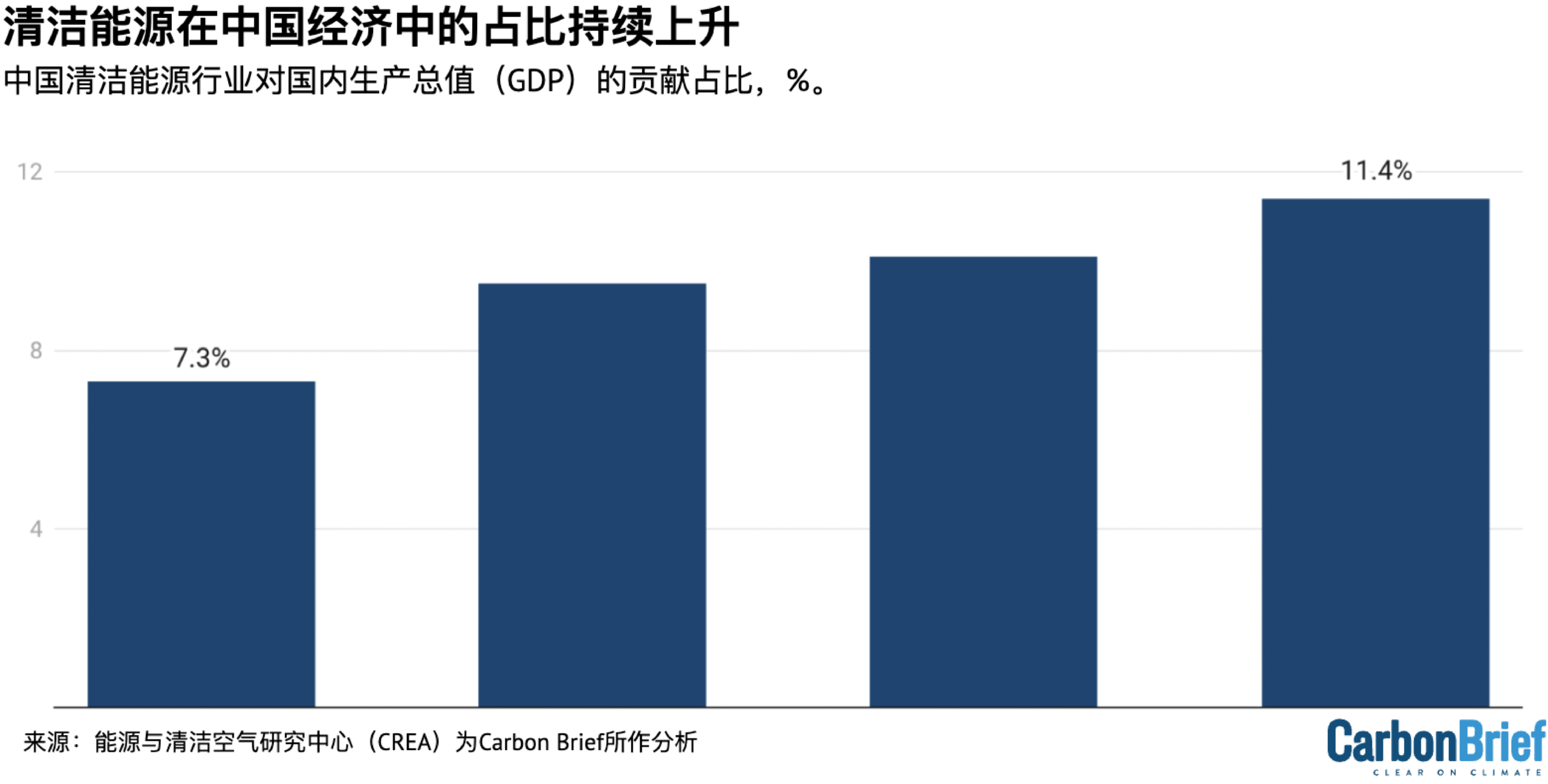
中国清洁能源行业对国内生产总值(GDP)的贡献占比,%。
中国清洁能源行业对国内生产总值(GDP)的贡献占比,%。来源:能源与清洁空气研究中心(CREA)为Carbon Brief所作分析。

如果没有清洁能源行业,中国2025年的GDP增速将仅为3.5%,因此,在经济稳定增长为中国首要目标之一的2025年,清洁能源做出了至关重要的贡献。

下表按行业和活动进行了详细分类。

电动汽车和电池是GDP增长的最大驱动力

2024年,电动汽车和太阳能是最大的增长驱动力。而到了2025年,电动汽车和电池则占据了主导地位,合计贡献了44%的经济效益,以及清洁能源行业一半以上的增长。这主要得益于产出和投资的同步强劲增长。

在未剔除通胀因素的名义GDP口径下,电动汽车的贡献甚至更为突出。这是因为电动汽车价格同比保持相对稳定,而整体经济仍处于通缩环境中。同时,电池制造投资在2024年下滑后于2025年出现反弹。

下图展示了电动汽车和电池的主要贡献,既反映了清洁能源经济的整体规模,也显示了各子行业对年度增量的具体贡献情况。
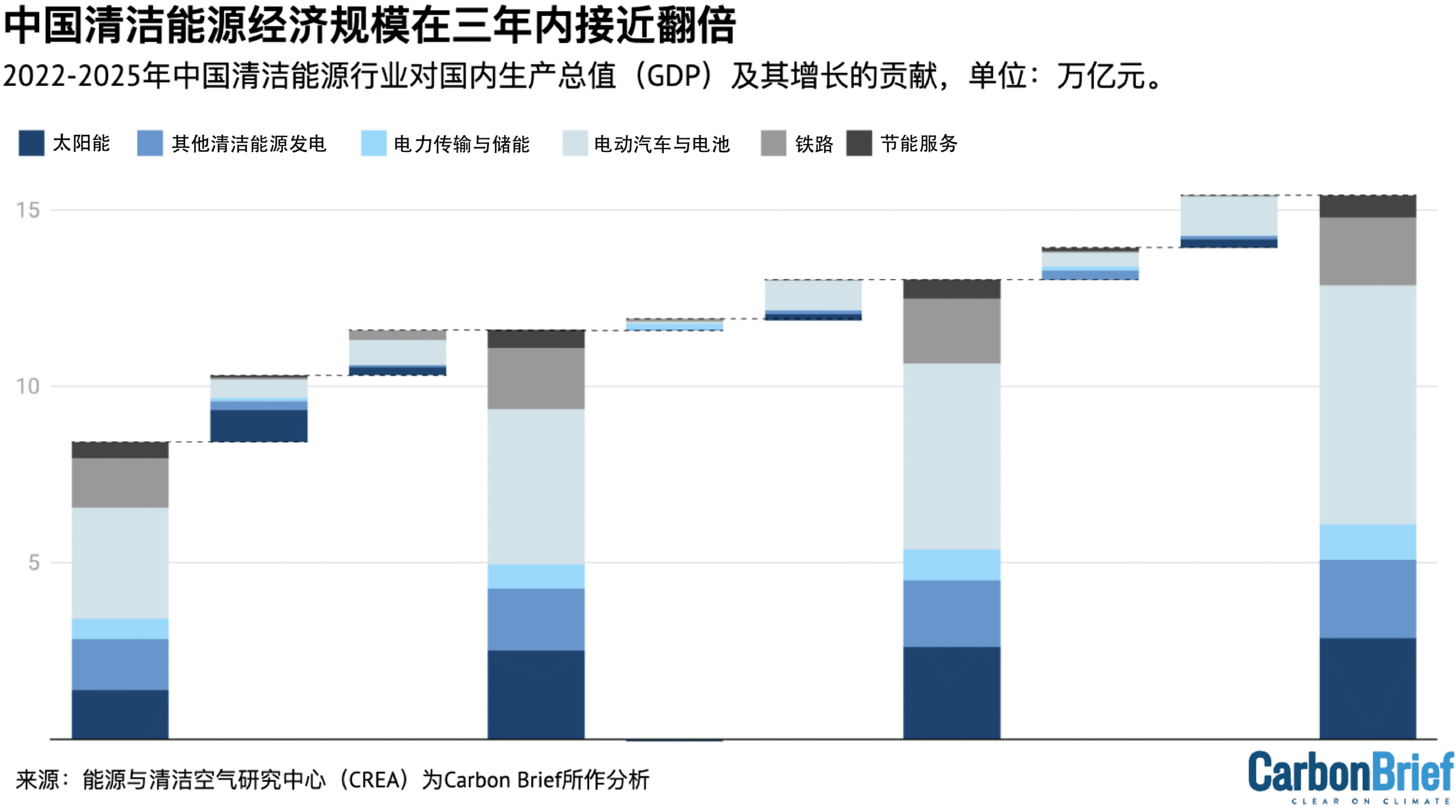
2022-2025年中国清洁能源行业对国内生产总值(GDP)及其增长的贡献
2022-2025年中国清洁能源行业对国内生产总值(GDP)及其增长的贡献,单位:万亿元。来源:能源与清洁空气研究中心(CREA)为Carbon Brief所作分析。

第二大子行业是清洁能源发电、输电和储能,在2025年占清洁能源对GDP贡献的40%,并贡献了清洁能源产业当年约30%的增长。

在电力领域内部,最主要的增长动力来自风电和太阳能发电装机投资的扩大,以及风电和太阳能发电量的增长;其次是太阳能设备及材料的出口。

作为2022–2023年的重要增长引擎,太阳能组件产业链投资在2025年连续第二年下降,这与政府遏制产能过剩和行业“非理性”价格竞争的政策导向一致。

此外,铁路运输约占清洁能源行业总经济产出的12%,但其同比增长相对温和,2025年其营业收入增长3%,投资增长6%。

需要指出的是,国际能源署(IEA)在其《世界能源投资报告》中估计,中国2025年清洁能源投资为 6270亿美元,而化石能源投资为 2570亿美元。

在采用与IEA一致的行业口径进行测算时,本研究对2025年中国清洁能源投资的估计为 4300亿美元,低于IEA的数值。而本文中所呈现的1万亿美元清洁能源投资总规模,并非源于更激进的单项假设,而是由于纳入了更为广泛的产业和活动范围,超出了IEA报告所覆盖的口径。

电动汽车和电池

2025年,电动汽车与动力电池成为中国清洁能源经济中最大的贡献部分,约占清洁能源行业总值的44%。

其中,纯电动汽车和插电式混合动力汽车的生产在价值规模和当年增长贡献两方面均居首位,产量同比增长29%。排在其后的是电动汽车制造领域的投资,在2024年增速放缓后,2025年投资规模同比增长 18%

电池制造投资在2024年出现下滑后也迎来反弹,这主要得益于电池新技术的涌现以及国内外市场的强劲需求。电池制造投资同比增长35%,达到2770亿元人民币。

到2025年底,电动汽车在全国汽车保有量中的占比预计达到12%,高于一年前的 9%,而在五年前这一比例还不足 2%。

在新车销售中,电动汽车占比进一步提升至 48%,高于2024年的 41%,其中乘用车电动汽车渗透率已突破50%。2025年11月,电动汽车在当月汽车总销量中的占比更是首次突破 60%,并持续成为拉动整体汽车销量增长的主要动力,如下图所示。
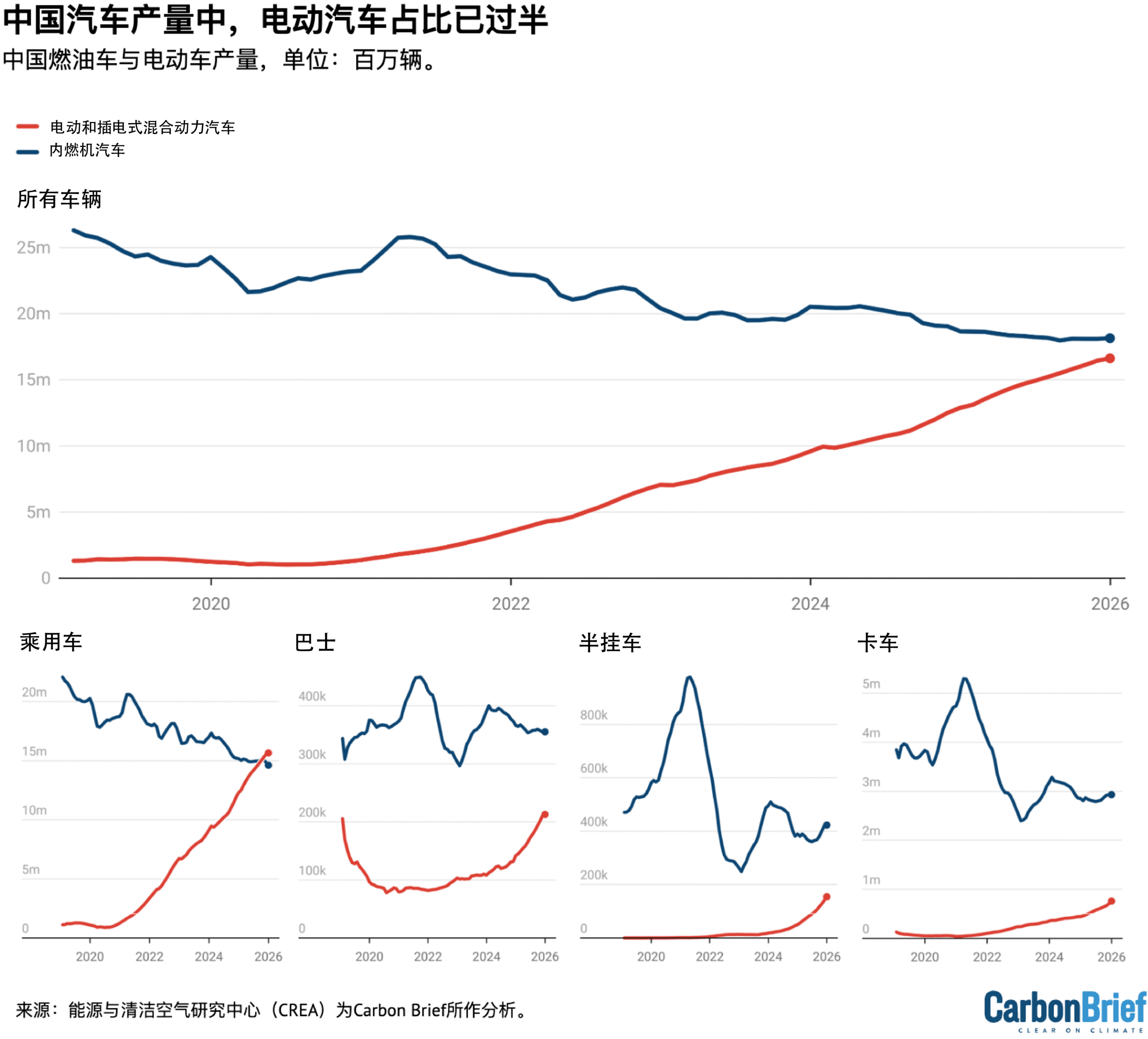
中国燃油车与电动车产量,单位:百万辆。电动车包含纯电动车及插电式混合动力车。
中国燃油车与电动车产量,单位:百万辆。电动车包含纯电动车及插电式混合动力车。数据来源:中国汽车工业协会,经Wind金融终端汇总整理。

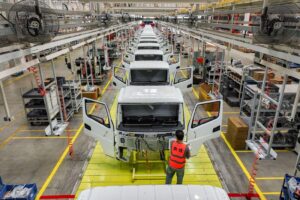
电动卡车市场取得突破性进展,其市场份额从2024年前九个月的8%,增长至2025年同期的23%。

政府对电动汽车的政策支持仍在持续,例如,一项最新政策提出,未来三年内充电基础设施规模将接近翻倍,以支撑电动汽车进一步普及。

在电动汽车市场中,出口增速快于国内销售增速,但整体销售仍以国内市场为主。2025年,中国电动汽车产量达到 1660万辆,同比增长 29%。其中,出口约340万辆,占总产量的 21%,但同比增速高达 86%。中国电动汽车的主要出口目的地包括西欧、中东和拉丁美洲。

电池出口额同样实现快速增长,同比上升 41%,成为推动GDP增长的第三大动力来源。电池出口主要流向西欧、北美和东南亚市场。

与许多清洁能源技术价格呈现的通缩趋势不同,2025年电动汽车的平均售价保持稳定,新车型在折扣后的平均加个甚至略有上涨。在全社会工业品出厂价格同比下降 2.6% 的背景下,这意味着电动汽车产业对名义GDP增长的贡献尤为突出。相比之下,电池价格仍延续下降趋势。

清洁能源发电

2025年,太阳能发电行业贡献了清洁能源产业总值的19%,为国民经济创造2.9万亿元人民币(约合410亿美元)的价值。

其中,新建太阳能发电厂的投资额达1.2万亿元人民币(约合1600亿美元),是清洁能源发电板块最大的驱动力;其次是太阳能技术出口额和太阳能发电本身创造的电力价值。太阳能制造业投资在2023年产能扩张浪潮结束之后持续下降,至0.5万亿元人民币(约合720亿美元),同比下降23%。

2025年,中国风电和太阳能发电新增装机容量再创新高。全国新增太阳能发电装机315吉瓦,新增风电装机119吉瓦,其中太阳能发电装机容量比全球其他地区总和还要多,而风电装机容量更是后者两倍之多。

在电力投资结构中,清洁能源占发电领域投资的90%,其中光伏一项就占到约50%。在此推动下,非化石能源发电量占全国总发电量的比重提升至42%,高于2024年的 39%。

不过,新出台的新能源定价政策以及相对谨慎的装机目标,也为这一轮增长能否持续带来了不确定性。在136号文件新政策框架下,新建风电和太阳能发电项目需要在电力市场中与既有煤电直接进行价格竞争,而在若干关键制度设计上仍处于相对不利的位置。

与此同时,电力市场本身仍处于建设和发展阶段,这也带来了投资的不确定性。

太阳能发电投资同比增长6%,但期间波动剧烈。开发商赶在新定价政策于6月生效前加速完成项目,第三季度放缓后,在年底再次赶工,以赶在“十四五”规划期内达成目标。

总体来看,太阳能产业整体投资规模与上一年大致持平:制造环节投资下降,被发电侧的增长所抵消。这在一定程度上支撑了制造产能利用率,也符合政府遏制行业“无序竞争”和价格内卷的政策目标。

2025年底,中国太阳能制造产能预计已达到每年1200吉瓦,远超2025年全球新增装机容量约650吉瓦的水平。目前,中国太阳能产业制造能力已显著超过全球市场吸收能力,激烈竞争导致行业盈利水平处于历史低位。

自2024年中期以来,中国的政策制定者已开始正面应对这一问题,包括警示“内卷式竞争”、出台监管措施,并召开行业会议向企业施压。相关举措已初见成效,2025年第三季度行业亏损有所收窄。

2025年,太阳能电池板及组件出口量再创历史新高,同比增长19%。其中,电池片和硅片出口量分别快速增长94%和52%,而电池板出口量仅增长4%。

这反映出,在关税压力上升、更多国家加快本土制造布局的背景下,全球太阳能供应链正日益趋向多元化。然而,由于平均出口价格下跌,以及出口产品结构从成品电池板向上游中间产品转移,出口名义价值反而同比下降了8%。

2025年,水能、风能和核能合计贡献了清洁能源行业总产值的约15%,为中国GDP带来约2.2万亿元人民币(3100亿美元)的增加值。

其中近三分之二(1.3万亿元人民币,1800亿美元)来自水电、风电和核电的发电价值,其余部分则来自新建发电项目的投资。

从发电量增速来看,2025年太阳能发电量增长33%,风电增长13%,水电增长3%,核电增长8%。

在发电投资领域,太阳能仍是价值规模最大的板块(如下图所示),但风电项目在2025年首次成为投资增长的最大贡献者,这是自2020年以来风电投资首次在增量上超过太阳能。
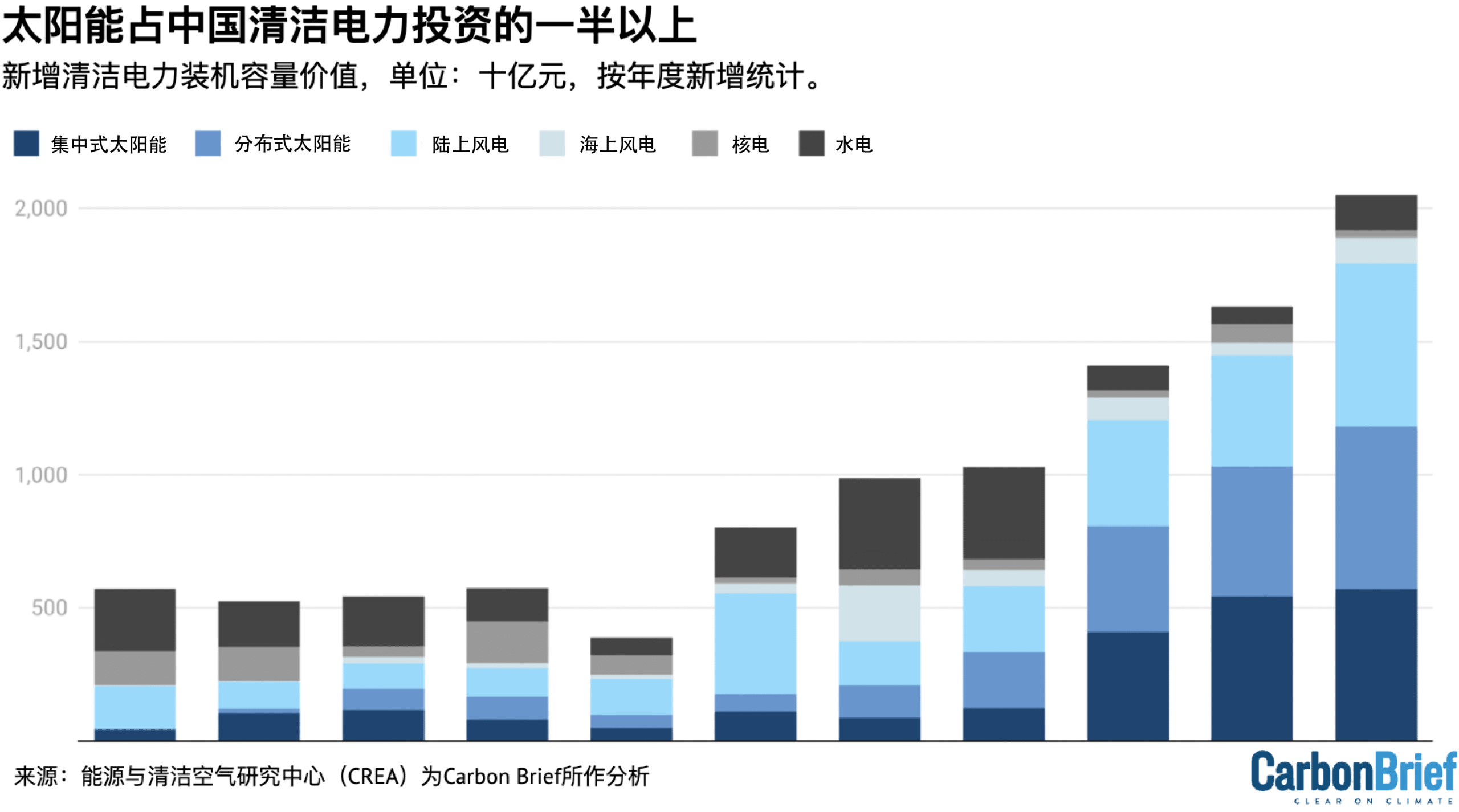
新增清洁电力装机容量价值,单位:十亿元,按年度新增统计
新增清洁电力装机容量价值,单位:十亿元,按年度新增统计。来源:能源与清洁空气研究中心(CREA)为Carbon Brief所作分析。

特别是海上风电装机投资如预期般反弹,在2024年大幅下降后,2025年实现翻倍增长,成为清洁电力投资中的一个亮点。

核电项目投资持续增长,但总体规模仍然较小,2025年投资额约为170亿元人民币。常规水电投资则延续下行趋势,同比下降7%。

储能和电网

2025年,输电和储能占清洁能源行业总产值的6%,规模达到1万亿元人民币(1400亿美元)。

其中,电网投资2025年增长了约6%,达到900亿美元。储能投资(涵盖抽水蓄能、新型储能和氢气制备)2025年达到约500亿美元。

新型储能投资同比增长幅度达50%,电解槽投资也增长了30%。受清洁能源发电快速增长推动,清洁能源输送规模预计增长13%。

中国电力储能总装机容量超过213吉瓦,其中新型储能容量超过145吉瓦,抽水蓄能容量为69吉瓦。预计2025年中国新增约66吉瓦新型储能装机容量,同比增长52%,占全球新增装机容量的40%以上。

值得注意的是,下半年新型储能装机增速加快,达43吉瓦,而上半年新增装机容量为23吉瓦。

在政策层面,136号文件规定在5月后取消了新能源配套储能的强制要求,曾一度导致新型储能市场增速放缓,但这一影响很快被“市场驱动型增长”所取代。省级电力现货市场的推进、分时电价机制以及太阳能弃光率上升,共同改善了储能项目的经济性。

到2025年底,中国前五大太阳能制造商均进入了新型储能市场,标志着行业战略的重要转变。

与此同时,抽水蓄能投资保持增长,仅2025年上半年,就有15吉瓦的项目获批,新增3吉瓦抽水蓄能投入运营。

铁路

铁路运输占清洁能源行业GDP的12%,其中客货运输收入是最主要的价值来源。行业增长主要来自铁路基础设施投资,2025年同比增长6%。

交通电气化不仅限于电动汽车,铁路客运、货运及相关投资规模也持续增长。2025年,中国高铁总里程约达5万公里,占全球高速铁路总里程的70%以上。

节能服务

2025年,节能服务投资强劲反弹。以大型节能服务公司(ESCO)的产值衡量,市场规模同比增长17%,恢复至2016-2020年期间的增长水平。

行业产值也已恢复到2021年的峰值水平,这表明在经历三年低迷后,行业已明显回暖。

行业预测显示,节能服务行业年产值有望在2030年达到1万亿元人民币,而行业经历低迷前曾预期这一目标将在2025年实现。

中国已发展成为全球最大的节能服务公司市场。其投资高度集中于建筑领域,约占业务总量的50%;工业应用占21%,而能源供应、需求侧灵活性与储能相关业务合计约占16%。

中国清洁能源布局的影响

中国持续向清洁能源制造业投入数千亿美元,代表着对全球能源持续转型的一项规模巨大的经济与金融押注。

除本文所涵盖的国内投资外,中国企业还在海外制造业领域展开了大规模投资布局,进一步加深了这一押注的全球化属性。

在十四五规划期间,清洁能源产业对中国实现经济增长目标起到了关键作用,在2023年、2024年和2025年分别贡献了约40%、25%和37%的GDP增长。

然而,长期的发展前景仍存在不确定性,尤其是在太阳能发电领域。136文件下新的可再生能源发电定价机制已导致短期投资增速放缓,并显著增加了市场不确定性;与此同时,中央政府设定的清洁电力新增装机目标也相对保守,远低于当前实际增长水平。

2025年下半年,太阳能发电和光伏制造领域的投资均出现下降,尽管从全年来看,发电投资保持了增长。这反映出在当前电力市场制度仍偏向煤电的框架下,清洁能源产业面临结构性风险。

清洁能源技术价格下降幅度显著,以致在未来核算GDP时,这些行业对实际GDP(经通胀或通缩调整后的GDP)的贡献可能会被向下修正。

尽管如此,清洁能源产业在宏观经济中的关键地位,本身就构成了维持这一轮清洁能源发展势头的强烈政策和经济动机。如果国内市场增长出现明显放缓,不仅可能削弱遏制产能过剩的努力,或将迫使更多产能转向出口,从而加剧国际贸易摩擦。

能源与清洁空气研究中心近期针对中国气候与能源领域专家开展的一项调查显示,多数专家认为,在经济和地缘政治挑战加剧的背景下,“双碳目标”及其所依托的清洁能源产业,只会变得更加重要。

地方政府和国企同样将深刻影响该行业的发展前景。在十四五期间,正是地方政府和国企的积极推进,促成了规模空前、且显著超出预期的“风光大基地”建设。

同时,各省在落实新电力市场机制和可再生能源购电合同安排方面拥有较大的自主空间,因此,将于今年发布的十五五规划,将成为决定清洁能源产业中长期走势的关键。

关于数据

本文分析尽可能采用已公布的投资与销售数据。若数据不可得,则依据实际数量(如装机容量、汽车销量等)结合单位成本或价格进行估算。

为衡量实际增长贡献,相关数据已按2022-2023年价格进行通胀或通缩调整。全部计算过程与数据来源详见附表。

估算范围涵盖清洁能源技术对上游原材料(如金属、化学品)的需求贡献。

该方法不仅能够反映清洁能源行业对整体经济活动的拉动作用,也能提现其对相关产业活动的带动作用,因此可适用于估算:若该行业未曾增长,经济增速可能降低多少。

为避免重复计算,仅计入价值链中不重叠的环节。例如,电动汽车的生产产值与储能电池的投资额均予计入,但不包含作为上述活动中间投入的、面向国内市场的电池生产价值。

同理,国内市场的太阳能电池板产值已包含在中国光伏发电装机容量的价值中,故不重复统计;然而,太阳能电池板及电池的出口价值则纳入计算。

2025年,两项关键投资指标出现明显背离:据报道,固定资产投资下降3.8%,为35年来首次下滑;而同期资本形成总额虽增速放缓至近年最低,但仍保持2%的正增长。

本研究采用资本形成总额作为投资衡量指标,因其是GDP的组成部分。但由于无法全面追踪库存变动,对清洁能源投资的估算仍基于各行业的固定资产投资数据。

本分析未专门考虑进口因素——其在清洁能源产品与服务生产中所占比例较小且持续下降。这意味着结果可能略微高估对GDP的贡献,但同时低估了对GDP增量的贡献。

例如,中国在电动汽车中对高端计算芯片仍存在较高的进口依赖。一辆典型电动汽车的芯片价值约1000美元,而该类芯片的进口依赖度高达90%,但这仍进展整车生产价值的3%以内。

在某些方面,本研究的估算可能相对保守。例如,彭博新能源财经(BNEF)估计2024年中国“能源转型投资”规模约为8000亿美元。彭博估算的行业覆盖范围与本分析大致相当,但未包含制造业产值。在相同口径下,本研究对应的投资规模约为6000亿美元。

根据中国国家统计局数据,2023年全国汽车产业总产值与销售额合计约11万亿元人民币。本分析估算,同年电动汽车销售额约为2.3万亿元,约占行业总值的20%。当时,电动汽车产量已占汽车总产量的31%,且其平均售价略高于传统燃油汽车。
The post 分析:清洁能源2025年为中国GDP增长贡献超过三分之一 appeared first on Carbon Brief.

分析:清洁能源2025年为中国GDP增长贡献超过三分之一

Continue Reading

Climate Change

Africa can lead the Age of Electrification

Published

on

Mohamed Adow is the founder and director of Power Shift Africa.

At London Climate Action Week, electrification moved from the margins of climate policy to the centre of the road to COP31. The launch of the Electrify Now campaign gave fresh momentum to a target floated at the Bonn climate talks: by 2035, electricity should provide 35% of the world’s final energy consumption, up from just over 20% today.

That makes electrification one of the defining tests for this year’s climate summit in Türkiye. If COP31 is to be more than another exercise in negotiating text, it must show how the world can replace fossil fuels in transport, heating, industry and everyday life with clean electricity.

For Africa, this agenda presents both an extraordinary opportunity and an immense challenge.

For decades, the continent has been viewed primarily through the lens of energy poverty. More than 600 million Africans still lack access to electricity. Yet that very deficit also means many African countries are not locked into ageing fossil-fuel infrastructure in the way industrialised economies are. They have the chance to build cleaner energy systems from the outset.

    The case for electrification is compelling. Transport, industry and heating account for much of the world’s fossil-fuel consumption. Replacing combustion engines with electric vehicles, diesel generators with renewable power and fossil-fuel heating with electric alternatives is one of the fastest ways to cut emissions while improving energy security. Electric technologies are also far more efficient, and renewable electricity is now the cheapest source of new power across much of the world.

    Africa also possesses one of the greatest renewable energy endowments on Earth. The continent possesses some of the world’s best solar resources. Vast wind corridors stretch across North, East and Southern Africa. Geothermal energy is already powering much of Kenya’s electricity system. Hydropower resources remain significant in several regions.

    But potential is not the same as progress.

    The biggest obstacle is not a lack of sunshine or wind. It is a shortage of investment.

    Financial barriers

    African countries pay some of the highest borrowing costs in the world despite contributing the least to climate change. Projects that would be commercially viable elsewhere become prohibitively expensive because of high interest rates and perceptions of financial risk. Until the cost of capital falls, many countries will struggle to build the renewable power stations, transmission lines and battery storage needed to electrify their economies.

    The electricity itself is another challenge. It is difficult to persuade people to buy electric vehicles or industries to electrify production if power supplies remain unreliable. Many national grids require major investment to expand access, improve reliability and accommodate growing volumes of renewable energy. In rural areas, decentralised solar and battery systems will often provide the quickest route to universal electricity access, but they too require finance and supportive policy frameworks.

    Industrial policy matters just as much.

    Africa is rich in many of the minerals needed for batteries and clean technologies, yet too often it exports raw materials and imports finished products. If electrification simply creates new markets for imported batteries, electric vehicles and solar equipment, much of the economic opportunity will be lost. The transition should also become a strategy for building African manufacturing, creating skilled jobs and capturing more value from the continent’s own resources.

    There are encouraging signs. Ethiopia has pushed aggressively to promote electric mobility while seeking to reduce its dependence on imported oil. Kenya has become a global leader in geothermal electricity and is seeing rapid growth in electric motorcycles. Morocco is building an industrial base around renewable energy and battery supply chains.

    Electrification is happening

    These examples show that electrification is no longer a distant prospect. But they also remain outliers rather than the norm. For most African countries, unreliable grids, high borrowing costs and limited access to finance still stand in the way of a much broader transformation. That is precisely why the emerging electrification agenda matters.

    If the world wants electricity to account for 35% of final energy demand by 2035, then success cannot be measured simply by announcing a global target. It must be measured by whether developing countries have the finance, technology and policy support to make that transition possible.

    For Africa, electrification is not only about reducing emissions. It is about determining what kind of development path the world’s youngest and fastest-growing continent will follow.

    More than a billion people live in Africa today. By mid-century, that number will be closer to 2.5 billion. This is a continent on the cusp of sweeping economic transformation, with cities expanding, industries growing and hundreds of millions of people rightly demanding the energy, mobility and prosperity long enjoyed elsewhere.

    Campaigners oppose Dangote’s planned Kenya refinery over climate and ecological risks

    That development will require vast amounts of power. The question is whether it will be delivered through the old fossil-fuel model of imported oil, gas infrastructure and polluting combustion, or through clean electricity generated from Africa’s own renewable resources.

    This matters for Africa. But it also matters for the world. A global transition to electrification cannot succeed if a continent of this scale is locked into a new generation of fossil-fuel dependence. Nor can it be just if Africa is told to decarbonise without being given the finance and technology to build something better.

    The choice facing COP31 is therefore not simply whether electrification will happen. It is whether Africa is helped to become an electro-state continent, powering its development through clean electricity, or pushed by neglect into repeating the fossil-fuel pathway that has already destabilised the climate.

    For the age of electrification to be a success, COP31 needs to ensure Africa is equipped to shape and accelerate it. If Africa is left behind, the global energy transition will fall behind with it.

    The post Africa can lead the Age of Electrification appeared first on Climate Home News.

    Africa can lead the Age of Electrification

    Continue Reading

    Climate Change

    UK withdraws millions in funding from world’s second-largest rainforest in Congo 

    Published

    on

    The UK has abandoned projects worth tens of millions of pounds that were meant to help protect Congo rainforests and support local people.

    Together, these initiatives would have made up around half of the £200m that the UK pledged to support conservation in the Congo basin – the world’s second-largest rainforest.

    When it hosted COP26 in Glasgow, the UK led a new initiative to end forest loss, which included a collective pledge by 12 donors of “at least” $1.5bn (£1.1bn) for Congo rainforest nations by 2025.

    Development minister Jenny Chapman revealed last week that, as of 2024, the UK had only provided £39.8m towards this goal.

    Alongside the US and much of Europe, the UK has significantly cut its aid budget in recent years, leading to much of its Congo rainforest spending being cancelled or reappraised.

    The government says it still plans to “prioritise” rainforest regions, including the Congo basin, but civil society groups and MPs are concerned about the lack of “ring-fenced” forest funding in the UK’s new aid strategy.

    COP pledge

    At COP26, the UK – led by then prime minister Boris Johnson – launched the “Glasgow leaders’ declaration”, with a goal to “halt and reverse forest loss” by 2030. This was backed by more than 140 nations.

    The UK also made various funding pledges, including £200m to protect the Congo basin, £350m for tropical forests in Indonesia and “up to £300m” for the Amazon.

    These commitments target the world’s three largest rainforests, all of which face major forest loss due to threats such as agriculture, logging and climate change.

    The Congo basin is the planet’s largest forested carbon sink. Yet, its six host nations are among the poorest in the world and face significant funding barriers.

    This has global ramifications. An official UK assessment warned that “degradation or collapse” of the Amazon or Congo rainforests “threaten UK national security and prosperity”.

    Forest cuts

    Following successive aid cuts introduced by both the Conservative and then Labour governments – tracking a global trend – the UK’s Congo funding is under threat.

    The Congo basin forest action programme (CBFA) was launched by the UK at COP27. It was explicitly set up to provide “roughly half” of the UK’s £200m Congo pledge.

    CBFA set out to “empower central African nations”, such as the Democratic Republic of the Congo (DRC), with support for “community forests” and other measures to curb forest loss.

    Now, after reporting delays, the UK has slashed the CBFA as part of the Labour government’s recent aid cuts, intended to free up money for defence spending.

    Its original £90m budget has now been reduced to £18.8m. Government data shows that £15m of this has already been spent.

    This is not the only Congo project that has been dropped due to this latest round of aid cuts.

    The Congo part of the biodiverse landscapes fundchampioned by the previous government and worth at least £12.3m – has been closed, just two years into its seven-year schedule.

    Government documents reveal more Congo forest funding is at risk as the UK scales back its aid budget, including the UK’s two largest remaining projects in the region.

    One initiative, intended to “incubate forest-friendly enterprises” in DRC, faces “reduc[ed] budgets”. Officials working on the other, while more optimistic, reported that the project may be forced to operate in fewer countries as the cuts set in.

    Documents also reveal the difficulties that come when operating in the Congo, including “complex political economies and, in Gabon, a military coup – which “complicated matters”.

    ‘Breaking promises’

    Damian Fleming, a senior director of forests at WWF International tells Carbon Brief:

    “Tropical forest countries are making long-term policy and development choices in expectation that international partners will honour their commitments.”

    In a series of recent parliamentary responses, Chapman revealed that the UK had only spent £39.8m on Congo forest finance, as of 2024. (She declined to provide any information on the Indonesia and Amazon regional goals.)

    Despite being presented as the UK’s “contribution” to the £1.1bn-by-2025 global goal agreed at COP26, the £200m target has a deadline of 2029.

    Therefore, while the collective goal has been met, the UK’s contribution so far has been relatively small.

    Zac Goldsmith, a former Conservative minister who oversaw the forest targets at COP26, tells Carbon Brief that, in his view, the UK has “discarded” its regional pledges:

    “We have gone from being perhaps the leader on protecting nature internationally to breaking promises to countries around the world for whom the environment is an existential issue.”

    Future targets

    The Labour government says it has met the five-year “climate finance” target of £11.6bn that expires this year.

    Ministers also say the government has met “and exceeded” the £3bn and £1.5bn sub-goals for “preserving nature” and forests, respectively, within the £11.6bn. These are the funding streams that include support for the Congo basin and other rainforests.

    The UK has funded a variety of projects in line with its forest goals, including mangrove restoration in Indonesia, support for carbon-offsetting projects in Brazil and promoting “forest stewardship” among farmers in Cameroon.

    Chapman has stated that the UK will continue to “prioritise” the Congo rainforest, in line with its new plan for aid spending in Africa. The UK even helped to launch a new “call to action” for Congo basin funding at COP30 last year.

    The UK government also says it supported the creation of Brazil’s flagshipTropical Forest Forever Facility” (TFFF). However, so far it has not provided any funding for the facility.

    When the government announced a new climate finance pledge for 2026 onwards, it stressed that nature would still be a “focus” and said it would also generate billions in “climate and nature positive investments”. Nevertheless, it dropped the “ring-fenced” amounts for nature and forests that had appeared in its previous pledge.

    The UK, alongside other developed countries, has pledged to provide biodiversity finance to developing countries, under the Kunming-Montreal Global Biodiversity Framework (GBF) – a non-binding global pact to halt and reverse nature loss by 2030.

    Sarah Champion, chair of the international development committee of MPs, says “sub-pledges” for nature and forests are a “cost-effective and impactful” way to ensure this finance is provided, alongside climate finance. She tells Carbon Brief that she was “concerned” about the move away from this approach:

    “When the minister recently appeared before the international development committee, I was concerned to hear her characterise this shift as a ‘gamble’.”

    A government spokesperson tells Carbon Brief:

    “We remain committed to providing finance for forests, including in the Congo basin, as a core element of our overall climate funding.”

    A shorter version of this article was first published in Cropped, Carbon Brief’s fortnightly newsletter that provides a digest of food, land and nature news, on 15 July 2026. Subscribe for free.

    The post UK withdraws millions in funding from world’s second-largest rainforest in Congo  appeared first on Carbon Brief.

    UK withdraws millions in funding from world’s second-largest rainforest in Congo 

    Continue Reading

    Climate Change

    Cropped 15 July 2026: Uganda starves | Trump opens endangered habitats | UK cuts rainforest aid

    Published

    on

    We handpick and explain the most important stories at the intersection of climate, land, food and nature over the past fortnight.

    This is an online version of Carbon Brief’s fortnightly Cropped email newsletter.
    Subscribe for free here.

    Key developments

    Global drought and heat

    DRY THEN WET: A recent heatwave and months of low rainfall has led to a prolonged drought for Uganda, resulting in at least 16 deaths from hunger and significant crop losses, reported BBC News. Bastille Post Global suggested that “a developing El Niño later this year could bring heavier rainfall to parts of the region, raising the risk of flooding in areas now struggling with drought”.

    FUNDING FOOD: The UN Food and Agriculture Organization (FAO) and the World Food Programme (WFP) have appealed for $200m in funding to help African nations deal with the impact of El Niño, stated Deutsche Welle. This would target 22 high-risk countries with measures, including “cash transfers, climate-resilient seeds, livestock protection and flood control.” The Guardian explained how El Niño could still “cause a severe shock to global food prices lasting into 2028”.

    FARMING FEARS: Extreme weather has devastated agriculture across the world. India saw its driest June in 12 years, reported BBC News, and France has had a “double-digit production” decline, according to Le Monde. The Financial Times reported that farmers in the UK are mitigating the impacts of extreme heat by eliminating “chemicals and intensive ploughing to improve soil quality so it retains water”.

    EURO FIRES: Wildfires have spread across Europe, with Spain reporting at least 12 deaths so far, according to the Guardian, and France experiencing road closures, said Reuters. Wildfire Today reported that the most extreme conditions are “across France, Spain and northern Portugal, the Alpine arc extending into northern Italy, the south of the UK and south-east Ireland”. CNN explained how “the climate crisis is driving hotter, drier weather, which is setting the stage for fiercer fire seasons”.

    Endangering species

    REDEFINING HARM: The Trump administration “reversed decades of longstanding environmental law protecting endangered species…opening up sensitive habitats…to drilling, mining, farming and real estate development”, reported CNN. According to the story, the change “redefines what constitutes ‘harm’” to endangered species, which historically prohibited habitat modification or degradation. Agence France-Presse reported that US environmental groups sued the Trump government over the move, arguing that it had violated “common sense, biological science and federal law”.

    OPEN SEASON: Reuters reported that the change “limits the reach of the 50-year-old Endangered Species Act” (ESA), which is a “key regulatory consideration” when granting permits for “oil and gas, mining, electric transmission and ​other operations on federal lands and water”. Legal scholars told the New York Times the US government “was acting without conducting scientific research into the impact” of the change, while the National Mining Association “applauded the announcement”.

    News and views

    • INTERNATIONAL WATERS: After a significant delay, the UK ratified the Biodiversity Beyond National Jurisdiction Agreement (BBNJ), also known as the High Seas Treaty. Oceanographic detailed how this will allow for “marine protected areas across international waters for the first time”, but also stressed that the “hard part” starts now. 
    • SCOPE-FREE: The world’s largest meat supplier JBS “scrapped a key climate goal” in its net-zero plan that accounts for its suppliers’ emissions, “which make up the vast bulk of the company’s environmental footprint”, reported the Financial Times. The company told the paper it was difficult to control these “indirect” emissions.
    • DEEP TROUBLE: Pacific gray whales are facing a “catastrophic die-off” as sea-ice loss threatens their food sources, said the Guardian. Separately, conservationists warned that more than half of all molluscs that “cluster around underwater vents” could face extinction from deep-sea mining, reported Reuters.
    • ETHANOL PUSHBACK: India’s new rules to promote 100% ethanol fuel and make ethanol-blended fuel mandatory at pumps “triggered a political row”, reported the Times of India. While the Indian government defended the push to automobile owners, a Hindu editorial and an Indian Express comment warned against incentivising fuels made from “water-intensive” sugarcane and rice. 
    • AMAZON ACTION: Deforestation in the Brazilian Amazon fell to its lowest level in a decade, but president Lula’s plans to “end illegal deforestation by 2030” could be hampered if he is not re-elected, reported Al Jazeera. Meanwhile, Colombia’s outgoing environment minister warned of greater environmental and climate risk under the incoming government, said the Associated Press
    • WAR WORRIES: The International Energy Agency (IEA) warned of the impact of the Iran war on Africa’s clean cooking efforts as disruption in the strait of Hormuz has stunted supplies and increased prices of liquefied petroleum gas (LPG), explained Climate Home News

    Spotlight

    UK ‘discards’ Congo rainforest funding

    Amid worldwide cuts to aid spending, Carbon Brief explores how the UK is backtracking on funding for the Congo basin – the world’s second-largest rainforest.

    The UK has abandoned projects worth tens of millions of pounds that were meant to help protect Congo rainforests and support local people.

    Together, these initiatives would have made up half of the £200m that the UK pledged to support forest conservation in the Congo basin.

    When it hosted COP26 in Glasgow, the UK led a new initiative to end forest loss, which included a collective pledge of “at least” $1.5bn (£1.1bn) for Congo rainforest nations by 2025.

    Development minister Jenny Chapman revealed last week that, as of 2024, the UK had only provided £39.8m towards this goal.

    COP pledge

    At COP26, the UK – led by then prime minister Boris Johnson – launched the “Glasgow leaders’ declaration”, with a goal to “halt and reverse forest loss” by 2030.

    The UK also made various regional funding pledges, including £200m for the Congo basin, £350m for tropical forests in Indonesia and “up to £300m” for the Amazon.

    All of these rainforests face major forest loss. The Congo basin is the planet’s largest forested carbon sink, but its six host nations are among the poorest in the world and face significant funding barriers.

    This has global ramifications. An official UK assessment warned that “degradation or collapse” of the Amazon or Congo rainforests “threaten UK national security and prosperity”.

    African elephant pictured in Congo.
    African elephant pictured in Congo. Credit: BIOSPHOTO / Alamy Stock Photo

    Forest cuts

    Following successive aid cuts introduced by both Conservative and Labour governments – tracking a global trend – the UK’s Congo funding is under threat.

    The Congo basin forest action programme (CBFA) was explicitly set up to provide “roughly half” of the UK’s £200m Congo pledge.

    Now, after reporting delays, the UK has slashed the CBFA as part of the Labour government’s aid cuts. Its £90m budget has been “quietly reduced by 79% to £18.8m”, according to the Times.

    This is not the only Congo project that has been dropped due to aid cuts. The Congo part of the biodiverse landscapes fund – worth at least £12.3m – has closed five years early.

    Official documents reveal more Congo forest funding is at risk, including the UK’s two largest remaining projects in the region. One initiative, intended to “incubate forest-friendly enterprises” in DRC, faces “reduc[ed] budgets”.

    Documents also show the difficulties operating in the Congo, including “complex political economies and, in Gabon, a military coup – which “complicated matters”.

    ‘Breaking promises’

    Damian Fleming, a senior forests director at WWF International told Carbon Brief:

    “Tropical forest countries are making long-term policy and development choices in expectation that international partners will honour their commitments.”

    In a parliamentary response, Chapman said that the UK had spent £39.8m towards its £200m Congo target, as of 2024.

    Despite being described as the UK’s contribution to the £1.1bn-by-2025 global goal agreed at COP26, the £200m target has a deadline of 2029. Therefore, while the collective goal has been met, the UK’s contribution was relatively small.

    Zac Goldsmith, a former Conservative minister who oversaw the forest targets at COP26, told Carbon Brief that, in his view, the UK has “discarded” its regional pledges:

    “We have gone from being perhaps the leader on protecting nature internationally to breaking promises to countries around the world.”

    The Labour government says it has met its overarching “climate finance” goals and still intends to “prioritise” the Congo rainforest.

    However, civil society groups and MPs are concerned about the lack of “ring-fenced” forest funding in the UK’s new aid strategy.

    Watch, read, listen

    TOXIC TROUBLES: DeSmog unpacked a new report that said Northern Ireland is being turned into a “toxic” pig and poultry farming “sacrifice zone” to satiate the UK’s meat appetite.

    NEED TO NOAA: Laid-off scientists from the US’s National Oceanic and Atmospheric Administration (NOAA) launched Climate.Us – an independent, public-backed version of the climate information website shut down by Trump last year.

    DRY FRUIT: A Dialogue Earth long read looked at how climate change is impacting apricot harvests in the “stark, high-altitude desert” region of Ladakh, India.

    READING ALOUD: A London Review of Books podcast discussed Robin Wall Kimmerer’s influential book “Braiding Sweetgrass”, weighing its compelling themes and where it veers into “scientific overreach”.

    New science

    • Climate change could cause Indigenous peoples in the Amazon to lose 28-34% of their plant species and 18-23% of their associated services | Nature
    • Biodiversity in forests can act as a “buffer” against compound extreme weather events | Nature Communications
    • Zero-deforestation commitments in Indonesia’s palm oil sector have had “no additional impacts” on reducing forest loss | Proceedings of the National Academy of Sciences

    In the diary

    This edition of Cropped was written by Jess Milligan, Josh Gabbatiss and Aruna Chandrasekhar. Cropped is edited by Dr Giuliana Viglione. This edition was edited by Daisy Dunne. Please send tips and feedback to cropped@carbonbrief.org.

    The post Cropped 15 July 2026: Uganda starves | Trump opens endangered habitats | UK cuts rainforest aid appeared first on Carbon Brief.

    Cropped 15 July 2026: Uganda starves | Trump opens endangered habitats | UK cuts rainforest aid

    Continue Reading

    Trending

    Copyright © 2022 BreakingClimateChange.com