

Ever looked around a grocery store and thought “wow, there’s so much plastic”? From pre-cut fruit in clamshells to cucumbers wrapped in plastic, it can be hard to avoid.
That’s because plastic food packaging makes up approximately 40% of all plastic waste generated globally. The USA, Europe and China generate the most packaging waste.
Some of the links in this post are affiliate links; for more information please see my disclosure policy.
But plastic isn’t the only source of waste associated with our food. Food waste is a huge problem too – and it happens on both an individual and retail level.
For example, did you know grocery stores will toss perfectly good produce if it doesn’t meet their ‘beauty standards’? If it’s not the right size, shape, or has even minor blemishes, it’s tossed.
Additionally, Americans waste 40% of all our food – be it through improper storage, buying more than needed, etc.
In today’s economy, everything’s becoming more expensive, and that includes groceries. According to the USDA, in 2026, prices for all food are predicted to increase 3.6 percent. In other words, we – literally – can’t afford to waste anything.
If you want to start zero waste grocery shopping, there’s more to consider than just plastic packaging. Here’s everything you need to know about getting plastic-free groceries, avoiding food waste, and saving money in the process.
what is zero waste grocery shopping?
Zero waste grocery shopping is when you try to reduce waste while buying items like produce and dry goods. And it shouldn’t only account for plastic packaging waste, but food waste too.
You can accomplish this by choosing loose/naked produce over pre-packaged goods. Bringing your own produce bags and tote bags help cut back on single-use plastics.
Choosing imperfect produce or lonely bananas also helps reduce waste. Some grocery stores will even sell wonky or slightly damaged produce at a discount.
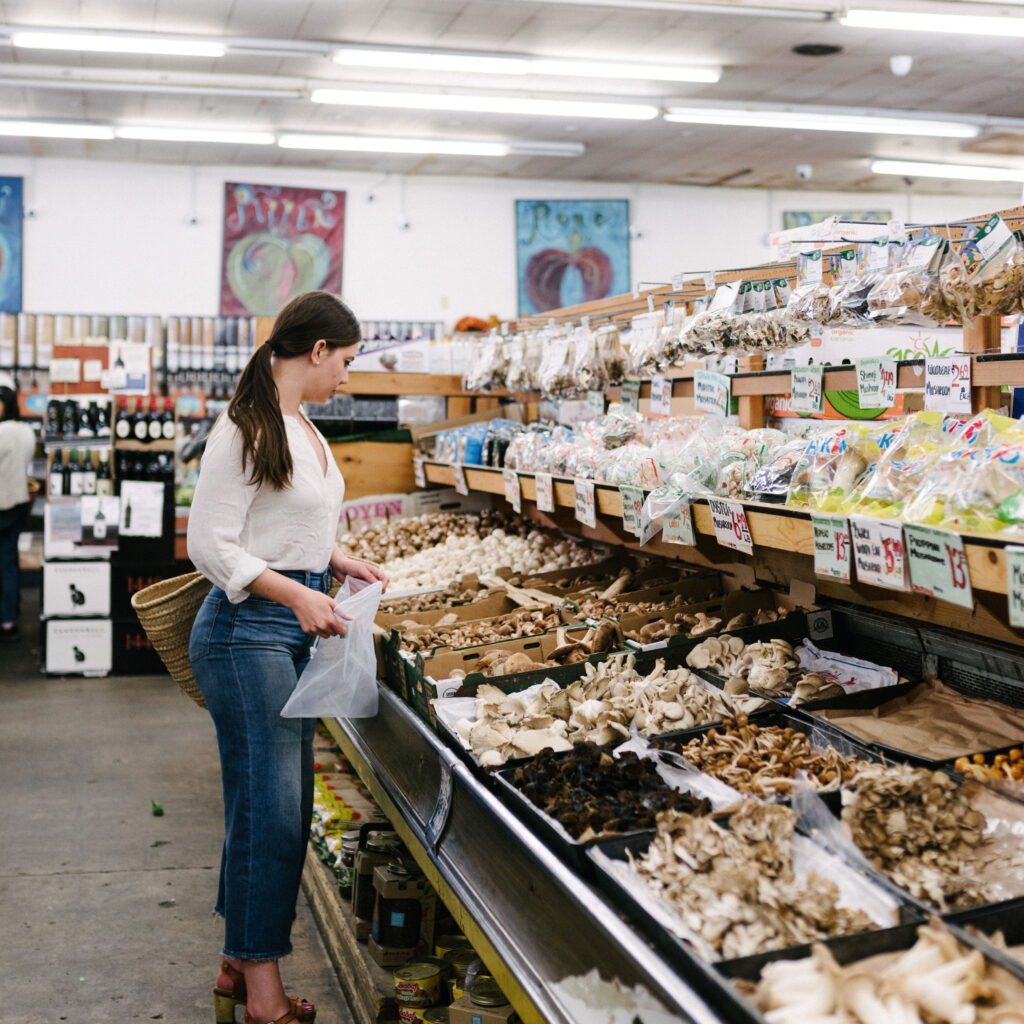
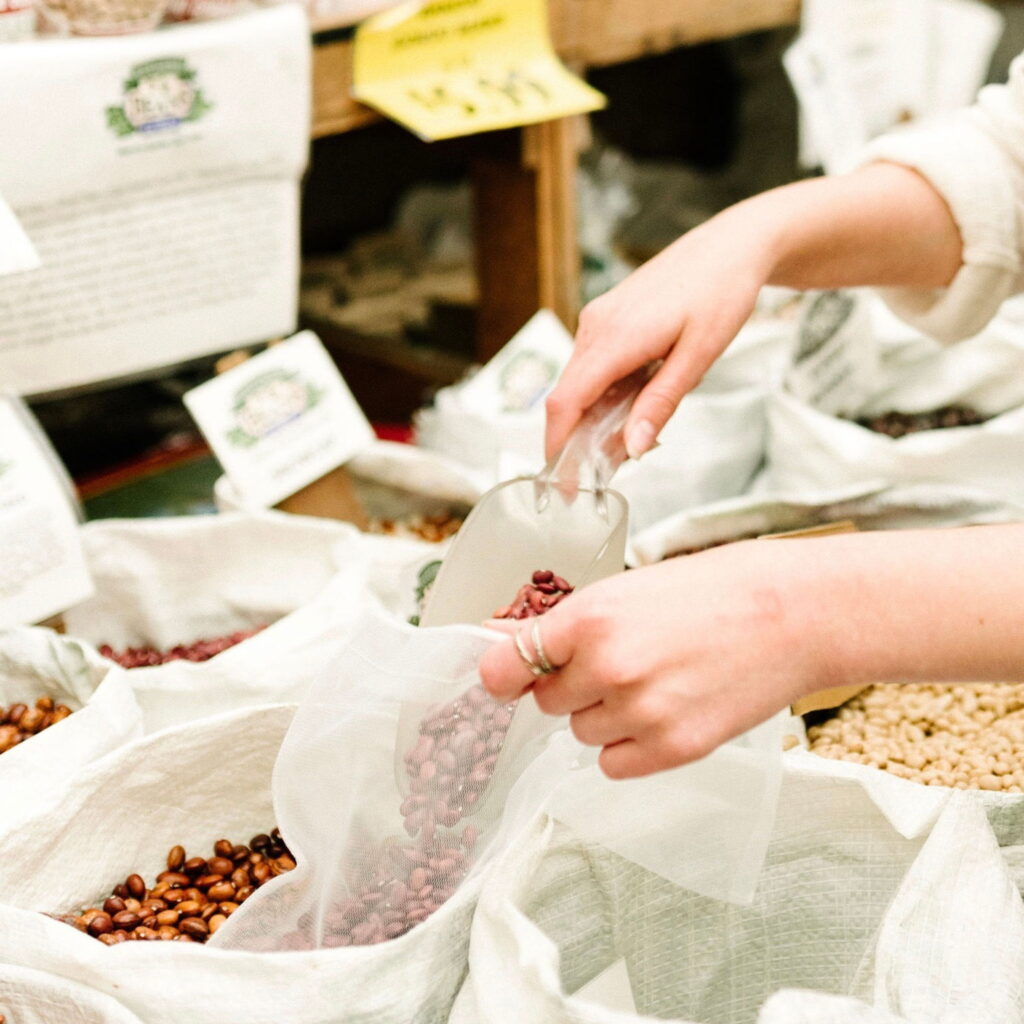
It’s also helpful if you have access to bulk bins (aka refillieries). You bring your own containers and fill them with goods like dry beans, spices, and flours. The beauty is getting to take as much or as little as you need.
Farmers markets are also great because most produce is package-free and doesn’t have produce stickers on it. Berries tend to come in paper cartons and they’re not afraid to sell wonky looking produce either.
However, you can still get plastic-free groceries even without access to these shops. Check if your local grocery store has naked produce to choose from.
For other goods, (like pasta, pickles, or rice), try to opt for packaging like glass, paper, cardboard, and metal over plastic. Here’s how to keep your groceries low waste even without bulk bins.
And if you’re still left with lots of packaging, make it a goal to upcycle the containers whenever possible. Reusing plastic clamshells to make crafts or donating them to community gardens is a good start.
Soft plastics can be harder to upcycle and recycle, as they’re not typically accepted via curbside recycling. Check if your local grocery store has a soft plastic recycling take-back program.
And remember, zero waste can (and should) still apply to your actual food! We’ll be discussing creative ways to reduce food waste in the coming sections so be on the lookout.
For a more in-depth look at the zero waste grocery system, be sure to check out my book 101 Tips For a Zero Waste Kitchen.
make a plan
Now that you know what zero waste grocery shopping is, making a plan can help you succeed.
Researching where your nearest bulk bins and farmers markets are located is beneficial. The Refill Collective is a handy resource for finding local refilleries – just put in your zip code and see what pops up!
If they’re too far away (more than an hour’s drive), it may be more efficient to utilize your local grocery store. Here’s everything to consider when shopping for low waste groceries.
budgeting
What does your budget look like? Mapping out how much you’re comfortable spending is important, especially if you’re going to the bulk bins.
For example, maybe you have $150 altogether you’re comfortable spending, but plan on going to both the market and the bulk bins. Consider setting aside $50 for the market, $100 for the rest of the groceries.
It can help to take cash to avoid going over your designated budget. Credit cards are easy to overspend on because you can’t see the money leaving your hands.
And don’t forget to take advantage of discounts, sales and coupons. If you download your local grocery store’s app, or follow them on socials, you may be the first to find out about these deals.
Local farmers may also be willing to lower their prices on slightly bruised produce or even throw in an extra one for free! Don’t be afraid to haggle, especially if you’ve built a rapport.
Here are a few more tips for staying in budget:
- In-season items tend to be less, because they’re more bountiful. Ex: Summer tomatoes over tomatoes in the dead of winter.
- Dry beans and legumes will always be less than pre-cooked, canned versions. Stock up!
- What’s happening in the world can affect market prices – look for more affordable alternatives when this happens (ex: Instead of berries, choose bananas)
RELATED: How I Cut My Grocery Bill to $300 a Month

what to bring
To shop low waste, there are certain items that’ll make your life easier. Here are a few of my all-time favorites.
produce bags
There are all kinds of reusable produce bags, from synthetic to cloth, mesh vs. solid. I personally love mesh cotton produce bags for big leafy greens like lettuce or kale. Solid cloth bags are also great for storing dry beans or grains at bulk bins.
tote bags
You probably have a bunch of these stashed in one of your drawers. Or buried in your closet. If not, ask your loved ones if they’d be willing to part with some – bet they have a bunch too. Use totes to carry all the produce you stash in your reusable produce bags.
jars
If you’re planning on hitting up a bulk store, taking some mason jars (or upcycled empty jars) is ideal. To make sure they don’t clank against one another, position them into a wine bag with dividers – this will keep them stable.
meal plan and prep
Creating a meal plan for the week helps you better understand what to buy on grocery runs.
I suggest planning meals around ingredients over meals. Because who knows what you’ll be craving Tuesday night opposed to Sunday night?
Making a master list of all your favorite recipes can help narrow down what ingredients you may need for the week. For example, I love Mexican food so I know I’ll want a burrito or a taco at least once in the week.
Make sure to write your list down – either on scrap paper or in an app – and stick to it. This will help you prevent impulse purchases.
But always check your fridge first before buying more. Because who needs an extra bushel of carrots floating around?
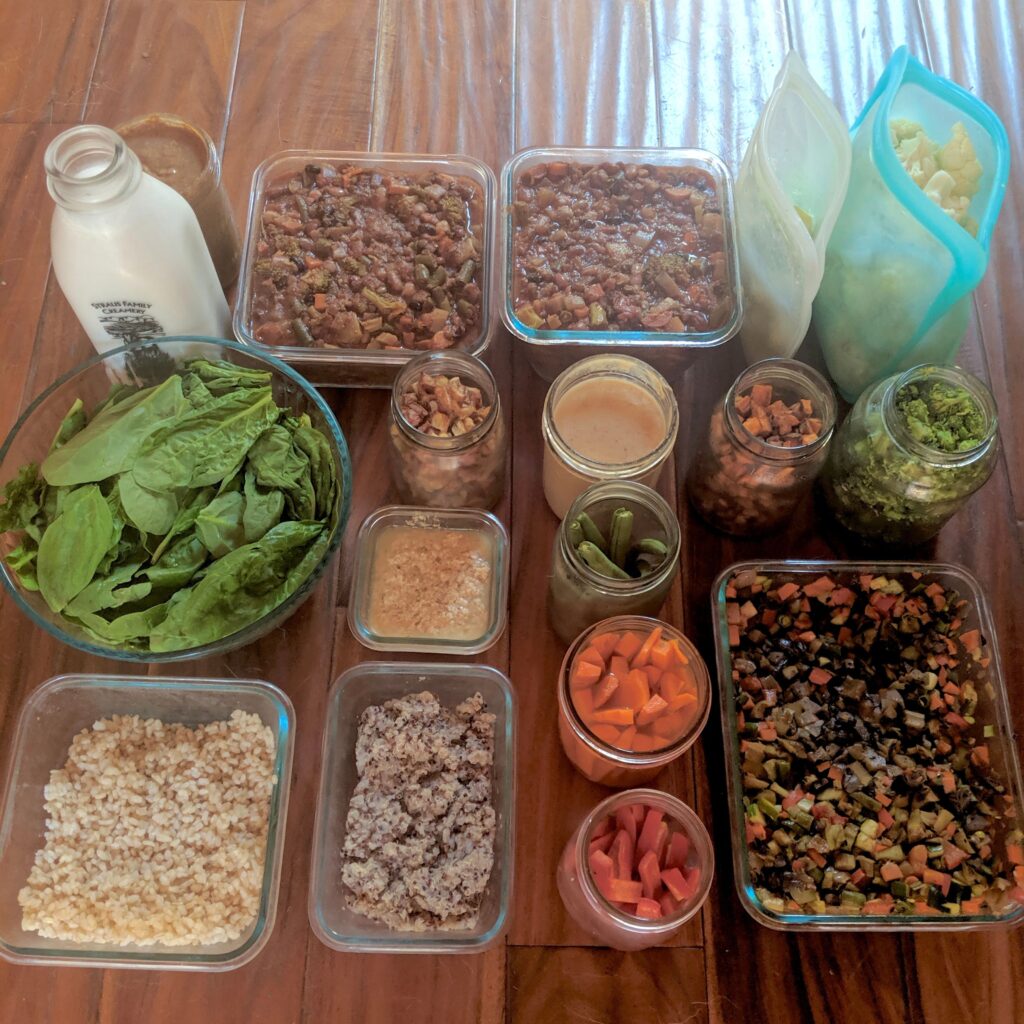
Once you’ve acquired your ingredients, prepping some of them ahead of time will help you in the long run.
You don’t have to spend a whole day cooking every single meal. Just peeling and chopping your carrots is a good place to start.
Having ingredients chopped and ready to go makes assembling dinner so much quicker – a blessing after a long day at work!
RELATED: My Weekly Meal Planning System That Prevents Food Waste
If you’re into visual content, check out my meal prepping video above! It’ll give you a better grasp on what I mean by prepping ingredients (not just meals).

know how to store your food
This runs into knowing how to store your food (prepped or not). If you take those carrots and just chuck them into your fridge, you may lose them sooner than you can get to them.
Instead, consider chopping and storing carrots in a glass of water in the fridge. This will keep them crisp for much longer and prevent them from going limp. They’re also easier to snack on this way (I love mine with homemade hummus)!
The opposite is true of berries – don’t wash or cut them until ready to eat. You’ll want to keep them in an airtight container.
And speaking of containers, always try to store food plastic-free. I recommend glass snapware, silicone bags, upcycled jars, and metal tiffins.
Where you put those containers matters too. Fridge organization plays a huge role in how long your produce holds up.
For example, you don’t want to store items like berries on the fridge door – that’s the warmest spot in your fridge! Save that space for items like condiments and sauces that won’t spoil easily.
Your crisper drawers are ideal for keeping high humidity (like leafy greens) and low humidity (ethylene-emitting fruits) produce separate. Just don’t overpack them.
RELATED: How to Store Food So It Lasts Weeks
reduce food waste
Now how do you keep all this food from going bad? You cook with it of course! And that means using up everything – from leftovers to odds and ends.
I better not see you tossing out your carrot tops. They taste similar to parsley! You can use them to make pestos or flavor salad dressings.
And that doesn’t just go for carrot tops. There are so many edible parts of vegetables many people don’t know about – strawberry tops, beet tops, celery root, etc. You just have to know how to cook with them.
Adding strawberry tops into smoothies gives you an extra dose of vitamins – plus you don’t even taste them. And I love making salads using beet and radish tops.
Even vegetable peels can be made into things like chips or stock. Doing this not only prevents food waste but also saves you so much money.
For even more ways to use up odds and ends, I have tons of great scraptastic recipes in my book 101 Tips For a Zero Waste Kitchen. Learn how to make strawberry top simple syrup, preserve your lemon peels, and so much more!
RELATED: How to Stop Wasting Food (And Save Money)
I recently challenged myself to save my food scraps for a week! Watch to learn more savvy ways to use up your bits and ends.

compost
If you can’t reuse your odds and ends in a dish, compost them. Because food scraps don’t break down in landfills.
You can do this by simply collecting food scraps in an empty takeout container and keeping it in the freezer. Even an empty plastic sandwich bag works.
Investing in a countertop compost pail with compostable liners helps keep everything clean. Ideally, you’ll want to get one with a charcoal filter to prevent odors.
At the end of the week, you can compost your scraps by utilizing curbside compost or a pickup delivery service. Community gardens and farmers markets will sometimes also accept food scraps.
If you have access to a backyard, you can get a tumbler, DIY a compost bin, or a bokashi compost system. Trench composting is also a simple option (aka, digging a hole and burying your scraps).
It’s also a good idea to brush up on what’s considered compostable. This will vary depending on who is accepting your compost.
If you’re using curbside compost, they often have access to industrial compost facilities that can break down items like meat and dairy. But if you’re backyard composting, you may want to steer clear of those unless using a bokashi method.
Just remember – composting your food scraps should remain a last resort! Always try to give them a second life first.
RELATED: Your Guide to Backyard Composting
What did you think of this guide to zero waste grocery shopping?
If you need more inspiration, consider purchasing my book 101 Tips For a Zero Waste Kitchen. Inside, I teach you how to buy in bulk, avoid unnecessary packaging, upcycle jars, and more.
The post The Ultimate Guide to Zero Waste Grocery Shopping appeared first on Going Zero Waste.

Last winter, we kept our house at 60 degrees and our electric bill was STILL $280. I’ve been interested in solar for a long time, but on the long list of house projects (especially when you’re restoring a 200 year old house on the historic registry) some are more pressing than others.
But with a few of those major projects wrapping up, and a daunting bill before me, I figured now was the time for a quick google search on solar panels, and let me tell you….. It can be very overwhelming.
Figuring out the rules (cough, cough, historic society), incentives or rebates if applicable, how much it would cost, how much we could save, etc. felt a little like a part-time job. But, one website made it really easy to compare things, and I am happy to be partnering with Aurora Solar to share that site with you.
Because I think you should be able to easily run the numbers on your house without a lot of hassle!
This post is sponsored by Aurora Solar, but all thoughts and opinions are my own.
If you’ve ever gotten a solar quote, there’s a good chance that Aurora Solar was involved. Aurora was founded in 2013 after its co-founders spent seven months trying to design a solar energy system using a patchwork of different tools.
Afterall, designing a solar system shouldn’t be harder than actually installing one. So they built software specifically for solar professionals. Today, more than 7,000 solar organizations use Aurora, and more than 20 million solar projects have been designed using the platform. They are also the largest solar software provider in the world. Their software is used by roughly 80% of the top 75 residential solar companies in the U.S.
All of this tech has been primarily used by professional installers to map your roof and then create a proposal, but now Aurora is offering this tech to us to help compare quotes.
So instead of having to call a bunch of different installers, I could use the Aurora Solar Marketplace to understand my solar potential, compare estimates, understand my possible savings, look into battery storage and other home electrification incentives, and map out different financing options.
1. know how much electricity the system will actually produce
Before you even get into the price, make sure you understand what you’re actually being quoted.
Two solar systems can have very different prices because they may not be the same size or produce the same amount of electricity. A cheaper system might simply have fewer panels and offset less of your electric bill.
With Aurora, you can compare solar estimates and see the system size, energy production, and how much electricity the system should offset.
You can also upload your utility bill to get a solar estimate based more closely on your actual energy usage, to make the quote accurate for you instead of a ‘generic household’.
2. understand the solar payback period
Aurora calculates things like payback period and lifetime savings, which makes it much easier to understand the long-term finances.
The solar payback period is basically how long it takes for your estimated savings to make up for what you spent on the system, and this is the number that surprised me most!
One estimate had a payback period of around 7 years, and another was closer to 11 years! Over 25 years, two of the estimates I looked at had almost a $13,000 difference in projected savings.
Of course, these are still projections as electricity rates can change (HELLO 2026) but when you’re trying to compare two options for the same house, knowing that one is projected to pay for itself four years sooner is pretty useful information.
3. look beyond the monthly payment
Depending on the installer, you may be looking at a cash purchase, solar loan, lease, or power purchase agreement.
But thankfully with Aurora you can compare the different financing options side-by-side which makes it a lot easier to see the trade-offs. One option may have a lower upfront cost, another may have a lower monthly payment, and another may give you better long-term savings.
4. find out which solar incentives actually apply to you
The minute you start Googling solar, you can find federal incentives, state incentives, utility programs, rebates, net metering, and a whole bunch of information that may or may not even apply to where you live.
And some of the articles ranking at the top of Google are several years old! (RIP to the federal incentives canceled at the end of 2025.) But, Aurora can account for solar incentives when calculating the cost and savings of a system, including state, local, and utility-specific programs.
I would still double check any incentive or tax benefit you’re planning to use before signing a contract, especially because programs and eligibility can change, but having all the relevant information in the same place makes the research process much less overwhelming.
5. research the installer, equipment, and warranties
Aurora lets you compare solar installers based on things like reviews, reputation, pricing, and financing options, which I think is just as important as the actual quote.
I’d also look closely at what equipment is included. What panels are they using? What kind of inverter? How long are the equipment warranties? Is there also a workmanship warranty from the installer? Who handles repairs if something goes wrong five or ten years from now?
And, I know I’ve said it a million times, but it’s nice to see it side-by-side without having to fill out a bunch of forms and be hounded on the phone just to get an idea of what solar may look like.
The post How to Compare Solar Quotes: What to Look For Before You Choose appeared first on Going Zero Waste.
How to Compare Solar Quotes: What to Look For Before You Choose
Green Living
Sustainability In Your Ear: XPRIZE’s David Babson on Why Climate Grand Challenges Need Buyers, Too
Buyers contracted nearly 30 million tons of durable carbon removal in 2025, more than triple the 2024 total, according to CDR.fyi data reported by Heatmap. About 90% of those purchases came from a single company, Microsoft, and suppliers delivered only about 450,000 tons during the year. That is a sliver of the six to 10 billion tons of removal a year that climate scenarios suggest the world will need by 2050. The technology to pull carbon out of the air works, but the customers needed to scale it remain scarce.
Our guest today, David Babson, is executive vice president of the Energy, Climate, and Nature domain at the XPRIZE Foundation. He calls the slow progress a market failure, because the technology is progressing faster than it is being adopted. Babson previously led MIT’s Climate Grand Challenges initiative and was a program director at the U.S. Department of Energy’s ARPA-E. His portfolio includes XPRIZE Carbon Removal, which drew 1,334 teams and whose participants have raised more than $3.3 billion. In April 2025, Mati Carbon won its $50 million grand prize for spreading crushed basalt on smallholder farms in India, where the rock locks away carbon dioxide. “If people could make money taking carbon out of the air and putting it underground, as opposed to only being able to make money t