

Welcome to Carbon Brief’s China Briefing.
China Briefing handpicks and explains the most important climate and energy stories from China over the past fortnight. Subscribe for free here.
Key developments
China’s equipment ‘trade-in’ act could reduce emissions
EQUIPMENT UPGRADE: On 13 March, the State Council, China’s top administrative authority, released an action plan to “promote the large-scale renewal of equipment and the trading-in of consumer goods”, reported state news agency Xinhua. According to the official document, “the scale of equipment investment, in areas including industry, agriculture, construction, transportation, education, culture, tourism and medical care, is planned to increase by more than 25% by 2027 compared with last year”. The upgrade in “key industries” will also help “reduce emissions” and “increase efficiency”, the document said. Chinese financial outlet Yicai said that, under the plan, the government also aims to double the volume of scrapped cars being recycled and increase the recycling of household appliances by 30%.
DOMESTIC DEMAND: Bloomberg said that the equipment upgrade action plan was a “pillar” of the government’s plan for economic expansion: “The programme will get support from the central government budget alongside tax breaks and targeted lending from banks…The statements didn’t specify the amount of government funding for the programme, which was first mentioned by President Xi Jinping in February as a way of boosting demand for goods.” The outlet quoted one economist saying the plan would add 0.7 percentage points to GDP growth each year until 2027, with most of the boost coming from support for car purchases. It reported an economist that advises the Chinese government saying that “China needs to boost domestic demand and adjust its industrial policy to counter rising criticism from the US and Europe”.
New rules to boost renewables
GUARANTEED PURCHASE: China’s top economic planner the National Development and Reform Commission (NDRC) released measures to provide “fully-guaranteed purchase of renewable energy electricity” from 1 April, industry news outlet BJX News reported. The rules update an existing policy from 2007, according to an analysis published by Jiemian, to clarify the scope of the “fully guaranteed purchase” programme. The report added that the purchase mechanism was designed to allocate “purchase responsibilities” based on “market behaviour (need)”. An analysis republished on WeChat by BJX News said that the rules also clarify there might be legal “consequences” for both the renewable energy producer and grids that purchase the power, if they failed to meet their targets of production and purchase. For power purchasers, it is their “responsibility” to purchase a certain amount of renewable power under the purchase mechanism, added the outlet.
CURTAILMENT TOLERATED: Elsewhere, local media in China suggested that the country may soon “end its policy of limiting [renewable power] installations when power curtailments rise above 5% of installed capacity for a given source”, Bloomberg reported, adding that “solar manufacturers have seen their shares rebound in recent days as speculation mounts”. It noted that the local outlets did not provide a source for this information. However, Yu Qing, chief executive of an electricity company in Hangzhou, wrote in an analysis on social media platform WeChat that he was sceptical about the benefit for solar. He said that while easing curtailment rules would allow some previously restricted projects to connect to the grid, it was only a “planning method” and that market signals and other constraints would still cause problems for solar developers.
Carbon market expands to aluminium industry
NEW JOINER: China’s national emissions trading scheme (ETS) is about to expand beyond the power sector to cover aluminium production, Chinese economic media outlet Caixin reported, but the details have not yet been finalised. Electrolytic aluminium production emits “the most carbon in the non-ferrous metals sector in China” and was responsible for 4.5% of the national total carbon emissions in 2020, added Caixin. (For more, see Carbon Brief’s Q&A on the ETS, China country profile and China Briefing of 8 February.)
WHAT TO EXPECT: Yan Qin, lead analyst at London Stock Exchange Group, told Carbon Brief that the consultation draft of the official document hinted the ETS will cover “indirect emissions from aluminium production”, related to the electricity used in the process. She added that, “as previously announced, industry sectors will only conduct ‘simulation trading’ at the beginning” of their entry into the ETS. The recently closed “two sessions” political gathering (see below) sent a signal that the ETS will involve more industries in the future, said an analysis published by the Chinese government-backed China clean development mechanism fund. Chinese media outlet Lintan-energy posted on its WeChat account that the cement industry is likely to be the third sector to join the ETS, after power and aluminium, and could enter the market by the end of this year.
Booming EV industry faces export difficulties
‘INTENSIFYING’ MARKET: The number of newly registered companies selling electric vehicles (EVs) in 2023 was six times higher than in 2019, said Chinese outlet Science and Technology Daily, citing a report on trends in the country’s manufacturing industry. China’s technology giant Xiaomi will start EV sales this month, according to BBC News, which said the move “comes as a price war in China’s EV market has been intensifying”. Meanwhile, the Financial Times reported on a “zombie” combustion-engine car factory in China – referring to unused production lines due to lack of demand – and said analysts were predicting hundreds more over the next decade “as buyers opt for EVs”. The head of Chinese EV giant BYD said “new energy vehicles” – including EVs and plug-in hybrids – made up 48% of new cars sales in China last week, Australian outlet the Driven reported, which quoted him saying that, “if it continues at this rate, I estimate that the penetration could cross 50% in the next three months”.
ROAD BUMPS: Despite the phenomenon of combustion car “zombie” factories, Volkswagen said it still believed the market for petrol-powered cars remains “lucrative” in smaller Chinese cities, said the Financial Times. The report added that poorer cities’ “lack of charging infrastructure” has frustrated EV industry growth. In related news Caixin, citing data from consultancy firm McKinsey China, reported that there was significant “disillusionment” among Chinese EV owners in 2023, with 22% stating they would not consider an EV for their next car, a sharp rise from 3% in 2022. It said the number of EV owners in small cities and rural areas regretting their purchase was at a “striking” 54%, due to inconvenient charging infrastructure.
EXPORT CONUNDRUM: Following investigations in the EU and US over the growth of Chinese EV exports, the UK is expected to launch its own probe, reported the Daily Telegraph, adding that transport secretary Mark Harper warned of “robust” trade sanctions to prevent what the newspaper called a “flood” of cheap Chinese EVs. Responding to the moves, He Yadong, spokesperson of China’s Ministry of Commerce, expressed “concerns” and added that China’s exports will not “damage” the EU market, reported BJX. Italy has already approached Chinese EV firms and setting up manufacturing in Italy would be “a big win for China’s auto industry”, which sees Italy as a “strategically positioned bridgehead” to get into European, African and Middle Eastern markets, reported Quartz.
Spotlight
What does the economic signal from China’s ‘two sessions’ mean for global emissions, geopolitics and trade?
Every spring, China’s top leaders use the annual political event lianghui (两会), which is also known as “two sessions”, to send signals to the world about how they would like to lead the country in the coming year.
As the “two sessions” drew to a close, experts, academics and foreign investors moved on to interpreting those signals and drafting strategies in response to them. In the previous issue of China Briefing, Carbon Brief analysed the “two sessions” domestic impact.
But, as the world’s second-largest economy and largest emitter, China’s influence does not stop there. This week, Carbon Brief looks into the bigger picture and asks leading experts to interpret how geopolitics, international trade and global emissions could be impacted. Their responses have been edited for clarity and length.
Dr Li Fang, China country director at World Resources Institute:
The most impressive takeaways from this year’s “two sessions”, for me, are the emphasis on how to vitalise development through internal-driven forces, how to improve its market allocation, and how to establish a more low-carbon, ecological and equitable business environment.
The discussion surrounding high-standard international economic and trade rules integrating considerations for climate, ecology and human welfare signals that China is exploring how to achieve a better combination of “effective government” and “efficient market”.
It is speeding up efforts to incorporate new production elements like carbon into its considerations. I believe there’s a growing inclination among China’s decision-makers to propose proactive strategies aligning economic development with addressing sustainability challenges like climate change and biodiversity loss. I believe there are emerging opportunities for markets and businesses to play more significant roles in China’s future transition.
Nis Grünberg, lead analyst at MERICS:
The “two sessions” did not offer anything surprising or substantively new, but confirmed the approach of the past months, prioritising energy security and economic stability before an accelerated, potentially disruptive, exit of fossil fuel. No new ambitions on emission cuts or coal consumption were announced.
On the positive side, officials plan to continue the massive buildup of renewable energy capacity and systematic support of clean-tech industries. In the short run, this means no quick departure from fossil fuel and large emissions, but, in the long run, the added renewables and China’s rapidly growing clean-tech sector will displace fossil fuel and bring down emissions.
The strong focus on technology apparent throughout the government work report means continuing the substantial political and economic investment in clean tech, which has become a key sector for growth. This also means there is no end in sight to trade conflicts over Chinese exports of electric vehicles (EVs), solar and batteries, which were singled out as success stories. China is signalling that it is not building its clean-tech industry for domestic consumption only, but seeks to double down and expand its export capacities.
Yao Zhe, policy analyst at Greenpeace East Asia:
At a time when China’s economy is in dire need of confidence, clean-energy industries offered a rare success story. At this year’s “two sessions”, renewable energy and EVs received the highest recognition for their contributions to economic growth and industrial upgrading. Where the low-carbon economy was once a catchy concept seeking political buy-in, it has now established itself. That signal is clear: China will not waste this potential. The global race for net-zero economies will only accelerate.
But while Chinese policymakers are eager to embrace the future, the past has proven tricky to discard. Coal power continues to receive special treatment, slotted as a safety net for China’s energy consumption, fueling concerns that China will miss its key 2025 climate targets. China’s carbon emissions may soon reach a tipping point. But this year’s “two sessions” did not reveal how or on what near-term timetable policymakers will navigate this historic change.
Ali Wyne, senior research and advocacy advisor on US-China relationship, International Crisis Group:
Chinese leaders emphasised cultivating “new productive forces“. [“Productive forces” is a central idea in Marxist theory referring to the combination of human labour with technology and infrastructure, explained a recent article in the Hong Kong-based South China Morning Post. It added that Chinese president Xi Jinping coined the phrase “new productive forces” last year and quoted him saying it means “advanced productivity freed from traditional economic growth models’, feature “high technology, high efficiency and high quality” and “align with the country’s new development philosophy”.]
With [leaders] emphasising the concept, the “two sessions” underscored China’s hope that investing in leading-edge industries including advanced manufacturing, artificial intelligence and renewable energy will sustain its growth more reliably than investing in traditional drivers, such as real estate.
Domestic demand is unlikely to keep pace with the new capacity that this push generates, however, so economic frictions between China and advanced industrial democracies, especially in the West, are poised to intensify further.
Watch, read, listen
WOMEN AND CLIMATE CHANGE: Chinese climate and investment consultancy firm 2060 Advisory produced a podcast on International Women’s Day about female entrepreneurship in the climate industry.
CLIMATE COOPERATION: The Legal Planet, a climate policy and environmental law blog, released a video recording of Joanna Lewis, writer of the book “Cooperating for the Climate”, giving a lecture on how to cooperate with China at UCLA’s Emmett Institute.
‘TWO SESSIONS’ AND JAPAN: UK thinkthank Chatham House recorded a podcast discussing China’s National People’s Congress – the legislative body that hosted the recent “two sessions” – and China’s relationship with its close neighbour Japan.
STEEL EMISSIONS: Hong Kong-based South China Morning Post published an article based on data from US thinktank Global Energy Monitor (GEM), which found China’s steel sector could cut carbon emissions by more than 10% in 2025 with a “faster shift to clean production”.
New science
Health cost impacts of extreme temperature on older adults based on city-level data from 28 provinces in China
Environmental Research Letters
New research into the impact of extreme temperatures on medical costs for “older adults” found that in western Chinese provinces, costs will more than triple by 2030, compared to a 2016-20 baseline. The authors found that under the very high emissions RCP8.5 scenario, older adults could cost 2.7tn Chinese yuan by 2050. However, costs can be reduced by 4.6% and 7.4% by limiting emissions in line with the medium-emissions RCP4.5 and low-emissions RCP2.6 scenarios, respectively.
Assessing the supply risks of critical metals in China’s low-carbon energy transition
Global Environmental Change
China has “grown increasingly susceptible to disruptions” in critical metal supplies as it transitions to low-carbon technologies, according to a new study. The nation is the largest consumer and importer of these metals, leaving it vulnerable to geopolitical shifts and volatile prices, the researchers say. They model supply risks for 30 metals and conclude that the risk facing China for nine metals – including copper and chromium – “exceeds that of other countries that consume large amounts of critical metals”.
China Briefing is researched and written by Wanyuan Song, Anika Patel and other contributors. Please send tips and feedback to china@carbonbrief.org

The post China Briefing 21 March: New ‘trade-in’ policy; China ETS expands; ‘Two sessions’ geopolitical impact appeared first on Carbon Brief.

Drought and heatwaves occurring together – known as “compound” events – have “surged” across the world since the early 2000s, a new study shows.
Compound drought and heat events (CDHEs) can have devastating effects, creating the ideal conditions for intense wildfires, such as Australia’s “Black Summer” of 2019-20 where bushfires burned 24m hectares and killed 33 people.
The research, published in Science Advances, finds that the increase in CDHEs is predominantly being driven by events that start with a heatwave.
The global area affected by such “heatwave-led” compound events has more than doubled between 1980-2001 and 2002-23, the study says.
The rapid increase in these events over the last 23 years cannot be explained solely by global warming, the authors note.
Since the late 1990s, feedbacks between the land and the atmosphere have become stronger, making heatwaves more likely to trigger drought conditions, they explain.
One of the study authors tells Carbon Brief that societies must pay greater attention to compound events, which can “cause severe impacts on ecosystems, agriculture and society”.
Compound events
CDHEs are extreme weather events where drought and heatwave conditions occur simultaneously – or shortly after each other – in the same region.
These events are often triggered by large-scale weather patterns, such as “blocking” highs, which can produce “prolonged” hot and dry conditions, according to the study.
Prof Sang-Wook Yeh is one of the study authors and a professor at the Ewha Womans University in South Korea. He tells Carbon Brief:
“When heatwaves and droughts occur together, the two hazards reinforce each other through land-atmosphere interactions. This amplifies surface heating and soil moisture deficits, making compound events more intense and damaging than single hazards.”
CDHEs can begin with either a heatwave or a drought.
The sequence of these extremes is important, the study says, as they have different drivers and impacts.
For example, in a CDHE where the heatwave was the precursor, increased direct sunshine causes more moisture loss from soils and plants, leading to a drought.
Conversely, in an event where the drought was the precursor, the lack of soil moisture means that less of the sun’s energy goes into evaporation and more goes into warming the Earth’s surface. This produces favourable conditions for heatwaves.
The study shows that the majority of CDHEs globally start out as a drought.
In recent years, there has been increasing focus on these events due to the devastating impact they have on agriculture, ecosystems and public health.
In Russia in the summer of 2010, a compound drought-heatwave event – and the associated wildfires – caused the death of nearly 55,000 people, the study notes.

The record-breaking Pacific north-west “heat dome” in 2021 triggered extreme drought conditions that caused “significant declines” in wheat yields, as well as in barley, canola and fruit production in British Columbia and Alberta, Canada, says the study.
Increasing events
To assess how CDHEs are changing, the researchers use daily reanalysis data to identify droughts and heatwaves events. (Reanalysis data combines past observations with climate models to create a historical climate record.) Then, using an algorithm, they analyse how these events overlap in both time and space.
The study covers the period from 1980 to 2023 and the world’s land surface, excluding polar regions where CDHEs are rare.
The research finds that the area of land affected by CDHEs has “increased substantially” since the early 2000s.
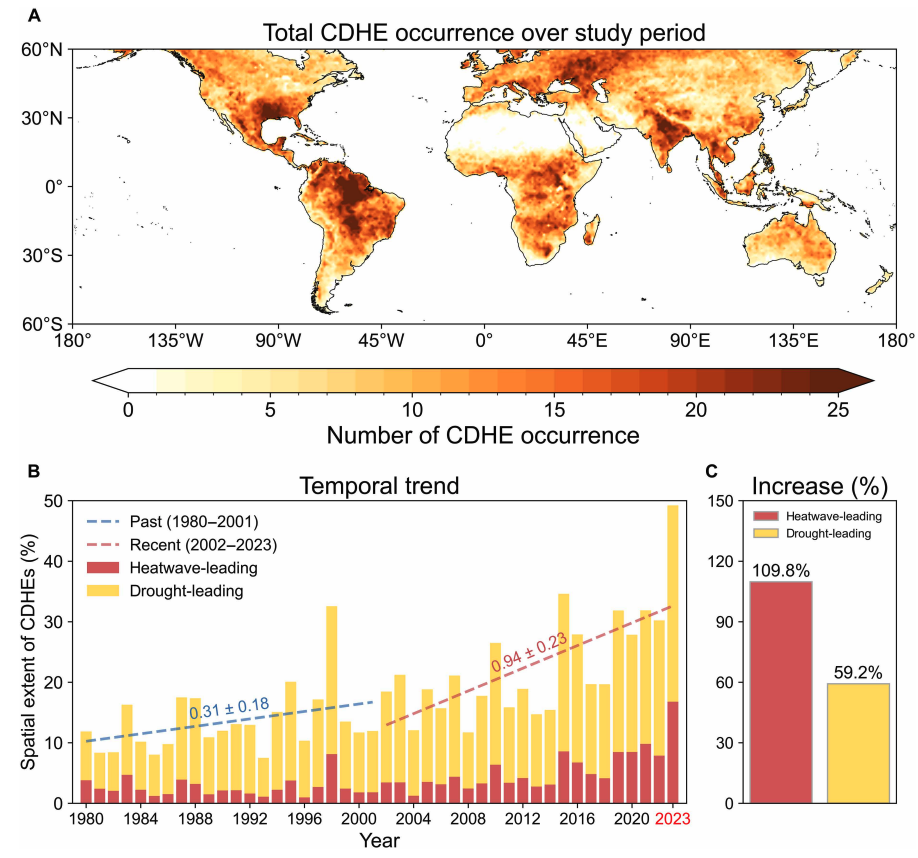
Heatwave-led events have been the main contributor to this increase, the study says, with their spatial extent rising 110% between 1980-2001 and 2002-23, compared to a 59% increase for drought-led events.
The map below shows the global distribution of CDHEs over 1980-2023. The charts show the percentage of the land surface affected by a heatwave-led CDHE (red) or a drought-led CDHE (yellow) in a given year (left) and relative increase in each CDHE type (right).
The study finds that CDHEs have occurred most frequently in northern South America, the southern US, eastern Europe, central Africa and south Asia.
Threshold passed
The authors explain that the increase in heatwave-led CDHEs is related to rising global temperatures, but that this does not tell the whole story.
In the earlier 22-year period of 1980-2001, the study finds that the spatial extent of heatwave-led CDHEs rises by 1.6% per 1C of global temperature rise. For the more-recent period of 2022-23, this increases “nearly eightfold” to 13.1%.
The change suggests that the rapid increase in the heatwave-led CDHEs occurred after the global average temperature “surpasse[d] a certain temperature threshold”, the paper says.
This threshold is an absolute global average temperature of 14.3C, the authors estimate (based on an 11-year average), which the world passed around the year 2000.
Investigating the recent surge in heatwave-leading CDHEs further, the researchers find a “regime shift” in land-atmosphere dynamics “toward a persistently intensified state after the late 1990s”.
In other words, the way that drier soils drive higher surface temperatures, and vice versa, is becoming stronger, resulting in more heatwave-led compound events.
Daily data
The research has some advantages over other previous studies, Yeh says. For instance, the new work uses daily estimations of CDHEs, compared to monthly data used in past research. This is “important for capturing the detailed occurrence” of these events, says Yeh.
He adds that another advantage of their study is that it distinguishes the sequence of droughts and heatwaves, which allows them to “better understand the differences” in the characteristics of CDHEs.
Dr Meryem Tanarhte is a climate scientist at the University Hassan II in Morocco, and Dr Ruth Cerezo Mota is a climatologist and a researcher at the National Autonomous University of Mexico. Both scientists, who were not involved in the study, agree that the daily estimations give a clearer picture of how CDHEs are changing.
Cerezo-Mota adds that another major contribution of the study is its global focus. She tells Carbon Brief that in some regions, such as Mexico and Africa, there is a lack of studies on CDHEs:
“Not because the events do not occur, but perhaps because [these regions] do not have all the data or the expertise to do so.”
However, she notes that the reanalysis data used by the study does have limitations with how it represents rainfall in some parts of the world.
Compound impacts
The study notes that if CDHEs continue to intensify – particularly events where heatwaves are the precursors – they could drive declining crop productivity, increased wildfire frequency and severe public health crises.
These impacts could be “much more rapid and severe as global warming continues”, Yeh tells Carbon Brief.
Tanarhte notes that these events can be forecasted up to 10 days ahead in many regions. Furthermore, she says, the strongest impacts can be prevented “through preparedness and adaptation”, including through “water management for agriculture, heatwave mitigation measures and wildfire mitigation”.
The study recommends reassessing current risk management strategies for these compound events. It also suggests incorporating the sequences of drought and heatwaves into compound event analysis frameworks “to enhance climate risk management”.
Cerezo-Mota says that it is clear that the world needs to be prepared for the increased occurrence of these events. She tells Carbon Brief:
“These [risk assessments and strategies] need to be carried out at the local level to understand the complexities of each region.”



The post Heatwaves driving recent ‘surge’ in compound drought and heat extremes appeared first on Carbon Brief.
Heatwaves driving recent ‘surge’ in compound drought and heat extremes
Greenhouse Gases
DeBriefed 6 March 2026: Iran energy crisis | China climate plan | Bristol’s ‘pioneering’ wind turbine