

Slip into style this season with a pair of sustainable and ethical sandals from one of these conscious brands.
This sustainable sandal guide has any type of footwear you need for warmer weather! Think eco-friendly vegan sandals, recycled and natural rubber flip flops, fair trade slides, and ethical walking sandals.
What Are (More) Sustainable Sandals?
Oof. The word “sustainable” is a bit of a loaded term that comes with a lot of confusion and difference of opinions! I actually try to stay away from using the word sustainable when it comes to products, since pretty much no product is sustainable, even if it was made with some lower impact and eco-minded processes. But that’s the language most people use, and I want this content to be accessible and discoverable.
With that said, here are some sustainability criterion you’ll want to look for when it comes to footwear like sandals:
Quality and Materials
Footwear is probably the hardest category in fashion to find eco-friendly materials for, because shoes require considerable functionality and durability. Virtually no footwear right now is recyclable (with the exception of a few brands). So durability is even more important for shoes than clothing when it comes to sustainability.
Buying less (which usually requires buying more durable, longer-lasting goods) is a key part of sustainability. This is why I’ve included vegetable-tanned leather sandals, despite some very valid concerns about the sustainability of leather. Good quality leather is long-lasting, durable, and importantly, more repairable.
I have also included plant-based vegan leather alternatives. Most of these do still contain a percentage of synthetic materials. I am a vegetarian myself so buying leather doesn’t quite sit right with me, and I do like to see more alternatives coming to the market since “vegan leather” right now typically means pleather (i.e. plastic). In addition to being made with fossil fuels, many plastic vegan leather items I own haven’t lasted. They’ve simply shedded off after a year or two of wear! Disappointing to say the least.
Personally, I prioritize upcycled leather and secondhand leather so I can get the best of both worlds with durability, sustainability, and animal welfare. However, you might feel uncomfortable buying used shoes, and I totally understand that!
Ethical Production
Way too often, we see workers left out of the sustainability equation. But safe conditions and fair wages are absolutely necessary in a truly sustainable fashion future. People are part of the planet too! So you’ll see next to the Conscious Qualities section by each brand, I’ve added which brands are going above and beyond to ensure supply chain transparency and fair production.
Other Sustainable Practices
Some other sustainability-minded supply chain practices might include:
- Use of renewable energy at manufacturing facilities and throughout the supply chain
- Take-back and resale program
- Repairability of products
- Recycled and biodegradable packaging
The Certifications to Look For
Certifications are never an end-all-be-all (I know, don’t we wish anything could be simple in sustainability?!) but they can be a helpful sign that a brand is investing in better materials, processes, and/or labor practices. Here are a few certifications relevant to footwear you might want to know about.
Leather Working Group (LWG)
LWG is a multi-stakeholder group, which means it doesn’t just encompass brands and retailers but also leather manufacturers, suppliers, traders, industry groups, nonprofits, and finished product manufacturers.
The Leather Working Group certifies suppliers that use best practices in production, including water and energy use, waste and effluent management, traceability, worker health and safety, chemical management, and emissions. This means that its the manufacturers or traders getting this certification, not brands. That said, a brand might work with a certified supplier and use the LWG certification on their product pages.
OEKO-TEX® STANDARD 100 and OEKO-TEX® LEATHER STANDARD
OEKO-TEX® is a common certification group, and their most common certification is the OEKO-TEX® STANDARD 100 which tests for over 1,000 harmful substances and chemicals. For the footwear testing, independent laboratories test both individual components of shoes (like the uppers, midsoles, outsoles, and insoles) as well as the finished footwear product.
As you might imagine, the leather production process varies vastly from a normal textile item, so there is a different certification for shoes primarily made with leather. Though these items are also tested against a list of over 1,000 harmful substances.
All products with either certification are compliant with global regulations including the EU’s REACH directive — the bloc’s primary law designed to protect human health and the environment from hazardous chemicals.
From there, there are four different product classes, depending on how close the product is to the skin typically. Class 2 encompasses products with direct skin contact, like underwear or bed linens, while Class 4 includes home textile items like curtains. Class 1 for products made for babies and children has the strictest requirements and lowest limit values.
OEKO-TEX® STANDARD 100 does not certify for other types of environmental sustainability beyond testing against toxic substances.
GRS (Global Recycled Standard) Certified or SCS Recycled Content Certification
Both of these are third-party certifications verifying claims around the recycled content of products. GRS generally has a higher standard, usually requiring that a product contains at least 50% recycled content to hold the certification, while the SCS Recycled Content Standard could apply to products with as little as 5% recycled material. That doesn’t mean that products with the SCS label have a lower recycled content percentage necessarily, it just means the bar to entry is lower. So you may want to do some additional due diligence on that certification.
Where to Find Sustainable and Ethical Sandals
Without further ado, let’s get onto the brand list! Each brand features a description, a breakdown of their sustainability highlights (called “Conscious Qualities), and a price range key, so you have an idea of which brands fit your budget for your ethical and eco-friendly sandals.
One note on the budget front: don’t forget to consider cost per wear! This is the total cost divided by the number of times you wear an item. If you’re buying a quality pair of sandals that’ll be your go-to shoes for many summers to come, you could be wearing them 300+ times!
Price Range Key: $ = Under $100 | $$ = $100 – $200 | $$$ = $200+
This article features affiliates and partners. As always, we only feature brands that meet high standards for sustainability that we love — and that we think you’ll love too!
1. Nisolo
Best for classic everyday sandals
Nisolo is a women-led footwear brand with artisan-made shoes crafted from Leather Working Group-certified leather.
I own several pairs of Nisolo sandals that I’ve had for several years and they’ve held up really well. They’ve been my tried and true simple sandals for everyday wear.
Conscious Qualities: Artisan Craftsmanship, LWG-Certified Leather, Reclamation and Donations
Price Range: $$
Size Range: US 5 -11

2. VIVAIA
Best for variety of sandal styles
Founded in 2020, VIVAIA is a brand dedicating to merging sustainability, comfort, and style. Not an easy mix to master!
Their styles — all made with recycled plastic bottles and plant-based materials like rice husks and natural rubber— range from platform and walker sandals to slides and round-toe slippers, to slingbacks and block heel sandals. Coming in warm neutrals or pops of color, many of their shoes are machine washable, though not their platform or heeled styles.
Conscious Qualities: Recycled & Plant-Based Materials, Shoe Donation Programs, Greener Shipping
Price Range: $$
Size Range: US 5-11

3. Rothy’s
Best for machine-washable vegan sandals
The shoe brand that made waves with their ultra comfy recycled flats has a gorgeous selection of sandals, too.
Rothy’s uses recycled plastic bottles for their footwear. While I’m typically not a fan of using recycled plastic in fashion, it can make sense in footwear which necessitates durability with flexibility. I have a pair of Rothy’s that has held up well for the past 5 years — I love that they’re machine washable so I can easily get them looking (almost) good as new again.
Conscious Qualities: Vegan, Recycled Materials, TRUE Platinum certified for zero waste practices
Price Range: $ – $$
Size Range: US 5-13

4. Brother Vellies
Best for leather artisan-crafted sandals
Brother Vellies is a Black-owned sustainable accessories brand founded by Aurora James with the goal of celebrating and sustaining traditional African artisan techniques. The brand sources from artisans around the world who create timeless, quality shoes from conscious materials like vegetable-tanned leathers, recycled tires, hand-carved wood, and natural dyes — all in intentionally small batches.
Conscious Qualities: Artisan-Made, Black Woman-Owned, Small Batch
Price Range: $$$ – $$$+
Size Range: US 5-12

5. Indosole
Best for budget-friendly recycled flip flops
Indosole creates vegan flip flops from recycled tires, which helps reduce the 1.5 billion tires that end up in the landfill each year while also avoiding the production of new resources. For the uppers of the flip flops, Indosole uses organic canvas, banana leaves, and grass. The B-Corporation pretty much checks the box for every value: sustainable, ethically-made, and vegan! And compared to many other conscious shoe brands, the prices are affordable too.
Conscious Qualities: Ethical Production, Recycled Materials, Vegan
Price Range: $
Size Range: US 4-11

6. NAE Vegan
Best for cork and plant-based vegan sandal alternatives
Nae is a vegan shoe brand producing sustainable sandals from natural materials like cork and piñatex (faux leather made from discarded pineapple leaves) and recycled materials, such as rubber from car tires.
When browsing their selections, note that there are also some synthetic materials used such as OEKO-TEX Certified microsuede which aren’t as ideal. I would personally avoid these!
Conscious Qualities: Vegan, Plant-Based and Recycled Options
Price Range: $ – $$
Size Range: EU 36-42 (US 5.5-11)
Shipping: Global (more info here)

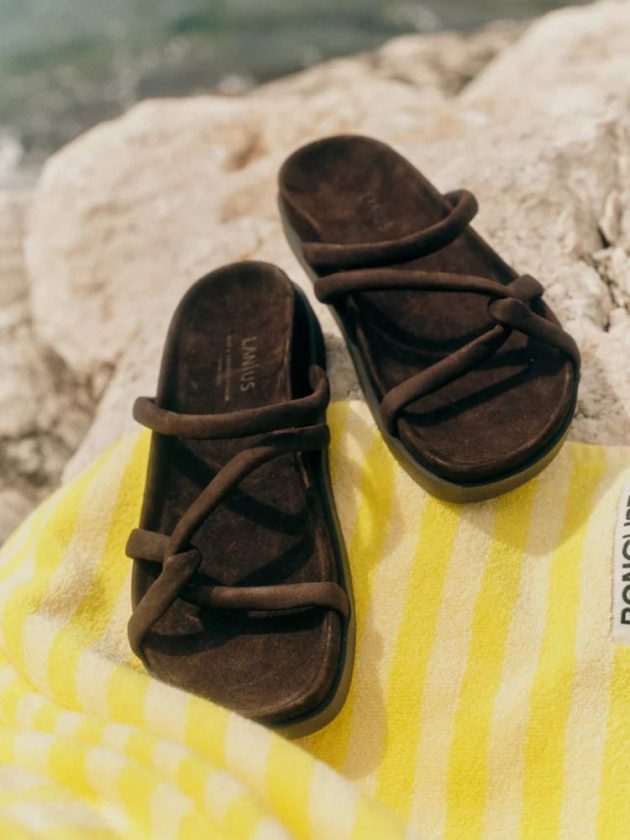
7. Lanius
Best for sophisticated veg-tanned leather sandals
Dedicated to using only the highest quality natural materials, and producing under fair conditions, this German brand’s sandals are responsibly made from vegetable-tanned leather from Germany and Austria.
Lanius partners only with certified factories to produce their wares, with many of the veg-tanned leather sandals being produced in a Fair Wear audited facility in Romania.
And you don’t have to sacrifice aesthetics for sustainability either. My favorite picks: the strappy sandal in chocolate and cork mule in kiwi (a bright summery yellow).
Conscious Qualities: ClimatePartner Certified, Locally-Sourced Vegetable-Tanned Leather
Price Range: €€
Size Range: EU 36-42 (US 5.5-11)
Shipping: Europe (more info here)
Bonus: ThredUp (Secondhand)
ThredUp is the ultimate online destination for thrifted fashion — shoes included. You can sort by size, color, and price range among many other filters to find a pair that suits you. I know that not everyone feels comfortable wearing pre-worn sandals, but ThredUp also has some options with tags still on them so it may still be worth browsing through even if you would prefer a pair of sandals that haven’t been worn before.
Conscious Qualities: Sustainable
Price Range: $ – $$
Size Range: US 4-12
Explore ThredUp’s Secondhand Sandals
You May Also Want to Check Out:
14 Ethical, Eco & Vegan Shoe Brands
Sustainably Handmade Sandals and Slides from Salt + Umber
7 Brands with Sustainable and Ethical Flats
The post 7 Best Ethical and Sustainable Sandals Brands For Summer Days appeared first on Conscious Life & Style.
7 Best Ethical and Sustainable Sandals Brands For Summer Days

Last winter, we kept our house at 60 degrees and our electric bill was STILL $280. I’ve been interested in solar for a long time, but on the long list of house projects (especially when you’re restoring a 200 year old house on the historic registry) some are more pressing than others.
But with a few of those major projects wrapping up, and a daunting bill before me, I figured now was the time for a quick google search on solar panels, and let me tell you….. It can be very overwhelming.
Figuring out the rules (cough, cough, historic society), incentives or rebates if applicable, how much it would cost, how much we could save, etc. felt a little like a part-time job. But, one website made it really easy to compare things, and I am happy to be partnering with Aurora Solar to share that site with you.
Because I think you should be able to easily run the numbers on your house without a lot of hassle!
This post is sponsored by Aurora Solar, but all thoughts and opinions are my own.
If you’ve ever gotten a solar quote, there’s a good chance that Aurora Solar was involved. Aurora was founded in 2013 after its co-founders spent seven months trying to design a solar energy system using a patchwork of different tools.
Afterall, designing a solar system shouldn’t be harder than actually installing one. So they built software specifically for solar professionals. Today, more than 7,000 solar organizations use Aurora, and more than 20 million solar projects have been designed using the platform. They are also the largest solar software provider in the world. Their software is used by roughly 80% of the top 75 residential solar companies in the U.S.
All of this tech has been primarily used by professional installers to map your roof and then create a proposal, but now Aurora is offering this tech to us to help compare quotes.
So instead of having to call a bunch of different installers, I could use the Aurora Solar Marketplace to understand my solar potential, compare estimates, understand my possible savings, look into battery storage and other home electrification incentives, and map out different financing options.
1. know how much electricity the system will actually produce
Before you even get into the price, make sure you understand what you’re actually being quoted.
Two solar systems can have very different prices because they may not be the same size or produce the same amount of electricity. A cheaper system might simply have fewer panels and offset less of your electric bill.
With Aurora, you can compare solar estimates and see the system size, energy production, and how much electricity the system should offset.
You can also upload your utility bill to get a solar estimate based more closely on your actual energy usage, to make the quote accurate for you instead of a ‘generic household’.
2. understand the solar payback period
Aurora calculates things like payback period and lifetime savings, which makes it much easier to understand the long-term finances.
The solar payback period is basically how long it takes for your estimated savings to make up for what you spent on the system, and this is the number that surprised me most!
One estimate had a payback period of around 7 years, and another was closer to 11 years! Over 25 years, two of the estimates I looked at had almost a $13,000 difference in projected savings.
Of course, these are still projections as electricity rates can change (HELLO 2026) but when you’re trying to compare two options for the same house, knowing that one is projected to pay for itself four years sooner is pretty useful information.
3. look beyond the monthly payment
Depending on the installer, you may be looking at a cash purchase, solar loan, lease, or power purchase agreement.
But thankfully with Aurora you can compare the different financing options side-by-side which makes it a lot easier to see the trade-offs. One option may have a lower upfront cost, another may have a lower monthly payment, and another may give you better long-term savings.
4. find out which solar incentives actually apply to you
The minute you start Googling solar, you can find federal incentives, state incentives, utility programs, rebates, net metering, and a whole bunch of information that may or may not even apply to where you live.
And some of the articles ranking at the top of Google are several years old! (RIP to the federal incentives canceled at the end of 2025.) But, Aurora can account for solar incentives when calculating the cost and savings of a system, including state, local, and utility-specific programs.
I would still double check any incentive or tax benefit you’re planning to use before signing a contract, especially because programs and eligibility can change, but having all the relevant information in the same place makes the research process much less overwhelming.
5. research the installer, equipment, and warranties
Aurora lets you compare solar installers based on things like reviews, reputation, pricing, and financing options, which I think is just as important as the actual quote.
I’d also look closely at what equipment is included. What panels are they using? What kind of inverter? How long are the equipment warranties? Is there also a workmanship warranty from the installer? Who handles repairs if something goes wrong five or ten years from now?
And, I know I’ve said it a million times, but it’s nice to see it side-by-side without having to fill out a bunch of forms and be hounded on the phone just to get an idea of what solar may look like.
The post How to Compare Solar Quotes: What to Look For Before You Choose appeared first on Going Zero Waste.
How to Compare Solar Quotes: What to Look For Before You Choose
Green Living
Sustainability In Your Ear: XPRIZE’s David Babson on Why Climate Grand Challenges Need Buyers, Too
Buyers contracted nearly 30 million tons of durable carbon removal in 2025, more than triple the 2024 total, according to CDR.fyi data reported by Heatmap. About 90% of those purchases came from a single company, Microsoft, and suppliers delivered only about 450,000 tons during the year. That is a sliver of the six to 10 billion tons of removal a year that climate scenarios suggest the world will need by 2050. The technology to pull carbon out of the air works, but the customers needed to scale it remain scarce.
Our guest today, David Babson, is executive vice president of the Energy, Climate, and Nature domain at the XPRIZE Foundation. He calls the slow progress a market failure, because the technology is progressing faster than it is being adopted. Babson previously led MIT’s Climate Grand Challenges initiative and was a program director at the U.S. Department of Energy’s ARPA-E. His portfolio includes XPRIZE Carbon Removal, which drew 1,334 teams and whose participants have raised more than $3.3 billion. In April 2025, Mati Carbon won its $50 million grand prize for spreading crushed basalt on smallholder farms in India, where the rock locks away carbon dioxide. “If people could make money taking carbon out of the air and putting it underground, as opposed to only being able to make money taking it from underground and putting it in the air, we would be in a better place,” Babson says. Mati is weathering the slump in part because its rock dust also improves soil health and crop yields, giving farmers a reason to participate that doesn’t depend on carbon credit prices.

XPRIZE’s answer is to change what winners receive. Babson describes “mixed purses” that pair a cash award with a guaranteed buyer through an advance market commitment, a power purchase agreement, or an offtake contract. In one thought experiment, a carbon removal prize would come with a separate $1 billion fund raised from credit buyers, which qualified teams could draw on as they deliver verified tons. XPRIZE is applying the same thinking to a planned series of fusion energy prizes, pairing technical milestones with market mechanisms to build the supply chain that commercial fusion will require. The same gap between invention and adoption shows up in other XPRIZE competitions. On September 23, XPRIZE Wildfire awarded about $4.55 million from its $11 million purse, with defense contractor Anduril Industries taking first place in autonomous fire response along with a $1 million Lockheed Martin bonus. Babson expects costs to fall as fire agencies adopt the tools and as startups license individual components into cheaper platforms, though underfunded agencies will need a way to buy the first systems. He also notes that the competition left fuel management and ground-based autonomy for future prizes. Earlier this year, program director Andrea Santy told us that field testing had moved ahead of drone regulations. In biodiversity, Limelight Rainforest won $5 million for surveying 100 hectares of tropical forest in under 24 hours and identifying more than 250 species. Biodiversity still lacks a price, but Babson argues that once ecosystems can be measured, slow-walking policy becomes “a dereliction of what they should be doing.”
We also discuss the tension inside XPRIZE’s vision of “equitable abundance,” including a $101 million Healthspan prize that could add years of consumption to longer lives. Babson argues that abundant, cheap clean energy would let society mov