

2024年5月,尽管用电需求持续增长,清洁能源发电量占到中国全国总发电量的44%,创下历史新高;燃煤发电量占比降至53%,达到历史低点。
基于官方数据和其他数据,Carbon Brief 的新分析揭示了煤炭在能源结构中占比下降的真实程度。
2023年5月,煤炭在中国发电量中所占比例为60%。一年后,这一数字下降了7个百分点。
该分析揭示的其他关键信息包括:
- 国家统计局按发电方式分列的月度发电量数据现在对风能和太阳能发电量计入非常有局限性。例如,它未纳入“分布式”屋顶光伏和较小的集中式太阳能发电站,因此只能捕捉到约一半的太阳能发电量。
- 国家统计局的月度总发电量为718太瓦时(TWh),而国家能源局报告提出月度电力需求为775太瓦时,两者的差距显著。实际上,由于发电厂和电网损耗,发电量肯定应高于需求量。
- 媒体报道曾猜测,创纪录的新增可再生能源装机容量会在5月份触及电网上限,但新数据显示情况并非如此。
- 2024年5月,中国电力需求同比增长49太瓦时(7.2%)。
- 与此同时,清洁能源发电量创纪录地增长了78太瓦时,其中太阳能发电量创纪录地增长了41太瓦时(78%),水力发电量从早些时候干旱造成的低点回升了34太瓦时(39%),风力发电量小幅增长了4太瓦时(5%)。
- 随着清洁能源的增长超过电力需求增长,化石燃料发电量被迫回落,出现了自2019年新冠大流行以来最大的月度降幅。天然气发电量下降了4太瓦时(16%),燃煤发电量下降了16太瓦时(4%)。
- 化石燃料发电量的下降意味着电力行业的CO2排放量下降了3.6%,而电力行业的CO2排放量约占中国温室气体排放总量的五分之二,是近年来排放增长的主要来源。

从2024年3月开始,中国化石燃料和水泥行业的CO2排放量由增变减。新的研究结果表明,这一趋势仍在继续。
如果目前风能和太阳能的快速部署得以继续,那么中国的CO2排放量很可能会继续下降,从而使2023年成为中国碳达峰的一年。
月度数据差异
国家统计局每月都会公布中国按发电方式分列的发电量数据。2024年5月的数据是在近一个月前的6月中旬公布,并被广泛报道。
然而,这些数据的局限性越来越大,因为其中不包括“分布式”光伏电站,如家庭和企业屋顶上安装的光伏系统。本文的分析表明,这使得大约一半的太阳能发电总量被遗漏。
如果仔细审视用电量,国家统计局发电量数据不完整这一事实显而易见:国家能源局报告的5月份用电量为775太瓦时,而国家统计局报告的发电量仅为718太瓦时。实际上,由于发电厂和输电过程中的损耗,发电量肯定远远大于用电量。
国家统计局报告的太阳能和风能发电量似乎很少,这引起了人们的困惑,并导致有报道声称中国的风能和太阳能发电表现不佳。
中电联收集的“利用率”数据可跟踪风能和太阳能发电的表现,显示相对于最大潜力的实际出力。这些数据通常包含在国家能源局发布的月度统计数据中。
国家能源局因在5月份发布的数据中略过了利用率,这导致彭博社和路透社猜测背后原因可能是风能和太阳能数据不佳。这一猜测在中电联直接提供其数据后基本被证明不成立,因为太阳能发电利用率大幅上升;风能利用率虽然下降,但在正常的年度变化范围内。
另一个数据集追踪了由于电网灵活性低而浪费的太阳能和风能发电量的比例,结果显示两者分别小幅增长了0.8和1.7个百分点。这对电厂运营者来说是个问题,但该升幅远未达到会显著影响利用率的程度——消纳率的年际变化幅度通常超过5%。
现在有足够的数据来破解国家统计局发电数据的局限性,并描绘出中国5月份发电结构的全貌。
首先值得一提的是,国家统计局的数据是以30天为一个月进行归一化处理的,这造成了部分数据不匹配。本文剩余部分使用归一化后的30天数据。
除了使用国家统计局数据,还可根据报告的装机容量和利用率来估算太阳能和风能发电量。通过将这些估计值与其他技术的报告发电量相结合,得出总发电量为783太瓦时,同比增长8%。
报告的750太瓦时用电量(按30天为一个月进行归一化)与估计的783太瓦时发电量相符,另有4.2%的差异是由于传输损耗造成的。
目前尚无输电损耗的月度数据,但2023年的平均值为4.5%,与报告的用电量和预估发电量之间的差距非常吻合。
创纪录的结果
综合各种数据可以看出,2024年5月太阳能发电量创纪录地增长了78%,远高于不完整的国家统计局数据中29%的同比增幅。
太阳能发电装机容量增加52%至691吉瓦(gigawatt),产能利用率从16%提高到19%,太阳能发电量从2023年5月的53太瓦时增至2024年5月的94太瓦时,增加了41太瓦时,创下中国各发电方式发电量中最大的增幅。
水电发电量的增幅位居第二,虽然发电量仅增长了1%,但利用率却从31%跃升至41%,因为该行业正从2022年至2023年创纪录的干旱中恢复过来。这使得水电发电量增加了39%(34太瓦时),达到115太瓦时。
风电装机大幅增长了21%,但其利用率却有所下降,这可能是由于风力条件逐月变化所致。因此,发电量的增幅相对较小,仅为5%(4太瓦时),达到83太瓦时。核电和生物质发电的发电量也有小幅增长,但核电站的利用率从87%下降到85%。
如下图所示,清洁能源发电量总计增长了78太瓦时。这足以超过49太瓦时的需求增长。
因此,尽管燃气发电装机增加了9%,但发电量却大幅下降16%,利用率急剧下降了24%。燃煤发电装机增加了3%,但发电量却下降了3.7%,平均利用率下降了7%。需求下降可能会抑制过去两年火热的对新建煤炭产能的投资。
燃煤和燃气发电量的变化,加之燃煤电厂热耗率的轻微下降,意味着电力行业的CO2排放量下降了3.6%。
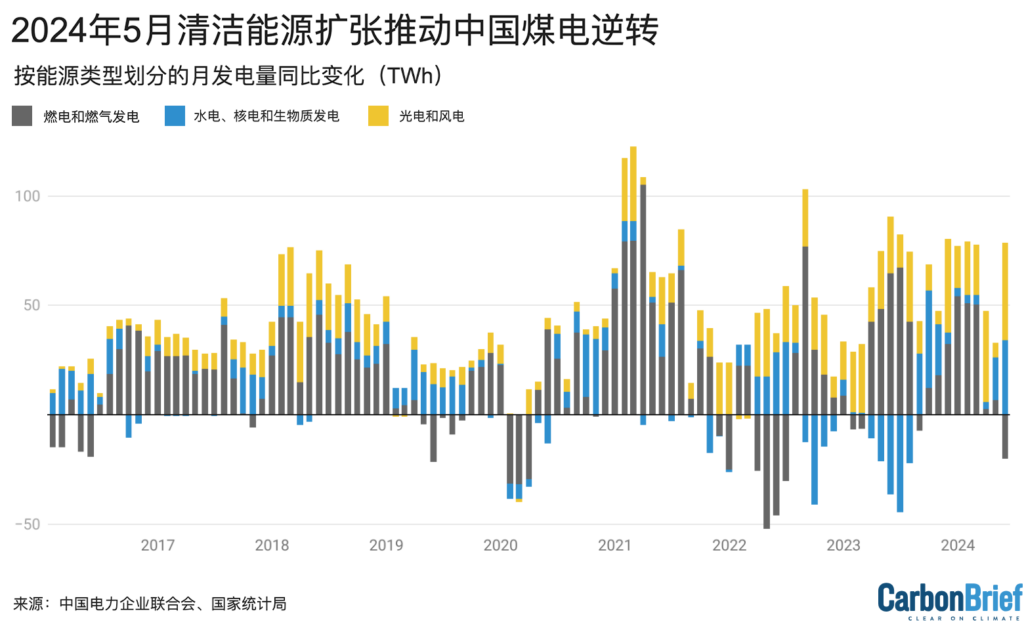
在发电量发生上述变化后,中国的发电结构在2024年5月已大幅减少了对化石燃料的依赖。如下图所示,燃煤发电份额从去年同期的60%降至53%,是有记录以来的最低份额。
与此同时,太阳能发电占比从去年同期的7%上升到12%,创历史最高纪录。其余为风电(11%)、水电(15%)、核电(5%)、天然气发电(3%)和生物质发电(2%)。

非化石能源的总体份额达到创纪录的44%,间歇性可再生能源(太阳能和风能)的比例也创下新高,达到23%。
如上图所示,尽管需求不断增长,但太阳能和风能在中国电力结构中的份额正在迅速增加。2016年5月,它们仅占总量的7%。
与此同时,2024年5月,清洁能源发电装机继续强劲增长,新增太阳能发电装机19吉瓦 ,风电3吉瓦 ,核电1.2吉瓦。
在2024年的前五个月,中国新增了约79吉瓦的太阳能和20吉瓦的风能。如下图所示,这两个新增发电装机数字比去年分别增长了29%和21%,而去年的数字已经创下历史新高。
就太阳能发电具体而言,2024年5月的月新增装机高于4月,与2023年5月相比也有同比增长。

太阳能发电量的快速增长表明,太阳能产能的激增正在提供新的电力供应,其规模足以满足中国大部分的需求增长。
这进一步印证了中国的CO2排放量正处于结构性下降时期的观点。
如果清洁能源的新增装机保持在2023年和2024年初的水平,那么CO2排放量可能会持续下降,这将确定2023年是中国实现碳达峰的一年。
由于中国将在明年初宣布新的气候目标,政府对清洁能源增长的雄心水平仍有待观察。
关于数据
风能和太阳能发电量,以及按燃料划分的火电发电量系通过将每月末的发电装机乘月利用率计算得出,数据来自万得金融终端提供的中电联报告数据。
火电、水电和核电的总发电量来源于国家统计局的月度发布数据。由于无法获得生物质发电的月度利用率数据,因此采用2023年的年平均利用率52%。
发电产生的碳排放量估算基于中国最新的2018年国家温室气体排放清单中的排放因子,以及国家能源局公布的燃煤电厂月平均热耗率,并假设燃气电厂平均热耗率为50%。




The post 分析:中国清洁能源发展使五月燃煤发电份额降至53%的历史低点 appeared first on Carbon Brief.

N.C. Gov. Josh Stein wants state lawmakers to rethink tax breaks for data centers. The industry’s opacity makes it difficult to evaluate costs and benefits.
Tax breaks for data centers in North Carolina keep as much as $57 million each year into from state and local government coffers, state figures show, an amount that could balloon to billions of dollars if all the proposed projects are built.
The Global Environment Facility (GEF), a multilateral fund that provides climate and nature finance to developing countries, has raised $3.9 billion from donor governments in its last pledging session ahead of a key fundraising deadline at the end of May.
The amount, which is meant to cover the fund’s activities for the next four years (July 2026-June 2030), falls significantly short of the previous four-year cycle for which the GEF managed to raise $5.3bn from governments. Since then, military and other political priorities have squeezed rich nations’ budgets for climate and development aid.
The facility said in a statement that it expects more pledges ahead of the final replenishment package, which is set for approval at the next GEF Council meeting from May 31 to June 3.
Claude Gascon, interim CEO of the GEF, said that “donor countries have risen to the challenge and made bold commitments towards a more positive future for the planet”. He added that the pledges send a message that “the world is not giving up on nature even in a time of competing priorities”.
-
UK imports of “green” jet fuel linked to Amazon deforestation
A Texas refinery shipping sustainable aviation fuel to Europe has sourced beef tallow with links to a meatpacking firm fined over illegal cattle purchases -
Italy pushes coal exit back after gas prices rise
Analysts say the move sends a negative signal, but its impact will be limited given coal’s marginal role in Italy’s energy mix


Donors under pressure
But Brian O’Donnell, director of the environmental non-profit Campaign for Nature, said the announcement shows “an alarming trend” of donor governments cutting public finance for climate and nature.
“Wealthy nations pledged to increase international nature finance, and yet we are seeing cuts and lower contributions. Investing in nature prevents extinctions and supports livelihoods, security, health, food, clean water and climate,” he said. “Failing to safeguard nature now will result in much larger costs later.”
At COP29 in Baku, developed countries pledged to mobilise $300bn a year in public climate finance by 2035, while at UN biodiversity talks they have also pledged to raise $30bn per year by 2030. Yet several wealthy governments have announced cuts to green finance to increase defense spending, among them most recently the UK.
As for the US, despite Trump’s cuts to international climate finance, Congress approved a $150 million increase in its contribution to the GEF after what was described as the organisation’s “refocus on non-climate priorities like biodiversity, plastics and ocean ecosystems, per US Treasury guidance”.
The facility will only reveal how much each country has pledged when its assembly of 186 member countries meets in early June. The last period’s largest donors were Germany ($575 million), Japan ($451 million), and the US ($425 million).
The GEF has also gone through a change in leadership halfway through its fundraising cycle. Last December, the GEF Council asked former CEO Carlos Manuel Rodriguez to step down effective immediately and appointed Gascon as interim CEO.
Santa Marta conference: fossil fuel transition in an unstable world
New guidelines
As part of the upcoming funding cycle, the GEF has approved a set of guidelines for spending the $3.9bn raised so far, which include allocating 35% of resources for least developed countries and small island states, as well as 20% of the money going to Indigenous people and communities.
Its programs will help countries shift five key systems – nature, food, urban, energy and health – from models that drive degradation to alternatives that protect the planet and support human well-being by integrating the value of nature into production and consumption systems.
The new priorities also include a target to allocate 25% of the GEF’s budget for mobilising private funds through blended finance. This aligns with efforts by wealthy countries to increase contributions from the private sector to international climate finance.
Niels Annen, Germany’s State Secretary for Economic Cooperation and Development, said in a statement that the country’s priorities are “very well reflected” in the GEF’s new spending guidelines, including on “innovative finance for nature and people, better cooperation with the private sector, and stable resources for the most vulnerable countries”.
Aliou Mustafa, of the GEF Indigenous Peoples Advisory Group (IPAG), also welcomed the announcement, adding that “the GEF is strengthening trust and meaningful partnerships with Indigenous Peoples and local communities” by placing them at the “centre of decision-making”.
The post GEF raises $3.9bn ahead of funding deadline, $1bn below previous budget appeared first on Climate Home News.
GEF raises $3.9bn ahead of funding deadline, $1bn below previous budget
Tropical cyclones that rapidly intensify when passing over marine heatwaves can become “supercharged”, increasing the likelihood of high economic losses, a new study finds.
Such storms also have higher rates of rainfall and higher maximum windspeeds, according to the research.
The study, published in Science Advances, looks at the economic damages caused by nearly 800 tropical cyclones that occurred around the world between 1981 and 2023.
It finds that rapidly intensifying tropical cyclones that pass near abnormally warm parts of the ocean produce nearly double – 93% – the economic damages as storms that do not, even when levels of coastal development are taken into account.
One researcher, who was not involved in the study, tells Carbon Brief that the new analysis is a “step forward in understanding how we can better refine our predictions of what might happen in the future” in an increasingly warm world.
As marine heatwaves are projected to become more frequent under future climate change, the authors say that the interactions between storms and these heatwaves “should be given greater consideration in future strategies for climate adaptation and climate preparedness”.
‘Rapid intensification’
Tropical cyclones are rapidly rotating storm systems that form over warm ocean waters, characterised by low pressure at their cores and sustained winds that can reach more than 120 kilometres per hour.
The term “tropical cyclones” encompasses hurricanes, cyclones and typhoons, which are named as such depending on which ocean basin they occur in.
When they make landfall, these storms can cause major damage. They accounted for six of the top 10 disasters between 1900 and 2024 in terms of economic loss, according to the insurance company Aon’s 2025 climate catastrophe insight report.
These economic losses are largely caused by high wind speeds, large amounts of rainfall and damaging storm surges.
Storms can become particularly dangerous through a process called “rapid intensification”.
Rapid intensification is when a storm strengthens considerably in a short period of time. It is defined as an increase in sustained wind speed of at least 30 knots (around 55 kilometres per hour) in a 24-hour period.
There are several factors that can lead to rapid intensification, including warm ocean temperatures, high humidity and low vertical “wind shear” – meaning that the wind speeds higher up in the atmosphere are very similar to the wind speeds near the surface.
Rapid intensification has become more common since the 1980s and is projected to become even more frequent in the future with continued warming. (Although there is uncertainty as to how climate change will impact the frequency of tropical cyclones, the increase in strength and intensification is more clear.)
Marine heatwaves are another type of extreme event that are becoming more frequent due to recent warming. Like their atmospheric counterparts, marine heatwaves are periods of abnormally high ocean temperatures.
Previous research has shown that these marine heatwaves can contribute to a cyclone undergoing rapid intensification. This is because the warm ocean water acts as a “fuel” for a storm, says Dr Hamed Moftakhari, an associate professor of civil engineering at the University of Alabama who was one of the authors of the new study. He explains:
“The entire strength of the tropical cyclone [depends on] how hot the [ocean] surface is. Marine heatwave means we have an abundance of hot water that is like a gas [petrol] station. As you move over that, it’s going to supercharge you.”
However, the authors say, there is no global assessment of how rapid intensification and marine heatwaves interact – or how they contribute to economic damages.
Using the International Best Track Archive for Climate Stewardship (IBTrACS) – a database of tropical cyclone paths and intensities – the researchers identify 1,600 storms that made landfall during the 1981-2023 period, out of a total of 3,464 events.
Of these 1,600 storms, they were able to match 789 individual, land-falling cyclones with economic loss data from the Emergency Events Database (EM-DAT) and other official sources.
Then, using the IBTrACS storm data and ocean-temperature data from the European Centre for Medium-Range Weather Forecasts, the researchers classify each cyclone by whether or not it underwent rapid intensification and if it passed near a recent marine heatwave event before making landfall.
The researchers find that there is a “modest” rise in the number of marine heatwave-influenced tropical cyclones globally since 1981, but with significant regional variations. In particular, they say, there are “clear” upward trends in the north Atlantic Ocean, the north Indian Ocean and the northern hemisphere basin of the eastern Pacific Ocean.
‘Storm characteristics’
The researchers find substantial differences in the characteristics of tropical cyclones that experience rapid intensification and those that do not, as well as between rapidly intensifying storms that occur with marine heatwaves and those that occur without them.
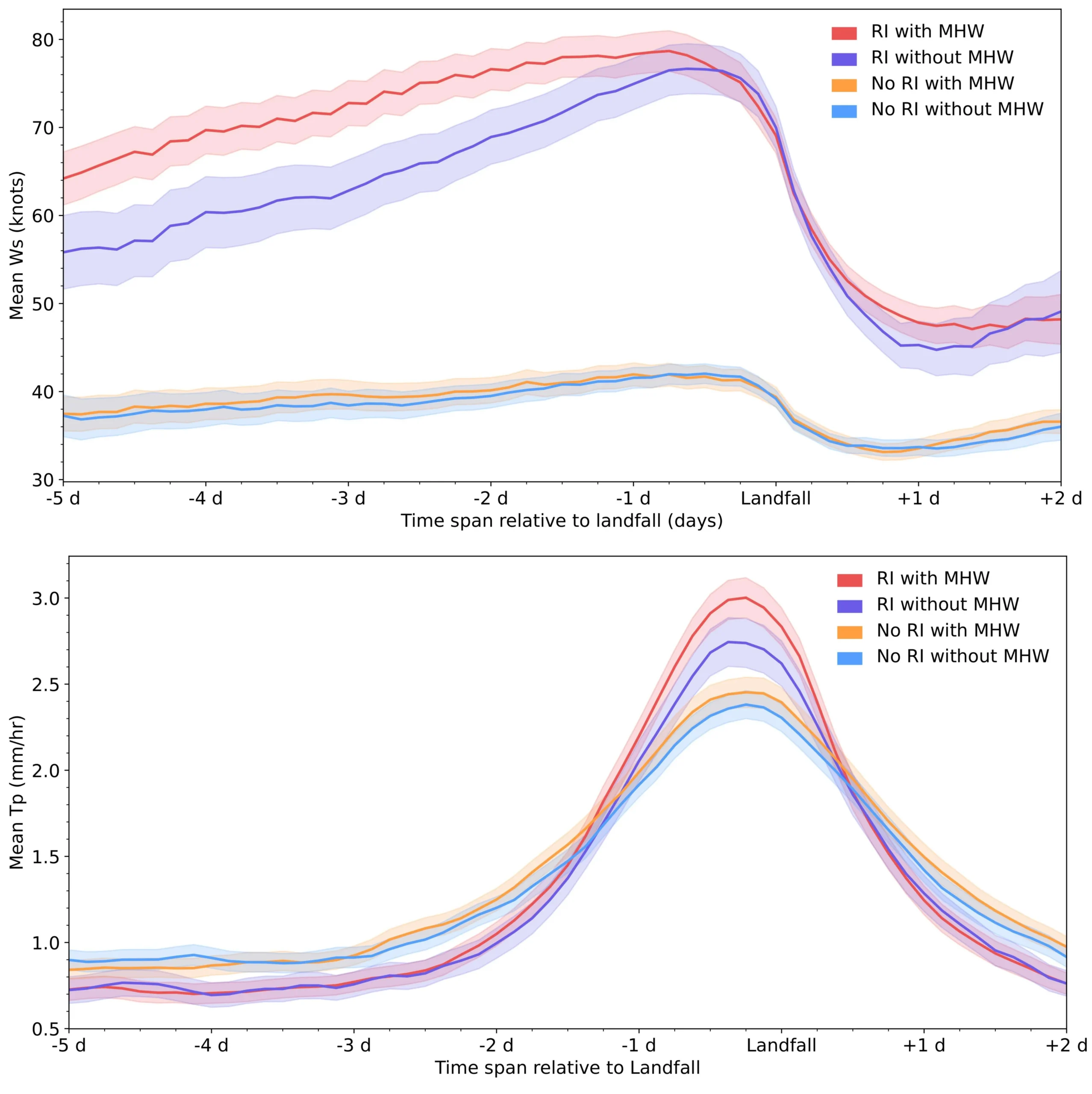
For example, tropical cyclones that do not experience rapid intensification have, on average, maximum wind speeds of around 40 knots (74km/hr), whereas storms that rapidly intensify have an average maximum wind speed of nearly 80 knots (148km/hr).
Of the rapidly intensifying storms, those that are influenced by marine heatwaves maintain higher wind speeds during the days leading up to landfall.
Although the wind speeds are very similar between the two groups once the storms make landfall, the pre-landfall difference still has an impact on a storm’s destructiveness, says Dr Soheil Radfar, a hurricane-hazard modeller at Princeton University. Radfar, who is the lead author of the new study, tells Carbon Brief:
“Hurricane damage starts days before the landfall…Four or five days before a hurricane making landfall, we expect to have high wind speeds and, because of that high wind speed, we expect to have storm surges that impact coastal communities.”
They also find that rapidly intensifying storms have higher peak rainfall than non-rapidly intensifying storms, with marine heatwave-influenced, rapidly intensifying storms exhibiting the highest average rainfall at landfall.
The charts below show the mean sustained wind speed in knots (top) and the mean rainfall in millimetres per hour (bottom) for the tropical cyclones analysed in the study in the five days leading up to and two days following a storm making landfall.
The four lines show storms that: rapidly intensified with the influence of marine heatwaves (red); those that rapidly intensified without marine heatwaves (purple); those that experienced marine heatwaves, but did not rapidly intensify (orange); and those that neither rapidly intensified nor experienced a marine heatwave (blue).
Dr Daneeja Mawren, an ocean and climate consultant at the Mauritius-based Mascarene Environmental Consulting who was not involved in the study, tells Carbon Brief that the new study “helps clarify how marine heatwaves amplify storm characteristics”, such as stronger winds and heavier rainfall. She notes that this “has not been done on a global scale before”.
However, Mawren adds that other factors not considered in the analysis can “make a huge difference” in the rapid intensification of tropical cyclones, including subsurface marine heatwaves and eddies – circular, spinning ocean currents that can trap warm water.
Dr Jonathan Lin, an atmospheric scientist at Cornell University who was also not involved in the study, tells Carbon Brief that, while the intensification found by the study “makes physical sense”, it is inherently limited by the relatively small number of storms that occur. He adds:
“There’s not that many storms, to tease out the physical mechanisms and observational data. So being able to reproduce this kind of work in a physical model would be really important.”
Economic costs
Storm intensity is not the only factor that determines how destructive a given cyclone can be – the economic damages also depend strongly on the population density and the amount of infrastructure development where a storm hits. The study explains:
“A high storm surge in a sparsely populated area may cause less economic damage than a smaller surge in a densely populated, economically important region.”
To account for the differences in development, the researchers use a type of data called “built-up volume”, from the Global Human Settlement Layer. Built-up volume is a quantity derived from satellite data and other high-resolution imagery that combines measurements of building area and average building height in a given area. This can be used as a proxy for the level of development, the authors explain.
By comparing different cyclones that impacted areas with similar built-up volumes, the researchers can analyse how rapid intensification and marine heatwaves contribute to the overall economic damages of a storm.
They find that, even when controlling for levels of coastal development, storms that pass through a marine heatwave during their rapid intensification cause 93% higher economic damages than storms that do not.
They identify 71 marine heatwave-influenced storms that cause more than $1bn (inflation-adjusted across the dataset) in damages, compared to 45 storms that cause those levels of damage without the influence of marine heatwaves.
This quantification of the cyclones’ economic impact is one of the study’s most “important contributions”, says Mawren.
The authors also note that the continued development in coastal regions may increase the likelihood of tropical cyclone damages over time.
Towards forecasting
The study notes that the increased damages caused by marine heatwave-influenced tropical cyclones, along with the projected increases in marine heatwaves, means such storms “should be given greater consideration” in planning for future climate change.
For Radfar and Moftakhari, the new study emphasises the importance of understanding the interactions between extreme events, such as tropical cyclones and marine heatwaves.
Moftakhari notes that extreme events in the future are expected to become both more intense and more complex. This becomes a problem for climate resilience because “we basically design in the future based on what we’ve observed in the past”, he says. This may lead to underestimating potential hazards, he adds.
Mawren agrees, telling Carbon Brief that, in order to “fully capture the intensification potential”, future forecasts and risk assessments must account for marine heatwaves and other ocean phenomena, such as subsurface heat.
Lin adds that the actions needed to reduce storm damages “take on the order of decades to do right”. He tells Carbon Brief:
“All these [planning] decisions have to come by understanding the future uncertainty and so this research is a step forward in understanding how we can better refine our predictions of what might happen in the future.”



The post Marine heatwaves ‘nearly double’ the economic damage caused by tropical cyclones appeared first on Carbon Brief.
Marine heatwaves ‘nearly double’ the economic damage caused by tropical cyclones



-
Climate Change8 months ago
Guest post: Why China is still building new coal – and when it might stop
-
Greenhouse Gases8 months ago
Guest post: Why China is still building new coal – and when it might stop
-

 Greenhouse Gases2 years ago
嘉宾来稿:满足中国增长的用电需求 光伏加储能“比新建煤电更实惠”
-
Climate Change2 years ago
Bill Discounting Climate Change in Florida’s Energy Policy Awaits DeSantis’ Approval
-

 Climate Change2 years ago
嘉宾来稿:满足中国增长的用电需求 光伏加储能“比新建煤电更实惠”
-
Climate Change Videos2 years ago
The toxic gas flares fuelling Nigeria’s climate change – BBC News
-

 Renewable Energy6 months ago
Sending Progressive Philanthropist George Soros to Prison?
-

 Carbon Footprint2 years ago
US SEC’s Climate Disclosure Rules Spur Renewed Interest in Carbon Credits