

2025年,太阳能、电动汽车及其他清洁能源技术对中国经济增长的贡献已超过三分之一,并拉动超过九成的投资增长。
中国清洁能源行业产值在2025年达到创纪录的15.4万亿元人民币(约合2.1万亿美元),约占国内生产总值(GDP)的11.4%,该数字相当于巴西或加拿大的经济规模。
Carbon Brief基于官方数字、行业数据及分析师报告进行的最新分析显示,2022年至2025年间,中国清洁能源行业的实际规模几乎翻了一番;若将其视为一个独立经济体,其规模可位列全球第八。
该分析的其他主要成果包括:
- 清洁能源行业支撑中国实现了“5%左右”的GDP增长目标,若排除清洁能源行业,2025年GDP实际增速仅为3.5%。
- 清洁能源产业的扩张速度持续快于整体经济,其年增长率从2024年的12%提升至2025年的18%。
- 电动汽车、电池和光伏“新三样”仍是中国清洁能源经济贡献的核心,创造了约三分之二的增加值,并吸纳了一半以上的行业投资。
- 2025年,中国在清洁能源领域的投资达7.2万亿元人民币(约1万亿美元),约为同期化石燃料开采与煤电投资(2600亿美元)的四倍。
- 尽管2025年清洁能源技术出口保持了快速增长,但对中国企业而言,国内市场在价值规模上仍显著大于出口市场。
这些投向清洁能源制造业的资金,代表着对中国乃至全球能源转型的重大押注,也为政府和企业保持这一发展势头提供了动力。
然而,未来的长期走势仍然存在不确定性,尤其是在太阳能领域。受136号文件下的新定价机制影响,太阳能发电装机增速已有所放缓,而中央政府设定的相关目标也明显低于近几年的实际扩张水平。
如果放缓趋势持续下去,这些产业或将从经济增长的驱动力转变为拖累因素,同时加剧工业领域的“产能过剩”问题,并进一步恶化国际贸易摩擦。
但即便中央政府对清洁能源未来五年的目标设定较为谨慎,地方政府和国有企业的规划与投资力度,仍有可能推动清洁能源产业继续实现显著增长。
本文在此前对2023年和2024年清洁能源经济贡献分析的基础上进行了更新。
清洁能源行业表现优于整体经济
中国的清洁能源经济持续高速增长,远超整体经济增速。这意味着它对年度经济增长的贡献尤为显著。
下图显示,2025年,清洁能源技术贡献了中国超过三分之一的GDP增量,并推动了超过90%的新增投资增长。
2022年,中国清洁能源经济规模约为8.4万亿元人民币(1.2万亿美元)。到2025年,这一规模几乎翻了一番,达到15.4万亿元人民币(2.1万亿美元)。
这一体量相当于巴西或加拿大的经济总量,使中国的清洁能源产业堪比全球第八大经济体,产值约为世界第四大经济体印度经济总量的一般,也大致相当于美国加利福尼亚州经济规模的一半。
由于清洁能源产业持续跑赢整体经济,其在中国经济中的占比也在不断上升,从2022年占中国GDP的7.3%上升至2025年的11.4%。
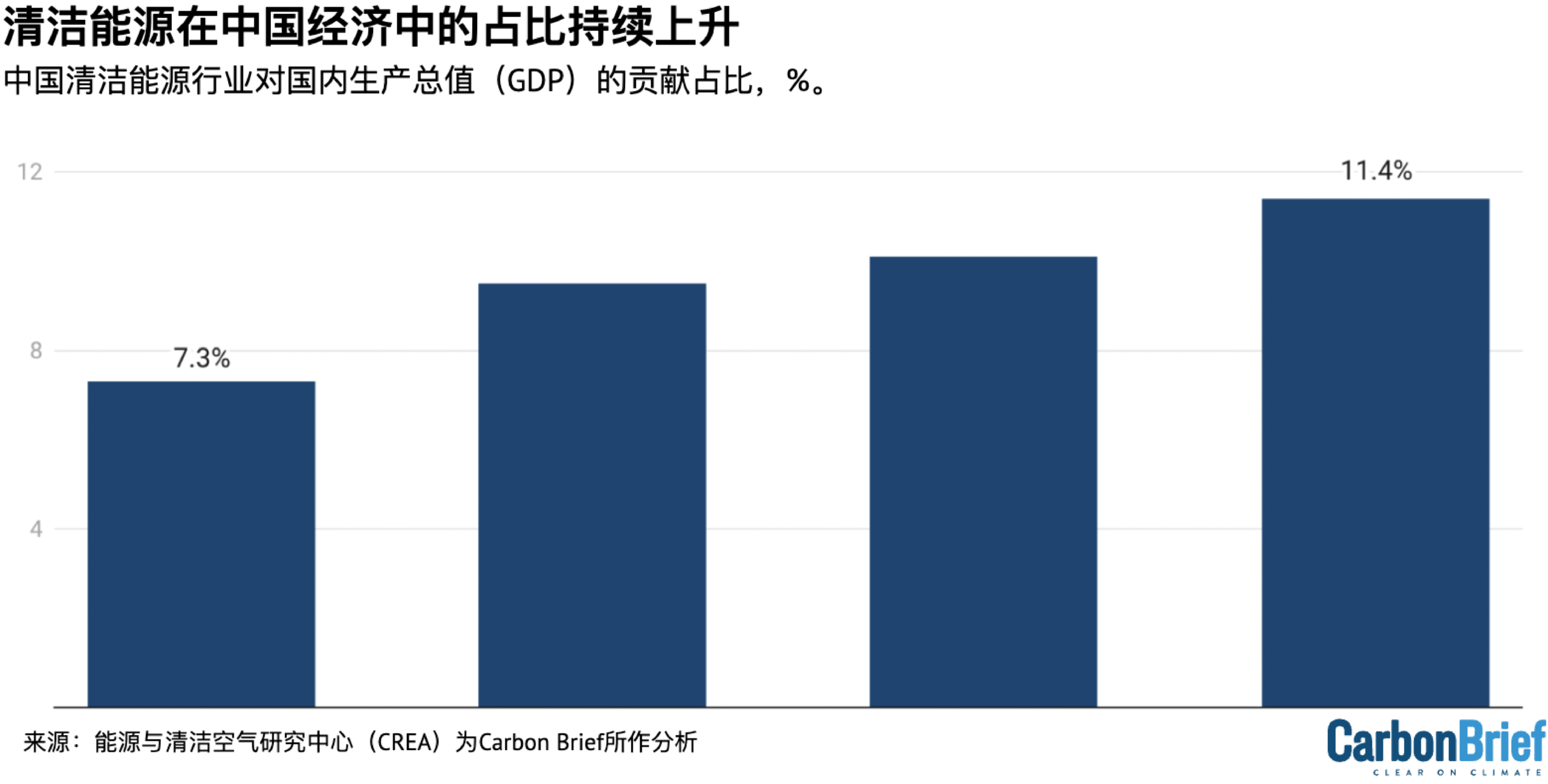
如果没有清洁能源行业,中国2025年的GDP增速将仅为3.5%,因此,在经济稳定增长为中国首要目标之一的2025年,清洁能源做出了至关重要的贡献。
下表按行业和活动进行了详细分类。
电动汽车和电池是GDP增长的最大驱动力
2024年,电动汽车和太阳能是最大的增长驱动力。而到了2025年,电动汽车和电池则占据了主导地位,合计贡献了44%的经济效益,以及清洁能源行业一半以上的增长。这主要得益于产出和投资的同步强劲增长。
在未剔除通胀因素的名义GDP口径下,电动汽车的贡献甚至更为突出。这是因为电动汽车价格同比保持相对稳定,而整体经济仍处于通缩环境中。同时,电池制造投资在2024年下滑后于2025年出现反弹。
下图展示了电动汽车和电池的主要贡献,既反映了清洁能源经济的整体规模,也显示了各子行业对年度增量的具体贡献情况。
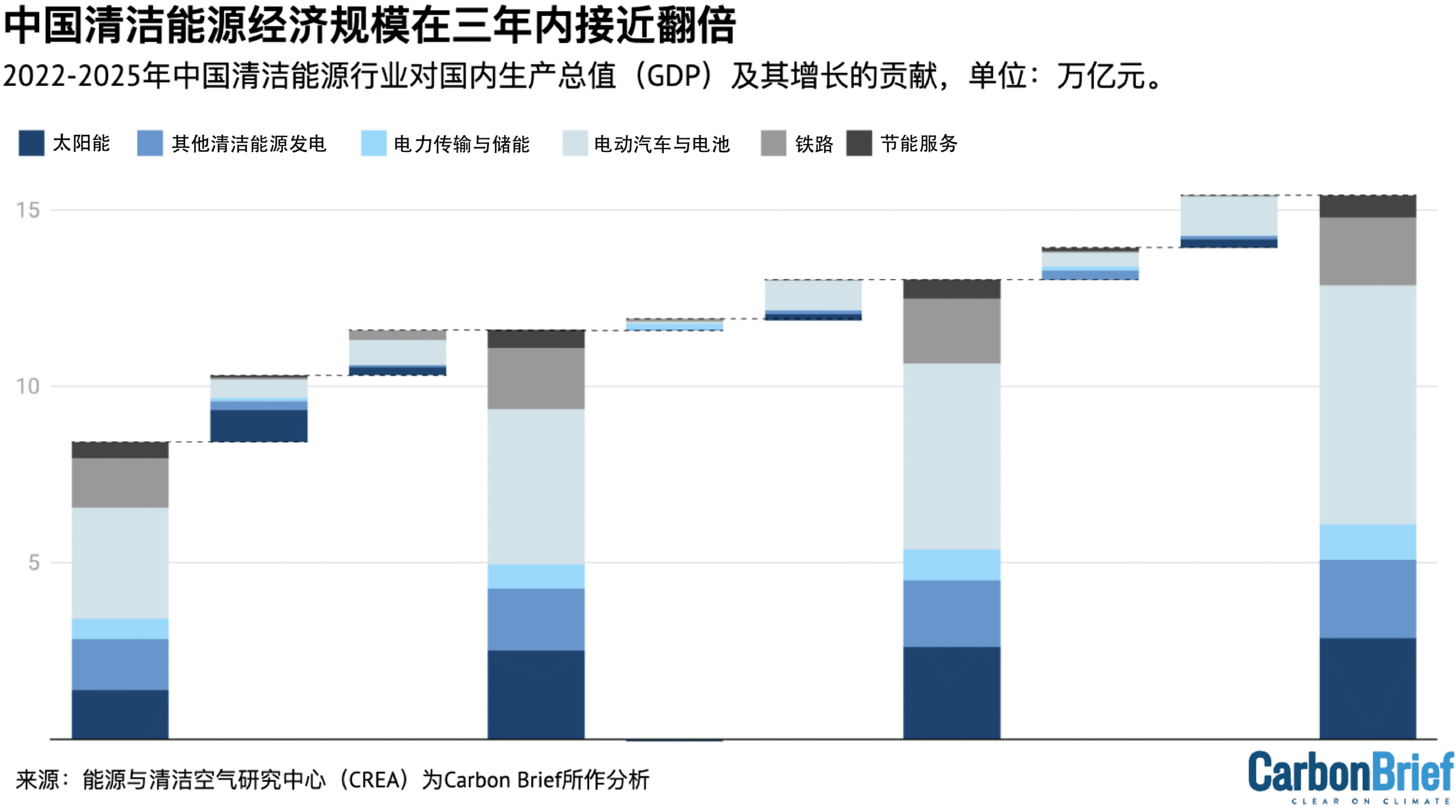
第二大子行业是清洁能源发电、输电和储能,在2025年占清洁能源对GDP贡献的40%,并贡献了清洁能源产业当年约30%的增长。
在电力领域内部,最主要的增长动力来自风电和太阳能发电装机投资的扩大,以及风电和太阳能发电量的增长;其次是太阳能设备及材料的出口。
作为2022–2023年的重要增长引擎,太阳能组件产业链投资在2025年连续第二年下降,这与政府遏制产能过剩和行业“非理性”价格竞争的政策导向一致。
此外,铁路运输约占清洁能源行业总经济产出的12%,但其同比增长相对温和,2025年其营业收入增长3%,投资增长6%。
需要指出的是,国际能源署(IEA)在其《世界能源投资报告》中估计,中国2025年清洁能源投资为 6270亿美元,而化石能源投资为 2570亿美元。
在采用与IEA一致的行业口径进行测算时,本研究对2025年中国清洁能源投资的估计为 4300亿美元,低于IEA的数值。而本文中所呈现的1万亿美元清洁能源投资总规模,并非源于更激进的单项假设,而是由于纳入了更为广泛的产业和活动范围,超出了IEA报告所覆盖的口径。
电动汽车和电池
2025年,电动汽车与动力电池成为中国清洁能源经济中最大的贡献部分,约占清洁能源行业总值的44%。
其中,纯电动汽车和插电式混合动力汽车的生产在价值规模和当年增长贡献两方面均居首位,产量同比增长29%。排在其后的是电动汽车制造领域的投资,在2024年增速放缓后,2025年投资规模同比增长 18%
电池制造投资在2024年出现下滑后也迎来反弹,这主要得益于电池新技术的涌现以及国内外市场的强劲需求。电池制造投资同比增长35%,达到2770亿元人民币。
到2025年底,电动汽车在全国汽车保有量中的占比预计达到12%,高于一年前的 9%,而在五年前这一比例还不足 2%。
在新车销售中,电动汽车占比进一步提升至 48%,高于2024年的 41%,其中乘用车电动汽车渗透率已突破50%。2025年11月,电动汽车在当月汽车总销量中的占比更是首次突破 60%,并持续成为拉动整体汽车销量增长的主要动力,如下图所示。
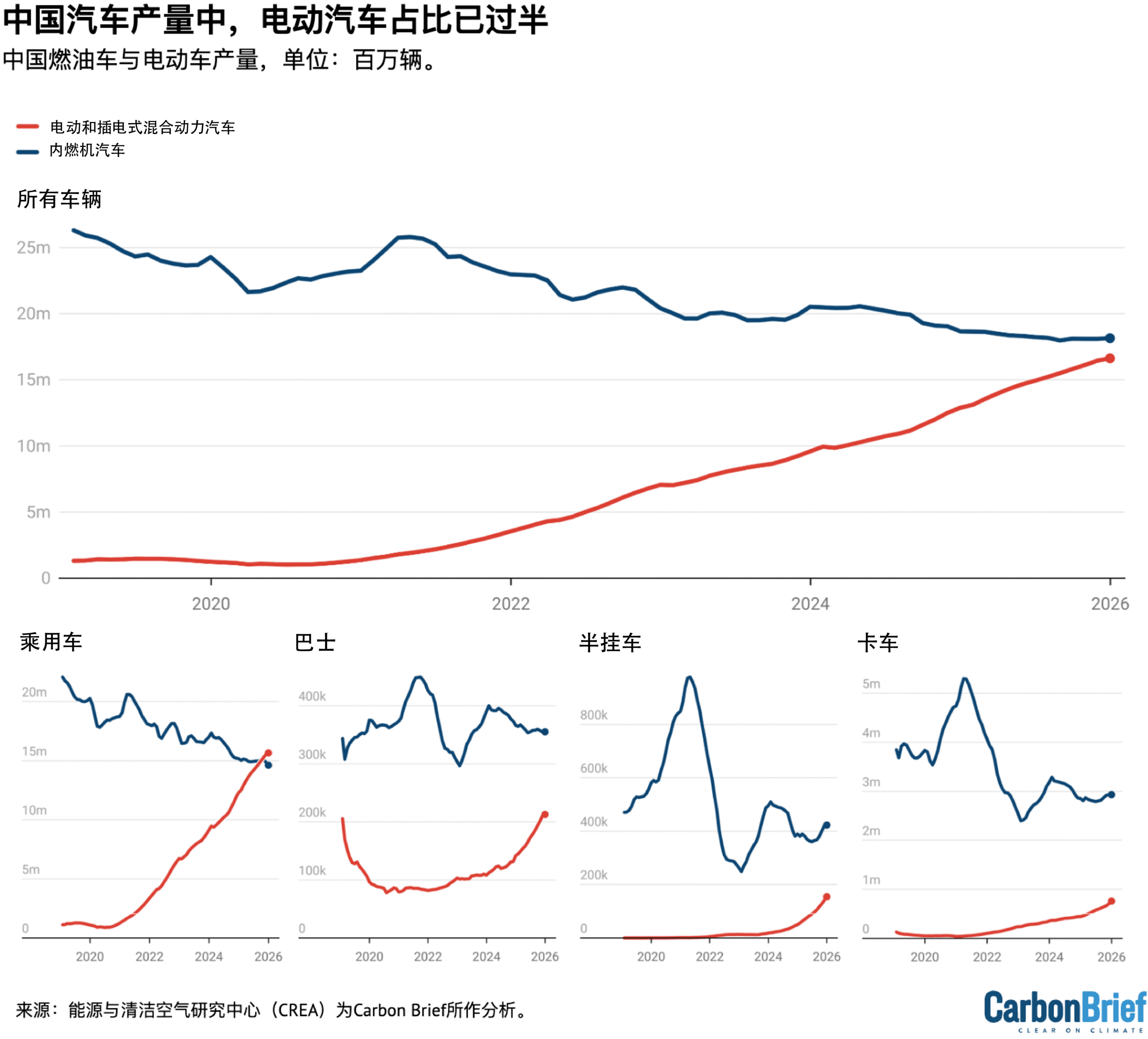
电动卡车市场取得突破性进展,其市场份额从2024年前九个月的8%,增长至2025年同期的23%。
政府对电动汽车的政策支持仍在持续,例如,一项最新政策提出,未来三年内充电基础设施规模将接近翻倍,以支撑电动汽车进一步普及。
在电动汽车市场中,出口增速快于国内销售增速,但整体销售仍以国内市场为主。2025年,中国电动汽车产量达到 1660万辆,同比增长 29%。其中,出口约340万辆,占总产量的 21%,但同比增速高达 86%。中国电动汽车的主要出口目的地包括西欧、中东和拉丁美洲。
电池出口额同样实现快速增长,同比上升 41%,成为推动GDP增长的第三大动力来源。电池出口主要流向西欧、北美和东南亚市场。
与许多清洁能源技术价格呈现的通缩趋势不同,2025年电动汽车的平均售价保持稳定,新车型在折扣后的平均加个甚至略有上涨。在全社会工业品出厂价格同比下降 2.6% 的背景下,这意味着电动汽车产业对名义GDP增长的贡献尤为突出。相比之下,电池价格仍延续下降趋势。
清洁能源发电
2025年,太阳能发电行业贡献了清洁能源产业总值的19%,为国民经济创造2.9万亿元人民币(约合410亿美元)的价值。
其中,新建太阳能发电厂的投资额达1.2万亿元人民币(约合1600亿美元),是清洁能源发电板块最大的驱动力;其次是太阳能技术出口额和太阳能发电本身创造的电力价值。太阳能制造业投资在2023年产能扩张浪潮结束之后持续下降,至0.5万亿元人民币(约合720亿美元),同比下降23%。
2025年,中国风电和太阳能发电新增装机容量再创新高。全国新增太阳能发电装机315吉瓦,新增风电装机119吉瓦,其中太阳能发电装机容量比全球其他地区总和还要多,而风电装机容量更是后者两倍之多。
在电力投资结构中,清洁能源占发电领域投资的90%,其中光伏一项就占到约50%。在此推动下,非化石能源发电量占全国总发电量的比重提升至42%,高于2024年的 39%。
不过,新出台的新能源定价政策以及相对谨慎的装机目标,也为这一轮增长能否持续带来了不确定性。在136号文件新政策框架下,新建风电和太阳能发电项目需要在电力市场中与既有煤电直接进行价格竞争,而在若干关键制度设计上仍处于相对不利的位置。
与此同时,电力市场本身仍处于建设和发展阶段,这也带来了投资的不确定性。
太阳能发电投资同比增长6%,但期间波动剧烈。开发商赶在新定价政策于6月生效前加速完成项目,第三季度放缓后,在年底再次赶工,以赶在“十四五”规划期内达成目标。
总体来看,太阳能产业整体投资规模与上一年大致持平:制造环节投资下降,被发电侧的增长所抵消。这在一定程度上支撑了制造产能利用率,也符合政府遏制行业“无序竞争”和价格内卷的政策目标。
2025年底,中国太阳能制造产能预计已达到每年1200吉瓦,远超2025年全球新增装机容量约650吉瓦的水平。目前,中国太阳能产业制造能力已显著超过全球市场吸收能力,激烈竞争导致行业盈利水平处于历史低位。
自2024年中期以来,中国的政策制定者已开始正面应对这一问题,包括警示“内卷式竞争”、出台监管措施,并召开行业会议向企业施压。相关举措已初见成效,2025年第三季度行业亏损有所收窄。
2025年,太阳能电池板及组件出口量再创历史新高,同比增长19%。其中,电池片和硅片出口量分别快速增长94%和52%,而电池板出口量仅增长4%。
这反映出,在关税压力上升、更多国家加快本土制造布局的背景下,全球太阳能供应链正日益趋向多元化。然而,由于平均出口价格下跌,以及出口产品结构从成品电池板向上游中间产品转移,出口名义价值反而同比下降了8%。
2025年,水能、风能和核能合计贡献了清洁能源行业总产值的约15%,为中国GDP带来约2.2万亿元人民币(3100亿美元)的增加值。
其中近三分之二(1.3万亿元人民币,1800亿美元)来自水电、风电和核电的发电价值,其余部分则来自新建发电项目的投资。
从发电量增速来看,2025年太阳能发电量增长33%,风电增长13%,水电增长3%,核电增长8%。
在发电投资领域,太阳能仍是价值规模最大的板块(如下图所示),但风电项目在2025年首次成为投资增长的最大贡献者,这是自2020年以来风电投资首次在增量上超过太阳能。
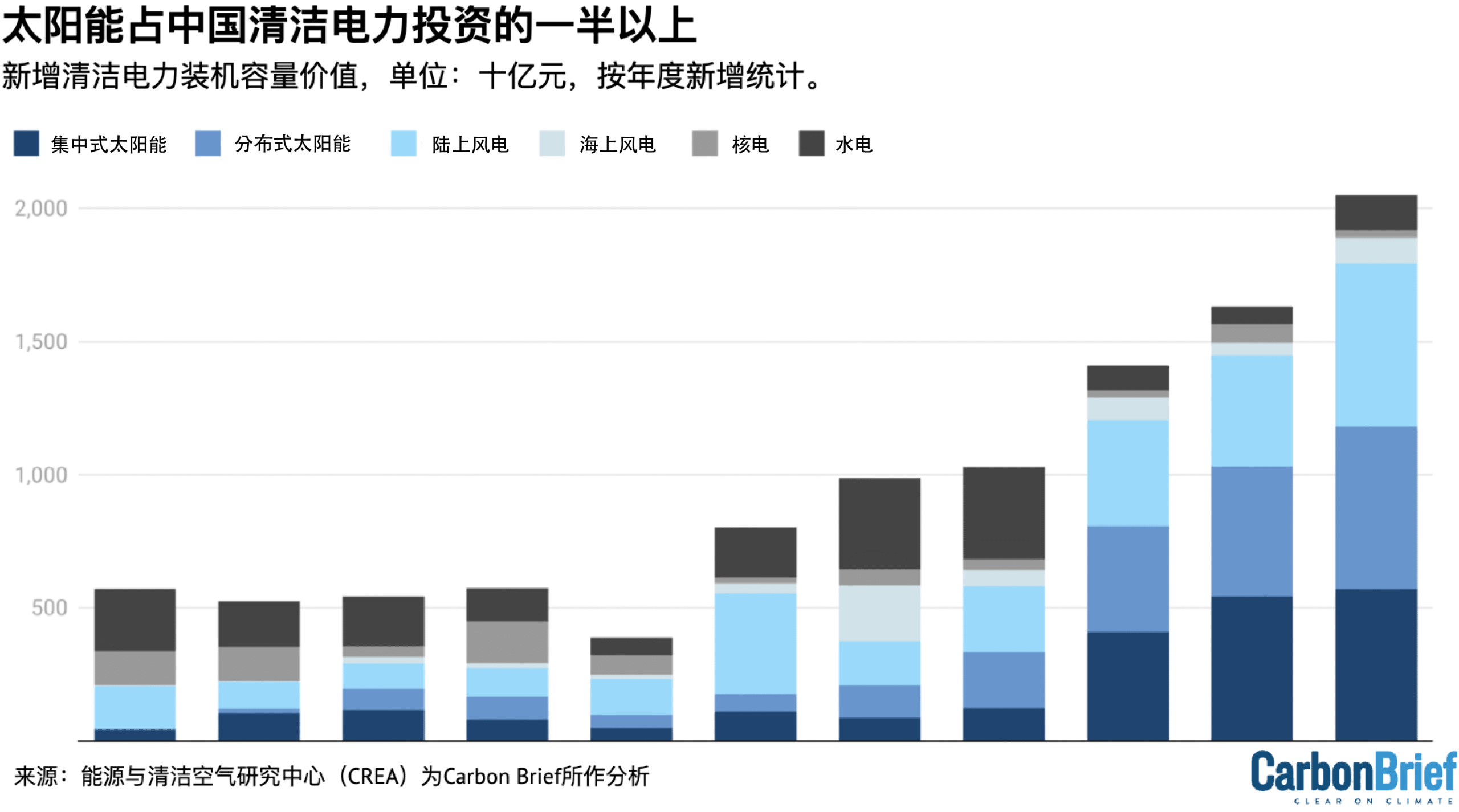
特别是海上风电装机投资如预期般反弹,在2024年大幅下降后,2025年实现翻倍增长,成为清洁电力投资中的一个亮点。
核电项目投资持续增长,但总体规模仍然较小,2025年投资额约为170亿元人民币。常规水电投资则延续下行趋势,同比下降7%。
储能和电网
2025年,输电和储能占清洁能源行业总产值的6%,规模达到1万亿元人民币(1400亿美元)。
其中,电网投资2025年增长了约6%,达到900亿美元。储能投资(涵盖抽水蓄能、新型储能和氢气制备)2025年达到约500亿美元。
新型储能投资同比增长幅度达50%,电解槽投资也增长了30%。受清洁能源发电快速增长推动,清洁能源输送规模预计增长13%。
中国电力储能总装机容量超过213吉瓦,其中新型储能容量超过145吉瓦,抽水蓄能容量为69吉瓦。预计2025年中国新增约66吉瓦新型储能装机容量,同比增长52%,占全球新增装机容量的40%以上。
值得注意的是,下半年新型储能装机增速加快,达43吉瓦,而上半年新增装机容量为23吉瓦。
在政策层面,136号文件规定在5月后取消了新能源配套储能的强制要求,曾一度导致新型储能市场增速放缓,但这一影响很快被“市场驱动型增长”所取代。省级电力现货市场的推进、分时电价机制以及太阳能弃光率上升,共同改善了储能项目的经济性。
到2025年底,中国前五大太阳能制造商均进入了新型储能市场,标志着行业战略的重要转变。
与此同时,抽水蓄能投资保持增长,仅2025年上半年,就有15吉瓦的项目获批,新增3吉瓦抽水蓄能投入运营。
铁路
铁路运输占清洁能源行业GDP的12%,其中客货运输收入是最主要的价值来源。行业增长主要来自铁路基础设施投资,2025年同比增长6%。
交通电气化不仅限于电动汽车,铁路客运、货运及相关投资规模也持续增长。2025年,中国高铁总里程约达5万公里,占全球高速铁路总里程的70%以上。
节能服务
2025年,节能服务投资强劲反弹。以大型节能服务公司(ESCO)的产值衡量,市场规模同比增长17%,恢复至2016-2020年期间的增长水平。
行业产值也已恢复到2021年的峰值水平,这表明在经历三年低迷后,行业已明显回暖。
行业预测显示,节能服务行业年产值有望在2030年达到1万亿元人民币,而行业经历低迷前曾预期这一目标将在2025年实现。
中国已发展成为全球最大的节能服务公司市场。其投资高度集中于建筑领域,约占业务总量的50%;工业应用占21%,而能源供应、需求侧灵活性与储能相关业务合计约占16%。
中国清洁能源布局的影响
中国持续向清洁能源制造业投入数千亿美元,代表着对全球能源持续转型的一项规模巨大的经济与金融押注。
除本文所涵盖的国内投资外,中国企业还在海外制造业领域展开了大规模投资布局,进一步加深了这一押注的全球化属性。
在十四五规划期间,清洁能源产业对中国实现经济增长目标起到了关键作用,在2023年、2024年和2025年分别贡献了约40%、25%和37%的GDP增长。
然而,长期的发展前景仍存在不确定性,尤其是在太阳能发电领域。136文件下新的可再生能源发电定价机制已导致短期投资增速放缓,并显著增加了市场不确定性;与此同时,中央政府设定的清洁电力新增装机目标也相对保守,远低于当前实际增长水平。
2025年下半年,太阳能发电和光伏制造领域的投资均出现下降,尽管从全年来看,发电投资保持了增长。这反映出在当前电力市场制度仍偏向煤电的框架下,清洁能源产业面临结构性风险。
清洁能源技术价格下降幅度显著,以致在未来核算GDP时,这些行业对实际GDP(经通胀或通缩调整后的GDP)的贡献可能会被向下修正。
尽管如此,清洁能源产业在宏观经济中的关键地位,本身就构成了维持这一轮清洁能源发展势头的强烈政策和经济动机。如果国内市场增长出现明显放缓,不仅可能削弱遏制产能过剩的努力,或将迫使更多产能转向出口,从而加剧国际贸易摩擦。
能源与清洁空气研究中心近期针对中国气候与能源领域专家开展的一项调查显示,多数专家认为,在经济和地缘政治挑战加剧的背景下,“双碳目标”及其所依托的清洁能源产业,只会变得更加重要。
地方政府和国企同样将深刻影响该行业的发展前景。在十四五期间,正是地方政府和国企的积极推进,促成了规模空前、且显著超出预期的“风光大基地”建设。
同时,各省在落实新电力市场机制和可再生能源购电合同安排方面拥有较大的自主空间,因此,将于今年发布的十五五规划,将成为决定清洁能源产业中长期走势的关键。
关于数据
本文分析尽可能采用已公布的投资与销售数据。若数据不可得,则依据实际数量(如装机容量、汽车销量等)结合单位成本或价格进行估算。
为衡量实际增长贡献,相关数据已按2022-2023年价格进行通胀或通缩调整。全部计算过程与数据来源详见附表。
估算范围涵盖清洁能源技术对上游原材料(如金属、化学品)的需求贡献。
该方法不仅能够反映清洁能源行业对整体经济活动的拉动作用,也能提现其对相关产业活动的带动作用,因此可适用于估算:若该行业未曾增长,经济增速可能降低多少。
为避免重复计算,仅计入价值链中不重叠的环节。例如,电动汽车的生产产值与储能电池的投资额均予计入,但不包含作为上述活动中间投入的、面向国内市场的电池生产价值。
同理,国内市场的太阳能电池板产值已包含在中国光伏发电装机容量的价值中,故不重复统计;然而,太阳能电池板及电池的出口价值则纳入计算。
2025年,两项关键投资指标出现明显背离:据报道,固定资产投资下降3.8%,为35年来首次下滑;而同期资本形成总额虽增速放缓至近年最低,但仍保持2%的正增长。
本研究采用资本形成总额作为投资衡量指标,因其是GDP的组成部分。但由于无法全面追踪库存变动,对清洁能源投资的估算仍基于各行业的固定资产投资数据。
本分析未专门考虑进口因素——其在清洁能源产品与服务生产中所占比例较小且持续下降。这意味着结果可能略微高估对GDP的贡献,但同时低估了对GDP增量的贡献。
例如,中国在电动汽车中对高端计算芯片仍存在较高的进口依赖。一辆典型电动汽车的芯片价值约1000美元,而该类芯片的进口依赖度高达90%,但这仍进展整车生产价值的3%以内。
在某些方面,本研究的估算可能相对保守。例如,彭博新能源财经(BNEF)估计2024年中国“能源转型投资”规模约为8000亿美元。彭博估算的行业覆盖范围与本分析大致相当,但未包含制造业产值。在相同口径下,本研究对应的投资规模约为6000亿美元。
根据中国国家统计局数据,2023年全国汽车产业总产值与销售额合计约11万亿元人民币。本分析估算,同年电动汽车销售额约为2.3万亿元,约占行业总值的20%。当时,电动汽车产量已占汽车总产量的31%,且其平均售价略高于传统燃油汽车。




The post 分析:清洁能源2025年为中国GDP增长贡献超过三分之一 appeared first on Carbon Brief.

Marcelo Behar is the COP30 Special Envoy for Bioeconomy and co-founder of Ambition Loop Brazil.
Can we be the generation to end the rampant deforestation that is harming the planet’s ecosystems and climate? Back in February, the Brazilian COP30 Presidency opened a call for submissions on its proposed Roadmap for Halting Deforestation and Forest Degradation, which closes today.
What might look like a technical step quickly drew significant attention, with more than 100 responses submitted by governments, civil society organisations, businesses and other stakeholders.
This level of engagement is telling. It reflects both the urgency of the issue and the recognition that this process could shape whether the global goal to end deforestation by 2030 finally moves from ambition to delivery.
As a Brazilian, I see this moment with both pride and realism. Brazil has played a central role in elevating forests on the climate agenda, and the COP30 Presidency has shown leadership in carrying this issue forward far beyond the Belém summit.
COP30 rainforest fund unlikely to make first payments until 2028
But last year also offered a sobering signal. Despite strong efforts from the Brazilian Presidency, the proposed roadmap did not secure consensus in the final outcome of COP30. That outcome underlined a simple truth: while there is broad recognition of the importance of forests, agreeing on how to move forward remains complex. The road ahead is still long and likely uneven.
That is precisely why this moment matters.
Progress on commitments falling short
The world is not short of commitments. Over the past decade, countries have repeatedly pledged to halt and reverse deforestation by 2030. There is a growing body of experience through the REDD+ (Reducing Emissions from Deforestation and Degradation) programme, including the emergence of jurisdictional approaches that are beginning to connect forest protection with finance at scale.
Initiatives such as the Forest and Climate Leaders’ Partnership have helped sustain political attention and cooperation among countries, while national strategies continue to evolve, and Indigenous Peoples and local communities remain at the forefront of protecting forests.
And yet, progress is still falling short.
The gap is not only one of alignment. It is also one of political will – and of having a credible, shared pathway that brings together these efforts in a way that drives implementation at scale.
Civil society is watching this process closely. For many organisations working across climate, nature and conservation, this is not just another initiative – it is a priority. After years of advocating to end deforestation, there is a strong sense that this moment cannot be lost. The expectation is clear: this roadmap must move beyond intention and help unlock real progress.
The opportunity now is to ensure that it does exactly that. This cannot become another report.
Implementation key to roadmap success
A detailed assessment of pathways and challenges, however valuable, will not be enough to change outcomes on the ground. What is needed is an implementation roadmap, one that connects existing commitments, aligns incentives and provides clarity on how to move from ambition to delivery between now and 2030.
The consultation process is an important step. But its value will ultimately be judged by what it produces.
If the roadmap is to succeed, several priorities should guide its development.
-
With no COP30 roadmap, hopes of saving forests hinge on voluntary initiatives
The world is falling short of a target to halt deforestation by 2030, but the “Amazon COP” failed to agree a concrete global plan to save rainforests despite backing by over 80 nations -
Deep in the Amazon, forest protection cash must vie with glitter of illegal gold
The TFFF fund launched at COP30 aims to pay communities to protect the rainforest, but will it be enough? On French Guiana’s border with Brazil, the profits to be had from mining are far higher


First: policy. It must be designed as a tool for implementation. That means going beyond diagnosis to define concrete action: who needs to act, by when, and how progress will be tracked. The solutions are not new, but coordination has been missing.
Second: accountability. It should bring coherence to the existing landscape. The value of a roadmap lies not in creating new commitments, but in connecting what already exists: global targets, REDD+ experience, national action plans, Indigenous leadership and supply chain initiatives. Reducing fragmentation is essential to accelerating delivery.
Early milestones needed
Third: finance. It must be grounded in economic reality. Halting deforestation will not happen without addressing the incentives that underpin it. Aligning public finance, private investment, and market demand with forest protection is not a technical detail; it is the core of the transition.
Fourth: transparency. Legitimacy will depend on openness. A credible roadmap cannot be developed behind closed doors. Governments, Indigenous Peoples and local communities, civil society, business and finance actors all have a role to play and must be able to see how their contributions shape the outcome.
Fifth: urgency. Progress must be visible in 2026. Without early milestones, momentum will fade. By the time climate negotiators gather in Bonn mid-year, the roadmap should have a clear structure, priority actions and growing political backing.
Governments must deliver on the plan
Finally, countries themselves will need to step forward. Last year’s outcome showed that support alone is not enough. Delivering this roadmap will require active political engagement. That means governments that are willing not only to participate in the process, but to help shape and implement it.
Brazil has created an important opening. It has also taken on the responsibility that comes with leadership: to help turn a widely supported idea into something that can deliver in practice.
The commitment to end deforestation by 2030 already exists. What is still needed is a path. And the courage to walk it.
The post How a Brazil-led roadmap can rescue global pledge to halt deforestation appeared first on Climate Home News.
How a Brazil-led roadmap can rescue global pledge to halt deforestation
A US biofuels producer that exports “green” aviation fuel to Britain and the European Union has purchased beef tallow from a Brazilian supply chain tied to illegal deforestation in the Amazon, shipping data and a court document show.
Diamond Green Diesel (DGD), a major provider of sustainable aviation fuel (SAF) and renewable diesel, has sourced hundreds of thousands of tonnes of beef tallow from Brazil, alongside waste fats from other sources, over the last three years, as global demand for biofuel feedstocks soars.
Reporting by Unearthed and nonprofit investigative outlet Repórter Brasil reveals DGD’s connection to a rendering plant that has sourced supplies from a meatpacker fined for buying cattle from an illegally deforested Amazon reserve. A previous investigation by Reuters and Repórter Brasil found DGD had bought animal fat from two other rendering factories linked to supplies of cattle from illegal ranches.
The newly identified factory, Pacífico Indústria e Comércio de Óleos e Proteínas Ltda, which is based in Cacoal, a small city in the far-western Amazon state of Rondônia, has been supplied by Rondônia meatpacker DistriBoi, a 2022 court document shows.
DistriBoi was fined two years ago for illegally purchasing cattle from the state’s Jaci-Paraná conservation reserve, which has been ravaged by illegal ranching.
There is no suggestion that the companies involved were aware of deforestation at farm level. But the findings suggest a traceability gap in the supply chain of feedstocks for sustainable fuels, where cattle by-products are subject to less oversight than the primary commodities of the cattle industry, such as meat and leather.

Pristine rainforest blanketed the Jaci-Paraná reserve when it was created 30 years ago to protect traditional forest activities such as rubber tapping and nut harvesting.
Today, illegal ranching has devoured nearly 80% of its forest cover and it has become a notorious example of the devastation wrought by land grabbers in the world’s largest rainforest.
“The damage to biodiversity has been devastating,” said local Indigenous activist Neidinha Suruí, who featured in the 2025 Emmy Award-winning documentary “O Território”.
“It is sad to see what has been lost,” she said.
Greener air travel?
The “renewable diesel” and sustainable aviation fuel (SAF) that are being exported by DGD – a joint venture between US oil refiner Valero Energy Corp and Texas-based Darling Ingredients – are classed as “green” because they are made from feedstocks classified as waste, including tallow, which consists of fat separated from cattle carcasses.
Many governments and airlines are pinning their hopes for greener flying on SAF made with organic waste materials, including Britain which introduced a compulsory blending requirement last year.
Top green jet fuel producer linked to suspect waste-oil supply chain
Air travel accounts for about 2.5% of global carbon emissions and in contrast to other transport sectors that can be electrified, shrinking aviation’s carbon footprint is much more difficult.
Waste products such as beef tallow and used cooking oil (UCO) are considered the greenest of viable SAF feedstocks on the grounds that they do not create competition with foodstuffs such as soy oil or palm oil, nor increase deforestation pressure.

But there is concern that the global rush to ramp up SAF use could indirectly exacerbate deforestation pressure by increasing demand for feedstocks such as tallow and UCO.
That could increase the profit margins of cattle ranches – including illegal ones – and have other unintended consequences, such as encouraging fraud in supply chains, as Climate Home News has reported.
An investigation published in March by Climate Home News and Swedish broadcaster SVT found that Finnish biofuels giant Neste is sourcing key ingredients for its SAF from an opaque supply chain that enables fresh palm oil to be passed off as used, waste oil.
Because tallow is classified as waste by regulators in markets including the UK and EU, the green fuel industry’s most widely used certification scheme – International Sustainability and Carbon Certification (ISCC) – does not assess whether forests were cleared to rear the cattle that produced it in the first place.
-
Amazon fires threaten initiatives to raise cash for rainforest protection
Brazil’s Tropical Forests Forever Facility (TFFF) and other innovative finance tools will be showcased at COP30, but surging wildfires in the Amazon pose a threat to their success, climate experts warn -
Deep in the Amazon, forest protection cash must vie with glitter of illegal gold
The TFFF fund launched at COP30 aims to pay communities to protect the rainforest, but will it be enough? On French Guiana’s border with Brazil, the profits to be had from mining are far higher -
Funding gap threatens next round of IPCC climate science reports, chair warns
The latest IPCC session in Bangkok was clouded by persistent differences over when its flagship reports should be published and concern over cost-cutting proposals


This allows tallow from cattle to qualify as a sustainable feedstock for green fuels, even if they were raised on illegally deforested land.
“There is clearly an oversight within the rules if the products, in this case animal tallow, are originally coming from deforested land,” said Cian Delaney, a campaign coordinator at the clean transport and energy advocacy group Transport & Environment.
That means government SAF mandates aimed at stemming air travel emissions could help boost the earnings of cattle ranchers linked to illegal deforestation in Brazil, where ranching and other forms of agriculture have been the main driver of forest loss.
Land grabbers clear way for ranchers
Once covered by an unbroken rainforest canopy, Rondônia’s Jaci-Paraná reserve has been decimated by illegal deforestation driven by cattle ranching – a major cause of tree loss in the Amazon.
Land-grabbers have seized – often violently – and cleared more than three-quarters of its forest for pasture, as ranching has steadily advanced into the southern Amazon.
Suruí, the local Indigenous activist, said companies that buy products derived from illegal activities perpetuate environmental crimes in the rainforest.
“If there were no meat processors buying illegally sourced cattle, there would be no land grabbing and no deforestation,” Suruí told Repórter Brasil, which partnered on the new investigation with Unearthed, and a team of journalists supported by JournalismFund Europe.
Lawsuits and linked supply chains
Brazilian President Luiz Inácio Lula da Silva has pledged to end all deforestation in the country by 2030, in part by strengthening environmental enforcement in the world’s biggest rainforest.
In Rondônia, authorities have launched more than 50 lawsuits related to land-grabbing and deforestation in the Jaci-Paraná reserve alone. Local slaughterhouse DistriBoi is named in 31 of the lawsuits, including the 2024 case in which it was fined.
According to the 2022 court document, which concerned an unrelated labour dispute, lawyers for Pacífico refer to DistriBoi as the rendering plant’s “largest supplier of raw materials”.
US-based DGD received almost 15,000 tonnes of tallow from Pacífico from 2023 to 2025 at its Texas refinery, as well as used cooking oil from various countries and sources, according to trade database Panjiva.

Darling Ingredients is also a parent company of Pacífico since its 2022 acquisition of Brazilian rendering company FASA Group.
A spokesperson for Darling Ingredients denied that Pacífico had sourced beef residues from DistriBoi’s Ji-Paraná slaughterhouse – one of two that the meatpacker operates in Rondônia.
“The rendering plant Pacífico does not source any materials from the slaughterhouse Distriboi in Ji-Paraná,” the spokesperson said in an emailed response, without providing evidence or commenting directly on the content of the 2022 court document.
Darling did not respond to a follow-up question about Distriboi’s other slaughterhouse in the region, which, according to cattle transfer documents, has also bought from a farm that has illegally cleared forest within the extractive reserve.
“Our relationships are typically with the slaughterhouse, several levels removed from cattle ranchers. Regardless, we are committed to ensuring our raw materials are deforestation free. We expect our raw material suppliers to abide by our supplier code of conduct. In addition, we are in the process of requiring all [the] raw materials to attest that their material is deforestation free,” the spokesperson said in a statement.
DistriBoi said in an apparent reference to the pending Jaci-Paraná lawsuits that “the matters mentioned … are already under review, including by higher courts”. It has previously denied wrongdoing. The company’s statement did not address a question about its commercial ties to Pacífico.
Valero Energy, the major refiner that co-owns DGD with Darling Ingredients, did not respond to requests for comment, nor did DGD itself.
From slaughterhouse to SAF
In an effort to rein in carbon emissions from air travel, regulators in Britain and the EU have mandated progressively increasing SAF blending quotas in the years ahead, creating a new market for feedstocks including beef tallow.
Brazil’s exports of tallow to the US have risen sharply in recent years, up from less than 10,000 tonnes in 2021 to almost 400,000 tonnes last year, according to Panjiva, reflecting growing demand for biofuels like SAF.
In the UK, Europe’s biggest aviation market by seat capacity, jet fuel was required to contain 2% SAF by the end of 2025, rising to 10% by 2030 and 22% by 2040.
DGD shipped 134,000 tonnes of SAF worth nearly $90 million from Texas to the UK in 2025, according to trade data from Panjiva. The company also exported smaller amounts of renewable diesel to Britain.
The EU received biofuels, including small quantities of SAF, worth over $1.1 billion from DGD’s Texas refinery last year, figures show.
Is the world’s big idea for greener air travel a flight of fancy?
Unearthed’s investigation could not identify which airlines or airports buy DGD’s SAF once it arrives in Britain.
Valero, DGD’s other parent company, is positioning itself as a key player in the transition to lower-carbon fuels in the UK, where it markets its renewable diesel under the Texaco brand.
It has been an active participant in SAF policy discussions and has criticised the government’s planned cap on waste fat sources in SAF, calling them “the world’s most cost-effective production route for SAF” in a submission to parliament.
Helping to cut emissions?
Even tighter oversight over SAF feedstocks is crucial to ensure that blending mandates such as Britain’s are effectively lowering emissions, said Anna Krajinska, a director at Transport & Environment UK.
Forests store vast amounts of carbon; when they are cut down or burned this carbon is released into the atmosphere.
“If there’s tallow coming from land that’s been deforested, then those emissions might be so high that you might not be getting to the greenhouse gas reduction threshold,” Krajinska said.

But as the world’s appetite for flying keeps on growing, some experts say SAF is the only viable means to reduce aviation emissions at present.
Referring to the deforestation links identified in Unearthed’s investigation, Wouter Dewulf, an aviation economist at Belgium’s University of Antwerp, said it “would be important to assess how large this infraction is”.
“I’m quite sure you have aberrations,” Dewulf added. “But biofuels are the best alternative for the moment.”
T&E’s Delaney said there needs to be less opacity and better oversight from regulatory authorities. “Right now, there are just too many blindspots,” he added.
The post UK imports of “green” jet fuel linked to Amazon deforestation appeared first on Climate Home News.
UK imports of “green” jet fuel linked to Amazon deforestation
A company has proposed to build a crude oil pipeline crossing the Canadian border near where the long-contested project would have entered the United States.
No project better embodies the nation’s wild swings in climate and energy policy than the Keystone XL pipeline.



-
Climate Change8 months ago
Guest post: Why China is still building new coal – and when it might stop
-
Greenhouse Gases8 months ago
Guest post: Why China is still building new coal – and when it might stop
-

 Greenhouse Gases2 years ago
嘉宾来稿:满足中国增长的用电需求 光伏加储能“比新建煤电更实惠”
-
Climate Change2 years ago
Bill Discounting Climate Change in Florida’s Energy Policy Awaits DeSantis’ Approval
-

 Climate Change2 years ago
嘉宾来稿:满足中国增长的用电需求 光伏加储能“比新建煤电更实惠”
-
Climate Change Videos2 years ago
The toxic gas flares fuelling Nigeria’s climate change – BBC News
-

 Renewable Energy6 months ago
Sending Progressive Philanthropist George Soros to Prison?
-

 Carbon Footprint2 years ago
US SEC’s Climate Disclosure Rules Spur Renewed Interest in Carbon Credits