

新研究显示,中国来自农业机械的碳排放快速增长,可能会“阻碍”该国实现净零排放的目标。
这项发表在《自然-食品》(Nature Food)期刊上的研究发现,自1985年以来,中国农业机械CO2(二氧化碳)排放量增加了大约七倍。
研究人员利用政府发布的不同时期农机数量统计数据,计算了1985年至2020年期间CO2排放量及其他空气污染物的变化。
他们发现,自1985年以来,农业机械的CO2排放量平均每年增长近6%。
研究指出,按照中国实现2060年净零排放目标的路径,若农业机械化程度按“预期趋势”继续提升,其相关排放在2050年可能占中国总排放量的21%。

作者表示,这可能会使中国实现减排目标更加困难,并导致空气质量“恶化”。
然而,研究还发现,如果广泛采用由可再生能源驱动的农业机械,有望减少65%至70%的相关排放。
一位未参与该研究的专家对Carbon Brief表示,尽管该研究“具有价值”,但农业机械不太可能在总排放量中占到如此高的比例。
“如果中国在减少其他排放源方面取得了快速进展……那么我预计在农业机械的脱碳方面也会取得显著成效。”她说。
农机相关排放
粮食系统大约占人类温室气体排放的三分之一。
这一数字涵盖了与粮食生产相关的所有排放——从因森林砍伐或土地使用变化导致的排放,到奶牛打嗝或粪便释放的甲烷。
这项新研究的数据来自《中国统计年鉴》,后者提供了各种社会经济指标的年度统计数据。研究者从中提取了中国农业机械的数量与功率、机械所用的燃料属性、耕地面积、人口等信息。
除了CO2排放量外,研究者还计算了三种与农业机械相关的空气污染物排放量:PM2.5(细颗粒物)、NOx(氮氧化物)和THC(总烃)。
研究者将农业机械分为四类:小型拖拉机、大型拖拉机、田间管理机械和收割机械。然后,他们计算了每类机械在每一年的CO2、PM2.5、NOx和THC排放量。
下图展示了1985年至2020年研究期间的CO2排放量。图中柱状表示不同类型农业机械的排放量:收割机械(浅蓝色)、田间管理机械(粉色)、小型拖拉机(浅绿色)和大型拖拉机(深绿色)。
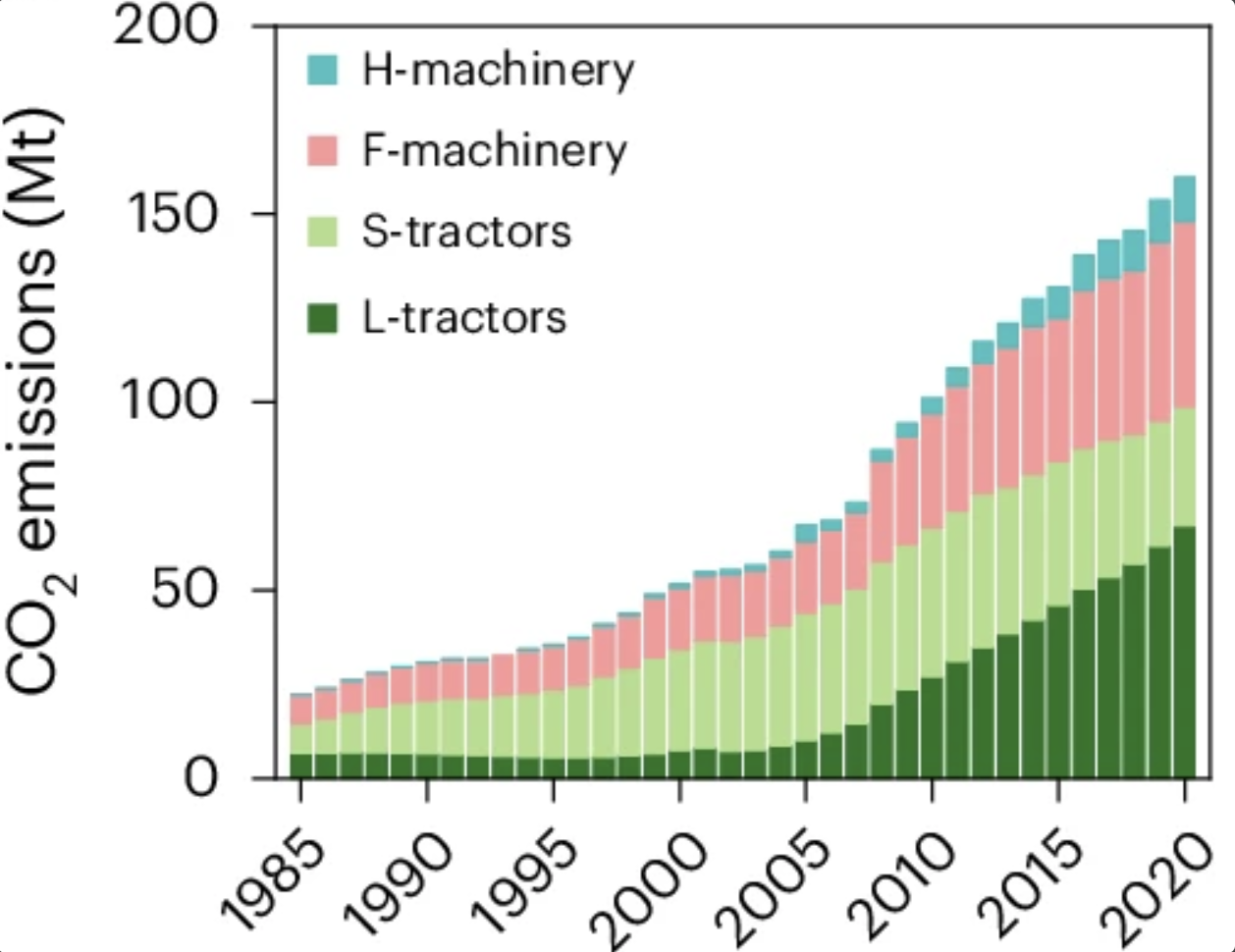
他们发现,农业机械CO2排放总量已从1985年的约23MtCO2(1MtCO2=百万吨二氧化碳),增长到2020年的近160MtCO2,年均增长率为5.7%。
这相当于2020年中国总排放量的约1.5%。虽然比例不高,但作者指出,这一排放量实际上超过了部分国家的年排放总量,如荷兰、菲律宾和尼日利亚。
尤其是,大型拖拉机所带来的排放量自2005年以来平稳增长,作者将此归因于“一系列推动大型机械化的政策”。
未参与该研究的中山大学教授覃章才表示,该研究将农业机械排放从更广泛的食品系统中拆分出来“提供了独特的视角”。覃教授表示,该做法“使政策制定者能够在不影响农业生产力的情况下,设计有针对性的干预措施”。
区域分布
研究者还将排放数据细化到省级层面,发现不同地区农业机械排放量差异很大。排放量最低省份仅有约0.1MtCO2,而排放最高的省份则达到17.5MtCO2。
他们发现,中国东部和东北的五个省份——山东、河南、黑龙江、河北和安徽,占农业机械排放总量的40%以上。这些省份合计拥有全国三分之一的耕地面积和约46%的农机总动力。
然而,即使在这些高排放地区之间,机械类型的构成也存在差异,有些省份更依赖大型拖拉机,有些则以田间管理机械为主。
未参与该研究的《Our World in Data》副主编汉娜·里奇(Hannah Ritchie)博士表示,这种次国家级排放分析是该研究的关键进展之一。
里奇博士解释说:“这种排放估算的空间分辨率极具价值,因为在中国这样幅员辽阔的国家,各地排放差异显著。它还为未来在不同机械化程度和低碳技术采纳率下的潜在排放路径,提供了重要的洞见。”
增长因素
研究人员确定了四个推动排放增加的社会经济因素:人口增长、人均耕地面积变化、机械化水平以及排放强度。
下图展示了由排放强度(深蓝色)、机械化水平(浅蓝色)、人均耕地面积(黄色)和人口(橙色)的变化所导致的CO2排放量变化(黑色)。
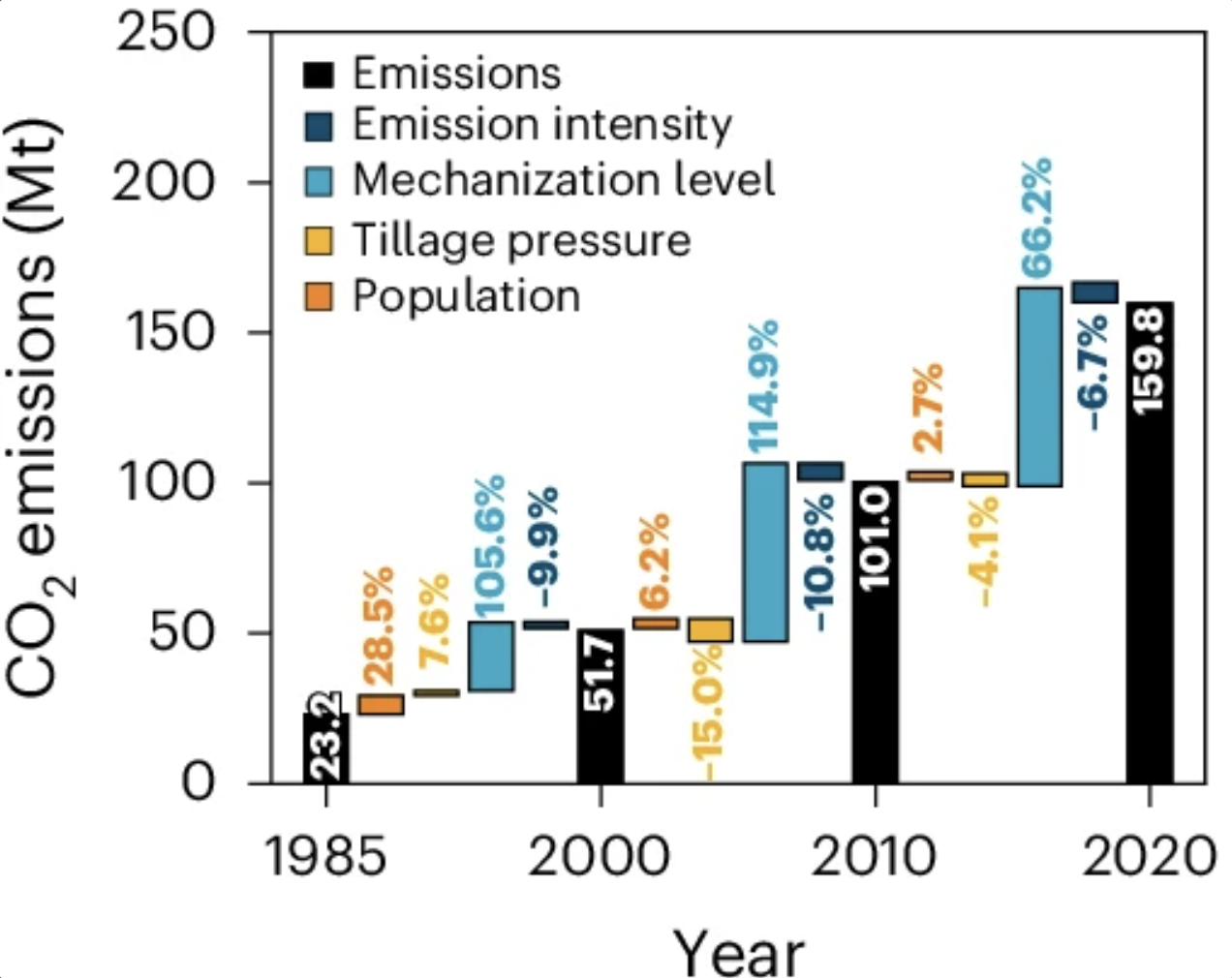
论文指出,在这些因素中,机械化水平的提升“主导”了排放变化。仅这些变化就导致1985年至2000年间排放量增加了约100%。
研究指出,人口增长也是研究区间早期农业机械排放量增长的重要驱动力,但自2000年以来,这一因素的影响有所减弱。
相比之下,作者指出,排放强度的上升总体上反而促使排放减少;而“耕作压力”在研究初期推动了排放上升,但自2000年起则转而起到抑制排放的作用。
碳排放目标
作者指出,根据现行政策,中国致力于“到2035年主要农作物生产实现全过程机械化”。
因此,他们警告称,若农业机械化持续增长且未加遏制,可能会对中国实现“双碳”目标构成挑战。(“双碳”目标指的是中国承诺在2030年前实现碳达峰,并在2060年前实现碳中和。)
作者指出,有效减排需在短期和长期分别采取不同策略,并强调从短期可用性来看,“生物燃料和天然气将在未来十年发挥重要作用”。
作者还认为,从长远来看,可再生能源以及绿氢“具有最大的减排潜力”。
此前研究表明,使用自动化设备、电动拖拉机和可再生能源可以减少90%的农业排放。
里奇表示,她“对农业机械的相对(排放量占比)在2050年能达到20%持一定怀疑态度”。
她补充道:“这基于一个假设,即这些排放大多不会减少,而其他大多数行业排放迅速下降。但如果中国在减少其他排放源,包括卡车等更大型的道路运输排放和其他农业排放方面取得快速进展……那么我预计在农业机械的脱碳方面也会取得显著成效。”


The post 中国农机排放量上升或“阻碍”净零目标实现 appeared first on Carbon Brief.
https://www.carbonbrief.org/translations-rising-emissions-from-farm-equipment-could-hinder-chinas-net-zero-goals/

Cleaner cooking projects in the UN carbon market will have to set aside a share of their credits to insure against the risk that the trees they save are lost to fire, drought or logging, after the market’s regulator rejected calls to exempt the sector.
The requirement is part of a new rulebook that the Paris Agreement carbon market regulator – the Article 6.4 Supervisory Body – approved last Friday for programmes that aim to cut emissions by distributing new and cleaner cookstoves in regions that still burn wood or charcoal for cooking.
These are the UN mechanism’s first rulebooks for cookstoves, one of the carbon market’s most popular credit types and also one of its most criticised for overstating climate benefits.
They consist of two methodologies: one for programmes that aim to cut greenhouse gas emissions by distributing more efficient cookstoves that burn less wood or charcoal, and a separate methodology for projects shifting households to lower-emissions cookers running on electricity or liquid petroleum gas (LPG).
Mkhuthazi Steleki, the South African chair of the Supervisory Body, said “this decision gives cleaner cooking projects a new pathway under the UN carbon market, with clear rules to ensure that each credit represents a real and credible emission reduction”.
Industry and NGOs lobby to weaken UN carbon credit rules in “coordinated” push
In copycat submissions and a private briefing to government officials, the groups have opposed a proposal to tighten safeguards for emissions offsetsLaunch of Africa Energy Bank delayed again in blow to oil and gas hopes
Repeated delays are raising questions about the bank’s momentum and whether it can mobilise investment to finance Africa’s oil and gas ambitions in an era of energy transition

Exemption push rejected
More efficient cookstove projects earn credits based on the amount of carbon they save by preserving trees that would have otherwise been cut down and burned for fuel. But if those trees later burn in a wildfire or are logged, the carbon stored would be released anyway, erasing the climate benefits of the credits.
Several carbon credit developers, conservation NGOs and the UN Environment Programme (UNEP) disputed that cookstove projects face this risk, in what critics described as a “coordinated lobbying campaign”.
They argued that, unlike forest protection schemes, this type of credit represents a “flow” of avoided emissions rather than a “stock” of stored carbon that can be released. They also warned that requiring a buffer would impose disproportionate costs and undermine the financial viability of these activities.
But the UN carbon market regulator was not persuaded by the argument. It decided that projects would have to protect against this reversal risk by handing over a percentage of credits to a so-called “buffer pool” instead of selling them.
‘New paradigm’
The amount of credits to be given up is calculated by applying different methods for natural risks, like wildfires, droughts or hurricanes, and human-caused ones, such as logging or land clearing.
For natural risks, project developers will need to apply local risk values derived from new modelling published by a group of independent scientists.
Campaigners have broadly welcomed the decision. Federica Dossi, an expert at Brussels-based advocacy group Carbon Market Watch, said it sets a new paradigm for calculating reversal risk based on empirical data. “This approach is grounded in science and we hope to see this now being adopted by other carbon crediting mechanisms in the voluntary market,” she added.
Backers claim this method is more rigorous than current practice in the voluntary carbon market, which largely relies on expert guesswork.
Pre-COP draws attention to Pacific’s climate plight and 1.5C goal
Pushback over science
As Climate Home News previously revealed, the same industry and NGO groups that sought an exemption from the “buffer pool”, along with some corporate buyers, criticised the use of a study backed by the UN carbon market’s experts that recommended the new risk assessment approach.
The groups pushed for more flexible rules that would have allowed natural risk values drawn from other sources, including national databases, or from the project developers themselves.
While the Supervisory Body rejected this approach, it gave project developers and countries the option to propose alternative values that would first need to be vetted by the mechanism’s expert panel and then approved by the regulator.
A carbon market expert told Climate Home News that, while it is too early to say how this provision will be used, they expect requests will have to be backed up with solid scientific evidence, lowering the risk of unfounded claims.

Policy discounts questioned
To guard against human-caused risks, projects will need to apply a flat 20% value set by the Supervisory Body, at the bottom of the 20-45% range recommended by its technical experts ahead of last week’s meeting.
That value can be further reduced by up to two-thirds if the host country has an emission-reduction plan covering forests, a long-term climate strategy and a framework for the UN’s REDD+ forest protection scheme.
Injy Johnstone, senior research fellow at the Munich-based Max Planck Institute, said that, while these are important governance measures, their existence does not necessarily demonstrate that the underlying risk of forest carbon loss has been reduced.
“It is important to distinguish between evidence of actual risk reduction and assumptions about the effectiveness of policy commitments,” she added.
Moving target
A UN source told Climate Home News that, under the approved formula, improved cookstove projects must set aside at least 9% of credits linked to saved wood if they operate in the lowest-risk areas and the host country can claim all available discounts. The share of credits rises significantly in regions with high natural risk values, such as Guyana, Sri Lanka and Timor Leste, or that do not have REDD+ programmes.
These factors could change in the future as the Supervisory Body asked its technical experts to recommend revisiting the risk values “should credible new evidence arise”.
Climate change is likely to make forest destruction events, such as wildfires or hurricanes, more frequent and more severe in certain regions. Meanwhile, national policies on forest protection can shift significantly depending on government changes.
Johnstone said the UN carbon market needs periodic reassessment to respond to new evidence showing that previously assumed levels of risk were too low.
“The integrity of credits is not guaranteed simply because a reversal risk tool exists,” she added. “The real test will be whether the mechanism provides equivalent atmospheric protection over time, rather than simply introducing another layer of accounting requirements”.
The post UN carbon market forces cookstove projects to protect against forest loss appeared first on Climate Home News.
UN carbon market forces cookstove projects to protect against forest loss
Next week, diplomats from around the world will descend on Yerevan, Armenia, to negotiate a series of decisions under the UN Convention on Biological Diversity (CBD).
Between 19 and 30 October, 196 parties will gather to hammer out the precise wording of the dozens of legal texts that make up the decisions under the Conference of the Parties (COP) to the CBD.
This year’s summit is particularly significant, as it marks the halfway point betwee