


In a major move, the U.S. Commerce Department announces preliminary anti-dumping duties of 93.5% on imports of Chinese graphite—a key input for electric vehicles (EV) batteries—after finding Chinese companies were selling it at unfairly low prices.
The duties affect up to $347 million in annual imports and could further disrupt U.S. battery supply chains. Analysts warn U.S. EV and battery manufacturers may face higher costs and production delays, while alternative suppliers rush to fill the gap.
The Unsung Hero Driving the EV Boom
Graphite is one of the most important materials used in EV batteries. It forms the anode, or negative electrode, in nearly all lithium-ion batteries—the type used in most EVs today. In fact, over 95% of all EV battery anodes rely on graphite.
Each electric vehicle contains between 50 and 100 kilograms of graphite, making it the largest battery component by mass and volume. The mineral allows lithium ions to move in and out of the battery during charging and discharging. This process helps EVs store energy, achieve long driving ranges, and charge quickly.
Graphite is also stable, durable, and cost-effective. It can handle thousands of charging cycles and helps prevent battery overheating. So far, there is no widely used alternative that offers the same performance at scale. Because of this, graphite is considered essential to the clean energy transition and a key mineral for the global EV industry.
U.S. Dependence on Chinese Graphite
As of 2024, the U.S. imported about 60,000 metric tons of natural graphite, down from roughly 84,000 tons in 2023. China remained the largest supplier, accounting for around 67.6% of all natural graphite imports by value. This is worth roughly $375 million. It represents a slight decrease in volume but still a dominant share of the market.
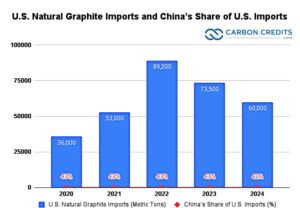
As the chart shows, China has consistently played a major role in supplying graphite to the U.S., especially in high-purity forms used for EVs. But recent policy changes are reshaping this trade.
Tariff Shock: U.S. Takes Aim at Chinese Graphite
The U.S. government recently declared provisional anti-dumping duties of up to 93.5% on imports of Chinese anode-grade graphite. Officials said Chinese exporters were selling graphite in the U.S. at unfairly low prices, which hurt American manufacturers.
These duties could impact up to $347 million in graphite imports each year. The move is part of a broader effort to support domestic production of critical materials and reduce dependence on foreign sources.
While the tariffs aim to protect U.S. businesses, they could also raise costs for American EV and battery makers. Finding new suppliers—or building up local production—will take time and investment, as analysts warn.
China Strikes Back: Export Curbs Escalate the Conflict
China responded by tightening controls on its own exports of graphite and other critical minerals. In late 2024 and early 2025, China added export licenses for tungsten, molybdenum, tellurium, indium, and bismuth, on top of earlier restrictions for gallium and germanium. These materials are important for electronics, chipmaking, and green energy technologies.
By requiring companies to apply for permission to export these minerals, China aims to protect its national security and gain leverage in trade talks. So far, the approval process has slowed shipments, with more than 60% of applications still waiting for clearance.
Together, these actions show that minerals like graphite are becoming tools in the wider strategic competition between the U.S. and China.
Impacts on the EV and Tech Industry: Who’s Getting Hit the Hardest?
This growing tension is having a ripple effect across industries—especially electric vehicles, batteries, and semiconductors. Here’s how this tension impacts the said industries:
- EV Battery Production: Tariffs and export restrictions could raise the price of battery materials, making EVs more expensive to build. Slower or costlier production may hurt efforts to expand EV use across the U.S.
- Clean Energy Transition: Minerals like graphite, gallium, and rare earths are key to making wind turbines, solar panels, and other low-carbon technologies. Any disruption could delay progress toward climate goals.
- Semiconductors and AI Chips: The U.S. has already limited exports of advanced chip technology to China. In return, China is squeezing supplies of gallium and germanium, which are used in chipmaking. This tit-for-tat adds risk to global electronics supply chains.
Many countries are now rushing to diversify their sources and build resilient supply chains. The U.S., for example, is investing in domestic mining and processing, as well as partnerships with countries like Australia and Canada. But rebuilding this infrastructure will take time—often 3 to 5 years or more.
What’s Next in the Mineral Cold War?
Several key events will shape how this trade conflict evolves. Analysts predicted these major ones to occur.
Final U.S. Decision on Tariffs:
The current graphite duties are provisional. A final ruling is expected by December 5, 2025, and could keep or adjust the tariffs based on further review.
China’s Export Licenses:
As China decides which companies can continue exporting key minerals, delays and uncertainty may persist well into 2026.
Negotiations and Trade-Offs:
There is still room for dialogue. For example, recent reports suggest the U.S. may allow chipmakers like Nvidia to sell some AI chips to China in exchange for cooperation on rare earth exports.
This back-and-forth could continue for years. But both sides are now deeply focused on economic security, especially in strategic industries like batteries, semiconductors, and clean energy.
Beyond Batteries: How Minerals Shape Global Power Plays
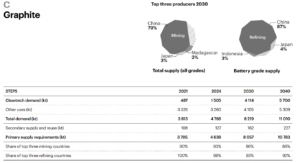
Graphite may seem like just another material, but it plays a big role in shaping the future of transportation and technology. For now, China leads the global market in graphite production and processing, both in 2024 and in 2030, as predicted by the IEA. The U.S., facing a supply risk, is using tariffs and domestic investments to try to close the gap.
At the same time, companies are watching closely. Automakers, battery makers, and tech giants all depend on stable access to key minerals. The next few years will show whether governments can build secure supply chains. Or whether trade tensions will disrupt the path to a cleaner, more connected world.
- FURTHER READING: DOE Supercharges the U.S. Battery and Critical Minerals Industry with $3 Billion Boost
The post US–China Trade Tensions Heat Up Over Graphite and EV Battery Supply Chains appeared first on Carbon Credits.

EU carbon credit claims changed on 27 September 2026, the day the Directive (EU) 2024/825 began to apply across the European Union. The change is narrow. It changes how a company can talk about the credits it buys. A product can no longer be called neutral on the strength of compensation alone; however, every specific, evidenced statement about what a company measured, reduced, and funded stays fully available.

The post Promoting Improved Cooking Practices in Nigeria appeared first on Terrapass.



-
Climate Change1 year ago
Guest post: Why China is still building new coal – and when it might stop
-

 Greenhouse Gases2 years ago
嘉宾来稿:满足中国增长的用电需求 光伏加储能“比新建煤电更实惠”
-
Greenhouse Gases1 year ago
Guest post: Why China is still building new coal – and when it might stop
-

 Climate Change2 years ago
嘉宾来稿:满足中国增长的用电需求 光伏加储能“比新建煤电更实惠”
-

 Renewable Energy12 months ago
Sending Progressive Philanthropist George Soros to Prison?
-
Climate Change2 years ago
Bill Discounting Climate Change in Florida’s Energy Policy Awaits DeSantis’ Approval
-
Greenhouse Gases1 year ago
嘉宾来稿:探究火山喷发如何影响气候预测
-

 Climate Change2 years ago
Analysis: China’s CO2 falls 1% in Q2 2024 in first quarterly drop since Covid-19