

An Lambrechts is a biodiversity politics expert at Greenpeace International with extensive experience in biodiversity-related multilateral negotiations. She is the head of the Greenpeace delegation at the Convention on Biological Diversity (CBD) COP17 happening in Yerevan, Armenia.
In 2022, COP15 delivered the landmark Kunming-Montreal Global Biodiversity Framework to halt and reverse biodiversity loss by 2030. With COP17 starting in Yerevan, we are now halfway to the deadline, and according to the first Global Review of progress, countries are not on track to meet the biodiversity targets, and implementation must accelerate fast.
One of the main findings of the Global Review is that funding falls far short of the scale needed to halt and reverse nature loss. But the crisis facing the world’s biodiversity is not an absolute scarcity of capital – it is a profound public policy distortion.
The global economy currently spends roughly $30 destroying nature for every single dollar invested in its protection. According to a report from the Intergovernmental Science-Policy Platform on Biodiversity and Ecosystem Services, a staggering $2.4 trillion is spent in public subsidies for fossil fuels, agriculture and water use, while global investment in biodiversity conservation and restoration stands at a mere $220 billion.
Countries urged to ramp up “insufficient” nature policies at COP17
Yet, discussions about how to close the biodiversity finance gap continue to claim that salvation lies in mobilising private capital, scaling offsets and “derisking” investments in nature. This is a fundamental misunderstanding of both the nature of ecological stewardship and of the global financial architecture.
Biodiversity conservation is not a speculative investment portfolio – it is the foundation of human survival. The health of our planet is a non-monetisable, non-excludable public good. Expecting profit-seeking private capital to protect nature perpetuates the structural drivers of ecosystem destruction in the first place.
But if private market mechanisms cannot save biodiversity, where will the necessary public resources come from?
Money going to the wrong places
The answer lies in recovering the vast public wealth currently drained by cross-border tax abuse, financial secrecy and corporate impunity. Finance and environment ministers meeting in Yerevan must give a strong political signal that, to avert ecological breakdown, countries need to take swift action to reform global tax rules, eliminate harmful public subsidies and cancel unsustainable sovereign debts for the public revenues to end up where they belong.
Extractive sectors such as industrial agriculture, fishing, timber and mining continue business-as-usual, often heavily subsidised by public treasuries, while voluntary carbon and biodiversity offset markets pose a serious risk to nature conservation. Offset schemes have delivered only a negligible fraction of the funding needed to preserve ecosystems, allowing industries to continue with their destructive business-as-usual practices.
-
Global deforestation slowed in 2025 but Brazil’s election could undo “fragile” gains
Countries remain 70% off track to meet a goal to end deforestation by 2030, as progress in Latin America offset by failures in Africa -
Brazil confident new rainforest fund will reach $10bn donor milestone
Brazil’s environment minister said the Tropical Forest Forever Facility has raised billions in record time – which he hopes will convince more investors


In advanced economies, public funding often actively undermines biodiversity. In Europe, over €5.3 billion in public subsidies is funnelled annually into intensive forest biomass harvesting under renewable energy directives, degrading primary forest ecosystems and undermining long-term climate resilience. Pleading with private investors to fill a “finance gap” while pouring billions into ecological destruction is an exercise in futility.
Developing countries struggle with debt burden
For developing countries, reliance on private finance is further compounded by a crushing sovereign debt crisis. In 2024, public debt in developing economies reached record levels, with net interest payments alone absorbing $921 billion. A record 61 developing countries now spend more than 10% of government revenue on foreign debt service, with many climate-vulnerable nations spending twice as much servicing external debt as they receive in climate and biodiversity finance combined.
This burden acts as a structural driver of ecosystem destruction. Under pressure from external creditors and international financial institutions to avoid default and secure foreign exchange, governments are routinely forced into austerity measures and pushed to expand raw commodity exports into pristine biomes.
Comment: World Bank and IMF should lead the financial system in responding to the climate crisis
The current negotiations for a United Nations Framework Convention on International Tax Cooperation (UNFCITC) also offer a way forward. An estimated $492 billion in tax revenue is lost every year to offshore tax havens. Multinational corporations account for around $348 billion of this total by shifting profits away from the countries where real economic extraction and environmental degradation occur.
In the mining sector alone, developing nations lose tens of billions annually to corporate tax dodging. Furthermore, international financial secrecy shields environmental criminals, with illicit financial flows from illegal logging draining between $51 billion and $152 billion annually.
At COP17, leaders must seize the opportunity to build a bridge between the two conventions and enhance cooperation. Governments must put the world on a firm path to securing predictable, sufficient, sovereign public finance for biodiversity conservation. It’s the only path to a restorative, rights-based future for people and the planet.
The post Protecting nature is a public duty, not a Wall Street profit opportunity appeared first on Climate Home News.
Protecting nature is a public duty, not a Wall Street profit opportunity

Climate Change
Albanese must deliver credible action to end fossil fuel chokehold, not just rhetoric
ANTALYA,Türkiye, Thursday 12 November 2026 — In response to Prime Minister Albanese’s COP31 Leaders’ Summit address, Shiva Gounden, Head of Pacific at Greenpeace Australia Pacific, speaking from Antalya said:
“Prime Minister Albanese’s COP31 address was full of nice rhetoric, but once again failed to confront or even mention the root cause of the climate crisis — fossil fuels.
“In Antalya, UN climate chief Guterres told leaders to “tell the truth”. The truth is Australia can not credibly talk about its clean energy transition while continuing to expand the industry it needs to leave behind. Australia must reckon with reality; its damning track record of 38 coal and gas approvals since it took office in 2022.
“We meet in Antalya amidst a global energy shock and dire projections of 1.5°C overshoot. Overshoot means something in the Pacific — it means irreversible harm, lives and cultures lost forever, entire nations at stake. We must face the fierce urgency of now.
“Never before has the need to end the fossil fuel chokehold been so abundantly clear, as our Pacific communities again suffer the consequences of a global economy hooked on coal, oil and gas. The Pacific needs credible roadmaps and clear timelines to unhook from fossil fuels — Australia can’t keep saying implementation and not reflect it with credible action.”
ENDS
COP31 images and video available here in Greenpeace Media Library
Media contact: Kate O’Callaghan in Antalya (GMT+3) on +61 406 231 892 (Whatsapp/Signal)
Albanese must deliver credible action to end fossil fuel chokehold, not just rhetoric
A second set of world leaders give their speeches on Thursday before heading out of town and leaving their negotiators to it. After around 40 leaders spoke on Wednesday, today there will be just 25 or so including the UK’s Andy Burnham, Venezuela’s Delcy Rodriguez and Bangladesh’s Tarique Rahman.
But Brazil’s President Lula is still there and is expected to keep grabbing headlines, along with California’s Governor – and maybe next US president – Gavin Newsom – and Swedish climate activist Greta Thunberg who has lost none of her star power, if the crowd around her in the press centre was anything to go by.
We’ll bring you highlights through the day on issues ranging from finance to methane, and update you on a pledging event for the Pacific Resilience Facility, which the climate-vulnerable region is relying on to keep small island nations as safe as possible in the face of intensifying storms, drought and sea level rise.
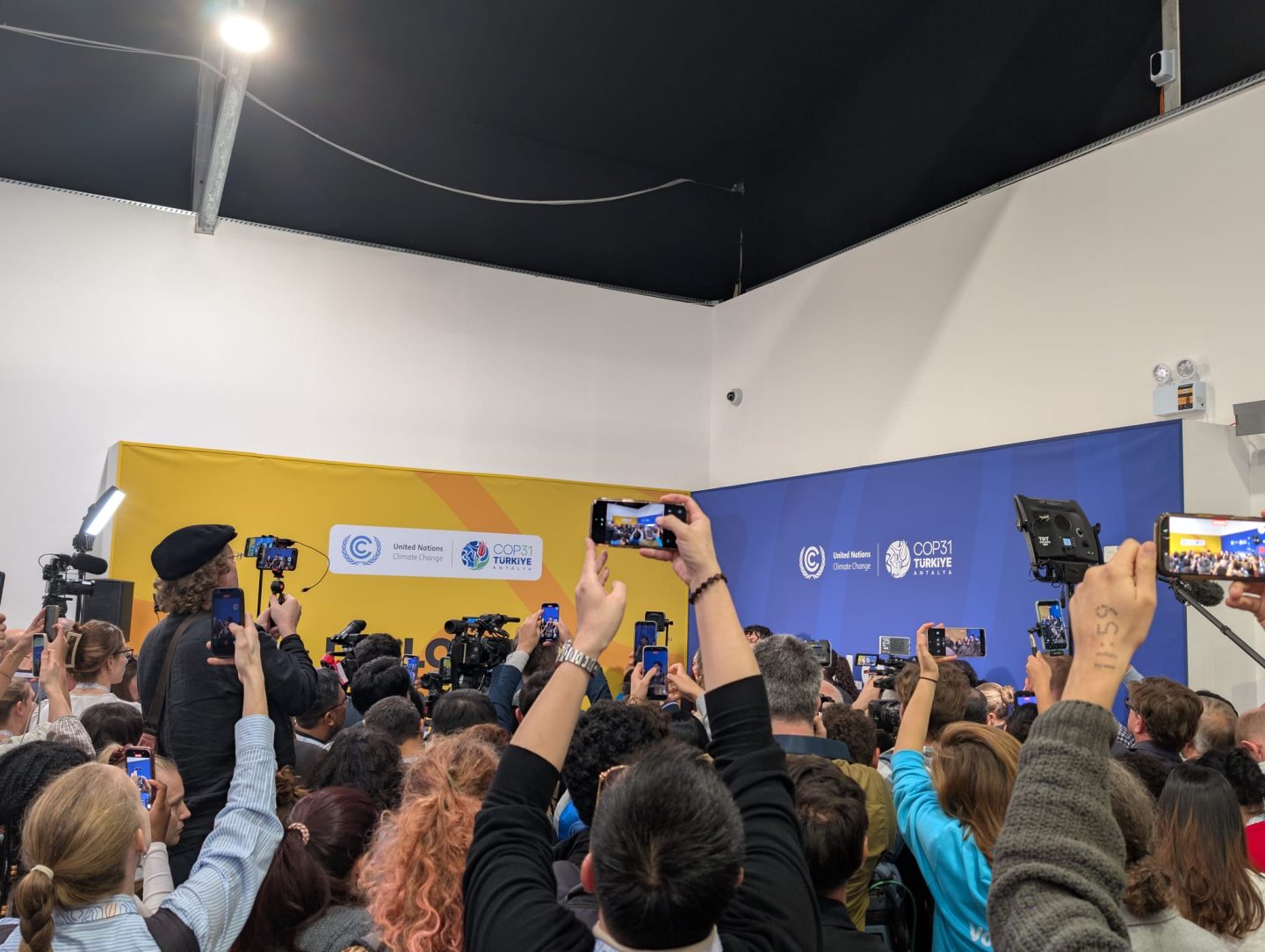
The post COP31 Bulletin Day 4: Burnham speaks with UK climate policy under fire appeared first on Climate Home News.
COP31 Bulletin Day 4: Burnham speaks with UK climate policy under fire
Climate Change
Australia must ‘pull all available levers’ to deliver fossil fuel phase out, following Albanese’s COP31 address
ANTALYA, Türkiye, Wednesday 11 November 2026 — In response to Prime Minister Albanese’s COP31 Leaders’ Summit address, Dr Susie Byers, Head of Advocacy at Greenpeace Australia Pacific, speaking from Antalya said:
“Prime Minister Albanese’s Leaders’ Summit address emphasised the power and clarity of Pacific climate leadership and that we must all fight to return warming to below 1.5°C. To inject the momentum these talks critically need, Australia must lead by example.
“Australia takes the reins of the COP31 talks at a critical moment where global instability can spark transformative change, or entrench more of the same inaction and paper pledges. Australia must pull all available levers over the next two weeks, taking the baton from Brazil and sprinting forward.
“The world’s most important job in Antalya is to deliver tangible action to end the fossil fuel era. Communities in Australia, the Pacific and around the world who are grappling with climate disasters and a cost of living crisis need concrete dates and credible plans. We know the transition is coming, one way or another. Our Government has a responsibility to make a plan for this change, which is based on the best available science, and a commitment to put people, energy security and our environment ahead of fossil fuel profits.
“In his address, UN climate chief Guterres told leaders to “tell the truth”. Prime Minister Albanese told an important truth today: that we all have solemn responsibilities to return warming to below 1.5°C. We also know that the best way for Australia to lead through this summit is to start by making its own commitments to turn the temperature down, by stopping developing and exporting fossil fuels.
“Australia’s domestic progress on renewables, and the ‘35 by 35’ electrification goal, are welcome and important. Now we must ensure electricity comes from clean, renewable sources that actually displace fossil fuels and align with the science of 1.5°C.
“The pressure on Australia is building. COP31 must deliver real action to advance multilateral climate cooperation, accelerate the just transition away from fossil fuels, and advance Pacific priorities — including significantly scaling-up climate finance and keeping 1.5°C alive.”
ENDS
COP31 images and video available here in Greenpeace Media Library
Media contact: Kate O’Callaghan in Antalya (GMT+3) on +61 406 231 892 (Whatsapp/Signal)



-
Climate Change1 year ago
Guest post: Why China is still building new coal – and when it might stop
-
Greenhouse Gases1 year ago
Guest post: Why China is still building new coal – and when it might stop
-

 Greenhouse Gases2 years ago
嘉宾来稿:满足中国增长的用电需求 光伏加储能“比新建煤电更实惠”
-

 Climate Change2 years ago
嘉宾来稿:满足中国增长的用电需求 光伏加储能“比新建煤电更实惠”
-

 Renewable Energy1 year ago
Sending Progressive Philanthropist George Soros to Prison?
-
Greenhouse Gases1 year ago
嘉宾来稿:探究火山喷发如何影响气候预测
-

 Climate Change2 years ago
Analysis: China’s CO2 falls 1% in Q2 2024 in first quarterly drop since Covid-19
-
