


Uranium Energy Corp (NYSE:UEC) reported its fiscal 2025 results, showing revenue of $66.84 million. This fell short of Wall Street’s $77.2 million estimate. The company also recorded a net loss of -$0.20 per share, slightly above the expected -$0.18.
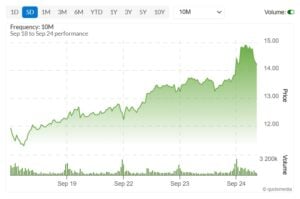
Despite this earnings miss, UEC shares rose 1.66% in pre-market trading. Investors were encouraged by the company’s operational progress, strategic acquisitions, and strong balance sheet. UEC is positioning itself as a key player in the U.S. effort to rebuild its nuclear fuel supply chain.
UEC Stock Performance
Uranium Energy Corp’s Financial Strength and Uranium Ramp-Up
UEC’s financial highlights indicate a focus on future growth:
-
Revenue: $66.8 million, driven by 810,000 pounds of uranium sold at an average price of $82.52 per pound in the first half of fiscal 2025.
-
Gross Profit: $24.5 million from uranium sales.
-
Inventory Build: As of July 31, 2025, the company held 1.36 million pounds of uranium valued at $96.6 million. Another 300,000 pounds will be added through contracts at $37.05 per pound by December 2025.
-
Balance Sheet: UEC closed the year with $321 million in cash, inventory, and equities, with no debt.
The press release says UEC is fully unhedged, which maximizes its exposure to rising uranium prices. This approach enabled opportunistic sales earlier this year and helped grow inventory for future contracts, including possible sales to the U.S. Uranium Reserve.
Notably, at Christensen Ranch in Wyoming, two new in-situ recovery (ISR) mine units began operations. This will boost production in the Powder River Basin. In Texas, construction at Burke Hollow is 90% complete. Operations are set to start by December 2025.
Expanding U.S. Uranium Assets: Sweetwater Acquisition
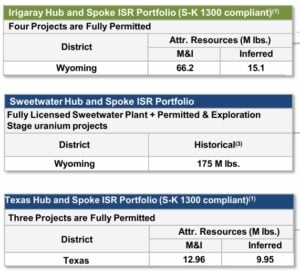
In 2025, UEC boosted its position by buying Rio Tinto’s Sweetwater Plant and Wyoming assets for $175 million. The deal added about 175 million pounds of historic resources and a processing plant capable of producing 4.1 million pounds annually.
The U.S. government granted Sweetwater a FAST-41 designation under President Trump’s March 2025 order to speed up critical mineral projects. This lets UEC fast-track ISR permitting. The acquisition also gave UEC over 6.1 million feet of historic drilling data, multiple permitted mines. It included Sweetwater, Big Eagle, and Jackpot, and saved time and costs by upgrading the existing plant.
The move strengthens UEC’s role as the uranium company with the largest and most diverse resource base in the Western Hemisphere.
Roughrider Pre-Feasibility Study Advances in Canada
Outside the U.S., UEC advanced its Roughrider Project in Saskatchewan’s Athabasca Basin, known for its rich uranium deposits.
In fiscal 2025, the company:
-
Completed metallurgical tests, including solvent extraction and yellowcake precipitation.
-
Launched a pre-feasibility study (PFS) to advance this high-grade project.
-
Sought proposals for technical reporting on the project.
Roughrider highlights UEC’s strategy to balance U.S. assets with opportunities in Canada’s uranium basin, enhancing its long-term growth potential.
Launch of U.S. Uranium Refining & Conversion Corp
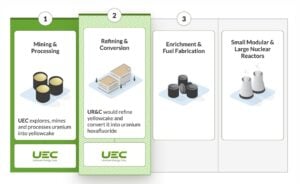
In a strategic step, UEC launched the United States Uranium Refining & Conversion Corp (UR&C), a wholly owned subsidiary. This initiative aims to make UEC the only vertically integrated U.S. uranium company, covering mining, processing, refining, and conversion.
The facility will produce Uranium Hexafluoride (UF₆), essential for both traditional nuclear reactors and next-generation small modular reactors (SMRs).
UEC’s refining and conversion plans align with U.S. policy under the Defense Production Act, which seeks to strengthen the American nuclear fuel supply chain. Early discussions with federal and state energy authorities, utilities, and investors are already in progress.
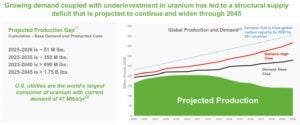
U.S. Nuclear Policy and AI Power Demand Boost Outlook
UEC’s Path to Cleaner Uranium and Biodiversity Protection
In 2025, UEC’s sustainability efforts received a Sustainalytics rating of 23.8, placing it in the top 5% of the Diversified Metals and Mining subindustry.
Greenhouse Gas Emissions
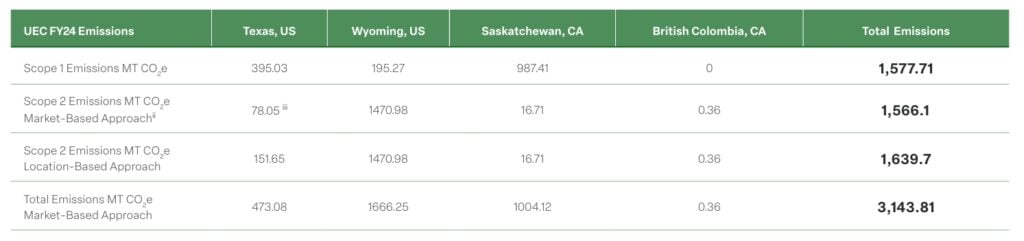
UEC’s company-wide GHG emissions for FY24 totaled 3,143.81 MT CO₂e. It invested over $400,000 in R&D for decarbonization and mine design, and enhanced scenario planning to better manage climate risks.
Its decarbonization efforts include:
- Saskatchewan & Wyoming: Expanded decarbonization studies, explored renewable energy, electric and hybrid vehicles, and renewable diesel for heavy equipment.
- Energy Efficiency: Cut fuel use 30% with efficient drills, added LED lighting, VFDs, and a garbage compressor; procured 73.6 MT CO₂e in RECs at Palangana.
- Texas & Wyoming: At Roughrider, optimized energy use, lowered emissions, reduced waste, and increased hydroelectric power.
A Larger Share: Scope 3 Emissions:
UEC’s Scope 3 study revealed that the majority of the company’s value chain emissions—around 91%—originate from Category 10: Processing of Sold Products.
This category covers all processes the uranium undergoes after the sale of yellowcake, including conversion, enrichment, and fuel fabrication. Total Scope 3 GHG emissions amounted to 336,801 MTCO₂e.
Biodiversity and Reclamation
The uranium miner is dedicated to reclaiming all land impacted by ISR activities. It has allocated over $27 million for reclamation in Texas and Wyoming. The company also avoids exploration in World Heritage sites and protected areas. This aligns with global biodiversity standards.
Thus, from the Sweetwater acquisition and Roughrider development to launching UR&C, Uranium Energy Corp is creating a fully integrated uranium supply chain while cutting emissions and protecting biodiversity. And lastly, with AI-driven energy demand and strong U.S. nuclear policies, UEC is poised to lead the clean, carbon-free power transition in America.
The post Uranium Energy Corp (UEC) Reports $66.8M Revenue in 2025, Expands U.S. Nuclear Supply Chain and Sustainability Goals appeared first on Carbon Credits.

EU carbon credit claims changed on 27 September 2026, the day the Directive (EU) 2024/825 began to apply across the European Union. The change is narrow. It changes how a company can talk about the credits it buys. A product can no longer be called neutral on the strength of compensation alone; however, every specific, evidenced statement about what a company measured, reduced, and funded stays fully available.

The post Promoting Improved Cooking Practices in Nigeria appeared first on Terrapass.



-
Climate Change1 year ago
Guest post: Why China is still building new coal – and when it might stop
-

 Greenhouse Gases2 years ago
嘉宾来稿:满足中国增长的用电需求 光伏加储能“比新建煤电更实惠”
-
Greenhouse Gases1 year ago
Guest post: Why China is still building new coal – and when it might stop
-

 Climate Change2 years ago
嘉宾来稿:满足中国增长的用电需求 光伏加储能“比新建煤电更实惠”
-

 Renewable Energy12 months ago
Sending Progressive Philanthropist George Soros to Prison?
-
Climate Change2 years ago
Bill Discounting Climate Change in Florida’s Energy Policy Awaits DeSantis’ Approval
-
Greenhouse Gases1 year ago
嘉宾来稿:探究火山喷发如何影响气候预测
-

 Climate Change2 years ago
Analysis: China’s CO2 falls 1% in Q2 2024 in first quarterly drop since Covid-19