Developing countries are receiving just a fraction of the international finance they need to prepare citizens and adapt infrastructure for escalating climate impacts.
That is according to the latest adaptation gap report from the UN Environment Programme (UNEP), which calculates that developing nations will need more than $310bn annually between now and 2035 to prepare for the impacts of climate change.
And yet, in 2023, developed nations provided just $26bn in international adaptation finance to developing nations, according to the report.
UNEP warns that, under current trends, developed nations are on track to miss their goal – agreed at the COP26 climate summit in Glasgow – of doubling 2019 international adaptation finance by 2025.
It cautions that countries’ more recent climate-finance pledge for 2035 – the new collective quantified goal (NCGQ) – will be “insufficient” to meet adaptation finance needs.
The UN report – entitled, “Running on empty: The world is gearing up for climate resilience without the money to get there” – also explores how countries are integrating adaptation priorities into national climate plans, policies and practices.
It finds that 87% of countries have at least one national adaptation plan or strategy in place, but warns that gaps remain in the implementation of measures.
Inger Andersen, the executive director of UNEP, says: “Even amid tight budgets and competing priorities, the reality is simple: if we do not invest in adaptation now, we will face escalating costs every year.”
Below, Carbon Brief summarises some of the key takeaways from the report.
- Developed countries are on track to miss their 2025 adaptation finance goal
- Developing nations’ adaptation finance needs are 12 times greater than current flows
- A majority of countries have a national adaptation plan or strategy in place
- Implementation of adaptation measures is progressing – but gaps remain
- The NCQG is insufficient on its own to meet adaptation finance needs
Developed countries are on track to miss their 2025 adaptation finance goal
Climate change adaptation refers to a range of measures that reduce society’s and infrastructure’s vulnerability to climate change, from planting crop varieties that can withstand greater heat through to building stronger defences against floods.
Spending from the public funds of developed nations is a key source of finance for these actions in developing nations, especially for low-income countries that are vulnerable to climate impacts.
Under Article 9 of the Paris Agreement, developed countries agreed to achieve a “balance” in the amount of climate finance raised for emissions reduction and adaptation. However, more money has been raised for cutting emissions than preparing for climate impacts.
UNEP’s adaptation gap report notes that, in 2023, the amount of public money channelled to developing countries from richer nations for adaptation measures fell.
In total, developed countries raised $25.9bn in international adaptation finance – marking a decline on the $27.9bn recorded in 2022.
The report authors attribute the fall to a decline in funding from multilateral development banks, such as the World Bank, which provided more than half – 57% – of international adaptation finance.
The table below shows how adaptation finance provided by developed countries for developing countries (orange) dipped in 2023 – despite an uptick in climate finance as a whole.
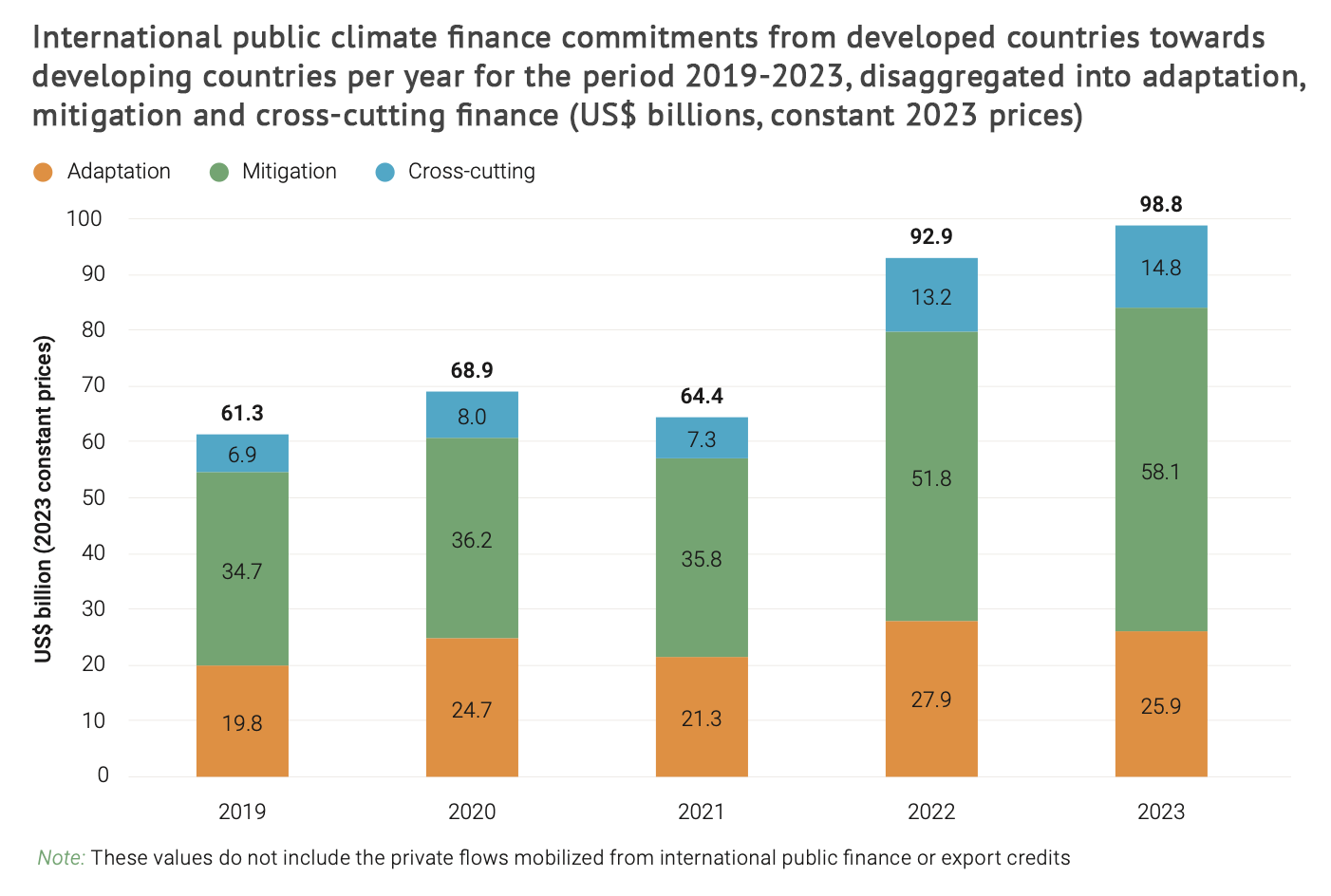
The UN warns that, if current trends continue, developed nations are set to miss their goal of doubling 2019 adaptation finance flows by 2025.
This goal – set out in the Glasgow Climate Pact agreed at the COP26 climate summit in 2021 – commits developed nations to providing $40bn in adaptation funding for developing nations by 2025.
Official climate-finance figures from the Organisation for Economic Co-operation and Development (OECD) for 2025 will not be available for several years. However, the report notes that, over 2019-23, international adaptation finance grew at a compound rate of 7% – falling short of the 12% rate required to meet the Glasgow Climate Pact goal.
Cuts to international aid budgets since 2023 are also threatening the Glasgow Climate Pact goal, according to the report authors. They note that, globally, foreign aid fell by 9% in 2024 and predict that reductions announced in 2025 are “likely” to lead to a further 9-17% decline.
Meanwhile, countries’ more recent pledge to help raise $300bn a year by 2035 for both tackling and adapting to climate change – set out in the new collective quantified goal for climate finance (NCQG), agreed last year at COP29 in Baku – is also under threat, according to the report.
In the introduction of the report, UNEP’s Anderson writes:
“While the numbers for 2024 and 2025 are not yet available, one thing is clear: unless trends in adaptation financing do not turn around, which currently seems unlikely, the Glasgow Climate Pact goal will not be achieved, the NCQG will not be achieved and many more people will suffer needlessly.”
‘Adaptation investment trap’
The report also breaks down international adaptation finance in 2023 by funding type. It finds that that 70% was either grants, which allow countries to address climate impacts without exacerbating debt, or “concessional” loans, which are provided at below market rate.
However, it notes that “non-consessional” finance – which is provided at, or near, market rates – is on the rise, growing at an annual compound rate of 7% over 2019-23. In 2023, non-concessional loans exceeded concessional ones for the first time, the report notes.
The “increasing proportion” of non-concessional finance raises “long-term affordability and equity” concerns, the authors warn. They also point to the risk of an “adaptation investment trap” – whereby rising climate disasters increase developing countries’ “indebtedness”, which subsequently makes it harder for them to invest in adaptation.
The report also finds that loans and other forms of “debt instruments” comprised “58% on average” of international adaptation finance in 2022-23.
The NCQG text highlights the need for “concessional” and “non-debt creating” finance.
(This came after strong calls from many developing countries to exclude “non-concessional” loans – which result in wealth flowing back to the donor countries as loan repayments and interest – as a form of climate finance. Analysis has shown that many developing countries are spending more on servicing debts than they receive in climate finance.)
Elsewhere, the authors also find that funding for new adaptation projects through UN Framework Convention on Climate Change (UNFCCC) funds (the adaptation fund, green climate fund (GCF) and the least developed countries fund (LDCF) and special climate change fund (SCCF) managed by the Global Environment Facility) saw a “large spike” in 2024, with grants reaching around $920m.
However, they note that the recent increase “may not be a trend, with financial constraints likely to rise beyond 2025”.
Developing nations’ adaptation finance needs are 12 times greater than current flows
While previous UN adaptation gap reports have investigated adaptation finance shortfalls through to 2030, this latest analysis extends its estimates through to 2035.
This is in light of the NCQG, which states that developed countries should “take the lead” in raising “at least $300bn” a year for climate action in developing countries by 2035.
The report calculates that the costs of adaptation by 2035 for developing countries sit in a “plausible central range” of $310-365bn annually. It explains that it has arrived at this range based on “two lines of evidence”:
- A modelled estimate of the additional costs of adaptation, calculated using “global sectoral models with national-level resolution”. This exercise pins the cost of adaptation for developing countries at $310bn a year by 2035 under an intermediate emissions scenario.
- An analysis of the climate finance needs set out by developing countries in 97 national adaptation plans and nationally determined contributions (NDCs) submitted to the UNFCCC – with “extrapolation” of this data to all 155 developing countries. This results in the upper figure of $365bn per year up to 2035.
The chart below shows the disparity between existing finance flows (dark blue bar) and adaptation finance needs and modelled costs (red bars).

With current levels of international adaptation finance estimated at $26bn a year, the report calculates that developing countries are facing an “adaptation finance gap” in the range of $284-339bn per year by 2035.
As such, it calculates that the adaptation finance needs of developing countries by 2035 are “12-14 times” as much as current finance flows.
Of the public adaptation finance that has been issued, a higher proportion currently goes to the countries most exposed to climate hazards, according to the report. It notes that, in 2022-23, $10.4bn and $1.2bn was allocated to least-developed countries (LDCs), including Afghanistan and Rwanda, and small island developing states (SIDS), such as Tuvalua and the Marshall Islands, respectively.
Nevertheless, finance provided to these climate-vulnerable nations is still “modest relative to needs”, the report warns. It estimates that the adaptation finance needs of LDCs and SIDS are $50bn a year.
It also finds that per-capita adaptation finance to both country groups was lower in 2022-23 than previous years, at $9 for LDCs and $20 in SIDs.
A majority of countries have a national adaptation plan or strategy in place
Under the framework for the global goal on adaptation agreed at COP28, countries said they would put in place “national adaptation plans, policy instruments and planning processes and/or strategies” by 2030.
To assess the “global status” of national adaptation planning, the authors of the report tracked the publication of national plans, strategies and policies for adaptation in each country.
According to the report, the first national adaptation policy was published in 2002. It finds that there was a “notable acceleration” in countries developing national adaptation planning instruments over 2011-21, but says that, since then, progress has “slowed significantly”.
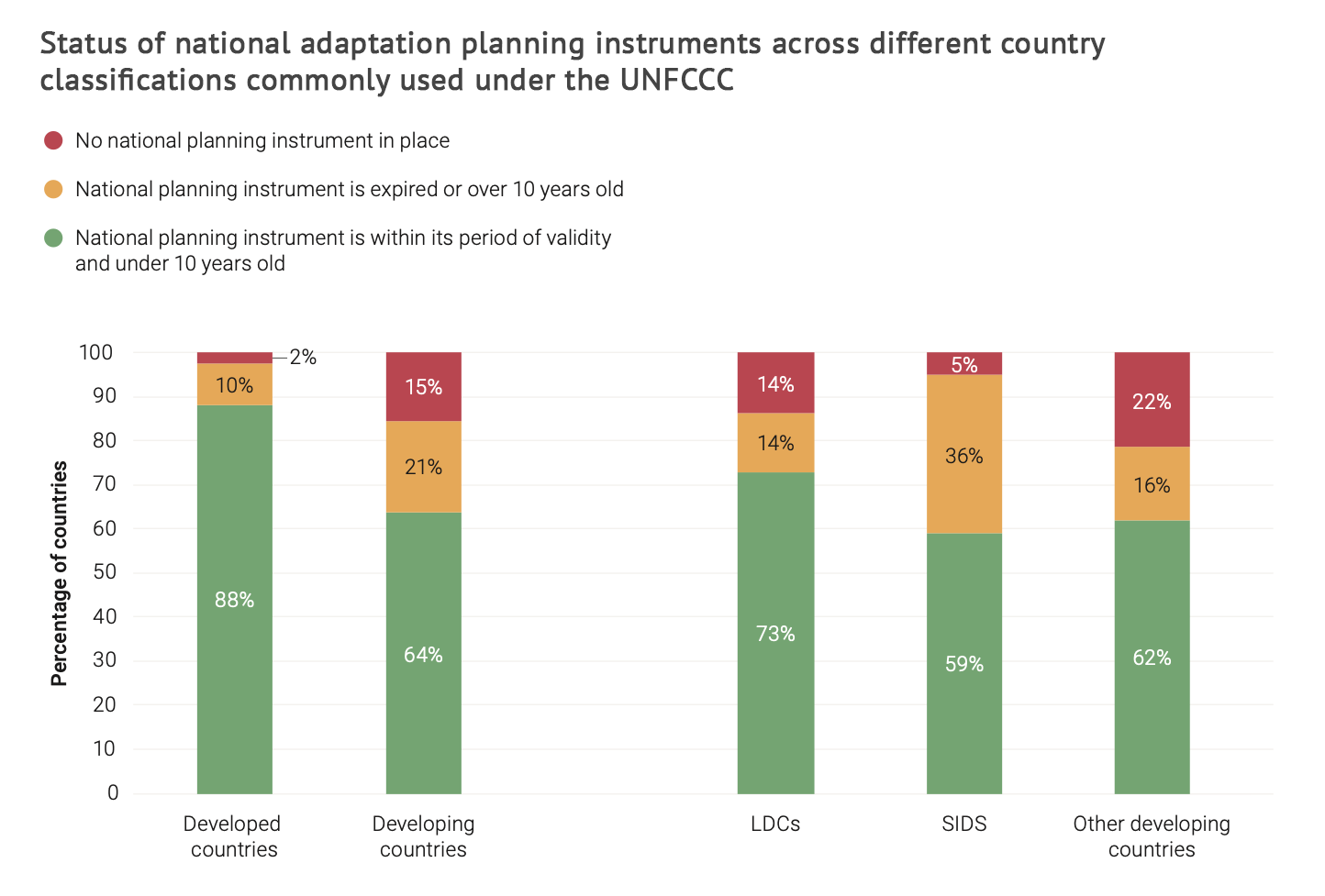
According to the report, 87% of countries had at least one national adaptation policy, strategy or plan in place as of 31 August 2025. However, 36 of these 172 countries’ plans are “expired” or “outdated”.
Meanwhile, 25 countries had no national adaptation plan at all, according to the report. It explains that these are “predominantly developing countries, suggesting that financial, technical and human resource constraints inhibit national adaptation planning”.
Of these countries without plans, 21 have “initiated a process to develop” a national adaptation plan, according to the report. However, it notes that many of these countries have “been in this process for a long time”.
The chart below shows the percentage of countries from different “country classifications” that have no national adaptation planning instrument in place (red), an expired adaptation planning instrument in place (yellow) and a valid instrument in place (green).
The report also discusses different types of adaptation “mainstreaming”. This is defined by the report authors as the “integration of adaptation objectives and climate risk considerations into the established functions, policy and practice of government institutions to build climate resilience”.
The authors list six different mainstreaming strategies. For example, “directed” mainstreaming means “dedicating funding, staff capacity-building and resources specifically to adaptation, including through financial frameworks and fiscal processes such as budget planning”.
Another example is “regulatory mainstreaming”, which means “modifying the formal or informal policy instruments such as legislation, frameworks, strategies and plans by integrating adaptation”.
According to the report, only regulatory mainstreaming is captured by the framework for the global goal on adaptation’s target related to planning.
The report also outlines the different “levels” of mainstreaming. These range from “prioritisation”, which it describes as a strong level of mainstreaming in which adaptation takes precedence over existing policy goals, to “coordination”, in which adaptation “is recognised as a policy goal, but is secondary to existing priorities”.
However, the report says there is “presently no agreement on how to measure and assess the outcomes of mainstreaming”.
Implementation of adaptation measures is progressing – but gaps remain
Under the UN “enhanced transparency framework”, countries are required to submit information about their climate progress in biennial transparency reports (BTR). The first report was due at the end of 2024.
The adaptation gap report calls BTRs the “most comprehensive national source of information on adaptation implementation worldwide available”.
The report says that 105 countries had submitted BRTs as of 31 August 2025, of which 94 include details about adaptation
The authors find that 75 of these BTRs mention gender in relation to adaptation. However, only 4% of the results reported through BTRs are directly related to “gender and social inclusion”.
The report also highlights the “uneven coverage” of BTRs globally. According to the report, 88% of developed countries have submitted a BTR, compared to only 37% of developing countries.
It adds that there are further inequalities within the bracket of “developing countries”. Only 21% of SIDS and 14% of LDCs have submitted BTRs with “detailed information on climate impacts and adaptation”, according to the report.
This could “indicate that preparing national reports such as BTRs is most burdensome for the countries with the least capacity”, the report authors suggest.
The map below shows the countries that have submitted a BTR including “detailed information on climate impacts and adaptation” (blue) and those that have not (grey). For the former category, darker blue indicates that the country’s BTR includes more segments of text (data points) about climate impacts and adaptation.
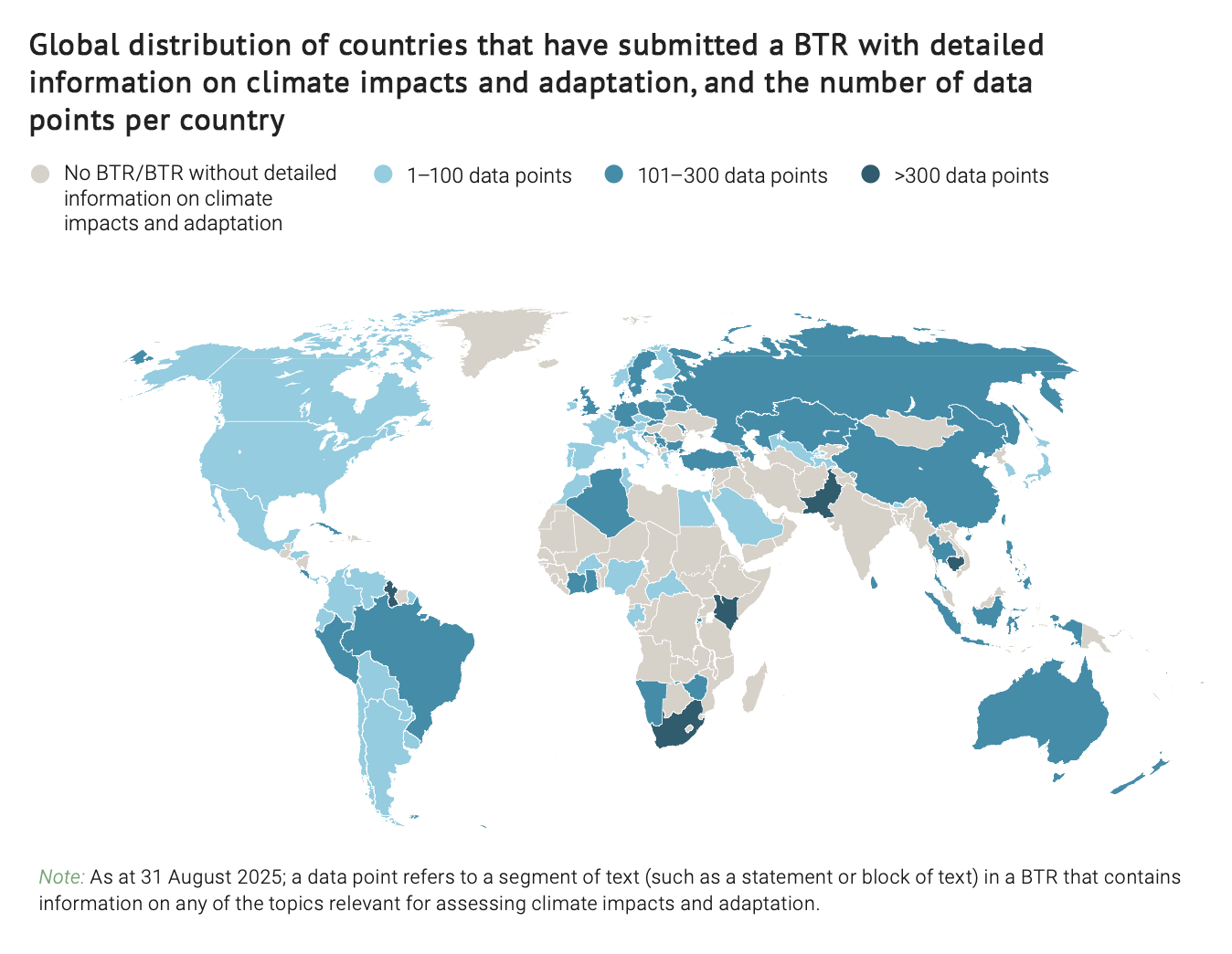
The report finds that countries are “disproportionately reporting on climate hazards, systems at risk, climate change impacts and adaptation priorities” in BTRs. Meanwhile, only 15% and 7% of the data points in the map above discuss adaptation “actions” and “results” respectively.
In total, the report identifies 1,640 “adaptation actions” across 68 BTRs. It says that 23% of these are related to “biodiversity and ecosystems”, 18% to “infrastructure and human settlements”, 16% to “water and sanitation” and 14% to “food and agriculture”.
However, it finds that actions targeting health and poverty alleviation or livelihoods are each accounting for only 5%, while those addressing cultural heritage are “nearly absent” and account for less than 1% of all reported actions.
In a separate analysis, the report explores documents submitted by developing countries to the UNFCCC to understand how adaptation needs break down by sector. It finds that the 55 plans submitted by developing countries which include “detailed sectoral information” reveal that the agriculture and food sector and water supply are “common priorities across all regions, though they vary in terms of their relative importance”.
The NCQG is insufficient on its own to meet adaptation finance needs
At COP29 last year, developed nations pledged to raise at least $300bn per year under the NCQG for both mitigation and adaptation.
The report says that, although the target “appears significantly higher than the previous goal for developed countries to mobilise $100bn by 2020 for developing countries”, it is still “clearly insufficient” to meet adaptation finance needs in 2035.
The report sets out two reasons for this.
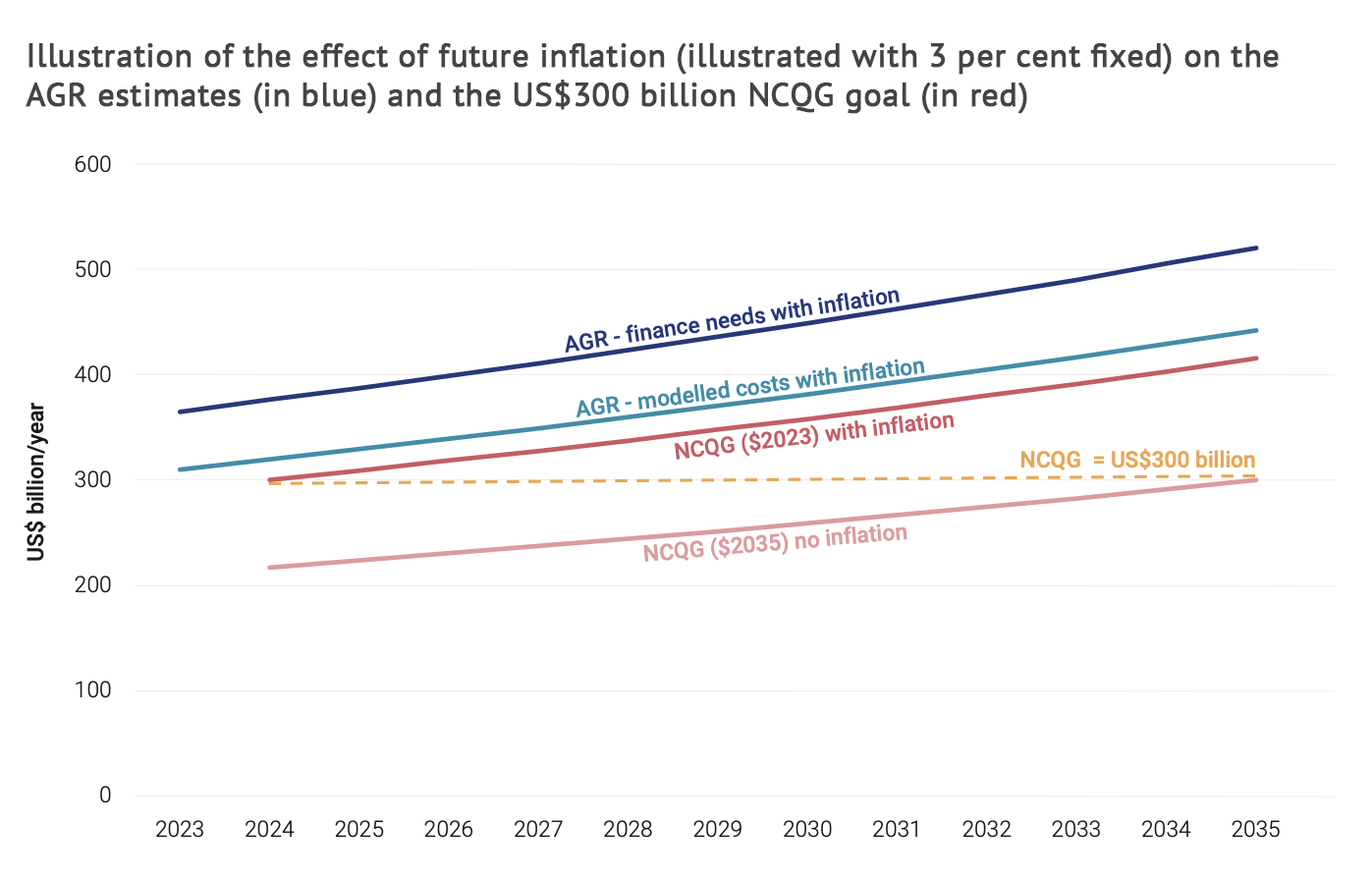
First, the authors explain that the $300bn target is not adjusted for inflation. It says that adaptation costs for developing countries are currently estimated at $310-365bn annually until 2035, based on costs in 2023. However, when adjusting for an inflation rate of 3% per year for the next decade, this number rises to US$440–520bn by 2035.
(In an analysis published last year, Carbon Brief noted that the $300bn target does not account for inflation.)
The plot below shows the effect of inflation on adaptation finance needs (dark blue) and modelled costs (light blue). It also shows the NCQG goal, accounting for inflation, based on 2023 costs (red) and without inflation based on 2035 costs (pink). It also shows the NCQG goal of $300bn by 2035 (yellow).
Second, it notes that the NCQG covers both mitigation – namely, efforts to cut emissions – and adaptation. So far, it warns that no “subgoal” has been agreed to determine how much money goes to each.
The report authors have also developed two scenarios exploring how much the NCQG would bridge the adaptation finance gap, if the $300bn target is met, both of which account for inflation. These are:
- A “minimum adaptation scenario”. The authors assume that 26% of the NCQG money will be used for adaptation finance as this is the percentage of all international climate finance that was spent on adaptation over 2011-20. Based on historical proportioning of finance, $3bn of the resulting $78bn this would go to SIDS and the rest to $25bn to LDCs.
- A “maximum adaptation scenario”. Under this scenario, the Glasgow Pact and Baku to Belém Roadmap are achieved, meaning that adaptation funding reaches $40bn annually by 2025 and $120bn annually by 2030. They also assume that adaptation finance grows by 7% per year, reaching $166bn by 2035 – more than half of the NCGQ finance goal of $300bn. Under this scenario, SIDS would receive $6bn in adaptation funding by 2035 and LDCs would receive $55bn.
The report concludes that, even if the NCQG is achieved, a “significant adaptation finance gap” is likely to remain in 2035 “regardless of the share of international public climate finance that will flow towards adaptation”.
Meanwhile, the report notes that private-sector finance can help “fill the adaptation finance gap” – but cautions that its overall contribution is likely to be “modest”.
The “realistic” potential for private-sector investment, according to the report, is $50bn per year by 2035 – a figure it estimates would cover 15-20% of overall estimated needs.
Reaching this level of private-sector finance will require “targeted policy action” given that current private-sector flows to “publicly identified” adaptation priorities in 2023 are estimated at $5bn, it notes.
Furthermore, UNEP warns that many proposed approaches for raising private-sector funds for adaptation measures pass “most of the costs of adaptation back to developing countries or households”.

The post UN report: Five charts which explain the ‘gap’ in finance for climate adaptation appeared first on Carbon Brief.
UN report: Five charts which explain the ‘gap’ in finance for climate adaptation

Drought and heatwaves occurring together – known as “compound” events – have “surged” across the world since the early 2000s, a new study shows.
Compound drought and heat events (CDHEs) can have devastating effects, creating the ideal conditions for intense wildfires, such as Australia’s “Black Summer” of 2019-20 where bushfires burned 24m hectares and killed 33 people.
The research, published in Science Advances, finds that the increase in CDHEs is predominantly being driven by events that start with a heatwave.
The global area affected by such “heatwave-led” compound events has more than doubled between 1980-2001 and 2002-23, the study says.
The rapid increase in these events over the last 23 years cannot be explained solely by global warming, the authors note.
Since the late 1990s, feedbacks between the land and the atmosphere have become stronger, making heatwaves more likely to trigger drought conditions, they explain.
One of the study authors tells Carbon Brief that societies must pay greater attention to compound events, which can “cause severe impacts on ecosystems, agriculture and society”.
Compound events
CDHEs are extreme weather events where drought and heatwave conditions occur simultaneously – or shortly after each other – in the same region.
These events are often triggered by large-scale weather patterns, such as “blocking” highs, which can produce “prolonged” hot and dry conditions, according to the study.
Prof Sang-Wook Yeh is one of the study authors and a professor at the Ewha Womans University in South Korea. He tells Carbon Brief:
“When heatwaves and droughts occur together, the two hazards reinforce each other through land-atmosphere interactions. This amplifies surface heating and soil moisture deficits, making compound events more intense and damaging than single hazards.”
CDHEs can begin with either a heatwave or a drought.
The sequence of these extremes is important, the study says, as they have different drivers and impacts.
For example, in a CDHE where the heatwave was the precursor, increased direct sunshine causes more moisture loss from soils and plants, leading to a drought.
Conversely, in an event where the drought was the precursor, the lack of soil moisture means that less of the sun’s energy goes into evaporation and more goes into warming the Earth’s surface. This produces favourable conditions for heatwaves.
The study shows that the majority of CDHEs globally start out as a drought.
In recent years, there has been increasing focus on these events due to the devastating impact they have on agriculture, ecosystems and public health.
In Russia in the summer of 2010, a compound drought-heatwave event – and the associated wildfires – caused the death of nearly 55,000 people, the study notes.

The record-breaking Pacific north-west “heat dome” in 2021 triggered extreme drought conditions that caused “significant declines” in wheat yields, as well as in barley, canola and fruit production in British Columbia and Alberta, Canada, says the study.
Increasing events
To assess how CDHEs are changing, the researchers use daily reanalysis data to identify droughts and heatwaves events. (Reanalysis data combines past observations with climate models to create a historical climate record.) Then, using an algorithm, they analyse how these events overlap in both time and space.
The study covers the period from 1980 to 2023 and the world’s land surface, excluding polar regions where CDHEs are rare.
The research finds that the area of land affected by CDHEs has “increased substantially” since the early 2000s.
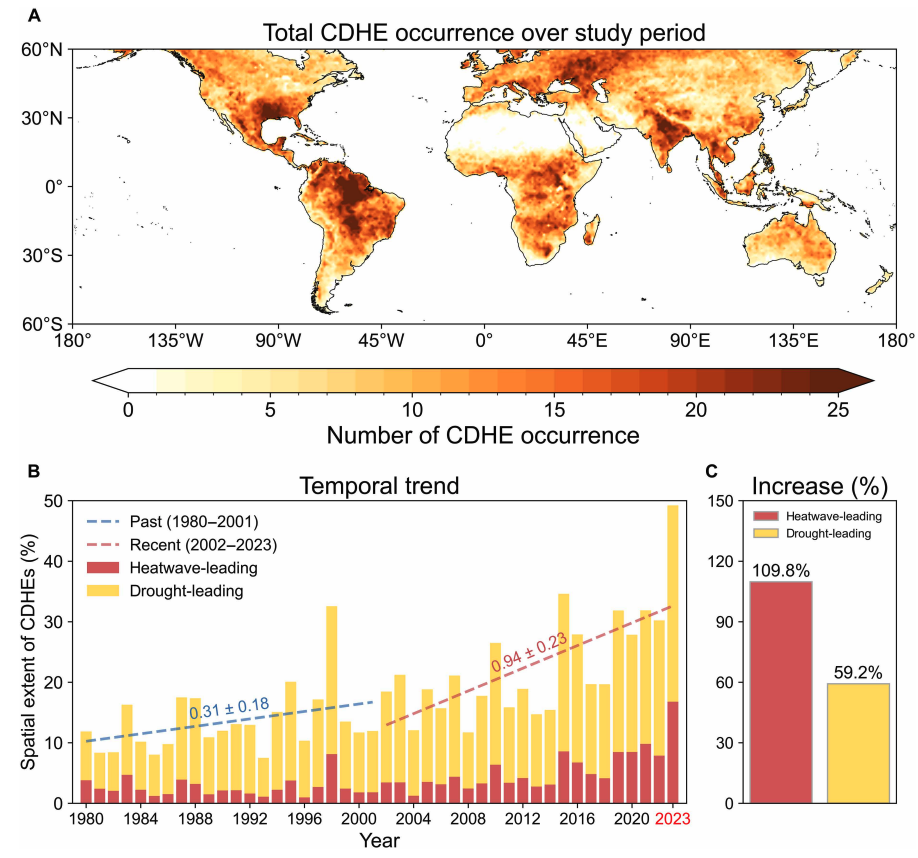
Heatwave-led events have been the main contributor to this increase, the study says, with their spatial extent rising 110% between 1980-2001 and 2002-23, compared to a 59% increase for drought-led events.
The map below shows the global distribution of CDHEs over 1980-2023. The charts show the percentage of the land surface affected by a heatwave-led CDHE (red) or a drought-led CDHE (yellow) in a given year (left) and relative increase in each CDHE type (right).
The study finds that CDHEs have occurred most frequently in northern South America, the southern US, eastern Europe, central Africa and south Asia.
Threshold passed
The authors explain that the increase in heatwave-led CDHEs is related to rising global temperatures, but that this does not tell the whole story.
In the earlier 22-year period of 1980-2001, the study finds that the spatial extent of heatwave-led CDHEs rises by 1.6% per 1C of global temperature rise. For the more-recent period of 2022-23, this increases “nearly eightfold” to 13.1%.
The change suggests that the rapid increase in the heatwave-led CDHEs occurred after the global average temperature “surpasse[d] a certain temperature threshold”, the paper says.
This threshold is an absolute global average temperature of 14.3C, the authors estimate (based on an 11-year average), which the world passed around the year 2000.
Investigating the recent surge in heatwave-leading CDHEs further, the researchers find a “regime shift” in land-atmosphere dynamics “toward a persistently intensified state after the late 1990s”.
In other words, the way that drier soils drive higher surface temperatures, and vice versa, is becoming stronger, resulting in more heatwave-led compound events.
Daily data
The research has some advantages over other previous studies, Yeh says. For instance, the new work uses daily estimations of CDHEs, compared to monthly data used in past research. This is “important for capturing the detailed occurrence” of these events, says Yeh.
He adds that another advantage of their study is that it distinguishes the sequence of droughts and heatwaves, which allows them to “better understand the differences” in the characteristics of CDHEs.
Dr Meryem Tanarhte is a climate scientist at the University Hassan II in Morocco, and Dr Ruth Cerezo Mota is a climatologist and a researcher at the National Autonomous University of Mexico. Both scientists, who were not involved in the study, agree that the daily estimations give a clearer picture of how CDHEs are changing.
Cerezo-Mota adds that another major contribution of the study is its global focus. She tells Carbon Brief that in some regions, such as Mexico and Africa, there is a lack of studies on CDHEs:
“Not because the events do not occur, but perhaps because [these regions] do not have all the data or the expertise to do so.”
However, she notes that the reanalysis data used by the study does have limitations with how it represents rainfall in some parts of the world.
Compound impacts
The study notes that if CDHEs continue to intensify – particularly events where heatwaves are the precursors – they could drive declining crop productivity, increased wildfire frequency and severe public health crises.
These impacts could be “much more rapid and severe as global warming continues”, Yeh tells Carbon Brief.
Tanarhte notes that these events can be forecasted up to 10 days ahead in many regions. Furthermore, she says, the strongest impacts can be prevented “through preparedness and adaptation”, including through “water management for agriculture, heatwave mitigation measures and wildfire mitigation”.
The study recommends reassessing current risk management strategies for these compound events. It also suggests incorporating the sequences of drought and heatwaves into compound event analysis frameworks “to enhance climate risk management”.
Cerezo-Mota says that it is clear that the world needs to be prepared for the increased occurrence of these events. She tells Carbon Brief:
“These [risk assessments and strategies] need to be carried out at the local level to understand the complexities of each region.”