Hunger has, on average, fallen worldwide after hitting 15-year highs in 2021 and 2022.
This is one of the key findings from the latest “State of Food Security and Nutrition in the World” (SOFI) report, an annual assessment produced jointly by the UN Food and Agriculture Organization (FAO), International Fund for Agricultural Development, UN Children’s Fund, World Food Programme and World Health Organization.
The SOFI report also examines the cost of a “healthy” diet around the world, the surge in food price inflation and the contribution of energy and fertiliser prices to overall food inflation.
In a statement, FAO director-general Dr Qu Dongyu said that it is “encouraging” to see the world making progress on hunger, but added: “We must recognise that progress is uneven.”
Below, Carbon Brief highlights five charts from the report which explain the state of food insecurity around the world.
- Hunger decreased in recent years in most parts of the world, following sharp increases in 2020-21
- The cost of a healthy diet increased around the world
- Food price inflation outstripped general inflation over 2019-25
- Gas price shocks contributed to high commodity prices
- Fertiliser prices have remained high following Russia’s invasion of Ukraine
1. Hunger decreased in recent years in most parts of the world, following sharp increases in 2020-21
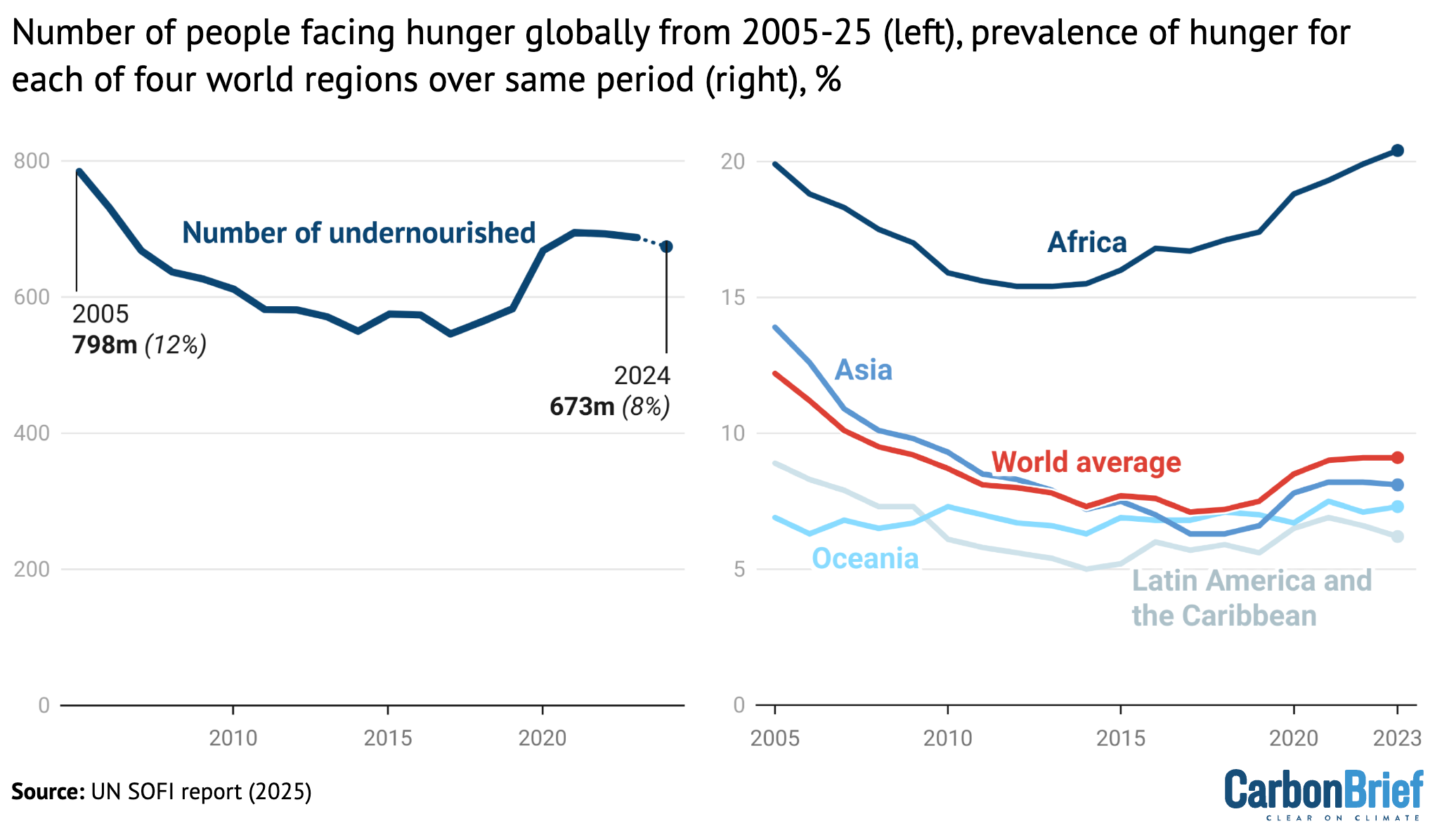
Number of undernourished people, globally, from 2005-24 (left) and the prevalence of undernourishment (right) for the world (red), Africa (dark blue), Asia (blue), Latin America and the Caribbean (light blue) and Oceania (cyan) over the same time period. Credit: Carbon Brief, based on the UN State of Food Security and Nutrition in the World report (2025)
Since 1975, the FAO has tracked the prevalence of undernourishment – the proportion of the population in each country who does not regularly consume sufficient amounts of food for sustaining a healthy life.
These estimates are used to assess progress on achieving global goals, such as the 2030 Sustainable Development Goals (SDGs), launched in 2015.
The left-hand chart above shows the number of people facing hunger each year from 2005-24. The right-hand chart shows the percentage of the population facing hunger over this time period for the world as a whole (red), Africa (dark blue), Asia (blue), Latin America and the Caribbean (light blue) and Oceania (cyan).
Over the past 20 years, undernourishment broadly decreased until 2016 and then began to rise sharply in 2020 and 2021. This increase coincided with the Covid-19 pandemic.
The report estimates that the population facing hunger in 2024 was between 638 million and 720 million people, or between 7.8% and 8.8% of the global population.
The report sets its “best estimate” of the population facing hunger at 673 million people, which represents a decrease of 15 million people compared to the previous year.
However, the report notes that the progress made in reducing hunger worldwide has been uneven, as seen in the chart above.
There were improvements in south-west and southern Asia, as well as Latin America, but a continuing rise in hunger in much of Africa and western Asia.
The report also finds that around 2.3 billion people were “moderate or severely food insecure” in 2024, noting that this represents an increase of 683 million more people than when the SDGs was launched a decade ago.
The report projects that by 2030 around 512 million people could face chronic hunger, with 60% of the world’s undernourished people located in Africa.
It highlights that achieving the goal of eliminating hunger by 2030 will be an “elusive target”.
The report warns that the “deteriorating food insecurity” in territories and countries currently affected by humanitarian crises – such as the Gaza Strip, South Sudan, Sudan, Yemen and Haiti – may not be fully reflected in its current estimates.
2. The cost of a healthy diet increased around the world
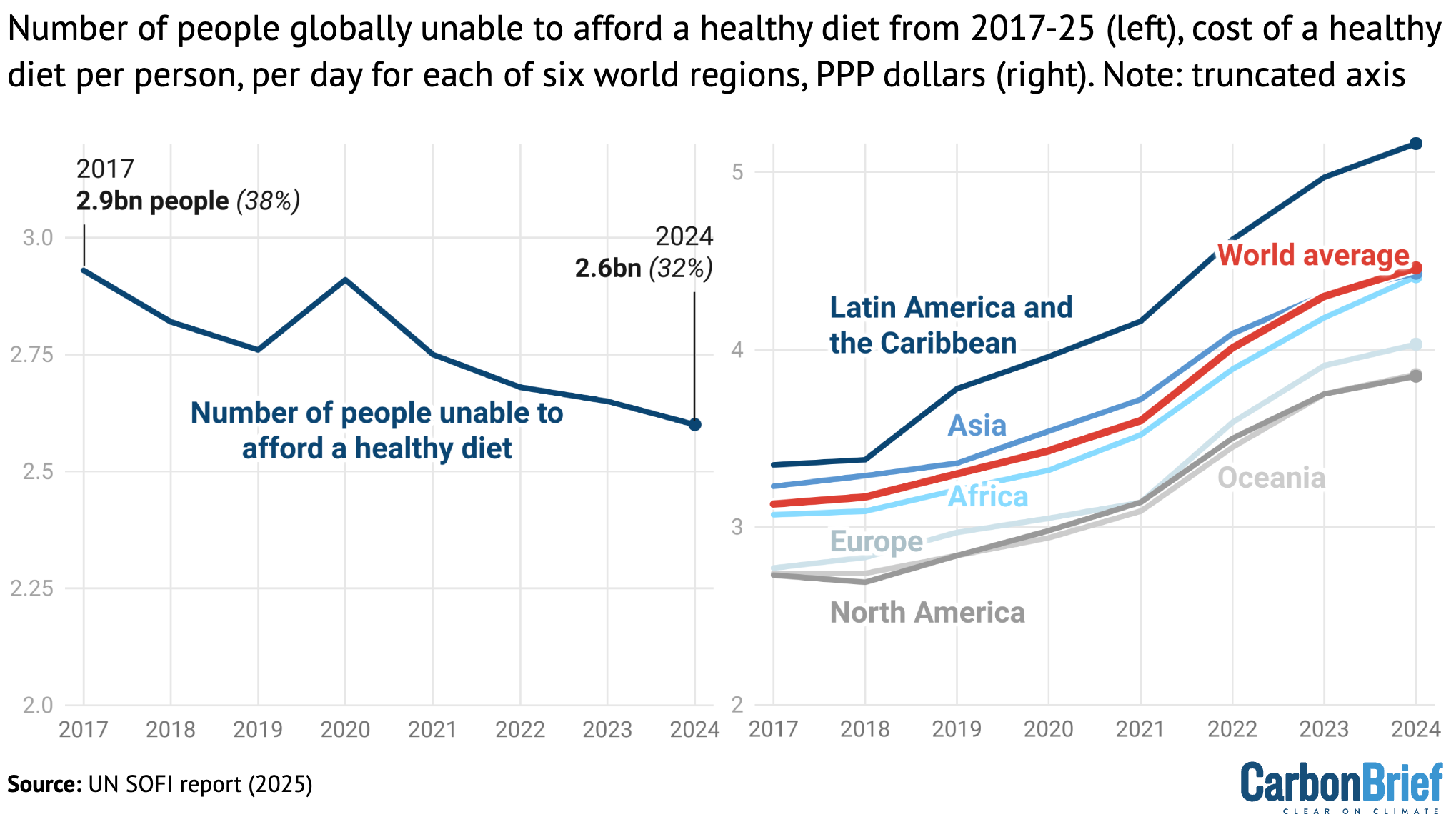
The number of people around the world who were unable to afford a healthy diet (left) from 2017-24. The cost of a healthy diet per person, per day in purchasing power parity dollars (right) for the world (red), Africa (cyan), Asia (blue), Europe (light blue), Latin America and the Caribbean (dark blue), North America (dark grey) and Oceania (light grey). Credit: Carbon Brief, based on the UN State of Food Security and Nutrition in the World report (2025)
The report finds that the cost of a “healthy” diet rose during 2023 and 2024.
It defines a “healthy” diet as one that comprises a “variety of locally available foods that meet energy and most nutrient requirements”. A healthy diet should be diverse, adequate and balanced, while maintaining moderation in consumption of food related to poor health outcomes, the report says.
In 2019, a healthy diet cost, on average, 3.30 purchasing power parity (PPP) dollars per person, per day. (Purchasing power parity is a type of currency conversion, based on the cost of goods in different locations, that allows one to compare the purchasing power of different currencies.)
By 2024, increasing food prices had driven this cost up to 4.46 PPP dollars, the report says.
At the same time, the report finds that the proportion of the population unable to afford a healthy diet has decreased every year since 2017, with the exception of 2020. For example, in 2020, the number of people worldwide who could not afford healthy food was 2.9 billion, which fell to 2.6 billion in 2024.
This is due to the economic recovery following the Covid-19 pandemic, which led to an increase in incomes that outstripped the rise in food prices, the report says.
The chart above shows how the global population was unable to afford a healthy diet each year from 2017-24 (left) and the average cost of a healthy diet, in PPP dollars per person, per day (right, red). The right-hand chart also shows the cost in each of six regions: Latin America and the Caribbean (dark blue), Asia (blue), Africa (cyan), Europe (light blue), Oceania (light grey) and North America (dark grey).
However, not all regions experienced the same economic recovery, it adds.
Asia, as a whole, saw the largest decrease in the unaffordability of healthy food – with the proportion of people unable to afford a healthy diet falling from 35% in 2019 to 28% in 2024. In contrast, the unaffordability of healthy diets increased “substantially” in Africa, with two-thirds of the population unable to afford healthy diets in 2024.
The rest of the world’s regions – with the exception of Oceania – saw a “marginal” decrease in the unaffordability of healthy food in recent years, the report says.
There are significant differences in affordability according to national incomes.
In low-income countries, the number of people unable to afford a healthy diet “has been steadily increasing since 2017”, says the report. This is attributed to a recent halt in economic growth and a sharp rise in food prices.
In lower-middle-income countries, that number decreased from 2020 to 2024, mainly due to improvements in affordability in India.
Conversely, in upper-middle- and high-income countries, the number of people unable to afford healthy food has been declining since 2020.
The report concludes that “people who are unable to afford even a least-cost healthy diet are likely experiencing some level of food insecurity”.
3. Food price inflation outstripped general inflation over 2019-25
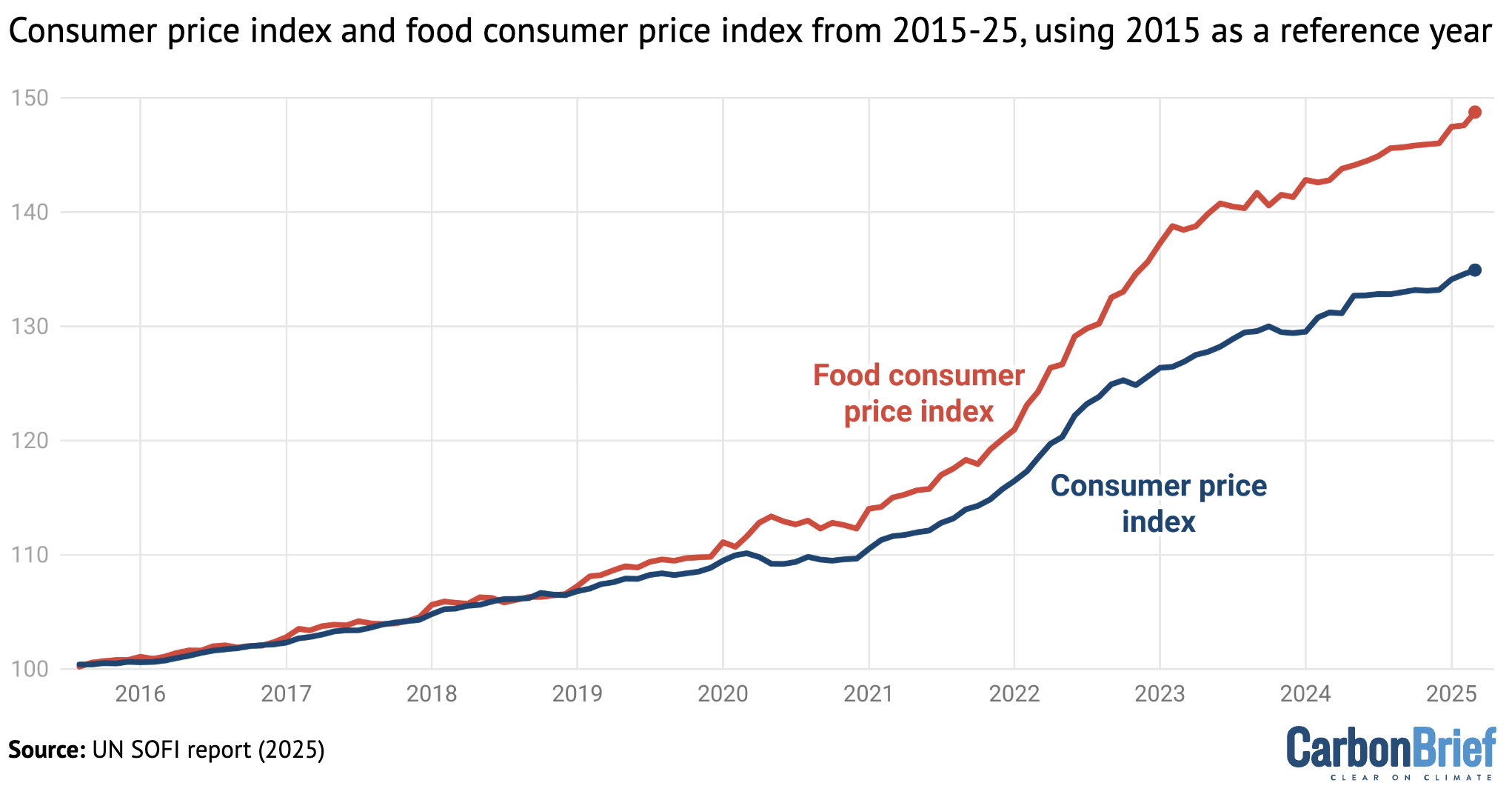
Consumer price index (blue) and food consumer price index (red) from 2015-25, using 2015 as a reference year. Credit: Carbon Brief, based on the UN State of Food Security and Nutrition in the World report (2025)
The report finds that food price inflation has “significantly” outstripped general inflation over the past five years. Median global food price inflation rose from 2.3% in December 2020 to 13.6% in January 2023.
The chart above shows consumer price index (blue) – which includes price changes to all of the items a household typically consumes – and the consumer food price index (red) over 2015-25, with 2015 taken as the reference year.
The highest rates of inflation occurred in low-income countries, with several countries experiencing “hyperinflation”, including inflation levels above 350%. The report explains that most households in low-income countries source much of their food from local markets, which are more vulnerable to price shocks.
The authors attribute the heightened inflation to a combination of factors that includes the Covid-19 pandemic, the war in Ukraine and shifting monetary policy – from lowering interest rates and launching fiscal support at the beginning of the pandemic to raising interest rates to combat surging prices.
According to the report, previous food-price shocks – such as the one that occurred during the 2008 global financial crisis – were “predominantly” driven by supply, while the current surging inflation was driven initially by demand.
Supply-side shocks occur when production or distribution of food are disrupted by external factors, resulting in a “steep and prolonged rise in food prices”. Supply-side shocks create “persistent inflationary pressures”, the report says.
Demand-side shocks – a “sudden and unexpected increase in consumer demand for food products” – are often due to economic growth and changes in consumption patterns. (The report cites as an example the Covid-19 pandemic, which led to a “surge” in demand for food at home.) Demand-side shocks are characterised by rapid increases in price, but do not typically have a long-term impact.
In addition to the global factors driving food inflation, localised shocks – such as extreme weather events – impacted inflation on sub-national and national scales, by destroying crops, disrupting supply chains and suppressing household incomes.
Since 2020, the report says, 139 out of 203 countries have faced cumulative food price inflation above 25%, with 49 countries experiencing cumulative food inflation higher than 50%. It warns:
“Such prolonged food price pressures risk undermining household coping capacities and worsening food insecurity.”
According to the report, food price rises of 10% are associated with a 3.5% rise in “moderate or severe” food insecurity, with women “disproportionately affected”.
It also notes that food price inflation has previously been found to have “detrimental effects on child nutrition”, particularly among vulnerable populations.
4. Gas price shocks contributed to high commodity prices
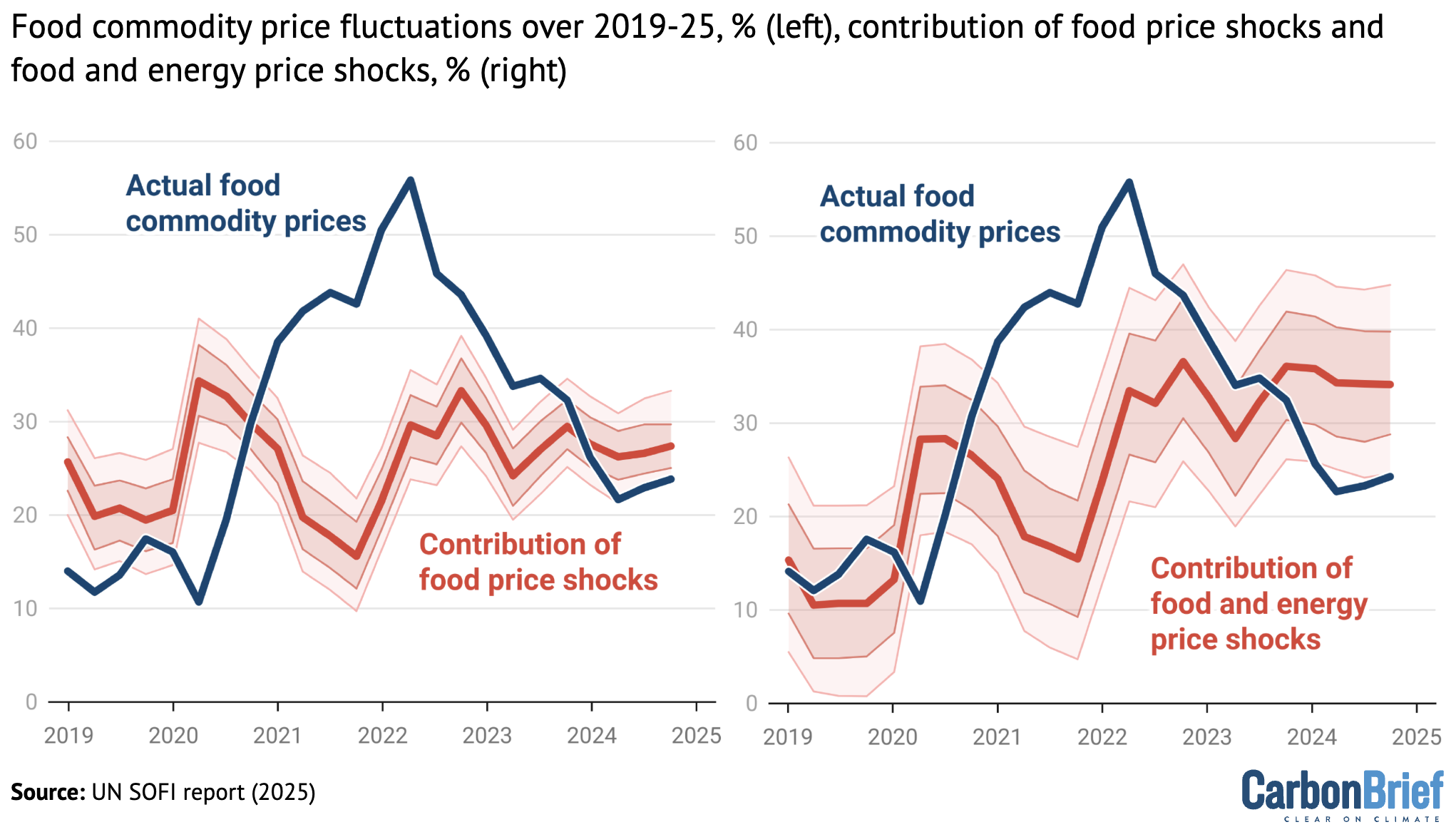
Contribution of food price shocks (left) and food and energy price shocks (right) to global commodity food prices, from 2019-25. Overall fluctuations in food commodity prices are shown in dark blue on both charts. Credit: Carbon Brief, based on the UN State of Food Security and Nutrition in the World report (2025)
Rising food prices were amplified by rising energy costs over the past several years, the report says.
It points out that oil and gas are “key input[s] in agriculture production – from fertiliser manufacturing through to transportation”.
(Nitrogen-based fertilisers are typically produced using fossil gas as an input. The process of manufacturing them is an energy-intensive one – accounting for about 1% of all global energy usage.)
The report cites two “waves” of shocks that “largely shaped” the changes in agricultural commodity prices over 2020-22.
The first wave, it says, occurred early in the Covid-19 pandemic as food supplies contracted due to supply-chain disruptions, as well as “precautionary trade restrictions and increased stockpiling”.
Global energy markets were further “destabilised” by the second shockwave – Russia’s invasion of Ukraine in February 2022. Prior to the outbreak of the war, Russia was the third-largest producer of oil and the second-largest producer of fossil gas in the world.
The war resulted in “significant price increases and heightened volatility”, which translated into higher production costs economy-wide, the report says.
The initial surge at the beginning of the pandemic contributed about 15 percentage points to global food inflation, while the war in Ukraine added 18 percentage points, the report says.
The charts above show global food price inflation (black lines) over 2019-25. The blue line in the left panel shows the contribution of “food price shocks”, such as the disruption of the Black Sea trade corridor and the decline in fertiliser exports from Russia. In the right panel, the red line shows the contribution of both food price and energy price shocks to food inflation.
According to the report, the rise in agricultural and energy commodity prices account for nearly half of food price inflation in the US and more than one-third of food price inflation in the Euro area during peak inflation over the past few years.
It adds that the remaining inflation is explained by several other factors, “including rising labour costs, exchange rate fluctuations and pricing behaviour along the supply chain”.
5. Fertiliser prices have remained high following Russia’s invasion of Ukraine
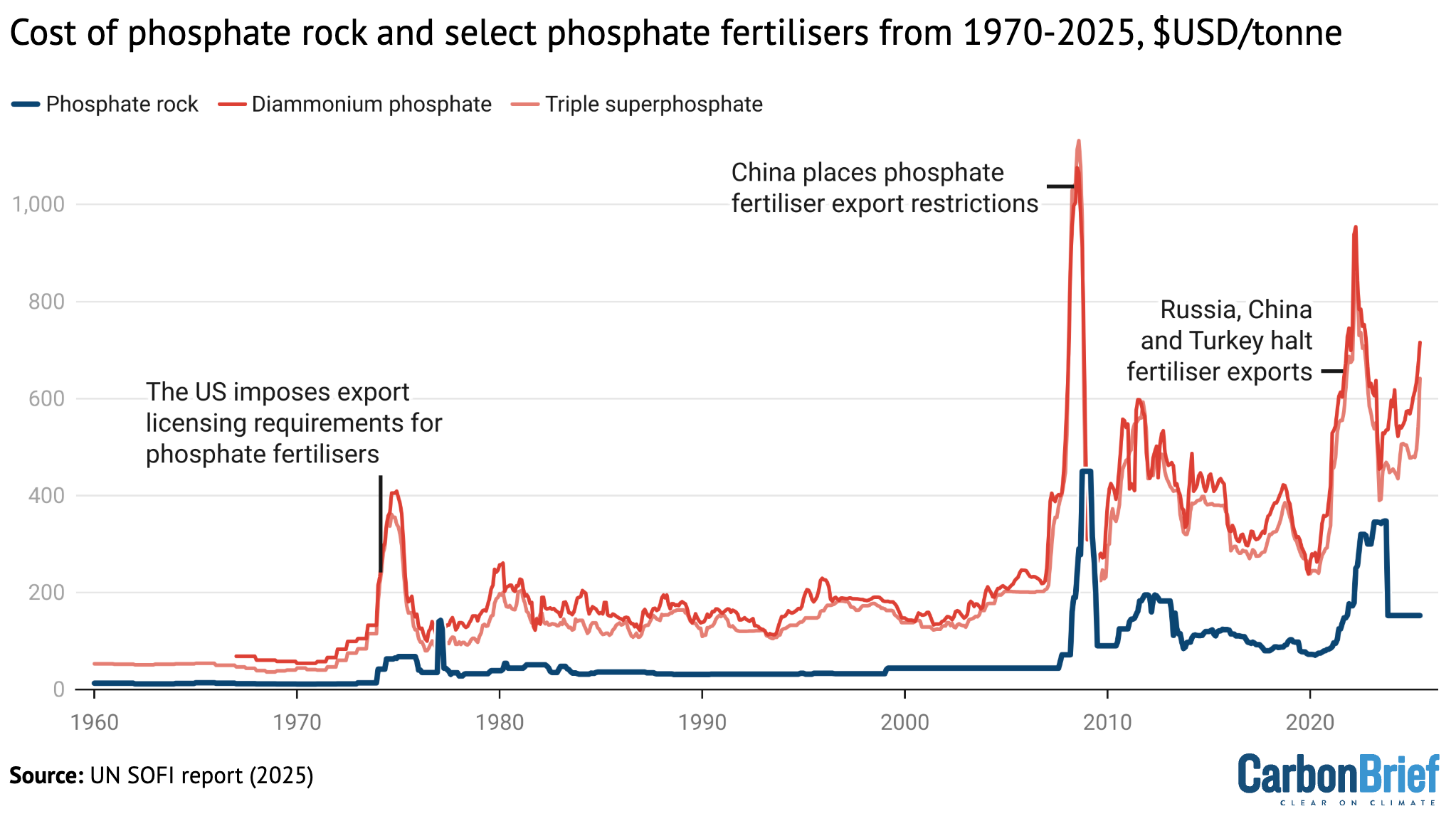
Monthly price of phosphate rock (blue), diammonium phosphate fertiliser (dark red) and triple superphosphate fertiliser (light red) from 1970-2025. Credit: Carbon Brief, based on the UN State of Food Security and Nutrition in the World report (2025)
The report notes that Russia’s invasion of Ukraine in February 2022 upended global fertiliser markets due to economic sanctions against Russia and Belarus – two of the world’s largest fertiliser exporters.
In 2020, Russia exported 14% of globally traded urea, the most commonly used nitrogen fertiliser. Belarus and Russia combined account for more than 40% of traded potash, a key potassium fertiliser.
While many of the sanctions against Russia following the outbreak of the war specifically omitted fertilisers and agricultural commodities, the report notes that restrictions on banking and trade increased the “cost of doing business” and restricted the ability of countries to purchase food and fertilisers from Russia.
However, the report points out, global potassium fertiliser prices were already on the rise prior to Russia’s invasion of Ukraine, due to export restrictions on fertilisers from China.
Similar trade measures on fertilisers – both export restrictions and import tariffs – have “played a role” in price spikes during previous episodes of global food price crises, including in 2007-08 and 2011-12, the report says.
The report looks specifically at phosphate fertilisers, noting that those prices have “historically been shaped by both long-term structural trends and short-term shocks”. These factors include trade restrictions, energy costs, geopolitical tensions and imbalances in supply and demand.
The chart above shows the monthly price of phosphate rock (blue), diammonium phosphate (dark red) and triple superphosphate (light red) from 1970 to 2025.
(Phosphate rock is the raw material used to manufacture most phosphate-based fertilisers, while diammonium phosphate and triple superphosphate are two commonly used phosphate fertilisers.)
Export restrictions were “critical factors” in driving the three major historical phosphate price spikes highlighted in the chart – in 1974, 2008 and 2021-22.
Given the small number of countries that produce phosphate fertilisers – their production is highly concentrated in China, the US, India, Russia and Morocco – these actions “exacerbat[e] global shortages”, the report says.
The report also points out that the concentration of agricultural markets – including the fertiliser market – is a “systemic issue that undermines efficiency and affordability” in both low- and high-income countries.
The post UN report: Five charts explaining the rise of global food insecurity appeared first on Carbon Brief.
UN report: Five charts explaining the rise of global food insecurity
Greenhouse Gases
DeBriefed 7 November 2025: Belém COP begins; UN warns of 1.5C breach; changing roles of climate scientists
Welcome to Carbon Brief’s DeBriefed.
An essential guide to the week’s key developments relating to climate change.
This week
Eve of COP30
MULTILATERAL HOPES A gathering of world leaders kicked off in Belém, Brazil, ahead of the official opening of COP30 next week. The leaders of China, the US and India – the “planet’s three biggest polluters” – are “notably absent” from the two-day leaders summit, reported the Associated Press. Some Latin American leaders “were openly critical” of the US president’s stance on climate change in their speeches at the “diminished” summit, noted the Financial Times.
‘MORAL FAILURE’: Speaking at the world leaders summit, UN secretary-general António Guterres described failing to remain below 1.5C as a “moral failure and deadly negligence”, reported the Guardian. Guterres added: “Every fraction of a degree means more hunger, displacement and loss – especially for those least responsible.” The UN chief’s speech came as the World Meteorological Organization confirmed that 2025 is “on track to be the second or third warmest globally”, noted Reuters.
‘POSITIVE TIPPING POINT’: The Brazilian COP presidency published a “Baku to Belém roadmap” detailing how climate finance for developing nations could be scaled up to $1.3tn a year by 2035, Climate Home News reported. The roadmap was published ahead of the UN climate talks, but will not be formally discussed as part of the negotiations, the outlet added. Read Carbon Brief’s summary of what the roadmap means for climate finance.
FORESTS NOT FOREVER: Brazil also launched its Tropical Forests Forever Facility (TFFF) this week, said Agence France-Presse, designed to help tropical countries protect their forests. Norway has joined France and Brazil in investing in the fund, while Germany will announce its contribution on Friday, noted Bloomberg. The Guardian dubbed the UK’s decision to opt out as “a major letdown”. For more on the TFFF, see Carbon Brief’s explainer.
UN report says world is heading for 2.8C
UNFULFILLING: The United Nations Environment Programme (UNEP) annual “emissions gap” report warned that global temperature rise could be heading for 2.8C this century, if only current policies are fulfilled, the Financial Times reported. The rise could be limited to 2.5C, if unconditional national pledges are met in full – or to 2.3C, if pledges conditional on financial support are put into action, the newspaper noted.
STALLED PROGRESS: The world’s warming trajectory is now “0.3C lower than it was a year ago…meaning new plans announced this year have done little to move the needle”, noted Reuters. Some of this progress will be “cancelled” out, the New York Times added, once the US withdrawal from the Paris Agreement takes effect. See Carbon Brief’s in-depth coverage of the UNEP report.
Around the world
- WATERED DOWN: The EU finally confirmed a “significantly weakened” plan to cut emissions to 90% below 1990 levels by 2040, reported the Financial Times.
- DEADLY DISASTER: The Philippines is in a state of emergency after Typhoon Kalmaegi left at least 114 people dead and nearly 130 missing.
- DROPPING COMMITMENTS: The junior partner in Australia’s opposition Coalition – the Nationals – has formally abandoned a commitment to reach net-zero emissions by 2050, reported ABC News.
- MAYORAL WIN: Zohran Mamdani won New York City’s mayoral election, having “refram[ed] climate policy as a quality-of-life issue”, Inside Climate News reported.
100
The number of proposed indicators to track progress towards the “global goal on adaptation” that will be negotiated at COP, according to Carbon Brief‘s new Q&A.
Latest climate research
- Rising temperatures could affect the muscles that Arctic bumblebees use to generate their “charismatic buzz” | Nature Communications
- The release of CO2 from the the Southern Ocean has been “underestimated” by up to 40% in previous studies | Science
- Outdoor heat stress has led to a 10% decline in labour capacity in “rural to urban migration hotspots” in India | Environmental Research Letters
(For more, see Carbon Brief’s in-depth daily summaries of the top climate news stories on Monday, Tuesday, Wednesday, Thursday and Friday.)
Captured
IPCC funding shortfall

Carbon Brief covered the latest meeting of the Intergovernmental Panel on Climate Change (IPCC) in Lima, Peru. Alongside funding from parent organisations the World Meteorological Organization (WMO) and UN Environment Programme, voluntary contributions by countries help pay for the work of the IPCC. The biggest contributors so far in 2025 are Norway, the UNFCCC, Canada and the WMO. The red bars show how US contributions have dropped off during Trump’s two terms in office. Having provided 30% of direct contributions throughout the IPCC’s history, the US has not made a contribution so far this year.
Spotlight
‘With knowledge comes responsibility’: the changing role of climate scientists in a warming world
This week, Carbon Brief speaks to a researcher about the different ways climate scientists are feeling and taking responsibility for the knowledge they hold.

From calling for action in Belém to defending science against attempts to discredit or downplay it, climate scientists are responding to world events in ever-more visible ways.
Dr Friederike Hartz is a research and policy associate at University College London.
For her PhD thesis, carried out at the University of Cambridge, Hartz interviewed 77 experts who participated in IPCC reports, the world’s most authoritative global assessments of climate science coordinated by the UN.
‘You can’t unsee it’
Hartz’s findings show how climate scientists can feel a sense of responsibility, as those who bear the knowledge and evidence of climate change.
Some interviewees felt a sense of “representational responsibility” – motivated by the wish to improve the lives of the vulnerable or underrepresented communities they belong to.
Others expressed a sense of “intergenerational responsibility”, resolving to contribute to a better world for their children and grandchildren.
Hartz called this the “inescapability” of climate knowledge. She told Carbon Brief:
“Once you know, you know. As one of my interviewees shared with me, you simply can’t unsee it. Especially as a scientist, you’re trained to see those things.”
Taking responsibility
Hartz’s research looked at what it means for climate scientists to act on the sense of responsibility they feel, beyond producing the science itself.
Some take part in formal IPCC assessments. Others “have come to accept and further embrace a responsibility for communicating” their knowledge, Hartz noted in her paper.
Beyond the IPCC, some scientists take on additional responsibility for evidence-based “advocacy” or even call for more “activism” in science.
Similarly, on the grounds that “with knowledge comes responsibility”, some have called for scientists to “step beyond their traditional roles” or act as “sentinels” to alert society to threats. Hartz told Carbon Brief:
“This is all part of what I call ‘science enactment’: putting science into action or putting it in the hands of other people who can act on it.”
Navigating what it means to take responsibility is a very individual thing, said Hartz, which speaks to late biologist Stephen Schneider’s “double ethical bind” – the balance between a commitment to the “scientific method” and the “wish to see the world a better place”.
Lived experience
Hartz pointed to research suggesting the traditional view – that engaging in activism or advocacy can damage a scientist’s credibility – may be unwarranted. But there can be other downsides, she noted, including the emotional toll. As one of her interviewees expressed it:
“As scientists, we are not droids…And, so, to say that we are not at all influenced by what is going on in science is not true.”
Hartz suggested that scientists can simultaneously experience feelings of enthusiasm about their work and frustration about its uptake. Or as she noted in her thesis, citing a seminal political science study:
“Knowledge can only speak ‘truth to power’ to the extent that ‘power listens to truth’.”
Watch, read, listen
‘WHITE HOUSE EFFECT’: A Netflix documentary looked at how a “crucial opportunity” to take climate action was “deliberately undermined” during the George HW Bush administration.
‘COP OF TRUTH’: Brazil’s president, Luiz Inácio Lula da Silva, wrote in the Guardian ahead of COP30 about the need to act “with the urgency the climate crisis demands”.
HUMAN STORIES: A video by the Grantham Institute at Imperial College London explored the pivotal moments leading to the historic establishment of a loss and damage fund.
Coming up
- 10 November: UN Climate Change conference (COP30) begins in Belém, Brazil
- 12 November: IEA World Energy Outlook 2025 launch, Paris
- 13 November: Global Carbon Budget annual update released
Pick of the jobs
- Project Drawdown, program manager, research fellow and senior analyst | Salary: Various. Location: Remote
- UK Centre for Ecology and Hydrology, laboratory assistant | £26,206 – £27,808. Location: Lancaster, UK
- Ofwat, Wales environmental policy lead | £57,783 – £72,000. Location: Cardiff, UK
- UNEP, mitigation expert on sand and dust storms | Salary: Not specified. Location: Riyadh, Saudi Arabia
- Conservation International, senior manager, climate & landscape restoration | Salary: Not specified. Location: Acornhoek, South Africa.
DeBriefed is edited by Daisy Dunne. Please send any tips or feedback to debriefed@carbonbrief.org.
This is an online version of Carbon Brief’s weekly DeBriefed email newsletter. Subscribe for free here.
The post DeBriefed 7 November 2025: Belém COP begins; UN warns of 1.5C breach; changing roles of climate scientists appeared first on Carbon Brief.
Greenhouse Gases
Interactive: Tracking negotiating texts at the COP30 climate summit
The centrepiece of every UN climate summit is for countries to negotiate the wording of a large number of legal agreements – and COP30 in the Brazilian city of Belém is no different.
These texts are hashed out behind closed doors in the “blue zone” at the COP, where diplomats from nearly 200 nations haggle over every paragraph and each individual verb.
Over the course of the two-week summit, negotiators will be trying to reach consensus on more than 100 separate agreements – but, first, they must agree which issues are on the agenda.
The complexity of this process can make it challenging to keep track of what countries are fighting about and how negotiations are progressing.
Carbon Brief’s real-time text tracker, below, offers a helping hand by decoding the agenda and keeping a searchable record of every document for each part of the negotiations.
The first column of the interactive tracker lists the topic of each agenda item, with further columns including dates, page counts and links to the original PDFs.
The table is searchable via the interactive text box and can be sorted using the arrow icons.
Key negotiations at COP30 include those on the “global goal on adaptation”, as well as the question of whether or how to reform the COP process itself, a discussion that appears on the agenda under the innocuous heading: “Arrangements for intergovernmental meetings.”
While most of the items on the agenda are agreed in advance, parties can suggest late additions. These must be signed off before negotiations can begin, often resulting in an “agenda fight”.
Recent negotiations have all started with an agenda fight over two proposals from the Like-Minded Developing Countries (LMDCs) – a group that includes China, India and Saudi Arabia.
The LMDC proposals relate to the provision of climate finance by developed countries – under Article 9.1 of the Paris Agreement – and to what they describe as “unilateral trade measures”, a term understood to include the EU’s carbon border adjustment mechanism (CBAM).
The LMDCs have asked again that these issues be included on the agenda at COP30.
Ahead of the opening of the summit, Carbon Brief’s text tracker counts 111 substantive items on the agenda, not including procedural matters, such as the election of COP officials.
However, it is likely that not all of these items will ultimately end up being included.
The figure below illustrates the status of the COP30 negotiations overall, in a traffic-light format. Each agenda item is colour-coded according to its current status.
For topics shown in red, negotiators have not yet managed to put anything down on paper, perhaps because parties have fundamentally different views on how they should proceed.
For items in orange, negotiators are working on an “informal text”, which is an early draft setting out the views of different parties, but not yet expressed in formal legal language.
Once a draft legal agreement becomes available, topics will be colour-coded yellow. At this point, areas of remaining disagreement will be denoted in the text with [square brackets] and “options”.
As such, texts with many square brackets or options tend to be an indicator of a high level of disagreement between parties within this negotiation track. For this reason, the tracker table above counts and displays the number of outstanding brackets and options in each document.
During the course of the summit, negotiators may work through multiple iterations of text on each agenda item. These documents may include “bridging text”, designed to resolve differences of opinion and to find a “landing zone” that all groups can agree on.
Agreement is reached on a given topic once all brackets and options have been resolved, at which point the issue will be coloured green in Carbon Brief’s traffic-light chart.
Where agreement cannot be reached, discussions may be subject to “rule 16”, meaning negotiations are postponed until the next session. These topics are colour-coded grey.
The figure below gives an at-a-glance overview of the status of the main topics up for negotiation.
As parties narrow down the options and brackets towards the end of each summit, they start to generate “clean” texts, which contain no areas of disagreement and can be converted into “draft decisions” that are ready for formal adoption at the closing plenary of the meeting.
Finally, at the closing plenary, each draft decision must be gavelled through by the COP president, signifying its formal adoption as a legal agreement and outcome of the summit.
This last step is usually a formality, but dramatic exceptions are possible.
During the closing plenary at COP29, the president of the meeting failed to adopt a deal relating to the “global stocktake” from 2023, which had called for “transitioning away” from fossil fuels.
Carbon Brief also ran text trackers for COP28 and COP29.
The post Interactive: Tracking negotiating texts at the COP30 climate summit appeared first on Carbon Brief.
Interactive: Tracking negotiating texts at the COP30 climate summit
Greenhouse Gases
Ongoing failure to agree AR7 timeline is ‘unprecedented’ in IPCC history
Governments have, once again, failed to agree on a timeline for the Intergovernmental Panel on Climate Change (IPCC) seventh assessment cycle (AR7), two years into the process.
Last week, more than 300 scientists and government officials from around the world met in Lima, Peru for the 63rd session of the IPCC (IPCC-63).
According to the Earth Negotiations Bulletin (ENB), reporting exclusively from inside the four-day meeting, the closed-door talks were characterised by “fraught deliberations” where “once-routine” issues became “deeply controversial and time-consuming”.
Countries reached a compromise on the content of a methodology report on carbon dioxide removal technologies – a sticking point at the last IPCC meeting.
However, the meeting marked the fourth time in a row that delegates could not reach consensus on the timings of the IPCC’s influential three-part assessment report, after deadlocked talks in Hangzhou, China earlier this year and Sofia, Bulgaria and Istanbul, Turkey in 2024.
Observers told Carbon Brief of an atmosphere of “deepening mistrust” at the meeting, as emerging economies clashed with a coalition of small-island states and developed nations amid repeated accusations of “micromanagement”.
IPCC chair Prof Jim Skea reportedly lamented in his closing remarks that “as a category five hurricane [Hurricane Melissa] swept through the Carribean, IPCC-63 was deliberating on pronouns and footnotes”.
One former IPCC author tells Carbon Brief that certain countries’ opposition to agreeing a “deadline for AR7” was a “clear tactic for playing down the importance of IPCC climate science in decision-making on climate change”.
Historic splits
Each assessment cycle, the IPCC publishes three “working group” reports that focus on climate science (WG1), impacts and adaptation (WG2) and mitigation (WG3). It also publishes a small number of special reports and methodology reports.
The IPCC’s current assessment cycle has been underway since July 2023, with the authors for its three headline reports confirmed earlier this year.
It is atypical for the IPCC to have not yet agreed when these reports would be published so far into an assessment cycle. The workplans for AR5 and AR6 were “agreed with little difficulty”, the ENB notes in its summary of the event, adding:
“The debate about the timeline is unprecedented in the history of the IPCC.”
There are, broadly speaking, two camps in the debate around timelines for AR7.
The first wants a timeline that would align the publication of the IPCC’s three headline reports, plus special and methodology reports, with the second “global stocktake” (GST).
The GST is an appraisal of global progress on tackling climate change, which takes place every five years under the Paris Agreement. The second GST is scheduled to conclude at COP33 at the end of 2028, so that its findings can inform the fourth round of national climate pledges due a few years later.
Other countries, however, have advocated for a longer timeline. Among their concerns are the potential burden reviewing reports back-to-back could place on more resource-strapped countries, as well as whether the current schedule offers enough time for gaps in scientific literature to be filled.
As proceedings kicked off in Peru, the IPCC proposed a timeline for AR7 which would see all three of its headline reports published in 2028, with approval sessions earmarked for May, June and July of that year for the three working group reports.
WGI co-chair Dr Robert Vautard noted that the ongoing uncertainty on timelines was stressful for both the authors of reports, as well as for scientists wishing to submit research for the cycle, according to the ENB.
The delegation from Antigua and Barbuda, meanwhile, noted that agreement on the timeline is typically procedural and “not negotiated by governments”. It also said the proposed cycle length of around six-and-a-half years was consistent with the IPCC’s last two assessment cycles.

‘Compromise’ timeline
Throughout the four-day meeting, positions on both sides on the debate around AR7 remained “entrenched”, the ENB notes.
A “majority” of countries were in favour of a workplan which would align AR7 with the GST, the ENB says. However, this group was opposed by a “smaller, but growing” number of countries in favour of a less compressed timeline.
Early on in proceedings, for example, Kenya described a slower timeline as a “great equaliser” and said a more compressed timeline did not favour authors, nor the coordinating agencies, from developing countries, ENB says.
Meanwhile, India argued that the GST was “extraneous” to the IPCC and said there were no formal IPCC rules about aligning with the stocktaking exercise, according to ENB. Algeria, China, Libya, India, Russia, Saudi Arabia and South Africa also reportedly voiced their opposition to the IPCC’s proposals.
Inclusivity concerns were also cited by countries in favour of the IPCC’s timeline. For example, the small-island state of Vanuatu reportedly said that delaying the reports would deprive countries of important scientific information ahead of key international meetings.
Antigua and Barbuda, Australia, the Bahamas, France, the Gambia, Korea and Nepal were among the countries to speak up in favour of the IPCC’s proposed timeline, according to ENB.
Simon Steill, executive director of the UN Framework Convention on Climate Change (UNFCCC), urged countries to agree on a timeline which aligned AR7 with the GST. In his opening address to the Lima meeting, he said:
“Taken together, the reports will be indispensable and I will continue to urge all countries to agree on timelines that ensure all three assessments inform the second global stocktake.
“Because the stocktake is not just a technical exercise. It is a crucial moment for the world to recognise the state of play, reaffirm its commitment to Paris and respond with action and support at the pace and scale that science demands.”
The ENB reports that a contact group was set up on Monday to work through the issue, co-chaired by Brazil and Denmark.
On Tuesday, a revised timeline for AR7 was presented by WG1 co-chair Dr Xiaoye Zhang and WG2 co-chair Dr Bart Van den Hurk, which took into account deliberations from the contact group, the ENB says. It set out a number of changes to the initial timeline, concentrated at the end of the cycle so as to address government concerns while limiting impacts on report authors.
This included spacing out approval sessions – where the final reports are signed off line by line – so that WG2 would be held in July 2028 (instead of June) and WG3 in September (instead of July). It also set out an extension of expert and government review periods for report drafts.
Discussion of the revised schedule was deferred until Wednesday at the request of Ghana, Kenya, India, Russia and Saudi Arabia.
As talks resumed, a number of emerging-economy countries spoke out against the updated timeline, including Algeria, Jordan, Morocco, Tunisia and Zimbabwe, ENB notes.
Russia said that aligning the work of the IPCC with the UNFCCC would send a “negative signal”, ENB says, whereas China suggested that the timeline would put “pressure” on developing countries. South Africa similarly argued that the timeline would “harm” the inclusivity and geographic representativeness of the reports, according to ENB.
Among the countries in favour of the revised timeline were small-island developing states Haiti, Jamaica, Sao Tome and Principe and Vanuatu, as well developed economies Australia, Finland, Italy, Ireland, New Zealand and the UK, ENB says.
Grenada is quoted by ENB as describing the new timeline constituted a “compromise of a compromise”. The country also emphasised that it was supported by a majority of countries across regions and development levels, ENB says.
At the request of certain members of the contact group, WG1’s Vautard presented a visualisation of the new timeline for all three reports and the special report on cities on Wednesday evening. The graphic – seen by Carbon Brief – plots the timeline for “first-order” draft review (by experts), “second-order” draft review (by governments and experts), final government review and panel approval for each report.
Vautard noted that first-order draft reviews of the WG1 and WG2 reports overlapped “intentionally”, to allow experts to see both drafts at once.
(The request for a visualisation prompted accusations – not for the first time at the meeting – that certain countries were drawing the IPCC process into “micromanagement”, the ENB notes.)
The visualisation was followed by a new wave of objections from countries, who argued against a timeline where review periods for different reports overlapped with each other and UNFCCC meetings, according to ENB.
Among them were Russia and China, who argued that AR7 should be extended to 2029, ENB says. (Russia reportedly said it would “consider a plan” to deliver the overarching synthesis report by December 2029 – if its concerns were addressed.)
On the other hand, Antigua and Barbuda argued that avoiding any overlaps would not be feasible and expressed concerns that certain countries’ interventions seemed to be aimed “more at delay than progress”, the ENB notes.
Skea said he “struggled to see” why consecutive and overlapping reviews were a problem, according to the ENB. He noted that the IPCC rulebook states that panel and working group sessions should be scheduled to coordinate with, “to the extent possible, with other related international meetings”.
Lindsey Fielder-Cook, interim deputy director and the representative for climate change at the Quaker UN Office, was an observer to the talks. She tells Carbon Brief that “blocking” governments had “serious and genuine concerns” around the lack of equity inclusion in climate modelling and a failure of co-chairs to “sufficiently engage” with their proposals.
However, she says these countries also cited “structural” concerns around timing and capacity that “could be overcome” and speculated that these were “used to cover [for] what the countries do not say publicly”. She adds:
“For example, concerns include capacity and vacation times during [report] review times – which were not a concern raised by small-island developing states and many least-developed countries with even less capacity, [as well as concerns about] developing country scientific input, which the IPCC has made genuine efforts to improve.”
On Thursday evening, the facilitators of the contact group reported that no consensus had been reached, the ENB notes. Consequently, the IPCC agreed to – once again – defer decisions on the rest of the workplan to a future session.
Countries agreed that working groups should press on with activities and author meetings detailed in the 2026 budget.
(This outcome – where the IPCC plans in annual increments – had been described earlier in the week by Skea as the “worst option”. Nepal, meanwhile, said this result would “harm the IPCC’s legitimacy”.)
Routine issues ‘have become controversial’
This is now the fourth meeting in a row – following Istanbul, Sofia and Hangzhou – where the timeline for producing, reviewing and publishing the IPCC’s reports in AR7 has not been agreed.
In its analysis of the “fraught negotiations” in Lima, the ENB notes that “deep divisions” on the timeline and other procedural issues have “plagued the IPCC during the first two years of its seventh assessment cycle”. It added:
“Issues that were once routine have become deeply controversial and time-consuming.”
The failure to approve the timeline for AR7 was not the only issue on which countries were unable to agree. Approval of the official summaries of the two preceding IPCC meetings was also deferred, after certain countries said they could not sign off on the drafts.
After the previous IPCC meeting in Hangzhou, Skea told Carbon Brief that negotiations over just the outlines of the three AR7 working group reports “had some of the quality of an approval session”, where a finished report is scrutinised line by line.
In Lima, Skea “remarked that these disagreements [over the timeline] are unprecedented so early in an assessment cycle”, the ENB reports.
Throughout the meeting, the ENB records multiple instances of countries voicing their concerns about the implications for the work of the IPCC.

In its analysis of the meeting, the ENB says these concerns reflect “growing tensions within the panel, as “delegates expressed increasing frustration with what they see as inflexible positions”.
The ENB also notes:
“References made in this session to disrespectful interactions among delegates are atypical in the IPCC context and raise concerns that trust the basis for compromise and flexibility may be dwindling in some parts of the IPCC.”
(The IPCC has not responded to Carbon Brief’s multiple interview requests.)
In her observations, Fielder-Cook tells Carbon Brief that the meeting was “actually more relaxed” than recent IPCC sessions. This was “in part due to the gentle and generous hosting of Peru and in part to a sense of resignation on the timeline”.
Nonetheless, she says, the mood in the room was of “concern for the IPCC and its reputation, for its ability to protect science from intensifying political influence”, as well as “concern over the increasing political efforts to influence the scientific output”. She adds:
“While the work will continue, IPCC authors working voluntarily have no clear timeline on their voluntary commitment.”
Prof Lisa Schipper, a professor of development geography at the University of Bonn and IPCC AR6 author, tells Carbon Brief:
“Some countries refusing to set a deadline for the AR7 is a clear tactic for playing down the importance of IPCC climate science in decision-making on climate change. And this will be a problem if the report is done and cannot be approved and used by governments.”
Nonetheless, she adds, “there is plenty of good science being produced and governments are not in any way restricted from using this science in their decision-making”.
Ultimately, though, “we do need a decision on the AR7 timeline”, she says:
“No other single report provides the same evaluation and assessment of this collected knowledge or is able to give an authoritative overview of what we know, what we don’t know, and which future is more likely under different conditions.”
Consensus on CDR
Earlier this year in Hangzhou, governments failed to reach consensus on the outline for a methodology report on carbon dioxide removal (CDR) and carbon capture, utilisation and storage (CCUS) technologies, which is slated for publication in 2027.
This was largely due to disagreements around chapter seven in the proposed outline, a section that would focus on carbon removals from oceans, lakes and rivers.
On the first day in Lima, Takeshi Enoki – a co-chair of the IPCC task force on national greenhouse gas inventories (TFI), which is responsible for producing the report – introduced the outline and workplan for the methodology report.
Enoki explained that discussions about the report would focus on the table of contents and “particularly the proposed volume seven on the direct removal of CO2 from waterbodies”, according to ENB.
Fielder-Cook – the observer from the Quaker UN Office – tells Carbon Brief there was “significant concern” across a “range of developed and developing countries” over language in the initial methodology report outline that “could allow harmful marine geoengineering”.
Antigua and Barbuda, France and Germany were among the countries who opposed the inclusion of a seventh chapter. They cited concerns related to the “effectiveness, scalability, legality and environmental impacts” of marine CDR, the ENB notes.
Some of these countries suggested that the IPCC adopt the outline for “volumes one to six”, “with the possibility of adding to these volumes later”, the ENB says.
However, Saudi Arabia said that all “expert-recognised CDR and CCUS technologies, including marine-based technologies, must be considered”. It called for an outline that “encompasses the full spectrum of these technologies”.
ENB notes that the “point of contention” was whether the IPCC should develop methodologies for measuring and assessing the impacts of all CDR technologies. Some countries argued that the report should be limited to technologies that are “environmentally safe”, while others argued that it is “not the responsibility of a TFI methodology report to make that judgment”.

Skea set up a contact group on the first day of the meeting, facilitated by China and Turkey, to work on the outline of the report.
The following days saw “significant discussion” within the contact group, before delegates reconvened in plenary on Thursday to continue discussing the report, according to the ENB.
Delegates were eventually able to reach a compromise on the outline by agreeing to remove the chapter on direct removal of CO2 from waterbodies from the plan, the ENB reports.
Meanwhile, delegates agreed to hold an expert meeting on alkalinity enhancement – the addition of alkaline substances to seawater, which allows the ocean to take in more carbon from the atmosphere – and direct ocean capture. This meeting will be co-organised by the TFI and the three IPCC working groups.
Funding ‘shortfall’
At the Lima meeting, countries approved the IPCC’s budgets for 2025 and 2026, but also noted “with concern the significantly reduced cash balance” of the IPCC trust fund and the “accelerating decline” in the level of annual voluntary contributions from countries and other organisations, says the ENB.
The IPCC is funded by its parent organisations, the World Meteorological Organization (WMO) and UN Environment Programme (UNEP), along with voluntary contributions from member governments and the UNFCCC.
These contributions feed into the IPCC “trust fund”, which is used to pay for the work of the IPCC. In addition, member countries provide “in-kind” support, such as offering facilities for meetings and hosting the “technical support units” for each working group.
By the end of June, contributions in 2025 amounted to 1.2m Swiss francs (£1.1m) – significantly down compared to the annual totals of previous years. Compared to spending of 2.9m Swiss francs (£2.8m), this leaves a shortfall of around 1.7m Swiss francs (£1.6m) for 2025.
At the start of this year, the balance of the trust fund stood at 17.8m Swiss francs (£16.9m).
The chart below shows the direct contributions from countries and organisations throughout the IPCC’s history and up to the end of June this year.

Chart showing the largest direct contributors to the IPCC since its inception in 1988, with the US (red bars), European Union (dark blue) and UNFCCC/WMO/UNEP (mid blue) highlighted. Grey bars show all other contributors combined. Figures for 2025 are January to June inclusive. Figures for 1988-2003 are reported per two years, so these totals have been divided equally between each year. Source: IPCC (2025) and (2010). Contributions have been adjusted, as per IPCC footnotes, so they appear in the year they are received, rather than pledged.
The largest direct contributions to the IPCC trust fund so far this year have come from Norway (244,000 Swiss francs, or £230,000), the UNFCCC (230,000 Swiss francs, or £220,000), Canada (210,000 Swiss francs, or £200,000) and the WMO (125,000 Swiss francs, or £118,000).
Other countries to contribute this year include Australia, New Zealand, Pakistan, Peru, South Korea, Sweden, Trinidad and Tobago, and 213 Swiss francs (£200) from Cambodia.
The US – which has provided 30% of the IPCC’s direct contributions throughout its history – has not made a contribution so far this year.
In its final decision, the panel invited “member countries to make their annual voluntary contributions to the IPCC trust fund and, if possible, to increase [them]”, says the ENB.
Member countries also discussed a proposal from the WMO for the IPCC to pay 300,000 Swiss francs (£280,000) for administrative support that was previously provided as an in-kind contribution.
Given the “deteriorating financial situation” of the IPCC, the ENB reports that a decision on this proposal was deferred – not to the next meeting, but the one after that.
Progress reports and next steps
The Lima meeting was also an opportunity for each IPCC working group to update the rest of the delegates on progress since the last meeting.
All working groups discussed the process of selecting authors for the IPCC’s upcoming seventh assessment, highlighting their efforts to be “inclusive”.
For example, the WG3 co-chair said 52% of the selected WG3 authors are from developing countries, 40% are female and 59% are new to the IPCC.
A WG2 co-chair also reported that six chapter scientists had been selected from more than 1,320 applications for the special report on cities slated for publication in March 2027.
In addition, the WG1 co-chairs outlined their preparations for the first joint-lead author meeting for their assessment report, which will be held in December 2025.
They also laid out plans for a cross-working group “expert meeting” on “Earth system high impact events, tipping points and their consequences”, co-sponsored by the World Climate Research Programme (WCPR).
The meeting also granted “observer status” to 20 new organisations, allowing them to attend IPCC sessions and nominate experts as authors or workshop leads.
The IPCC confirmed that its next meeting will be held in Bangkok, Thailand over 24-27 March 2026.
Skea announced that workshops on “diverse knowledge systems and methods of assessment” will be held in February 2026 at the University of Reading in the UK.
Skea also proposed an expert meeting to “support the transition from conceptual design to technical implementation” of the AR7 WG1 and WG2 interactive atlases.
The atlases are interactive online tools that allow users to explore much of the data underpinning the working group reports.
The meeting was approved, subject to agreement on the budget. It is slated to take place between April and June 2026.
The post Ongoing failure to agree AR7 timeline is ‘unprecedented’ in IPCC history appeared first on Carbon Brief.
Ongoing failure to agree AR7 timeline is ‘unprecedented’ in IPCC history
-
Climate Change3 months ago
Guest post: Why China is still building new coal – and when it might stop
-
Climate Change2 years ago
Spanish-language misinformation on renewable energy spreads online, report shows
-
Greenhouse Gases3 months ago
Guest post: Why China is still building new coal – and when it might stop
-
Climate Change Videos2 years ago
The toxic gas flares fuelling Nigeria’s climate change – BBC News
-
Greenhouse Gases1 year ago嘉宾来稿:满足中国增长的用电需求 光伏加储能“比新建煤电更实惠”
-
Climate Change1 year ago嘉宾来稿:满足中国增长的用电需求 光伏加储能“比新建煤电更实惠”
-
Carbon Footprint2 years agoUS SEC’s Climate Disclosure Rules Spur Renewed Interest in Carbon Credits
-
Renewable Energy4 months ago
US Grid Strain, Possible Allete Sale