

The UN has increased a subsidy for diplomats from most developing nations to attend COP30, after complaints about the high costs of attending the climate summit in Brazil’s Amazon region – but limited resources mean fewer people can now receive the payment unless more money is raised.
With more than half of all countries yet to secure accommodation in the city of Belém due to soaring costs, UN climate chief Simon Stiell said on Wednesday that the daily subsistence allowance (DSA) had been raised from $144 to $197 per day.
The payment usually helps cover lodging and meals for two delegates each from 144 eligible developing countries, with small island states and least developed countries receiving support for an additional representative.
But Climate Home News understands that the money currently available in a special funding mechanism supported by donations is not enough to guarantee the higher allowance to the usual number of beneficiaries.
The trust fund for participation in the UN climate process had received $2.1 million in voluntary contributions by the end of August – with the vast majority of funding provided by Denmark. That amount falls far short of the nearly $8 million the UN climate body had budgeted for the fund in 2025.
Brazil wants UN to fork out more money
Brazil’s COP30 presidency, which had been pushing for a top-up of the daily allowance rate, welcomed the decision, calling it “a step forward” in helping developing nations attend November’s climate talks.
But its statement added that was still not enough because the amount remains below the rate applied in other Brazilian cities and does not “fully cover local costs”. The COP30 hosts urged the UN climate body (UNFCCC) to consider giving extra money to delegates from developing nations through an “emergency supplement”.
A UNFCCC spokesperson declined to comment on the feasibility of this request.
-
COP observers invited to reveal who is bank-rolling their participation at climate talks
As UN climate change body introduces new voluntary transparency measures, campaigners welcome “much needed step” to keep fossil fuel influence out of the talks -
Countries trail COP30 clash over global response to shortfall in national climate plans
China, India and Saudi Arabia rejected a COP30 dialogue on an upcoming UN review of climate plans, widely expected to show the world is not on track to limit global warming to agreed levels


In recent years, the UN climate body has been struggling for funding as contributions from governments and other donors fail to match the ever-growing list of activities countries have asked it to carry out.
In its budget proposal for the next two years, the UNFCCC Secretariat said that insufficient funding and unpredictable contributions to the trust fund for participation can cause cancellations of important events and limit options for inclusive participation.
Most inclusive COP ever?
Brazil has vowed that COP30 will go down in history as the “most inclusive” climate summit ever. But that promise risks breaking under the weight of an accommodation crisis in the remote Amazonian city where hotels are charging up to 15 times their regular rates during the conference period.
To help the situation, the COP30 presidency has made a set number of rooms available to poorer countries at a fixed price range.
Brazil insists it will host COP30 in Belém, despite accommodation worries
So far, 79 countries have confirmed their accommodation in Belém, while another 70 are still negotiating their lodging options, the COP30 presidency told members of the COP bureau – a committee that advises on COP matters – on Wednesday.
Valter Correia, Brazil’s special secretary for COP30, said the hosts have maintained “active dialogues” with delegations and “have shown flexibility in addressing their concerns”, for example by supporting them in negotiations with hotels and rental providers.
But speaking to Climate Home, Richard Muyungi, chair of the African Group of Negotiators who is also a member of the COP bureau, said he was still not satisfied with the cost, available types of rooms and the number allocated to delegations.
“Still the problem is there – it hasn’t been solved as we had expected,” he said, adding that he had hoped for more support for African countries from Brazil. “I complained and I will keep complaining.”
The few rooms still available on the official accommodation platform cost $420 a night – more than double the daily allowance provided by the UN.
Speaking on Wednesday ahead of the bureau meeting, Ilana Seid, chair of the AOSIS group of small island states, said the cost of the rooms offered by the presidency needs to match the daily allowance rate.
“There are still quite a few things that need to be ironed out, and we are working with Brazil,” she added.
The post UN raises COP30 allowance to help with Belém accommodation crisis appeared first on Climate Home News.
UN raises COP30 allowance to help with Belém accommodation crisis

Three countries have been named by the Paris Agreement’s compliance committee for failing to submit a nationally determined contribution (NDC) and repeatedly snubbing offers of help with their climate plans.
After months of internal debate over whether to identify serial non-responders, the Paris Agreement’s Implementation and Compliance Committee (PAICC) named the three countries which have failed to engage with it over their NDCs on Friday.
It named Democratic Republic of Congo, Senegal and North Korea in a footnote of its annual report, adding that it decided to name them “with a view to facilitating engagement”, adding that representatives of the three nations had been invited to its meeting in early 2027 “with the purpose of identifying any challenges and constraints”.
“The Committee noted the importance of Parties engaging with the Committee in a timely manner, while noting that some delays may be due to the national capabilities and circumstances of the Parties”, the report said.
-
Under US pressure, World Bank says it will back gas “where appropriate”
The US wants the World Bank to expand its gas support while climate campaigners are pushing for it to end – its head spoke this week of limited backing for the fossil fuel -
IPCC scientists vow to press on with climate reports despite political deadlock
After governments again failed to agree a timeline, nearly 120 IPCC authors pledged to complete their assessment on time and with full scientific rigour -
Paris Agreement committee snubbed over missing NDC climate plans
Many governments have still not submitted a nationally determined contribution to the UN, breaching a key requirement of the Paris Agreement

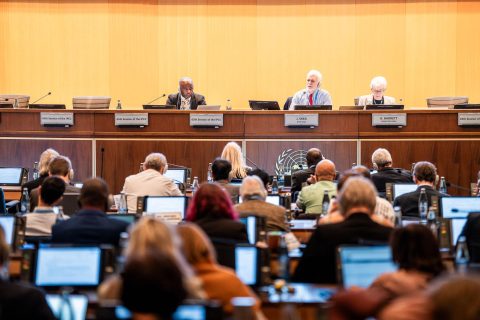

In July, PAICC said 12 countries had ignored its repeated attempts to discuss why they had not published an NDC as required every five years under the 2015 Paris accord.
Members of the committee had been divided over whether to name them, but at a September meeting decided to do so in their annual report to the annual climate COP summit.
By the time the report was published on Friday, only Congo, Senegal and North Korea “had not communicated an NDC or submitted a [Biennial Transparency Report] and had not yet responded to any of the Committee’s notifications, despite several reminders issued by the Committee in this regard”.
Rainforest and renewable energy ambitions
The silence from Congo and Senegal is notable because the former is home to much of the Congo Basin rainforest while the latter has sought billions of dollars in climate finance to support its renewable energy ambitions.
After Brazil, Congo has more rainforest than any country in the world. This forest, and the country’s peatlands, absorb huge amounts of greenhouse gas but are fast being lost to expanding farmland, charcoal production, logging and mining.
Senegal signed a Just Energy Transition Partnership with Canada and wealthy European nations in 2023, to help it meet its renewable energy targets under the-then government of Macky Sall. It was chair of the Least Developed Countries group between January 2022 and December 2023.

Tejas Rao, who is researching the PAICC as part of a doctoral thesis at Cambridge University, said the governments of the three countries should engage with the committee.
“Engagement costs these governments very little and the committee has shown it will listen,” he said.
“Silence leaves the committee with no basis to help, and it leaves the [governments] exposed to the narrative that they are simply disengaged,” he told Climate Home News.
Paris Agreement requirement
The 2015 Paris Agreement requires all parties to publish an NDC every five years outlining their emissions reduction targets, with each plan meant to be more ambitious than the country’s last NDC.
The latest set – the third round of plans, with new targets for 2035 – was due in February 2025. While most countries missed this deadline, all but around 30 – mostly small emitters but including Egypt, Vietnam and Argentina – have now submitted them.
Over the year, the PAICC – which is made up of government climate officials from developed and developing countries – has been communicating with governments that have not submitted NDCs and trying to overcome barriers to them doing so.
Some nations have cited exceptional circumstances as the reason for not submitting an NDC, a process that requires a significant amount of work in tracking emissions and consulting on how to curb them across the economy. For example, a letter from a Sudanese official to the PAICC, seen by Climate Home News, said that the country’s civil war had led to the suspension of its NDC preparation.
-
IPCC scientists vow to press on with climate reports despite political deadlock
After governments again failed to agree a timeline, nearly 120 IPCC authors pledged to complete their assessment on time and with full scientific rigour -
Under US pressure, World Bank says it will back gas “where appropriate”
The US wants the World Bank to expand its gas support while climate campaigners are pushing for it to end – its head spoke this week of limited backing for the fossil fuel -
Who shapes climate science? The equity question facing the IPCC
Early completion of the next global climate science assessment reports risks excluding research from the Global South, which is key to ensuring the findings are fair
The US and Iran are not signed up to the Paris Agreement and so do not have active NDCs, nor does Taiwan, which is not a UN member state.
Rao said that because the PAICC is “facilitative and non-punitive”, naming the countries “is meant to open a door, not close one – the invited consultation is the point”.
“In recent months, governments that explained their constraints, whether capacity, finance or domestic process, have been met with follow-up and support rather than sanction, and the number of silent governments has fallen sharply,” Rao said.
The post Paris Agreement committee names three countries snubbing it over NDCs appeared first on Climate Home News.
Paris Agreement committee names three countries snubbing it over NDCs