A US biofuels producer that exports “green” aviation fuel to Britain and the European Union has purchased beef tallow from a Brazilian supply chain tied to illegal deforestation in the Amazon, shipping data and a court document show.
Diamond Green Diesel (DGD), a major provider of sustainable aviation fuel (SAF) and renewable diesel, has sourced hundreds of thousands of tonnes of beef tallow from Brazil, alongside waste fats from other sources, over the last three years, as global demand for biofuel feedstocks soars.
Reporting by Unearthed and nonprofit investigative outlet Repórter Brasil reveals DGD’s connection to a rendering plant that has sourced supplies from a meatpacker fined for buying cattle from an illegally deforested Amazon reserve. A previous investigation by Reuters and Repórter Brasil found DGD had bought animal fat from two other rendering factories linked to supplies of cattle from illegal ranches.
The newly identified factory, Pacífico Indústria e Comércio de Óleos e Proteínas Ltda, which is based in Cacoal, a small city in the far-western Amazon state of Rondônia, has been supplied by Rondônia meatpacker DistriBoi, a 2022 court document shows.
DistriBoi was fined two years ago for illegally purchasing cattle from the state’s Jaci-Paraná conservation reserve, which has been ravaged by illegal ranching.
There is no suggestion that the companies involved were aware of deforestation at farm level. But the findings suggest a traceability gap in the supply chain of feedstocks for sustainable fuels, where cattle by-products are subject to less oversight than the primary commodities of the cattle industry, such as meat and leather.

Pristine rainforest blanketed the Jaci-Paraná reserve when it was created 30 years ago to protect traditional forest activities such as rubber tapping and nut harvesting.
Today, illegal ranching has devoured nearly 80% of its forest cover and it has become a notorious example of the devastation wrought by land grabbers in the world’s largest rainforest.
“The damage to biodiversity has been devastating,” said local Indigenous activist Neidinha Suruí, who featured in the 2025 Emmy Award-winning documentary “O Território”.
“It is sad to see what has been lost,” she said.
Greener air travel?
The “renewable diesel” and sustainable aviation fuel (SAF) that are being exported by DGD – a joint venture between US oil refiner Valero Energy Corp and Texas-based Darling Ingredients – are classed as “green” because they are made from feedstocks classified as waste, including tallow, which consists of fat separated from cattle carcasses.
Many governments and airlines are pinning their hopes for greener flying on SAF made with organic waste materials, including Britain which introduced a compulsory blending requirement last year.
Top green jet fuel producer linked to suspect waste-oil supply chain
Air travel accounts for about 2.5% of global carbon emissions and in contrast to other transport sectors that can be electrified, shrinking aviation’s carbon footprint is much more difficult.
Waste products such as beef tallow and used cooking oil (UCO) are considered the greenest of viable SAF feedstocks on the grounds that they do not create competition with foodstuffs such as soy oil or palm oil, nor increase deforestation pressure.

But there is concern that the global rush to ramp up SAF use could indirectly exacerbate deforestation pressure by increasing demand for feedstocks such as tallow and UCO.
That could increase the profit margins of cattle ranches – including illegal ones – and have other unintended consequences, such as encouraging fraud in supply chains, as Climate Home News has reported.
An investigation published in March by Climate Home News and Swedish broadcaster SVT found that Finnish biofuels giant Neste is sourcing key ingredients for its SAF from an opaque supply chain that enables fresh palm oil to be passed off as used, waste oil.
Because tallow is classified as waste by regulators in markets including the UK and EU, the green fuel industry’s most widely used certification scheme – International Sustainability and Carbon Certification (ISCC) – does not assess whether forests were cleared to rear the cattle that produced it in the first place.
-
Amazon fires threaten initiatives to raise cash for rainforest protection
Brazil’s Tropical Forests Forever Facility (TFFF) and other innovative finance tools will be showcased at COP30, but surging wildfires in the Amazon pose a threat to their success, climate experts warn -
Deep in the Amazon, forest protection cash must vie with glitter of illegal gold
The TFFF fund launched at COP30 aims to pay communities to protect the rainforest, but will it be enough? On French Guiana’s border with Brazil, the profits to be had from mining are far higher -
Funding gap threatens next round of IPCC climate science reports, chair warns
The latest IPCC session in Bangkok was clouded by persistent differences over when its flagship reports should be published and concern over cost-cutting proposals


This allows tallow from cattle to qualify as a sustainable feedstock for green fuels, even if they were raised on illegally deforested land.
“There is clearly an oversight within the rules if the products, in this case animal tallow, are originally coming from deforested land,” said Cian Delaney, a campaign coordinator at the clean transport and energy advocacy group Transport & Environment.
That means government SAF mandates aimed at stemming air travel emissions could help boost the earnings of cattle ranchers linked to illegal deforestation in Brazil, where ranching and other forms of agriculture have been the main driver of forest loss.
Land grabbers clear way for ranchers
Once covered by an unbroken rainforest canopy, Rondônia’s Jaci-Paraná reserve has been decimated by illegal deforestation driven by cattle ranching – a major cause of tree loss in the Amazon.
Land-grabbers have seized – often violently – and cleared more than three-quarters of its forest for pasture, as ranching has steadily advanced into the southern Amazon.
Suruí, the local Indigenous activist, said companies that buy products derived from illegal activities perpetuate environmental crimes in the rainforest.
“If there were no meat processors buying illegally sourced cattle, there would be no land grabbing and no deforestation,” Suruí told Repórter Brasil, which partnered on the new investigation with Unearthed, and a team of journalists supported by JournalismFund Europe.
Lawsuits and linked supply chains
Brazilian President Luiz Inácio Lula da Silva has pledged to end all deforestation in the country by 2030, in part by strengthening environmental enforcement in the world’s biggest rainforest.
In Rondônia, authorities have launched more than 50 lawsuits related to land-grabbing and deforestation in the Jaci-Paraná reserve alone. Local slaughterhouse DistriBoi is named in 31 of the lawsuits, including the 2024 case in which it was fined.
According to the 2022 court document, which concerned an unrelated labour dispute, lawyers for Pacífico refer to DistriBoi as the rendering plant’s “largest supplier of raw materials”.
US-based DGD received almost 15,000 tonnes of tallow from Pacífico from 2023 to 2025 at its Texas refinery, as well as used cooking oil from various countries and sources, according to trade database Panjiva.

Darling Ingredients is also a parent company of Pacífico since its 2022 acquisition of Brazilian rendering company FASA Group.
A spokesperson for Darling Ingredients denied that Pacífico had sourced beef residues from DistriBoi’s Ji-Paraná slaughterhouse – one of two that the meatpacker operates in Rondônia.
“The rendering plant Pacífico does not source any materials from the slaughterhouse Distriboi in Ji-Paraná,” the spokesperson said in an emailed response, without providing evidence or commenting directly on the content of the 2022 court document.
Darling did not respond to a follow-up question about Distriboi’s other slaughterhouse in the region, which, according to cattle transfer documents, has also bought from a farm that has illegally cleared forest within the extractive reserve.
“Our relationships are typically with the slaughterhouse, several levels removed from cattle ranchers. Regardless, we are committed to ensuring our raw materials are deforestation free. We expect our raw material suppliers to abide by our supplier code of conduct. In addition, we are in the process of requiring all [the] raw materials to attest that their material is deforestation free,” the spokesperson said in a statement.
DistriBoi said in an apparent reference to the pending Jaci-Paraná lawsuits that “the matters mentioned … are already under review, including by higher courts”. It has previously denied wrongdoing. The company’s statement did not address a question about its commercial ties to Pacífico.
Valero Energy, the major refiner that co-owns DGD with Darling Ingredients, did not respond to requests for comment, nor did DGD itself.
From slaughterhouse to SAF
In an effort to rein in carbon emissions from air travel, regulators in Britain and the EU have mandated progressively increasing SAF blending quotas in the years ahead, creating a new market for feedstocks including beef tallow.
Brazil’s exports of tallow to the US have risen sharply in recent years, up from less than 10,000 tonnes in 2021 to almost 400,000 tonnes last year, according to Panjiva, reflecting growing demand for biofuels like SAF.
In the UK, Europe’s biggest aviation market by seat capacity, jet fuel was required to contain 2% SAF by the end of 2025, rising to 10% by 2030 and 22% by 2040.
DGD shipped 134,000 tonnes of SAF worth nearly $90 million from Texas to the UK in 2025, according to trade data from Panjiva. The company also exported smaller amounts of renewable diesel to Britain.
The EU received biofuels, including small quantities of SAF, worth over $1.1 billion from DGD’s Texas refinery last year, figures show.
Is the world’s big idea for greener air travel a flight of fancy?
Unearthed’s investigation could not identify which airlines or airports buy DGD’s SAF once it arrives in Britain.
Valero, DGD’s other parent company, is positioning itself as a key player in the transition to lower-carbon fuels in the UK, where it markets its renewable diesel under the Texaco brand.
It has been an active participant in SAF policy discussions and has criticised the government’s planned cap on waste fat sources in SAF, calling them “the world’s most cost-effective production route for SAF” in a submission to parliament.
Helping to cut emissions?
Even tighter oversight over SAF feedstocks is crucial to ensure that blending mandates such as Britain’s are effectively lowering emissions, said Anna Krajinska, a director at Transport & Environment UK.
Forests store vast amounts of carbon; when they are cut down or burned this carbon is released into the atmosphere.
“If there’s tallow coming from land that’s been deforested, then those emissions might be so high that you might not be getting to the greenhouse gas reduction threshold,” Krajinska said.

But as the world’s appetite for flying keeps on growing, some experts say SAF is the only viable means to reduce aviation emissions at present.
Referring to the deforestation links identified in Unearthed’s investigation, Wouter Dewulf, an aviation economist at Belgium’s University of Antwerp, said it “would be important to assess how large this infraction is”.
“I’m quite sure you have aberrations,” Dewulf added. “But biofuels are the best alternative for the moment.”
T&E’s Delaney said there needs to be less opacity and better oversight from regulatory authorities. “Right now, there are just too many blindspots,” he added.
The post UK imports of “green” jet fuel linked to Amazon deforestation appeared first on Climate Home News.
UK imports of “green” jet fuel linked to Amazon deforestation

Climate Change
“Sink or swim”: WA Gov hugely underestimating decline in regional gas demand while sleeping on green exports, new report finds
PERTH, Tuesday 13 October 2026 — A new report from Greenpeace Australia Pacific and Springmount Advisory reveals green commodity exports are an untapped economic opportunity for Western Australia in a declining Asian gas market, while offering a genuine solution for decarbonising Asia.
From Gas to Green: Building Western Australia’s Future State is a comprehensive analysis of the declining gas market in Asia, and the untapped economic opportunity for WA to become a global leader in green commodity exports while driving the regional shift away from fossil fuels.
The report offers key recommendations for the WA Government to support regional decarbonisation through an orderly phase out of gas exports in favour of green iron and other green exports. It comes as global climate leaders from across business, politics and advocacy prepare to meet for the Global Citizen Now: Perth event focused on decarbonising WA.
Key findings:
- Gas demand is falling across WA’s core markets in Asia: Gas demand fell in 2025 and is projected to continue to decline, driven by a combination of global geopolitical factors and domestic concerns.
- Policy shifts in key markets since the war on Iran now prioritise renewables and nuclear over gas: Japan, South Korea and China have legislated energy plans that prioritise renewables and nuclear over gas.
- New WA gas would arrive in a saturated, uncertain Asian market filled with cheaper gas: The US is now the world’s largest liquefied gas producer and plans to double its capacity as it also targets Asian markets.
- Green commodities offer a real solution to sustain WA’s economy: WA can lead Australia’s green commodity exports, which by 2060 could be worth almost a trillion dollars.
- Exporting more WA gas is likely to delay or impede Asia decarbonisation: Despite claims by the gas industry, there is no evidence that WA gas is displacing coal in Asia, and in fact diverts resources from genuine decarbonisation options.
Geoff Bice, WA Campaign Lead at Greenpeace Australia Pacific said: “As our export partners in Asia shift away from expensive and polluting gas, the WA Government has a golden opportunity to pivot our economy to green exports, like green iron, which is the most effective way to help our region to decarbonise.
“The writing is on the wall: gas is in decline, renewables are our future. In this context, it makes zero sense for the government to encourage high risk projects like Woodside’s reckless Browse gas proposal at Scott Reef.
“This report clearly shows that the WA Government faces a choice: sink or swim. They can either allow the gas industry to keep ripping off West Australians and continue propping up its decline, or choose the path that will deliver enormous benefits to the state and the world by becoming a leader in the rapidly expanding green economy.”
Tom Quinn, Managing Director of Springmount Advisory: “Western Australia prospers when it looks to the future and builds for future demand. Twenty years from now, what the world needs is green commodities made using WAs abundant renewable resources. Just like it did with iron ore in the 1950s and gas in the 1970s, WA should look to the future and build what the world will need, not sunsetting industries like gas that are already past their peak.”
-ENDS-
Media contact
Kate O’Callaghan on 0406 231 892 or kate.ocallaghan@greenpeace.org
Lucy Keller on 0491 135 308 or lucy.keller@greenpeace.org
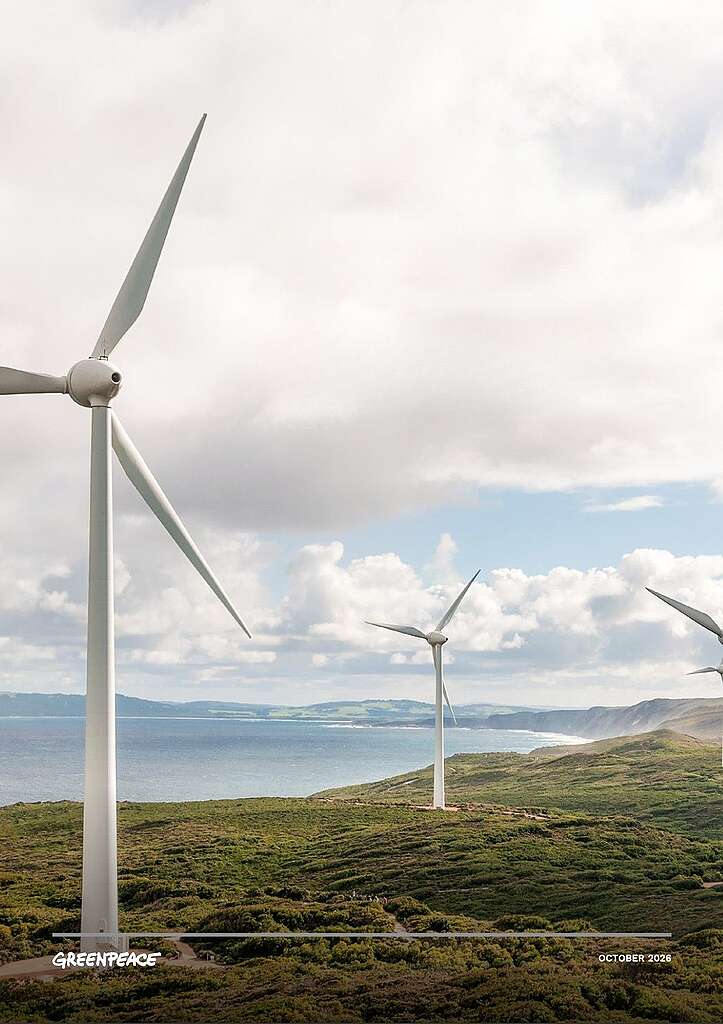
A report from Greenpeace Australia Pacific and Springmount Advisory reveals the untapped green economic opportunity for Western Australia in a declining Asian gas market, which also offers a genuine solution for decarbonisation in Asia.
Is Western Australia clinging to a fading gas industry while a thriving green future passes it by? As major Asian trading partners rapidly pivot away from volatile gas imports toward cheap solar and battery storage, this report exposes a high-stakes choice: risk becoming stranded in an oversupplied fossil fuel market, or harness WA’s unmatched sun and wind to lead the global clean energy transition.