


TVA needs to hit refresh! This is not a difficult concept. I’ll even include a link to the WikiHow page on how to do it. But if decision-makers fail to do that, the information they’re accessing from the internet may be outdated and their decisions may be misguided.
Solar energy is a dynamic field. A lot can change in a year. Decisions need to be based on current reality and future projections. Pricing and availability of solar modules from 2022 are largely irrelevant for decisions being made now.
TVA, however, has relied on outdated and inaccurate information about the solar market in its Final Environmental Impact Statement (Final EIS) just released last month for retiring and replacing the Kingston Fossil Plant (nine coal-fired units in operation since 1954-1955). The Final EIS is the last step before the TVA Board of Directors makes a decision on whether to replace the coal plant with another fossil fuel or clean energy. The TVA Board needs to require TVA staff to redo its analysis of the two options with accurate information before making a final decision.
TVA assessed two options:
Alternative A: a combined-cycle (CC) gas unit paired with 16 dual-fuel Aeroderivative (Aero) combustion turbine (CT) units plus 3- to 4-MW solar on-site, a 100-MW battery energy storage system, and transmission investments. These would all be on-site at the Kingston Reservation 35 miles west of Knoxville — and would require a 122-mile gas pipeline with a gas compressor station, which would pass through Roane, Morgan, Fentress, Overton, Jackson, and Smith counties.
Alternative B: multiple solar generation and energy storage facilities at alternate locations, portions of which would be in Eastern Tennessee — along with the necessary transmission.
SACE has identified a fundamental flaw in the EIS. I’d like to highlight three examples from Section 1.2.3.3.1 (on pages 11-12 of the 845 page document) with emphasis added:
“The short-term effects of the IRA [Inflation Reduction Act] thus far have resulted in increased demand, higher prices, and a limited supply of resources needed for renewable technologies (Solar Energy Industries Association [SEIA] 2022).”
“Solar generation and energy storage facilities would require the development of multiple solar generating facilities and therefore are subject to market factors, such as variable costs, supply chain disruptions, and limited availability of materials. Solar panels are primarily produced overseas, and, at this time, the U.S. has little competitive onshore solar manufacturing capability (USDOE 2022, SEIA 2022).“
“The increased demand and subsequent increase in cost and limited availability of resources has resulted in a reversal of a decades-old trend of decreasing solar prices, and many solar projects being postponed or canceled as a result. While the IRA incentivizes the transition of the solar supply chain to the U.S., it is projected that it will take 3 to 5 years for the domestic supply chain to mature and ease the current constraints on the solar industry (SEIA 2022).”
A common element across these three assertions is that they all cite information from the Solar Energy Industries Association from 2022. Tracing that lead to page 828 of the Final EIS document (Literature Cited), we find:
Solar Energy Industries Association (SEIA). 2022. Solar Market Insight Report 2022 Q2. Available at [URL]: https://www.seia.org/research-resources/solar-market-insight-report-2022-q2. (Accessed December 2023).
SEIA is a reputable trade-association and it, no-doubt, reported the supply chain disruptions in 2022. So did SACE. But SEIA updates that Solar Market Insight Report on a quarterly basis. By the time TVA accessed that Q2 2022 report in December 2023, SEIA would have prepared six more recent/updated versions.
The Q4 2023 version was released on December 7, 2023. And one of the things they express is that:
“The strong deployment growth in Q3 2023 has largely been due to module supply chain stabilization within the past year.” U.S. Solar Market Insight: December 7, 2023 [emphasis added]
In fact, the US installed more solar in 2023 than ever before.

The Q4 2023 Solar Market Insights report goes on to say that a combination of factors:
“pushed US module prices down 10-15% over the same timeframe as supply constraints have alleviated.” [emphasis added]
And, as for the claim that “the U.S. has little competitive onshore solar manufacturing capability” and that “it will take 3 to 5 years for the domestic supply chain to mature”… well, Qcells in Dalton, Georgia, just south of the TVA service territory, has become the largest solar factory in the western hemisphere.
The Final EIS cover sheet (page i) estimates that preparation of the report cost $2.2 million. Wow! For that kind of money, they should be able to get accurate, up-to-date information. The TVA Board should insist on it. Otherwise, the Board runs the risk of making a decision based on bad intel that saddles the people of the Tennessee Valley with expensive and dirty energy for the next generation.
TVA can do better.
#CleanUpTVA
The post TVA relies on out-dated info to stall solar progress and justify fossil gas appeared first on SACE | Southern Alliance for Clean Energy.
TVA relies on out-dated info to stall solar progress and justify fossil gas

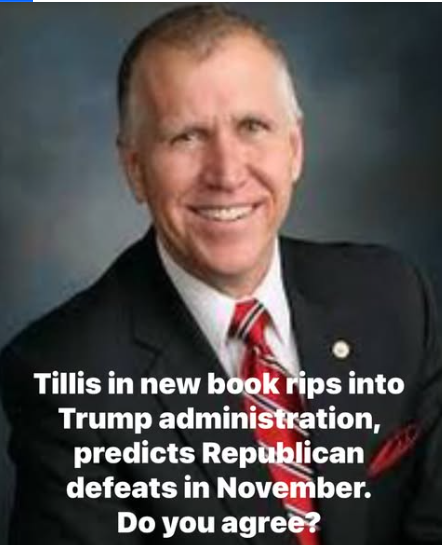 Maybe, as they say, “Hell has a special place reserved in it” for people like Thom Tillis, Republican Senator from North Carolina, who enabled Trump to rape and destroy the United States.
That was until it became clear to Tillis that he could jump ship, write a scathing book about the president, get all over mainstream news promoting it, and go on to enjoy another chapter of political success.
That we Americans are so stupid that we accept this blatant hypocrisy and criminality is sad proof that we’re not the people we were 20 years ago. Maybe what many people are saying are correct: we deserved what we got.
Here’s a short video from Elle Cordova that reminds us that science is something of a rarity in human history.
The great tyrants of history have done their best to cause the people they ruled to reject science, simply to ensure the masses are ignorant, terrified, superstitious, and thus easily controlled.
The current political administration is particularly engrossed in the rejection of science. I wonder why.
 Are you saying that the ascendency of a criminal sociopath made Western Civilization great?
Not sure how credible that is to people with the IQ of an artichoke.



-
Climate Change1 year ago
Guest post: Why China is still building new coal – and when it might stop
-

 Greenhouse Gases2 years ago
嘉宾来稿:满足中国增长的用电需求 光伏加储能“比新建煤电更实惠”
-
Greenhouse Gases1 year ago
Guest post: Why China is still building new coal – and when it might stop
-

 Climate Change2 years ago
嘉宾来稿:满足中国增长的用电需求 光伏加储能“比新建煤电更实惠”
-

 Renewable Energy12 months ago
Sending Progressive Philanthropist George Soros to Prison?
-
Climate Change2 years ago
Bill Discounting Climate Change in Florida’s Energy Policy Awaits DeSantis’ Approval
-
Greenhouse Gases1 year ago
嘉宾来稿:探究火山喷发如何影响气候预测
-

 Climate Change2 years ago
Analysis: China’s CO2 falls 1% in Q2 2024 in first quarterly drop since Covid-19