
Connect with us

Published

on

TotalEnergies Hits Record $73 Million Carbon Credit Spend as 2025 Profits Stay Strong

TotalEnergies spent a record $73 million on carbon credits in 2025. This was up 49% compared with 2024. The figure was disclosed alongside the company’s full-year financial results.

Carbon credits allow companies to offset emissions by funding projects that reduce or remove carbon dioxide. These projects include forest protection, reforestation, and other verified climate initiatives.

The higher spending shows that TotalEnergies is expanding its carbon portfolio. The company uses carbon credits to manage emissions that are hard to cut quickly. This includes emissions from oil and gas production and from the use of its products.

The $73 million figure marks the company’s highest annual carbon credit spend to date.

Strong Profits Hold Firm in a Softer Oil Market

TotalEnergies reported strong 2025 financial results even as oil prices softened. For the full year 2025:

  • Adjusted net income reached $15.6 billion, down about 15% from 2024.
  • IFRS net income totaled $13.1 billion, down around 17% year-on-year.
  • The company generated nearly $28 billion in cash flow from operations, about 7% lower than 2024.
  • Return on average capital employed stood at 12.6%, among the highest for major energy companies.
  • Net debt remained low, with a gearing ratio of around 15% at year-end.
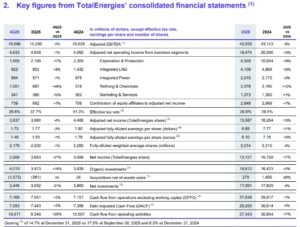
Totalenergies 2025 financial results
Source: TotalEnergies

These results show that TotalEnergies maintained strong profitability and balance sheet discipline. Upstream oil and gas production rose by about 4% in 2025, helping offset weaker oil prices. LNG sales also supported earnings.

The company continued to reward shareholders while investing in future growth.

Billions Flow Into Renewables and Power Growth

TotalEnergies invested $17.1 billion in capital expenditures in 2025. About 37% went to new oil and gas projects while around $3.5 billion went to low-carbon energies. Of that, nearly $3 billion was directed to electricity and renewables.

The company added 8 gigawatts (GW) of renewable capacity in 2025. This matches its goal of adding about 8 GW per year through 2030.

Electricity production continues to grow as part of the company’s strategy. In 2024, TotalEnergies reported a 23% rise in net electricity generation compared with the previous year.

Methane reduction also advanced. In 2025, TotalEnergies reported a 65% cut in methane emissions compared with 2020 levels. The company aims for near-zero methane by 2030. 
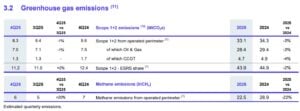
Totalenergies GHG emissions 2025
Source: TotalEnergies

These steps support its broader climate strategy while keeping traditional energy operations active.

Offsets as a Bridge in the Net-Zero Plan

Carbon credits play a defined role in TotalEnergies’ climate plan. The company has stated that it plans to invest about $100 million per year in carbon projects over time. These projects aim to build a large portfolio of credits to offset residual emissions by 2030.
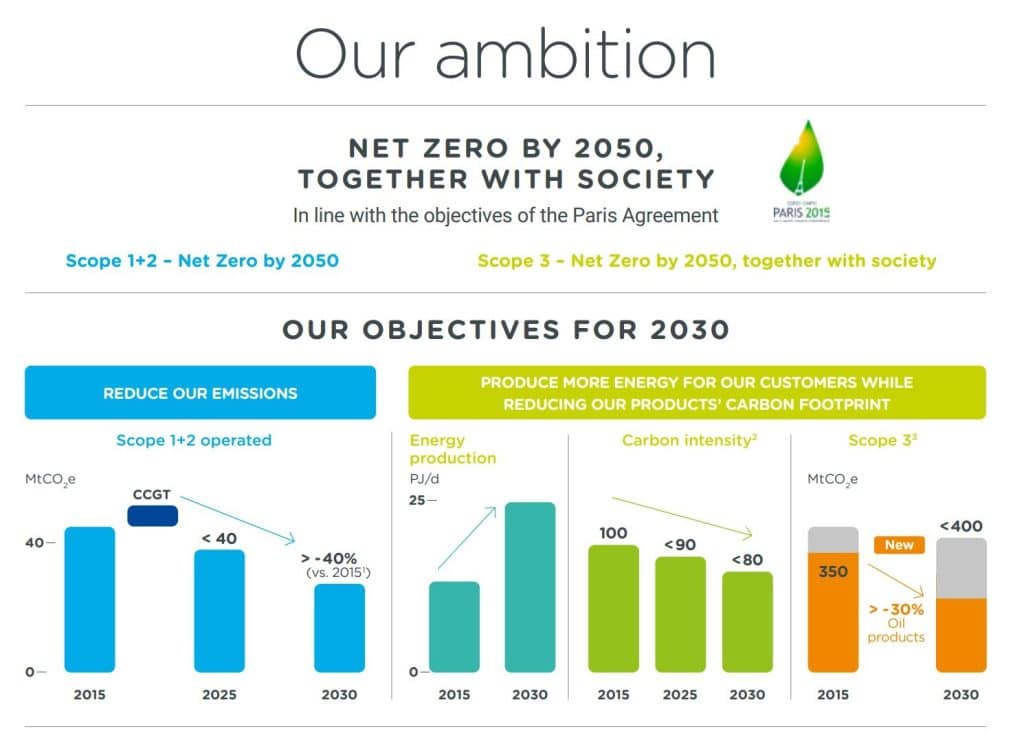
TotalEnergies net zero 2050 ambition
Source: TotalEnergies

Carbon credits help cover emissions that cannot yet be eliminated through technology or operational changes. For oil and gas companies, this often includes emissions from product use, also known as Scope 3 emissions.

TotalEnergies aims to reach net-zero emissions by 2050 across its operations and energy products. This includes reducing direct emissions and lowering the carbon intensity of the energy it sells.

In 2024, the energy company reported a 16.5% reduction in lifecycle carbon intensity compared with 2015, exceeding its initial 14% target. 

Carbon credits serve as a bridge. They support climate projects while the company expands renewables and reduces operational emissions. The oil major reduced its Scope 1 and 2 GHG emissions from 34.3 Mt CO₂e in 2024 to 33.1 Mt CO₂e in 2025, a drop of 1.2 Mt or ~3.5%. 
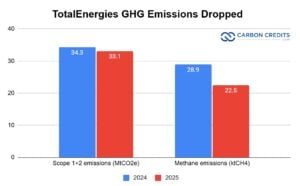
TotalEnergies GHG Emissions Dropped 2025

How Big Oil Is Leveraging the Carbon Credit Market

TotalEnergies is not alone in using carbon credits. Many large oil and gas companies use credits as part of their climate plans. For example:

  • Shell has invested in nature-based carbon projects and operates a large carbon credit portfolio to offset customer emissions.
  • BP has also used carbon credits in voluntary carbon markets as part of its net-zero ambition.
  • Equinor invests in carbon capture and storage and has supported carbon market mechanisms.

Oil majors face unique challenges. Their products release emissions when burned. Cutting these emissions fully will take decades and large-scale changes in global energy systems. This is where carbon credits come in. It allows companies to support emission reductions elsewhere while they shift their energy mix. 

The voluntary carbon market has grown in recent years. Companies across sectors use credits to meet climate commitments. However, the market has also faced scrutiny over credit quality and verification standards, and thus, the declining transaction volume. 
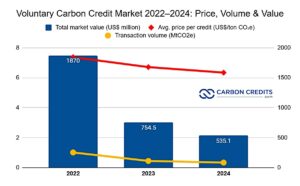
Voluntary carbon credit market; price, volume, value 2022-2024

As a result, many large companies now focus on high-quality, verified projects. These include forest conservation, reforestation, and technology-based carbon removal.

For oil majors, carbon credits are often a small share of total spending. But they signal engagement with climate tools and frameworks. TotalEnergies’ record $73 million spend in 2025 reflects both climate strategy and market conditions.

Balancing Cash Flow and Climate Goals

TotalEnergies continues to operate as a diversified energy company. Oil and gas remain core revenue drivers. At the same time, renewables, electricity, and low-carbon investments are growing.

The oil major also plans to keep expanding renewable capacity while maintaining upstream strength.

In 2025, TotalEnergies signed and advanced major electricity projects totaling more than 14 GW of capacity in Europe. It also recycled capital through asset sales to fund further clean energy investments. This dual strategy allows the company to generate cash from traditional energy while investing in transition pathways

The record carbon credit spending fits into this broader balance. It complements operational emission cuts and renewable expansion.

For instance, TotalEnergies has partnered with Google on large renewable energy deals.  The company has signed two 15-year solar PPAs in Texas. These agreements will provide 1 GW of solar capacity. That’s about 28 TWh for Google’s data centers in Texas over the contract period.

These deals reflect TotalEnergies’ expanding role in corporate renewable supply and its growing electricity portfolio across the United States.

2026 Outlook: Profitability Meets Transition Pressure

The French multinational integrated energy company enters 2026 with strong finances and a defined climate path. The company plans to continue investing in oil and gas projects that generate stable returns. At the same time, it aims to grow electricity production and low-carbon assets. Carbon credits will likely remain part of its strategy, especially as voluntary carbon markets mature and standards improve.

The $73 million record in 2025 shows increased use of carbon market tools. It also highlights how energy companies are combining financial performance with climate commitments.

TotalEnergies’ results suggest that profitability and climate investment can move in parallel, even in a changing energy landscape.

The post TotalEnergies Hits Record $73 Million Carbon Credit Spend as 2025 Profits Stay Strong appeared first on Carbon Credits.

Continue Reading

Carbon Footprint

Building global awareness: Green Earth’s outreach to independent analysts and commentators

Published

on

At Green Earth Group N.V. (Euronext Amsterdam: EARTH, ISIN: NL0009169515), we are committed to engineering possibilities for a greener planet with a mission to make regeneration scalable and investable for people and the planet. We are a leading end-to-end developer of high-quality, large-scale nature-based solutions that restore ecosystems and improve livelihoods.

Continue Reading

Carbon Footprint

Boeing Locks In 40,000 Tons of Carbon Removal Credits in Major Biochar Climate Deal

Published

on

Boeing Locks In 40,000 Tons of Carbon Removal Credits in Major Biochar Climate Deal

Aerospace giant Boeing has signed a multi-year agreement with carbon removal platform Carbonfuture to purchase at least 40,000 tonnes of durable carbon dioxide removal (CDR) credits. The deal ranks among the largest carbon removal procurements in the aviation sector so far.

The carbon credits will come from a portfolio of biochar carbon removal projects, mainly located across the Global South. Biochar is created by heating plant material in a low-oxygen environment. The process converts biomass into a stable form of carbon that can be stored in soil for long periods.

Carbonfuture will track each credit using its digital monitoring system. The platform records the entire carbon removal process—from biochar production to soil application. It also verifies ownership of the credits.

The agreement helps Boeing tackle emissions that technology or fuel changes can’t eliminate yet. The company plans to apply these credits to Scope 3 emissions linked to business travel.

Allison Melia, VP Global Enterprise Sustainability, Boeing, said:

“To support long-term global demand for air travel, the aviation industry has set goals to reduce emissions. We’re excited to team up with Carbonfuture to support technological innovation in carbon removals to help meet these needs.”

This partnership reflects a broader shift in corporate climate strategies. Many industries now combine emissions reductions with carbon removal to manage their climate impact.

Why Aviation Is Turning to Carbon Removal

Decarbonizing aviation is difficult. Aircraft can last for decades, and alternatives like hydrogen planes or fully electric aircraft are still years away from wide use.

The aviation sector produces around 2–3% of global carbon dioxide emissions, based on research from energy and industry studies. When scientists look at the warming effects of contrails and other non-CO₂ emissions, aviation’s climate impact gets bigger.

Airline aviation sector ghg emissions 2024 IATA
Source: IATA

Demand for flights also continues to grow. Rising global travel has offset many efficiency improvements in aircraft design and operations.

Sustainable aviation fuel (SAF) is one promising solution. However, SAF still accounts for less than 1% of global jet fuel supply and often costs two to ten times more than conventional jet fuel.

SAF supply forecast 2030

Because of these limits, aviation companies are turning to carbon removal technologies. These systems physically remove carbon dioxide from the atmosphere rather than simply avoiding emissions.

Boeing’s deal with Carbonfuture shows how carbon removal can complement other decarbonization strategies.

Biochar Carbon Removal: Turning Biomass Into Long-Term Carbon Storage

The credits in Boeing’s deal come from biochar-based carbon removal projects. Biochar forms through a process called pyrolysis. Organic waste, such as crop residues or forestry by-products, is heated in a low-oxygen environment. This converts the biomass into a carbon-rich charcoal.

biochar carbon market snapshot 2025

When biochar is added to soil, it can store carbon for hundreds of years while improving soil health and water retention.

The projects in Boeing’s agreement also provide environmental benefits beyond carbon storage. Biochar can increase soil fertility, improve crop yields, and support agricultural resilience in regions facing land degradation.

Carbonfuture’s digital platform tracks every stage of the carbon removal process. This monitoring system aims to increase transparency and trust in carbon credit markets.

High-quality verification matters. Voluntary carbon markets have faced criticism for weak oversight and questionable offset projects.

Inside Boeing’s Emissions Footprint and Net-Zero Strategy

The carbon removal agreement is part of Boeing’s broader sustainability strategy. Like many aerospace companies, the aerospace giant faces large emissions from its value chain. Most of its climate impact comes from Scope 3 emissions. These include airline aircraft operations and other indirect activities.

Boeing’s total carbon footprint is estimated at around 374 million metric tons of CO₂ equivalent for 2024. Of this, about 373 million tons are from Scope 3 sources.

Direct emissions from Boeing operations are much smaller. The company reported about 517,000 tons of Scope 1 emissions and 464,000 tons of Scope 2 emissions from purchased electricity.

Because Scope 3 emissions dominate aviation’s footprint, companies must work across the entire ecosystem. That includes airlines, fuel suppliers, airports, and aircraft manufacturers.

Boeing plan to decarbonize aerospace

The ariplane maker says its strategy focuses on four main areas:

  • improving aircraft fuel efficiency,
  • supporting sustainable aviation fuel development,
  • advancing new propulsion technologies, and
  • using carbon removal for residual emissions.

Carbon removal purchases help address emissions that cannot yet be eliminated through technological change.

Corporate Demand Is Fueling the Carbon Removal Market

Boeing’s deal also reflects rapid growth in the carbon removal market. Corporate demand for carbon dioxide removal has expanded in recent years. Many companies now view durable removals as a key tool for meeting net-zero climate targets.

Recent data shows that high-durability carbon removal credits hit nearly 8 million metric tons in 2024. This is up from about 2.4 million tons in 2023. That’s a jump of around 233% in just one year, according to CDR.fyi.

Analysts expect carbon removal demand to rise sharply over the next decade as climate targets tighten. BCG estimates that annual demand for carbon removal might hit 40–200 million tons of CO₂ by 2030. It could grow further to 80–900 million tons by 2040 as more companies commit to net-zero goals.

New technologies such as biochar, direct air capture, and mineralization are gaining attention from investors and large corporate buyers.

Early demand will likely come from voluntary corporate buyers. These buyers could make up about 90% of carbon removal purchases soon as companies are looking for high-quality solutions to tackle hard-to-eliminate emissions.

Large technology companies such as Alphabet, Stripe, and Microsoft currently dominate the market. Microsoft alone purchased about 5.1 million tons of durable carbon removal credits in 2024, representing around 63% of total market demand.

Earlier, Boeing signed another major removal agreement with carbon removal firm Charm Industrial. That deal targeted up to 100,000 tons of CO₂ removal, showing the company’s growing interest in durable climate solutions.

Aviation’s Net-Zero Path: Fuel Innovation Meets Carbon Removal

The Boeing–Carbonfuture agreement highlights a growing trend in hard-to-abate industries. Aviation, steel, shipping, and cement all face similar challenges. These sectors depend on energy-dense fuels and long-lived infrastructure.

Because of this, companies are exploring multiple climate strategies at once. These include:

  • new aircraft designs,
  • sustainable aviation fuels,
  • operational efficiency improvements, and
  • carbon removal technologies.

Durable carbon removal is increasingly viewed as a bridge solution. It can help manage emissions while new technologies mature.

As global air travel grows, airlines and aircraft makers will face more pressure. They need to show clear paths for decarbonization.

Scaling Climate Solutions for Hard-to-Abate Sectors

Boeing’s carbon removal partnership with Carbonfuture marks an important step in aviation’s evolving climate strategy. The agreement will secure at least 40,000 tonnes of durable carbon removal credits, making it one of the largest such deals in the aerospace sector.

Carbon removal won’t solve aviation’s emissions issue by itself. However, it can support fuel innovation, improve efficiency, and help with cleaner energy systems.

As industries move toward net-zero targets, carbon removal markets are likely to grow rapidly. For companies across transportation, the path to a low-carbon future will rely on a mix of technological breakthroughs and credible climate solutions.

The post Boeing Locks In 40,000 Tons of Carbon Removal Credits in Major Biochar Climate Deal appeared first on Carbon Credits.

Continue Reading

Carbon Footprint

Apple Beats ‘Carbon Neutral’ Lawsuit, But Greenwashing Scrutiny Is Heating Up

Published

on

Apple Beats ‘Carbon Neutral’ Lawsuit, But Greenwashing Scrutiny Is Heating Up

A U.S. federal judge has dismissed a proposed class-action lawsuit accusing Apple of misleading consumers with “carbon neutral” marketing for several Apple Watch models. The case targeted the Apple Watch Series 9, Apple Watch SE, and Apple Watch Ultra 2. Plaintiffs said the company exaggerated the environmental benefits of the watches. They claimed Apple relied on carbon offset projects that did not truly cancel the products’ emissions.

Seven buyers filed the lawsuit in February 2025 in federal court in California. They argued they would not have bought the watches, or would have paid less, if they knew the details of Apple’s carbon accounting.

In February 2026, U.S. District Judge Noël Wise dismissed the case. The court ruled the complaint lacked strong evidence showing Apple’s carbon-neutral claims were false or misleading. Wise said:

“At this juncture, the court has a narrow question to consider: have plaintiffs plausibly alleged that Apple’s claims of carbon neutrality are false? Because the court finds that the answer to that question is no, Apple’s motion to dismiss is granted.”

The ruling gives Apple an early legal win. But it also highlights growing scrutiny of corporate climate marketing.

How Apple Calculates a “Zero-Emission” Watch

Apple launched its first carbon-neutral devices in September 2023. The company said the Apple Watch models achieved neutrality through a mix of emissions reductions and carbon offsets.

For example, Apple estimates the lifecycle carbon footprint of a carbon-neutral watch model at about 8.1 kg of CO₂-equivalent emissions per device before offsets. After applying carbon credits, Apple says the net footprint becomes 0 kg CO₂e.

The tech giant says it lowers emissions by:

  • using recycled materials,
  • increasing renewable electricity in manufacturing,
  • improving product efficiency, and
  • reducing shipping emissions.

Any remaining emissions are offset through environmental projects.

The lawsuit challenged two offset projects tied to Apple’s claims. One project protects forests in Kenya’s Chyulu Hills, while another supports reforestation efforts in China. Critics argued such projects may not always deliver additional carbon reductions.

The court did not rule on the scientific debate over offsets. Instead, it said the plaintiffs failed to show Apple’s claims were clearly deceptive.

The Tech Giant’s 2030 Net-Zero Roadmap

Apple’s carbon-neutral watches are part of a larger climate plan known as “Apple 2030.” The company aims to make its entire business, supply chain, and product lifecycle carbon neutral by 2030.

Apple carbon neutral to 2030 pathway
Source: Apple

The iPhone maker has made progress toward that goal. The company says its global greenhouse gas emissions have fallen by more than 60% compared with 2015 levels.

In 2024, Apple reported a total carbon footprint of about 16.5 million metric tons of CO₂-equivalent emissions across its operations and supply chain. That figure represented a decline from the previous year.

apple carbon emissions 2024
Source: Apple

Most of Apple’s emissions come from Scope 3 sources, including manufacturing and product use. To address that, it works closely with suppliers. The company reports that 17.8 gigawatts of renewable electricity are now operating in its global supply chain. Those projects helped avoid about 21.8 million metric tons of greenhouse gas emissions in 2024 alone.

Apple has also increased recycled materials in its products. About 24% of the materials used in Apple devices in 2024 came from recycled or renewable sources. These efforts are central to the company’s climate strategy.

Greenwashing on Trial: Climate Claims Face Legal Tests

Even though Apple won the U.S. case, climate lawsuits are rising worldwide. Greenwashing claims typically challenge marketing statements such as:

  • “carbon neutral”
  • “net zero”
  • “climate friendly”

These terms can involve complex carbon accounting that consumers may not fully understand.

Apple has faced legal pressure outside the United States as well. A court in Frankfurt, Germany ruled in 2025 that Apple could not advertise the Apple Watch as “CO₂-neutral” in Germany. The court said the claim could mislead consumers under local competition law.

European regulators are also tightening rules on environmental claims. New EU consumer protection rules will restrict vague labels like “carbon neutral” in advertising beginning in 2026. These legal developments could reshape how companies communicate climate progress.

Big Tech Emissions: Clean Energy vs. Rising Power Demand

The Apple case reflects a larger trend in the technology sector. Tech companies are under growing pressure to cut emissions as demand for digital services rises.

Data centers, cloud computing, and artificial intelligence require massive amounts of electricity. As a result, technology firms are investing heavily in renewable energy and carbon removal projects.

Apple’s progress contrasts with some peers whose emissions have risen due to expanding AI infrastructure. Apple still emitted about 15.3 million metric tons of CO₂ in 2024, but that figure is far below its 2015 baseline of 38.4 million tons.

At the same time, clean energy adoption is growing globally. The rapid expansion of renewable power also supports other low-carbon industries, including electric vehicles.

Apple’s Clean Energy Capacity by Year

Companies such as Tesla rely heavily on the decarbonization of electricity systems. The climate benefit of electric cars increases when power grids shift toward renewable energy.

Global electric vehicle adoption is rising quickly. According to the International Energy Agency, EVs represented about 20% of global car sales in 2024, compared with 18% in 2023 and just 4% in 2020. That growth is expected to continue as governments strengthen climate policies and consumers adopt cleaner transportation.

Technology companies and automakers both depend on credible climate strategies to maintain investor confidence.

The Role of Carbon Credits in Corporate Climate Plans

Carbon credits remain a key tool for many companies pursuing net-zero goals. Apple increased its use of carbon credits in 2024, retiring about 737,100 tons of CO₂-equivalent offsets—its highest level to date.

Carbon offsets support several projects such as:

  • forest protection,
  • reforestation,
  • methane capture, and
  • renewable energy development.

However, the quality of carbon credits has become a major issue in climate policy.

Some researchers argue that certain nature-based credits may overestimate their climate impact. Others say these projects are essential for protecting ecosystems and funding conservation. The debate is likely to intensify as more corporations adopt net-zero targets.

A Legal Win, but Climate Claims Under the Microscope

Apple’s victory in the U.S. greenwashing lawsuit marks an important moment in the evolving field of climate litigation. The court ruled that the plaintiffs did not present enough evidence to prove the tech giant’s carbon-neutral claims were misleading.

However, the case also shows how closely corporate climate messaging is now examined. Companies across technology, energy, and transportation sectors face growing pressure to show real emissions reductions and transparent reporting.

As the clean-energy transition accelerates, and industries from consumer electronics to electric vehicles expand, clear standards for climate claims will become increasingly important.

For Apple and other global companies, the challenge is not only reducing emissions but also proving those reductions in ways that stand up to scientific, legal, and public scrutiny.

The post Apple Beats ‘Carbon Neutral’ Lawsuit, But Greenwashing Scrutiny Is Heating Up appeared first on Carbon Credits.

Continue Reading

Trending

Copyright © 2022 BreakingClimateChange.com

