

Emma Pinchbeck has been the chief executive of the UK’s Climate Change Committee (CCC) since November 2024.
The committee is a statutory body created under the Climate Change Act 2008 and is the official adviser to the UK government on climate change mitigation and adaptation.
In this role, the CCC delivers regular progress reports to parliament and advises the government on the level of future targets to cut the UK’s greenhouse gas emissions.
Previously, Pinchbeck was the chief executive of Energy UK, the trade association for the nation’s energy companies.
- On the UK’s net-zero progress: “[A] 50% reduction in emissions is pretty good going…the Climate Change Act has demonstrably worked.”
- On how the UK has cut emissions: “It’s not from exporting or offshoring emissions. It’s largely from displacing coal with renewables.”
- On what 2050 could look like: “I think it’s about keeping the stuff that we really love. And then making the stuff we don’t love better.”
- On the household impacts: “We’re pretty sure that a household with [clean technologies] in 2050 will be saving money, relative to a world where we stay dependent on fossil fuels.”
- On failing to reach net-zero: “Something that is in the memories of people in the 1970s as a one-off [heatwave] is going to be very common for our children.”
- On opposition threats to the Climate Change Act: “Whenever we’re doing our advice, we try and think about…how it reflects the priorities of different political parties.”
- On the UK’s high energy costs: “Over 80% of the rise over the last 10 years in energy bills has been about the price of gas.”
- On technology choices: “We’re an ‘all-of-the-above’ country, and I think that’s a good thing…the most resilient energy systems are those where you have a mix.”
- On the upcoming renewable auction: “We’re looking at that relative cost the whole time…I’m still extremely confident that a decarbonised energy system is cheaper than the counterfactual fossil-fuel one.”
- On decarbonising industry: “There should be a really vibrant future for our industrial sector…This positioning of ‘its industrialisation or its net-zero’ is wrong.”
- On the seventh carbon budget: “What exactly [the budget] looks like is down to parliamentarians and government [to] hash out.”
- On communicating on climate: “I think [the British are] natural environmentalists…I think we can talk to them more about why we’re doing this. I think we might have forgotten to do that, actually.”
- On climate misinformation: “Something that comes back in our social research is a desire for accurate information and particularly from policymakers.”
- On public communication campaigns: “The ones from the 1960s…[are] also quite punchy.”
- On talking to children about climate: “I’m aware that some of the loss sits with me, not with them. They will not have memories of how many butterflies there used to be.”
Listen to this interview:
Carbon Brief: Well, thanks very much for joining us today, Emma. I wanted to start with a kind of big question. The UK’s emissions are now a little more than 50% below 1990 levels and we’ve got about 25 years to get to the net-zero target by 2050. How would you say the UK is doing overall and why?
Emma Pinchbeck: Well, [a] 50% reduction in emissions is pretty good going. I think that’s the first thing to say, is that the Climate Change Act has demonstrably worked. And two important things; the pace of emissions doubled after the introduction of the Climate Change Act and also those emissions reductions have come from what I call “real change in the economy”.
So it’s not from changing patterns of, say, consumption emissions. It’s not from exporting or offshoring emissions. It’s largely from displacing coal with renewables – and also the magical thing is that it is coal to renewables. It’s not gone coal-gas-renewables either, which is what we thought it would do. So there’s a good story there in terms of the governance and how the Climate Change Act has worked.
I think also what’s important is that it was a technology-led process and there’s a lot of flexibility in the act. And so that in a coal-to-renewable shift, it’s probably not what we’d have all banked on when we were writing the Climate Change Act in 2008 or when they were writing the Climate Change Act. And so we think about that, if you look forward, you’re looking to replicate the successes of that in other bits of the economy now. We’ve done power, largely. I think it’s about heat in particular, but also transport. And then you start getting into trickier areas of the economy, where it is less about an energy transition and more into land use, things like offsets and removals.
But I think the overall story is similar, in that you set out a long-term objective, 10 years out. So, legislate the seventh carbon budget, and then try and invest in the technologies that you’ve got to deliver emissions reduction, try and make them as cheap as possible, try and make them as attractive as possible for people, and then do the tricky stuff.
And what we’ve said in the progress report is that the government needs to have more thinking on heat. We need to start planting trees, because it takes 25 years to grow a tree, and we need to start investing in the next wave of novel technologies. So the kind of surprises in the pathway, and there is a lot of focus on clean power, but it’s now about energy demand. That was a long answer.
CB: That’s fine, thank you. So you’ve already touched on this a little bit, but just projecting forward that 25 years to 2050, if you just imagine that we’re in the UK, we’ve hit the net-zero target. What does that look like? What does that mean for our communities, our environment, our consumer choices? Can you just paint a bit of a picture?
EP: So the first thing to say is, whatever picture I paint, I will inevitably be wrong. And that is, again, one of the joys about the Climate Change Act, is that we’re kind of thinking about outcomes, rather than necessarily wedding ourselves to single technology pathways.
That said, there are now some very clear winners, because over the last 10 years in energy, there’s been this huge shift towards electrical technologies on the demand side. The economics of stuff like batteries, solar PV [and] renewables are all trending down, and they look set over the next decade to beat their counterfactual fossil-fuel technology. So that will mean by about 2040, I think we’re saying three-quarters of cars on the road will be electric vehicles. We’re talking about a significant shift in electric vans also on the road. 40% of households with an electric heat pump and a shift to electrical heating.
We’re talking about more trees being planted – and native tree species and hedgerows largely rather than agroforestry. And what that then means in terms of the money, because these technologies on the energy side are more efficient, we’re pretty sure that a household with them in 2050 will be saving money relative to a world where we stay dependent on fossil fuels, and we’ve modelled that to be about £700 [in] savings.
But if you just want to talk about the physics, it’s because a heat pump is three to four times more efficient than a gas boiler. So you start getting savings back from the investment in these technologies by about 2040. At a whole economy level, you start saving money because you’re using a more efficient energy system, which both has a bills impact in the long run, but also does things like it changes our need to import as much gas, so it’s a more secure economy.
I realise they’re not tangible, but they’re important, particularly after the last 10 years. We’ve just gone through a gas crisis, and that has been really real for people. And then if you think about at community level, there’ll be different industries in different places, whether that’s carbon capture and storage or other low carbon fuels in the Humber, in the South Wales cluster, in parts of Scotland, some of that will be recycling existing fossil-fuel infrastructure, skills, jobs, some of it will be brand new industries, a “gigafactory”, for example.
And also in rural communities like the one I live in, you’ll see changes in how we’re managing land. And I think if the government gets its policies right, you should also see farming on a sustainable footing. And I mean, like, financially sustainable. So in some ways, it’s also about not changing, it’s about keeping things that we love, cherish, think about as part of our national heritage, and helping them survive a really big industrial transition.
So I get asked this question a lot, and sometimes I say to people that I think we’re quite keen to describe a world where everything is different, but actually I think it’s about keeping the stuff that we really love. And then making the stuff we don’t love better. And I wonder if that’s a more helpful pitch for people than everything is going to wildly change around you.
CB: Yeah. So again, you sort of touched on this, but let’s think about a world where we get to 2050, we haven’t reached our net-zero target in the UK, and perhaps more importantly, let’s say that the world has also failed to get close to net-zero emissions by mid-century. What does that world look like?
EP: We just did our adaptation progress report, which we do every two years, and in that, we talked about some of the impacts of climate change on the UK economy. We’re about to issue our statutory advice, which you do every five years in adaptation, and we will go into more detail on that.
But just to give you some high-level examples, it’s a world [where] the UK’s got more extremes. So our highest temperature in the summer has crossed 40C for the first time this year. That will become much more commonplace. We’ll see more of those kinds of hot summers, like we had in 2022 and just recently, more frequently. So every few years, rather than every 10 years. Something that is in the memories of people in the 1970s as a one-off, is going to be very common for our children.
If you think about winters, they will be warmer and wetter on average, so something like the last 18 months that we had before the heatwave, with all the rainfall.
What that then means [is that] the extremes [have] consequences for our infrastructure. So it becomes about how do you make sure that a hospital, a care home, a school, can stay open in a heatwave?
We know from 2022 that there are around 2,500 additional deaths because of the heat, largely in the vulnerable population. So we’ll need to think about that. Air conditioning for care homes or schools. We lose 1.7 school days on average to extreme heat. Again, what do you do about those settings?
If you think about rainfall and flooding, that has had a dramatic effect on UK agriculture already, things like the wheat crop, which is very sensitive to changes in temperatures or to rainfall. So maybe it’s our farmers diversifying, growing things like quinoa and other crops in different places, but also it will be about helping to mitigate what happens when we lose a harvest. So there’s that.
On infrastructure, it’s about making sure we’re building power plants, railways, new houses [on places other than] on floodplains, but also to be as flood resilient as we can possibly manage. We lose something like a quarter of railway kilometres already to extreme rainfall, which will become commonplace in 2050. A quarter of new homes, I think, are planned to be built in floodplains or will be affected by flooding by 2050.
So it’s really important to talk about the fact that when we’re thinking about mitigating emissions, it’s partly about reducing the amount of money that you have to spend on adapting the economy, but the impacts are already here, so we do also need to do adaptation.
CB: Great. Yeah. So obviously, the Conservative Party, the opposition Conservatives, have just pledged to repeal the Climate Change Act, should they be elected in 2029, and Reform’s also pledged to scrap the UK’s net-zero target. I’m just curious, have either of those parties been in touch with the committee, before or after or around those announcements?
EP: Well, not during the announcements and as you’d expect, we’re public servants at the Climate Change Committee and during party conferences and like the rest of the civil service, we’re not engaging [with] political announcements at all. So no, they haven’t, but nor would I expect them to and in a similar way, nor would I seek out that engagement.
What I can say is, whenever we’re doing our advice, we try and think about how it is meaningful, how it reflects the priorities of different political parties. We write out to every political party and offer to brief them. And we briefed the shadow secretary of state [Claire Coutinho] on the seventh carbon budget when that came out, and all of our analysis, and we will carry on having those relationships.
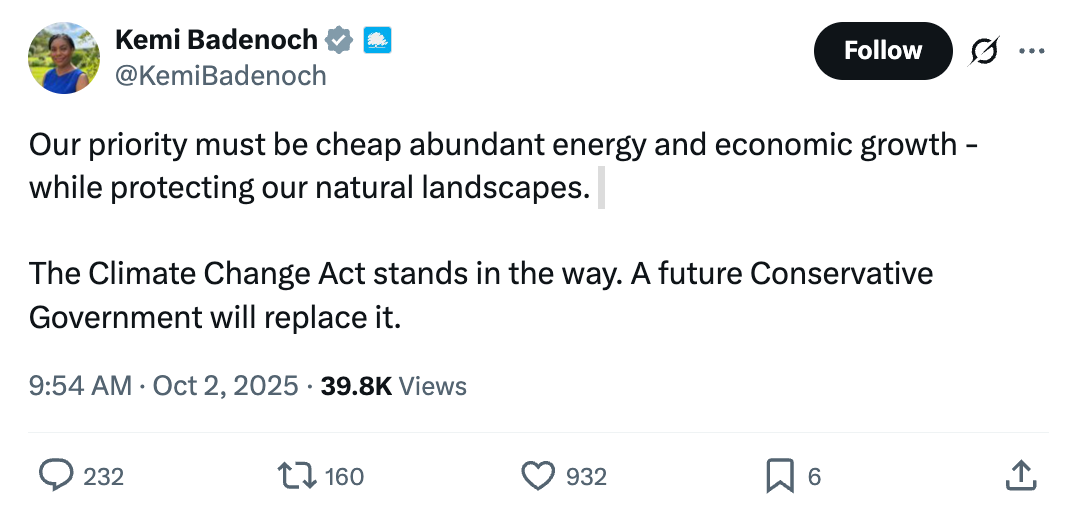
Fundamentally, the role of the committee is to advise governments, where advice is written for the government of the day, but it is also to report to parliament. We have no ability to hold ministers to account or overall policymakers, or [to] do anything of that kind. That’s not our job, but it is the job of parliament to hold government accountable. And so the mechanism is that we give parliament the best possible evidence and information in order for them to inform their own policies, whether or not they’re in opposition parties or in the government, and also to hold government to account on any legally agreed targets set by parliament, so we’ll keep doing that job.
CB: Great. Yeah, one of the big bug bears for both of those opposition parties is around the UK’s high cost of energy at the moment. Can you just kind of talk me through what’s going on? Why are our bills so high?
EP: Yes. How long have you got? So there’s a short-term, long-term framing for this, right? So over 80% of the rise over the last 10 years in energy bills has been about the price of gas. The UK is exposed to the price of gas on the international market, even when we’ve got relatively plentiful supplies in the UK, because we use a lot of gas in our heating as well as in our power generation. We’re quite a gassy energy system.
And because we are a relatively small producer, even with the North Sea, our ability to affect that price in any of the gas markets is limited. And so the only protection we have against price spikes or volatility or a rise in gas prices, really, is to reduce gas demand. And that’s one of the attractions of a more electrified power system, that’s what you’re effectively doing.
When I was in my last job and the energy crisis was on, one of the focuses of those of us who were being asked about what we could do about bills, what we could do about the economic exposure to gas, what we could do about energy security, was about electrification – nothing to do with climate at the time – but about trying to reduce gas demand. And that’s what other countries in Europe had been doing too in response to Russia’s invasion of Ukraine. So Poland has rolled out heat pumps, not because of climate, but because they’re trying to reduce their exposure to the gas price.
So that’s the wholesale cost of energy, and our exposure to gas is a huge part of the problem, and we shouldn’t lose sight of that. The other components of the bill are about policy costs and infrastructure costs that are levied from the bill or passed through to the bills by suppliers. So there is a component of the bill which is to do with the money it costs to reinforce our energy networks, and that’s increasing at the moment because we’re building out the power sector. That’s true. And there is also a bit of the bill which is about policy costs for things like renewables, but also social policy costs, things like the warm homes discount. And governments have always changed the levels of those policies. They designed them, but they also put them on the electricity bill rather than, say, on gas or in taxation; it was a choice to put them on bills. And so things like the cost of renewables and the renewables auctions, the costs of the early-stage renewables projects, the policy costs for energy efficiency, and so on. They’re all on that bit of the bill.
Now, those will change over time, and a lot of them are coming off in 2030 or being replaced by cheaper contracts that have been negotiated since. But there is a chunk of the bill at the moment, which are levy costs, and we have been saying to the government for some time now – including [to the] previous governments – that we think that those costs should be removed or redistributed. Now, how they do that is entirely up to them. We’re not policymakers, and we shouldn’t be prescribing issues of tax or distribution. But in having those policy costs in the electricity bill, people think electricity is much more expensive than it is, and so getting things like heat pumps onto the system, which would then help you with gas prices or our gas exposure, is harder because you’ve disproportionately impacted the electricity price. So it’s that, I don’t know if that was helpful.
I mean, at the supply end, there’s also the question of how much of the cost of generation that we’re then paying for that goes into that wholesale price? Are renewables cheaper or more expensive than a gas power station? Generally speaking, the economics of the energy transition should be cheaper overall than sticking with fossil fuels, in the long run, [so] what you’ve got to do is build the infrastructure. Though there’s a cost to that [and] it needs to be financed properly, the reason we think it should still be cheaper in the long run is once you’ve built the infrastructure, you don’t have the associated fuel costs for a renewables-led system. You have some different costs that we’re also paying for, to balance the system and to manage it. But even those work out to be cheaper than a system where you stay dependent on fossil fuels, we think.
So it is really complicated to explain to people and I suppose in a nutshell – I’d say, what, that took me like 10 minutes? And I can still see you being like, “well, that’s not a punchy answer”. And in that is the problem, because it’s in that lack of clarity, in the ability to be able to say, “well, it’s about the cost of decarbonisation”, and then we lose sight of the fact it’s actually, over the long term, been more about the cost of gas. I really need to have a better answer to that question.
CB: I mean, it’s interesting, maybe you can kind of slightly zoom out to, not just about the energy bills, but that whole cost of the transition. Because obviously, you’ve already mentioned some of this, but you’ve got investments, costs that we’re adding, building out the infrastructure, but also savings in terms of fossil fuel bills, and the way that that nets out, and the total that you come up, it’s quite easy to focus on one half of that or the other and not give the full picture.
EP: So you could do it in this way. You could think about the energy system as a whole. It’s the infrastructure in your system. And if you’re just talking about – let’s just talk about electricity, which is where a lot of the conversation is. To generate electricity, you need a power plant of some kind, which you have to build. Because even in a world where you were saying, “well, it’s not about building clean technology”, you have to build some power generation for things like artificial intelligence, the growing demand in the economy, you need [an] abundant energy supply. So you have to have a power plant, and [so] you have to build some new power plants. And then once you built your power plant, you need to move the power around. Even in a world where, say, you could generate the power, like with solar PV on people’s roofs and then use it in their homes. In the UK system, because we’ve got big nuclear, we’ve got cities, we’ve got factories, you need some big kit that generates big stuff, and then you have to move it around the system. So then you have to pay for pipes and/or wires to move things around. Your gas, if it’s going into a gas-fired power station, and then your wires to move the electricity that you generate.
And then once you’ve got all of that, you’re then paying the costs of managing the system. And there are costs involved in that, because you pay your power plants to provide services. But if they have to do unexpected things or provide a balance for another plant, or a power plant goes off, and you have to turn one on, there’s a cost for that that we all pay for in the market. And then at the end, we have these other policy costs, which are about redistributing money to pay for schemes that we think are important for the wider energy system, whether that’s energy efficiency or bill relief for fuel poverty. So those are some of your costs.
If you strip all of that back to the beginning, the reason that people like me say a renewables-led system is cheaper is [because] to build a brand new solar plant or wind plant is likely to be cheaper than the cost of building a gas CCGT, in most cases. So your cost of building the new plant is cheaper, and then you don’t have a fuel cost if you’ve built renewables, because you’re not buying in your gas to power it. You don’t need to build your gas pipeline, so there’s a saving there, but you do need to build more cables, because you need all kinds of renewable plants.
There’s then the cost of backing up your renewables with batteries or some decarbonised generation, maybe hydrogen. And then you’ve got your policy costs on the end. And so if you look at the balancing costs, you have to ask, “Well, does it cost more to balance out this wiggly renewable system and have to build another plant, then you’re saving on that fuel input?” And again, the answer there is, there are some costs of balancing the system, but it looks like they’re still cheaper than relying on the fossil fuel system.
And lastly, just very simply, generating electricity and then using it in more efficient products at the end is highly efficient. So in our analysis for the seventh carbon budget, we halve energy waste across the entire energy system, because the technologies on the other end of the system are more efficient, like electric vehicles and heat pumps. The technologies on this end of the system, like new renewables, are highly efficient, and we’re just moving stuff around on wires more efficiently. And that is also a saving, I think everyone out there knows that if you’re not wasting stuff, you’re saving money.
You’ve got to look at the whole system. It’s no good just to compare two different kinds of technology and think that that’s the answer. You’ve got to look at the whole system in the round, and then at the end, the bill in the round, and then make your choices.
Again, that’s a long answer, but because you’re talking about an energy system that underpins the entire economy, the mistake people often make is to look at a single data point on this end, on one day of the year, in one year. And it’s actually looking at the whole thing in the round. Is that better?
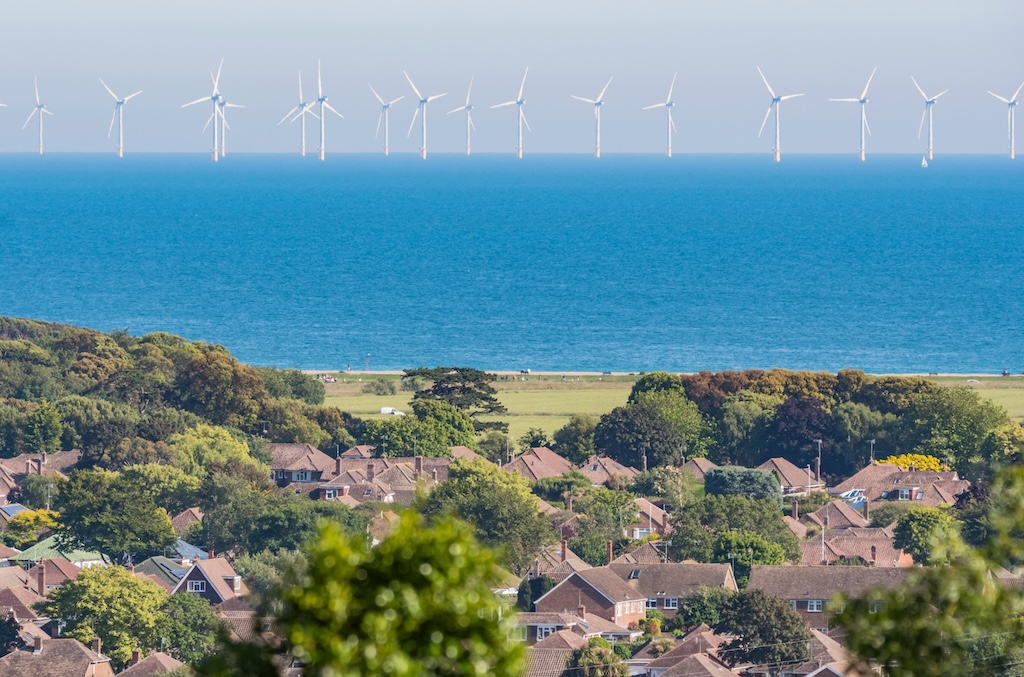
CB: Yes. So the UK’s net-zero transitions are obviously quite dependent on offshore wind, because of the fact that we’re an island nation, we’re at high latitude, we’ve got peak demand in winter and we don’t have great solar resources. People are looking at the energy transition globally and looking at how that picture’s changed.
You talked about falling technology costs; that’s been a big part of solar costs coming down massively. The cost of wind has come down a lot. And offshore wind’s a lot cheaper than we thought, but its costs have been going up in the last few years. And so some people I’ve seen [are] suggesting that perhaps the UK has made the wrong bet.
What do you think about that? And what are the other options that the UK could take, or is actually offshore wind still the right answer?
EP: Yeah. Well, actually, this sounds like a dodge, but it’s not. It’s important that we say this. It’s not the CCC’s job, actually, to dictate the technology mix. Like when we are doing our analysis, we model different technology pathways, and the reason for that is only that we have to demonstrate to parliamentarians that the number that we come up with for the carbon budget – so the percentage emissions reduction – is credible enough that they’re confident that the target could be met. How they then go about delivering that is for the government’s carbon budget delivery plan and for parliament.
And so the question for the CCC is, would we have a view on whether it should be offshore wind and onshore wind? No, beyond telling you what the relative costs of decarbonisation might be in 15 years time if you choose one or the other. And then the other thing is, sometimes governments make decisions about technologies for reasons that sit outside our remit. For example, it could be about [whether] you take an early punt on a technology because you want the jobs and the industrial benefits. You know, the reason that Scandinavians have so many wind companies and manufacture so many components is [that] they took an early bet on wind, after actually, the turbines were developed in the UK. There we go.
If you think about China and batteries, it’s similar. They took an early punt on electric vehicles and now have cheap electric vehicles. That’s an industrial play, almost more than it is the least cost way of delivering decarbonisation.
So it’s sort of respects the reason that the government might back particular technologies, and I think the government’s offshore wind targets – my memory of them at the time were also about Boris Johnson’s industrial vision for the UK, and I think they were bigger than what the CCC had recommended as well. So, there are always reasons for the government to back a technology which are not about decarbonisation. It’s a long way of saying, “Don’t ask me”.
But I think two other quick points. It is always a mix; the UK system is magnificent, because it is a mix of big and small and different technologies. We’re a pro-nuclear country, we’re a pro-renewables country, we’re an all-kinds-of-renewables country. We are also a country where we’re still going to have gas, and maybe potentially, one of the places that works out how to do things like carbon capture and hydrogen, because we’ve got a legacy of oil and gas industry here.
We’re an “all-of-the-above” country, and I think that’s a good thing, and the most resilient energy systems are those where you have a mix. And that would be something that I would say as an energy analyst, but it’s also the CCC’s approach when we’re looking at the energy system.
So if, for some reason, government chooses a pathway that is away from a particular technology, we’ll find another way of delivering it.
CB: So just more specifically on offshore wind, we’ve obviously got the next auction for CfD projects coming up, [with] results due in December or possibly a bit later. What are you expecting to see come out of that?
EP: You should go and ask me at my last job, where I would have probably had more of an idea of the commercials in the market, because that was literally the job – to understand that and live and breathe the auction. I think we would say, like every analyst is saying, [that] we’re expecting to see some of the supply chain crunch and the pressures on the industry in the prices.
But the beauty of competitive auctions is [that] they force competition. So I have been wrong on auction prices pretty much every time, apart from once, and I have learned not to speculate. There is always so much speculation in the run up to renewables auctions, and I think it’s unwise to try and work out what the prices are before we see them.
On the constraints and the sort of general economics, we modeled in a 25% uplift on our offshore wind costs relative to the kind of standard levelised cost assessment. And that’s because we’re assuming that there are supply chain pressures out to about 2030 and then we wind it down. So I think everyone can see that there have been labour shortages, there’s a higher cost of capital, there have been supply chain constraints because lots of other countries are doing offshore wind. There’s competition for the components and all of the rest.
The very last thing is, for my job, what’s relevant is [whether] the cost of other technologies go up? And a lot of those factors also apply for trying to build a new gas-fired power station or a new nuclear power station, because it’s about skilled labour, it’s about the cost of components, about the cost of financing large-scale infrastructure. And I think we’re looking at that relative cost the whole time, and in that I’m still extremely confident that a decarbonised energy system is cheaper than the counterfactual fossil fuel one.
The exact technology mix and the exact prices over the long run have very little impact on that final GDP number, first thing. And second thing, I think we’re in a pre-2030 world and we’ll see what happens with individual technologies in the long run. And very, very lastly, no one should speculate on auction prices. You’ll just look like an idiot when the final results come out.
CB: Great, yeah. So behind some of the political rhetoric that we’ve been seeing around the UK’s climate goals, the Climate Change Act, there are some genuine concerns around things like how to shepherd the UK’s industry through the transition.
It’s obviously quite a big change for the UK economy, but particularly for things like heavy industry. Do you think that the UK approach is getting the balance right in that area, particularly?
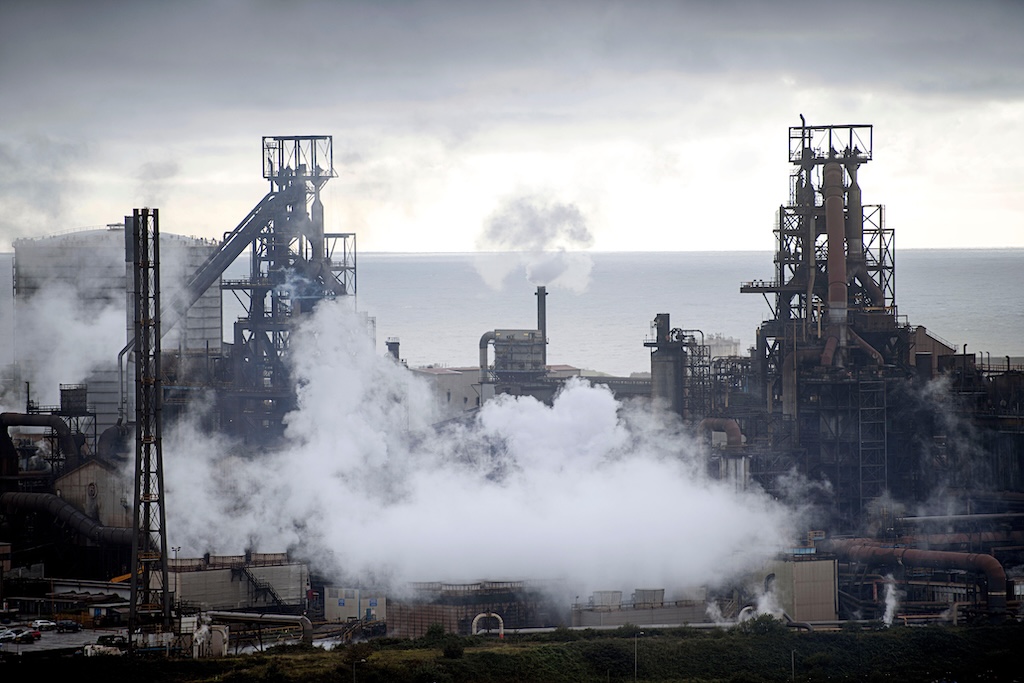
EP: We said when we issued our advice to the Welsh government that we thought that the way that Port Talbot had gone was the wrong way to decarbonise. And by that, we meant [that] you do need to plan ahead for industrial change. It takes time to repurpose sites and to train workers, and there are often longer lead times you end up with by the time government acts.
So the example with Port Talbot in Wales was that everyone knew that that plant was struggling, that there was an opportunity to have an electric arc furnace and there’s just basically been a gap now, between turning off the blast furnaces and starting up the electric arc furnace, because there wasn’t enough early action in the middle. That’s meant there are workers that have lost jobs, that may be an opportunity to redeploy or retrain.
Now, if you contrast that with the closure of Ratcliffe power station, which was the UK’s last coal-fired power station, there was a very long lead, because they knew that the plant would close – not least because of the UK’s carbon budgets. They had a very long process of working with that workforce, to think about how to retrain and redeploy them, and sat down with the unions in the planning. And I think every single worker ended up either retrained or redeployed or retired. That’s a good transition; that’s what you want. And redeployed in the energy sector, right, doing kind of purposeful jobs in their community.
So that’s one answer. [You’ve] got to make sure you do some transition planning and you need a decent industrial policy. I think a lot of other markets, when we’ve looked at it, the difference in our [energy] prices for our industrials are different because of a lack of industrial strategy. So there are incentives and subsidies and things in Europe that don’t exist here. So that produces a competitive difference in the energy price and costs for our industries, which I think is worth looking at. But again, that’s an industrial strategy outside of my remit, but I think that’s missing.
And lastly, I suppose more optimistically, we think that a low-carbon power system [means] electricity [leads to] about 60% of emissions reduction, but it’s also cheap and abundant energy. Industry electrification should therefore have a reduced cost for its energy, which is a big input. They should be able to use new technologies. There should be a really vibrant future for our industrial sector. There’s no reason why there shouldn’t be.
And also, there are opportunities for new industries. I’ve mentioned some of them, but hydrogen, sustainable aviation fuel, carbon capture and storage, there’s loads of stuff that really suits the UK’s heritage in chemicals and in oil and gas. So I think this positioning of “its industrialisation or its net-zero” is wrong.
The other thing I’d say is that narrative tends to miss that we’ve structurally changed what industry means in the UK. So one of the reasons our emissions footprint from heavy industry is down is not because our industries have gone abroad, it is [because] we switched to high-value manufacturing. So we’ve actually grown our manufacturing output in the UK. It’s just a different kind of manufacturing.
I think we actually do need industries like steel in this country. There are huge opportunities for green steel globally. There are huge opportunities for carbon capture. There are huge opportunities for hydrogen. We think we should do those industries here, and [the CCC] said that. But there are also lots of other new industries and manufacturers that we don’t talk about anywhere near enough, and they’re a kind of core driver of the UK economy.
CB: So looking ahead a little bit, by June next year, the government’s going to have to legislate for the seventh carbon budget, which centres on 2040, so we’re looking ahead 15 years, and the committee’s already put out its advice. I think it was an 87% reduction?
EP: 87% emissions reduction between the years of 2038 and 2042, including international aviation and shipping.
CB: Yes. So ahead of that legislation being passed, assuming it will be passed in June, there’s obviously a bit of a process the government will put out, like draft legislation. There’s going to be some sort of impact assessment and debate in parliament and so on.
There’s been a bit of a conversation about whether that process should look different, compared to how previous carbon budgets were passed. Calls for greater scrutiny, more time in parliament and so on. What are you hoping to see out of that process?
EP: Again, we serve [the] government, not the other way around. So they will decide what they think is the most effective way of legislating the target. [Currently the budget] is at the point that we’ve given our advice, [so] it becomes the government’s target [now and] they could accept that advice or reject it. No government ever has. It’s been pretty solid advice so far, but they will take that number, scrutinise it, work out whether it’s the number they’re going to offer parliament and then, as you say, offer their own impact assessment or plans or whatever else around it. And then there’s the debate in parliament.
Once we’ve issued our advice, it only serves to be an independent view for parliament, when they’re having the debate, and we are not in charge of the process at all, though I’m sure they will tell us when they decide what to do.
What we have said, I think, in the past on this is [that] it’s obviously a good thing for parliament to have good numbers and to be able to have a debate. What exactly that looks like is down to parliamentarians and government [to] hash out.
CB: All right, we’ll be watching this space. Slightly different question now. Since you’ve been in this role, chief executive of the Climate Change Committee, there’s been quite a notable number of comment pieces published in newspapers with a kind of misogynistic portrayal of you personally. I’m thinking in pieces in the Daily Mail, Daily Telegraph and Sunday Times. What do you think they’re trying to do with that kind of article?
EP: I don’t know. And actually, I don’t tend to read them,
CB: Probably wise.
EP: Thank you. Good, good. I don’t Google myself. I don’t know. I mean, I think it’s a pretty generic and not surprising observation to say that women in public life have a different experience than men. I have been in public-facing jobs before, so in that sense, that’s not new.
The one thing that I would say is I think some of this job is about representing something and I have been struck that it’s actually – it’s not the gender thing that strikes me. It’s the difference in moving from the private energy market and being an energy person and moving to being a public servant working for the Climate Change Committee. Some of the things I would say about energy prices or energy, as an energy analyst, were taken very differently, even though I’m saying – almost verbatim – the same things about things like energy security and gas dependency and costs than in this job. And that’s actually the thing that I find interesting, there’s been a kind of shift in how that expertise is perceived, because of the role change. Otherwise, yeah, I don’t read the stuff.
CB: We’re in this slightly different, well, very different world, when it comes to the public conversation around climate change at the moment, compared to say even two years ago. How do you think, personally, we could have better conversations about what’s obviously a very challenging topic? And how are you trying to make that happen?
EP: I think we should reach people where they are and the things that they’re worried about. And by that, I mean I think it is completely understandable that climate change can remain an absolute priority issue for people in this country. I’ve seen that in every focus group, poll, the social research that we do, and also just what it’s meant to grow up in this country.
And we are, I think, natural environmentalists. [We are] people care about newts and trees and nature, and I don’t think that’s changed. And I think you see that people do understand that climate change is happening, and they want something done about it, and they worry for their children. And so I think we can talk to them more about why we’re doing this. I think we might have forgotten to do that, actually.
I think we should re-center what this is all about and talk about some of the impacts for the things that we love here. For me, 10 generations of my family have come from the same part of Gloucestershire and I live there now. And there’s a really beautiful valley that I walk in, which is populated by beech trees, which are changing colour at the moment. That species is vulnerable to drought and I think, what would this valley look like if those trees couldn’t grow here anymore? And that, for me, is almost more resonant than everything that I know intellectually about climate from my job. It’s about something really deeply personal. It’s about a legacy I want to pass on to my children, that was passed on to me. We could do more of that I think, you know, really talking to people realistically, without hyperbole about what this means.
And then the other thing is, I think we should acknowledge that it’s challenging in places. I think we should acknowledge we have to build some stuff and that costs money, and it is spend-to-save. We know that savings outstrip costs from about 2040, that if we make the investment in a modern energy system, it will pay back, but you still have to make the investment and it has been a really challenging time for people, and so our message to the government has been, “you have to focus on electricity costs, you have to get bills down”. And the Climate Change Committee is saying that, because we understand that it is important in order for people to stay on board with the transition coming in the economy.
I was the chief executive of the energy trade body during the energy crisis. I know how hard it is for people on their energy bills right now and I don’t think we can tackle net-zero without having the answer to those questions. If you think about the rise in populism in this country, it’s about [the] cost of living and people feeling like the economy isn’t delivering for them. So, of course, you should focus on industrial energy prices. Of course, you should focus on energy bills. These are not incorrect things to say that the public worries about.
I think if you can explain to people why clean electric technologies will, yes, help save the places they love, and do our bit for climate change and look after nature, but also do stuff for bills and industry and jobs. I think that’s really important and the sooner we get those benefits to people, the better. I don’t think we can say, wait. And that’s a long way of saying everyone is right. Actually, we should just have much more pragmatic, open, deliberative conversations and engage with the fact that everyone is right here.
CB: Do you think, though – I mean, because we’re also in a world where there’s increasing levels of misinformation, not only across social media, obviously that goes without saying, but also within traditional media, newspapers and so on. Is everyone right in that sense?
EP: I think we have not put enough effort into, like, fact-checking and making sure there’s accurate information, of course. And we are a body that exists, we’re like the charts people. So if you want accurate charts, then come to us. We’ve got lots of those.
What I mean by everyone’s right is [that] there’s often an underpinning sort of question or narrative, that I think we should just be open to following through. It is about, if renewables are cheap, why is my bill higher? It is about when these new industries will be here and what does it mean for my job? And there’s obviously a cost to building new power plants, so who pays for that? And when?
If you look at the Climate Change Committee’s analysis, you can see that there is a cost to building the infrastructure, that we don’t shy away from, and also that we are worried about energy bills and we’re saying to people, we need more action on that bit of it. The thing that’s often missed is [that] then, you get these massive savings for the economy coming through from 2040 and rolling onto 2050. So I think it’s about engaging with people’s genuine concerns about the how.
I think it’s about being very clear that there are facts, like climate change is happening, it will have impacts, it will have costs. You know, fossil fuels have been, over the last 10 years, volatile [and] 80% of the rise on your bills is because of that. It’s not because of these other things. But you can also say these other things have costs too, and we need to think about how to do it.
So that’s what I mean. And you know, the rest of it is sort of outside my job as a civil servant. But I do think, when we do our social research, when we run our citizens panels, one of the most interesting things is we often get questions about [things] like is climate change man made? Or can you tell us about the impacts? And it only takes 10 minutes with the actual climate scientists and people understand – they’re just looking for really good information. And something else that comes back in our social research is a desire for accurate information, particularly from policymakers.
CB: Do you think that the government should be doing more in terms of having that conversation with the public, trying to explain the why and the what and the how?
EP: The committee in the past has said the government should focus more on communications and that’s because of what comes out of the citizens panels. We run small panels of the public that are demographically and politically diverse, and then spend time with them, asking about – usually – trade-offs. So if there’s a decision on what we’re recommending, that could go either way, getting that sense of what people think and feel is important because, in the Climate Change Act, we’re required to consider social factors. So that’s us doing that bit.
And whenever we do those [panels], people say things like, “Oh, I wish I’d known this before”. Or [that] it’s new information for them. And they often then come around to a recommendation that you should communicate more clearly. So, yeah, yeah.
I think it’s always been an afterthought, as well. It’s hard, isn’t it, when you’ve got so much to do, to want to spend money on doing communication. But we did do that in the past. The last time we did a big upgrade of the electricity system in the 1960s, there was a big public information campaign that went out in all kinds of newspapers and magazines [such as] Country Life. [It] talked about, in long form, why we were building pylons and [a] transmission network across England to get electricity to Wales. And now it’s maybe the inverse.

That’s a really important thing to do when you’re making a big change over. I think we did the same when we were changing over from coal gas to methane in our heating. We’ve done the same with the digital switchover.
So when you’re talking about economic or energy transitions, then we’ve got a good legacy of having communications programs alongside. That’s part [of] the reason the committee said, maybe we should be doing some more of that now.
CB: Yeah, it’s interesting, because it definitely doesn’t feel like that has happened around the changes that are being made or asked for in climate policy.
EP: Have you seen them, the ones from the 1960s ever?
CB: I haven’t. No.
EP: Oh, they’re also quite punchy. It’s worth finding them. There’s one explaining why part of the country is having infrastructure [built] for another part of the country. And there’s one about children and why we’re building infrastructure for the next generation. And I can’t remember the exact headline, but it is something as literal as “Are you going to explain to these small children why you don’t want them to have cheap power in the future?” It’s quite direct.
So, yeah, we used to do that. We used to have no problem doing public information campaigns. Maybe that’s the option here. But again, how it’s done [and at] what level of government, that’s really for policymakers to decide.
CB: Great. Well, that’s [a] perfect segue into my final question. You’ve obviously got young children [and we’ve] just been talking about messages to children. I don’t know if you talk to your kids yet about climate change? How do you think about having that conversation?
EP: We’ve got wind turbines on the hill not far from where I live, and my son, who’s three, has been obsessed with them because they’re going round and round. He likes things that go round and round, see also cars, washing machines, anything that moves. But off the back of that, it’s been quite easy to explain to him that I do something to do with wind turbines. So whenever they see wind turbines, they say, “look, mummy, it’s your job”, which is quite sweet.
I haven’t worked out how to fully explain climate, because they’re six and three. They’re still little. I also, and maybe this is the wrong thing, but I also slightly just want them to live their life as they know it. It’s quite a complex thing [climate change] and small children are quite good at getting worried about stuff they don’t fully understand. We lost a close family member in May and trying to explain death to a three-year-old or a six-year-old – there are some things that are sort of “Big”.
What we do do is talk to them about the fact that my work, the reason I’m not always home, the reason I sometimes miss bedtime, it’s about trying to look after nature. It’s trying to look after the newts in the pond outside, or the beech trees in the valley, and that’s important. And we need to be kind. That’s as far as we’ve got.
I will endeavour to explain atmospheric physics to them before they finish primary school, but I also just want them to enjoy the world as they experience it, too. There’ll be a time for more complex discussions when they get big.
And I suppose that’s a nice segue, because I get asked the question about the kids a lot. It’s about making the world safe enough that they can have a lovely life, of course it is, but I’m aware that some of the loss sits with me, not with them. They will not have memories of how many butterflies there used to be. They’ll just be excited by butterflies. They will experience the world as it is. I would like them to have as many of the experiences that I’ve had, as many grasshoppers in the summer, as many butterflies, as many beautiful, crisp autumn mornings walking the dog to school, but they will ultimately just know the world as it is.
I’m the one [who] has to carry knowing what they’ve lost and I don’t see any reason right now to put that on them. They’re still quite excited when they see a jaybird in the garden.
CB: Great. Well. Thank you very much, Emma. It’s been great to chat with you.
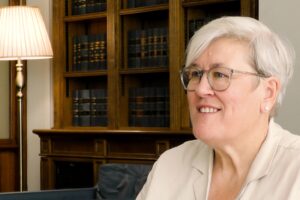


The post The Carbon Brief Interview: UK Climate Change Committee’s Emma Pinchbeck appeared first on Carbon Brief.
The Carbon Brief Interview: UK Climate Change Committee’s Emma Pinchbeck

Climate Change
After a Slow Start on Climate, Zohran Mamdani Faces Scrutiny Over Parks Budget and Environmental Promises
Climate-conscious New Yorkers hope the mayor hasn’t forgotten them.
During his New York City mayoral campaign, Zohran Mamdani courted votes from environmentalists. He promised to expand green spaces in public schools and equip them with renewable energy, to meet the demands of the city’s building electrification laws and to increase investments in city parks.
That would be American ratepayers—i.e., you.
From our collaborating partner Living on Earth, public radio’s environmental news magazine, an interview by Jenni Doering with Katharine Kollins, the president of Southeastern Wind Coalition.
Who Loses in the Trump Administration’s $1 Billion ‘Deal’ to Abandon Offshore Wind?
County officials have said they will eventually close the incinerator, located in a predominantly Black community. Advocates want a concrete plan.
Minneapolis activists are escalating a decades-long fight by going on a hunger strike to demand that local officials shut down a polluting trash incinerator.
Minneapolis Activists Launch Hunger Strike to Protest Polluting Trash Incinerator

After a Slow Start on Climate, Zohran Mamdani Faces Scrutiny Over Parks Budget and Environmental Promises
Who Loses in the Trump Administration’s $1 Billion ‘Deal’ to Abandon Offshore Wind?
Minneapolis Activists Launch Hunger Strike to Protest Polluting Trash Incinerator
-
Climate Change8 months ago
Guest post: Why China is still building new coal – and when it might stop
-
Greenhouse Gases8 months ago
Guest post: Why China is still building new coal – and when it might stop
-

 Greenhouse Gases2 years ago
嘉宾来稿:满足中国增长的用电需求 光伏加储能“比新建煤电更实惠”
-
Climate Change2 years ago
Bill Discounting Climate Change in Florida’s Energy Policy Awaits DeSantis’ Approval
-

 Climate Change2 years ago
嘉宾来稿:满足中国增长的用电需求 光伏加储能“比新建煤电更实惠”
-
Climate Change Videos2 years ago
The toxic gas flares fuelling Nigeria’s climate change – BBC News
-

 Renewable Energy6 months ago
Sending Progressive Philanthropist George Soros to Prison?
-

 Carbon Footprint2 years ago
US SEC’s Climate Disclosure Rules Spur Renewed Interest in Carbon Credits