At COP28 in Dubai, Carbon Brief’s Anika Patel spoke with Prof Zou Ji, CEO and president of the Energy Foundation China, to discuss China’s approach to its energy transition.
This wide-ranging interview covers China’s stance on fossil fuels, issues-based alliances and energy efficiency pledges at COP28, pathways to the country growing its renewable power generation and what China has learned from Germany’s energy transition. It is transcribed in full below, following a summary of key quotes.
Energy Foundation China is a professional grantmaking organisation dedicated to China’s sustainable energy development. Prof Zou has years of experience in economics, energy, environment, climate change, and policymaking, having previously served as a deputy director general of China’s National Center for Climate Change Strategy and International Cooperation, under the government’s national development and reform commission (NDRC).
He was also a key member of the Chinese climate negotiation team leading up to the Paris Agreement, and has been a lead author for several assessment reports of the Intergovernmental Panel on Climate Change.
- On why China did not join the pledge to triple renewables and double efficiency: “[Before COP28] we have not seen [it laid out] very clearly which year should be the base year [from which tripling renewables should be calculated]. Should it be 2020? Should it be 2022? This might seem to be technical but, [in] the past two years, global development of renewables, especially in China, [have been significantly boosted, and so]…the difference in targets might be very significant.”
- On signing pledges at COP: “If you look at the whole history of the COP…I do not [remember] China joining any alliances. I have never seen that…As a party, China [is only concerned with] official procedures, waiting for a legal framework of the UNFCCC or the Paris Agreement.”
- On China’s commitment to decarbonisation: “If you look back at history, there have been very few cases that show China [first making] and then [giving up] a commitment. This is not the political culture in China.”
- On China’s electricity consumption: “For low-income level groups, although their income has not grown very much, their consumption preferences and mindsets – especially for younger generations of consumers – mean they are more willing to use electricity [than previous generations].”
- On comparisons of China to the EU and US: “There is a structural [difference] compared to the [energy mix] in Europe and the US. The majority of energy use [in China] has been for industrial production, rather than for residential [use]…In China, the average power consumption per capita is around 6,000 kilowatt-hours (kWh), compared to 8,000kWh in Europe and over 12,000kWh in the US.”
- On energy efficiency: “Physically, I think China has become better and better [in terms of] its efficiency, but, economically, this cannot produce as high a value-add as Europe and the US in monetary terms.”
- On fossil fuel phaseout: “I would like to see…[China] very quickly enlarging its renewable capacity. Only if [there is] adequate capacity and generation of renewables can this lead to a real phasing out or phasing down of fossil fuels.”
- On ensuring more renewables uptake: “We have raised the share of renewable power generation from seven, eight, nine per cent to today’s 16%. This is progress, but it is not quick enough or large enough. We want to push the grid companies…to do more and do it faster.”
- On the power of distributed renewables: “We should also consider…creat[ing] another, totally new power system. This would be a sort of nexus of a centralised and decentralised grid system…If [the central grid] is having difficulties [increasing renewable generation], and if these are very challenging to overcome, then let’s [shift] to a lot of microgrids.”
- On distributed renewables growth: “Today, the share of distributed [renewables] is still lower than centralised renewables. But the incremental [distributed] renewables growth has become higher than growth of centralised renewables in the past year or two, and I would assume this will remain a trend in the future.”
- On substituting fossil fuels with renewables: “Relying only on solar and the wind [means] you need not rely on imported oil or gas. And so, gradually, you will de-link your energy use from coal [and] from fossil fuels.”
- On the need for CCUS: “In some sectors, like, for example, iron and steel, cement, chemicals and petrochemicals, we do need carbon capture, utilisation and storage (CCUS), because it is very difficult to phase out coal or carbon dioxide [completely].”
- On CCUS in the power sector: “I have mixed feelings about CCUS for the power sector. I have an ideal vision that we can reach real zero emissions in these sectors through a more developed grid system, with more connectivity across provinces or regions and the use of AI technology.”
Carbon Brief: Could you give an overview of what your expectations are for COP28?
Zou Ji: It might be a little early to make a judgement [on] what outcomes this COP can reach, but we do know what the key issues here are…[The] global stocktake (GST) is the core issue for this COP as it is the first time it has taken place since the Paris Agreement …But for the GST there are different levels [at which we need] to understand [the process and]…its outcome. Number one, [in terms of] the scope of GST, what should we take stock [of]? Many colleagues, especially colleagues from Europe and maybe also from the US – I mean industrialised countries – would like to concentrate more on mitigation…We still have a significant gap…[to fill] to achieve the 1.5C target. The gap [is] there, and we need to enhance our ambition to close the gap. So this is a major concern…in the GST.
But meanwhile, we see some other parties, [such as] the so-called [like-minded] developing country [LMDC] group… the Alliance of Small Island States and Least Developed Countries group, [which are] mainly located in Africa. [These groups] are very keen to [address] the gap in financial support for capacity building and technology transfer, in short, means of implementation.
And there has been, since [COP26 in] Glasgow, I think, a very specific financial issue: the loss and damage fund. Together with some general financial issues like developed countries mobilis[ing] $100bn each year by 2023, this will continue to be a concern. But…we also have other issues, more specific issues like the tripling of renewables and doubling efficiency and… [procedure-related] issues like transparency. [There are] a lot of issues!
Before COP we have seen…official statements from Europe, from the US and also from China – especially the joint Sunnylands statement – [which is] relevant to China-US cooperation in COP28 and…can [give us] some very initial expectations on the outcome.
[Taking the GST as an example], I would assume there will be a political decision by all the parties [to say] they recognise the significant gap for achieving well-below 2C, [following] the Paris Agreement language. But [there is an] even larger gap for 1.5C. This should be one [thing] we could expect [to see appear in the final text], but certainly I think there must be some tough negotiations on the scope of the GST: especially [on if we] should include…issues [such as] adaptation, financial support to developing countries, technology transfer, capacity building, etc…The negotiations will be very tough, but it is a long debate.
[Another issue to watch is the] tripling renewables and doubling efficiency [pledge]. I would say [that the issue has received]…endorsement from the G20 and the Sunnylands statement. But in those two statements…we have not seen [it laid out] very clearly which year should be the base year. Should it be 2020? Should it be 2022? This might seem to be technical but, [in] the past two years, global development of renewables, especially in China, [have been significantly boosted]… So [depending on which year is picked as the base year,] the difference in targets might be very significant.
And then it is packaged together with [a more defined] target…[to] not only [focus on the] tripling [of renewables] but also [to focus on] the total amount of the capacity of renewables…11,000GW [gigawatts] has been proposed. If this is the case, [meaning that] the base year is 2020…then, [from some negotiators’ perspectives] this might be a different understanding of the definition of the target from the one [proposed] before the COP. And then, this may lead to some parties hesitat[ing] to make an official commitment on that. I know you might be very interested in China’s position on that issue.
CB: You read my mind.
ZJ: I would try to understand it in this way. If you look at the whole history of the COP…I do not [remember] China joining any alliances [Prof Zou here means issue-based alliances or pledges]. I have never seen that. That means that[,]…as a party, China only focuses on official procedures, waiting for a legal framework of the UNFCCC or the Paris Agreement. And if you look at different initiatives, [such as the] climate ambition alliance, [global] renewables alliance, etc – for the moment, they have not readied a legal framework. So now…[the pledges are] informal, without official or legal commitments. So, I cannot find evidence [of China joining informal alliances in this way].
Certainly I do not have any assessments whether China should…or should not [join the pledge to triple renewable energy and double energy efficiency]. But this is the history…of China’s engagement in UNFCCC, the Paris Agreement [and] the Kyoto Protocol…If China makes [such] a commitment, this would be somewhat surprising [from a historical perspective].
[Secondly,] maybe this reflects the difference of political systems and…policymaking in different political regimes or cities, especially between China and Europe and the United States. As you know, in Europe and the US you have election[-based] regimes or systems – every four or five years you will elect a different parliament, a different cabinet, a different president or a different prime minister, etc. Their term might be short or it might be long, depending on the results of the election. That means that there is no guarantee for one party or for one policymaker to stay in power for a long time. It might be two terms, it might be three terms. But in China, the political assumption is [that] the communist party will be in power forever. [No-one would assume that] next year, or next term, we will have another party leading the country.
My observation is [that] Chinese policymakers are very cautious [about] making commitments, not only because of concerns around the challenges and difficulty of achieving this commitment. They would say: “If I make the commitment, this should be something I must [achieve].” [This is] because they make the decision or commitment for a single party. No matter [which] generation of leader [made the commitment], the commitment comes from the same party…So that partially [explains] why China seems to be very careful to make even a long-term commitment.
Just to take a very immediate example, the US made a commitment on the Kyoto Protocol during the Clinton administration, but only [on behalf of] the White House. When [power] turned to the Bush administration in the early 2000s, the Bush administration said [they] will not submit that proposal to congress, because [they] knew it would not be approved…And then [eventually] the US gave up [trying] to ratify the Kyoto Protocol.
This is the first case, and unfortunately, we see another case in the Trump administration. The Obama administration…signed the Paris Agreement. But…[then] Trump became president and Trump said the US will withdraw from the Paris Agreement. And this [type of turbulence] is something, in fact, I take for granted, given [my] understanding of the US political system. But this is not the case in China.
Thirdly, it might be a matter of political culture. For the Chinese, normally, [as I said]…if they make a commitment, the commitment…is something they must [achieve]. Normally they will not…just make the commitment to ‘talk [big]’ and then, after several years, give up or ‘forget’ [about it]. Normally, China will remember [its] commitments and will achieve [them], [on the] basis of trust. So, China puts very high [importance] on achieving these commitments, [which] leads to some difficulties for the Chinese government to make commitments. If you look back at history, there have been very few cases that show China [first making] and then [giving up] a commitment. This is not the political culture in China. But this is my understanding, not a standardised or official interpretation!
CB: I was having a conversation with another academic earlier today, and they offered an additional explanation – that recent economic troubles might be an added factor increasing caution towards committing to targets in China. Would you agree with that?
ZJ: It’s not easy to simply answer yes or no, agree or disagree. But I would say yes. The uncertainty of growth in the past years, especially since the pandemic, seems to [have made] things a little bit…complicated, especially in terms of carbon intensity.
In past years, the [economic] growth rate has become lower and lower – even lower than expectations. But carbon emissions continue to increase. Several years ago, the common understanding was that if the growth rate stays at a very high level, the economy will grow over time, and then emissions will grow over time. But this time, we saw that growth was very slow, but emissions continued to grow. But I would like to try to look at this in more detail, to identify the driving force behind [this]. Why have we had a lower growth rate in the past year, but carbon emissions, coal use and also energy use have continued to grow?
[In this case], we had better look at energy use per capita, and especially electricity use per capita. Although the growth rate is very low, the base amount of power use per capita was also very low in the past. For low-income level groups, although their income has not grown very much, their consumption preferences and mindsets, especially for younger generations of consumers, mean they are more willing to use electricity…Just look at the energy use performance of low-income groups in rural areas.
In urban areas, blue collar [workers] have better living conditions – they have air conditioners, better heating [and can access better options for] travel. Although their income level continues to be very low, their consumption behaviour has changed over time…Everybody [now] has a mobile phone and connection to the internet…They saw [examples of how to live a better life] from people in the middle income [band]. They saw this from advertisements, from movies, from TV programmes, etc…Compared to their fathers’ generation, [who had a] similar income level, their pursuit of a higher quality of life [could be a reason why] today [they] have a higher level of energy consumption. This is one interpretation [of the data], but it can be proven by many pieces of evidence.
Another [interpretation] is if you look at China’s mix of energy use, in terms of total amount and in terms of per capita, there is a structural [difference] compared to the [energy mix] in Europe and the US. The majority of energy use [in China] has been for industrial production, rather than for residential [use]. And given what I just mentioned, [in terms of] the change of consumption behaviour…[The effects are] marginal [if] they increase their consumption of energy. In China, the average power consumption per capita is around 6,000 kilowatt-hours (kWh), compared to 8,000kWh in Europe and over 12,000kWh in the US.
CB: Does that have an implication for why China talks about energy intensity, whereas Europe and the US talk about energy efficiency?
ZJ: Yes. In China, the general indicator is energy intensity per unit of GDP. But when you talk about energy efficiency, what is the indicator? You have physical indicators, for example, energy use per tonne of iron, steel, ammonia or cement. This is one way to measure efficiency. Another way is just to [calculate it] per unit of GDP, which shows the major sources of money in your economy. Physically, I think China has become better and better [in terms of] its efficiency, but economically this cannot produce as high a value-add as Europe and the US in monetary terms. So that changes things, especially given two [factors]. One is the lower and lower GDP growth rate, which makes carbon intensity higher. Another is the chang[ing] foreign exchange situation in recent years. The raising of interest rates by the US Federal Reserve makes US dollars more expensive, increasing foreign exchange rates which then enlarges the monetary GDP gap, making Chinese GDP [in dollar terms] fall and carbon intensity rise.
So, there are several variables [affecting this decision], but we should also not ignore the real improvements to efficiency [in China], measured by physical indicators. I saw slightly slower progress in efficiency improvements, but maybe those are the matter of measurement.
CB: That’s always the fun fine print. Going back to the scope of the GST at COP28, how would you interpret China’s position on the ideal language around fossil fuels?
ZJ: I retired from the delegation eight years ago, so [I can’t say for sure] about the ideal language! But, maybe we can revisit the language from the Sunnylands statement. There is a specific paragraph talking about recognising the global tripling of renewables and the doubling of efficiency…[which is] then followed by several phrases mentioning that China and the US should accelerate the deployment of renewables…to substitute fossil fuels, including coal, oil and gas. So, if I were in the delegation, I should look at fossil fuels as a whole. Certainly, we should accelerate the process to phase down or phase out fossil fuels.
I mean, in China, it is mainly the matter of coal. But in Europe and the US, it is mainly the matter of oil and gas. According to an International Energy Agency (IEA) report, in the past decade, the whole world moved very slowly to phase out coal, oil and gas. In China, the majority issue is coal, but in Europe we saw some positive but very small changes when you look at the share of fossil fuels – [particularly] oil and gas. Same in the US.
So, what about the pace of phasing out or phasing down coal, oil or gas? Different countries have different agendas here. So maybe fossil fuels should be covered for every country. [But] I would like to see…[China] very quickly enlarging its renewable capacity. Only if [there is] adequate capacity and generation of renewables can this lead to a real phasing out or phasing down of fossil fuels. In this sense, I think these are the same story for all the countries, for Europe, for the US and also for China.
CB: We published analysis recently saying that fossil fuels in China might enter a structural decline next year because of China’s renewable build out. However, as we all know, there are challenges facing the grid, I think not only with intermittency but also with developing market mechanisms. How optimistic are you that China will be able to overcome these constraints in the power grid and make renewable energy more widely consumed?
ZJ: This is a very good question. There are several ways to figure out the transmission issue to support broader and deeper use of renewables. Number one, as you know, we have a very unbalanced geographical distribution of renewables. Northern and north-western China has very rich renewable resources, especially solar and wind power. But the most dense centres of energy use are located in the eastern and southern part of China. This requires that we generate renewable power and then transmit [it] from northern and western China to eastern, southern and south-eastern China. This will require a very long-distance transmission grid, [covering] two-, three- or even four thousand kilometres. [That comes at] a very high expense, [creating a] high cost for transmission.
Normally, we have a very rough estimate that [transmission will cost] around 0.1 yuan per kilowatt-hour for every thousand kilometres. So how do we overcome [these higher costs]? One way is to optimise the distribution and allocation of remote renewable resources. For example, [we could] transmit [power] from the closest places, [such as transmitting power from] Inner Mongolia province…to the eastern part [of China]. This is one way. China now has [developed] an ultra-high voltage [UHV] transmission system, which enables long-distance transmission, and we rely on that technology. We have had some engineering pilots [for UHV transmission in place] already, from Qinghai province to Henan province…[and] from Baihetan in Sichuan province to Jiangsu province. There are several [other] transmission grids under construction.
Another bottleneck is the capacity of the grid to absorb renewables. To my knowledge, in the past few years, we have made some progress, but this has been very limited. We have raised the share of renewable power generation from seven, eight, nine percent to today’s 16%. This is progress, but it is not quick enough or large enough. We want to push the grid companies – State Grid and Southern Grid – to do more and do it faster.
What we want to push [can be] compared to a benchmark [set by the] German grid. As you may know, Germany’s grid is one of the most advanced grids in the world, in terms of featuring a higher share of renewable generation – it can have up to 40% or even 50% of generated power come from solar and wind power. But what I’m thinking about now is if China can catch up and fill the gap between its grid and the German grid.
I’ve heard a lot of different opinions from power experts, [which] I will not go into detail here – it is too technical! But one long-term consideration to overcome…is the higher and higher marginal cost of raising the share of renewables in the German grid. This means [progress] to further enlarge the share of renewables in their grid has become slower. If this is the case for Germany today, this might also be the case for China tomorrow. That means that there might be some physical limitations [to having a higher share of renewables] in the current power system and the grid system.
But certainly the first step for China should be to close the gap between its current performance and Germany’s performance. Beyond that, a 40-50% [renewables] share is not enough for carbon neutrality or for [meeting the target of] 1.5C. We want to have more. What is the way out? We should also consider… creat[ing] another, totally new power system. This would be a sort of nexus of centralised and decentralised grid systems…If [the central grid] is having difficulties [increasing renewable generation], and if these are very challenging to overcome, then let’s [shift] to a lot of microgrids, together with a distribution grid, which would act as a lower level of the grid.
[To do this] you need to figure out a lot of technological issues, including [the use of] transformers and changing the [grid] system. To allow [for] more and more distributed renewables, it should not be necessary [for them] to be connected to the centralised grid system. [Instead, microgrids] should just have to connect with each other, with [households] having their own rooftop solar [panels] which are connected with each other using AI technology, etc. And if they do that, then most of [China’s] electricity [will be] generated by distributed renewables. That way, we [can] rely on the centralised grid less and less.
This might be one way to figure out today’s bottleneck, and Energy Foundation China is exploring a pilot [to trial this]. The solution is mainly applicable to rural areas…households… and also SMEs outside the central mega-cities…This might serve as the power source [that will cover] the increase in our power demand in the future. We can stop [the go-to solution being to rely on] coal or other fossil fuels, and instead from the very beginning [demand would be met through] renewables. So that is something I’m thinking about.
CB: That’s a really interesting possibility. I’m a bit of a pessimist, so an immediate question that comes to mind is that we have seen how important energy security and stability is to the general political system in China. If we have this decentralised system, would that cause nervousness among some government stakeholders?
ZJ: I would say that a distributed power system would help to raise the degree of energy security.
CB: Is that because it would be complementary to a central system, not replacing a central system?
ZJ: At the very earliest stages of the development, it would be complementary, but beyond 2030, the share of distributed renewables in the overall renewables system will become higher and higher. Today, the share of distributed [renewables] are still lower than centralised renewables. But the incremental renewables growth has become higher than growth of centralised renewables in the past year or two, and I would assume this will remain a trend in the future. Some of the obstacles to developing centralised renewables, in terms of technology, in terms of institutions, etc, means that distributed renewables have some comparative advantages [which are currently] being formed. [Renewables are] lower cost and [grant] higher energy security, relying only on solar and the wind [means] you need not rely on imported oil or gas. And so gradually, you will de-link your energy use from coal [and] fossil fuels.
… But certainly, we are in the very early stages [of] developing [such a system]. I believe, in China, all stakeholders – including government, business, academia, and NGOs like us — wish to make a collective effort to make that happen.
CB: Absolutely. I’m aware that it is very late, so I’ll leave with one last question. In two scenarios – first of all, where there is more distributed energy and a kind of constellation of these microgrids that you described, and then, secondly, in a future where perhaps, there’s a more centralised system but ever-increasing renewable capacity, do you see a role in both of these scenarios for CCUS?
ZJ: Carbon capture, utilisation and storage (CCUS) is still very controversial, among researchers and stakeholders. Especially in the power sector. But it is my understanding that in some sectors, like, for example, iron and steel, cement, chemicals and petrochemicals, we do need CCUS, because it is very difficult to phase out coal or carbon dioxide [completely]. I mean, even with the technology [coming down the pipeline], there [will still have to] be some [CO2] emissions.
Although you might be able to minimise the emission of CO2 in those fields, you cannot phase them out, only down. In [order to] achieve carbon neutrality, you have to capture those carbon emissions from those sectors. So we need CCUS for those specific sectors and technologies.
But for the power sector, I have mixed feelings about this. I have an ideal vision that, maybe, we can reach real zero emissions in these sectors through a more developed grid system, with more connectivity across provinces or regions and the use of AI technology to connect microgrids, for example, and let them trade with each other to complement each other’s peak and valley loads. This is one way out for the power sector, together with a more developed energy storage system, in the upstream, midstream and downstream ends of the power system.
My instinct is we should go in that direction [for the power sector]. We should not rely on coal for stabilising the grid system or for stabilising the whole power system. I know the mainstream thinking is we should rely on coal as the baseload for stabilising the power system. But I have a slightly different idea, that through more developed connectivity of the grid, more smart grids, together with very strong grid energy storage…If this is successful, then we would not need so much CCUS in the power sector.
I can share that the current mainstream academic understanding [is that], even though China will reach its [2060] carbon neutrality target, it will continue to have to maintain 600 gigawatts of coal-fired power plants capacity. These are the sort of estimations [we’re working with now], for the capacity [needed] to serve as the baseload to stabilise the power sector.
Maybe I’m too [optimistic] – I believe we may need some [coal] capacity there, as a backup in case of disaster, like Germany did right after the Ukraine war, when they opened several coal-fired power plants. But this doesn’t necessarily mean [that the government] will rebound the use of coal. Its function will just be as the backup.


The post The Carbon Brief Interview: Prof Zou Ji appeared first on Carbon Brief.

Drought and heatwaves occurring together – known as “compound” events – have “surged” across the world since the early 2000s, a new study shows.
Compound drought and heat events (CDHEs) can have devastating effects, creating the ideal conditions for intense wildfires, such as Australia’s “Black Summer” of 2019-20 where bushfires burned 24m hectares and killed 33 people.
The research, published in Science Advances, finds that the increase in CDHEs is predominantly being driven by events that start with a heatwave.
The global area affected by such “heatwave-led” compound events has more than doubled between 1980-2001 and 2002-23, the study says.
The rapid increase in these events over the last 23 years cannot be explained solely by global warming, the authors note.
Since the late 1990s, feedbacks between the land and the atmosphere have become stronger, making heatwaves more likely to trigger drought conditions, they explain.
One of the study authors tells Carbon Brief that societies must pay greater attention to compound events, which can “cause severe impacts on ecosystems, agriculture and society”.
Compound events
CDHEs are extreme weather events where drought and heatwave conditions occur simultaneously – or shortly after each other – in the same region.
These events are often triggered by large-scale weather patterns, such as “blocking” highs, which can produce “prolonged” hot and dry conditions, according to the study.
Prof Sang-Wook Yeh is one of the study authors and a professor at the Ewha Womans University in South Korea. He tells Carbon Brief:
“When heatwaves and droughts occur together, the two hazards reinforce each other through land-atmosphere interactions. This amplifies surface heating and soil moisture deficits, making compound events more intense and damaging than single hazards.”
CDHEs can begin with either a heatwave or a drought.
The sequence of these extremes is important, the study says, as they have different drivers and impacts.
For example, in a CDHE where the heatwave was the precursor, increased direct sunshine causes more moisture loss from soils and plants, leading to a drought.
Conversely, in an event where the drought was the precursor, the lack of soil moisture means that less of the sun’s energy goes into evaporation and more goes into warming the Earth’s surface. This produces favourable conditions for heatwaves.
The study shows that the majority of CDHEs globally start out as a drought.
In recent years, there has been increasing focus on these events due to the devastating impact they have on agriculture, ecosystems and public health.
In Russia in the summer of 2010, a compound drought-heatwave event – and the associated wildfires – caused the death of nearly 55,000 people, the study notes.

The record-breaking Pacific north-west “heat dome” in 2021 triggered extreme drought conditions that caused “significant declines” in wheat yields, as well as in barley, canola and fruit production in British Columbia and Alberta, Canada, says the study.
Increasing events
To assess how CDHEs are changing, the researchers use daily reanalysis data to identify droughts and heatwaves events. (Reanalysis data combines past observations with climate models to create a historical climate record.) Then, using an algorithm, they analyse how these events overlap in both time and space.
The study covers the period from 1980 to 2023 and the world’s land surface, excluding polar regions where CDHEs are rare.
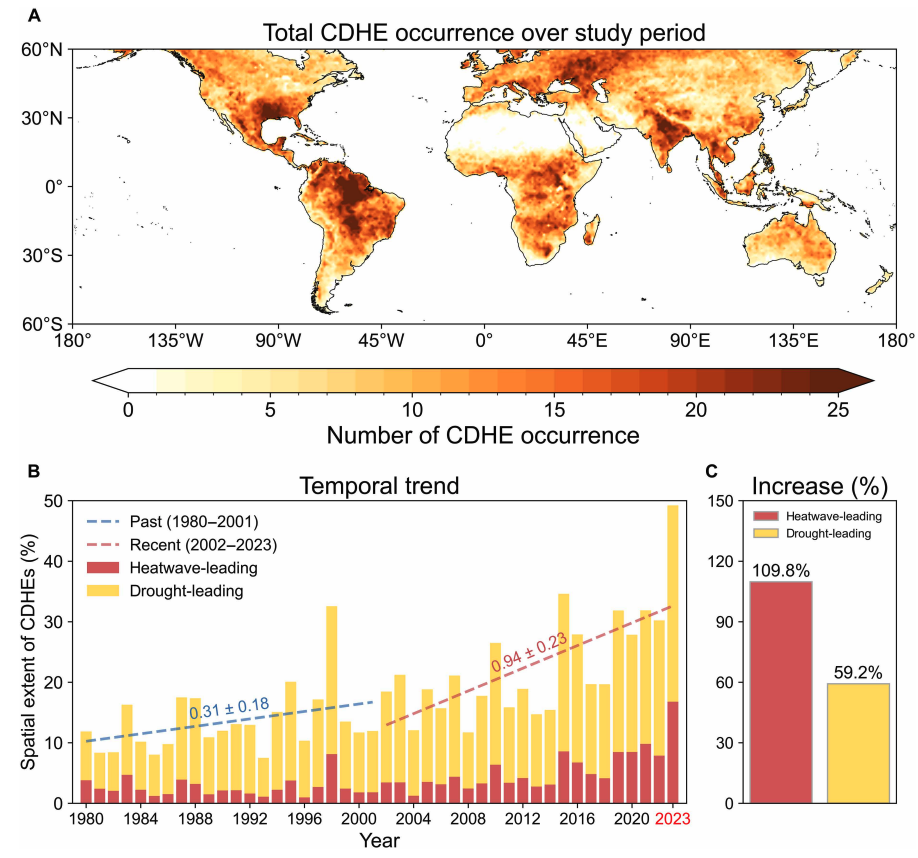
The research finds that the area of land affected by CDHEs has “increased substantially” since the early 2000s.
Heatwave-led events have been the main contributor to this increase, the study says, with their spatial extent rising 110% between 1980-2001 and 2002-23, compared to a 59% increase for drought-led events.
The map below shows the global distribution of CDHEs over 1980-2023. The charts show the percentage of the land surface affected by a heatwave-led CDHE (red) or a drought-led CDHE (yellow) in a given year (left) and relative increase in each CDHE type (right).
The study finds that CDHEs have occurred most frequently in northern South America, the southern US, eastern Europe, central Africa and south Asia.
Threshold passed
The authors explain that the increase in heatwave-led CDHEs is related to rising global temperatures, but that this does not tell the whole story.
In the earlier 22-year period of 1980-2001, the study finds that the spatial extent of heatwave-led CDHEs rises by 1.6% per 1C of global temperature rise. For the more-recent period of 2022-23, this increases “nearly eightfold” to 13.1%.
The change suggests that the rapid increase in the heatwave-led CDHEs occurred after the global average temperature “surpasse[d] a certain temperature threshold”, the paper says.
This threshold is an absolute global average temperature of 14.3C, the authors estimate (based on an 11-year average), which the world passed around the year 2000.
Investigating the recent surge in heatwave-leading CDHEs further, the researchers find a “regime shift” in land-atmosphere dynamics “toward a persistently intensified state after the late 1990s”.
In other words, the way that drier soils drive higher surface temperatures, and vice versa, is becoming stronger, resulting in more heatwave-led compound events.
Daily data
The research has some advantages over other previous studies, Yeh says. For instance, the new work uses daily estimations of CDHEs, compared to monthly data used in past research. This is “important for capturing the detailed occurrence” of these events, says Yeh.
He adds that another advantage of their study is that it distinguishes the sequence of droughts and heatwaves, which allows them to “better understand the differences” in the characteristics of CDHEs.
Dr Meryem Tanarhte is a climate scientist at the University Hassan II in Morocco, and Dr Ruth Cerezo Mota is a climatologist and a researcher at the National Autonomous University of Mexico. Both scientists, who were not involved in the study, agree that the daily estimations give a clearer picture of how CDHEs are changing.
Cerezo-Mota adds that another major contribution of the study is its global focus. She tells Carbon Brief that in some regions, such as Mexico and Africa, there is a lack of studies on CDHEs:
“Not because the events do not occur, but perhaps because [these regions] do not have all the data or the expertise to do so.”
However, she notes that the reanalysis data used by the study does have limitations with how it represents rainfall in some parts of the world.
Compound impacts
The study notes that if CDHEs continue to intensify – particularly events where heatwaves are the precursors – they could drive declining crop productivity, increased wildfire frequency and severe public health crises.
These impacts could be “much more rapid and severe as global warming continues”, Yeh tells Carbon Brief.
Tanarhte notes that these events can be forecasted up to 10 days ahead in many regions. Furthermore, she says, the strongest impacts can be prevented “through preparedness and adaptation”, including through “water management for agriculture, heatwave mitigation measures and wildfire mitigation”.
The study recommends reassessing current risk management strategies for these compound events. It also suggests incorporating the sequences of drought and heatwaves into compound event analysis frameworks “to enhance climate risk management”.
Cerezo-Mota says that it is clear that the world needs to be prepared for the increased occurrence of these events. She tells Carbon Brief:
“These [risk assessments and strategies] need to be carried out at the local level to understand the complexities of each region.”