

Global warming linked to the world’s biggest oil and gas companies made all “major” 21st century heatwaves more intense and frequent.
This is according to new research, published in Nature, which uses “extreme event attribution” to assess the impact of climate change on all 21st-century heatwaves that were classified as “major disasters”.
The authors find one-quarter of the 213 heatwaves would have been “virtually impossible” without human-caused global warming.
They add that the effect of climate change on heatwave frequency and intensity is becoming more pronounced as the planet warms.
The study estimates the emissions stemming from the operations and production of more than 100 “carbon majors”, such as ExxonMobil, BP, Saudi Aramco and Shell.
The fossil fuels produced by these companies account for 60% of all human-caused CO2 emissions over 1850-2023, the study says.
The authors find that heatwaves recorded over 2000-23 were made, on average, 1.7C hotter due to climate change, with half of this increase due to the emissions originating from carbon majors.
This study “could be used to support future climate lawsuits and aid diplomatic negotiation”, according to a scientist not involved in the research.
Worsening heatwaves
As the planet warms, heatwaves are becoming more intense and frequent, driving economic losses, ecosystem damage and a rise in heath-related deaths.
The EM-DAT database catalogues all “major disasters” that have been reported since the year 1900 – defined as events that cause at least 10 fatalities, affect at least 100 people, or result in the declaration of state of emergency or a call for international assistance.
Between 2000 and 2023, the database lists more than 200 heatwaves. These are shown on the map below, where darker pink indicates a greater number of heatwaves. Countries with no reported heatwaves are shown in grey.
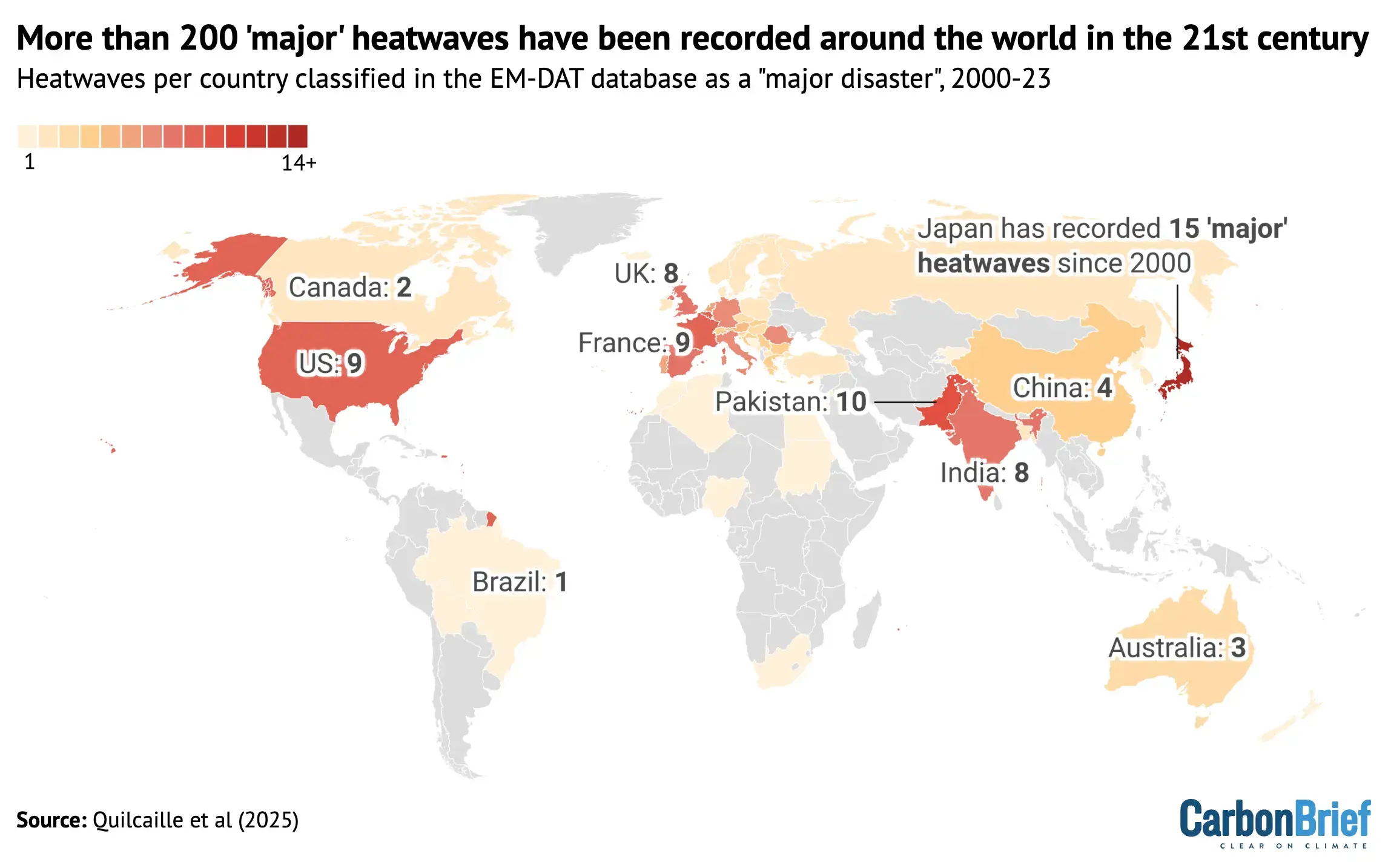
The study authors acknowledge that heatwave reporting is “highly uneven”, with only nine of the heatwaves reported in the database since the year 2000 in Africa, Latin America or the Caribbean. (This is largely because extreme heat events in these regions are not routinely monitored.)
They then carried an attribution analysis on each heatwave to identify whether it was made more likely or intense due to human-caused climate change.
The chart below shows how climate changes increased the intensity and frequency of the 78 heatwaves assessed over 2000-09 (left), 54 heatwaves assessed over 2010-19 (middle) and 81 heatwaves assessed over 2020-23 (right).
The authors find that climate change increased the intensity and probability of all 213 heatwaves in the study. They add that the influence of climate change on heatwaves is strengthening over time.
In each panel, the bars show the percentage of heatwaves in that time period that were made 0.25-1.0C (yellow), 1.0-2.0C (orange) or 2.0-3.0C (red) hotter due to climate change.
The position of bars indicate the change in likelihood of the heatwaves. This ranges from those made 1-10 times more likely due to climate change (left-most bar in each panel) to those made more than 11,000 times more likely (right-most bar in each panel).
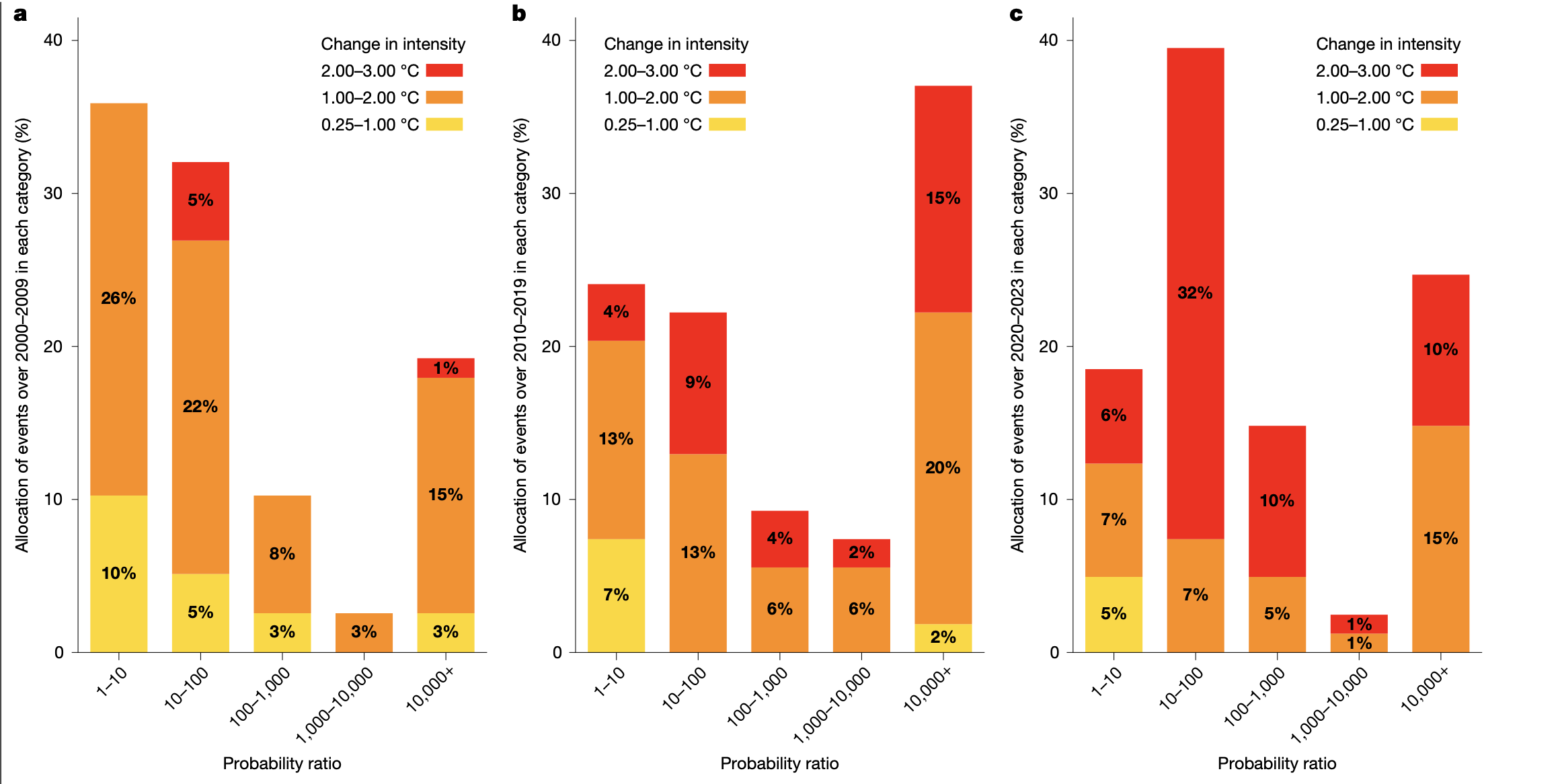
Heatwaves recorded over 2000-09 were, on average, 20 times more likely due to climate change, according to the authors. Meanwhile, those recorded over 2010-19 were about 200 times more likely.
Similarly, 2000-09 heatwaves were 1.4C hotter due to human-caused climate change on average, according to the study, while 2010-19 heatwaves were made 1.7C hotter.
The study finds that human-caused climate change made 55 heatwaves at least 10,000 times more likely. According to the authors, this is “equivalent to saying that they would have been virtually impossible” without the influence of human activity.
Carbon majors
To assess the contribution to heatwaves by oil and gas companies’ products, the authors use a database of carbon dioxide and methane emissions from 180 carbon majors over 1854-2023. This includes direct emissions from the companies, as well as the emissions released when the oil and gas they produced is used by others.
The 180 carbon majors in the database represent 60% of all human-caused CO2 emissions, including land use, over 1850-2023, according to the study. The paper adds that 14 companies, including ExxonMobil, BP, Saudi Aramco and Shell, are responsible for almost half of these emissions.
Using the Earth system model OSCAR, the authors estimate that global average surface temperatures increased by 1.3C between the 1850-1900 average and the year 2023.
They find that 0.7C of this increase was linked to the carbon majors, with 0.3C due to the emissions of the 14 largest.
The chart below, taken from an accompanying Nature “news and views” article, shows the contribution of oil and gas companies’ products to increasing global average surface temperatures over 1950-2023, compared to the 1850-1900 average.
Each colour indicates a carbon major, while grey indicates other sources of temperature increase, such as land-use change.
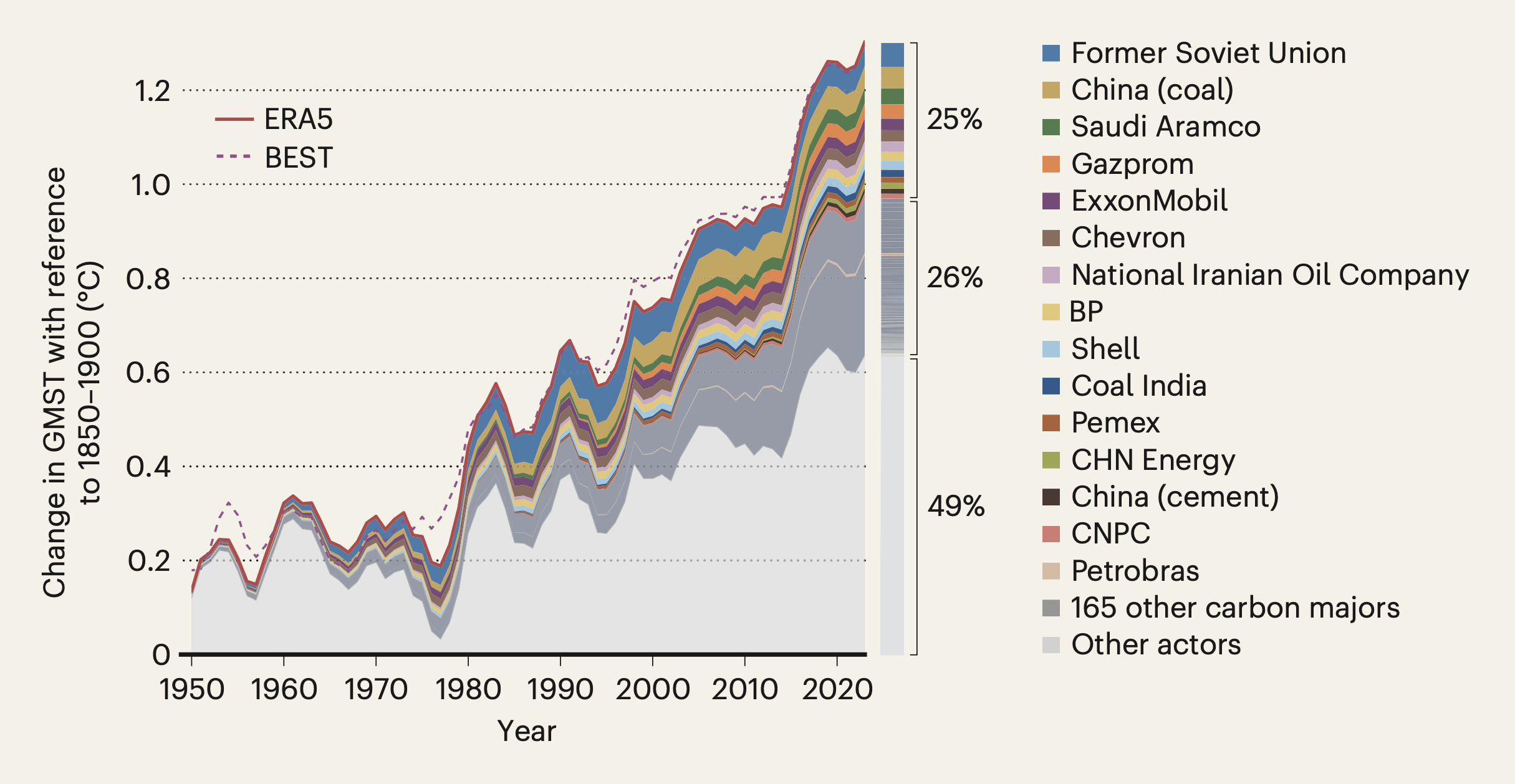
Heatwaves recorded over 2000-23 were, on average, 1.7C hotter due to climate change, according to the study. The authors find that emissions originating from carbon majors and their products contributed about half of the increase in intensity of heatwaves seen since pre-industrial times.
The authors then break down the contribution of emissions from each carbon major on each heatwave in their analysis.
For example, they find that the emissions linked to Saudi Aramco made 51 heatwaves at least 10,000 times more likely. They add that on average, emissions tied to the company made the 213 heatwaves 0.04C hotter.
Legal action
Attribution studies already play an important role in courts by providing evidence that helps judges to determine liability.
Dr Rupert Stuart-Smith is a research associate in climate science and the law at the University of Oxford’s Sustainable Law Programme. He was not involved in the study, but has published separate work showing that the emissions linked to each of the six largest corporate emitters cause one heat-related death in Zurich alone, every summer.
Stuart-Smith tells Carbon Brief that the new paper is a “high-quality analysis and a meaningful step forward for the field of climate change attribution”. He adds:
“With more and more lawsuits aiming to hold high-emitting companies responsible for their contributions to climate change impacts or compel state and corporate actors to reduce their emissions and prevent rising climate harms, work like this provides the basis for well-informed judicial decision-making.”
Dr Yann Quilcaille is a researcher at ETH Zürich and lead author of the study. He stresses the importance of attribution research for court cases, telling Carbon Brief that he hopes his work “can be used by legal practitioners”.
However, he also says that his role as a scientist is not to assign “responsibility” for climate change, but to “provide information to governments for decision making and to courts for litigation”.
Earlier this year, Dr Christopher Callahan, the principal investigator of the IU Climate & Society Lab, published a study with Prof Justin Makin, an associate professor in the department of geography at the University of Dartmouth, which links trillions of dollars in economic losses to the extreme heat caused by emissions tied to oil and gas companies.
Mankin tells Carbon Brief that the new paper is “very closely” linked to his research.
Callahan says the new paper is “an important contribution to an emerging literature that illustrates how individual emitters can be linked to the change risk of extreme climate conditions and human impacts”.
He explains that “this kind of evidence will be important in courtrooms – holding emitters legally accountable requires demonstrating a causal nexus between that emitter and a particularised harm suffered by a plaintiff”.
Attribution
The cutting-edge field of extreme weather attribution seeks to establish the role that human-caused warming played in these events. Attribution studies have been carried out on hundreds of heatwaves all around the world, as shown in Carbon Brief’s interactive map.
The new paper uses one of the earliest and most commonly used methods of attribution, called “probabilistic attribution”.
Specifically, it uses the method set out by the World Weather Attribution initiative for its “rapid attribution” analyses.
The authors first chose a temperature “threshold” to define their heatwave.
They then used a global climate model to simulate two worlds – one mirroring the world as it was during the heatwave and the other using the climate of 1850-1900. This second scenario is used to represent the climate in a world without human-caused climate change.
The authors run their models thousands of times in each scenario. As the world’s climate is inherently chaotic, each model “run” – individual simulations of how the climate progresses over many years – produces a slightly different progression of temperatures. This means that some runs simulate the heatwave, while others do not.
The authors count how many times the threshold temperature was in each model run. They then compared the likelihood of crossing the threshold temperature in the world with – and a world without – climate change.
For example, they find that the 2021 Pacific north-west heatwave was made 3.1C hotter due to human caused climate change and more than 10,000 times more likely.
(A study by the WWA at the time of the heatwave found that the heatwave was made 150 times more likely. The discrepancy is due to differences in the definition of the event, as well as its “very unlikely nature” according to the study authors.)
Dr Frederieke Otto is a professor at Imperial College London and founder of the WWA initiative. She tells Carbon Brief that the new study is “very similar to some other recent studies on impacts, based on the hazard attribution method used by WWA”, but says that “this is the most high profile and wide-reaching one”.
Otto adds:
“I do hope that many more impact attribution studies will follow, based on our or other extreme event attribution studies. We need more research on this.”



The post Study links world’s top oil and gas firms to 200 ‘more intense’ heatwaves appeared first on Carbon Brief.
Study links world’s top oil and gas firms to 200 ‘more intense’ heatwaves

The Endangered Species Committee, known as the God Squad, issued a rare exemption from compliance with the Endangered Species Act for oil and gas activities in the Gulf of Mexico.
Environmental groups are suing the Trump administration over its decision to exempt oil and gas drilling in the Gulf of Mexico from complying with the Endangered Species Act, a move they say threatens both the coastline region and the law designed to protect threatened plants and animals.
Environmental Groups Take Trump Administration’s ‘God Squad’ to Court
The ocean’s fastest and most formidable predators might also be the most physiologically vulnerable to warming waters, researchers warn.
The evolutionary edge that fueled great white shark dominance for millions of years could soon become its greatest downfall.
Climate Change
China Briefing 16 April 2026: Billions for grid | Petrochemical plan | China’s high-seas bid
Welcome to Carbon Brief’s China Briefing.
China Briefing handpicks and explains the most important climate and energy stories from China over the past fortnight. Subscribe for free here.
Key developments
Surge in grid investment
TRILLION-YUAN ERA: China’s two largest power grid operators invested a total of 167.5bn yuan ($24.5bn) in the first quarter of 2026, reported state broadcaster CCTV. State Grid said that during this period it spent more than 10bn yuan on connecting “new energy” projects to the grid, up 50% from last year, reported Shanghai-based news outlet the Paper. The two state-owned enterprises (SOEs) plan to invest 1tn yuan ($146bn) annually over the 15th five-year plan period (2026-2030), said finance news outlet Yicai.
POWER CURBED: However, in what Bloomberg called a “clear signal that the grid is struggling to absorb all the extra power from the rapid growth in renewables”, solar and wind utilisation rates – the percentage of total power generated by a source that is used by the grid – fell again at the start of the year. They stood at 90.8% and 91.5%, respectively, in January and February 2026, according to a post by an SOE-linked research institute republished by energy news outlet International Energy Net. The rates are now “approaching [minimum] limits that the government had relaxed only two years ago”, added Bloomberg.

SIX PROVINCES SUPERVISED: A recent meeting of the National Energy Administration (NEA) concluded that China’s renewable installations had seen “steady growth” in 2026, adding that the body must make “sustained efforts” to “expand” investment in renewable power, reported International Energy Net. Separately, International Energy Net also said that the NEA will increase “supervision” of the power sectors in six provinces – Hebei, Jilin, Xinjiang, Fujian, Hunan and Guangdong. The outlet said this would entail scrutinising how they implement “energy conservation and carbon reduction” tasks, with a “focus” on coal plants, how they construct large clean-energy bases and their consumption of new energy, as well as their power infrastructure and markets.
Conflict spurred cooperation with China
CHINA ‘WINNING’: In Vienna, Chinese climate envoy Liu Zhenmin told state news agency Xinhua that the Middle East conflict has created an urgent need for countries to rethink energy security strategies and accelerate the energy transition. Xinhua also cited Liu as warning against over-reliance on a single source of energy imports. Meanwhile, state broadcaster CCTV published a segment arguing that a “greener” system will “provide a strong guarantee” for energy security, although it did not mention the conflict. Several outlets have continued to highlight how low-carbon energy has helped China weather the conflict and boosted sales of Chinese technologies, including the New York Times, Wall Street Journal, Associated Press, Indian Express, Washington Post and Bloomberg. Semafor said China was “winning the global energy war”.
MANY MEETINGS: United Arab Emirates crown prince Sheikh Khaled bin Mohamed bin Zayed Al Nahyan and Chinese president Xi Jinping discussed how to “prevent further impacts” from the conflict on energy security, said Xinhua. Australian prime minister Anthony Albanese said he addressed “regional energy security” with Chinese premier Li Qiang, reported Reuters. A post by China-Russia Information Net on nationalist media outlet Guancha quoted a Chinese diplomat in Russia telling reporters that “current dramatic changes in the international situation” are causing the two countries to discuss “further energy cooperation”. The Philippines is continuing to consider “oil and gas cooperation” with China, despite territorial disputes, Reuters also reported.
‘PROFOUND’ IMPACTS: Energy administration head Wang Hongzhi wrote a chapter in a “study guide” to the 15th five-year plan, published by industry outlet China Power News Net, in which he noted that “geopolitical conflicts are profoundly reshaping the global energy landscape”. He added that “traditional fossil fuels must continue to serve as a safety net while [China] simultaneously accelerates efforts to transition [to clean energy sources]”. Environment minister Huang Runqiu wrote in the CPPCC Daily, the official newspaper for the advisory body Chinese People’s Political Consultative Conference (CPPCC), that China will “earnestly” carry out “carbon peaking actions” in the next five years. Huang also said that, with “concerted efforts”, China’s 15th five-year plan targets are “achievable”.
Petrochemical plan published
UPGRADE DEADLINE: China issued a plan for either upgrading or phasing out “outdated” petrochemical plants by 2029, reported Reuters. It added that the plan did not confirm explicitly “how many plants may be upgraded or phased out”. The news outlet Economic Daily said that, according to the document, China would focus on upgrading or phasing out outdated capacity “as determined in 2025”, while also developing a “long-term working system” for assessing the industry. According to the full document, published on the Ministry of Industry and Information Technology (MIIT) website, carbon-emission assessments were part of the selection criteria, with policymakers planning on “developing or revising” further standards for carbon emissions under the plan.
-
Sign up to Carbon Brief’s free “China Briefing” email newsletter. All you need to know about the latest developments relating to China and climate change. Sent to your inbox every Thursday.
CHEMICAL OVERCAPACITY: The Paper quoted MIIT official Chang Guowu telling reporters that the plan will address the “low standards of design and construction” and “outdated processes” in older plants that lead to “significant” environmental risks. Xinhua said that, of China’s more than 27,000 petrochemical plants, “more than 1,600…outdated facilities” were reported in 2025, 600 of which required upgrading. Chemical news WeChat account WeLink Chemicals noted the policy was released against a backdrop of “overcapacity and declining demand for road transport fuels”, with the government having “stepped up efforts to curb overcapacity” in 2025.
More China news
- TARGET PLEDGED: China will cut the carbon intensity of its international shipping vessels by at least 15% by 2030 compared to 2025 levels, said climate outlet IdeaCarbon. It said China will also “significantly enhance” its influence in emission reduction talks at the International Maritime Organization.
- SANCHEZ VISITED: China and Spain “can contribute to finding solutions” for environmental issues, Spanish leader Pedro Sanchez told Xi Jinping, according to the Associated Press. Ahead of the meeting, Sanchez also argued China should play a more substantial role on climate change, said the Singapore-based Straits Times.
- CHINA COMMITTED: Huang Runqiu reaffirmed China’s support, “as always”, for global climate governance in a meeting with UN advisor Selwin Hart, said the Paper.
- FUNDING HALTED: The EU “quietly” approved a plan to prevent EU funds being provided to “clean technology projects containing Chinese inverters”, said the Hong Kong-based South China Morning Post.
- AI UNVEILED: Chinese researchers developed a “first-of-its-kind artificial intelligence model designed to track carbon emissions”, reported Xinhua, adding that it “could shift the balance of power” in global climate negotiations, such as by quantifying the “embedded carbon” of products that developed countries import from China.
- CONTROLS CONSIDERED: China is deliberating “limiting exports” to the US of the equipment needed to make solar panels, according to Reuters.
Spotlight
The debate over China’s bid to host the “high seas” treaty
The final preparatory commission for the Biodiversity Beyond National Jurisdiction (BBNJ) agreement has closed, laying the groundwork for the treaty’s first conference of the parties (COP1).
One key agenda item was China’s presentation of a bid to host the secretariat. In this issue, Carbon Brief examines the debate surrounding the bid.
The BBNJ agreement, also known as the High Seas Treaty, governs the sustainable use and conservation of the “high seas” – marine areas outside national jurisdictions – with a new United Nations (UN) body established to oversee enforcement.
As well as facing significant impacts from climate change, the ocean plays an important role as a carbon sink, absorbing around 29% of man-made emissions.
The treaty “recognis[es]” the need to address oceanic biodiversity loss and ecosystem degradation, according to previous Carbon Brief analysis, identifying key impacts from climate change, acidification, pollution and “unsustainable” use.
It aims to encourage conservation and sustainable use of marine biodiversity in the high seas, such as by managing “marine genetic resources”, creating protected areas in the ocean, developing environmental impact assessments and facilitating capacity-building and transfer of marine technology.
China’s bid
China’s bid to host the secretariat focused on its “sustainability efforts” and “commitment to multilateralism”, reported the Earth Negotiations Bulletin.
The country’s bid document drew attention to several of its emission-reduction efforts, including “green shipping corridors” and strengthening carbon sinks through protecting mangroves, seagrass beds and coral reefs.
In a speech, Chinese ambassador to the UN Fu Cong said that the bid “reflects China’s unwavering support” for multilateralism, adding that a successful Chinese bid would lead to the first UN-related body headquartered in the Asia Pacific region. He said:
“That means it will not only be welcomed, but also be prioritised. It will have the full backing from all levels of government in China and its people.”
Li Shuo, director at the Asia Society Policy Institute’s China climate hub, attended the meetings. He said in a note that China’s decision to bid “reportedly came from [President] Xi Jinping”, galvanising a coordinated cross-ministry effort to secure host the secretariat.
Creating debate
China entering the race has caused a stir.
As host, it could inhibit “robust environmental safeguards” by “embedding elements of its domestic governance model” into how the treaty operates, wrote Dr Chime Youdon, research fellow at India’s National Maritime Foundation, on the organisation’s platform.
But such concerns are weakened by the fact that China would “want the treaty to function” if it were host, argued Prof Philippe Le Billon and Zelda Ladefoged, professor and master’s student at the University of British Columbia, in an article for the Conversation.
Nevertheless, they noted “sustained” worries around China’s influence, given the extensive involvement of its companies in distant-water fishing and deep-sea mining, which are not covered in the treaty.
Li told Carbon Brief that, as far as he saw, no-one was “actively pushing back against” the bid on any of the above grounds. Instead, he observed “anxieties” around “accreditation, information security and visa and conference participation issues”.
Daniel Kachelriess, cross-cutting coordinator at the High Seas Alliance, an umbrella group of non-governmental organisations focused on ocean governance, echoed this in comments to Carbon Brief. He said “values like neutrality and impartiality, transparency and accountability” are important for the decision, as well as practical issues such as “reliable” internet access.
The Financial Times reported that Chinese delegates have offered immunity to attendees and flexibility around visas, citing unnamed sources.
But a successful Chinese bid could be a “significant escalation” of China’s involvement in global environmental governance, wrote Le Billon and Ladefoged.
As such, the BBNJ could prove a “case study” of sustaining environmental progress without the US and of China “learning to translate its ambitions into leadership”, said Li.
Watch, read, listen
PROFIT PRESSURE: The Economic Observer investigated how higher profit remittance requirements for state-owned enterprises is placing pressure on the balance sheets of power, coal and other energy companies.
CARNEY’S CALCULUS: The Wire China Podcast discussed how a deteriorating relationship with the US affected Canada’s approach to importing Chinese electric vehicles.
AFRICAN SOLAR: Climate Home News interviewed a renewables company working in Africa about what the end of Chinese solar export rebates could mean for the continent.
FUEL PRICE WOES: The New York Times published a video about how rising diesel prices are hitting China’s long-haul truck drivers hard.
140%
The year-on-year rise in March in exports of Chinese new-energy vehicles (NEVs, including both plug-in hybrids and pure electric vehicles), reported Bloomberg, citing renewed interest caused by the “global energy shock stemming from the Iran war”.
-14%
The year-on-year fall in March in domestic sales of Chinese NEVs, reported Yicai, citing “changes to the NEV purchase tax exemption and the overlapping effects of the Chinese New Year holiday”.
New science
- Between 1978 and 2023, emissions of “gaseous reactive nitrogen” – including ammonia and nitrous oxide – from croplands in China more than doubled | PNAS
- There are “disparities in [the] energy transition” between households in rural China, with small, low-income households and areas in the Loess plateau facing a “disproportionate energy burden and energy poverty” | Communications Earth and Environment
Recently published on WeChat
China Briefing is written by Anika Patel, with contributions from Lekai Liu, and edited by Simon Evans. Please send tips and feedback to china@carbonbrief.org

The post China Briefing 16 April 2026: Billions for grid | Petrochemical plan | China’s high-seas bid appeared first on Carbon Brief.
China Briefing 16 April 2026: Billions for grid | Petrochemical plan | China’s high-seas bid


-
Greenhouse Gases8 months ago
Guest post: Why China is still building new coal – and when it might stop
-
Climate Change8 months ago
Guest post: Why China is still building new coal – and when it might stop
-

 Greenhouse Gases2 years ago
嘉宾来稿:满足中国增长的用电需求 光伏加储能“比新建煤电更实惠”
-
Climate Change2 years ago
Bill Discounting Climate Change in Florida’s Energy Policy Awaits DeSantis’ Approval
-

 Climate Change2 years ago
嘉宾来稿:满足中国增长的用电需求 光伏加储能“比新建煤电更实惠”
-
Climate Change Videos2 years ago
The toxic gas flares fuelling Nigeria’s climate change – BBC News
-

 Renewable Energy6 months ago
Sending Progressive Philanthropist George Soros to Prison?
-

 Carbon Footprint2 years ago
US SEC’s Climate Disclosure Rules Spur Renewed Interest in Carbon Credits