

Average global yields of six staple crops could fall by more than 11% under a moderate warming scenario by the end of the century – even when accounting for how farmers could adapt to climate change, new research finds.
The study, published in Nature, examines changes in yields for cassava, maize, rice, sorghum, soya bean and wheat under two different warming scenarios.
But, unlike previous studies, it also factors in adaptive measures that farmers may employ to adjust to the changing climate.
It finds that implementing adaptation could reduce total yield losses by around 12% by the end of the century – although the world would still face “substantial losses”, it says.
The study also finds that the world’s “breadbaskets” – such as the US and Europe – will have less adaptive capacity than poorer regions, as their farming industries have been optimised for high yields, rather than resilience.
One researcher, who was not involved in the new study, tells Carbon Brief that these types of studies “are essential steps” towards better understanding adaptation in agriculture.
‘Partially protective’ adaptation
Globally, agriculture is projected to be one of the industries that is hit hardest by the impacts of climate change.
Along with rising average temperatures and changing rainfall patterns, increasingly frequent and severe weather extremes threaten planted crops.
However, large uncertainties remain around how farmers will adapt to future climate change.
Most previous research on the yield impacts of climate change either assumes that farmers will not adapt to the changes at all or that they can adapt infinitely, explains Dr Andrew Hultgren, an environmental economist at the University of Illinois Urbana-Champaign.
Hultgren, who led the new study, tells Carbon Brief:
“The question is: ‘What do real world farmers actually do?’ So that’s what we really set out to tackle…And what we find is that, essentially, neither of these extreme stories is really accurate. Farmers do adapt, but that adaptation is partially protective – not fully protective.”
The researchers model the impacts on crop yields under two emissions scenarios – moderate (RCP4.5) and very high (RCP8.5) – for two time periods – 2050 and 2098. They select six staple crops for their study: cassava, maize, rice, sorghum, soya bean and wheat.
For both emissions scenarios, the researchers apply projected future incomes consistent with SSP3 socioeconomic pathway. This portrays a “rocky road” of global development in the future due to rising geopolitical tensions driven by “regional rivalry”.
Under the moderate-emissions scenario, they find an overall decrease in staple crop yield of 8.3% in 2050 and 12.7% in 2098.
However, they find that these losses can be reduced somewhat by the introduction of adaptive measures, such as switching to different varieties of a crop or adjusting irrigation levels.
In order to account for adaptation, the researchers use data on crop yields from 12,658 sub-national regions to create a model that links changes in yields to exposure to extremely hot days.
This allows the researchers to project the impacts of adaptive measures without having to prescribe what, exactly, those measures would be, Hultgren says. Relatively lower losses on extreme heat days are “reflective of adaptation”, he adds.
In other words, if two regions with similar baseline climates and yields both experience a season of extreme heat, the one that has lower yield losses has more adaptations to climate change.
Factoring in adaptation and income growth, they find that the yield losses fall to 7.8% in 2050 and 11.2% in 2098 under moderate emissions. While these changes are relatively small, they are not insignificant, Hultgren argues:
“Twelve percent mitigation of losses is still a globally important amount of gains from adaptation.”
Dr Jyoti Singh, a climate-crop modeller at Columbia University’s Center for Climate Systems Research, tells Carbon Brief that the dataset assembled for the new study is its “most noteworthy strength”. Singh, who was not involved in the new work, adds that it “significantly contributes to empirical agricultural impact modelling”.
However, she says, there is a “big limitation” of the study in that empirical models are based only on past data – they cannot account for the full range of potential futures. Therefore, the results from the new study cannot be compared directly to results from models that more explicitly represent the processes that influence crop growth, she says.
Regional loss patterns
The losses are not equal across all six staples. The end-of-century losses range from just over 1% loss for rice yields to 22.4% loss for soya bean yields. This is because each of the crops has a different response to changes in temperature and rainfall.
The change in rice yield is particularly low, Hultgren explains, because the losses associated with overall warming are somewhat counterbalanced by yield increases due to rising nighttime temperatures.
In addition to the differences between crops, the researchers identify strong regional differences in the amount of future losses – as well as the extent to which adaptation will offset these losses.
In Africa, for example, the researchers project an overall yield decrease of 16% by 2098 with no adaptive measures in place. Adding in these adaptations reduces that yield loss to 11.6%. By contrast, adding adaptation to projections of staple yields in North America makes almost no change – reducing the losses from 21.0% to 20.8%.
The maps below show the percentage of yield losses for (clockwise from top-left) maize, soya bean, wheat, sorghum, cassava and rice in 2098 under a moderate-warming scenario that factors in adaptation.
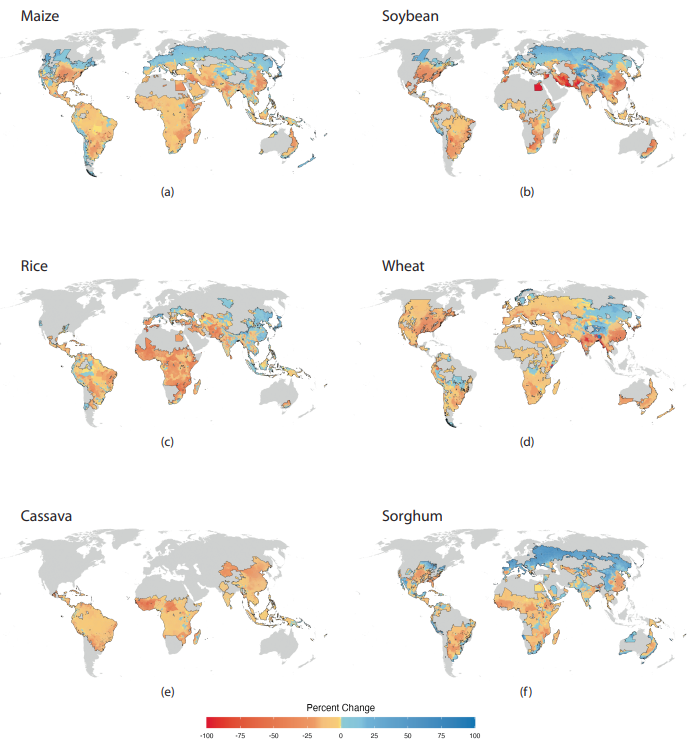
The maps show that many of the staple crops studied suffer the most significant losses in current “breadbasket” regions of the world that produce much of the world’s calories, such as the US and Europe. In contrast, many lower-income, tropical regions see more modest losses. The authors write:
“Because such a large fraction of agricultural production is concentrated in these wealthy-but-low-adaption regions, they dominate projections of global calorie production, generating much of the global food security risk we document.”
However, Hultgren points out, subsistence farmers – particularly those who rely on cassava – will also be significantly impacted by climate change. The researchers identify the highest losses among the top two deciles of the global income distribution and the bottom decile.
This result was “surprising”, Hultgren says. Typically, he explains, research has shown that poorer areas are the hardest-hit by climate change.
He adds that the finding is reflective of the trade-off between average yields and adaptive measures. In high-producing regions, farmers have generally relied on planting the highest-yielding varieties, instead of crop varieties that might have lower average yields, but are more resilient to changes in climate.
Hultgren tells Carbon Brief:
“Adaptation is costly…That’s why losses in the breadbasket portion of the world are so large, because farmers have to essentially pay a high price. Either in terms of actual financial inputs or in terms of just average yield losses, they have to pay a high price in order to get the adaptation they need.”
‘Giving up breakfast’
By combining the projected yields for all six crops, the researchers also estimate the total impact of warming on global calories.
They find a “nearly linear” decrease in global calorific output of 554tn kilocalories per 1C of warming – equivalent to about 120 kcal per person per day per 1C. (The recommended daily intake is typically around 2,000kcal for women and 2,500kcal for men.)
Hultgren tells Carbon Brief:
“If you think about a 3C warmer future, that’s like a population that is giving up breakfast every day – that would be the level of the caloric output loss.”
That result “should raise questions” about global food security and international political stability, Hultgren says.
The study’s method of linking global calories to changes in temperature is one of the “key innovations” of the new study, Singh says. She adds that it “improve[s the] policy relevance” of the work.
Singh tells Carbon Brief:
“Real-world adaptation decisions, from changing crop types to investing in irrigation or adopting resilient varieties, vary significantly depending on policies and farmers’ knowledge, resource access and financial capacity.
“Studies like this one, even if not fully comprehensive, are essential steps toward understanding and incorporating adaptive capacity into yield projections, moving us closer to more realistic agricultural impact assessment efforts.”

The post Staple crops yields face ‘substantial losses’ in warming world – even with adaptation appeared first on Carbon Brief.
Staple crops yields face ‘substantial losses’ in warming world – even with adaptation

That would be American ratepayers—i.e., you.
From our collaborating partner Living on Earth, public radio’s environmental news magazine, an interview by Jenni Doering with Katharine Kollins, the president of Southeastern Wind Coalition.
Who Loses in the Trump Administration’s $1 Billion ‘Deal’ to Abandon Offshore Wind?
County officials have said they will eventually close the incinerator, located in a predominantly Black community. Advocates want a concrete plan.
Minneapolis activists are escalating a decades-long fight by going on a hunger strike to demand that local officials shut down a polluting trash incinerator.
Minneapolis Activists Launch Hunger Strike to Protest Polluting Trash Incinerator
Ahead of next year’s legislative session, lawmakers probe regulators and industry leaders about how data centers operate.
As Texas confronts decades of water mismanagement and growing demands for electricity from data centers, the state’s top utility regulator, Public Utility Commission Chairman Thomas Gleeson, told a state House committee on Thursday that it’s critical to have a clear picture of how much water data centers use.
Texas Data Center Developers Play Offense on Water, Claiming Huge Cuts in Usage

Who Loses in the Trump Administration’s $1 Billion ‘Deal’ to Abandon Offshore Wind?
Minneapolis Activists Launch Hunger Strike to Protest Polluting Trash Incinerator
Texas Data Center Developers Play Offense on Water, Claiming Huge Cuts in Usage
-
Climate Change8 months ago
Guest post: Why China is still building new coal – and when it might stop
-
Greenhouse Gases8 months ago
Guest post: Why China is still building new coal – and when it might stop
-

 Greenhouse Gases2 years ago
嘉宾来稿:满足中国增长的用电需求 光伏加储能“比新建煤电更实惠”
-
Climate Change2 years ago
Bill Discounting Climate Change in Florida’s Energy Policy Awaits DeSantis’ Approval
-

 Climate Change2 years ago
嘉宾来稿:满足中国增长的用电需求 光伏加储能“比新建煤电更实惠”
-
Climate Change Videos2 years ago
The toxic gas flares fuelling Nigeria’s climate change – BBC News
-

 Renewable Energy6 months ago
Sending Progressive Philanthropist George Soros to Prison?
-

 Carbon Footprint2 years ago
US SEC’s Climate Disclosure Rules Spur Renewed Interest in Carbon Credits