

Weather Guard Lightning Tech
Sensing360’s Fiber Optics Catch Gearbox Failures Early
Eric van Genuchten, COO and Co-founder of Sensing360, explains how fiber optic technology is changing gearbox monitoring by catching failures that standard vibration sensors miss. The company’s system uses light-based sensors mounted directly onto planetary gearboxes to measure tiny steel deformations and load changes, providing early warning for the 10% of catastrophic failures current monitoring can’t detect.
Sign up now for Uptime Tech News, our weekly email update on all things wind technology. This episode is sponsored by Weather Guard Lightning Tech. Learn more about Weather Guard’s StrikeTape Wind Turbine LPS retrofit. Follow the show on Facebook, YouTube, Twitter, Linkedin and visit Weather Guard on the web. And subscribe to Rosemary Barnes’ YouTube channel here. Have a question we can answer on the show? Email us!
Welcome to Uptime Spotlight, shining light on wind. Energy’s brightest innovators. This is the Progress Powering. Tomorrow
I am here with Eric van Genuchten. Uh, so Eric is the COO and Co-founder of Sensing 360. Um, and they are bringing optics, um, to monitoring for gearbox, other rotational equipment. Uh, we’re gonna talk a little bit about what that means for the wind industry today, implementation retrofits, uh, from the factory, all kinds of good stuff.
So, Eric, can you give us a little bit of a, of your background? What’s, what makes you an expert in the space?
Eric van Genuchten: Uh, that’s a good question. So basically my background is. Uh, I studied physics when I was much younger than I’m now, so, uh, I’m not gonna disclose when, but, uh, I’ve been working since roughly 20 years and I have a background in SKF in the [00:01:00] bearing, uh, uh, manufacturing space.
And basically I’ve been working within SKF as condition monitoring, uh, solution developer. So I’ve been in condition monitoring for almost 15 years now. And from SKF, where we developed, uh, condition monitoring systems for all kind of applications, but also wind of course, we went towards, um, load sensing of barrens to be very specific to help our large customers.
And for that we used, uh, fiber sensing. And, uh, eight years ago, seven and a half years ago, uh, I started with two colleagues. I started sensing 360. Which is the 360 is of course the rotation, but we are using five optical sand or optics, uh, for rotating equipment, mainly bearings, large bearings, gear boxes.
And uh, we have been focusing a lot on wind, uh, the last five years, uh, mainly on the planetary gearbox because that’s a challenging part from the rotating, uh, [00:02:00] system to monitor. So that’s where we, uh, think we can add some value.
Joel Saxum: So I know like, uh, I, I wanna share this with the users too. Our listeners here too, because I came across your technology man, three, four or five years ago or something, uh, over in Europe.
I, I think it was, we were in Copenhagen, wind, Europe and Copenhagen. Um, and I remember seeing you guys in like the startup space and I walked over and you had like, basically what looked to be, um, a stainless steel bearing race on the, on the table. With your sensor package on it and a live readout. And I looked at it and I went to pick it up and I was like, this is interesting.
And when I picked it up, just my hand on it, I looked at the screen and I could see all the deflections happening on the screen from just me grabbing this. And I mean, it was, I mean, you remember what the product thing there was? It was probably four millimeters thick of stainless steel. Like that’s not, I’m not squishing that thing with my hand, but you could see it.
Eric van Genuchten: Yeah, no, a lot of people checked if we had a camera around it to see if they were mimicking the move. But basically, [00:03:00] if you ring about it, it’s, it’s this, this product still, we still have it, it’s still operational. And this is the, the, the type of bearing a small, relatively small one for, for let’s say, um, wind.
But it’s, uh, 22 kilotons of bearing and you can still see the pinching of your arms. So, uh, indeed. And that’s basically what we do. We, we, we integrate our sensors in steel and make, uh, I don’t say stupid steel smart, or if you put it around, we made rotating equipment smarter if you rephrase it vaguely, basically.
Joel Saxum: I like that. I like that. So, um, you know, in the wind industry, if you’re, if you talk about the past, the past was. Uh, when blades were shorter, of course now everybody’s worried about blades, blades, blades. That’s what we hear all the time. But when blades were shorter and more robust, the problem was gear boxes.
It was, what are we doing about this rotating equipment? We’re having failures. This is a, this is a regular thing. Um, we’ve gotten a little bit past that, um, with. Better bearing [00:04:00] technology, more iterations of gear boxes, different things of this sort. But there’s still issues out there. Um, and, but this is your mission statement, right?
So can you describe the problem of basically what you guys see in the field and what you’re trying to solve?
Eric van Genuchten: Yeah, so the problem in the field where we see gearbox specific and also what has been accomplished with several OEMs, because we, we like to work with customers because that basically brings the real problems outside is, is still.
And it’s, it’s valid for all slowly rotating equipment, but it’s still, uh, if it’s slowly rotating, there’s a lot, a lot of energy to do the classical, more classical vibration monitoring. So you have a challenge to predict failures, and that’s what we are still, uh, focusing on eliminating failure. So let’s say in a bare main bearing, they get 99% of the failures by vibration monitoring.
In the high speed shop bearing, they get the same amount, but in the. Gear In the gearbox, they get 90%, so there’s still 10% of fillers they cannot detect. And [00:05:00] planetary gearbox fillers are pretty catastrophic. They are, let’s say, huge replacements, cranes downtime. So, um, yeah, we, we want to predict it better.
And secondly, um. Like all rotating parts basically. Do you translate the rotation to It’s the fixed world and it’s, it’s as we say, I used to say the bearing is not, the victim is not the cause, but the victim of a failure. Um, it is, you can derive almost all your running conditions from that single point of, uh, measurement.
So operation conditions, misbalance unbalance where, so you can make predictions about, this is my. Yeah, statement prediction about this is the drive line. And of course, as you mentioned, a wind turbine is not only a drive line, the weakest link kind of defines the total life, but the drive line is an essential part of it.
Uh, so it’s still a complex system to monitor. It currents [00:06:00] current vibration monitoring, and we, we add basically load and strain sensing towards it. Therefore we do better predictions.
Joel Saxum: Yeah, because I mean, the answer here is, or the, the, what we’re trying to arrive at is we want to have early prediction of what would be a failure, right?
Because we want the up tower repair. We want the 20, 30, 40, $50,000 repair versus the. 300,000, $400,000 repair where you’re replacing gear boxes or planetary or all kinds of things of that sort. Um, so the tech, the technology that you guys have, of course you’re using fiber optics, which we can, you can arrive at, uh, a much more finite measurement.
Can you explain how that works? I guess let’s take the first, the, the, the first side of it. Let’s explain how it works, if it’s integrated, say from an OEM standpoint. Yeah.
Eric van Genuchten: So
Joel Saxum: if it’s
Eric van Genuchten: integrated from an OE EM standpoint, and we’re working with two. Two of them, and there’s not that many. So basically when you integrate it, you put it directly on the outside of the, the ring gear, so the freely accessible site, uh, [00:07:00] uh, part of the system, and it’s directly put on the outside.
And as you mentioned, you can integrate more very sensitive sensors. And due to the fact that you have more sensors and that they’re so sensitive, you can distinguish between temperature, uh, loading, uh, misbalance, so you have more information than just one. Basic string gauge. Uh, so we integrated on the outside.
Then basically when the planets are rolling, so you have the planets and you have the sun, the planets are rotating. It presses basically the steel way. And we measure that. And that measurement can be done, integrated at the OEM. And then, uh, you get a, a smart gearbox basically, which measures, uh, torque and load sharing and used for prediction, even as you mentioned.
To prevent the, the, the, the small opt tower repairs or to actually to prevent the big non-op tower repairs, but do the small opt towers, repairs, and even winning time if you have to replace it anyways, the whole logistics saves a lot of money and time if you know it six months upfront instead of two [00:08:00] weeks.
Joel Saxum: So speaking of OEMs though, right, because of course weather guard here, we’re an aftermarket product company and we speak with OEMs about integrating from the factory level and, and those kind of things quite regularly, uh, as well as operators, right? You’re starting to see operators put aftermarket solutions that they’ve deemed to be good in their turbine supply agreements are in their turbine RFPs.
Hey, hey. OEMs, we want this. Um, you guys are working directly with OEMs. That’s a tough thing to do. Congrats on that. Right? Um, so what are they using it for? What I mean, of course we know sensing, right? But if it’s, it’s an advanced thing. It’s not on every turbine. Why, why your system? Why, why are they using it?
Eric van Genuchten: The main reasons, the two main reasons to use it maybe have to make three reasons to use it, is the. The main reason is that there’s now a trend towards journal bearings. They’re cheaper, they’re essentially longer life. So in the planets there’s and different type of bearings which are not possible to monitor with vibration sensing.
And we are able to monitor by looking at the, the load changes [00:09:00] over time. That’s the main reason. Extra condition monitor, better condition monitor. And secondly, I think gearbox OEMs will also want to extend their. Let’s say piece of the puzzle or piece of the cake, they want to be become more important so they become more digital.
I think you have seen the platforms by By 360 or Thrive, and they want to do the digitalization, but in the end to to, to provide extended warranty because that’s what their customers are asking for, and. You can give extended warranty if you know what happens with your system. And that’s why they use it.
They use it for the real operation and usage monitoring of their gearbox.
Joel Saxum: Well, I think that, that, that makes sense, right? If you’re trying to extend a warranty period, or like, I guess for, uh, a gearbox manufacturer, they get to sell an extra bit of warranty, right? So they’re happy with that. Um, but you were getting closer and closer to, and, and I know this, this.
Term always kind of bothers me. It’s like when people say, oh, this is ai, eh, it’s not always ai. Sometimes it’s machine learning, sometimes it’s algorithms, whatnot. But when we get closer to [00:10:00] that term of a digital twin, you guys are, are making progress towards getting the industry at that level for slowly rotating equipment, fast rot or quick rotating equipment.
Is, is that part of the, the, the marketing sales pitch from Sensing 360? Is the digital twin or what does it look like?
Eric van Genuchten: Yeah, so it’s input for the digital twin. So basically we provide information for data teams to make a digital twin. And it’s nice that you say that because I mentioned already we measure torque or loading, and 20% more loading on a gearbox or on a bearing is half of your life and the other way around, 20% less loading.
Double your life. So if you have a digital twin, the crucial part is what is actually the operating, uh, to do any yeah. Scenario planning or maintenance planning. So we provide the information for the digital twinning. We don’t make the digital twins. Um, we might, we grow, but at this point
Joel Saxum: I like, well, I like the idea, [00:11:00] right?
Because when, where you hear a lot of times like, oh, this, this turbine has this issue. Let’s, let’s de-rate it. We’ll de-rate it for this amount of time or this, this part of its life, or, or even if we’re into a lifetime extension scenario, we’re gonna de-rate it for the rest of its life. That happens. It’s happening around the world.
So, uh, but actually having knowledge and having, um, information and data, hard data, and I, I, I stress this with everybody, uh, and it’s not just a wind industry problem, right? It’s a, it’s an industry problem. Quantitative data versus qualitative data. Uh, but I stress quantitative data. So now you, you have the ability to produce that, hey, you’re reducing loads by 17% or 22%, whatever that may be, and the lifetime extension could look like this.
Um, that’s an important part of the, of furthering the wind industry, is we get to aging assets, especially here now in this, in the states as we see this last one big, beautiful bill thing changing our ability to do. [00:12:00] PTC repo driven Repowers, right? Which was like, ah, run this thing hard for 10 years. ’cause at year 11 we’re gonna repower.
That’s not a reality anymore. Over here in the United States, you know, who knows what could happen in four more years or eight more years. But right now we’re switching operational strategies, o and m thought processes to. How can we get a lifetime extension out of this? So, so let’s speak on that a little bit.
You know, you guys are integrating from the factory. Great. Now. Fantastic. However, retrofit, what does retrofit look like?
Eric van Genuchten: Retrofit looks the same. I would say. We still integrate it on the outside of the ring gear, even on the outside of the paint by, so something called, we call a sensor strip, which you can.
It takes an hour to install, basically opt tower, and then you have the same data as you have from the five factory installation. Of course, you need to think about, will I do with magnets? Will magnets live for long enough? So there, that’s always, is it acceptable, blah, blah, blah. Um, [00:13:00] but that gives the same load data.
Now, the good thing about a wind turbine is of course, that it runs. It rated power most of the time. So you can derive a calibration while running institute. So you don’t need a whole kinds of, uh, high level simulations or other thought to solve it. But looking at that, we measure for a month as an example, and then you get the, the, the torque levels, the load levels, the, the curtailment stops, the start stops, the, the, the breaks.
And we get all these effect. And every day you make a statement like, I have used this much life according. To the load I had and to the time I was running, and that comes to reduced capacity. Of course, you have to go back to make an estimation about the future, but you basically take a period of three months and you go back and forward with it with the same regime.
She can say, well, based on what we have now, now there six years left in this park. And then you talk about extension. If you have [00:14:00] multiple turbines, you can play with load balancing over the turbines to. Take the hard ones to, to, to, to reduce the air of loads and take the, the, the ones who have, based on the data, seen less load, take them a bit more load so you can kind of maximize energy output.
At least you have the information to do so. I don’t know if, if, if park owners are fully equipped to do it, but that’s one of the, the,
Joel Saxum: the,
Eric van Genuchten: the input parameters you can use to
Joel Saxum: do extension. Well that, that, that leads me to another question here. So sensing 360, of course you guys create the technology, uh, the hardware, the sensors, and you know, a software platform to look at the data.
But are you guys providing those operational insights or is that a part of your business model to say, Hey, you should do this or you should do that? Um, because one of the problems we see in wind and we, and talk about this all the time, is tons of data. We’ve got big data, big data, big data. What do we do with all of it?
And at the same time, you’re seeing. Engineering staffs shrink, uh, you know, some layoffs and things like [00:15:00] this, so they’re losing some internal resources. Is this something that you guys can help people with as well? Yeah, so our,
Eric van Genuchten: so our solution gives a recommendation. So in the end we are, don’t own the park.
So we, well, most of the time not allowed too many control on it, but it makes it, and I like to say it, and of course I would like to say that, but it makes condition monitoring basically one side simpler, and also the information more dedicated. So you need. Less of a degree to analyze it because if you are in the vibration space, looking at vibration spectrum and analysis and making the correct conclusion is still a science.
It’s still quite some, and of course AI is increasing there and we can look at an analogies and, but you still physically need to understand it to make. A good estimation. That is what we, since we have both usage and vibration monitoring, we both have, let’s say more, we have both information at one point.
So we use that to make it simpler. So also run in times are a lot shorter, basically. And secondly, a [00:16:00] statement like you have six years left is a relatively simple statement, but even financial people can translate into what, this is my cost over time. So. Yes, that’s our goal and we give recommendations and advices.
That’s still the case. Um, unless they won’t be to control their park. So I would love to build, build. I would love to build a business model, Joel, with, I get extra production. I get paid for in at least production. I don’t, but I’m not there yet.
Joel Saxum: I like that. Um, okay, so I’m gonna ask a couple questions then, I guess from an operation standpoint.
Say I am. Wind farm owner, X, Y, Z, and I have two parks and one of ’em I’ve been losing some gear boxes in, or I’m getting towards, uh, you know, a lifetime extension type thing. What, what does my journey look like if I call Eric and team and say, Hey, I would like to monitor these things. I, I need more insights of what’s going on in my rotational equipment.
How, what does life look like for me? If I’m trying to implement the solution?
Eric van Genuchten: They never [00:17:00] immediately start buying everything for the whole park. Which is understandable because we are not like, uh, the big, big, huge condition monitor company. So there’s still some, some trust issues, I would say, or, uh, but basically it starts with an assessment.
So basically we have now developed, uh. A two true, um, a suitcase where we will go up, we will put our sensor there with a magnets, with magnets measure for a day or an hour and then say, okay, this is what we can gather. This is the information and this is what we can see. Now we do that on one turbine and preferably three, four, if you have a pocket problems, it’s slightly different because then they know the problems we had in the past we cannot see with our current system.
So. We’re gonna instrument several of them and, and look together at the data. ’cause we have kind of proven that we can pick point teeth breaking, uh, bearing failures in the plan. So we, we have a story. [00:18:00] This is working if we go about lifetime extension. Yeah. That’s still, the proof is still in the pudding, let’s say, or in p the end proof is in the eating of the pudding.
Um. That’s still going together. Look at this data. Okay? We can see now last month with this one GI one wind turbine. We, this is the status and we see you have six years left and then you slowly go to two turbines, four turbines, whatever, turbines. That’s
Joel Saxum: the story, I think. Okay. When I look at the solution from the outside, I think, oh man, this must be difficult.
Um, but it seems like you guys have come with, uh, the hardware solution that’s not right, maging onto the outside of the, the planetary. Pretty f pretty freaking simple. Um, deploy a couple systems on some thing on a couple of different turbines. I, if you are leaving it now, I wanna get a cybersecurity question if you’re leaving it behind.
Um, what does communications and power look like up tower,
Eric van Genuchten: and that’s a good one. So, so basically you, you put on the sensors and you have a small computer [00:19:00] box, which both gets in the light, reach the light out, and does the calculation. Then there is the, the, the, the, the most classical ways to put it directly into the current systems, scatter systems, monitoring systems, which you already have, which have the security there, and also are managed on the security level.
Uh, and the data goes to the customer portal. That is the integration with current systems. Then parts problems, and especially older parks, do not always have condition monitoring systems. Uh, and then you need to indeed, uh, find a either a 4G connection, 5G starlink. There’s, there’s many options. And then there’s a secured connection towards our cloud according to the latest standards.
Uh, it depends per company. Indeed. What are the demands of your securing systems? But we have for. We know that there was, um, a huge hack, uh, at Nordic and, and, and so they have improved their security levels and we meet those. So that’s basically, [00:20:00] uh, currently there, but it, it’ll remain a, an ongoing, um, work evolution of what a secure what’s not.
Joel Saxum: Yeah. It’s continued to change all the time and, and I think you’re, you’re starting to see people. Get more stringent, right? We’ve, I’ve even had things where I’ve dealt with clients sending ’em an email and they’re like, whoa, whoa, whoa. We have to look at your email processes. Like, what? This is a bit ridiculous.
Um, but let, lemme go to another question. So this is a big one. Um, you’re working, so you’re, I wanna give a little track record for the company you’re working with OEMs. Uh, so you’re integrating things from the factory. Again, kudos on that, that’s difficult to do. You’re doing retrofits, uh, multiple different styles of gear boxes, uh, for different manufacturers.
How many, how many wind farms are you guys on? Or how many, uh. Turbines you guys on out in the field? I hope to,
Eric van Genuchten: to reach the 50 by the end of the year, but we’re currently at three, five turbines.
Joel Saxum: Yeah. Kudos to you guys. I think that, I mean, it’s a difficult place. It’s a, that’s a difficult hurdle to cross, right?
From a startup with a [00:21:00] bunch of really smart technology and smart people, uh, creating a product, getting it into the market, and then starting to expand the fact that you’ve done it with OEMs already. Again, difficult. Uh, so, so good work on that. Uh, Eric, um, what other message would you like to get across to the wind industry about, um.
About their gear boxes, what do they need to be doing? What’s the, what’s the best practices from Eric seat?
Eric van Genuchten: So there’s a statement from one of our earlier cooperators, which was Siemens, Gaza, uh, and he said it would be ridiculous with the increase of complexity and value of a gearbox to not instrument them with fiber optic sensing, which is a statement of course I would like to bring out.
And basically it is if you start integrating a couple of hundred euros of sensors in a gearbox, which is. The half a million, I have no idea. But in those ranges and failures are up to two tons, why not do that? And digital twins and AI start with making the physical, [00:22:00] physical digitally. So basically you still need the feed of data towards all these models to optimize an ai.
And if you, for me, it’s just we have more computing power and therefore the same equations we had 60 years ago are now actually. Being used, which wiser, but you need to make the physical, digital, and then you can start making all these great models. So I would say for me it’s a no brainer. And of course I will say that, but it’s also what our customers say.
And for the long term, this, it’s ridiculous not to do it.
Joel Saxum: We’ve talked about gear boxes, planter gear boxes, being able to sense the load changes on ’em. Slow rotating equipment. Okay. We’ve talked to a lot of people that test these things, uh, and they’re doing hybrid testing simply because it’s so difficult to test, say bearing pitch bearings, uh, rotor bearings, these kind of things because they are slower speed.
Can your technology be used, uh, for, for those types of applications as well?
Eric van Genuchten: Yeah, so that’s where we are currently also in the development roadmap. On, on, on the, the [00:23:00] large, slowly rotating parts. Pitch bearings in marine, you see more of them, the ones which keep the cranes on place, et cetera, slowing bearings, they’re nicely, but basically those are hard to monitor because there’s not enough energy to do vibration or to do sound measurements.
And by changing, loading or changing, uh, response of the outing. ’cause that’s what we are measuring the deformation. Uh, you can see cracks, you can see uneven loading, you can see other issues. So we are able to predict failures much earlier than, than what’s now ongoing, so that we are extending our, uh. Now I talk about a dream extending.
If you have one optical part in it, you can do the blades, you can do the pitch bearings. The the main bearing, the, the, the, the, the, the, the gearbox, the generator, probably the jaw, the pole fully optical monitoring. That is for, for me, it’s the long term goal to go
Joel Saxum: there. I, um, I’m gonna, uh, send some, some [00:24:00] thought energy to a specific OEM here in the states that needs helps with pitch bearings.
Call Eric and his team to get a project going so we can see the failure modes and these things before we start keep cracking hubs out in the field. Uh, but Eric, I I really want to thank you for the time today. Um, if anybody has any questions about fiber optic, sensing, slow rotating equipment, gearbox is all the above.
Eric and team are fantastic. How can, how can the listeners reach out to you?
Eric van Genuchten: On my site, there’s even my direct number still as a contact, so that’s why I’m ENS three sixty.com. You can look at contact and my number is there still. So that’s the perks of being a small company. And LinkedIn. We are pretty active on LinkedIn, getting active on YouTube, but mainly a VR site.
That’s how we are easiest to contact. Or you can do the simple one, eric@sensingthreesixty.com. That also helps.
Joel Saxum: Perfect. Uh, thanks
Eric van Genuchten: again Eric. Thank you. Thanks for having [00:25:00] me.
https://weatherguardwind.com/sensing-360-gearbox/

 On average, I meet perhaps 50 K-12 teachers each year, and I often ask them: What is the biggest challenge you face that impacts your ability to connect with and educate your students?
Here’s a rough tabulation:
Screen time, how it robs kids of their ability to pay attention, impedes social interaction, and makes parenting more difficult: 80%
Everything else combined: 20%
Maybe this is a cynical viewpoint, but it seems like that world of today revolves around the mega-corporations profiting by punishing their customers.
In this case, we have the tech giants ruining the lives of our children. Elsewhere, we have healthcare industry driving people into bankruptcy, Big Oil ruining our planet, the gun lobby murdering our kids, and, of course, an ultra-corrupt government looting our treasury to pay off billionaire donors.
Note that this wasn’t the case when we boomers were growing up 60 years ago. This is a distinctive shift from the 1960s when corporate America was focused on things like color TVs and the Ford Mustang.
Renewable Energy
Is a Team of Is a Bunch of MAGA Thugs Beating the Snot Out of a Woman a New Low, or Is it What We Now Need to Expect?
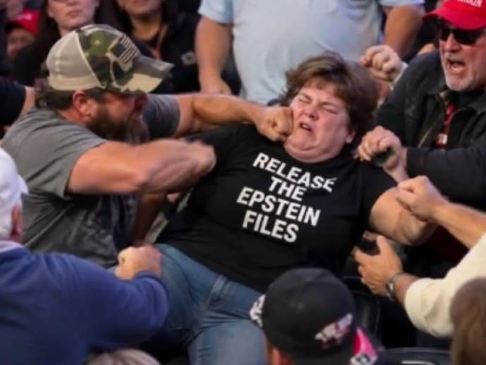 Just when we think there is a bottom, the United States sinks just a bit lower. It’s our brand nowadays.
That’s quite a left cross this thug delivered to this helpless female protestor.
It wasn’t too long ago that beating up women was taboo in America. My 11-year-old, sixth-grade son saw a male classmate of his badly bruise a girl by pushing her hard down to the ground–and proceeded to punch him in the mouth. A fellow father witnessed the scene and told me, “Your son’s fist was in that kid’s teeth within a fraction of a second.”
I had brought him up to avoid violence and achieve peaceful resolutions to conflicts, but I couldn’t fault him here.
What a disgusting bunch of turds we’ve become.
We’re starting to see intimations that stupidity like this is generated and posted by Russian data centers so as to appeal to MAGA idiots and favor the Republicans in the upcoming midterms.

GREENPEACE GAS PROTEST DAY TWO: Activists spend first night on Woodside’s Scarborough gas platform, “in this for the long haul”

Making Billions by Harming Others


