

Weather Guard Lightning Tech

Repurposing Retired Turbine Blades with REGEN Fiber
Wind turbine blades are getting a fresh new life thanks to REGEN Fiber’s innovative recycling process! Their mechanical process turns old blades into top-notch construction materials. REGEN’s can turn any blade into strong, clean fiber that passes all the tests. With wind farms desperate for sustainable solutions, this Iowa-based startup is gearing up to start recycling blades at scale. Their new facilities will give old blades a new purpose in buildings, roads and more as the wind industry upgrades to bigger and better turbines. Out with the old, in with the recycled – REGEN Fiber is spearheading a recycling revolution for the wind sector.
Check out REGEN Fiber
Contact Jeff Woods! jwoods@regenfiber.com
Sign up now for Uptime Tech News, our weekly email update on all things wind technology. This episode is sponsored by Weather Guard Lightning Tech. Learn more about Weather Guard’s StrikeTape Wind Turbine LPS retrofit. Follow the show on Facebook, YouTube, Twitter, Linkedin and visit Weather Guard on the web. And subscribe to Rosemary Barnes’ YouTube channel here. Have a question we can answer on the show? Email us!
Allen Hall: I’m Allen Hall and I’m here with my good friend Joel Saxum and on this special edition of the Uptime Wind Energy podcast, we have a really interesting topic. As of 2020, there were over 720,000 tons of blade material around the world that needed to be disposed of or recycled. With more wind farms being built every year, this number will continue to grow.
Landfilling the blades is problematic. Their large size makes transportation and burial difficult and expensive. So finding an effective way to recycle the blades is becoming an urgent priority for the wind industry. Companies and researchers are currently exploring how to design future turbine blades for easier recycling, but wind farm operators need better recycling and disposal options for existing old blades, some promising recycling methods are being developed. And we are speaking with 1 of the companies investing in new recycling methods, REGEN Fiber. Our guest today is Jeff Woods, director of business development at Travero and Travero is the parent company of REGEN Fiber. Jeff, Welcome to the podcast.
Jeff Woods: Thank you.
Allen Hall: Obviously, we know we have a lot of problems with old blades and in the United States. It does create a lot of publicity of pictures, of blades being buried and more recently in Iowa where you are and also down in Texas.
There’s been some disposal issues where blades have been sitting out for a long time and haven’t been recycled like they were supposed to be. And this is creating quite the clamor for wind turbine OEMs and operators.
Jeff Woods: It is. It’s a problem that I think when the industry got rolling
decades ago, there was a lot of passion about getting a renewable energy resource literally up in the air and running to produce electricity in the region here, particularly in the central Midwest, where we’ve got more wind tunnels and you can shake a stick at quite literally and, for a long period of time, there really wasn’t a lot of problems.
Yeah, a few blades were getting damaged through lightning or storms or hail or whatnot. But boy, in the last I’ll Five, seven, 10 years as some of these farms have approached, the 20 year mark in particular, which is generally accepted as a benchmark time for the lifespan for some of the original blades that are out there.
They’re coming down they’re stressed, they’ve been damaged. They need to be replaced. You’ve got the inflation reduction act now which is compelling even more ferns to absolutely amp up on steroids. What the future of wind energy production in the United States looks like. So you have a lot of companies that are talking about going in and repowering existing turbines, knocking existing turbines down entirely and replacing them with much bigger much more efficient units.
And that’s all great, but if you’re in this part of the world you’re quite aware of piles of blades stack up in certain parts of Texas certain parts of Iowa Nebraska, Wyoming, a lot of blades that have been landfilled. You said 720, 000 tons of material out there that needs to be processed.
There’s obviously over 70, 000 towers in the United States today and more coming. And I just don’t thank the industry or society in general today for a wind energy source that is other otherwise sustainable and circular wants to know that these are being buried in landfills whether it’s in whole or in part.
And right now the current incumbent recycling solution is to have them used as a co combustion product with coal in cement processing in kilns around the Midwest. And I think it’s certainly better than landfilling, but I think there’s people now questioning, is that really a sustainable use. Yeah it’s better than coal, but is that longterm what we need to do with blades? I think that’s compelled a lot of firms to look at what can we do with the wind blade when it comes down out of the sky. And we’re certainly one of those firms. And since we’re here in Iowa and ultimately our parent company is Alliant Energy, the third largest regulated wind producer in the United States.
So it’s something that corporately that we have very much on our mind down the road. For what’s. What are we going to do with these blades when they come down? And it’s an active discussion topic with anybody you talk to that’s in the industry today.
Allen Hall: And I think because you’re located in Iowa, the pressure is really on for your local area.
We were looking at the stats for 2022 and 100 percent of energy delivered by MidAmerican, which is your energy provider in Iowa, was 100 percent renewable. So it tells you how much renewable energy is being generated in Iowa, and it’s typically somewhere at least 60 percent of that is wind. That’s amazing amount of wind energy, and we have driven through Iowa, and I’m from Nebraska originally, so I’m in Iowa occasionally.
It’s remarkable how the landscape has changed in terms of wind energy that it has become a really valuable resource for Iowa. But it also has to have the end of life approach, what happens at end of life, because you’re, with the IRA bill, and we were just down in Texas, where a lot of repowering is happening, there are blades all over the place.
And you, I think it has really become an imperative for companies like you have, Regen you’re bringing new ideas to the forefront here and trying to do something different besides burning the blades and I want, can you walk through what your solution is and what your regens approaches to recycling turbine blades?
Jeff Woods: Yeah, sure. And I’ll start with how this all got it’s origins, if you will .We’re partners with a firm in Des Moines, Iowa folks that come from the fiber industry that also have a materials handling background. And, as they drove around Iowa and saw all these blades and started reading the newspapers about what are we going to do with these things other than put them in a landfill or burn them with their background they thought there, there might be means to do this in a different fashion.
And there are certainly people looking at other types of processes and having some success. Those generally involve heat and chemicals, thermal reactions, and all kinds of fancy terms. Our approach is, maybe a little more Iowa right? It’s a little more simple. I use the analogy of sometimes the best things start out with a couple of guys in the garage and that’s how this started.
And then really when we met them, how can we scale this up to a point where you’re dealing with an entire blade or an entire tower coming to you in a short period of time and reprocessing it, which gets into a whole litany of other issues that the industry faces. And I would contend will be other
issues down the road, which is how are you transporting these efficiently? Are we want to make sure we’re not transporting these blades halfway across the country. Cause that’s going to be the next carbon footprint reduction thing that the industry needs to be aware of is you can’t take blades from Eastern Oregon to west of the Mississippi river or close to it.
That, that is very expensive. And It’s it just uses a lot of carbon, right? So our solution is largely, it’s entirely really mechanical. It brings together the best of some of the industries that we see out here some stuff from grain processing, some stuff from traditional recycling.
And it’s a lot of rinse and repeat. And I can’t get into too many deals. We have a patent pending on it, but it’s really, our desire is to, you talk to the folks that own the wind farms, are there major contractors that are doing the work? And it’s interesting because the industry from my perspective has a lot of different people that like to do things different ways.
Some firms like to control each piece individually. I’ll work with the contractor on getting it to the ground and I’ll work with the person doing what I call the field work and I’ll work with you separately As the recycler, if you will. To other folks that are like, just take care of my problem.
I don’t want to deal with it. I just want a sustainable solution that I can tell that I’ve got a certificate of recycling or certificate of otherwise beneficial destruction, I’ll call it. We’re really willing to work with anybody in a different way, the different way they want. We’ve met a lot of people in this space at some of the events that we’ve been to.
I think there’s a lot of very qualified and capable people out there that can do everything from the field work to the shredding the niche gets into the recycling solutions a little bit and that’s where we
stand.
Allen Hall: I bet. I think we first met your company down in, at New Orleans at ACP.
Jeff Woods: We did.
Allen Hall: Yeah. There was nobody else that was talking recycling at that convention, which was very odd because it’s such an important part of the life cycle of renewable energy. It just seemed like we would run into more companies like yours and we didn’t. So that’s why we’re talking to you. But, when we had that first discussion, I was really trying to understand what you do what is the magic here?
And I think you broke it down really well at the time, which is you’re not bringing the blaze to your facility to get machined up. They’re coming to you in football size pieces.
Is that right?
Jeff Woods: Generally speaking, if you talk football and less that’s in the sweet spot, that’s in that four to six inch chunk range and down.
Cause when the folks in the field are doing the work there, the blades land there when they show up. And they’ve got two weeks to get it off the job site. Cut it into sections and those sections traditionally get transported someplace and then shred or a firm brings in a mobile shredder and does field shredding.
So what we’re really dealing with is the chunks we’ve ran things through our pilot facility. Some of the pieces were, three inches wide and two foot long down to fibers. And somewhere in between is really our sweet spot, but we can introduce those to what we’re building here in Cedar Rapids of Fairfax, Iowa, actually, our main line operation, which will be our biggest production facility.
We can feed that feedstock into the front end of the system and a few minutes later on the back end of the processing line outcomes, we have the ability to actually make different sized products. So if you think about what’s going into it, it’s the composites and the fibers. It’s the balsa wood.
It’s the foam, there’s some residual metals in there from lightning wire and other things. We have magnets that are in the system, right? And as we do our slough, it’s, we have the ability to separate out certain sizes at certain parts in the line. And then do some finishing, if you will, of the product at the end that gets it into different states.
We have the ability to turn it into certain sizes of fibers. We’ve tested with various people fibers that are what I’m going to call pencil like, that almost compete as a mini rebar, if you will and could actually be used in those types of applications. If you think about…
Road construction, highway construction some of it might be that type of product all the way down to the powders and any process that like ours where you do, you’ve naturally got what we refer to as fines, right? A percentage of material that is down, or if it gets a little off spec, it makes sense just to grind it into a powder.
And that has applications flowable fill sub bases for roads, things of that nature. We’re very pleased with all, any scale of the process that we’ve done so far we’ve gotten very similar results. And the testing on those various results has all been the same to meet, certain accreditations by labs that have to say, your product meets and performs at these certain industry accepted specifications for the ends used that we’re targeting.
But it’s pretty, it’s it’s a long process. We do a lot of different things to it in the middle of it. But so far, knock on wood without the use of heat and chemicals We’re able to get the end products from the blade into products that are desired by certain markets.
Joel Saxum: A couple of questions, and basically boiling back. One thing was, I like the idea of, it’s almost, your processes are almost agricultural so I like the concept of Occam’s razor, if you’ve ever heard of that, being basically like, a lot of times, the simplest solution is the answer. So instead of involving pyrolysis and heat and all the energy that takes or some complicated chemical formulas and then, all of the struggles that those can come with as far as, pollution or anything like that or, getting rid of them in certain ways.
You’ve boiled it down to something I like. I like the term very Iowa like. It’s very mechanical. We have some processes here. One of the, one of the questions then would be. The first one, and this is just one for my own interest. How many different products have you guys produced to date?
Different solutions, different kind of, like you said, roadbed, I’m sticking to that one because that’s what I said the other day, I said roadbed materials is great but yeah, so how many different solutions are
you guys putting out?
Jeff Woods: Yeah, maybe not five different solutions, but five different products that have applications in different things, if that makes sense.
So products that can be used as flowable fill. Perhaps with some additives, something of a fly ash replacement, it has certain pozzolanic capabilities and then we’ve had interest from both molding compound companies, and I think if you talk, frankly, if you talk to other people in the space that are in the business of recycling wind turbine blades, you’re going to hear some, but it’s not like we’re doing anything revolutionary in terms of end markets because other people are going after bolt molding and sheet molding compound companies.
And then just a lot of people that just want to know, can we put that in, can we use that and make it an additive and siding for houses, trims for houses, could it be used in other types of applications? I think the thing with us, you talked about some of the folks that have tried this early on and, maybe struggled is.
I think we’re a little less obsessed with trying to come up with an actual end product, as opposed to a product that people can use in their applications. Part of what we’re trying to do is stay in our lane and be a recycler that makes a reliable product with a good life cycle assessment score that can displace carbon in certain applications, like the concrete industry.
That’s a big differentiator between us is I’m not trying to turn it, return it to virgin fiber, if that makes sense.
Joel Saxum: And so that’s the question that we came up with, right? Was when we talked on the podcast the other day about this, the issues that are going on in the market right now, that if you’re reading the news about wind industry, you know what we’re talking about.
But it was Rosemary brought this up and it was very smart. Concept is. Okay, say we’re talking structural concrete. Now, structural concrete has to be pressure tested, mag tested, all these different tests to make sure that it gets to a certain strength. Now, and we all, we can all understand that as engineers and armchair engineers, wherever you are, you want to make sure that your product that you’re putting out is good.
Now, if it’s structural concrete, say in the base of wind, Wind Tower Foundations, it has to have certain PSI, certain strengths, certain flexibilities even. How do we make sure that the products that you guys are producing, because as we know, inside the blade, like you said earlier, foam, balsa wood, resins mats, all these different components, how do we make sure that when that gets ground up or gets put into certain things, that when if it was the product was to go to concrete, you don’t end up with Foam in the concrete or, how does the end product users know that the product that they’re getting from you is of high enough quality?
Will pass those standards where labs are testing it to make sure. How do you guys do
that?
Jeff Woods: So I’d say that really two answers to that. One is through our material separation capabilities where the foams and the balsas really get pulverized down into the soil stabilization type materials. And then through our process, we have a good means of getting what I’m going to just broadly refer to as good, clean fiber.
That I think you probably saw examples of it in New Orleans, Allen where we had bowls of the various hydroponics that we were there. And when people run their hands through the, we’ll soon have a video on our website where people can go in and see. And I’ve, I’m actually distributing some powders that are going into a cement truck in my hands.
And it’s amazing how clean it is. To that point, we have then tested those clean fibers and mixes thereof in accredited labs to meet certain ASTM standards and passed with really outstanding performance. Some of the quirks of our product are that it actually helps the absorption of other materials.
It’s good stuff. And then ultimately what what an end user, wants to know on the end use application at the wind industry. Is what are your processes around that? Are you going to be ISO certified? Are you going to have all, and ISO certification comes with, you have to be in production for a little while and have certain plans and all that, but certainly in our purview and our pre work is all about being ISO certified from a quality perspective and using good consistent feedstocks.
Which, this material is generally as we move forward, some of this stuff has sat around Iowa for a long period of time, but it stays, it’s shelf life is really good, albeit there’s a few trees growing out of some of it in certain locations that gotta be cleaned up at some point.
Joel Saxum: Some rattlesnake eggs, and maybe a rabbit or two.
Jeff Woods: They’ve made a Jeff Woods mascot, it’s a critter running around a blade pile in a place I won’t mention, but it’s a little furrier than I am, I know that. But yeah, it’s just… Doing things right and being open and transparent with your customers about what they want, our solutions are, and working with them together.
Joel Saxum: The commercial question I want to ask is, as this problem of recycling wind turbine blades has become more mainstream, more and more mainstream, you’re starting to see, because I’m always active on LinkedIn people pop up, company pop, company X, company Y, company Z, hey, we recycle blades, hey, we recycle blades, will you guys take Recycled blades from these others, say, we would almost call them subcontractors, right?
Because there’s people that’ll go out, someone will contract them to, to remove their blades and recycle them. They may not have their own recycling process, but they’re really good at getting the blades down, getting them cut up, figure out the logistics, and maybe getting them to you guys. Do you
guys do that?
Jeff Woods: Yeah, so we’re agnostic as to where the blade comes from. We’ve, I think to date, we’ve received blades from probably, and keep in mind, we’re not up and running yet we’re gonna have one facility operational around the end of the year, the main facility in Cedar Rapids here second quarter ish next year but in terms of where the blades are, we’ve got people calling us from coast to coast, quite literally It’s amazing to me, particularly since the Inflation Reduction Act came out, how many people are suddenly in the space of I grind blades.
I process blades. Sometimes it feels like anybody that’s ever ran a wood chipper thinks they’re in the blade recycling business. But you know what, that’s their space for them to figure out and their headaches. Whether it’s some of the major blade manufacturers, or some of the big engineering firms, or contractors that have been engaged to take down the blades, to mom and pops, if you will, that call us saying, I’ve got three blades coming from here.
Is this something that you would be interested in taking? We talk to everybody, we just to know what type of blade we’re dealing with for planning purposes more than anything.
Allen Hall: I want to ask a question that actually Rosemary asked during our podcast, which was, there’s a variety of different kinds of resin materials that are being used on blades and different manufacturers have different kind of approaches to things, so obviously the blades are slightly different.
Does that affect your end product at all of if they’re using a specific epoxy or polyurethane or whatever else is being used today, does that really matter in your process?
Jeff Woods: It has not. We have tested a RAM material from every blade manufacturer that I can think of all of whom have their own, McDonald’s secret sauce, so to speak, and how they do things.
And it just hasn’t mattered in terms of how it works and are running it through the actual operation. And nor has it mattered in terms of the testing results for the end product.
Allen Hall: That’s amazing. So your end customers then are they local to you for the product? There’s got to be a line of people at your doorstep ready to take the material because it does improve their existing products.
Especially for road bases and things like that, even concrete, right? It makes it stronger. Provides a lot of benefits. What is your in customer who are, who generally are they? Are they local? Are they national? Where are they coming from?
Jeff Woods: They’re all of the above. Keep in mind that a lot of the national firms that are in a concrete or asphalt industries, they might own 50 plants around the United States or 50 different companies around the United States or operations all over the United States of North America.
They are, I would say, literally could be anywhere. That said we do have a strong regional emphasis. I’m not going to exclude anybody and if they’re a thousand miles from here, they want all the material and the commercial terms are agreeable to all parties. That’s fine by Jeff. But certainly we want to A.
We’re an Iowa company trying to solve a problem that’s big in Iowa. So we do talk to a lot of Iowa companies about our solutions. And isn’t it a great message if, we could, we’re all doing this for each other and helping out ourselves. But there are certainly, if you look at the and I’m going to broadly label it as the concrete industry sometimes, and to an extent the aggregates industry and what they’re Scrutiny has been, as a contributor to global warming, they’re very interested in knowing that this solution is out there where, and these folks use massive amounts of reinforcing fibers in, whether it’s roadways, whether it’s, whether concrete or asphalt, whether it’s precast concrete, there’s just, to the pavers in your yard, right?
These folks use lots and lots of fiber and we’re just a fraction of it, right? We’re never going to displace virgin fiber under any scale, but I think that for a portion of their usage, we offer them a very compelling ESG message and carbon reduction footprint score. And most of those firms have significant goals to be reduced carbon or be carbon neutral by 2030.
So our timing is right by that. So strong interest from the industry. But consistent messaging also that it’s great you’ve got to meet performance scores to Joel’s points that are parallel with existing products cause they, they can’t be responsible for putting our material and I’m just going to a warehouse floor.
And then the owner calls up two years later, and guess what? I got cracks in the warehouse floor, right? The products got to perform and they compete every day against firms of all different types, shapes, and sizes. And some of them have more interest in compelling ESG messages than others.
We can’t be What I’m going to say we have to be cost neutral. The other third thing that, and this is going to sound a little bit funny but many of these companies are companies that have heard similar pitches before whether it’s from wind turbine blades, maybe at different levels. In other words, I want to give you chunks of this stuff, just throw it in a roadway, right?
Or I want to, I’ve given you fiber sources from other materials. That didn’t pan out. So there is a sense of, and there have been other people in the market that have tried it with other products. So we talked to people about putting our materials in fiber boards and things like that. There is a sense of this is all great.
We need to know you’re real, right? Because some of the things we talked about early on, Allen people are, that is very fresh and raw in certain people’s. Brains that sales pitches can be sales pitches. We need to know that you’re real, right? And legit.
Allen Hall: Does the state of Iowa play into this at all in terms of the state government, even local governments?
And are you seeing similar, anybody from a government standpoint say, Hey, REGEN this is really cool. What you’re doing in Iowa. Why don’t you come over to Wisconsin or where Joel is or come Oklahoma, Texas, obviously it seems like there’s a market for you and it would benefit the state that maybe the state regulators or even the legislature would be interested in bringing you down.
Jeff Woods: Yeah, the state of Iowa, certainly the agencies that we’ve talked to about it, and it’s really known that all of them are excited about our solution. Our outreach to other states, we’re really kicking in an earnest, through associations, so we’ll… We’ll start to get awareness out there, particularly as we look to take this to other locations.
So we’re not transporting those blades all over North America. I would say as much as the States, the wind industry is driving where they would like to see facilities, right? And it doesn’t take a rocket scientist to pull up any heat map on where our wind turbines in North America and say, where would these facilities make sense?
So I’m not disclosing any trade secrets there. And I would say that some of the potential end users that we’ve talked to that have become familiar with us through events like a world of concrete, or we’re going to the concrete expo next week, a huge event asphalt events that they say, man, we’d like to have that close to us because a lot of these firms went to sourcing fibers from overseas and felt some of the disruption in the supply chain that came right after COVID and the volatility and a supply of material.
And cost associated with it. So it’s, there’s a little bit of that reshoring aspect in there. So yeah, a lot of positive momentum for it. We just need to finish the job.
Allen Hall: And I know our listeners are going to be interested in picking this up, especially a lot of operators, right? So the operators in the United States are all looking for, like you’ve mentioned, they’re looking for recycling solutions, because if they’re not
already in the middle of a repower. They are planning repowers for the next five to 10 years, right? That takes, things take time and they need to be putting people like you in place as part of their repowering solution, right there to get the blades recycled and to use it for something beneficial to society and not just necessarily burn them like is currently happening.
So this is a really interesting approach. And I, as soon as your patent gets issued, I want to read it. I want to understand what goes on. And maybe if I’m on Iowa, maybe you can give me a little sneak peek through the factory.
Jeff Woods: We’ll walk you through the factory tomorrow. You’ll just be blindfolded.
Allen Hall: It’d make it a little difficult.
We really appreciate having you on the podcast.
How do people reach out to you and connect with you at REGEN?
Jeff Woods: So they can they can call me (319) 786-3698. Old guys like me still answer the phone once in a while. Or they can email at jwoods @regenfiber.com.
Allen Hall: And the website is regenfiber. com.
Thanks for being on the podcast and we love to have you back. So I’m serious, when you guys open the doors to outside eyes, we’ll be interested in taking a tour.
Jeff Woods: You’re more than welcome.

 I just came across the meme here, and I thought I’d react to it.
Let’s call these groups, from top to bottom, A, B, C, and D.
First, instead of joking around about C, let’s be clear: these are people who are dominated by hate, especially the tenets of white nationalism.
Then let’s add in group E, selfish pigs who are getting ever richer because of Trump’s corrupt policies.
Here’s my guess as to the percentage of each group, across the people eligible to vote in the United States:
A: 50
B: 5 (some of these people actually do exist)
C: 33 (Trump’s MAGA support base)
D: 10
E: 2
Now, a question that is often asked is: How is it possible that group E rules the country (and the world) with only 2% of the votes? Answer: They have almost all the money, and they couldn’t give a s*** about the wellbeing of others.
That this planet will slowly bake matters to most of us, but it doesn’t mean squat to a few.
Renewable Energy
Far-Right-wing Politician with No Scientific Training Says Climate Change Is a Hoax —- ZZzzzzzzz
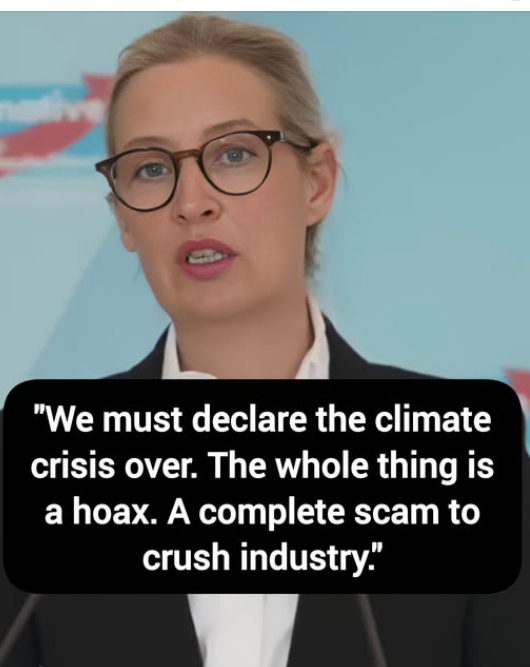 This is Germany’s Alice Weidel, a politician from Germany’s right-wing extremist party, Alternative for Germany. She studied economics and finance in college.
Who could possibly care what she thinks about climate change?
Far-Right-wing Politician with No Scientific Training Says Climate Change Is a Hoax —- ZZzzzzzzz
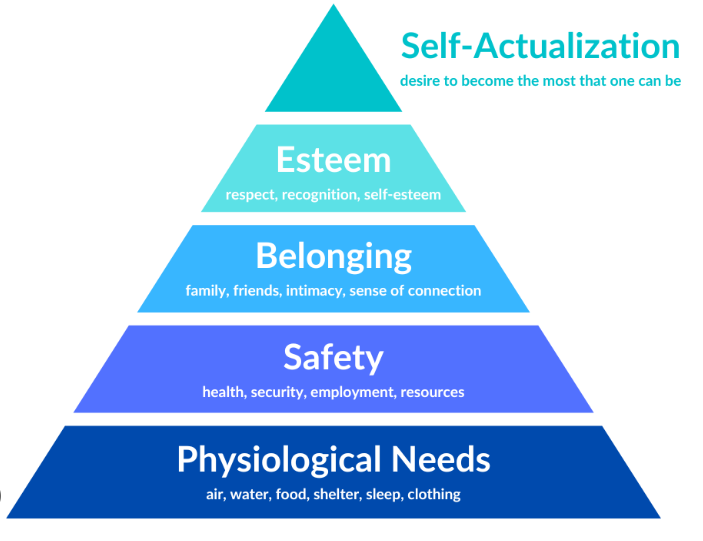 Here’s “A thought for today,” from A-Word-A Day:
A musician must make music, an artist must paint, a poet must write, if he is to be ultimately at peace with himself. What one can be, one must be. – Abraham Maslow
Maslow is best known for his “hierarchical needs,” which I always thought was excellent. The statement here is a part of that theory; it’s what “self-actualization” means.
Incredibly powerful, IMO.


-
Climate Change8 months ago
Guest post: Why China is still building new coal – and when it might stop
-
Greenhouse Gases8 months ago
Guest post: Why China is still building new coal – and when it might stop
-

 Greenhouse Gases2 years ago
嘉宾来稿:满足中国增长的用电需求 光伏加储能“比新建煤电更实惠”
-
Climate Change2 years ago
Bill Discounting Climate Change in Florida’s Energy Policy Awaits DeSantis’ Approval
-

 Climate Change2 years ago
嘉宾来稿:满足中国增长的用电需求 光伏加储能“比新建煤电更实惠”
-
Climate Change Videos2 years ago
The toxic gas flares fuelling Nigeria’s climate change – BBC News
-

 Renewable Energy5 months ago
Sending Progressive Philanthropist George Soros to Prison?
-

 Carbon Footprint2 years ago
US SEC’s Climate Disclosure Rules Spur Renewed Interest in Carbon Credits