Connect with us

Published

on

Oscar Berglund is a senior lecturer in international public and social policy at the University of Bristol and Tie Franco Brotto is a PhD candidate at the University of Bristol’s School for Policy Studies.

Climate and environmental protest is being criminalised and repressed around the world. The criminalisation of such protest has received a lot of attention in certain countries, including the UK and Australia. But there have not been any attempts to capture the global trend – until now.

We recently published a report, with three University of Bristol colleagues, which shows this repression is indeed a global trend – and that it is becoming more difficult around the world to stand up for climate justice.

This criminalisation and repression spans the global north and south, and includes more and less democratic countries. It does, however, take different forms.

Our report distinguishes between climate and environmental protest. The latter are campaigns against specific environmentally destructive projects – most commonly oil and gas extraction and pipelines, deforestation, dam building and mining. They take place all around the world.

Climate protests are aimed at mitigating climate change by decreasing carbon emissions, and tend to make bigger policy or political demands (“cut global emissions now” rather than “don’t build this power plant”). They often take place in urban areas and are more common in the global north.

Four ways to repress activism

The intensifying criminalisation and repression is taking four main forms.

1. Anti-protest laws are introduced

Anti-protest laws may give the police more powers to stop protest, introduce new criminal offences, increase sentence lengths for existing offences, or give policy impunity when harming protesters. In the 14 countries we looked at, we found 22 such pieces of legislation introduced since 2019.

2. Protest is criminalised through prosecution and courts

This can mean using laws against climate and environmental activists that were designed to be used against terrorism or organised crime. In Germany, members of Letzte Generation (Last Generation), a direct action group in the mould of Just Stop Oil, were charged in May 2024 with “forming a criminal organisation”. This section of the law is typically used against mafia organisations and had never been applied to a non-violent group.

In the Philippines, anti-terrorism laws have been used against environmentalists who have found themselves unable to return to their home islands.

Criminalising protest can also mean lowering the threshold for prosecution, preventing climate activists from mentioning climate change in court, and changing other court processes to make guilty verdicts more likely. Another example is injunctions that can be taken out by corporations against activists who protest against them.

3. Harsher policing

This stretches from stopping and searching to surveillance, arrests, violence, infiltration and threatening activists. The policing of activists is carried out not just by state actors like police and armed forces, but also private actors including private security, organised crime and corporations.

In Germany, regional police have been accused of collaborating with an energy giant (and its private fire brigade) to evict coal mine protesters, while private security was used extensively in policing anti-mining activists in Peru.

4. Killings and disappearances

Lastly, in the most extreme cases, environmental activists are murdered. This is an extension of the trend for harsher policing, as it typically follows threats by the same range of actors. We used data from the NGO Global Witness to show this is increasingly common in countries including Brazil, Philippines, Peru and India. In Brazil, most murders are carried out by organised crime groups while in Peru, it is the police force.

Protests are increasing

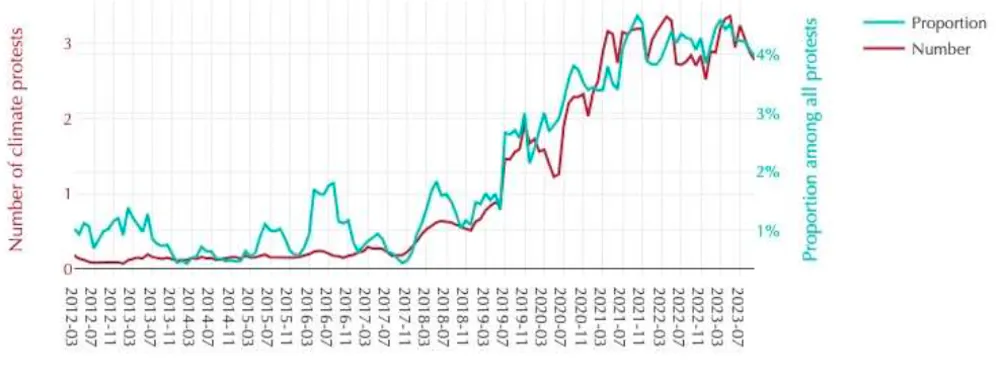
To look more closely at the global picture of climate and environmental protest – and the repression of it – we used the Armed Conflicts Location Event database. This showed us that climate protests increased dramatically in 2018-2019 and have not declined since. They make up on average about 4% of all protest in the 81 countries that had more than 1,000 protests recorded in the 2012-2023 period:
Graph
Climate protests increased sharply in the late 2010s in the 14 countries studied. (Data is smoothed over five months; number of protests is per country per month)
Berglund et al; Data: ACLED, CC BY-SA

This second graph shows that environmental protest has increased more gradually:

Graph
Environmental protests in the same 14 countries
Data: ACLED, CC BY-SA

We used this data to see what kind of repression activists face. By looking for keywords in the reporting of protest events, we found that on average 3% of climate and environmental protests face police violence, and 6.3% involve arrests. But behind these averages are large differences in the nature of protest and its policing.

A combination of the presence of protest groups like Extinction Rebellion, who often actively seek arrests, and police forces that are more likely to make arrests, mean countries such as Australia and the UK have very high levels of arrest. Some 20% of Australian climate and environmental protests involve arrests, against 17% in the UK – with the highest in the world being Canada on 27%.

Meanwhile, police violence is high in countries such as Peru (6.5%) and Uganda (4.4%). France stands out as a European country with relatively high levels of police violence (3.2%) and low levels of arrests (also 3.2%).

In summary, while criminalisation and repression does not look the same across the world, there are remarkable similarities. It is increasing in a lot of countries, it involves both state and corporate actors, and it takes many forms.

This repression is taking place in a context where states are not taking adequate action on climate change. By criminalising activists, states depoliticise them. This conceals the fact these activists are ultimately right about the state of the climate and environment – and the lack of positive government action in these areas.The Conversation

This article is republished from The Conversation under a Creative Commons license. Read the original article.


The post Repression of climate and environmental protest is intensifying across the world appeared first on Climate Home News.

Repression of climate and environmental protest is intensifying across the world

Continue Reading

Climate Change

A Tiny Caribbean Island Sued the Netherlands Over Climate Change, and Won

Published

on

The case shows that climate change is a fundamental human rights violation—and the victory of Bonaire, a Dutch territory, could open the door for similar lawsuits globally.

From our collaborating partner Living on Earth, public radio’s environmental news magazine, an interview by Paloma Beltran with Greenpeace Netherlands campaigner Eefje de Kroon.

A Tiny Caribbean Island Sued the Netherlands Over Climate Change, and Won

Continue Reading

Climate Change

Greenpeace organisations to appeal USD $345 million court judgment in Energy Transfer’s intimidation lawsuit

Published

on

SYDNEY, Saturday 28 February 2026 — Greenpeace International and Greenpeace organisations in the US announce they will seek a new trial and, if necessary, appeal the decision with the North Dakota Supreme Court following a North Dakota District Court judgment today awarding Energy Transfer (ET) USD $345 million. 

ET’s SLAPP suit remains a blatant attempt to silence free speech, erase Indigenous leadership of the Standing Rock movement, and punish solidarity with peaceful resistance to the Dakota Access Pipeline. Greenpeace International will also continue to seek damages for ET’s bullying lawsuits under EU anti-SLAPP legislation in the Netherlands.

Mads Christensen, Greenpeace International Executive Director said: “Energy Transfer’s attempts to silence us are failing. Greenpeace International will continue to resist intimidation tactics. We will not be silenced. We will only get louder, joining our voices to those of our allies all around the world against the corporate polluters and billionaire oligarchs who prioritise profits over people and the planet.

“With hard-won freedoms under threat and the climate crisis accelerating, the stakes of this legal fight couldn’t be higher. Through appeals in the US and Greenpeace International’s groundbreaking anti-SLAPP case in the Netherlands, we are exploring every option to hold Energy Transfer accountable for multiple abusive lawsuits and show all power-hungry bullies that their attacks will only result in a stronger people-powered movement.”

The Court’s final judgment today rejects some of the jury verdict delivered in March 2025, but still awards hundreds of millions of dollars to ET without a sound basis in law. The Greenpeace defendants will continue to press their arguments that the US Constitution does not allow liability here, that ET did not present evidence to support its claims, that the Court admitted inflammatory and irrelevant evidence at trial and excluded other evidence supporting the defense, and that the jury pool in Mandan could not be impartial.[1][2]

ET’s back-to-back lawsuits against Greenpeace International and the US organisations Greenpeace USA (Greenpeace Inc.) and Greenpeace Fund are clear-cut examples of SLAPPs — lawsuits attempting to bury nonprofits and activists in legal fees, push them towards bankruptcy and ultimately silence dissent.[3] Greenpeace International, which is based in the Netherlands, is pursuing justice in Europe, with a suit against ET under Dutch law and the European Union’s new anti-SLAPP directive, a landmark test of the new legislation which could help set a powerful precedent against corporate bullying.[4]

Kate Smolski, Program Director at Greenpeace Australia Pacific, said: “This is part of a worrying trend globally: fossil fuel corporations are increasingly using litigation to attack and silence ordinary people and groups using the law to challenge their polluting operations — and we’re not immune to these tactics here in Australia.

“Rulings like this have a chilling effect on democracy and public interest litigation — we must unite against these silencing tactics as bad for Australians and bad for our democracy. Our movement is stronger than any corporate bully, and grows even stronger when under attack.”

Energy Transfer’s SLAPPs are part of a wave of abusive lawsuits filed by Big Oil companies like Shell, Total, and ENI against Greenpeace entities in recent years.[3] A couple of these cases have been successfully stopped in their tracks. This includes Greenpeace France successfully defeating TotalEnergies’ SLAPP on 28 March 2024, and Greenpeace UK and Greenpeace International forcing Shell to back down from its SLAPP on 10 December 2024.

-ENDS-

Images available in Greenpeace Media Library

Notes:

[1] The judgment entered by North Dakota District Court Judge Gion follows a jury verdict finding Greenpeace entities liable for more than US$660 million on March 19, 2025. Judge Gion subsequently threw out several items from the jury’s verdict, reducing the total damages to approximately US$345 million.

[2] Public statements from the independent Trial Monitoring Committee

[3] Energy Transfer’s first lawsuit was filed in federal court in 2017 under the RICO Act – the Racketeer Influenced and Corrupt Organizations Act, a US federal statute designed to prosecute mob activity. The case was dismissed in 2019, with the judge stating the evidence fell “far short” of what was needed to establish a RICO enterprise. The federal court did not decide on Energy Transfer’s claims based on state law, so Energy Transfer promptly filed a new case in a North Dakota state court with these and other state law claims.

[4] Greenpeace International sent a Notice of Liability to Energy Transfer on 23 July 2024, informing the pipeline giant of Greenpeace International’s intention to bring an anti-SLAPP lawsuit against the company in a Dutch Court. After Energy Transfer declined to accept liability on multiple occasions (September 2024, December 2024), Greenpeace International initiated the first test of the European Union’s anti-SLAPP Directive on 11 February 2025 by filing a lawsuit in Dutch court against Energy Transfer. The case was officially registered in the docket of the Court of Amsterdam on 2 July, 2025. Greenpeace International seeks to recover all damages and costs it has suffered as a result of Energy Transfers’s back-to-back, abusive lawsuits demanding hundreds of millions of dollars from Greenpeace International and the Greenpeace organisations in the US. The next hearing in the Court of Amsterdam is scheduled for 16 April, 2026.

Media contact:

Kate O’Callaghan on 0406 231 892 or kate.ocallaghan@greenpeace.org

Greenpeace organisations to appeal USD $345 million court judgment in Energy Transfer’s intimidation lawsuit

Continue Reading

Climate Change

Former EPA Staff Detail Expanding Pollution Risks Under Trump

Published

on

The Trump administration’s relentless rollback of public health and environmental protections has allowed widespread toxic exposures to flourish, warn experts who helped implement safeguards now under assault.

In a new report that outlines a dozen high-risk pollutants given new life thanks to weakened, delayed or rescinded regulations, the Environmental Protection Network, a nonprofit, nonpartisan group of hundreds of former Environmental Protection Agency staff, warns that the EPA under President Donald Trump has abandoned the agency’s core mission of protecting people and the environment from preventable toxic exposures.

Former EPA Staff Detail Expanding Pollution Risks Under Trump

Continue Reading

Trending

Copyright © 2022 BreakingClimateChange.com
