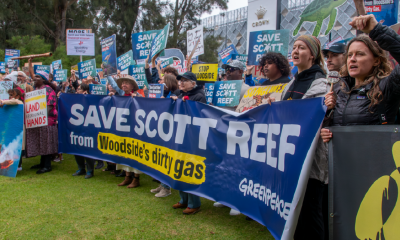
Greenpeace Australia Pacific believes Woodside cannot be trusted when it comes to our oceans, reefs and marine life.
INTRODUCTION
Woodside’s Burrup Hub, Australia’s largest proposed fossil fuel project, presents a severe threat to our oceans, wildlife and climate. Woodside, known for its poor environmental and safety record, plans to extract gas from six fields off the coast of Western Australia. This mega-project involves constructing extensive undersea infrastructure and extending the life of existing gas plants until 2070, locking Australia into the use of toxic gas long after we should have transitioned to clean energy.

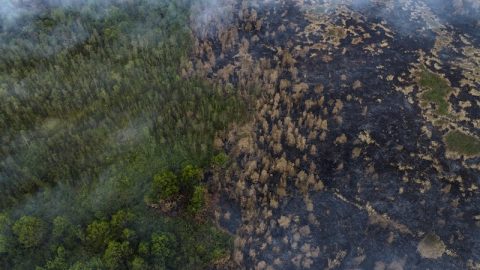
Aerial view of Scott Reef, next to which Woodside plans to drill up to 50 wells. The closest wells would be just over 2km from the reef itself. © Greenpeace / Alex Westover
ENVIRONMENTAL RISK
An oil spill from the Burrup Hub threatens 54 endangered species, including the critically endangered pygmy blue whale and green sea turtle. Gas flaring and lights disrupt turtle nesting, while subsidence threatens critical habitats. Shipping and drilling activities endanger whale migration pathways. A disaster at the project site could devastate marine ecosystems and coastlines as far as East Timor and Indonesia, causing long-term environmental damage.

Greenpeace has mapped Woodside’s Burrup Hub offshore infrastructure and its spill and accident scenarios using Geographic Information Software (GIS) data, based on Woodside’s own documents provided to state and federal regulators. © Greenpeace
CLIMATE IMPACTS
Emissions and methane leaks from the Burrup Hub’s operations will worsen Australia’s climate crisis. Greenpeace’s own analysis has revealed that Woodside’s Burrup Hub is Australia’s biggest climate threat, set to release 6.1 billion tonnes of greenhouse gas emissions over its proposed 50-year lifetime. Lifetime emissions from the Burrup Hub would be more than 13 times Australia’s annual emissions from all sources (and more than 73 times New Zealand’s annual emissions). This will not only impact Australia’s net zero commitments but also have far-reaching consequences globally.

Projected emissions from Woodside’s Burrup Hub Project. © Greenpeace
CONCERNING SAFETY RISKS
Woodside has a troubling history of environmental neglect, and has experienced at least six major incidents in the last decade, including an explosion, oil spill and whale calf collision. Additionally, it consistently fails to clean up its waste. Given this track record, why should we expect the Burrup Hub to be any different?

Greenpeace Australia Pacific activists climb and document a toxic, discarded oil tower owned by fossil fuel company Woodside, The Nganhurra Riser Turret Mooring. © Greenpeace
WOODSIDE’S TROUBLING RECORD
‘Explosion’ at Pluto LNG plant
In May 2023, an ‘explosion’ at the Pluto LNG plant caused the site to temporarily shut down during planned maintenance. Woodside had previously advised locals that it would be flaring gas and to expect ‘unusual dark smoke’ during the maintenance period. Unions accused Woodside of seeking to downplay the significance of the incident.
Woodside’s offshore rig leaks in the Cossack field
In 2016, one of Woodside’s oil rigs in the Cossack field, off the Dampier Peninsula, leaked 10,500 litres into the ocean. The source of the 175-litre-per-day leak was later found to be a degraded seal on a subsea hydraulic control line located on the rig. A spokesperson for Woodside claimed there was “no lasting impact to the environment”.
Woodside attempts to abandon decaying fossil fuel infrastructure in the ocean
When Woodside finished extracting oil from the Enfield field in 2018, it left behind the Nganhurra Riser Turret Mooring (RTM), an 83-metre-long, 2,452-tonne piece of infrastructure. The offshore regulator, NOPSEMA, chastised Woodside for failing to maintain the RTM.
In 2019, NOPSEMA ordered Woodside to remove the RTM. In 2021, Woodside proposed to sink the RTM, which reportedly contains toxic fire retardant foam, not far from biodiversity hotspots Ningaloo Reef and Exmouth Gulf. By 2022, the RTM had started taking on water and begun sinking. Woodside finally removed it in October 2023.
Woodside cuts maintenance budget despite multiple warnings
Woodside has been repeatedly warned by the offshore regulator, NOPSEMA, over its failure to properly maintain its aging offshore oil and gas rigs from corrosion. Nonetheless, in June 2021 Woodside announced that a 30% cut to operating costs will take place over three years. CEO Meg O’Neill was reported as saying, ‘a key focus area for us is maintenance which accounts for a significant portion of our production cost’.
The warnings continued. One week after Meg O’Neill’s announcement, NOPSEMA ordered Woodside to analyse the structural integrity of fourteen 24-tonne caissons located beneath its North Rankin A Platform. NOPSEMA warned that ‘loss of hydrocarbon (gas and condensate) from these pipelines may result in a major accident event.
Also in 2021, propane pipework at Woodside’s North West Shelf facility was found to have corroded to half the original wall thickness. In 2023, a NOPSEMA inspection of the North Rankin Complex concluded the ‘Flare Bridge and Flare Support Structure (including Guy Wires) to be defective in many places as a consequence of inadequate maintenance’.
Woodside contractor hits whale calf
In August 2023, a whale calf was hit by a tugboat operated by a Woodside contractor in the Port of Dampier. The collision, confirmed by the Department of Biodiversity, Conservation and Attractions (DBCA), was only made public when a local reporter made inquiries.
Woodside uses a legal loophole to dump the Northern Endeavour
In 2015, Woodside used a loophole to sell the aging Northern Endeavour oil vessel to “a small, inexperienced, financially weak one-person company”, Northern Oil and Gas Australia (NOGA). Woodside had left the Northern Endeavour corroding over time, in preparation for its decommissioning. But when presented with an opportunity to offload it, they used a complex web of legal maneuvers to transfer title to NOGA, using a loophole to escape the usual assessment of the capacity of a new entity to safely operate and decommission an oil rig. NOGA even ‘inherited’ Woodside ‘oil response plan’ for the Northern Endeavour, despite having never operated an offshore drill rig before, and not having the capacity for responding to an oil spill that Woodside relied upon when drafting the original plan. In response, NOPSEMA issued an escalating series of breach notices to NOGA, who were eventually forced to cease operations at the Northern Endeavour, and promptly went bankrupt, passing the liability for decommissioning to the Federal Government. This debacle led to a change in laws to establish trailing liability and decommissioning bonds. The Northern Endeavour incident shows the poor corporate behaviour of Woodside, and their willingness to use whatever legal means they have available to avoid responsibility for decommissioning, regardless of the environmental risk it creates.


Climate Change
“Sink or swim”: WA Gov hugely underestimating decline in regional gas demand while sleeping on green exports, new report finds
PERTH, Tuesday 13 October 2026 — A new report from Greenpeace Australia Pacific and Springmount Advisory reveals green commodity exports are an untapped economic opportunity for Western Australia in a declining Asian gas market, while offering a genuine solution for decarbonising Asia.
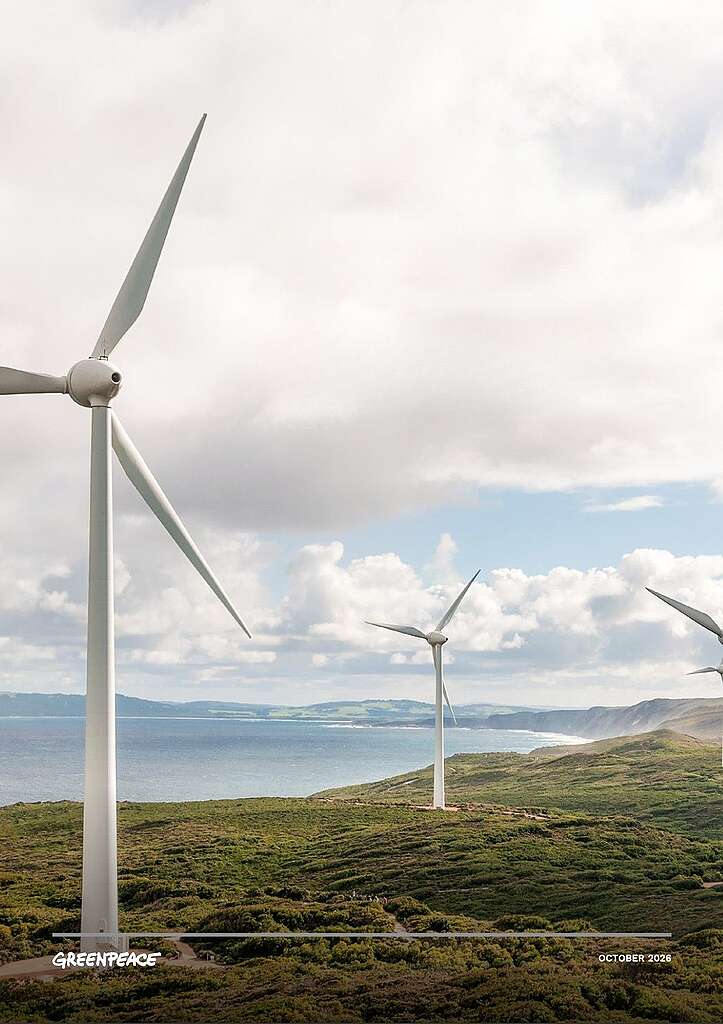
From Gas to Green: Building Western Australia’s Future State is a comprehensive analysis of the declining gas market in Asia, and the untapped economic opportunity for WA to become a global leader in green commodity exports while driving the regional shift away from fossil fuels.
The report offers key recommendations for the WA Government to support regional decarbonisation through an orderly phase out of gas exports in favour of green iron and other green exports. It comes as global climate leaders from across business, politics and advocacy prepare to meet for the Global Citizen Now: Perth event focused on decarbonising WA.
Key findings:
- Gas demand is falling across WA’s core markets in Asia: Gas demand fell in 2025 and is projected to continue to decline, driven by a combination of global geopolitical factors and domestic concerns.
- Policy shifts in key markets since the war on Iran now prioritise renewables and nuclear over gas: Japan, South Korea and China have legislated energy plans that prioritise renewables and nuclear over gas.
- New WA gas would arrive in a saturated, uncertain Asian market filled with cheaper gas: The US is now the world’s largest liquefied gas producer and plans to double its capacity as it also targets Asian markets.
- Green commodities offer a real solution to sustain WA’s economy: WA can lead Australia’s green commodity exports, which by 2060 could be worth almost a trillion dollars.
- Exporting more WA gas is likely to delay or impede Asia decarbonisation: Despite claims by the gas industry, there is no evidence that WA gas is displacing coal in Asia, and in fact diverts resources from genuine decarbonisation options.
Geoff Bice, WA Campaign Lead at Greenpeace Australia Pacific said: “As our export partners in Asia shift away from expensive and polluting gas, the WA Government has a golden opportunity to pivot our economy to green exports, like green iron, which is the most effective way to help our region to decarbonise.
“The writing is on the wall: gas is in decline, renewables are our future. In this context, it makes zero sense for the government to encourage high risk projects like Woodside’s reckless Browse gas proposal at Scott Reef.
“This report clearly shows that the WA Government faces a choice: sink or swim. They can either allow the gas industry to keep ripping off West Australians and continue propping up its decline, or choose the path that will deliver enormous benefits to the state and the world by becoming a leader in the rapidly expanding green economy.”
Tom Quinn, Managing Director of Springmount Advisory: “Western Australia prospers when it looks to the future and builds for future demand. Twenty years from now, what the world needs is green commodities made using WAs abundant renewable resources. Just like it did with iron ore in the 1950s and gas in the 1970s, WA should look to the future and build what the world will need, not sunsetting industries like gas that are already past their peak.”
-ENDS-
Media contact
Kate O’Callaghan on 0406 231 892 or kate.ocallaghan@greenpeace.org
Lucy Keller on 0491 135 308 or lucy.keller@greenpeace.org
A report from Greenpeace Australia Pacific and Springmount Advisory reveals the untapped green economic opportunity for Western Australia in a declining Asian gas market, which also offers a genuine solution for decarbonisation in Asia.
Is Western Australia clinging to a fading gas industry while a thriving green future passes it by? As major Asian trading partners rapidly pivot away from volatile gas imports toward cheap solar and battery storage, this report exposes a high-stakes choice: risk becoming stranded in an oversupplied fossil fuel market, or harness WA’s unmatched sun and wind to lead the global clean energy transition.
Summary
From Gas to Green: Building Western Australia’s Future State reveals that Western Australia (WA) faces a critical juncture as falling Asian gas demand, geopolitical gas supply volatility and accelerating renewable energy deployment undermine the long-term economic viability of gas exports. By harnessing its world-class wind and solar resources, the report demonstrates that WA can execute an orderly phase-out of gas and pioneer a green commodity export economy that could generate $987 billion in economic value by 2060, create 24,000 ongoing jobs, and drive a 9.6% reduction in global greenhouse gas emissions.
Key Findings
- Gas demand is falling in Asia – WA can no longer rely on gas exports: Gas demand in core Asian markets fell in 2025 and is projected to continue to decline in 2026. Legislated energy plans in Japan, South Korea, and China now prioritise renewables and nuclear over gas.
- Asia is increasing renewables, importing gas just gets in the way: Evidence from markets like Thailand suggests that gas imports are increasingly crowding out cheaper renewable energy investments and battery storage rather than displacing coal, locking in more emissions over time.
- Green commodities offer a real solution to decarbonise Asia – this is a major win for WA: With world-class renewables, WA can lead Australia’s green commodity exports, which by 2060 could be worth almost a trillion dollars ($987 billion) and support a genuine 9.6% reduction in global emissions.
Recommendations to WA government
Recommendation 1: Plan an orderly gas phase-out aligned with a trading partner pivot plan
Implement a managed, orderly phase-out of gas exports aligned with trading partners’ decarbonisation pathways, rather than waiting for demand to collapse, by:
- Developing and implementing a staged phase-out of gas facilities aligned with feedstock supply expiry or typical end of facility lifespans.
- Committing to no new gas development for gas expansion, including Browse and Kimberley fields.
- Developing new, reciprocal trade relationships with existing gas trade partners, structured to progressively replace gas exports with green commodities – integrated with recommendation 2.
Recommendation 2: Develop an integrated green commodity export strategy, positioning WA as a global green iron manufacturing hub
Establish an integrated green commodity export strategy that immediately prioritises green iron development, positioning WA as a global green iron manufacturing hub, by:
- Committing to green commodity export targets to give industry and investors a clear demand signal.
- Prioritising green iron as the lead sector within the broader green commodity strategy, given WA’s iron ore endowment and first-mover potential.
Recommendation 3: Reject false solutions such as carbon dumping (CCS) and blue hydrogen
Reject carbon dumping (also described as carbon capture and storage, or CCS) and blue hydrogen as viable decarbonisation technologies, and prioritise green hydrogen and proven renewables for clean energy and fuel production by:
- Excluding blue hydrogen projects (and CCS-dependent projects) from all government support programs.
- Requiring existing hydrogen-based production (including ammonia, methanol, synthetic fuels) to have clear, near-term transition timelines to switch to green hydrogen production.

What you can do
Together, we can push for a prosperous green future.
You can help by:
- Sending an email to Environment Minister Murray Watt and Prime Minister Anthony Albanese, calling on them to reject Browse.
- Sharing this story to help more Australians understand what’s at stake.
- Encouraging your friends and family to take action.
REPORT: “From Gas to Green” Building Western Australia’s Future State
Cleaner cooking projects in the UN carbon market will have to set aside a share of their credits to insure against the risk that the trees they save are lost to fire, drought or logging, after the market’s regulator rejected calls to exempt the sector.
The requirement is part of a new rulebook that the Paris Agreement carbon market regulator – the Article 6.4 Supervisory Body – approved last Friday for programmes that aim to cut emissions by distributing new and cleaner cookstoves in regions that still burn wood or charcoal for cooking.
These are the UN mechanism’s first rulebooks for cookstoves, one of the carbon market’s most popular credit types and also one of its most criticised for overstating climate benefits.
They consist of two methodologies: one for programmes that aim to cut greenhouse gas emissions by distributing more efficient cookstoves that burn less wood or charcoal, and a separate methodology for projects shifting households to lower-emissions cookers running on electricity or liquid petroleum gas (LPG).
Mkhuthazi Steleki, the South African chair of the Supervisory Body, said “this decision gives cleaner cooking projects a new pathway under the UN carbon market, with clear rules to ensure that each credit represents a real and credible emission reduction”.
Industry and NGOs lobby to weaken UN carbon credit rules in “coordinated” push
In copycat submissions and a private briefing to government officials, the groups have opposed a proposal to tighten safeguards for emissions offsets