

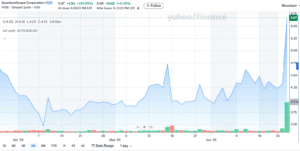
QuantumScape Corporation (NYSE: QS) saw its stock price rise by 35% after announcing a major improvement in solid-state battery technology. This new development helps solve two big problems with electric vehicles (EVs): short driving ranges and slow charging times.
Solving these problems helps more people switch from gas cars to electric ones. This change would lower carbon emissions in transportation.
Cobra Strikes: A Battery Manufacturing Breakthrough
QuantumScape’s recent success comes from its new manufacturing method called the Cobra separator process. This process is much faster and takes up less space than the company’s older “Raptor” method. In fact, Cobra is about 25x faster at heat treatment and needs only a small amount of physical space to operate.
The Cobra platform is a big step forward because it helps make battery parts faster and with less energy. This improvement could make it easier to build solid-state batteries at a large scale, which is necessary to meet the growing demand for EVs.
Dr. Siva Sivaram, CEO of QuantumScape, said the company has made strong progress with Cobra, noting:
“Our team has made impressive strides in advancing Cobra, a technology that exemplifies our progress in scaling solid-state battery production…By significantly improving throughput and shrinking the equipment footprint, Cobra gives us a powerful path forward for commercializing our next-generation battery technology.”
Solid-State Shift: Powering the Clean Transport Future
QuantumScape’s solid-state batteries are different from the regular lithium-ion batteries found in most EVs today. Traditional batteries use a liquid electrolyte, but solid-state batteries use a solid ceramic one. This change makes the batteries safer and allows them to store more energy.
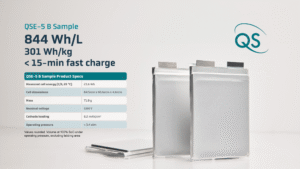
Because of this, solid-state batteries could increase EV driving range by 50% to 80%, with some models expected to reach 900 to 1,000 miles per charge. These improvements could remove what’s known as “range anxiety”—the fear that an EV will run out of power before reaching a charging station.
The benefits don’t stop there. EVs using these batteries will likely need to stop and charge less often on long trips. That means less strain on the power grid and better use of renewable energy like wind and solar.
Since EVs already reduce carbon emissions by up to 65% over their lifetime compared to gas vehicles, solid-state technology could make an even bigger impact on the environment.
Faster Charging, Safer Driving
Solid-state batteries from QuantumScape offer more than just long driving range. They also charge faster, which is a key concern for drivers. These batteries are built to handle rapid charging using high-voltage direct current (DC). That means you could charge your EV during a short stop instead of waiting for hours.
Safety is another major advantage. Solid electrolytes are not flammable and don’t cause the same fire risks as liquid ones. This makes the batteries more stable and lowers the risk of overheating or explosions. Better safety could also help governments approve new EV models faster, which would speed up adoption around the world.
Sealing the Deal: Volkswagen Backs the Tech
QuantumScape’s partnership with PowerCo, a battery company owned by Volkswagen Group, shows the real-world value of this technology. PowerCo has signed a deal to produce up to 80 gigawatt-hours (GWh) of batteries per year using QuantumScape’s designs. That’s enough power for about one million electric cars annually.
PowerCo also tested QuantumScape’s batteries and found they performed better than expected. The solid-state batteries went through over 1,000 charging cycles and still kept more than 95% of their energy capacity. That equals about 500,000 kilometers of driving, based on current EV standards.
PowerCo CEO Frank Blome said the results were very promising. He believes these batteries could offer longer driving ranges, very fast charging, and a longer lifespan, making them ideal for future EVs.
More notably, the global solid-state battery market was worth about $1,181.8 million in 2024, according to the Grand View Research. It is expected to grow to $15,067.3 million by 2030, with a fast yearly growth rate of 56.6% between 2025 and 2030.

This growth is mainly because more people are buying electric vehicles (EVs), and solid-state batteries are safer and store more energy than regular lithium-ion batteries.
Investment Voltage: Why Carbon Markets Are Watching Closely
Investors who care about clean energy are paying close attention to QuantumScape. The company’s battery improvements could help the transportation industry lower its carbon emissions more quickly. Governments and businesses are pushing for net-zero carbon goals. Thus, the demand for better battery technologies is rising.
QuantumScape’s batteries may also be used in areas beyond cars. For example, they could help store energy from renewable sources like wind and solar on the electric grid. This would make clean energy more reliable and easier to use during times when the sun isn’t shining or the wind isn’t blowing.
The company’s batteries could also help reduce Scope 3 emissions, which are the indirect emissions that come from supply chains or the use of sold products. This would be helpful for companies with large delivery fleets or transportation networks that are trying to reduce their carbon footprint.
Looking ahead, QuantumScape plans to begin larger-scale production and testing of its solid-state batteries by 2026. The company is working on a new battery model, QSE-5, which will serve as the base for commercial production.
By solving major challenges in battery manufacturing, QuantumScape is on track to bring solid-state batteries to the market in the next few years. The company continues to improve how it makes the batteries and plans to increase its production levels.
Road to Rollout: What’s Next for QuantumScape?
QuantumScape’s 35% stock rise shows how excited investors are about the company’s progress. The new Cobra technology solves important problems in how solid-state batteries are made and makes it easier to produce them in large numbers.
For people and companies focused on clean energy, QuantumScape offers a chance to invest in a solution that could reduce carbon emissions in the transportation sector. These batteries have the power to fix major problems like short range and slow charging while also being safer to use.
Transportation accounts for about 16.2% of global carbon dioxide emissions. So, advanced battery technologies like QuantumScape’s could greatly benefit the planet. With strong partnerships, proven results, and a clear path to mass production, QuantumScape is positioned to play an important role in the shift to zero-emission vehicles and a cleaner future.
The post QuantumScape (QS) Stock Surges 35% as EV Battery Technology Drives Carbon Reduction appeared first on Carbon Credits.

EU carbon credit claims changed on 27 September 2026, the day the Directive (EU) 2024/825 began to apply across the European Union. The change is narrow. It changes how a company can talk about the credits it buys. A product can no longer be called neutral on the strength of compensation alone; however, every specific, evidenced statement about what a company measured, reduced, and funded stays fully available.

The post Promoting Improved Cooking Practices in Nigeria appeared first on Terrapass.



-
Climate Change1 year ago
Guest post: Why China is still building new coal – and when it might stop
-

 Greenhouse Gases2 years ago
嘉宾来稿:满足中国增长的用电需求 光伏加储能“比新建煤电更实惠”
-
Greenhouse Gases1 year ago
Guest post: Why China is still building new coal – and when it might stop
-

 Climate Change2 years ago
嘉宾来稿:满足中国增长的用电需求 光伏加储能“比新建煤电更实惠”
-

 Renewable Energy12 months ago
Sending Progressive Philanthropist George Soros to Prison?
-
Climate Change2 years ago
Bill Discounting Climate Change in Florida’s Energy Policy Awaits DeSantis’ Approval
-
Greenhouse Gases1 year ago
嘉宾来稿:探究火山喷发如何影响气候预测
-

 Climate Change2 years ago
Analysis: China’s CO2 falls 1% in Q2 2024 in first quarterly drop since Covid-19