

The Trump administration in the US has announced its intention to withdraw from the UN’s landmark climate treaty, alongside 65 other international bodies that “no longer serve American interests”.
Every nation in the world has committed to tackling “dangerous anthropogenic interference with the climate system” under the 1992 UN Framework Convention on Climate Change (UNFCCC).
During Donald Trump’s second presidency, the US has already failed to meet a number of its UN climate treaty obligations, including reporting its emissions and funding the UNFCCC – and it has not attended recent climate summits.
However, pulling out of the UNFCCC would be an unprecedented step and would mark the latest move by the US to disavow global cooperation and climate action.
Among the other organisations the US plans to leave is the Intergovernmental Panel on Climate Change (IPCC), the UN body seen as the global authority on climate science.
In this article, Carbon Brief considers the implications of the US leaving these bodies, as well as the potential for it rejoining the UNFCCC in the future.
Carbon Brief has also spoken to experts about the contested legality of leaving the UNFCCC and what practical changes – if any – will result from the US departure.
- What is the process for pulling out of the UNFCCC?
- Is it legal for Trump to take the US out of the UNFCCC unilaterally?
- How could the US rejoin the UNFCCC and Paris Agreement?
- What changes when the US withdraws from the UNFCCC?
- What about the US withdrawal from the IPCC?
- What other organisations are affected?
What is the process for pulling out of the UNFCCC?
The Trump administration set out its intention to withdraw from the UNFCCC and the IPCC in a White House presidential memorandum issued on 7 January 2026.
It claims authority “vested in me as president by the constitution and laws of the US” to withdraw the country from the treaty, along with 65 other international and UN bodies.
However, the memo includes a caveat around its instructions, stating:
“For UN entities, withdrawal means ceasing participation in or funding to those entities to the extent permitted by law.”
(In an 8 January interview with the New York Times, Trump said he did not “need international law” and that his powers were constrained only by his “own morality”.)
The US is the first and only country in the world to announce it wants to withdraw from the UNFCCC.
The convention was adopted at the UN headquarters in New York in May 1992 and opened for signatures at the Rio Earth summit the following month. The US became the first industrialised nation to ratify the treaty that same year.
It was ultimately signed by every nation on Earth – making it one of the most ratified global treaties in history.
Article 25 of the treaty states that any party may withdraw by giving written notification to the “depositary”, which is elsewhere defined as being the UN secretary general – currently, António Guterres.
The article, shown below, adds that the withdrawal will come into force a year after a written notification is supplied.
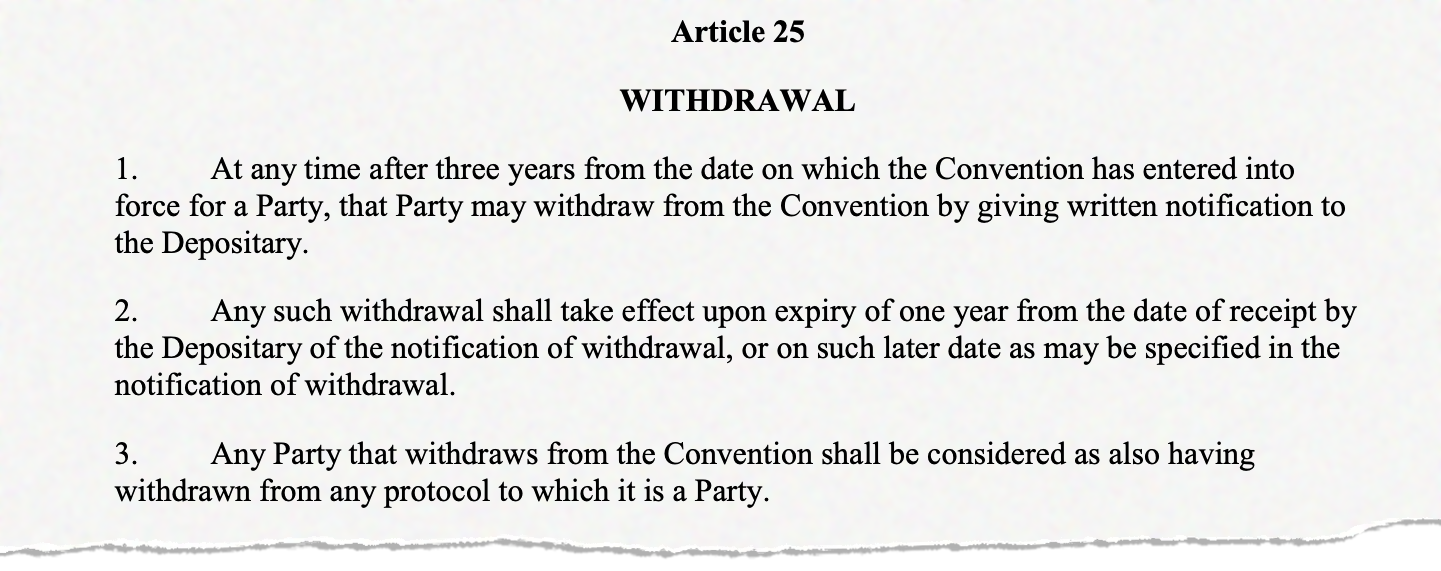
The treaty adds that any party that withdraws from the convention shall be considered as also having left any related protocol.
The UNFCCC has two main protocols: the Kyoto Protocol of 1997 and the Paris Agreement of 2015.
Although former US president Bill Clinton signed the Kyoto Protocol in 1998, its formal ratification faced opposition from the Senate and the treaty was ultimately rejected by his successor, president George W Bush, in 2001.
Domestic opposition to the protocol centred around the exclusion of major developing countries, such as China and India, from emissions reduction measures.
The US did ratify the Paris Agreement, but Trump signed an executive order to take the nation out of the pact for a second time on his first resumed day in office in January 2025.
Is it legal for Trump to take the US out of the UNFCCC unilaterally?
Whether Trump can legally pull the US out of the UNFCCC without the consent of the Senate remains unclear.
The US previously left the Paris Agreement during Trump’s first term.
Both the UNFCCC and the Paris Agreement allow any party to withdraw with a year’s written notice. However, both treaties state that parties cannot withdraw within the first three years of ratification.
As such, the first Trump administration filed notice to exit the Paris Agreement in November 2019 and became the first nation in the world to formally leave a year later – the day after Democrat Joe Biden won the 2020 presidential election.
On his first day in office in 2021, Biden rejoined the Paris Agreement. This took 30 days from notifying the UNFCCC to come into force.
The legalities of leaving the UNFCCC are murkier, due to how it was adopted.
As Michael B Gerrard, director of the Sabin Center for Climate Change Law at Columbia Law School, explains to Carbon Brief, the Paris Agreement was ratified without Senate approval.
Article 2 of the US Constitution says presidents have the power to make or join treaties subject to the “advice and consent” of the Senate – including a two-thirds majority vote (see below).
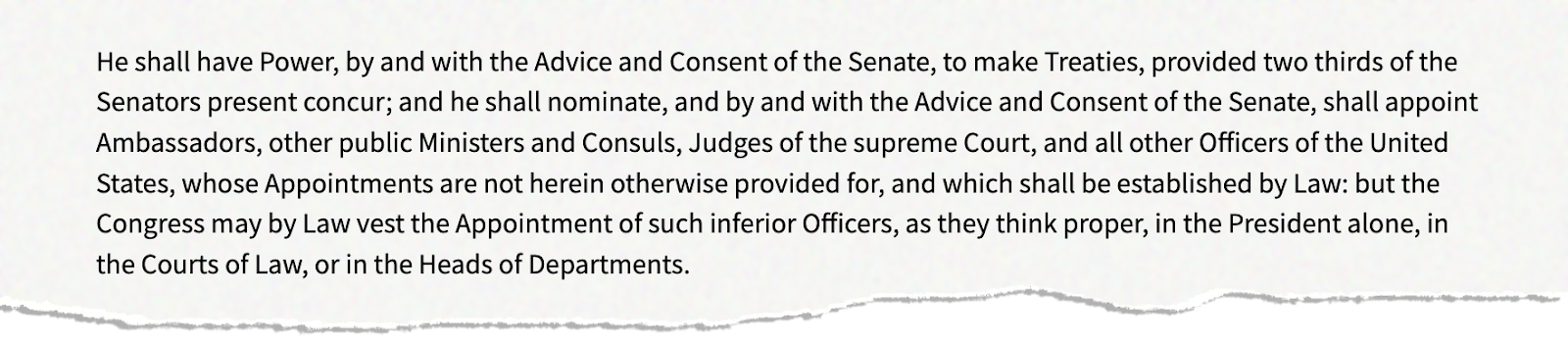
However, Barack Obama took the position that, as the Paris Agreement “did not impose binding legal obligations on the US, it was not a treaty that required Senate ratification”, Gerrard tells Carbon Brief.
As noted in a post by Jake Schmidt, a senior strategic director at the environmental NGO Natural Resources Defense Council (NRDC), the US has other mechanisms for entering international agreements. It says the US has joined more than 90% of the international agreements it is party to through different mechanisms.
In contrast, George H Bush did submit the UNFCCC to the Senate in 1992, where it was unanimously ratified by a 92-0 vote, ahead of his signing it into law.
Reversing this is uncertain legal territory. Gerrard tells Carbon Brief:
“There is an open legal question whether a president can unilaterally withdraw the US from a Senate-ratified treaty. A case raising that question reached the US Supreme Court in 1979 (Goldwater vs Carter), but the Supreme Court ruled this was a political question not suitable for the courts.”
Unlike ratifying a treaty, the US Constitution does not explicitly specify whether the consent of the Senate is required to leave one.
This has created legal uncertainty around the process.
Given the lack of clarity on the legal precedent, some have suggested that, in practice, Trump can pull the US out of treaties unilaterally.
Sue Biniaz, former US principal deputy special envoy for climate and a key legal architect of the Paris Agreement, tells Carbon Brief:
“In terms of domestic law, while the Supreme Court has not spoken to this issue (it treated the issue as non-justifiable in the Goldwater v Carter case), it has been US practice, and the mainstream legal view, that the president may constitutionally withdraw unilaterally from a treaty, ie without going back to the Senate.”
Additionally, the potential for Congress to block the withdrawal from the UNFCCC and other treaties is unclear. When asked by Carbon Brief if it could play a role, Biniaz says:
“Theoretically, but politically unlikely, Congress could pass a law prohibiting the president from unilaterally withdrawing from the UNFCCC. (The 2024 NDAA contains such a provision with respect to NATO.) In such case, its constitutionality would likely be the subject of debate.”
How could the US rejoin the UNFCCC and Paris Agreement?
The US would be able to rejoin the UNFCCC in future, but experts disagree on how straightforward the process would be and whether it would require a political vote.
In addition to it being unclear whether a two-thirds “supermajority” vote in the Senate is required to leave a treaty, it is unclear whether rejoining would require a similar vote again – or if the original 1992 Senate consent would still hold.
Citing arguments set out by Prof Jean Galbraith of the University of Pennsylvania law school, Schmidt’s NRDC post says that a future president could rejoin the convention within 90 days of a formal decision, under the merit of the previous Senate approval.
Biniaz tells Carbon Brief that there are “multiple future pathways to rejoining”, adding:
“For example, Prof Jean Galbraith has persuasively laid out the view that the original Senate resolution of advice and consent with respect to the UNFCCC continues in effect and provides the legal authority for a future president to rejoin. Of course, the Senate could also give its advice and consent again. In any case, per Article 23 of the UNFCCC, it would enter into force for the US 90 days after the deposit of its instrument.”
Prof Oona Hathaway, an international law professor at Yale Law School, believes there is a “very strong case that a future president could rejoin the treaty without another Senate vote”.
She tells Carbon Brief that there is precedent for this based on US leaders quitting and rejoining global organisations in the past, explaining:
“The US joined the International Labour Organization in 1934. In 1975, the Ford administration unilaterally withdrew, and in 1980, the Carter administration rejoined without seeking congressional approval.
“Similarly, the US became a member of the United Nations Educational, Scientific and Cultural Organization (UNESCO) in 1946. In the 1980s, the Reagan administration unilaterally withdrew the US. The Bush administration rejoined UNESCO in 2002, but in 2019 the Trump administration once again withdrew. The Biden administration rejoined in 2023, and the Trump Administration announced its withdrawal again in 2025.”
But this “legal theory” of a future US president specifically re-entering the UNFCCC “based on the prior Senate ratification” has “never been tested in court”, Prof Gerrard from Columbia Law School tells Carbon Brief.
Dr Joanna Depledge, an expert on global climate negotiations and research fellow at the University of Cambridge, tells Carbon Brief:
“Due to the need for Senate ratification of the UNFCCC (in my interpretation), there is no way back now for the US into the climate treaties. But there is nothing to stop a future US president applying [the treaty] rules or – what is more important – adopting aggressive climate policy independently of them.”
If it were required, achieving Senate approval to rejoin the UNFCCC would take a “significant shift in US domestic politics”, public policy professor Thomas Hale from the University of Oxford notes on Bluesky.
Rejoining the Paris Agreement, on the other hand, is a simpler process that the US has already undertaken in recent years. (See: Is it legal for Trump to take the US out of the UNFCCC unilaterally?) Biniaz explains:
“In terms of the Paris Agreement, a party to that agreement must also be a party to the UNFCCC (Article 20). Assuming the US had rejoined the UNFCCC, it could rejoin the Paris Agreement as an executive agreement (as it did in early 2021). The agreement would enter into force for the US 30 days after the deposit of its instrument (Article 21).”
The Center for Climate and Energy Solutions, an environmental non-profit, explains that Senate approval was not required for Paris “because it elaborates an existing treaty” – the UNFCCC.
What changes when the US withdraws from the UNFCCC?
US withdrawal from the UNFCCC has been described in media coverage as a “massive hit” to global climate efforts that will “significantly limit” the treaty’s influence.
However, experts tell Carbon Brief that, as the Trump administration has already effectively withdrawn from most international climate activities, this latest move will make little difference.
Moreover, Depledge tells Carbon Brief that the international climate regime “will not collapse” as a result of US withdrawal. She says:
“International climate cooperation will not collapse because the UNFCCC has 195 members rather than 196. In a way, the climate treaties have already done their job. The world is already well advanced on the path to a lower-carbon future. Had the US left 10 years ago, it would have been a serious threat, but not today. China and other renewable energy giants will assert even more dominance.”
Depledge adds that while the “path to net-zero will be longer because of the drastic rollback of domestic climate policy in the US”, it “won’t be reversed”.
Technically, US departure from the UNFCCC would formally release it from certain obligations, including the need to report national emissions.
As the world’s second-largest annual emitter, this is potentially significant.
“The US withdrawal from the UNFCCC undoubtedly impacts on efforts to monitor and report global greenhouse gas emissions,” Dr William Lamb, a senior researcher at the Potsdam Institute for Climate Impact Research (PIK), tells Carbon Brief.
Lamb notes that while scientific bodies, such as the IPCC, often use third-party data, national inventories are still important. The US already failed to report its emissions data last year, in breach of its UNFCCC treaty obligations.
Robbie Andrew, senior researcher at Norwegian climate institute CICERO, says that it will currently be possible for third-party groups to “get pretty close” to the carbon dioxide (CO2) emissions estimates previously published by the US administration. However, he adds:
“The further question, though, is whether the EIA [US Energy Information Administration] will continue reporting all of the energy data they currently do. Will the White House decide that reporting flaring is woke? That even reporting coal consumption is an unnecessary burden on business? I suspect the energy sector would be extremely unhappy with changes to the EIA’s reporting, but there’s nothing at the moment that could guarantee anything at all in that regard.”
Andrew says that estimating CO2 emissions from energy is “relatively straightforward when you have detailed energy data”. In contrast, estimating CO2 emissions from agriculture, land use, land-use change and forestry, as well as other greenhouse gas emissions, is “far more difficult”.
The US Treasury has also announced that the US will withdraw from the UN’s Green Climate Fund (GCF) and give up its seat on the board, “in alignment” with its departure from the UNFCCC. The Trump administration had already cancelled $4bn of pledged funds for the GCF.
Another specific impact of US departure would be on the UNFCCC secretariat budget, which already faces a significant funding gap. US annual contributions typically make up around 22% of the body’s core budget, which comes from member states.
However, as with emissions data and GCF withdrawal, the Trump administration had previously indicated that the US would stop funding the UNFCCC.
In fact, billionaire and UN special climate envoy Michael Bloomberg has already committed, alongside other philanthropists, to making up the US shortfall.
Veteran French climate negotiator Paul Watkinson tells Carbon Brief:
“In some ways the US has already suspended its participation. It has already stopped paying its budget contributions, it sent no delegation to meetings in 2025. It is not going to do any reporting any longer – although most of that is now under the Paris Agreement. So whether it formally leaves the UNFCCC or not does not change what it is likely to do.”
Dr Joanna Depledge tells Carbon Brief that she agrees:
“This is symbolically and politically huge, but in practice it makes little difference, given that Trump had already announced total disengagement last year.”
The US has a history of either leaving or not joining major environmental treaties and organisations, such as the Paris Agreement and the Kyoto Protocol. (See: What is the process for pulling out of the UNFCCC?)
Dr Jennifer Allan, a global environmental politics researcher at Cardiff University, tells Carbon Brief:
“The US has always been an unreliable partner…Historically speaking, this is kind of more of the same.”
The NRDC’s Jake Schmidt tells Carbon Brief that he doubts US absence will lead to less progress at UN climate negotiations. He adds:
“[The] Trump team would have only messed things up, so not having them participate will probably actually lead to better outcomes.”
However, he acknowledges that “US non-participation over the long-term could be used by climate slow-walking countries as an excuse for inaction”.
Biniaz tells Carbon Brief that the absence of the US is unlikely to unlock reform of the UN climate process – and that it might make negotiations more difficult. She says:
“I don’t see the absence of the US as promoting reform of the COP process. While the US may have had strong views on certain topics, many other parties did as well, and there is unlikely to be agreement among them to move away from the consensus (or near consensus) decision-making process that currently prevails. In fact, the US has historically played quite a significant ‘broker’ role in the negotiations, which might actually make it more difficult for the remaining parties to reach agreement.”
After leaving the UNFCCC, the US would still be able to participate in UN climate talks as an observer, albeit with diminished influence. (It is worth noting that the US did not send a delegation to COP30 last year.)
There is still scope for the US to use its global power and influence to disrupt international climate processes from the outside.
For example, last year, the Trump administration threatened nations and negotiators with tariffs and withdrawn visa rights if they backed an International Maritime Organization (IMO) effort to cut shipping emissions. Ultimately, the measures were delayed due to a lack of consensus.
(Notably, the IMO is among the international bodies that the US has not pledged to leave.)
What about the US withdrawal from the IPCC?
As a scientific body, rather than a treaty, there is no formal mechanism for “withdrawing” from the IPCC. In its own words, the IPCC is an “organisation of governments that are members of the UN or World Meteorological Organization” (WMO).
Therefore, just being part of the UN or WMO means a country is eligible to participate in the IPCC. If a country no longer wishes to play a role in the IPCC, it can simply disengage from its activities – for example, by not attending plenary meetings, nominating authors or providing financial support.
This is exactly what the US government has been doing since last year.
Shortly before the IPCC’s plenary meeting for member governments – known as a “session” – in Hangzhou, China, in March 2025, reports emerged that US officials had been denied permission to attend.
In addition, the contract for the technical support unit for Working Group III (WG3) was terminated by its provider, NASA, which also eliminated the role of chief scientist – the position held by WG3 co-chair Dr Kate Cavlin.
(Each of the IPCC’s three “working groups” has a technical support unit, or TSU, which provides scientific and operational support. These are typically “co-located” between the home countries of a working group’s two co-chairs.)
The Hangzhou session was the first time that the US had missed a plenary since the IPCC was founded in 1988. It then missed another in Lima, Peru, in October 2025.
Although the US government did not nominate any authors for the IPCC’s seventh assessment cycle (AR7), US scientists were still put forward through other channels. Analysis by Carbon Brief shows that, across the three AR7 working group reports, 55 authors are affiliated with US institutions.
However, while IPCC authors are supported by their institutions – they are volunteers and so are not paid by the IPCC – their travel costs for meetings are typically covered by their country’s government. (For scientists from developing countries, there is financial support centrally from the IPCC.)
Prof Chris Field, co-chair of Working Group II during the IPCC’s fifth assessment (AR5), tells Carbon Brief that a “number of philanthropies have stepped up to facilitate participation by US authors not supported by the US government”.
The US Academic Alliance for the IPCC – a collaboration of US universities and research institutions formed last year to fill the gap left by the government – has been raising funds to support travel.
In a statement reacting to the US withdrawal, IPCC chair Prof Sir Jim Skea said that the panel’s focus remains on preparing the reports for AR7:
“The panel continues to make decisions by consensus among its member governments at its regular plenary sessions. Our attention remains firmly on the delivery of these reports.”
The various reports will be finalised, reviewed and approved in the coming years – a process that can continue without the US. As it stands, the US government will not have a say on the content and wording of these reports.
Field describes the US withdrawal as a “self-inflicted wound to US prestige and leadership” on climate change. He adds:
“I don’t have a crystal ball, but I hope that the US administration’s animosity toward climate change science will lead other countries to support the IPCC even more strongly. The IPCC is a global treasure.”
The University of Edinburgh’s Prof Gabi Hegerl, who has been involved in multiple IPCC reports, tells Carbon Brief:
“The contribution and influence of US scientists is presently reduced, but there are still a lot of enthusiastic scientists out there that contribute in any way they can even against difficult obstacles.”
On Twitter, Prof Jean-Pascal van Ypersele – IPCC vice-chair during AR5 – wrote that the US withdrawal was “deeply regrettable” and that to claim the IPCC’s work is contrary to US interests is “simply nonsensical”. He continued:
“Let us remember that the creation of the IPCC was facilitated in 1988 by an agreement between Ronald Reagan and Margaret Thatcher, who can hardly be described as ‘woke’. Climate and the environment are not a matter of ideology or political affiliation: they concern everyone.”
Van Ypersele added that while the IPCC will “continue its work in the service of all”, other countries “will have to compensate for the budgetary losses”.
The IPCC’s most recent budget figures show that the US did not make a contribution in 2025.
Carbon Brief analysis shows that the US has provided around 30% of all voluntary contributions in the IPCC’s history. Totalling approximately $67m (£50m), this is more than four times that of the next-largest direct contributor, the EU.
However, this is not the first time that the US has withdrawn funding from the IPCC. During Trump’s first term of office, his administration cut its contributions in 2017, with other countries stepping up their funding in response. The US subsequently resumed its contributions.
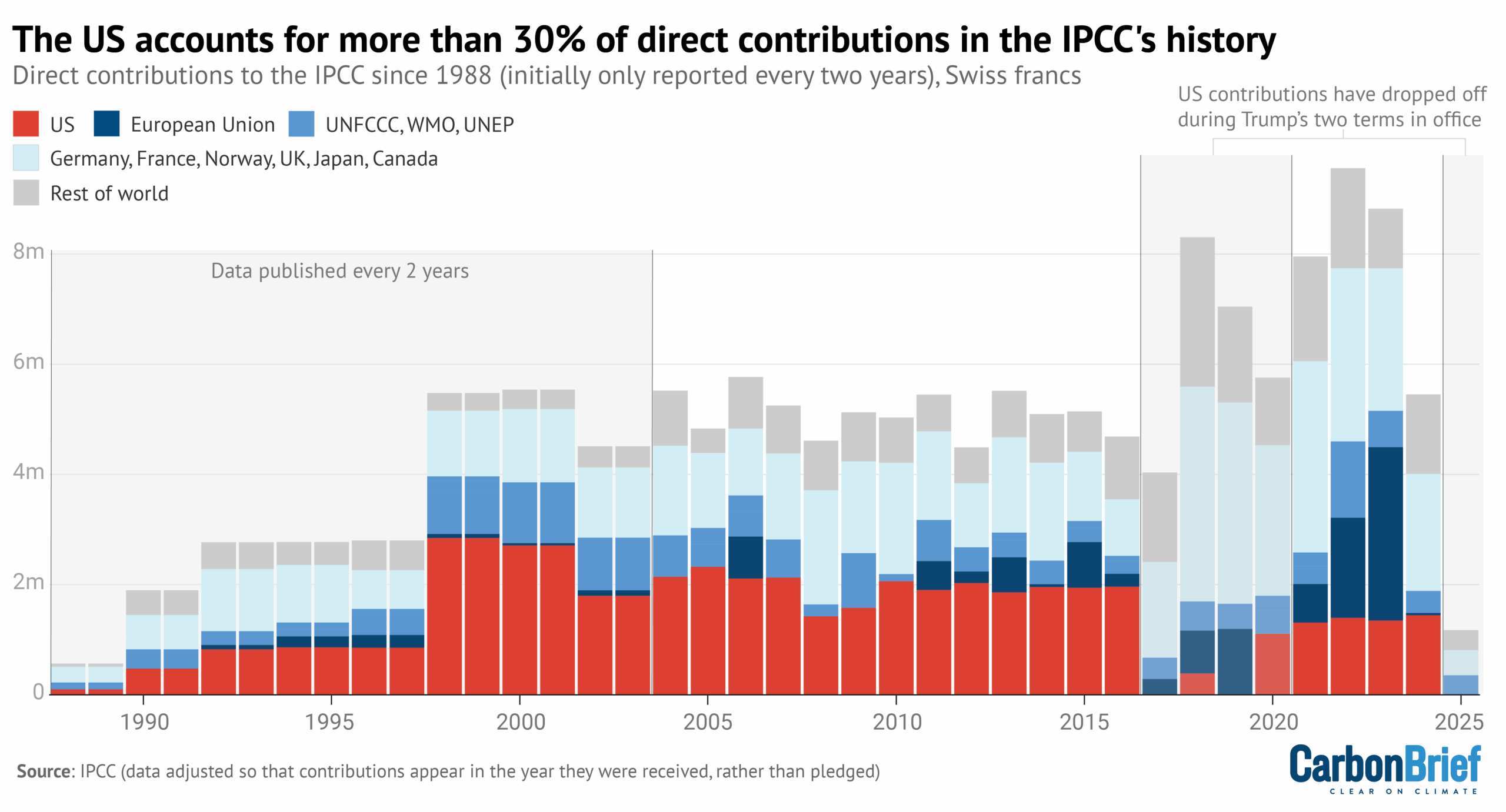
At its most recent meeting in Lima, Peru, in October 2025, the IPCC warned of an “accelerating decline” in the level of annual voluntary contributions from countries and other organisations, reported the Earth Negotiations Bulletin. As a result, the IPCC invited member countries to increase their donations “if possible”.
What other organisations are affected?
In addition to announcing his plan to withdraw the US from the UNFCCC and the IPCC, Trump also called for the nation’s departure from 16 other organisations related to climate change, biodiversity and clean energy.
These include:
- The Intergovernmental Science-Policy Platform on Biodiversity and Ecosystem Services (IPBES) – the biodiversity equivalent of the IPCC.
- Intergovernmental Forum on Mining, Minerals, Metals and Sustainable Development – a voluntary group of more than 80 countries aiming to make the mining sector more sustainable.
- UN Energy – the principal UN organisation for international collaboration on energy.
- UN Oceans – a UN mechanism responsible for overseeing the International Seabed Authority (ISA) and other UN agencies related to ocean and coastal issues.
- UN Water – the UN agency responsible for water and sanitation.
- UN Collaborative Programme on Reducing Emissions from Deforestation and Forest Degradation in Developing Countries (UN-REDD) – a UN collaborative initiative for creating financial incentives for protecting forests.
- International Renewable Energy Agency – an intergovernmental organisation supporting countries in their transition to renewable energy.
- 24/7 Carbon-Free Energy Compact – a UN initiative launched in 2021 pushing governments, companies and organisations to achieve 100% low-carbon electricity generation.
- Commission for Environmental Cooperation – an organisation aimed at conserving North America’s natural environment.
- Inter-American Institute for Global Change Research – an intergovernmental organisation supported by 19 countries in North and South America for the support of planetary change research.
- International Energy Forum – an intergovernmental platform for dialogue among countries, industry and experts.
- International Solar Alliance – an organisation supporting the development of solar power and the phaseout of fossil fuels.
- International Tropical Timber Organization – an organisation aimed at protecting tropical forest resources.
- International Union for Conservation of Nature – an international nature conservation organisation and authority on the state of biodiversity loss.
- Renewable Energy Policy Network for the 21st Century – a global policy forum for renewable energy leadership.
- Secretariat of the Pacific Regional Environment Programme – a regional organisation aimed at protecting the Pacific’s environment.
As well as participating in the work of these organisations, the US is also a key source of funding for many of them – leaving their futures uncertain.
In a letter to members seen by Carbon Brief, IPBES chair and Kenyan ecologist, Dr David Obura, described Trump’s move as “deeply disappointing”.
He said that IPBES “has not yet received any formal notification” from the US, but “anticipates that the intention expressed to withdraw will mean that the US will soon cease to be a member of IPBES”, adding:
“The US is a founding member of IPBES and scientists, policymakers and stakeholders – including Indigenous peoples and local communities – from the US have been among the most engaged contributors to the work of IPBES since its establishment in 2012, making valuable contributions to objective science-based assessments of the state of the planet, for people and nature.
“The contribution of US experts ranges from leading landmark assessment reports, to presiding over negotiations, serving as authors and reviewers, as well as helping to steer the organisation both scientifically and administratively.”
Despite being a party to IPBES until now, the US has never been a signatory to the UN Convention on Biological Diversity (CBD), the nature equivalent of the UNFCCC.
It is one of only two nations not to sign the convention, with the other being the Holy See, representing the Vatican City.
The lack of US representation at the CBD has not prevented countries from reaching agreements. In 2022, countries gathered under the CBD adopted the Kunming-Montreal Global Biodiversity Framework, often described as the “Paris Agreement for nature”.
However, some observers have pointed to the lack of US involvement as one of the reasons why biodiversity loss has received less international attention than climate change.




The post Q&A: What Trump’s US exit from UNFCCC and IPCC could mean for climate action appeared first on Carbon Brief.
Q&A: What Trump’s US exit from UNFCCC and IPCC could mean for climate action

N.C. Gov. Josh Stein wants state lawmakers to rethink tax breaks for data centers. The industry’s opacity makes it difficult to evaluate costs and benefits.
Tax breaks for data centers in North Carolina keep as much as $57 million each year into from state and local government coffers, state figures show, an amount that could balloon to billions of dollars if all the proposed projects are built.
The Global Environment Facility (GEF), a multilateral fund that provides climate and nature finance to developing countries, has raised $3.9 billion from donor governments in its last pledging session ahead of a key fundraising deadline at the end of May.
The amount, which is meant to cover the fund’s activities for the next four years (July 2026-June 2030), falls significantly short of the previous four-year cycle for which the GEF managed to raise $5.3bn from governments. Since then, military and other political priorities have squeezed rich nations’ budgets for climate and development aid.
The facility said in a statement that it expects more pledges ahead of the final replenishment package, which is set for approval at the next GEF Council meeting from May 31 to June 3.
Claude Gascon, interim CEO of the GEF, said that “donor countries have risen to the challenge and made bold commitments towards a more positive future for the planet”. He added that the pledges send a message that “the world is not giving up on nature even in a time of competing priorities”.
-
UK imports of “green” jet fuel linked to Amazon deforestation
A Texas refinery shipping sustainable aviation fuel to Europe has sourced beef tallow with links to a meatpacking firm fined over illegal cattle purchases -
Italy pushes coal exit back after gas prices rise
Analysts say the move sends a negative signal, but its impact will be limited given coal’s marginal role in Italy’s energy mix


Donors under pressure
But Brian O’Donnell, director of the environmental non-profit Campaign for Nature, said the announcement shows “an alarming trend” of donor governments cutting public finance for climate and nature.
“Wealthy nations pledged to increase international nature finance, and yet we are seeing cuts and lower contributions. Investing in nature prevents extinctions and supports livelihoods, security, health, food, clean water and climate,” he said. “Failing to safeguard nature now will result in much larger costs later.”
At COP29 in Baku, developed countries pledged to mobilise $300bn a year in public climate finance by 2035, while at UN biodiversity talks they have also pledged to raise $30bn per year by 2030. Yet several wealthy governments have announced cuts to green finance to increase defense spending, among them most recently the UK.
As for the US, despite Trump’s cuts to international climate finance, Congress approved a $150 million increase in its contribution to the GEF after what was described as the organisation’s “refocus on non-climate priorities like biodiversity, plastics and ocean ecosystems, per US Treasury guidance”.
The facility will only reveal how much each country has pledged when its assembly of 186 member countries meets in early June. The last period’s largest donors were Germany ($575 million), Japan ($451 million), and the US ($425 million).
The GEF has also gone through a change in leadership halfway through its fundraising cycle. Last December, the GEF Council asked former CEO Carlos Manuel Rodriguez to step down effective immediately and appointed Gascon as interim CEO.
Santa Marta conference: fossil fuel transition in an unstable world
New guidelines
As part of the upcoming funding cycle, the GEF has approved a set of guidelines for spending the $3.9bn raised so far, which include allocating 35% of resources for least developed countries and small island states, as well as 20% of the money going to Indigenous people and communities.
Its programs will help countries shift five key systems – nature, food, urban, energy and health – from models that drive degradation to alternatives that protect the planet and support human well-being by integrating the value of nature into production and consumption systems.
The new priorities also include a target to allocate 25% of the GEF’s budget for mobilising private funds through blended finance. This aligns with efforts by wealthy countries to increase contributions from the private sector to international climate finance.
Niels Annen, Germany’s State Secretary for Economic Cooperation and Development, said in a statement that the country’s priorities are “very well reflected” in the GEF’s new spending guidelines, including on “innovative finance for nature and people, better cooperation with the private sector, and stable resources for the most vulnerable countries”.
Aliou Mustafa, of the GEF Indigenous Peoples Advisory Group (IPAG), also welcomed the announcement, adding that “the GEF is strengthening trust and meaningful partnerships with Indigenous Peoples and local communities” by placing them at the “centre of decision-making”.
The post GEF raises $3.9bn ahead of funding deadline, $1bn below previous budget appeared first on Climate Home News.
GEF raises $3.9bn ahead of funding deadline, $1bn below previous budget
Tropical cyclones that rapidly intensify when passing over marine heatwaves can become “supercharged”, increasing the likelihood of high economic losses, a new study finds.
Such storms also have higher rates of rainfall and higher maximum windspeeds, according to the research.
The study, published in Science Advances, looks at the economic damages caused by nearly 800 tropical cyclones that occurred around the world between 1981 and 2023.
It finds that rapidly intensifying tropical cyclones that pass near abnormally warm parts of the ocean produce nearly double – 93% – the economic damages as storms that do not, even when levels of coastal development are taken into account.
One researcher, who was not involved in the study, tells Carbon Brief that the new analysis is a “step forward in understanding how we can better refine our predictions of what might happen in the future” in an increasingly warm world.
As marine heatwaves are projected to become more frequent under future climate change, the authors say that the interactions between storms and these heatwaves “should be given greater consideration in future strategies for climate adaptation and climate preparedness”.
‘Rapid intensification’
Tropical cyclones are rapidly rotating storm systems that form over warm ocean waters, characterised by low pressure at their cores and sustained winds that can reach more than 120 kilometres per hour.
The term “tropical cyclones” encompasses hurricanes, cyclones and typhoons, which are named as such depending on which ocean basin they occur in.
When they make landfall, these storms can cause major damage. They accounted for six of the top 10 disasters between 1900 and 2024 in terms of economic loss, according to the insurance company Aon’s 2025 climate catastrophe insight report.
These economic losses are largely caused by high wind speeds, large amounts of rainfall and damaging storm surges.
Storms can become particularly dangerous through a process called “rapid intensification”.
Rapid intensification is when a storm strengthens considerably in a short period of time. It is defined as an increase in sustained wind speed of at least 30 knots (around 55 kilometres per hour) in a 24-hour period.
There are several factors that can lead to rapid intensification, including warm ocean temperatures, high humidity and low vertical “wind shear” – meaning that the wind speeds higher up in the atmosphere are very similar to the wind speeds near the surface.
Rapid intensification has become more common since the 1980s and is projected to become even more frequent in the future with continued warming. (Although there is uncertainty as to how climate change will impact the frequency of tropical cyclones, the increase in strength and intensification is more clear.)
Marine heatwaves are another type of extreme event that are becoming more frequent due to recent warming. Like their atmospheric counterparts, marine heatwaves are periods of abnormally high ocean temperatures.
Previous research has shown that these marine heatwaves can contribute to a cyclone undergoing rapid intensification. This is because the warm ocean water acts as a “fuel” for a storm, says Dr Hamed Moftakhari, an associate professor of civil engineering at the University of Alabama who was one of the authors of the new study. He explains:
“The entire strength of the tropical cyclone [depends on] how hot the [ocean] surface is. Marine heatwave means we have an abundance of hot water that is like a gas [petrol] station. As you move over that, it’s going to supercharge you.”
However, the authors say, there is no global assessment of how rapid intensification and marine heatwaves interact – or how they contribute to economic damages.
Using the International Best Track Archive for Climate Stewardship (IBTrACS) – a database of tropical cyclone paths and intensities – the researchers identify 1,600 storms that made landfall during the 1981-2023 period, out of a total of 3,464 events.
Of these 1,600 storms, they were able to match 789 individual, land-falling cyclones with economic loss data from the Emergency Events Database (EM-DAT) and other official sources.
Then, using the IBTrACS storm data and ocean-temperature data from the European Centre for Medium-Range Weather Forecasts, the researchers classify each cyclone by whether or not it underwent rapid intensification and if it passed near a recent marine heatwave event before making landfall.
The researchers find that there is a “modest” rise in the number of marine heatwave-influenced tropical cyclones globally since 1981, but with significant regional variations. In particular, they say, there are “clear” upward trends in the north Atlantic Ocean, the north Indian Ocean and the northern hemisphere basin of the eastern Pacific Ocean.
‘Storm characteristics’
The researchers find substantial differences in the characteristics of tropical cyclones that experience rapid intensification and those that do not, as well as between rapidly intensifying storms that occur with marine heatwaves and those that occur without them.
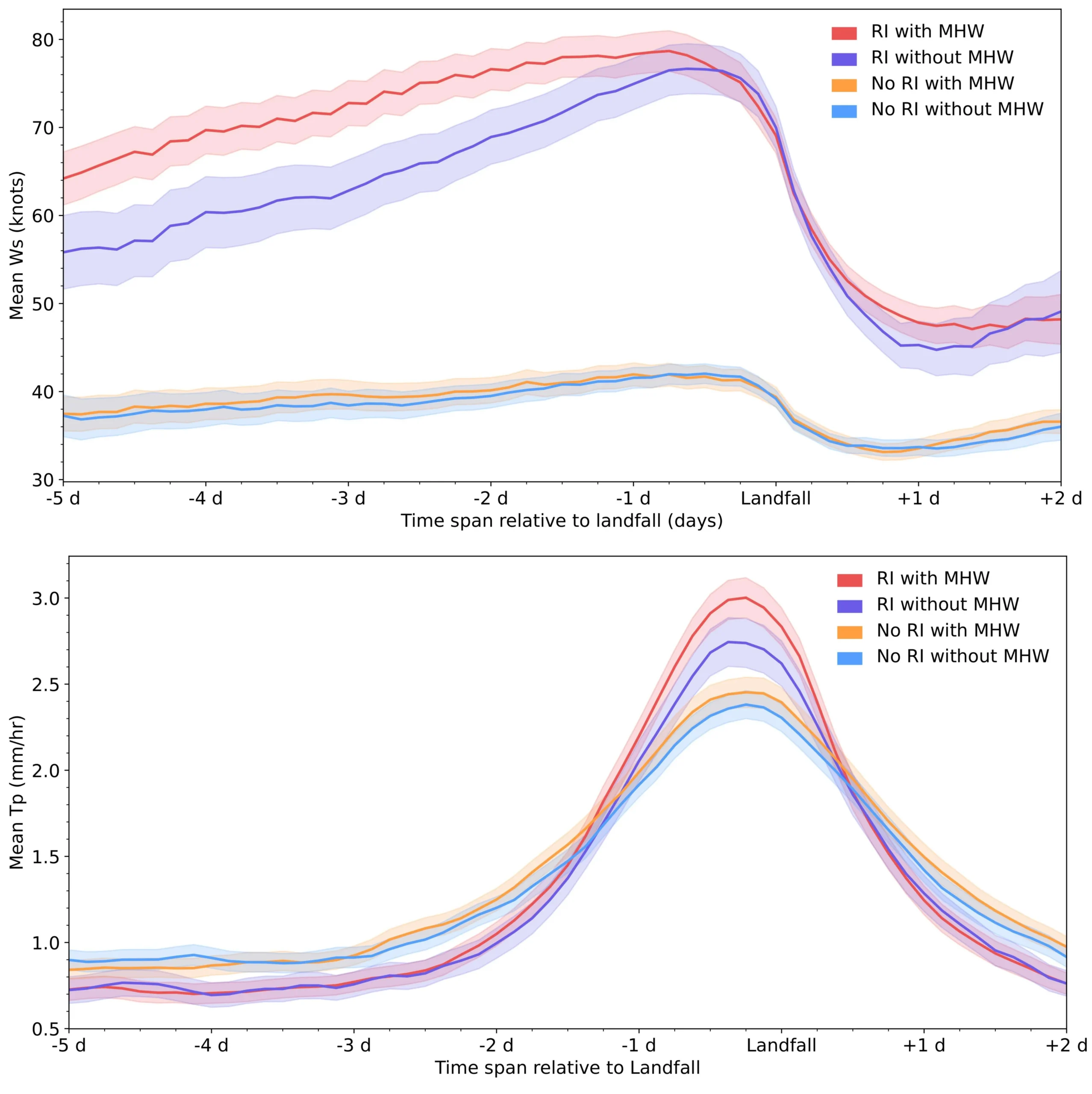
For example, tropical cyclones that do not experience rapid intensification have, on average, maximum wind speeds of around 40 knots (74km/hr), whereas storms that rapidly intensify have an average maximum wind speed of nearly 80 knots (148km/hr).
Of the rapidly intensifying storms, those that are influenced by marine heatwaves maintain higher wind speeds during the days leading up to landfall.
Although the wind speeds are very similar between the two groups once the storms make landfall, the pre-landfall difference still has an impact on a storm’s destructiveness, says Dr Soheil Radfar, a hurricane-hazard modeller at Princeton University. Radfar, who is the lead author of the new study, tells Carbon Brief:
“Hurricane damage starts days before the landfall…Four or five days before a hurricane making landfall, we expect to have high wind speeds and, because of that high wind speed, we expect to have storm surges that impact coastal communities.”
They also find that rapidly intensifying storms have higher peak rainfall than non-rapidly intensifying storms, with marine heatwave-influenced, rapidly intensifying storms exhibiting the highest average rainfall at landfall.
The charts below show the mean sustained wind speed in knots (top) and the mean rainfall in millimetres per hour (bottom) for the tropical cyclones analysed in the study in the five days leading up to and two days following a storm making landfall.
The four lines show storms that: rapidly intensified with the influence of marine heatwaves (red); those that rapidly intensified without marine heatwaves (purple); those that experienced marine heatwaves, but did not rapidly intensify (orange); and those that neither rapidly intensified nor experienced a marine heatwave (blue).
Dr Daneeja Mawren, an ocean and climate consultant at the Mauritius-based Mascarene Environmental Consulting who was not involved in the study, tells Carbon Brief that the new study “helps clarify how marine heatwaves amplify storm characteristics”, such as stronger winds and heavier rainfall. She notes that this “has not been done on a global scale before”.
However, Mawren adds that other factors not considered in the analysis can “make a huge difference” in the rapid intensification of tropical cyclones, including subsurface marine heatwaves and eddies – circular, spinning ocean currents that can trap warm water.
Dr Jonathan Lin, an atmospheric scientist at Cornell University who was also not involved in the study, tells Carbon Brief that, while the intensification found by the study “makes physical sense”, it is inherently limited by the relatively small number of storms that occur. He adds:
“There’s not that many storms, to tease out the physical mechanisms and observational data. So being able to reproduce this kind of work in a physical model would be really important.”
Economic costs
Storm intensity is not the only factor that determines how destructive a given cyclone can be – the economic damages also depend strongly on the population density and the amount of infrastructure development where a storm hits. The study explains:
“A high storm surge in a sparsely populated area may cause less economic damage than a smaller surge in a densely populated, economically important region.”
To account for the differences in development, the researchers use a type of data called “built-up volume”, from the Global Human Settlement Layer. Built-up volume is a quantity derived from satellite data and other high-resolution imagery that combines measurements of building area and average building height in a given area. This can be used as a proxy for the level of development, the authors explain.
By comparing different cyclones that impacted areas with similar built-up volumes, the researchers can analyse how rapid intensification and marine heatwaves contribute to the overall economic damages of a storm.
They find that, even when controlling for levels of coastal development, storms that pass through a marine heatwave during their rapid intensification cause 93% higher economic damages than storms that do not.
They identify 71 marine heatwave-influenced storms that cause more than $1bn (inflation-adjusted across the dataset) in damages, compared to 45 storms that cause those levels of damage without the influence of marine heatwaves.
This quantification of the cyclones’ economic impact is one of the study’s most “important contributions”, says Mawren.
The authors also note that the continued development in coastal regions may increase the likelihood of tropical cyclone damages over time.
Towards forecasting
The study notes that the increased damages caused by marine heatwave-influenced tropical cyclones, along with the projected increases in marine heatwaves, means such storms “should be given greater consideration” in planning for future climate change.
For Radfar and Moftakhari, the new study emphasises the importance of understanding the interactions between extreme events, such as tropical cyclones and marine heatwaves.
Moftakhari notes that extreme events in the future are expected to become both more intense and more complex. This becomes a problem for climate resilience because “we basically design in the future based on what we’ve observed in the past”, he says. This may lead to underestimating potential hazards, he adds.
Mawren agrees, telling Carbon Brief that, in order to “fully capture the intensification potential”, future forecasts and risk assessments must account for marine heatwaves and other ocean phenomena, such as subsurface heat.
Lin adds that the actions needed to reduce storm damages “take on the order of decades to do right”. He tells Carbon Brief:
“All these [planning] decisions have to come by understanding the future uncertainty and so this research is a step forward in understanding how we can better refine our predictions of what might happen in the future.”


The post Marine heatwaves ‘nearly double’ the economic damage caused by tropical cyclones appeared first on Carbon Brief.
Marine heatwaves ‘nearly double’ the economic damage caused by tropical cyclones



-
Climate Change8 months ago
Guest post: Why China is still building new coal – and when it might stop
-
Greenhouse Gases8 months ago
Guest post: Why China is still building new coal – and when it might stop
-

 Greenhouse Gases2 years ago
嘉宾来稿:满足中国增长的用电需求 光伏加储能“比新建煤电更实惠”
-
Climate Change2 years ago
Bill Discounting Climate Change in Florida’s Energy Policy Awaits DeSantis’ Approval
-

 Climate Change2 years ago
嘉宾来稿:满足中国增长的用电需求 光伏加储能“比新建煤电更实惠”
-
Climate Change Videos2 years ago
The toxic gas flares fuelling Nigeria’s climate change – BBC News
-

 Renewable Energy6 months ago
Sending Progressive Philanthropist George Soros to Prison?
-

 Carbon Footprint2 years ago
US SEC’s Climate Disclosure Rules Spur Renewed Interest in Carbon Credits