

Earlier this month, a years-long legal attempt by community and environmental groups to challenge a new oil project in Horse Hill, Surrey resulted in victory – with implications for all new fossil fuel projects in the UK.
On 20 June, the Supreme Court, the highest court for civil cases in the UK, issued a majority judgment ruling that Surrey County Council acted unlawfully by granting planning permission for the project, because councillors did not consider the climate impact from burning the fuel.
It came after an “incredibly finely balanced” legal battle, which saw multiple courts reject the arguments made by environmental groups – and judges in the Supreme Court take nearly a year to come to their own conclusion.
The judgment, which will now lead to changes in how the environmental impact of new fossil fuel projects is assessed, has been described as “landmark”, “watershed” and “tide-turning” by environmental groups, while right-leaning media warned it could “kill off the oil industry” completely.
Below, Carbon Brief speaks to environmental lawyers to unpack what happened in the Horse Hill case, what it actually means for UK fossil fuel production and how it could affect the policies of the next UK government.
- What happened in the Horse Hill case?
- What does the judgment mean for other fossil fuel projects in the UK?
- Could it affect other carbon-intensive projects, such as airport and road expansion?
- What could the judgment mean for the next UK government?
What happened in the Horse Hill case?
The story began back in 2012 when Surrey County Council granted planning permission for Horse Hill Developments Ltd to dig an exploratory oil well at Horse Hill, a site close to the town of Horley in Surrey and 3.5km north of Gatwick Airport.
In 2017, the council granted permission for a second borehole, a sidetrack well and for testing to commence.
In 2019, the council granted permission for the project to start drilling for oil – just two months after it had passed a motion declaring a climate emergency. The project was to include six oil wells, which would produce 3m tonnes of oil over a 20-year period.

In 2020, Sarah Finch, a freelance editor representing the Weald Action Group, a network of organisations opposing oil and gas in southern England, decided to challenge the council’s decision to grant planning permission in the High Court, with charity Friends of the Earth acting as the legal intervener.
(There is a clear scientific consensus that new fossil fuel projects are incompatible with meeting the Paris Agreement’s ambition of keeping global temperatures at 1.5C.)
Finch and her representatives argued that the decision to permit the oil development was unlawful because the council did not take into account the climate impact of burning the fossil fuels produced by the project.
Under an EU directive that has been incorporated into UK law, any development that is likely to have a significant effect on the environment must carry out an environmental impact assessment (EIA). This assessment must be considered by the decision makers responsible for permitting the project.
The legal challenge argued that the EIA for the Horse Hill drilling project only considered the climate impact from the process of dredging up the oil from the ground, rather than from burning the oil.
As with any fossil fuel project, the emissions from burning the fuel are far larger than those from simply setting up operations, Katie de Kauwe, the lead in-house lawyer at Friends of the Earth, explains to Carbon Brief:
“In the Finch case, the developer assessed that the operational emissions were around 114,000 tonnes of [carbon dioxide] equivalent (CO2e). But then during the hearing, it was recorded that the end use emissions from burning the oil were over 10m tonnes. So they really are dwarfed. And the decision maker had no information on that whatsoever when they granted permission for the oil drilling in Surrey.”
But, in December 2020, the High Court ruled that the council had acted lawfully, with the judge concluding that it would have been “impossible” for the council to have considered the emissions from burning the oil.
Finch appealed the decision. In November 2021, a Court of Appeal hearing before three judges resulted in an “unusual” split decision, with two judges upholding that the council acted lawfully and the third producing a strong dissenting judgment that it had not.
In contrast to the High Court judgment, the Court of Appeal judgment said that decision makers for fossil fuel projects are not prohibited from considering the emissions from burning the fuels.
However, in practical terms, it left it up to the decision makers themselves as to whether they will consider these emissions or not.
Finch appealed again, leading to a hearing before the Supreme Court, the highest court in the UK for civil cases, in June 2023. This took place before five judges.
In this hearing, legal interventions were made by Friends of the Earth, Greenpeace, the Office for Environmental Protection and representatives of the company behind a new coal mine in Whitehaven, Cumbria, which itself is facing a legal challenge from environmental groups (more on this below).
The Office for Environment Protection was set up post-Brexit to act as an independent environmental watchdog, pursuing the enforcement of environmental law and the introduction of new protections. It was the first time this office had intervened in a court case.

The Supreme Court took almost a year to deliver its judgment, which finally came on 20 June 2024.
It delivered a majority decision from three of the five judges that Surrey County Council had acted unlawfully in permitting the oil project, with the other judges giving a dissenting judgment.
Delivering the majority judgment, Lord Leggatt ruled that the decision to grant planning permission for the oil project was unlawful as the project’s EIA failed to assess the climate impact of burning the oil, and the reasons for disregarding this were “demonstrably flawed”.
Rejecting the arguments made by the council, the developer and the government that the emissions from burning the oil were not within their control, Lord Leggatt said:
“The combustion emissions are manifestly not outwith the control of the site operators. They are entirely within their control. If no oil is extracted, no combustion emissions will occur. Conversely, any extraction of oil by the site operators will in due course result in greenhouse gas emissions upon its inevitable combustion.”
The Supreme Court said any suggestion that local planning authorities are unable to consider climate change when making planning decisions is “misguided”.
It also rejected the Court of the Appeal’s ruling that it should be up to the decision maker to decide whether to consider emissions from burning the fuels produced by new fossil-fuel projects, with Lord Leggatt saying this “would be a recipe for unpredictable, inconsistent and arbitrary decision-making”.
It is the first time in UK legislative history that a judgment has ruled that decision-makers should consider the emissions from burning fossil fuels – also known as scope 3 emissions – and not just those from the project’s operations.
It follows on from a similar ruling in Norway in January of this year.
In a statement, environmental charity ClientEarth lawyer Sophie Marjanac said the two judgments indicated that the world is “reaching a tipping point where countries and companies are going to have to comprehensively account for the impact of every fossil fuel project on the climate”.
Speaking to Carbon Brief, Angus Walker, an infrastructure planning solicitor, noted that, from the very start, the Finch case proved highly divisive among the court judges:
“It was incredibly finely balanced all the way from the very first stage…It’s interesting that the dissenting judgment is as long as the leading judgment, that also shows how finely balanced it was. And it took them a year to produce it, which I think is unusually long even for the Supreme Court. Does that mean they were agonising over it? I don’t know.”
What does the judgment mean for other fossil fuel projects in the UK?
Much of the coverage of the judgment focused on what it could mean for the UK’s fossil-fuel industry.
Environmental groups described the ruling as “landmark”, “watershed” and “tide-turning”, while right-wing media warned it could “kill off the oil industry” completely.

Lawyers explain to Carbon Brief that the judgment will have consequences for new fossil fuel projects in the UK. However, it does not amount to a “ban” or “block” on Horse Hill or other similar projects.
Rather, the judgment makes it clear that, when an EIA is produced for a new fossil-fuel project, this should include information on the emissions associated with burning the coal, oil or gas produced – and not just the much smaller emissions from the project’s operations. Walker explains:
“It’s just assessing and reporting. The decision makers can still grant [an oil project planning permission], but it’s just about knowing what the impacts are. The judgment is careful to point out this is only information for the decision maker, it is not a factor that itself bans these projects from going ahead.”
Tessa Khan, an environmental lawyer and founder of Uplift, a group supporting actions on ending new oil and gas production, adds:
“It’s groundbreaking because, until now, when an EIA was done for an oil and gas project, you didn’t even need to know what the scope 3 emissions would be before you said that the environmental impacts were compatible with the decision to approve the project.
“What Horse Hill does is say that information has to be on the desk of the decision maker. But that doesn’t mean that that’s an automatic block on the project, it’s just one factor in the mix of different factors.”
The kinds of developments that are required to produce EIAs when looking to obtain development consent in the UK include onshore oil and gas, offshore oil and gas in the North Sea and coal mining projects.
When it comes to North Sea oil and gas projects, developers must first obtain a licence for fossil fuel exploration from the regulator, the North Sea Transition Authority (NSTA).
After this, developers will apply for development consent, which is granted by the NSTA and the secretary of state for energy infrastructure, which would currently be the secretary of state for energy security and net-zero, Claire Coutinho.
It is at this stage that project developers will have to produce an EIA containing information on emissions from burning the fossil fuels.
That means that oil and gas projects that have been awarded a licence for exploration, but have not yet obtained development consent, will be affected by the Horse Hill judgment.
Previous Carbon Brief analysis shows there are dozens of such projects looking to obtain development consent sometime between now and 2025.
North Sea oil and gas projects that have already received development consent, such as the Rosebank oil field, will not be automatically affected.
However, the judgment will offer new arms to legal challenges against such projects.
Khan, who is contributing to a legal challenge against Rosebank that is due to be held in the next few months, says:
“Our legal challenge against Rosebank, if we succeed, would mean that the decision has to be remade around the development consent. And so in making that decision, the government and the regulator would then have to consider the scope 3 emissions.”
Rosebank contains around 325m barrels of oil equivalent. Previous Carbon Brief analysis found that, when burnt, this would produce around 150m tonnes of CO2e – roughly the same as produced each year by 90 of the world’s lowest-emitting countries.
Coal mining is another activity that is likely to be affected by the judgment.
This likely explains why representatives from the company behind a new coal mine in Whitehaven, Cumbria, were moved to intervene in the Supreme Court case on Horse Hill, experts tell Carbon Brief.
The controversial project was permitted by communities secretary Michael Gove in 2022 and would be the UK’s first new deep coal mine in 30 years.
It plans to produce coking coal to be exported for global steel production, rather than for power production.
De Kauwe, who with Friends of the Earth is mounting a legal challenge against the coal mine to be held in the High Court on 16-18 July, said the reasoning used in the Horse Hill judgment is likely to hold true for the mining project:
“Coal’s role in all of this is to be burned as part of that steelmaking process. So it doesn’t matter that it’s not being used in power generation, it’s still the burning of fossil fuel.”
As with Rosebank, an overturning of the development consent given to the Cumbria mine by Gove would lead to the project having to produce a new EIA including information on emissions from burning the coal produced.
Could it affect other carbon-intensive projects, such as airport and road expansion?
While it is clear that the judgment will have implications for fossil fuel projects in the UK, it is unlikely to have consequences for other carbon-intensive infrastructure projects, such as airport and road expansion, experts tell Carbon Brief.
The judgment makes it clear that the ruling only applies to fossil-fuel projects, de Kauwe says:
“I think Lord Leggatt is very clear that in requiring the assessment of downstream emissions for fossil fuel projects, this is not opening up the floodgates, that was something that had clearly bothered both the High Court judge and the Court of Appeal.”
The judgment specifically says that fossil fuel projects are unique when compared to other types of carbon-intensive infrastructure, such as aeroplane manufacturing, she adds:
“[Lord Leggatt] said that the difference with fossil fuels, these have an inevitable use. They’ve only got one use. It’s for combustion.”
Walker adds that both road and airport expansion projects already consider the additional emissions from creating more car traffic or flights.
What could the judgment mean for the next UK government?
The judgment comes just days before a general election in the UK.
Carbon Brief has assessed where each party stands on fossil fuels. For example, the Conservatives have pledged to continue issuing new North Sea oil and gas licences, while Reform has promised to “fast-track” them.
Polls suggest that the Labour party is likely to win the election.
Labour’s manifesto says it “will not issue new licences” for oil and gas exploration, but that it “will not revoke existing licences”, leaving vagueness around whether it will grant development consent to new projects that have an exploration licence already.
Outside of the manifesto, representatives of Labour have previously pledged to put a stop to Rosebank and Cambo, two of the largest new oil and gas projects.
In light of the judgment, it is probable that the new energy secretary, which is likely to be the shadow energy and net-zero secretary Ed Miliband, will be faced with deciding whether to grant development consent to new North Sea oil and gas projects – with, for the first time, full knowledge of the emissions that will be caused by burning the fuels produced.
Commenting on the likely impact of the judgment on decision makers, Walker says:
“It makes the negatives appear greater, I would have thought, when weighing up whether to give consent.”


The post Q&A: What does the ‘landmark’ Horse Hill judgment mean for UK fossil fuels? appeared first on Carbon Brief.
Q&A: What does the ‘landmark’ Horse Hill judgment mean for UK fossil fuels?

With the U.S. bombing Iran and the Strait of Hormuz closed, energy experts say countries transitioning to renewables will be more resilient in the “face of the shock.”
The United States’ war on Iran could fundamentally alter how countries consume and generate energy and hamper international progress in combating climate change, a panel of energy experts said today.
The Global Energy Supply in a Decade ‘Is Not a World We’re Going to Recognize’
One month into the US and Israel’s war on Iran, at least 60 countries have taken emergency measures in response to the subsequent global energy crisis, according to analysis by Carbon Brief.
So far, these countries have announced nearly 200 policies to save fuel, support consumers and boost domestic energy supplies.
Carbon Brief has drawn on tracking by the International Energy Agency (IEA) and other sources to assess the global policy response, just as a temporary ceasefire is declared.
Since the start of the war in late February, both sides have bombed vital energy infrastructure across the region as Iran has blocked the Strait of Hormuz – a key waterway through which around a fifth of global oil and liquified natural gas (LNG) trade passes.
This has made it impossible to export the usual volumes of fossil fuels from the region and, as a result, sent prices soaring.
Around 30 nations, from Norway to Zambia, have cut fuel taxes to help people struggling with rising costs, making this by far the most common domestic policy response to the crisis.
Some countries have stressed the need to boost domestic renewable-energy construction, while others – including Japan, Italy and South Korea – have opted to lean more on coal, at least in the short term.
The most wide-ranging responses have been in Asia, where countries that rely heavily on fossil fuels from the Middle East have implemented driving bans, fuel rationing and school closures in order to reduce demand.
‘Largest disruption’
On 28 February, the US and Israel launched a surprise attack on Iran, triggering conflict across the Middle East and sending shockwaves around the world.
There have been numerous assaults on energy infrastructure, including an Iranian attack on the world’s largest LNG facility in Qatar and an Israeli bombing of Iran’s gas sites.
Iran’s blockade of the Strait of Hormuz, a chokepoint in the Persian Gulf, is causing what the IEA has called the “largest supply disruption in the history of the global oil market”.
A fifth of the world’s oil and LNG is normally shipped through this region, with 90% of those supplies going to destinations in Asia. Without these supplies, fuel prices have surged.
Governments around the world have taken emergency actions in response to this new energy crisis, shielding their citizens from price spikes, conserving energy where possible and considering longer-term energy policies.
Even with a two-week ceasefire announced, the energy crisis is expected to continue, given the extensive damage to infrastructure and continuing uncertainties.
Asian crunch
Carbon Brief has used tracking by the IEA, news reports, government announcements and internal monitoring by the thinktank E3G to assess the range of national responses to the energy crisis roughly one month into the Iran war.
In total, Carbon Brief has identified 185 relevant policies, announcements and campaigns from 60 national governments.
As the map below shows, these measures are concentrated in east and south Asia. These regions are facing the most extreme disruption, largely due to their reliance on oil and gas supplies from the Middle East.
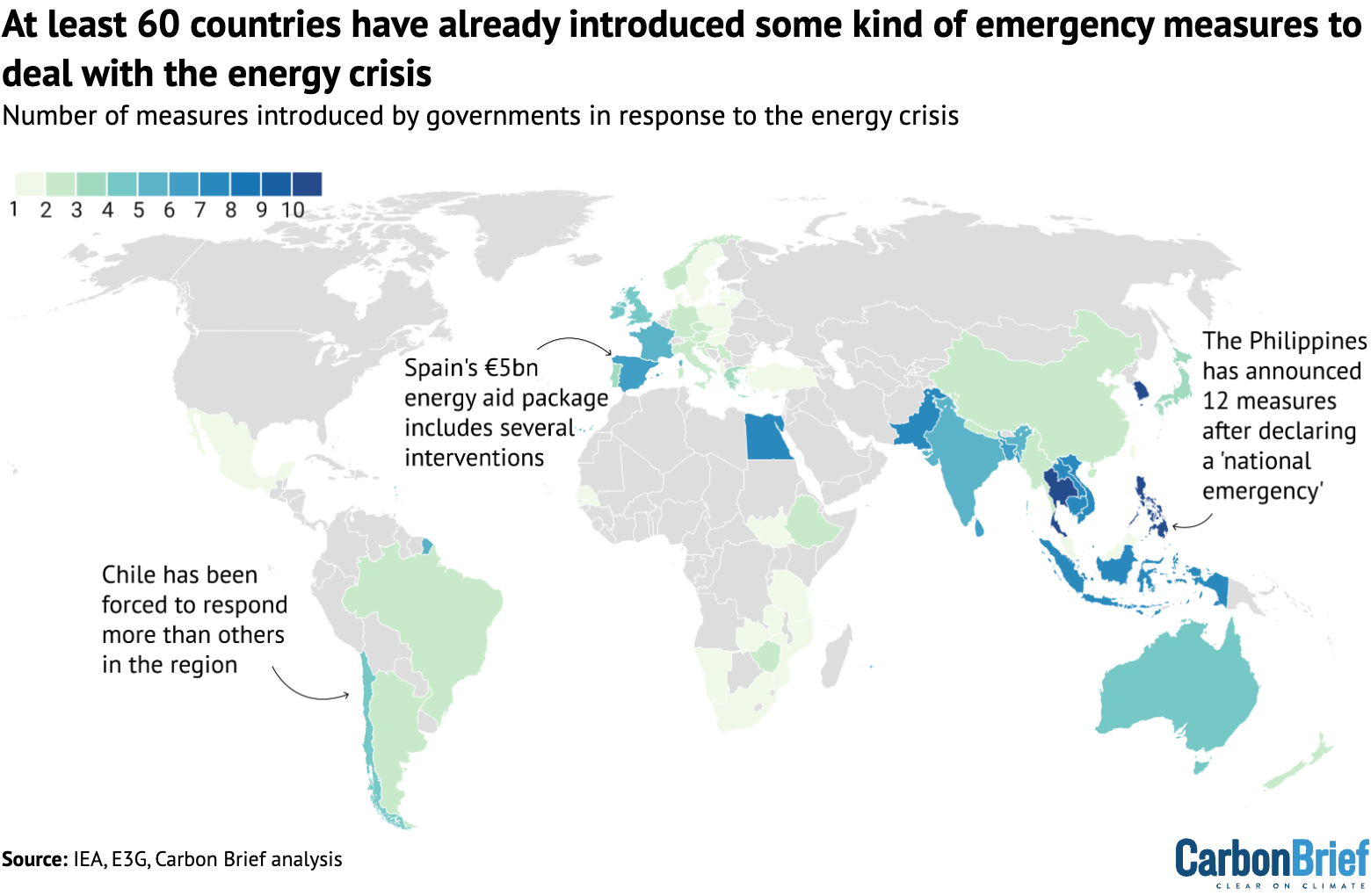
Nations including Indonesia, Japan, South Korea and India are already spending billions of dollars on fuel subsidies to protect people from rising costs.
At least 16 Asian countries are also taking drastic measures to reduce fuel consumption. For example, the Philippines has declared a “state of national emergency”, which includes limiting air conditioning in public buildings and subsidising public transport.
Other examples from the region include the government in Bangladesh asking the public and businesses to avoid unnecessary lighting, Pakistan reducing the speed limit on highways and Laos encouraging people to work from home.
Europe – which was hit hard by the 2022 energy crisis due to its reliance on Russian gas – is less immediately exposed to the current crisis than Asia. However, many nations are still heavily reliant on gas, including supplies from Qatar.
The continent is already feeling the effects of higher global energy prices as countries compete for more limited resources.
At least 18 European nations have introduced measures to help people with rising costs. Spain, which is relatively insulated from the crisis due to the high share of renewables in its electricity supply, nevertheless announced a €5bn aid package, with at least six measures to support consumers.
Many African countries, while also less reliant on direct fossil-fuel supplies via the Strait of Hormuz than Asia, are still facing the strain of higher import bills. Some, including Ethiopia, Kenya and Zambia, are also facing severe fuel shortages.
There have been fewer new policies across the Americas, which have been comparatively insulated from the energy crisis so far. One outlier is Chile, which is among the region’s biggest fuel importers and is, therefore, more exposed to global price increases.
Tax cuts
The most common types of policy response to the energy crisis so far have been efforts to protect people and businesses from the surge in fuel prices.
At least 28 nations, including Italy, Brazil and Australia, have introduced a total of 31 measures to cut taxes – and, therefore, prices – on fuel.
Even across Africa, where state revenues are already stretched, some nations – including Namibia and South Africa – are cutting fuel levies in a bid to stabilise prices.
Another 17 countries, including Mexico and Poland, have directly capped the price of fuel. Others, such as France and the UK, have opted for more targeted fuel subsidies, designed to support specific vulnerable groups and industries.
These measures are all shown in the dark blue “consumer support” bars in the chart below.
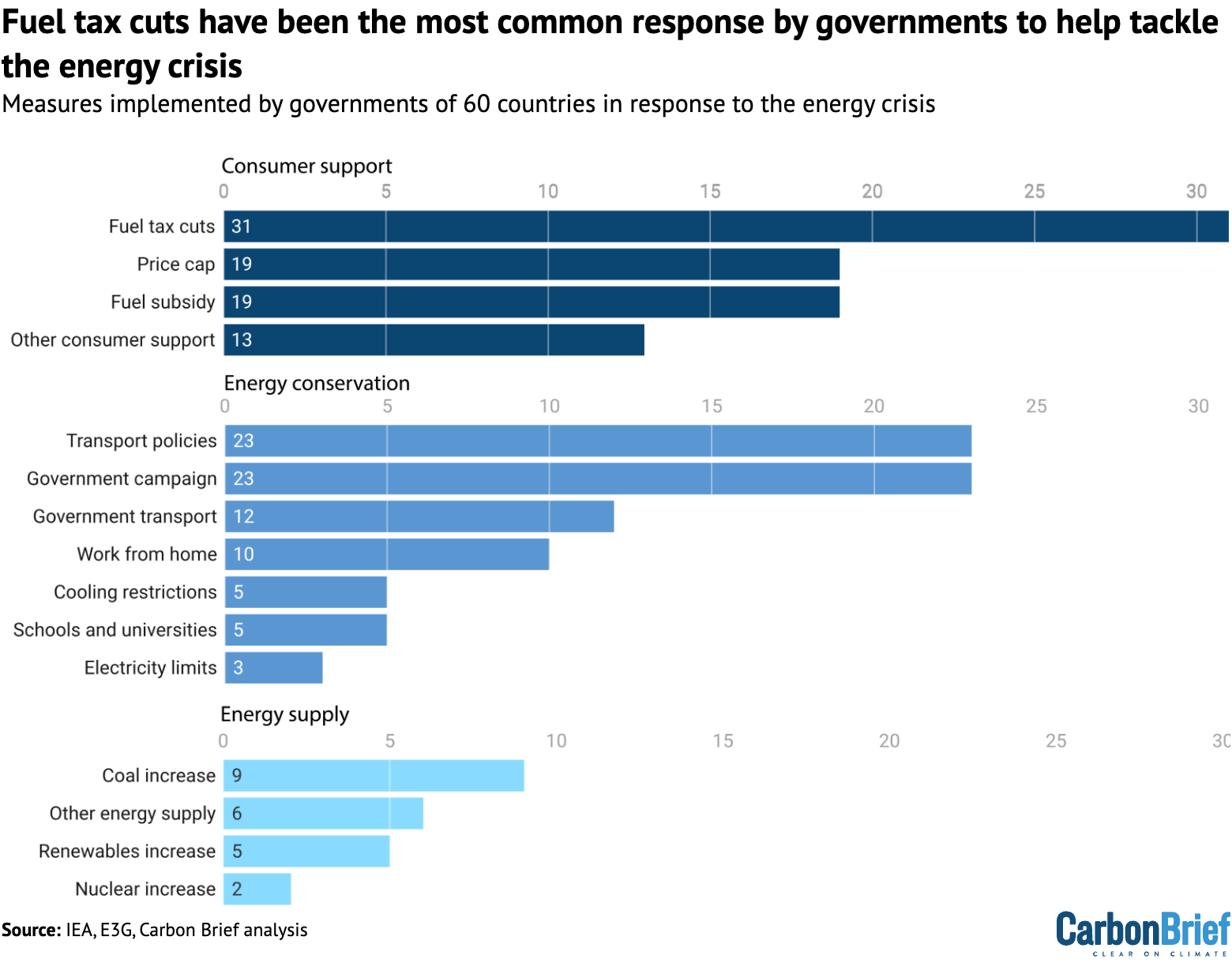
Such measures can directly help consumers, but some leaders, NGOs and financial experts have noted that there is also the risk of them driving inflation and reinforcing reliance on the existing fossil fuel-based system.
Christine Lagarde, president of the European Central Bank, spoke in favour of short-term measures to “smooth the shock”, but noted that “broad-based and open-ended measures may add excessively to demand”.
Measures to conserve energy, of the type that many developing countries in Asia have implemented extensively, have been described by the IEA as “more effective and fiscally sustainable than broad-based subsidies”.
So far, there have been at least 23 such measures introduced to limit the use of transport, particularly private cars.
These include Lithuania cutting train fares, two Australian states making public transport free and Myanmar and South Korea asking people to only drive their cars on certain days.
Clean vs coal
At least eight countries have announced plans to either increase their use of coal or review existing plans to transition away from coal, according to Carbon Brief’s analysis. These include Japan, South Korea, Bangladesh, the Philippines, Thailand, Pakistan, Germany and Italy.
These measures broadly involve delaying coal-plant closure, as in Italy, or allowing older sites to operate at higher rates, as in Japan – rather than building more coal plants.
There has been extensive coverage of how the energy crisis is “driving Asia back to coal”. However, as Bloomberg columnist David Fickling has noted, this shift is relatively small and likely to be offset by a move to cheap solar power in the longer term.
Indeed, some countries have begun to consider changes to the way they use energy going forward, amid a crisis driven by the spiralling costs of fossil-fuel imports.
Leaders in India, Barbados and the UK have explicitly stressed the importance of a structural shift to using clean power. Governments in France and the Philippines are among those linking new renewable-energy announcements with the unfolding crisis.
New renewable-energy capacity will take time to come online, albeit substantially less time than developing new fossil-fuel generation. In the meantime, some nations are also taking short-term measures to make their road transport less reliant on fossil fuels.
For example, the Chilean government has enabled taxi drivers to access preferential credit for purchasing electric vehicles (EVs). Cambodia has cut import taxes on EVs and Laos has lowered excise taxes on them.
Finally, there have been some signs that countries are reconsidering their future exposure to imported fossil fuels, given the current economics of oil and gas.
The New Zealand government has indicated that a plan to build a new LNG terminal by 2027 now faces uncertainty. Reuters reported that Vietnamese conglomerate Vingroup has told the government it wanted to abandon a plan to build a new LNG-fired power plant in Vietnam, in favour of renewables.


The post Iran war analysis: How 60 nations have responded to the global energy crisis appeared first on Carbon Brief.
Iran war analysis: How 60 nations have responded to the global energy crisis
Seven Senate Democrats launched the probe over controversial tax credits to the country’s largest exporter of liquefied natural gas.
Seven Democratic U.S. senators have launched a probe into a $370 million “alternative fuel” payout to Cheniere Energy, made earlier this year by the IRS, that critics say the liquefied natural gas export company never should have received.
US Senators Investigate $370 Million IRS Payout to Cheniere Energy



-
Climate Change8 months ago
Guest post: Why China is still building new coal – and when it might stop
-
Greenhouse Gases8 months ago
Guest post: Why China is still building new coal – and when it might stop
-

 Greenhouse Gases2 years ago
嘉宾来稿:满足中国增长的用电需求 光伏加储能“比新建煤电更实惠”
-
Climate Change2 years ago
Bill Discounting Climate Change in Florida’s Energy Policy Awaits DeSantis’ Approval
-

 Climate Change2 years ago
嘉宾来稿:满足中国增长的用电需求 光伏加储能“比新建煤电更实惠”
-
Climate Change Videos2 years ago
The toxic gas flares fuelling Nigeria’s climate change – BBC News
-

 Renewable Energy6 months ago
Sending Progressive Philanthropist George Soros to Prison?
-

 Carbon Footprint2 years ago
US SEC’s Climate Disclosure Rules Spur Renewed Interest in Carbon Credits