

China’s Third Plenum, an important five-yearly meeting traditionally associated with major economic reforms, concluded on 18 July in Beijing.
Observers have been eagerly anticipating signals from the meeting about the leadership’s plans for economic growth and wider development, including on climate action.
The official readout from the meeting of the Central Committee of the Chinese Communist Party calls on policymakers to pursue a range of relevant reforms.
These include a focus on “high-quality economic development” (高质量发展), as well as “supporting all-around innovation” (支持全面创新) and “deepening reform in ecological conservation systems” (深化生态文明体制改革), among other areas.
It also urges officials to “make concerted efforts to cut carbon emissions” and “actively respond to climate change”. This is the first time carbon emissions have been mentioned in a plenum document.
A key step to achieve this, it adds, is through “improving institutional mechanisms for developing new quality productive forces” (NQPF, 新质生产力).
Since its first appearance in official rhetoric in September last year, this term has featured in Chinese state media in numerous high-level policy documents and commentaries about industrial development and low-carbon growth.
According to Chinese president Xi Jinping, one important element of NQPF is “green development”, which he has described as the “base colour of high-quality development”. In comments made in January 2024, he added that “new quality productivity itself is green productivity” (新质生产力本身就是绿色生产力).
This encapsulates both the development of low-carbon technologies, such as electric vehicles (EVs), and the “green transformation” of the economy.
However, there is significant debate as to whether the concept, which can also be translated as “new productive forces” or “new quality productivity”, will result in concrete policy outcomes and support further development of industries critical to China’s energy transition.
In this article, Carbon Brief unpacks the concepts underpinning new quality productive forces, and what it means for China’s climate, energy and industrial policy.
- What does ‘new quality productive forces’ mean?
- How significant is this for low-carbon development?
- Why is the concept important?
- What does this mean for China’s low-carbon technology industries?
- What are the concerns over NQPF?
- Will NQPF translate into concrete climate policy?
What does ‘new quality productive forces’ mean?
The phrase was first mentioned by Xi during a visit to Heilongjiang province, located in the “rust belt” of northeast China, in 2023.
In January 2024, he further defined it as innovation-led development that creates “a break with traditional economic growth models and development pathways”, resulting in a “high level of technology, efficiency and quality” (高科技、高效能、高质量) as well as an “in-depth transformation and upgrading of industry” (产业深度转型升级).
This has led to a “ubiquitous” focus on innovation across official discussions about NQPF, according to the University of Cambridge-affiliated thinktank Cambridge Industrial Innovation Policy.
Unleashing this innovation, according to official interpretations, will lead to a cascade of changes across China’s industrial system – “both technological and institutional” – that will improve China’s advanced manufacturing capabilities.
Nevertheless, innovation and advanced technology are not the only focus. Analysis by the Council on Geostrategy says the framing of NQPF “suggests that, while scientific and technological innovation is essential, [China recognises there] needs also to be deeper reforms of the…economic model”.

Priority areas for reform include the market-based economy; state owned enterprises (SOE); and China’s fiscal, household registration and healthcare systems.
These economic reforms, driven both by “the government’s ‘visible hand’ and the market’s ‘invisible hand’”, are necessary for China’s continuous prosperity, according to the Xinhua Institute, a thinktank affiliated with state news agency Xinhua.
The institute links NQPF with Marxism, arguing this is in line with improving “means of production” – an important force in Marxist theory for production, reform and human development.
Most official explanations of the concept are relatively broad and unspecific. However, low-carbon development is one of the few named priorities.
How significant is this for low-carbon development?
NQPF will provide an “important support for green development”, according to a commentary in the Communist party-affiliated People’s Daily, which was reposted on the website of China’s National Energy Administration.
“Protecting the ecological environment is to protect productivity and improving the ecological environment is to develop productivity,” it adds.
Some analysis takes this further. Prof Zhang Yunfei, from the Marxism studies department at Renmin University in Beijing and researcher at its National Institute of Development and Strategy, tells the government-affiliated newspaper China Environment News that NQPF represents a development model specific to China.
This contrasts with “traditional productive forces in Western societies”, or “black productivity” (黑色生产力), which saw “high consumption of resources and energy, and high pollution of the ecological environment”, he says.
Instead, NQPF signifies “green productivity”, which will help China “shift from conforming to leading globalisation, and promote the country’s healthy and green development”.
“Green productivity”, Zhang adds, is sustainable productivity that focuses both on increasingly productive “ecologicalisation” (生态化) and increasingly ecological productive forces driving wider development.
These forces are fundamentally provided by and rooted in nature, he explains. Driving forces include “sustainable resources such as information”, a “new generation of workers” that understand the concept of ecological civilisation and an enhanced “level of sustainable development” based on “green science and technology”.
Why is the concept important?
This concept of NQPF is a holistic approach “designed to address complex, interrelated challenges faced by China and to create a more resilient and dynamic economy that will bring long-term prosperity”, Dr Muyi Yang, senior electricity policy analyst for China from the thinktank Ember, tells Carbon Brief.
Arthur Kroeber, founding partner and head of research at research firm Gavekal Dragonomics, tells Carbon Brief that NQPF is “the latest iteration of a long-running trend towards industrial policy, technology and intensive growth”.
This is “essentially a new bottle for old wine”, Kroeber adds. “I think what it does do is emphasise the point that there is a national mission” to build China into a technological superpower.
“It is a big deal”, Bill Bishop, author of the Sinocism newsletter, told Bloomberg, as Xi “putting a stamp” on the idea will “send a powerful signal” to stakeholders across the system.
The idea addresses specific anxieties facing China’s leadership. As well as supporting economic growth, some argue that strengthening the country’s ability to innovate provides China with a greater sense of security.

According to the Chinese Communist party’s leading theoretical journal Qiushi, for example, Xi believes that China is “still reliant on others for some core technologies…our industry is still not strong enough in spite of its size and falls short of excellence…and we face significant pressure in making the transition to green and low-carbon production modes”.
Prof Yao Yang, liberal arts chair professor at the China Center for Economic Research and the National School of Development at Peking University in Beijing, echoes this, writing in a comment for China Daily that the “significance” of the concept is the overarching aim of “laying a solid foundation for the future of the Chinese economy”.
Kroeber tells Carbon Brief that this is also driven, in part, by historical parallels between China’s fear of being cut off from US technological advancements and the rupture with the Soviet Union in the Mao era. He says:
“After the Sino-Soviet split, Soviet advisors who went [to China] to help build steel plants and develop the petrochemical industry, for example, all left. China was left [to develop its economy] on its own…Xi Jinping has drawn a specific connection [to that].”
What does this mean for China’s low-carbon technology industries?
A primary aim of NQPF is to expand “strategic emerging industries” and “nurture future industries”, Deng Zhou, associate research fellow at the Institute of Industrial Economics of the Chinese Academy of Social Sciences, writes in the state-run newspaper China Daily.
“Strategic industries” include “new energy”, “new energy vehicles” and “energy conservation and environmental protection”. Recent analysis for Carbon Brief found that “clean energy” sectors contributed 11.4tn yuan ($1.6tn) to China’s economy in 2023.
“Future industries”, according to a policy document issued in January, include nuclear energy, nuclear fusion, hydrogen, biomass, crystalline silicon solar cells, thin-film solar cells and new energy storage such as batteries, among other areas.
These are “implied to be the major sectoral targets” for the NQPF, according to Kroeber.
In his January speech, Xi said that successful deployment of NQPF requires “accelerating green science and technology innovation…promoting application of advanced green technology…strengthening the green manufacturing industry…growing the green energy industry…[and] developing green and low-carbon industrial and supply chains”.
Much of this will be driven by state-coordinated efforts. China Daily says that efforts to cultivate NQPF “will encourage its centrally administered state-owned enterprises [SOEs] to deploy more resources toward developing strategic emerging industries”.
Kroeber believes that this will lead to “national resources [being] mobilised through a ‘new national system’ (新型举国体制)”.
He tells Carbon Brief that the system is an attempt to “create better coordination mechanisms” between the central and local governments in order to better achieve policy goals, such as through research consortiums focused on technological innovations.
This is inspired by the success of China’s electric vehicle (EV) industry, which benefited both from significant state support and from the emergence of innovative and intensely competitive businesses.
Several commentaries and articles highlight EVs as a key example of NQPF working in practice.
Wang Yiming, vice chairman of the China Center for International Economic Exchanges and former vice minister of the Development Research Center of the State Council, wrote in the state-sponsored Guangming Daily that “the rapid development of China’s EVs is a vivid case of NQPF, formed by the deep transformation and upgrading of industry”.
Using innovation to foster leading expertise across different industries, China hopes, will allow the country to replicate its achievements in the EV sector in other industries.
For example, a blog post on Yuyuan Tantian, a WeChat account affiliated with state broadcaster CCTV, draws a link between China’s experience in manufacturing LCD televisions and its later success in developing solar technologies, which require similar manufacturing technologies and processes.
Prof Zhang tells China Environment News:
“New quality productive forces are not simply a process of transformation from old productivity to new productivity…It is a qualitative leap in productivity based on the achievements of the new round of scientific and technological revolution and industrial transformation, which is characterised by green, intelligent and ubiquitous (绿色、智能、泛在) trends.”
What are the concerns over NQPF?
China’s use of state resources to support strategically important industries, such as EVs, has recently fuelled anxieties about “overcapacity” in some countries.
Both the US and the EU have imposed tariffs on China-made EV imports. The EU’s tariff rate for individual automakers is based on the amount of state subsidies, including R&D grants, that the bloc determined those companies to have received.
There are also concerns around overcapacity domestically. A March Reuters article quoted an anonymous Chinese policy adviser saying: “The direction of promoting tech innovation is right, but my worry is how to achieve it – what path and what institutional mechanisms should we rely on?”
To a point, these concerns are also shared by the leadership. In an article translated by the Pekingology newsletter, Han Wenxiu, a top economic policy planner, cautioned against “campaign-style” implementation of NQPF policies that lead to “neglecting or abandoning traditional industries”, as well as “blind conformity and bubbles”.
Some analysts have linked NQPF to a broader push for faster economic growth and challenges tackling “deep-seated difficulties” in economic reform, which has led to a “lack of more radical action on consumption”.
Michael Pettis, senior fellow at the Carnegie Endowment, is quoted by the Financial Times saying that “the exit strategy has to be, at the end of the day, consumption – there’s no point producing all this stuff if no one’s going to buy it”.
But given current tensions with the US, Kroeber tells Carbon Brief, China “can’t rely on imports of technology in the same way…It must have an all-of-nation effort to develop its own alternatives for the technologies it used to import.”

In his view, efforts to foster NQPF “could” lead to the creation of more capacity – although he finds concerns around overcapacity to be overly “politicised”.
He says that any spikes in capacity may be “unintentional” as “the Europeans and Chinese are actually starting discussions on [resolving concerns around] EVs”.
Yang tells Carbon Brief that “innovative technologies are often not commercially viable and struggle to compete with mature technologies in the market”, highlighting the need for government support to make the EV industry viable. He adds:
“The world needs to achieve rapid and deep decarbonisation within a very short timeframe. The market often drives incremental change. But what is required now is more radical, fundamental change.”
Will NQPF translate into concrete climate policy?
At a press conference on 24 June, the Ministry of Ecology and Environment (MEE) announced that it will release a ‘1+N’ policy on NQPF, which will “promote the accelerated development of NQPF” and “thicken” the “green-ness” of high-quality development (厚植高质量发展的绿色底色).
This followed an article in Qiushi by MEE minister Huang Runqiu and party secretary Sun Jinlong, who wrote that “ecology is itself the economy – if you protect ecology, ecology will give you returns”.
The ‘1+N’ framework is well-established in Chinese environmental policymaking, forming the basis for China’s climate policy.
It refers to “1” policy setting overarching objectives, which guides numerous (“N”) action plans and policy measures that include more concrete targets.
The MEE said that NQPF “can help promote the significant decline of pollutants and carbon emissions, and radically improve the quality of the ecological environment”.

On 11 July, it released one of the first “N” policies in the system – regulations to update “management of ecological environment zoning control”.
Analysis by consulting firm Trivium China questions whether this “will directly contribute” to development of NQPF, but adds that it could signal the MEE “leveraging” the concept to “push through reforms that might otherwise be stymied” by other stakeholders.
Meanwhile, the Ministry of Science and Technology (MOST) announced on 17 July that it will establish a centre for promoting NQPF. This may improve MOST’s “autonomy” in policy planning for science and technology innovation, an analyst told finance newspaper 21st Century Business Herald.
Kroeber says that “every document the government comes out with now has to have some reference to NQPF. It’s just a way for bureaucrats to say ‘we have heard the signal [from Beijing] and we are pursuing [those goals]’”.
He adds that one area in which China may issue more concrete policies is power market reform.
China has been trying to “introduce more competition” into its power market to address a range of challenges inherent to the old grid system, including increasing the share of renewable power in overall power generation.
It is “an area where this idea of coordination and the state playing a more leading role in getting everyone to move together” is crucial, Kroeber says, given the importance of access to abundant, low-cost electricity to power development of more technology.
Seeing further progress “would be the litmus test of whether the government is pursuing its aims [around NQPF] in an effective way”, he adds.
However, Yang tells Carbon Brief that while NQPF “has theoretical underpinnings, it is far from being purely conceptual”.
He says: “I believe more actions in various sectors will come soon to translate it into concrete initiatives and programs.”


The post Q&A: What China’s push for ‘new quality productive forces’ means for climate action appeared first on Carbon Brief.
Q&A: What China’s push for ‘new quality productive forces’ means for climate action

With the U.S. bombing Iran and the Strait of Hormuz closed, energy experts say countries transitioning to renewables will be more resilient in the “face of the shock.”
The United States’ war on Iran could fundamentally alter how countries consume and generate energy and hamper international progress in combating climate change, a panel of energy experts said today.
The Global Energy Supply in a Decade ‘Is Not a World We’re Going to Recognize’
One month into the US and Israel’s war on Iran, at least 60 countries have taken emergency measures in response to the subsequent global energy crisis, according to analysis by Carbon Brief.
So far, these countries have announced nearly 200 policies to save fuel, support consumers and boost domestic energy supplies.
Carbon Brief has drawn on tracking by the International Energy Agency (IEA) and other sources to assess the global policy response, just as a temporary ceasefire is declared.
Since the start of the war in late February, both sides have bombed vital energy infrastructure across the region as Iran has blocked the Strait of Hormuz – a key waterway through which around a fifth of global oil and liquified natural gas (LNG) trade passes.
This has made it impossible to export the usual volumes of fossil fuels from the region and, as a result, sent prices soaring.
Around 30 nations, from Norway to Zambia, have cut fuel taxes to help people struggling with rising costs, making this by far the most common domestic policy response to the crisis.
Some countries have stressed the need to boost domestic renewable-energy construction, while others – including Japan, Italy and South Korea – have opted to lean more on coal, at least in the short term.
The most wide-ranging responses have been in Asia, where countries that rely heavily on fossil fuels from the Middle East have implemented driving bans, fuel rationing and school closures in order to reduce demand.
‘Largest disruption’
On 28 February, the US and Israel launched a surprise attack on Iran, triggering conflict across the Middle East and sending shockwaves around the world.
There have been numerous assaults on energy infrastructure, including an Iranian attack on the world’s largest LNG facility in Qatar and an Israeli bombing of Iran’s gas sites.
Iran’s blockade of the Strait of Hormuz, a chokepoint in the Persian Gulf, is causing what the IEA has called the “largest supply disruption in the history of the global oil market”.
A fifth of the world’s oil and LNG is normally shipped through this region, with 90% of those supplies going to destinations in Asia. Without these supplies, fuel prices have surged.
Governments around the world have taken emergency actions in response to this new energy crisis, shielding their citizens from price spikes, conserving energy where possible and considering longer-term energy policies.
Even with a two-week ceasefire announced, the energy crisis is expected to continue, given the extensive damage to infrastructure and continuing uncertainties.
Asian crunch
Carbon Brief has used tracking by the IEA, news reports, government announcements and internal monitoring by the thinktank E3G to assess the range of national responses to the energy crisis roughly one month into the Iran war.
In total, Carbon Brief has identified 185 relevant policies, announcements and campaigns from 60 national governments.
As the map below shows, these measures are concentrated in east and south Asia. These regions are facing the most extreme disruption, largely due to their reliance on oil and gas supplies from the Middle East.
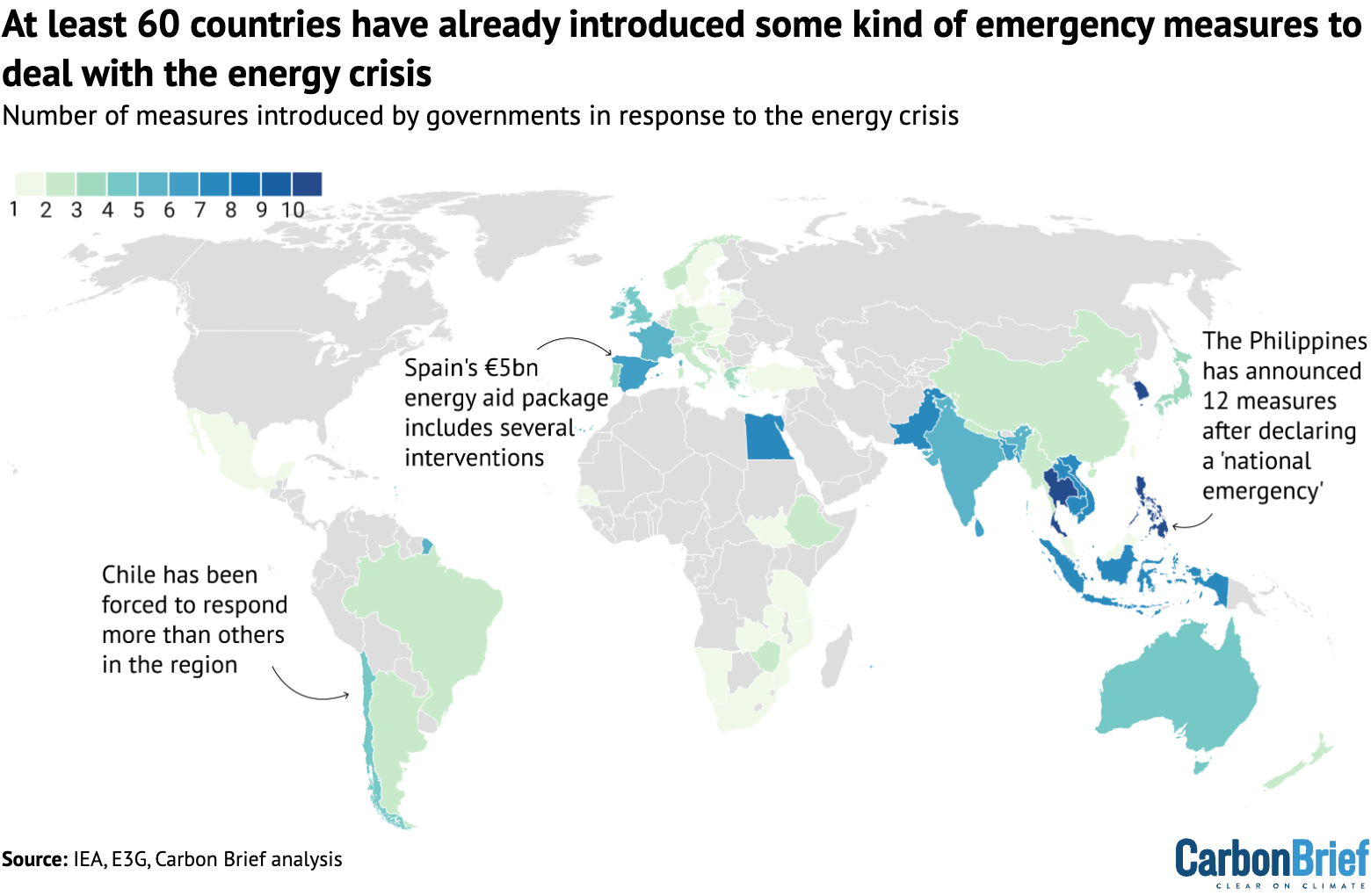
Nations including Indonesia, Japan, South Korea and India are already spending billions of dollars on fuel subsidies to protect people from rising costs.
At least 16 Asian countries are also taking drastic measures to reduce fuel consumption. For example, the Philippines has declared a “state of national emergency”, which includes limiting air conditioning in public buildings and subsidising public transport.
Other examples from the region include the government in Bangladesh asking the public and businesses to avoid unnecessary lighting, Pakistan reducing the speed limit on highways and Laos encouraging people to work from home.
Europe – which was hit hard by the 2022 energy crisis due to its reliance on Russian gas – is less immediately exposed to the current crisis than Asia. However, many nations are still heavily reliant on gas, including supplies from Qatar.
The continent is already feeling the effects of higher global energy prices as countries compete for more limited resources.
At least 18 European nations have introduced measures to help people with rising costs. Spain, which is relatively insulated from the crisis due to the high share of renewables in its electricity supply, nevertheless announced a €5bn aid package, with at least six measures to support consumers.
Many African countries, while also less reliant on direct fossil-fuel supplies via the Strait of Hormuz than Asia, are still facing the strain of higher import bills. Some, including Ethiopia, Kenya and Zambia, are also facing severe fuel shortages.
There have been fewer new policies across the Americas, which have been comparatively insulated from the energy crisis so far. One outlier is Chile, which is among the region’s biggest fuel importers and is, therefore, more exposed to global price increases.
Tax cuts
The most common types of policy response to the energy crisis so far have been efforts to protect people and businesses from the surge in fuel prices.
At least 28 nations, including Italy, Brazil and Australia, have introduced a total of 31 measures to cut taxes – and, therefore, prices – on fuel.
Even across Africa, where state revenues are already stretched, some nations – including Namibia and South Africa – are cutting fuel levies in a bid to stabilise prices.
Another 17 countries, including Mexico and Poland, have directly capped the price of fuel. Others, such as France and the UK, have opted for more targeted fuel subsidies, designed to support specific vulnerable groups and industries.
These measures are all shown in the dark blue “consumer support” bars in the chart below.
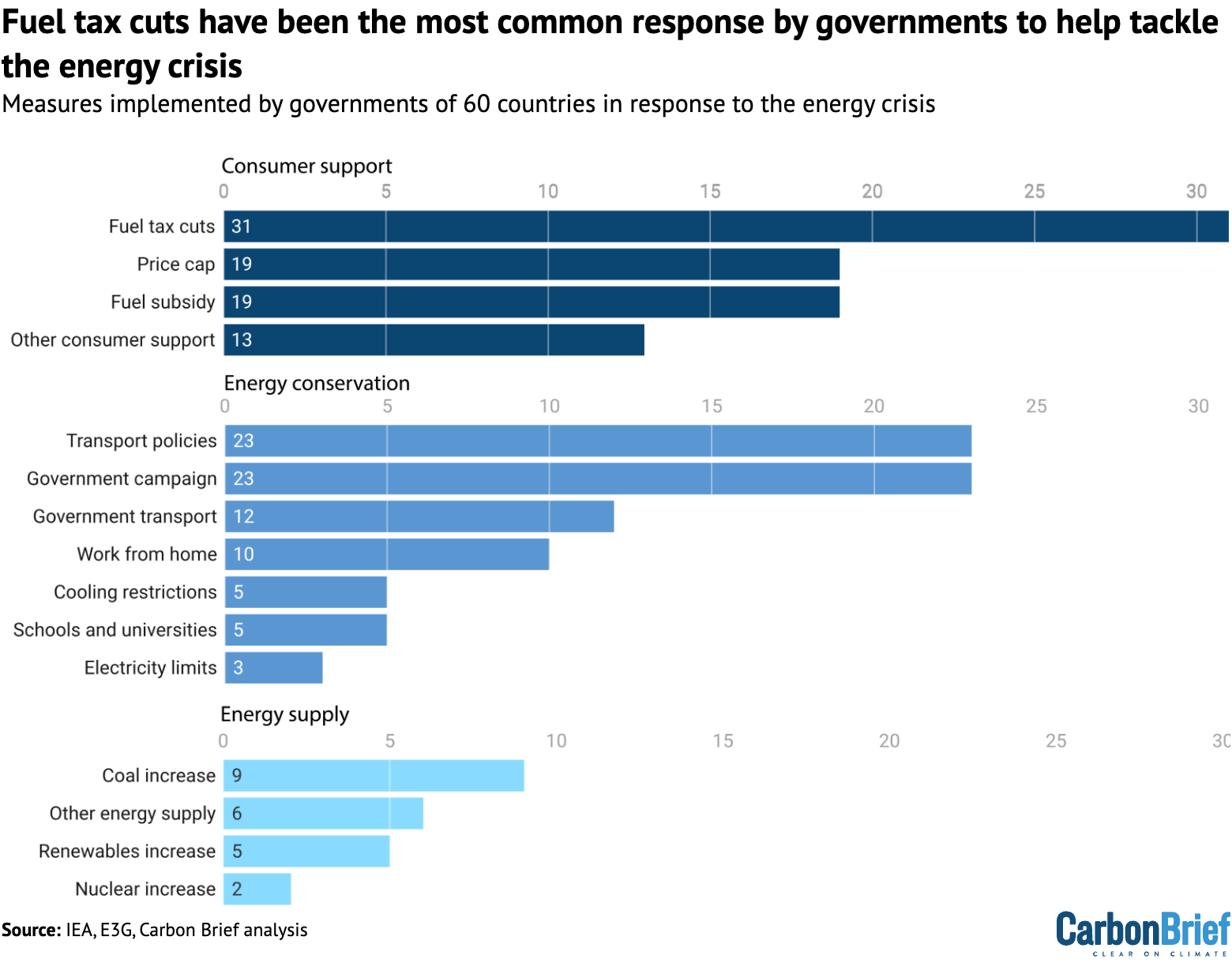
Such measures can directly help consumers, but some leaders, NGOs and financial experts have noted that there is also the risk of them driving inflation and reinforcing reliance on the existing fossil fuel-based system.
Christine Lagarde, president of the European Central Bank, spoke in favour of short-term measures to “smooth the shock”, but noted that “broad-based and open-ended measures may add excessively to demand”.
Measures to conserve energy, of the type that many developing countries in Asia have implemented extensively, have been described by the IEA as “more effective and fiscally sustainable than broad-based subsidies”.
So far, there have been at least 23 such measures introduced to limit the use of transport, particularly private cars.
These include Lithuania cutting train fares, two Australian states making public transport free and Myanmar and South Korea asking people to only drive their cars on certain days.
Clean vs coal
At least eight countries have announced plans to either increase their use of coal or review existing plans to transition away from coal, according to Carbon Brief’s analysis. These include Japan, South Korea, Bangladesh, the Philippines, Thailand, Pakistan, Germany and Italy.
These measures broadly involve delaying coal-plant closure, as in Italy, or allowing older sites to operate at higher rates, as in Japan – rather than building more coal plants.
There has been extensive coverage of how the energy crisis is “driving Asia back to coal”. However, as Bloomberg columnist David Fickling has noted, this shift is relatively small and likely to be offset by a move to cheap solar power in the longer term.
Indeed, some countries have begun to consider changes to the way they use energy going forward, amid a crisis driven by the spiralling costs of fossil-fuel imports.
Leaders in India, Barbados and the UK have explicitly stressed the importance of a structural shift to using clean power. Governments in France and the Philippines are among those linking new renewable-energy announcements with the unfolding crisis.
New renewable-energy capacity will take time to come online, albeit substantially less time than developing new fossil-fuel generation. In the meantime, some nations are also taking short-term measures to make their road transport less reliant on fossil fuels.
For example, the Chilean government has enabled taxi drivers to access preferential credit for purchasing electric vehicles (EVs). Cambodia has cut import taxes on EVs and Laos has lowered excise taxes on them.
Finally, there have been some signs that countries are reconsidering their future exposure to imported fossil fuels, given the current economics of oil and gas.
The New Zealand government has indicated that a plan to build a new LNG terminal by 2027 now faces uncertainty. Reuters reported that Vietnamese conglomerate Vingroup has told the government it wanted to abandon a plan to build a new LNG-fired power plant in Vietnam, in favour of renewables.

The post Iran war analysis: How 60 nations have responded to the global energy crisis appeared first on Carbon Brief.
Iran war analysis: How 60 nations have responded to the global energy crisis
Seven Senate Democrats launched the probe over controversial tax credits to the country’s largest exporter of liquefied natural gas.
Seven Democratic U.S. senators have launched a probe into a $370 million “alternative fuel” payout to Cheniere Energy, made earlier this year by the IRS, that critics say the liquefied natural gas export company never should have received.
US Senators Investigate $370 Million IRS Payout to Cheniere Energy

Boeing Locks in 40,000 Tons of Soil Carbon Removal with Texas-Based Grassroots Carbon
Tesla Reclaims EV Sales Crown from BYD in Q1 2026, Heating Up the EV Race
The Global Energy Supply in a Decade ‘Is Not a World We’re Going to Recognize’
-
Climate Change8 months ago
Guest post: Why China is still building new coal – and when it might stop
-
Greenhouse Gases8 months ago
Guest post: Why China is still building new coal – and when it might stop
-

 Greenhouse Gases2 years ago
嘉宾来稿:满足中国增长的用电需求 光伏加储能“比新建煤电更实惠”
-
Climate Change2 years ago
Bill Discounting Climate Change in Florida’s Energy Policy Awaits DeSantis’ Approval
-

 Climate Change2 years ago
嘉宾来稿:满足中国增长的用电需求 光伏加储能“比新建煤电更实惠”
-
Climate Change Videos2 years ago
The toxic gas flares fuelling Nigeria’s climate change – BBC News
-

 Renewable Energy6 months ago
Sending Progressive Philanthropist George Soros to Prison?
-

 Carbon Footprint2 years ago
US SEC’s Climate Disclosure Rules Spur Renewed Interest in Carbon Credits