

Governments have made progress on how a new global climate finance goal should be structured – but big gaps remain on who should pay out and how large the goal should be, negotiators chairing United Nations talks said on Wednesday.
Ministers gathered in Azerbaijan’s capital Baku to discuss a new post-2025 goal for finance to help developing countries tackle climate change. A deal is due to be reached by the end of the COP29 climate summit in Baku in late November.
At the start of Wednesday’s talks, Azerbaijan’s COP29 President Mukhtar Babayev said he had seen “positive signs that there may be growing convergence on the structure of the goal”.
Zaheer Fakir, a negotiator co-chairing the UN talks on the goal, added that “parties remain apart on some of the core issues” but “substantial progress has been made” on how the goal is structured.
The other co-chair, Australian Fiona Gilbert, said “many agree” that the goal should include both the provision of public climate finance to developing countries and the mobilisation of private finance – either as a single number or as two separate numbers.
Some governments, Gilbert said, want the smaller public finance – or “core” – goal to be complemented by an additional broader goal consisting of either total investment flows to developing countries or global investment flows for climate action in all countries.
Some countries, she said, want more specific sub-goals – for example, that a certain amount of money should go towards helping developing countries adapt to more extreme weather and rising seas.
The structure of the New Collective Quantified Goal (NCQG) will not be conclusively agreed until all aspects of the goal are settled at COP29 – and some resistance remains to this proposed structure. China’s negotiator today called it “overly complex”, and criticised its reliance on the private sector.
Ambitious or realistic?
Developed and developing countries also remain split on the size of the goal and which countries should contribute.
Developing countries said on Wednesday the goal should be large enough to help meet their climate action needs and have proposed figures of between one and two trillion dollars a year.
But wealthy nations have not proposed any figures, other than saying – as already specified in the Paris Agreement – that it should be at least as large as the previous goal of $100 billion a year, which they only met two years after the target year of 2020.
US climate envoy John Podesta said in Baku that the “inner layer” of the target, meaning the public finance element, should be “ambitious and stretch parties as the $100 billion goal did- but it also has to be realistically achievable”.
He said the overall amount of finance required would be “well above $1 trillion”, adding that this should include “the outer layer” of the goal, which would consist of private, philanthropic and domestic finance provided in all countries, as well as international public finance.
Switzerland’s negotiator said “ambition does not only refer to a number – ambition also means that a goal is achievable if we collectively try our best to get there and to that end, we have to take political and economic realities into account.”
He added that an “unrealistic” goal “makes it much harder to convince finance ministries, development agencies and other actors to make all the efforts to contribute a maximum to achieve it” and warned that a failure to achieve the goal would risk breaking trust in the UN climate system.
New study blows hole in “transition fuel” claim of fossil gas backers
On the other hand, the Philippines’ negotiator said the NCQG should be at least $1.3 trillion and “must be significantly supported by public finance”. “Only in this manner can we fill in the glaring financing gaps in climate action and address the challenges that disproportionately affect us,” she added.
China’s negotiator said that developed countries “must state the quantum they are willing to put on the table”.
Who should pay?
The United Nations climate convention (UNFCCC) currently groups countries into two broad camps: developed countries that are obliged to provide climate finance and developing countries that are entitled to receive it.
Developed nations like the US, UK, Japan and EU member states argue that this classification – drawn up in 1992 – is out of date as the global economy has shifted. Some developing countries like Saudi Arabia and China have become much wealthier and emit far more greenhouse gases than back then, they note.
Japan’s negotiator said an ambitious NCQG “is not achievable by the official financial resources of developed countries only”.
Switzerland’s negotiator said it would help developed countries’ environment and climate ministers to convince their finance ministries and parliaments to contribute more if they could say “we have all hands on deck – everyone’s contributing”.
Greenpeace Africa in disarray as restructuring meets resistance
But no developing countries expressed support for efforts to expand the official pool of climate finance contributors and several, particularly those targeted, expressed strong opposition to it.
China’s negotiator said: “We need to stick to what we have already agreed”, adding that “any attempts to change the rules or increase the obligations on developing countries is not in line with” the Paris Agreement or the UNFCCC.
Statements by the Arab Group and Singapore agreed with China that the list of government contributors should not be expanded.
Paris Agreement ‘sets up’ layers
Germany’s climate envoy Jennifer Morgan tried to reassure those nations, saying that “this is not about changing the status of any country” under the UN climate system and “one can be contributing and receiving at the same time”.
Brazil’s National Secretary for Climate Change Ana Toni noted that Article 9 of the Paris Agreement already states that developed countries “shall” provide climate finance, encourages developing countries to do the same “voluntarily”, and obliges developed countries to “take the lead in mobilising climate finance”. “There we have three layers already set up for us,” she said.
Commenting on the ministerial meeting in Baku, Teresa Anderson, ActionAid International’s global lead on climate justice, said talk by developed countries of a “multilayered approach” to climate finance “is code for their efforts to count loans and private investments towards the new climate finance goal”.
“If they could, rich countries would probably like to count the sun, the moon, and grandpa’s old socks as climate finance too,” she added in a statement, calling on them instead to provide “trillions of dollars in much-needed grants”.
(Reporting by Joe Lo; editing by Megan Rowling)
The post Progress on structure for new global climate finance goal but trickier divides persist appeared first on Climate Home News.
Progress on structure for new global climate finance goal but trickier divides persist

Energy bills in the UK have continued to soar in 2026, with intense debate raging about how to bring them down.
In October 2026, the cap on household energy bills reached its highest level in three years, rising by £60 amid high gas prices driven by the Iran war.
The cap is forecast to jump by as much as another quarter in January 2027, pushing annual energy bills towards £2,200.
Energy bills have not been that high since 2022 when, in the fallout of the Russian invasion of Ukraine, the UK government spent more than £60bn on supporting consumers through the crisis.
While expensive gas is behind the lion’s share of the rise in bills since 2020, policy costs and investment in the gas and electricity grids are also putting some pressure on prices.
This has sparked conflicting calls to continue the clean-energy transition to get off the “fossil-fuel rollercoaster”, to move more slowly – or to abandon climate goals in favour of more gas.
Below, Carbon Brief looks at the real drivers of high energy bills in the UK, what has been done to address them to date and what options are available to cut them going forward.
These include taking more policy costs off electricity bills, boosting flexibility or shifting to more efficient technologies with lower running costs, such as heat pumps and electric vehicles (EVs).
What is driving high energy bills?
In October 2026, UK household energy bills reached their highest levels since 2022, with the price cap for typical homes hitting £1,723 per year, up 47% in real terms since October 2020.
Industrial energy users also face high costs, particularly for their electricity.
For households, another sharp increase is now all but guaranteed under the price cap for January 2027, which is forecast to rise by around 25% from current levels.
Wholesale costs for electricity and gas make up 44% of the current cap of £1,723 per year, according to Carbon Brief analysis of figures from thinktank Nesta, shown in the figure below.
The wholesale cost of both electricity and gas is tied to gas prices, due to the marginal pricing system used in power markets in the UK and most other countries.
Network charges make up a further 24% of bills and operating costs are another 17%, whereas policy costs only account for 7% of the total.
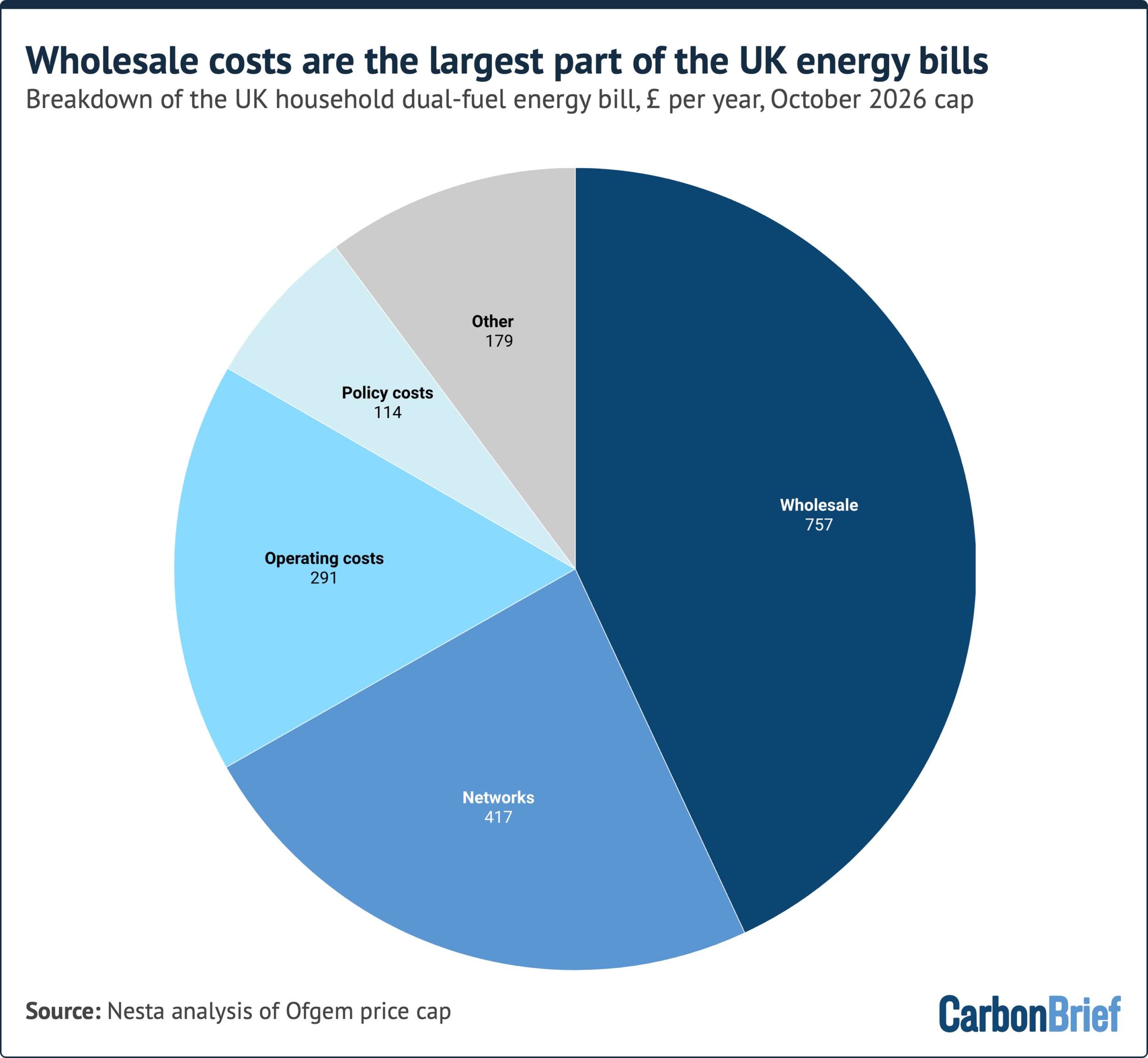
There has been increasing interest in the so-called “non-commodity costs” – those not related to wholesale energy – that now make up a significant portion of bills, as shown in the figure above.
Yet while these costs have been increasing – particularly those related to investing in energy networks – they are not the reason why energy bills have soared once again in recent months.
Indeed, Nesta analysis recently published by Carbon Brief shows that, contrary to widespread UK media and political narratives, a surge in wholesale costs driven by expensive gas is responsible for more than 80% of the rise in dual-fuel household energy bills since 2020, as shown below.
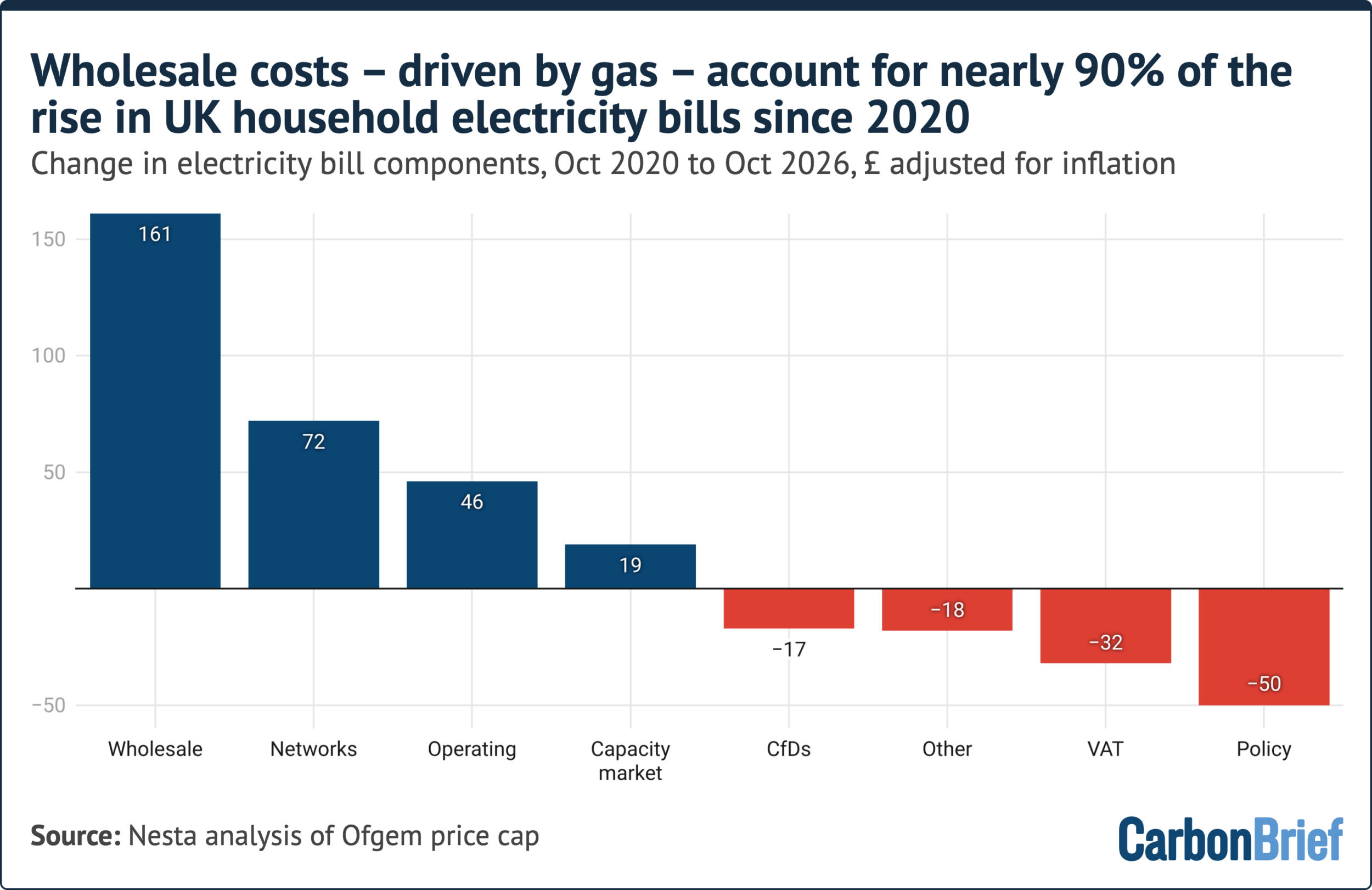
The second-largest driver of the rise in costs since 2020 is due to the cost of operating, maintaining and expanding gas and electricity networks, as shown in the figure above.
At the end of 2025, energy regulator Ofgem approved £29bn of upfront investment into the national gas and electricity grids, as well as the gas distribution network that connects to homes and businesses. This is part of a wider package of up to around £90bn of investment out to 2031.
As a result of these investment plans, network charges are expected to increase by around 50% between 2025 and 2030, from £222 a year to £330 for a typical dual-fuel household.
(This figure covers gas and electricity transmission and gas distribution, but not electricity distribution. A further package of increased investment in the electricity distribution network, for the period from 2028-2033, is due to be approved by Ofgem by the end of 2027.)
The increase in network costs is often attributed to the need to connect increasing levels of geographically dispersed renewable energy sources, particularly wind power.
However, a significant proportion of these increases relate to the need to update ageing infrastructure after decades of under-investment.
This package of investment represents a “once-in-a-generation renewal of our energy infrastructure”, Ofgem head Tim Jarvis told a recent conference attended by Carbon Brief.
Ofgem says some three-fifths of the £108 per household per year rise in network charges to 2030 is due to “business-as-usual” costs such as ongoing maintenance of the gas and electricity networks. It says only £30 is due to investing in expanding the electricity transmission grid.
Similarly, according to the Energy Networks Association, up to 80% of the investment in electricity grids is required to maintain existing assets, with the remainder going towards expansion.
Another point of contention is “constraint costs”, where windfarms are switched off if the network lacks the capacity to transmit their power – and gas plants are switched on to meet demand.
These costs sit within network balancing charges and – despite rising steeply in recent years, partly due to high gas prices – these still make up just £35, or 4% of typical annual electricity bills.
Today, rising constraint costs are partly a reflection of the decision in the 2010s to postpone network investments under a policy known as “connect and manage”. Ofgem says the investments it has now approved in the electricity grid would help limit constraints in the future.
Trade association RenewableUK’s head of policy Steven Agnew points to a recent review by the National Audit Office and says investment in the grid is “critical to avoid large rises in consumers’ bills as more of the country’s electricity is generated from clean sources”. He adds:
“The current crunch is the result of inaction by successive previous governments to tackle this issue. Consumers are losing out on some of the benefits because low-cost wind has to be turned down and expensive gas turned up elsewhere.”
Projections from the National Energy System Operator (Neso) illustrate how constraint costs depend on the relative pace of expansion in new generating capacity and the electricity network.
It says balancing costs could rise from £2bn to £8bn by 2030, if the grid faces delays. However, its central projection is £3-4bn, with a range of