

Hello! My Name is Athena Geer, and I am the Youth Climate Justice Coordinator here at Climate Generation. When I started this job in July 2023, I was overwhelmed with the much-anticipated joy of being a Youth Coordinator and also a coordinator of a program I used to be a part of as a young person.

I joined Youth Environmental Activists! (YEA!) six years ago as a sophomore in high school. Elated with excitement and steeped in teenage angst, I waltzed into my first network meeting not knowing how much it would change me as a young person but also about how it shaped me as a young adult. YEA! was a place for me to not only advocate climate change and its physical impacts on the world but also to talk about all of the interacting injustices that caused the systemic climate inaction we see today.

Working on climate legislation like the Climate Justice Education Bill and events like the Youth Climate Justice Summit where students come to delve into workshops catered to the work that’s happening around us and in our communities was life-changing. These were the places where it felt like I had choice and agency on how to enact this crucial work, and they also made me feel empowered and resilient in that work as well.
All of us at Climate Generation believe that, first and foremost, we want to ignite and sustain practices to fight systems perpetuating the climate crisis. For three and a half years I learned multiple different modalities for fighting for climate justice and liberation, and it was an amazing experience to have as a young person. Now I get to work here in a full circle moment as an alumni, and I’m excited to carry those intentions past and present into this upcoming school year.

We are just now wrapping up and finishing our programmatic arcs for the year. We are excited to talk and learn with our students about Climate Justice 101, Fast fashion human migration, and storytelling. Having our students be able to participate in these curriculum arcs this year and fostering leadership skills while giving them 1:1 mentorship will be the highlight of my year. I’m so honored to work with this new generation of activists and we are over on the YEA! Instagram will share all the content we are learning.
To a new school year,

Athena Geer is a Somali-American who grew up in the Cedar-Riverside/Phillips neighborhood. Athena came to YEA! 6 years ago and learned about the framework of climate justice, the importance of climate literacy, and the concept of youth agency. Athena hopes to give and aspire youth to take hands on their climate journey and that they are there to support them in that. Athena enjoys journaling, songwriting, and playing with their purfect roommate, Leona the kitten.
The post A Story About a YEA! Alum appeared first on Climate Generation.

Energy bills in the UK have continued to soar in 2026, with intense debate raging about how to bring them down.
In October 2026, the cap on household energy bills reached its highest level in three years, rising by £60 amid high gas prices driven by the Iran war.
The cap is forecast to jump by as much as another quarter in January 2027, pushing annual energy bills towards £2,200.
Energy bills have not been that high since 2022 when, in the fallout of the Russian invasion of Ukraine, the UK government spent more than £60bn on supporting consumers through the crisis.
While expensive gas is behind the lion’s share of the rise in bills since 2020, policy costs and investment in the gas and electricity grids are also putting some pressure on prices.
This has sparked conflicting calls to continue the clean-energy transition to get off the “fossil-fuel rollercoaster”, to move more slowly – or to abandon climate goals in favour of more gas.
Below, Carbon Brief looks at the real drivers of high energy bills in the UK, what has been done to address them to date and what options are available to cut them going forward.
These include taking more policy costs off electricity bills, boosting flexibility or shifting to more efficient technologies with lower running costs, such as heat pumps and electric vehicles (EVs).
What is driving high energy bills?
In October 2026, UK household energy bills reached their highest levels since 2022, with the price cap for typical homes hitting £1,723 per year, up 47% in real terms since October 2020.
Industrial energy users also face high costs, particularly for their electricity.
For households, another sharp increase is now all but guaranteed under the price cap for January 2027, which is forecast to rise by around 25% from current levels.
Wholesale costs for electricity and gas make up 44% of the current cap of £1,723 per year, according to Carbon Brief analysis of figures from thinktank Nesta, shown in the figure below.
The wholesale cost of both electricity and gas is tied to gas prices, due to the marginal pricing system used in power markets in the UK and most other countries.
Network charges make up a further 24% of bills and operating costs are another 17%, whereas policy costs only account for 7% of the total.
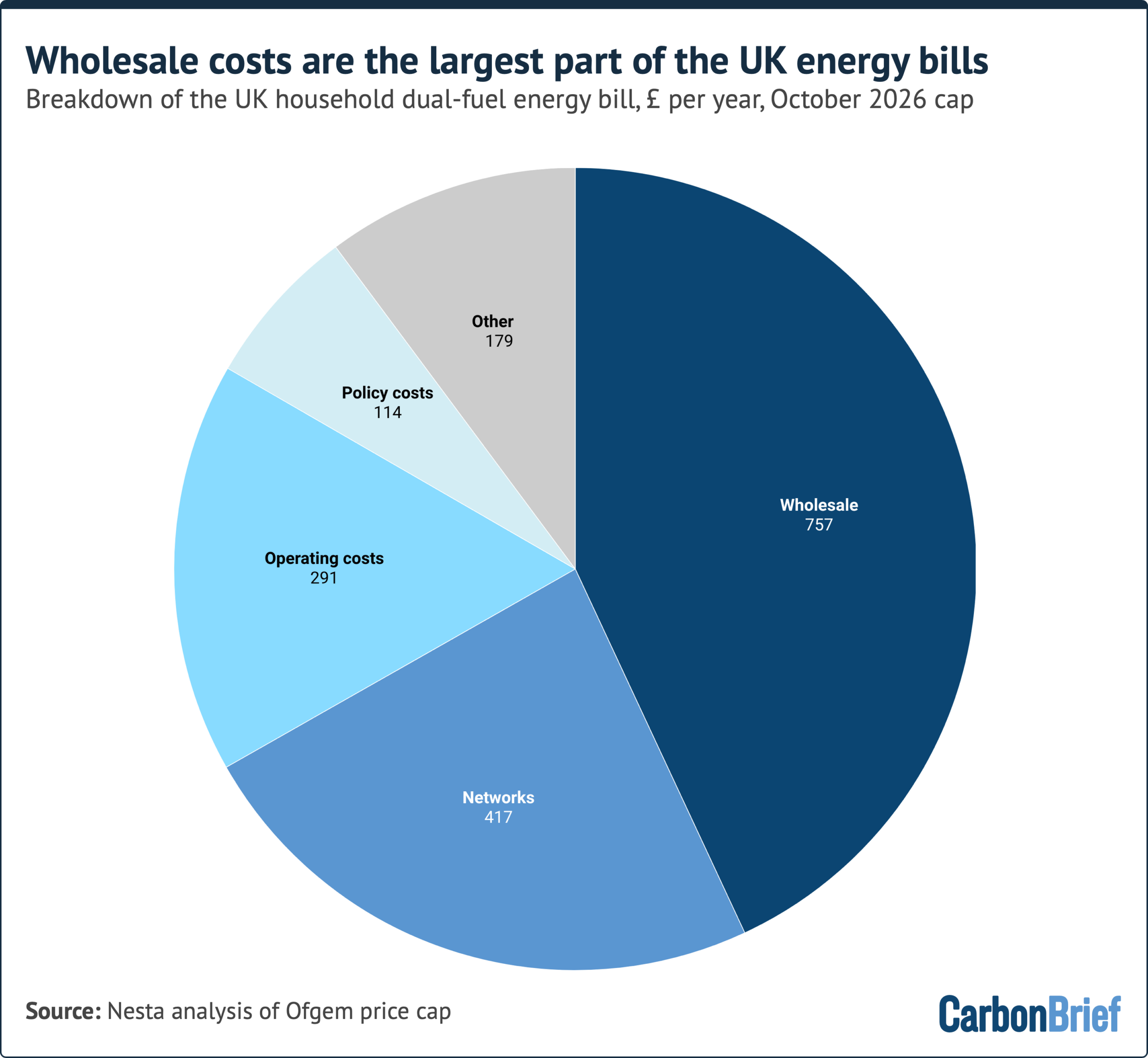
There has been increasing interest in the so-called “non-commodity costs” – those not related to wholesale energy – that now make up a significant portion of bills, as shown in the figure above.
Yet while these costs have been increasing – particularly those related to investing in energy networks – they are not the reason why energy bills have soared once again in recent months.
Indeed, Nesta analysis recently published by Carbon Brief shows that, contrary to widespread UK media and political narratives, a surge in wholesale costs driven by expensive gas is responsible for more than 80% of the rise in dual-fuel household energy bills since 2020, as shown below.
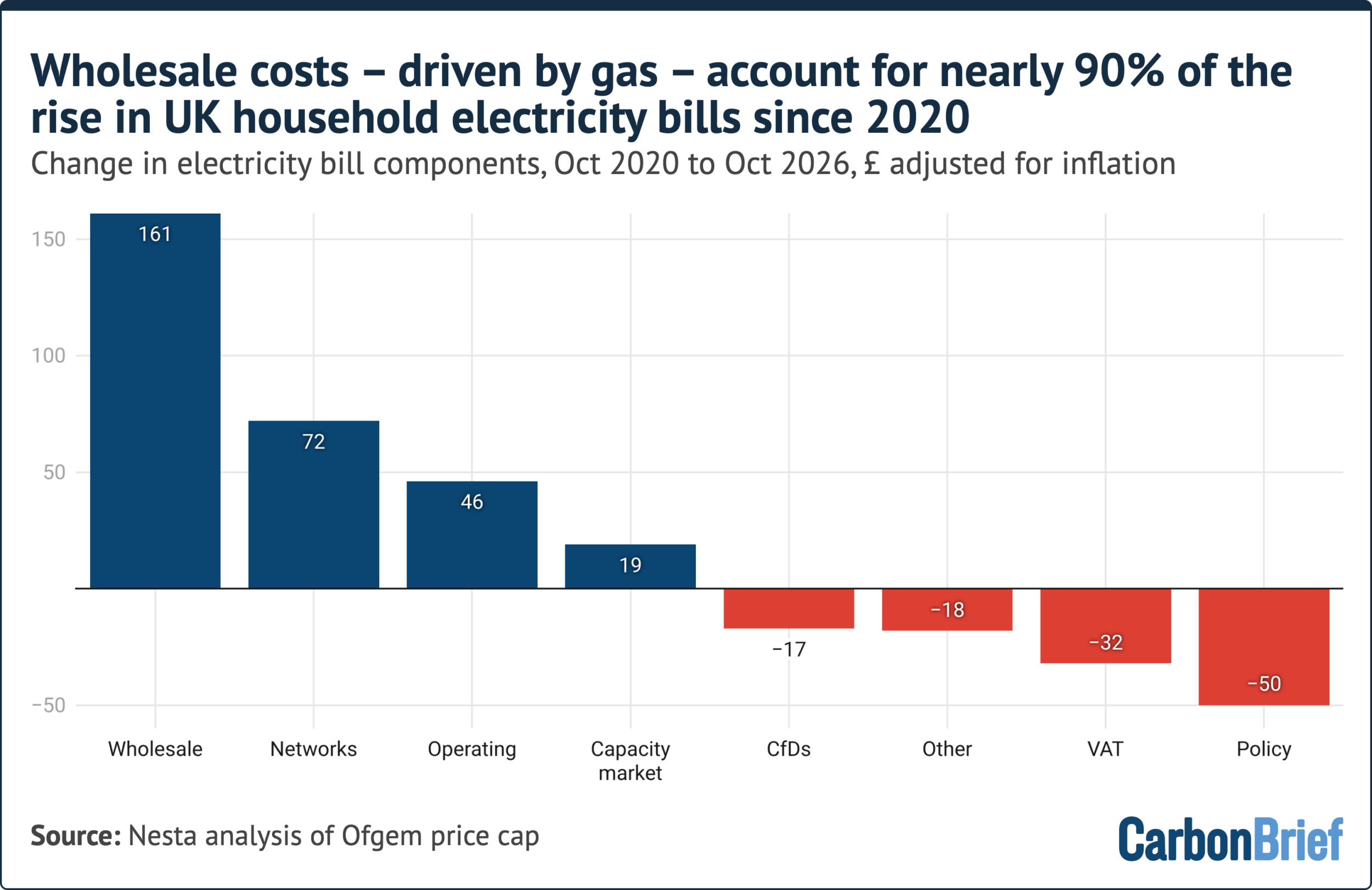
The second-largest driver of the rise in costs since 2020 is due to the cost of operating, maintaining and expanding gas and electricity networks, as shown in the figure above.
At the end of 2025, energy regulator Ofgem approved £29bn of upfront investment into the national gas and electricity grids, as well as the gas distribution network that connects to homes and businesses. This is part of a wider package of up to around £90bn of investment out to 2031.
As a result of these investment plans, network charges are expected to increase by around 50% between 2025 and 2030, from £222 a year to £330 for a typical dual-fuel household.
(This figure covers gas and electricity transmission and gas distribution, but not electricity distribution. A further package of increased investment in the electricity distribution network, for the period from 2028-2033, is due to be approved by Ofgem by the end of 2027.)
The increase in network costs is often attributed to the need to connect increasing levels of geographically dispersed renewable energy sources, particularly wind power.
However, a significant proportion of these increases relate to the need to update ageing infrastructure after decades of under-investment.
This package of investment represents a “once-in-a-generation renewal of our energy infrastructure”, Ofgem head Tim Jarvis told a recent conference attended by Carbon Brief.
Ofgem says some three-fifths of the £108 per household per year rise in network charges to 2030 is due to “business-as-usual” costs such as ongoing maintenance of the gas and electricity networks. It says only £30 is due to investing in expanding the electricity transmission grid.
Similarly, according to the Energy Networks Association, up to 80% of the investment in electricity grids is required to maintain existing assets, with the remainder going towards expansion.
Another point of contention is “constraint costs”, where windfarms are switched off if the network lacks the capacity to transmit their power – and gas plants are switched on to meet demand.
These costs sit within network balancing charges and – despite rising steeply in recent years, partly due to high gas prices – these still make up just £35, or 4% of typical annual electricity bills.
Today, rising constraint costs are partly a reflection of the decision in the 2010s to postpone network investments under a policy known as “connect and manage”. Ofgem says the investments it has now approved in the electricity grid would help limit constraints in the future.
Trade association RenewableUK’s head of policy Steven Agnew points to a recent review by the National Audit Office and says investment in the grid is “critical to avoid large rises in consumers’ bills as more of the country’s electricity is generated from clean sources”. He adds:
“The current crunch is the result of inaction by successive previous governments to tackle this issue. Consumers are losing out on some of the benefits because low-cost wind has to be turned down and expensive gas turned up elsewhere.”
Projections from the National Energy System Operator (Neso) illustrate how constraint costs depend on the relative pace of expansion in new generating capacity and the electricity network.
It says balancing costs could rise from £2bn to £8bn by 2030, if the grid faces delays. However, its central projection is £3-4bn, with a range of options available to limit this increase.
Finally, following years of elevated energy bills, the cost of “bad debt” has increased. This is where unpaid bills are recovered by energy companies through a charge on all households.
These charges add around £60 to typical bills, according to Carbon Brief analysis of Ofgem data. This is an increase of around £40 since 2020 – more than half of the rise in “operating costs”. Trade association Energy UK says rising debt could add another £10-15 to bills by next year.
What has been done to limit bills so far?
The Labour government was elected in 2024 on a manifesto that pledged to cut bills by £300 per year by 2030, relative to levels in late 2023.
The government has taken a number of steps in this direction.
At the 2025 budget, it closed the “energy company obligation” (ECO) efficiency scheme and moved 75% of the “renewables obligation” support scheme for legacy renewables into general taxation.
Collectively, these two changes were expected to save a typical household £134 per year, or £154 when including households that use electric heating. (These savings only apply to households.)
Many groups, from industry to politicians, had long called for policy costs to be taken off electricity bills in an effort to bring down prices, but this had previously been resisted by the Treasury.
In addition, new prime minister Andy Burnham announced in July that his government would remove VAT from electricity bills for six months from 1 October, cutting bills by around £45.
Yet despite these efforts, bills have continued to increase.
Speaking to Carbon Brief, Dr Richard Carmichael, a researcher at the UK Energy Research Centre (UKERC) and research fellow at Imperial College London, says the impact of reducing policy costs and VAT has been “masked” by rising wholesale energy prices.
As a result, there are calls for the government to go even further in its efforts to reduce policy costs – or to take more radical steps to cut bills. (See: What are the options to bring down bills?)
One factor that is less well-appreciated is the impact that clean-power sources have already had on energy bills. Commentators tend to focus narrowly on the co