

The attacks on climate science by the Trump administration means the US is now “part of the problem” on global warming and “not part of the solution”, says Prof Ben Santer.
Santer – a leading climate scientist and early pioneer in establishing the human “fingerprint” on warming – has played a central role in major climate change reports during his career spanning four decades.
In a wide-ranging interview with Carbon Brief, Santer says the Trump administration is “engaged in a systematic attempt to dismantle climate science”.
The “insane” cuts to major scientific institutions, satellite monitoring and climate research funding amounts to “institutionalised efforts to destroy the US capability to monitor, measure and understand changes in Earth’s climate”, he says.
He adds that “we all lose if we embrace ignorance with open arms and claim that the real world is what the president believes it to be, not what we actually measure and monitor”.
It is “heartbreaking” that “many of the best and the brightest [scientists] will leave the country”, says Santer, and go to work in Europe, China, Japan or Australia.
Now semi-retired, Santer himself is relocating to the UK in order to continue his research in the Climatic Research Unit at the University of East Anglia as it has become “difficult” to do so in the US.
He has been granted a five-year visa under the UK’s “Global Talent” programme.
He says he worries about the US influence on European politics as there “have been some efforts to export our willful ignorance” over to the UK.
The interview was conducted shortly before the Trump administration announced that it was withdrawing from more than 60 international bodies and treaties, including the UN Framework Convention on Climate Change (UNFCCC) and Intergovernmental Panel on Climate Change (IPCC).
- On why he is relocating to the UK: “The notion of not being able to do [my] work anymore in the US is unacceptable to me.”
- On his experiences during Trump’s first term: “In the end, the Trump administration did cut the funding for my research and my group’s research in climate change detection and attribution.”
- On managing to continue his work: “I was able to continue my research by cutting down the amount of time that I was actually paid by the Department of Energy.”
- On the reported cuts to US climate science: “It’s unthinkable to actually kill those kinds of critically important measurements, but yet, that’s where we are. It’s heartbreaking.”
- On whether other countries can step into the void: “If the US no longer is willing to lead, is no longer willing to invest in basic monitoring of weather and climate, other countries have to try and fill the gap.”
- On the risks of an “eddy of ignorance” in the US: “We’re part of the problem now in the US, not part of the solution to the problem of climate change.”
- On the Department of Energy climate review: “What did surprise me was just how brazen and blatantly wrong bits of it were.”
- On attacks on climate science: “What’s different today is that it’s an entire administration. This is institutionalised, willful ignorance on the part of the administration.”
- On engaging with science communication: “If you don’t, if you remain silent, then really bad stuff happens.”
- On advice to other scientists: “Only when you push back quickly and forcefully in a united way do you have some hope of avoiding the worst outcomes.”
- On lessons for Europe from US politics: “It’s one I worry about a lot, because there have been some efforts to export our willful ignorance.”
- On the next move for the Trump administration: “I think there will be continued efforts to go after modelling capability, which is – again – heartbreaking.”
- On the EPA’s “endangerment finding”: “I think the EPA Administrator Lee Zeldin has, right from the beginning, intended to rescind the endangerment finding.”
- On his reflections on Climategate: “When you go after the integrity of individuals and the[ir] decency and honesty – in the public arena – in such a vicious and nasty way, it has consequences.”
- On public trust in scientists: “When there’s this drum beat of incendiary language – “con job”, “hoax”, “conspiracy” – again and again and again, it erodes public trust in science and scientists.”
- On media coverage of climate change: “I do think that there’s more effort to hold the [Trump] administration accountable…for making incorrect claims.”
- On geopolitics affecting the IPCC: “I do worry about this fractured landscape, with powerful forces out there seeking to undermine the work of the IPCC.”
Carbon Brief: Ben, thank you very much for joining us. So, after a long career in the US, you’re now relocating to the UK, where you studied for your degrees. What has prompted your return?
BS: It’s really difficult for me to continue doing work in attribution science in the US in 2026. I’m a scientist – working on identification of human fingerprints on climate is in my life blood. It’s part of who I am. It’s part of what I’ve done for the last 40 years. The notion of not being able to do that work anymore in the US is unacceptable to me, so that’s one of the reasons why I’m moving to the UK to continue to do work in trying to disentangle human and natural effects on climate. I’m also coming to the UK because my partner lives here and I want to be with her.
CB: In Trump’s first term [as US president], you were at the Lawrence Livermore National Laboratory. I wonder, what impacts did you experience of the Trump administration when you were there?
BS: A number of impacts and those impacts started right at the beginning of the first Trump administration. So Trump’s nominee for the Environmental Protection Agency, Scott Pruitt, when he was nominated, had to go through Senate confirmation hearings. During those confirmation hearings, he was asked about the reality and seriousness of climate change. He responded that there had been no significant global warming since 1998. 1998 was a big natural El Nino, natural warming event. And Mr Pruitt was cherrypicking. He was saying [in effect], “when I look at satellite temperature records, the temperature of the lower atmosphere – the troposphere – and only go back to 1998 and then march forward in time, I believe there’s been no significant warming”. That was wrong, demonstrably so.
My colleagues and I at Lawrence Livermore National Lab were asked to investigate Mr Pruitt’s claim. We did. We published a paper in 2017 in the Journal of Climate [it was actually in Scientific Reports], showing that that claim was wrong. Even if one did the cherrypicking and forgot about the pre-1998 portion of the satellite temperature record. The LA Times [it was actually the Washington Post] reported on our Journal of Climate paper and I think it’s fair to say that the Trump administration did not like that we had factchecked Mr Pruitt. And did not like that we had shown that his on-the-record statement to the US Senate was wrong.
That incident led to a complaint by the Trump Department of Energy – the funder, primary funder, of Lawrence Livermore National Lab – to the director of Lawrence Livermore National Lab. The director asked for a meeting with me and, during that meeting, told me that the Trump administration was in a position to cut my funding for detection and attribution research at Livermore – and, indeed, to cut funding for Lawrence Livermore National Lab. In the end, the Trump administration did cut the funding for my research and my group’s research in climate change detection and attribution. In my opinion, that was a direct result of doing science [by] factchecking Mr Pruitt. The administration didn’t like that and they didn’t like the result of the factchecking.
CB: So, how were you able to continue your research at the time?
BS: I was able to continue my research by cutting down the amount of time that I was actually paid by the Department of Energy. So, essentially, I reduced my time at Livermore in order to allow my younger colleagues to continue to do this critically important work. At the time of these cuts, I had been in my position at Livermore for nearly three decades. I was at the tail end of my career. They were not – my younger colleagues were not – and I wanted them to continue to have sufficient funding to do this work.
CB: Fast forward to the Trump second term and there have been reported cuts to climate science and related programmes at the EPA [US Environmental Protection Agency], NCAR [National Center for Atmospheric Research], NOAA [National Oceanic and Atmospheric Administration] and NASA. I wonder which of these concerns you the most?
BS: They are all of deep concern to me. I would say the administration – the second Trump Administration – has engaged in a systematic attempt to dismantle climate science and not only climate science in the US, but I know the climate science piece of things reasonably well. They’ve gone after monitoring. They’ve gone after computer modelling. They’ve gone after people who do the kind of attribution science work that I do; people who look at extreme events and human contribution to the changes in the properties of extreme events – droughts, flooding, all of that – they’ve fired thousands of employees.
And when you break the evidentiary chain, when you no longer monitor, say, changes in Arctic sea ice extent or carbon emissions or atmospheric temperature, you make it difficult for people like me to get at the causes of climate change. That’s a deep, deep concern that we may no longer be able to continuously monitor stuff that we urgently need to monitor, not only for climate, but also for basic weather prediction. For example, if you stop monitoring atmospheric moisture, then you degrade the quality of weather forecasts that give you early warning of severe storms, of atmospheric rivers – it’s unthinkable to actually kill those kinds of critically important measurements, but yet, that’s where we are. It’s heartbreaking.
I have hundreds of colleagues at the National Centre for Atmospheric Research, at the Geophysical Fluid Dynamics Lab at the [NASA] Goddard Institute for Space Studies – women and men who have devoted their entire scientific careers to trying to model the climate system, understand the climatic shape of things to come. Many of them, particularly probationary employees, are gone. And you can’t flip a switch under a more enlightened administration, which we hope we get in three years from now, and bring all of that back. Science doesn’t work that way. Many of the best and the brightest will leave the country and will go to Europe or go to China or go to Japan or Australia. They will leave the US. They will see no future for themselves there. Or they won’t even come to the country to study, to do degrees – and that loss of talented, dedicated researchers is heartbreaking. That’s the only word for it.
CB: You mentioned a lot of programmes that have been cut – for example, monitoring. Do you think other countries can step into the void? And, if so, who and how?
BS: I hope so. I hope the Europeans and the Chinese and the Australians and the Japanese are making serious contingency plans – and recognising that this is a real thing. The Trump administration is going to turn off satellites. They’ve announced their intent to severely cut NASA and go after things like the Orbiting Carbon Observatory and other remote sensing systems that make measurements that they don’t like. So hopefully other space agencies recognise the danger to this evidentiary chain.
But, again, that’s not like flipping a switch that you can suddenly launch a satellite – developing sensors, deploying sensors in space – all of that is the stuff of years, not the stuff of a couple of months. But I hope that these kinds of discussions are going on at the highest level in countries that recognise the value of information – again, not only for climate, but for basic weather forecasting. If the US no longer is willing to lead, is no longer willing to invest in basic monitoring of weather and climate, other countries have to try and fill the gap.
CB: Shortly before Trump won his second term, you wrote that his election risks trapping the US and the planet in an “eddy of ignorance”. I wonder what your reflections are now that Trump is in power?
BS: We are in that “eddy of ignorance” in the US. Clearly, this administration seeks to redefine reality itself; seeks in its public-facing websites – say NASA, EPA – to generate a picture of a world where climate isn’t changing, or if it is, the changes are purely natural – they’re due to the sun, volcanoes, orbital perturbations; humans have no agency, have no discernible influence on climate. So, they’re creating an alternative universe in which human caused fossil fuel burning has no impact on climate. And what do you even call that? “Eddy of ignorance” is too weak a term to describe that willful misrepresentation of the world we actually live in – of the climate we actually live in – how it’s changed, how it’s likely to change it. It’s – again – heartbreaking when you think of the destruction of information on websites, the destruction of libraries – like, as has recently been reported, the Goddard Space Flight Centre library of volumes about atmospheric science, ocean science – the thought of that stuff going away, of not being there anymore. I don’t know what to do with that, I guess.
The only thing I can do with it – and have tried to do with that kind of willful ignorance – is shine a light on it and say “this is wrong”. No matter what differences in political positions we have, we all lose if we embrace ignorance with open arms and claim that the real world is what the president believes it to be, not what we actually measure and monitor. That’s where we are in the US – president Trump is defining reality and we risk – as many have written – going back to the Soviet Lysenkoism, where any science that conflicts with the prevailing political views of the leader is dismissed and denied. And that has serious negative consequences – of course, not only for the US, but for the entire world. We’re part of the problem now in the US, not part of the solution to the problem of climate change.
CB: You mentioned the Department of Energy (DoE) earlier and its involvement in the Lawrence Livermore Lab. And I wonder what your reaction was to their “critical review” on climate change that they published last year?
BS: So they published this review in July of 2025. It involved five noted climate change sceptics. I had dealt with all of them over the course of my time at Livermore. It was not a surprise that the administration was going to try and come up with some counter narrative to IPCC and national climate assessments. But what did surprise me was just how brazen and blatantly wrong bits of it were.
So, I’ll give you an example. Chapter 5.5 of this Department of Energy climate working group review dealt with temperature changes in the stratosphere. And it touched on work that my colleagues and I had had done and published most recently in 2023 in a paper in Proceedings of the National Academy of Sciences. And the DoE report cited our 2023 paper and said that we had not found a human fingerprint on climate. We had. We had found the most convincing evidence yet of a human fingerprint on the structure of atmospheric temperature. This predicted fingerprint of warming of the lower atmosphere and cooling of the upper atmosphere – predicted by Suki Manabe back in 1967 – we had found it in satellite measurements of atmospheric temperature change. And we had found that this signal was particularly clear where Manabi had predicted back in ‘67 – that it would be clear right in the upper stratosphere. The Department of Energy, in saying “you didn’t find a fingerprint”, was essentially doing the equivalent of something like this: The walls here in this room were white. They’re essentially telling you, “no, they’re not white, they’re black”. What do you do with something like that? When someone mischaracterises your own work and the work of your colleagues – sober, mature science that you’ve spent decades doing – and fundamentally turns it on his head in an official government report for a specific political purpose.
You know, the report was released on the same day as EPA administrator Lee Zeldin announced his intent to repeal the 2009 endangerment finding – the finding that emissions of greenhouse gases, through their effect on temperature and through temperature effects on air pollution, materially harm human health. So, this report fed into that political goal of wanting to repeal the endangerment finding. And our science is being misrepresented to support that political goal. That was pretty shocking to me – that it would be so blatant. There was no pretence, really, of trying to get the science right. And the example that I just mentioned – with our vertical fingerprint work with atmospheric temperature – is only one example of many dozens that the Dessler report takedown – and Carbon Brief’s own takedown of the many errors in the DoE report – showed. This was a pattern of behaviour. My job is about pattern analysis and there was a pattern in the DoE report of trying to misrepresent well-understood science.
CB: Your career has spanned periods where climate science has been attacked quite fiercely – back to the time of Kyoto in the 90s or Climategate at the end of the 2000s. What parallels or differences do you see today?
BS: So, back in the mid-90s, the attacks focused on the IPCC second assessment report. That report came out in early 1996 and its headline finding was the infamous 12-word statement: “The balance of evidence suggests a discernible human influence on global climate.” And that was significant because it was the first time that the international scientific community said formally: “We see a signal of human activity.” Other individual scientists had made such claims in the past – notably, Jim Hansen in 1988 in a paper in Journal of Geophysical Research. But this was the international community, the IPCC, saying: “Hey, humans are no longer innocent bystanders in the climate system. We formally identified a climate change signal due to our actions. It’s not the sun, it’s not volcanoes, it’s not natural internal variability, it’s on us.”
And as the play Kyoto, which you just mentioned, clearly notes, that was threatening – that discernible human influence finding – to very powerful, moneyed interests. To, for example, the Global Climate Coalition – a consortium of energy interests – they recognised that this was bad for business, that this finding might have downstream implications for their business models, for their ability to continue burning fossil fuels without considering the negative externalities of their actions. So the Global Climate Coalition and other fossil-fuel funded organisations – Western Fuels [Association], the Petroleum Association [the American Petroleum Institute] – went after the IPCC and went after me. No personal animus, but I was the lead author of the chapter in which this finding was situated. And individual folks in Congress, too, like Dana Rohrabacher, a Republican congressman, wanted to make names for themselves and felt that they could do so by casting doubt on the integrity of the IPCC process – the scientific integrity of people like me. So there was some attempt back then to politicise the science too. It wasn’t just fossil-fuel interests that went after the IPCC. It was also folks like Rohrabacher who wanted to make a name for themselves.
What’s different today is that it’s an entire administration. This is institutionalised, willful ignorance on the part of the administration – institutionalised efforts to destroy the US capability to monitor, measure and understand changes in Earth’s climate. That’s qualitatively different from anything I encountered in the mid-90s at the time of the IPCC second assessment report.
CB: If you were in the earlier stages of your career now, as you were then, do you think you would be just as involved in communication and public engagement on climate change?
BS: Absolutely. The lesson I learned 30 years ago – back at the time of the discernible human influence finding in 1996 – was, sometimes, you don’t have the luxury of sitting on the fence and just waiting to see how things develop. Back then, I was a representative of an entire scientific community. My job had been to – with my peers – assess the then-available science and come up with our best representation of what the science, back then – 30 years told us – and we did and we were right. The cautious, even wimpy, “balance of evidence suggests a discernible human influence on global climate” [statement] was justified by the then-available science. And, in the next 30 years, the science progressed – better models, longer data records, better fingerprint techniques for disentangling human and natural effects on climate, more scientists involved in this kind of work all over the world – leading to the word “unequivocal”.
It is now unequivocal, as the IPCC judged in its 2021 sixth assessment report [on climate science], that there are human fingerprints all over Earth’s climate system – atmosphere, oceans, land surface. Back then, in 1995-96, we were primarily looking at surface thermometer records, surface temperature records. Now, folks have interrogated literally dozens of variables – Arctic sea ice extent, atmospheric moisture, specific humidity, sea level pressure, ocean heat content, clouds, circulation patterns, extreme event properties – you name it, they’ve looked at it. They’ve kicked the tires. They’ve used pattern recognition methods to assess whether purely natural influences can explain the changes in each of those independently measured variables – natural causes can’t.
And that’s the frustration, I would say – this disconnect between this much more mature understanding of causes now in 2021 and this willful ignorance that we see in the Trump administration. Where the president of your own country refers to all of the work that you’ve done and your colleagues have done as a “con job”. So not only wrong, but criminal – as if there’s intent, on your part and your colleagues’ part, to mislead the global public about the reality and seriousness of climate change. The only response, in my opinion, is you have to, as a scientist, push back against that. If you don’t, if you remain silent, then really bad stuff happens. And I think that’s true for our democracy as well. If good people remain silent when there are serious challenges facing science and democracy, we all lose.
CB: What would be your advice to climate scientists in the US today, particularly those leading the organisations under attack?
BS: “Hang together or hang separately,” as Benjamin Franklin, I believe, famously said. You have to provide some kind of united front to these systematic efforts to dismantle US science. If you don’t, if you leave that to individuals or let the administration attack individual universities, you’re not going to prevail in preventing really serious harms. And I would say it’s taken the scientific community a long time to recognise that. In the US, certain institutions that should have led right from the beginning and said, “no, this is wrong”. Going after the CDC [Centers for Disease Control and Prevention] and going after vaccine schedules harms public health. People will die. Those kinds of messages needed to be made public very early, very forcefully – and they weren’t.
Same with climate science – starting to fire probationary employees, starting to go after climate modelling and to argue that modellers were scaring America’s children by making projections of the climatic shape of things to come. All of that demanded a firm, clear response, which was late in coming. And unfortunately, again, many of the harms that happened in those first few months – the firings, the withholding of grant money that will affect research at universities, climate research, medical research labs, the continuity of whole departments – those harms can’t be easily reversed. I think, for me, the personal lesson learned from the first administration is only when you push back quickly and forcefully in a united way do you have some hope of avoiding the worst outcomes.
CB: We’ve seen how quickly US federal climate science policy has changed under a new government. I wonder what lessons can European governments and institutions and scientists take from that on protecting climate science, regardless of political change?
BS: That’s a great question and it’s one I worry about a lot, because there have been some efforts to export our willful ignorance, say, to this country [the UK]. Steve Koonin, one of the five authors of the DoE climate working group report, has tried to persuade British colleagues that the science – the climate science done, say, at the Hadley Centre and other research centres and universities isn’t credible, that they shouldn’t make policy based on IPCC or internal climate assessments. And I think we’ll see more of that. I think the Royal Society needs to be very clear that it has to push back against those efforts to try and export our willful ignorance to this country and to Europe.
[The following part of Santer’s answer is missing from the video recording because of a technical issue.]
Those efforts are only just starting to ramp up in the US. We hear that the same five folks who worked on the DoE report are going to be in charge of the next [US] national climate assessment. And I would not be surprised to see folks like Koonin and others make more appearances over here and it’s in the [Trump] administration’s interests to undermine climate science internationally. Why? Because then they can say, well, “buy our oil – there are no consequences, no climate consequences. And the people who have told you that there are climate consequences are not real, credible scientists – believe our five hand-picked experts who wrote this DoE report and are now rewriting national climate assessments.”
I think you need here, in the UK, to observe what happened and the institutional failures to push back against this kind of willful ignorance and to learn from those failures. It really is critically important to support science and leading institutions can’t be silent. They can’t say, oh, we don’t want to offend president Trump, or we don’t want to offend Elon Musk, who is one of our members in the Royal Society. No, you will suffer serious, long-lasting reputational harm if you don’t defend science. That’s my lesson learned.
CB: Where do you see things going next in the US? What’s the next move for the Trump administration on climate change?
BS: Well, what I’ve mentioned already is that the five individuals who wrote the DoE’s climate working group report in July 2025 have apparently been tasked with leading the next national climate assessment, which is a congressionally mandated report to Congress. And it’s likely that that will be the same stuff we saw in the DoE report in July 2025 – a counter narrative, if you will, to mature scientific understanding encoded in 30+ years of IPCC reports. So, on the science side of things, it’s about presenting that counter narrative. It’s also, I think, about continuing to dismantle websites and continuing to present the public on EPA and NASA and NOAA websites with a very, very different understanding of the causes of climate change.
It’s – if Congress doesn’t do anything to stop it – going to involve continued cuts to NASA. The Trump administration has made it very clear that they don’t care about observing changes in Earth’s climate from space and they’re going to go after missions that they don’t like that provide basics – atmospheric temperature and atmospheric moisture and, again, pollutants, CO2 emissions, methane emissions, all of those kind of things I would say are imperilled, which is insane. That’s the only word for it. Removing our ability to measure and monitor how the world around us is changing, makes no sense whatsoever. But, yet, that’s where we are, because the data is inconvenient and doesn’t comport with the narrative of the president, that nothing is happening, nothing is changing, or if it is, it’s all natural.
I think there will be continued efforts to go after modelling capability, which is – again – heartbreaking. Some of the institutions I mentioned – like the National Centre for Atmospheric Research, Geophysical Fluid Dynamics Lab in Princeton, Goddard Institute for Space Studies [GISS] – they’re already under attack. Their funding is under attack. Their leases, in the case of GISS, have been rescinded or cancelled. There are efforts to break up these groups of very, very talented women and men and scatter them to the wind. I think that’s going to continue. And what will be important will be to see whether Congress pushes back against these things or is fearful of incurring Trump’s wrath and allows this sort of stuff to continue internationally.
I think the US is not going to engage with IPCC or UN Framework Convention [on Climate Change] or COPs. [The Trump administration has now withdrawn the US from the IPCC and UNFCCC.] They don’t care. All they care about is exporting US and now Venezuelan oil, presumably. And they don’t care about advancing climate science or any kind of science, really, which is an unbelievable thing to say, coming from a country where science has, since the end of the second world war, been an integral part of the country, of its development, of its economy, of its of its future. Now we’re turning away from science in the US. It’s like we’re handing the baton of leadership to you and saying, “here, we’re done leading in climate science, medical science – you lead now, rest of the world, we’re going to go back and try and make the horse and buggy great again”.
CB: What do you see happening to the [EPA’s] “endangerment finding”?
BS: I think the EPA Administrator Lee Zeldin has, right from the beginning, intended to rescind the endangerment finding – following Trump’s lead and following the guidance of Project 2025 [A blueprint to reshape the US federal government under a Republican president, published in 2023 by the Heritage Foundation and other right-wing organisations.] There are powerful interests in the US that, right from the beginning, have argued, “the endangerment finding is bad for business, so get rid of it. This should be an important thrust of the second Trump administration.” And it has been, right from the beginning of the administration. And part of the job has been to come up with this scientific counter narrative – in the DoE report and, I believe, now in the planned next national climate assessment – to argue that, “the science isn’t credible. We don’t need an endangerment finding because human actions aren’t endangering the climate. It’s all natural, folks. Nothing to see here.” That’s going to continue.
But, as I mentioned, that faces challenges, that counter narrative now, because it was so badly done. The DoE report was so sloppy, so riddled with mistakes – some of which were really transparent, not shades of grey differences between experts, but really badly wrong stuff. That’s the DoE report. The factchecking on that report has been done. It’s out there, [it] got widespread publicity – thank you Carbon Brief; thank you, Andy Dessler. The fast track study of the US National Academy of Sciences – done partly in response to the DoE report – has affirmed and confirmed the science is credible. Humans are influencing global climate through burning fossil fuels, through particulate pollution, and we need to do something about it. This is a serious danger to human health.
So, Mr Zeldin’s challenge is a difficult one. I would say he’s got powerful scientific – well, decades of mature science – that he’s going against, that he’s tilting against. And that’s going to be a tough sell. But, that said, it’ll wind up before the US supreme court and the supreme court has a conservative majority. How they adjudicate, given that they already decided back in 2009 [it was actually 2007] that climate change constitutes a danger to human health, will they reverse their decision? There’s a lot of uncertainty. But one thing that is very certain is that Trump wants the endangerment finding rescinded and everything flows from that.
CB: I want to look back now a little bit more. We’re now 15+ years on since Climategate [when thousands of emails between climate scientists were stolen from a university server and selectively released online in an attempt to undermine COP15 in Copenhagen in 2009]. And I wondered how you feel about that whole experience now?
BS: Pretty bad about the whole experience. I did my PhD at the Climatic Research Unit at UEA [the University of East Anglia]. I got my PhD in 1987 and I then went to Hamburg to do a postdoc at the Max Planck Institute [for Meteorology]. Then, after Max Planck, I went to Livermore in 1992 and I continued to work together with people at the Climatic Research Unit. They weren’t only colleagues. They were friends. We published a boatload of papers together. Watching what happened, what unfolded in 2009 and thereafter was terrible. The human cost hasn’t really been revealed – to good people who spent their lives trying to compile surface temperature data sets.
The case of Phil Jones, in the case of Keith Briffa – to do dendrochronology and advance understanding of century timescale changes in climate from looking at tree rings – all of that good work was dragged through the mud by these forces of unreason, by folks who had no real understanding of the science of the integrity of the work. It was sickening and disgusting to witness bad things happen to such good people. I spent a fair bit of time back then in 2009 and 2010 providing input to various investigations, speaking publicly about the individuals involved, and I remain deeply concerned at that human cost. This isn’t a game. When you go after the integrity of individuals and the[ir] decency and honesty – in the public arena – in such a vicious and nasty way, it has consequences.
Some of those consequences aren’t visible to people on the outside, who don’t know folks like Phil Jones and folks like Keith Briffa and others deeply involved in Climategate – folks like Michael Mann. But those consequences, those personal consequences, are very real and I’m concerned that that’s where we’re going again. The way forward, say, for the Trump administration is to challenge the integrity and decency and honesty and motives of climate scientists – as is occurring with use of incendiary language like “con job”. That’s where we’re going again.
CB: How do you think that public trust in climate science – and scientists – compares now to back then?
BS: Well, language matters. Words matter. That’s been a lesson of mine – a lesson I learned back in 1995 with those 12 words with the “discernible human influence” finding. So when there’s this drum beat of incendiary language – “con job”, “hoax”, “conspiracy” – again and again and again, it erodes public trust in science and scientists: “Well, the President surely wouldn’t be saying these things if there weren’t something behind them.” These folks have huge megaphones that they can exploit on a daily basis.
They are in control of the levers of power now – websites at NASA, NOAA, EPA. The president can address the UN General Assembly and use this kind of “con job” language, “you’re all fools if you believe scientists”. I have to believe that that has impact – cumulative impact. If you keep on doing it again and again and again, you can erode public confidence in science. And that’s why part of my job, as I see it, is to be a public figure – to speak and to write about evidence: “How do we know? How have we reached this time in history when we know that we’re not innocent bystanders in the climate system. What’s the nature of the evidence? Who gained it? How did they gain it? Do scientists look at alternate hypotheses? Could it all be the sun, volcanoes, orbital perturbations, intrinsic variability?” We have to do a better job explaining how we know and why it matters to what’s at stake here.
This [year] is likely – 2025 – to be the second- or third-warmest year ever. [This has now been confirmed.] And, over my lifetime, I’ve seen the signal of human-caused warming emerge from the noise of natural variability. We know it’s real. We know that if we do nothing to reduce emissions of greenhouse gases, that signal is going to manifest more clearly every year. So it’s critically, just critically, important to speak science to power and continue to push back against this narrative of “con job” and “hoax” and “conspiracy”. But it’s an uphill struggle. Again, given that I can have an interview with you, I can write stuff in Scientific American, but the president can reach tens of millions of people every day.
CB: Just thinking about the media, how do you think the media’s coverage of climate science has changed over time?
BS: I think it’s gotten better. Certainly back in the 90s, it was much more this binary, “he says, she says” type things: “Here’s Expert A, here’s Expert B, giving you some completely different view of a scientific question.” I would say that the reporting is now much more focused on trying to understand the science and rather than having duelling experts out there. Even in the US, we don’t get [prominent climate-sceptic scientists] Dick Lindzen or John Christy now, as we used to on every story about warming and changes in sea ice. You don’t get the counter narrative out there. And that’s good and that’s really positive.
Much of the reporting is now more in depth about what’s going on with the Thwaites great glacier, or what’s going on with sea level and what are the drivers of sea level rise? And all of that is good and positive. And I do think that there’s more effort to hold the administration accountable – the Trump administration accountable – for making incorrect claims. We were unwilling to use the word “lie” at the beginning of the first Trump administration. People are more willing now to say, “this is untrue, there’s no scientific basis for this statement or that statement”, and that’s good, too.
What I think is necessary, as I said before, is for more voices to enter the fray – for the leadership of powerful professional organisations to say, “this claim by the administration that climate science is a ‘con job’ is wrong. It’s not. And here are three decades of reports that we published that show that it’s a thing and we need to worry about it.” It can’t be just individual voices there of a few climate scientists speaking about the reality and seriousness of climate change.
CB: So, you have, obviously, been heavily involved in all IPCC reports throughout the years. We’re now at the early stages of the seventh assessment and countries are still yet to agree on a timeline for publication of the assessment reports. And I wonder what you thought that says about the state of climate politics today?
BS: Well, I’ve been involved in every IPCC assessment since the first one in 1990. I think they’re unique. They’re an invaluable way of providing the collective understanding of an entire community and showing how that understanding has evolved over time. I hope the IPCC continues. I think there’s a continuing need for an authoritative international organisation to say: “This is our best understanding of the science and this is our best understanding of likely outcomes if we do nothing to address the problem, or we follow this emission scenario, or this overshoot scenario.” We need that and it’s clearly good to be able to put error bars on these projections, to have the entire global scientific community involved – and be able to say: “This is what we know with confidence, this is what we don’t know with confidence. Here are our levels of confidence.”
All of that is extraordinary when you think about it, how a community has come together to make these authoritative assessments of the state of our understanding. Which is why it’s been so threatening, I think, to the Trump administration and why they pulled out of IPCC [in 2025] and why they don’t like it.
[The following part of Santer’s answer is missing from the video recording because of a technical issue.]
Because it doesn’t support the president’s narrative that this is a “con job” and that history is valuable to see how, over time, things have firmed up, how the “balance of evidence” finding was transformed into “unequivocal” human fingerprints on climate. Capturing that arc of history, that arc of scientific understanding.
But the IPCC has challenges. The US is backing out now. There are some efforts on the part of the philanthropic community to allow individual US scientists to participate. I hope that that continues. I hope that the US, in some way or other, continues to make scientific contributions to the IPCC. But I do worry about this fractured landscape, with powerful forces out there seeking to undermine the work of the IPCC. We’re going to see the rise of those forces – not only in the US, but elsewhere – to silence or diminish the effectiveness of voices like IPCC. So we need to be prepared for that and we need to have very clear communications about the richness of the evidence.
I think the scientific community and the IPCC maybe haven’t been that good in terms of explaining just how compelling the evidence is for human effects on climate – just how multivariate it is: atmosphere, ocean, land, temperature, moisture, circulation, ice. It’s everywhere. It’s in our backyards. It’s not just evidence of human effects on climate in the far flung Arctic or a few Pacific islands, we need to communicate that better.
CB: Thank you so much for your time.



The post Prof Ben Santer: Trump administration is ‘embracing ignorance’ on climate science appeared first on Carbon Brief.
Prof Ben Santer: Trump administration is ‘embracing ignorance’ on climate science

Drought and heatwaves occurring together – known as “compound” events – have “surged” across the world since the early 2000s, a new study shows.
Compound drought and heat events (CDHEs) can have devastating effects, creating the ideal conditions for intense wildfires, such as Australia’s “Black Summer” of 2019-20 where bushfires burned 24m hectares and killed 33 people.
The research, published in Science Advances, finds that the increase in CDHEs is predominantly being driven by events that start with a heatwave.
The global area affected by such “heatwave-led” compound events has more than doubled between 1980-2001 and 2002-23, the study says.
The rapid increase in these events over the last 23 years cannot be explained solely by global warming, the authors note.
Since the late 1990s, feedbacks between the land and the atmosphere have become stronger, making heatwaves more likely to trigger drought conditions, they explain.
One of the study authors tells Carbon Brief that societies must pay greater attention to compound events, which can “cause severe impacts on ecosystems, agriculture and society”.
Compound events
CDHEs are extreme weather events where drought and heatwave conditions occur simultaneously – or shortly after each other – in the same region.
These events are often triggered by large-scale weather patterns, such as “blocking” highs, which can produce “prolonged” hot and dry conditions, according to the study.
Prof Sang-Wook Yeh is one of the study authors and a professor at the Ewha Womans University in South Korea. He tells Carbon Brief:
“When heatwaves and droughts occur together, the two hazards reinforce each other through land-atmosphere interactions. This amplifies surface heating and soil moisture deficits, making compound events more intense and damaging than single hazards.”
CDHEs can begin with either a heatwave or a drought.
The sequence of these extremes is important, the study says, as they have different drivers and impacts.
For example, in a CDHE where the heatwave was the precursor, increased direct sunshine causes more moisture loss from soils and plants, leading to a drought.
Conversely, in an event where the drought was the precursor, the lack of soil moisture means that less of the sun’s energy goes into evaporation and more goes into warming the Earth’s surface. This produces favourable conditions for heatwaves.
The study shows that the majority of CDHEs globally start out as a drought.
In recent years, there has been increasing focus on these events due to the devastating impact they have on agriculture, ecosystems and public health.
In Russia in the summer of 2010, a compound drought-heatwave event – and the associated wildfires – caused the death of nearly 55,000 people, the study notes.

The record-breaking Pacific north-west “heat dome” in 2021 triggered extreme drought conditions that caused “significant declines” in wheat yields, as well as in barley, canola and fruit production in British Columbia and Alberta, Canada, says the study.
Increasing events
To assess how CDHEs are changing, the researchers use daily reanalysis data to identify droughts and heatwaves events. (Reanalysis data combines past observations with climate models to create a historical climate record.) Then, using an algorithm, they analyse how these events overlap in both time and space.
The study covers the period from 1980 to 2023 and the world’s land surface, excluding polar regions where CDHEs are rare.
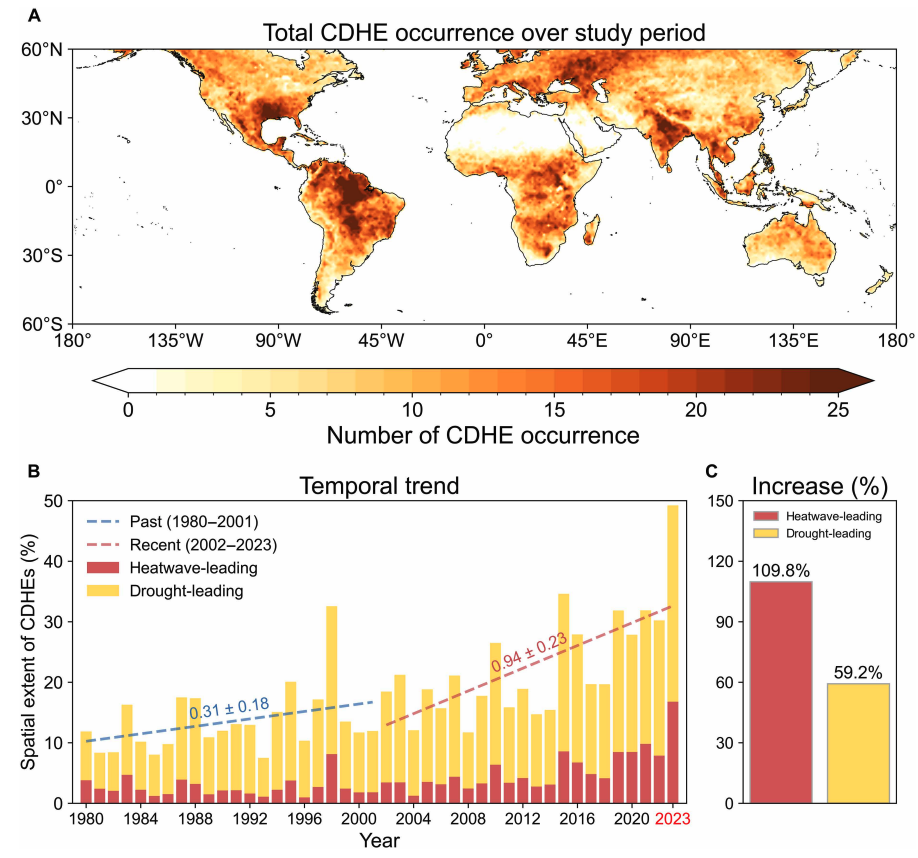
The research finds that the area of land affected by CDHEs has “increased substantially” since the early 2000s.
Heatwave-led events have been the main contributor to this increase, the study says, with their spatial extent rising 110% between 1980-2001 and 2002-23, compared to a 59% increase for drought-led events.
The map below shows the global distribution of CDHEs over 1980-2023. The charts show the percentage of the land surface affected by a heatwave-led CDHE (red) or a drought-led CDHE (yellow) in a given year (left) and relative increase in each CDHE type (right).
The study finds that CDHEs have occurred most frequently in northern South America, the southern US, eastern Europe, central Africa and south Asia.
Threshold passed
The authors explain that the increase in heatwave-led CDHEs is related to rising global temperatures, but that this does not tell the whole story.
In the earlier 22-year period of 1980-2001, the study finds that the spatial extent of heatwave-led CDHEs rises by 1.6% per 1C of global temperature rise. For the more-recent period of 2022-23, this increases “nearly eightfold” to 13.1%.
The change suggests that the rapid increase in the heatwave-led CDHEs occurred after the global average temperature “surpasse[d] a certain temperature threshold”, the paper says.
This threshold is an absolute global average temperature of 14.3C, the authors estimate (based on an 11-year average), which the world passed around the year 2000.
Investigating the recent surge in heatwave-leading CDHEs further, the researchers find a “regime shift” in land-atmosphere dynamics “toward a persistently intensified state after the late 1990s”.
In other words, the way that drier soils drive higher surface temperatures, and vice versa, is becoming stronger, resulting in more heatwave-led compound events.
Daily data
The research has some advantages over other previous studies, Yeh says. For instance, the new work uses daily estimations of CDHEs, compared to monthly data used in past research. This is “important for capturing the detailed occurrence” of these events, says Yeh.
He adds that another advantage of their study is that it distinguishes the sequence of droughts and heatwaves, which allows them to “better understand the differences” in the characteristics of CDHEs.
Dr Meryem Tanarhte is a climate scientist at the University Hassan II in Morocco, and Dr Ruth Cerezo Mota is a climatologist and a researcher at the National Autonomous University of Mexico. Both scientists, who were not involved in the study, agree that the daily estimations give a clearer picture of how CDHEs are changing.
Cerezo-Mota adds that another major contribution of the study is its global focus. She tells Carbon Brief that in some regions, such as Mexico and Africa, there is a lack of studies on CDHEs:
“Not because the events do not occur, but perhaps because [these regions] do not have all the data or the expertise to do so.”
However, she notes that the reanalysis data used by the study does have limitations with how it represents rainfall in some parts of the world.
Compound impacts
The study notes that if CDHEs continue to intensify – particularly events where heatwaves are the precursors – they could drive declining crop productivity, increased wildfire frequency and severe public health crises.
These impacts could be “much more rapid and severe as global warming continues”, Yeh tells Carbon Brief.
Tanarhte notes that these events can be forecasted up to 10 days ahead in many regions. Furthermore, she says, the strongest impacts can be prevented “through preparedness and adaptation”, including through “water management for agriculture, heatwave mitigation measures and wildfire mitigation”.
The study recommends reassessing current risk management strategies for these compound events. It also suggests incorporating the sequences of drought and heatwaves into compound event analysis frameworks “to enhance climate risk management”.
Cerezo-Mota says that it is clear that the world needs to be prepared for the increased occurrence of these events. She tells Carbon Brief:
“These [risk assessments and strategies] need to be carried out at the local level to understand the complexities of each region.”




The post Heatwaves driving recent ‘surge’ in compound drought and heat extremes appeared first on Carbon Brief.
Heatwaves driving recent ‘surge’ in compound drought and heat extremes
Greenhouse Gases
DeBriefed 6 March 2026: Iran energy crisis | China climate plan | Bristol’s ‘pioneering’ wind turbine
Welcome to Carbon Brief’s DeBriefed.
An essential guide to the week’s key developments relating to climate change.
This week
Energy crisis
ENERGY SPIKE: US-Israeli attacks on Iran and subsequent counterattacks across the Middle East have sent energy prices “soaring”, according to Reuters. The newswire reported that the region “accounts for just under a third of global oil production and almost a fifth of gas”. The Guardian noted that shipping traffic through the strait of Hormuz, which normally ferries 20% of the world’s oil, “all but ground to a halt”. The Financial Times reported that attacks by Iran on Middle East energy facilities – notably in Qatar – triggered the “biggest rise in gas prices since Russia’s full-scale invasion of Ukraine”.
‘RISK’ AND ‘BENEFITS’: Bloomberg reported on increases in diesel prices in Europe and the US, speculating that rising fuel costs could be “a risk for president Donald Trump”. US gas producers are “poised to benefit from the big disruption in global supply”, according to CNBC. Indian government sources told the Economic Times that Russia is prepared to “fulfil India’s energy demands”. China Daily quoted experts who said “China’s energy security remains fundamentally unshaken”, thanks to “emergency stockpiles and a wide array of import channels”.
‘ESSENTIAL’ RENEWABLES: Energy analysts said governments should cut their fossil-fuel reliance by investing in renewables, “rather than just seeking non-Gulf oil and gas suppliers”, reported Climate Home News. This message was echoed by UK business secretary Peter Kyle, who said “doubling down on renewables” was “essential” amid “regional instability”, according to the Daily Telegraph.
China’s climate plan
PEAK COAL?: China has set out its next “five-year plan” at the annual “two sessions” meeting of the National People’s Congress, including its climate strategy out to 2030, according to the Hong Kong-based South China Morning Post. The plan called for China to cut its carbon emissions per unit of gross domestic product (GDP) by 17% from 2026 to 2030, which “may allow for continued increase in emissions given the rate of GDP growth”, reported Reuters. The newswire added that the plan also had targets to reach peak coal in the next five years and replace 30m tonnes per year of coal with renewables.
ACTIVE YET PRUDENT: Bloomberg described the new plan as “cautious”, stating that it “frustrat[es] hopes for tighter policy that would drive the nation to peak carbon emissions well before president Xi Jinping’s 2030 deadline”. Carbon Brief has just published an in-depth analysis of the plan. China Daily reported that the strategy “highlights measures to promote the climate targets of peaking carbon dioxide emissions before 2030”, which China said it would work towards “actively yet prudently”.
Around the world
- EU RULES: The European Commission has proposed new “made in Europe” rules to support domestic low-carbon industries, “against fierce competition from China”, reported Agence France-Presse. Carbon Brief examined what it means for climate efforts.
- RECORD HEAT: The US National Oceanic and Atmospheric Administration has said there is a 50-60% chance that the El Niño weather pattern could return this year, amplifying the effect of global warming and potentially driving temperatures to “record highs”, according to Euronews.
- FLAGSHIP FUND: The African Development Bank’s “flagship clean energy fund” plans to more than double its financing to $2.5bn for African renewables over the next two years, reported the Associated Press.
- NO WITHDRAWAL: Vanuatu has defied US efforts to force the Pacific-island nation to drop a UN draft resolution calling on the world to implement a landmark International Court of Justice (ICJ) ruling on climate, according to the Guardian.
98
The number of nations that submitted their national reports on tackling nature loss to the UN on time – just half of the 196 countries that are part of the UN biodiversity treaty – according to analysis by Carbon Brief.
Latest climate research
- Sea levels are already “much higher than assumed” in most assessments of the threat posed by sea-level rise, due to “inadequate” modelling assumptions | Nature
- Accelerating human-caused global warming could see the Paris Agreement’s 1.5C limit crossed before 2030 | Geophysical Research Letters covered by Carbon Brief
- Future “super El Niño events” could “significantly lower” solar power generation due to a reduction in solar irradiance in key regions, such as California and east China | Communications Earth & Environment
(For more, see Carbon Brief’s in-depth daily summaries of the top climate news stories on Monday, Tuesday, Wednesday, Thursday and Friday.)
Captured
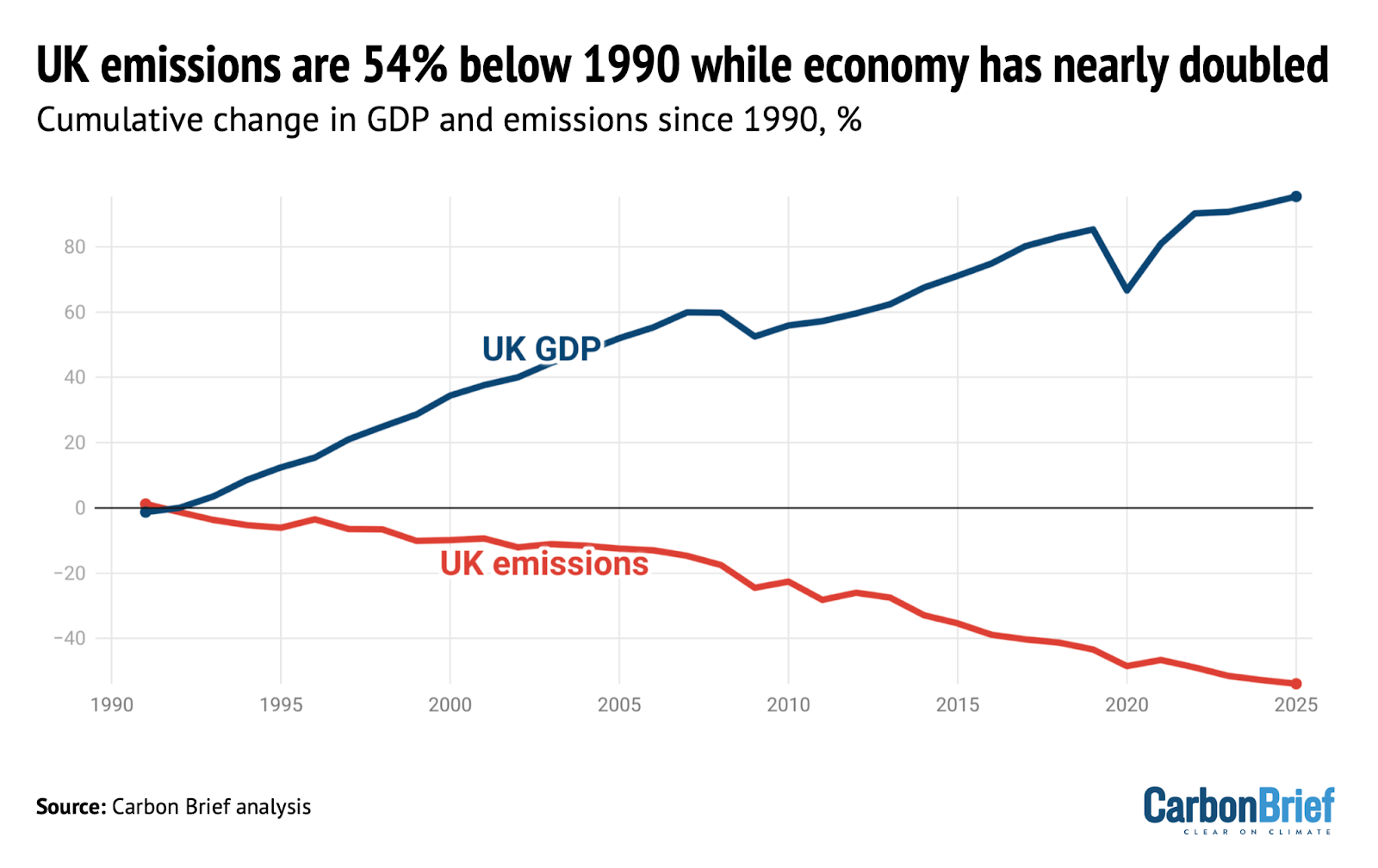
UK greenhouse gas emissions in 2025 fell to 54% below 1990 levels, the baseline year for its legally binding climate goals, according to new Carbon Brief analysis. Over the same period, data from the World Bank shows that the UK’s economy has expanded by 95%, meaning that emissions have been decoupling from growth.
Spotlight
Bristol’s ‘pioneering’ community wind turbine
Following the recent launch of the UK government’s local power plan, Carbon Brief visits one of the country’s community-energy success stories.
The Lawrence Weston housing estate is set apart from the main city of Bristol, wedged between the tree-lined grounds of a stately home and a sprawl of warehouses and waste incinerators. It is one of the most deprived areas in the city.
Yet, just across the M5 motorway stands a structure that has brought the spoils of the energy transition directly to this historically forgotten estate – a 4.2 megawatt (MW) wind turbine.
The turbine is owned by local charity Ambition Lawrence Weston and all the profits from its electricity sales – around £100,000 a year – go to the community. In the UK’s local power plan, it was singled out by energy secretary Ed Miliband as a “pioneering” project.
‘Sustainable income’
On a recent visit to the estate by Carbon Brief, Ambition Lawrence Weston’s development manager, Mark Pepper, rattled off the story behind the wind turbine.
In 2012, Pepper and his team were approached by the Bristol Energy Cooperative with a chance to get a slice of the income from a new solar farm. They jumped at the opportunity.
“Austerity measures were kicking in at the time,” Pepper told Carbon Brief. “We needed to generate an income. Our own, sustainable income.”
With the solar farm proving to be a success, the team started to explore other opportunities. This began a decade-long process that saw them navigate the Conservative government’s “ban” on onshore wind, raise £5.5m in funding and, ultimately, erect the turbine in 2023.
Today, the turbine generates electricity equivalent to Lawrence Weston’s 3,000 households and will save 87,600 tonnes of carbon dioxide (CO2) over its lifetime.
‘Climate by stealth’
Ambition Lawrence Weston’s hub is at the heart of the estate and the list of activities on offer is seemingly endless: birthday parties, kickboxing, a library, woodworking, help with employment and even a pop-up veterinary clinic. All supported, Pepper said, with the help of a steady income from community-owned energy.
The centre itself is kitted out with solar panels, heat pumps and electric-vehicle charging points, making it a living advertisement for the net-zero transition. Pepper noted that the organisation has also helped people with energy costs amid surging global gas prices.
Gesturing to the England flags dangling limply on lamp posts visible from the kitchen window, he said:
“There’s a bit of resentment around immigration and scarcity of materials and provision, so we’re trying to do our bit around community cohesion.”
This includes supper clubs and an interfaith grand iftar during the Muslim holy month of Ramadan.
Anti-immigration sentiment in the UK has often gone hand-in-hand with opposition to climate action. Right-wing politicians and media outlets promote the idea that net-zero policies will cost people a lot of money – and these ideas have cut through with the public.
Pepper told Carbon Brief he is sympathetic to people’s worries about costs and stressed that community energy is the perfect way to win people over:
“I think the only way you can change that is if, instead of being passive consumers…communities are like us and they’re generating an income to offset that.”
From the outset, Pepper stressed that “we weren’t that concerned about climate because we had other, bigger pressures”, adding:
“But, in time, we’ve delivered climate by stealth.”
Watch, read, listen
OIL WATCH: The Guardian has published a “visual guide” with charts and videos showing how the “escalating Iran conflict is driving up oil and gas prices”.
MURDER IN HONDURAS: Ten years on from the murder of Indigenous environmental justice advocate Berta Cáceres, Drilled asked why Honduras is still so dangerous for environmental activists.
TALKING WEATHER: A new film, narrated by actor Michael Sheen and titled You Told Us To Talk About the Weather, aimed to promote conversation about climate change with a blend of “poetry, folk horror and climate storytelling”.
Coming up
- 8 March: Colombia parliamentary election
- 9-19 March: 31st Annual Session of the International Seabed Authority, Kingston, Jamaica
- 11 March: UN Environment Programme state of finance for nature 2026 report launch
Pick of the jobs
- London School of Economics and Political Science, fellow in the social science of sustainability | Salary: £43,277-£51,714. Location: London
- NORCAP, innovative climate finance expert | Salary: Unknown. Location: Kyiv, Ukraine
- WBHM, environmental reporter | Salary: $50,050-$81,330. Location: Birmingham, Alabama, US
- Climate Cabinet, data engineer | Salary: hourly rate of $60-$120 per hour. Location: Remote anywhere in the US
DeBriefed is edited by Daisy Dunne. Please send any tips or feedback to debriefed@carbonbrief.org.
This is an online version of Carbon Brief’s weekly DeBriefed email newsletter. Subscribe for free here.


The post DeBriefed 6 March 2026: Iran energy crisis | China climate plan | Bristol’s ‘pioneering’ wind turbine appeared first on Carbon Brief.
China’s leadership has published a draft of its 15th five-year plan setting the strategic direction for the nation out to 2030, including support for clean energy and energy security.
The plan sets a target to cut China’s “carbon intensity” by 17% over the five years from 2026-30, but also changes the basis for calculating this key climate metric.
The plan continues to signal support for China’s clean-energy buildout and, in general, contains no major departures from the country’s current approach to the energy transition.
The government reaffirms support for several clean-energy industries, ranging from solar and electric vehicles (EVs) through to hydrogen and “new-energy” storage.
The plan also emphasises China’s willingness to steer climate governance and be seen as a provider of “global public goods”, in the form of affordable clean-energy technologies.
However, while the document says it will “promote the peaking” of coal and oil use, it does not set out a timeline and continues to call for the “clean and efficient” use of coal.
This shows that tensions remain between China’s climate goals and its focus on energy security, leading some analysts to raise concerns about its carbon-cutting ambition.
Below, Carbon Brief outlines the key climate change and energy aspects of the plan, including targets for carbon intensity, non-fossil energy and forestry.
Note: this article is based on a draft published on 5 March and will be updated if any significant changes are made in the final version of the plan, due to be released at the close next week of the “two sessions” meeting taking place in Beijing.
- What is China’s 15th five-year plan?
- What does the plan say about China’s climate action?
- What is China’s new CO2 intensity target?
- Does the plan encourage further clean-energy additions?
- What does the plan signal about coal?
- How will China approach global climate governance in the next five years?
- What else does the plan cover?
What is China’s 15th five-year plan?
Five-year plans are one of the most important documents in China’s political system.
Addressing everything from economic strategy to climate policy, they outline the planned direction for China’s socio-economic development in a five-year period. The 15th five-year plan covers 2026-30.
These plans include several “main goals”. These are largely quantitative indicators that are seen as particularly important to achieve and which provide a foundation for subsequent policies during the five-year period.
The table below outlines some of the key “main goals” from the draft 15th five-year plan.
| Category | Indicator | Indicator in 2025 | Target by 2030 | Cumulative target over 2026-2030 | Characteristic |
|---|---|---|---|---|---|
| Economic development | Gross domestic product (GDP) growth (%) | 5 | Maintained within a reasonable range and proposed annually as appropriate. | Anticipatory | |
| ‘Green and low-carbon | Reduction in CO2 emissions per unit of GDP (%) | 17.7 | 17 | Binding | |
| Share of non-fossil energy in total energy consumption (%) | 21.7 | 25 | Binding | ||
| Security guarantee | Comprehensive energy production capacity (100m tonnes of standard coal equivalent) |
51.3 | 58 | Binding |
Select list of targets highlighted in the “main goals” section of the draft 15th five-year plan. Source: Draft 15th five-year plan.
Since the 12th five-year plan, covering 2011-2015, these “main goals” have included energy intensity and carbon intensity as two of five key indicators for “green ecology”.
The previous five-year plan, which ran from 2021-2025, introduced the idea of an absolute “cap” on carbon dioxide (CO2) emissions, although it did not provide an explicit figure in the document. This has been subsequently addressed by a policy on the “dual-control of carbon” issued in 2024.
The latest plan removes the energy-intensity goal and elevates the carbon-intensity goal, but does not set an absolute cap on emissions (see below).
It covers the years until 2030, before which China has pledged to peak its carbon emissions. (Analysis for Carbon Brief found that emissions have been “flat or falling” since March 2024.)
The plans are released at the two sessions, an annual gathering of the National People’s Congress (NPC) and the Chinese People’s Political Consultative Conference (CPPCC). This year, it runs from 4-12 March.
The plans are often relatively high-level, with subsequent topic-specific five-year plans providing more concrete policy guidance.
Policymakers at the National Energy Agency (NEA) have indicated that in the coming years they will release five sector-specific plans for 2026-2030, covering topics such as the “new energy system”, electricity and renewable energy.
There may also be specific five-year plans covering carbon emissions and environmental protection, as well as the coal and nuclear sectors, according to analysts.
Other documents published during the two sessions include an annual government work report, which outlines key targets and policies for the year ahead.
The gathering is attended by thousands of deputies – delegates from across central and local governments, as well as Chinese Communist party members, members of other political parties, academics, industry leaders and other prominent figures.
What does the plan say about China’s climate action?
Achieving China’s climate targets will remain a key driver of the country’s policies in the next five years, according to the draft 15th five-year plan.
It lists the “acceleration” of China’s energy transition as a “major achievement” in the 14th five-year plan period (2021-2025), noting especially how clean-power capacity had overtaken fossil fuels.
The draft says China will “actively and steadily advance and achieve carbon peaking”, with policymakers continuing to strike a balance between building a “green economy” and ensuring stability.
Climate and environment continues to receive its own chapter in the plan. However, the framing and content of this chapter has shifted subtly compared with previous editions, as shown in the table below. For example, unlike previous plans, the first section of this chapter focuses on China’s goal to peak emissions.
| 11th five-year plan (2006-2010) | 12th five-year plan (2011-2015) | 13th five-year plan (2016-2020) | 14th five-year plan (2021-2025) | 15th five-year plan (2026-2030) | |
|---|---|---|---|---|---|
| Chapter title | Part 6: Build a resource-efficient and environmentally-friendly society | Part 6: Green development, building a resource-efficient and environmentally friendly society | Part 10: Ecosystems and the environment | Part 11: Promote green development and facilitate the harmonious coexistence of people and nature | Part 13: Accelerating the comprehensive green transformation of economic and social development to build a beautiful China |
| Sections | Developing a circular economy | Actively respond to global climate change | Accelerate the development of functional zones | Improve the quality and stability of ecosystems | Actively and steadily advancing and achieving carbon peaking |
| Protecting and restoring natural ecosystems | Strengthen resource conservation and management | Promote economical and intensive resource use | Continue to improve environmental quality | Continuously improving environmental quality | |
| Strengthening environmental protection | Vigorously develop the circular economy | Step up comprehensive environmental governance | Accelerate the green transformation of the development model | Enhancing the diversity, stability, and sustainability of ecosystems | |
| Enhancing resource management | Strengthen environmental protection efforts | Intensify ecological conservation and restoration | Accelerating the formation of green production and lifestyles | ||
| Rational utilisation of marine and climate resources | Promoting ecological conservation and restoration | Respond to global climate change | |||
| Strengthen the development of water conservancy and disaster prevention and mitigation systems | Improve mechanisms for ensuring ecological security | ||||
| Develop green and environmentally-friendly industries |
Title and main sections of the climate and environment-focused chapters in the last five five-year plans. Source: China’s 11th, 12th, 13th, 14th and 15th five-year plans.
The climate and environment chapter in the latest plan calls for China to “balance [economic] development and emission reduction” and “ensure the timely achievement of carbon peak targets”.
Under the plan, China will “continue to pursue” its established direction and objectives on climate, Prof Li Zheng, dean of the Tsinghua University Institute of Climate Change and Sustainable Development (ICCSD), tells Carbon Brief.
What is China’s new CO2 intensity target?
In the lead-up to the release of the plan, analysts were keenly watching for signals around China’s adoption of a system for the “dual-control of carbon”.
This would combine the existing targets for carbon intensity – the CO2 emissions per unit of GDP – with a new cap on China’s total carbon emissions. This would mark a dramatic step for the country, which has never before set itself a binding cap on total emissions.
Policymakers had said last year that this framework would come into effect during the 15th five-year plan period, replacing the previous system for the “dual-control of energy”.
However, the draft 15th five-year plan does not offer further details on when or how both parts of the dual-control of carbon system will be implemented. Instead, it continues to focus on carbon intensity targets alone.
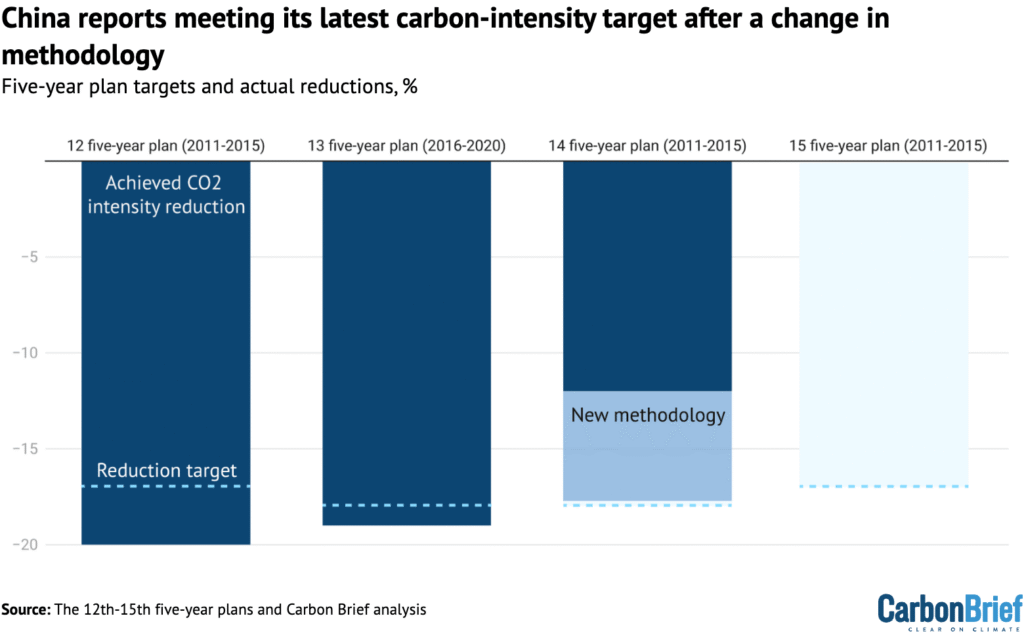
Looking back at the previous five-year plan period, the latest document says China had achieved a carbon-intensity reduction of 17.7%, just shy of its 18% goal.
This is in contrast with calculations by Lauri Myllyvirta, lead analyst at the Centre for Research on Energy and Clean Air (CREA), which had suggested that China had only cut its carbon intensity by 12% over the past five years.
At the time it was set in 2021, the 18% target had been seen as achievable, with analysts telling Carbon Brief that they expected China to realise reductions of 20% or more.
However, the government had fallen behind on meeting the target.
Last year, ecology and environment minister Huang Runqiu attributed this to the Covid-19 pandemic, extreme weather and trade tensions. He said that China, nevertheless, remained “broadly” on track to meet its 2030 international climate pledge of reducing carbon intensity by more than 65% from 2005 levels.
Myllyvirta tells Carbon Brief that the newly reported figure showing a carbon-intensity reduction of 17.7% is likely due to an “opportunistic” methodological revision. The new methodology now includes industrial process emissions – such as cement and chemicals – as well as the energy sector.
(This is not the first time China has redefined a target, with regulators changing the methodology for energy intensity in 2023.)
For the next five years, the plan sets a target to reduce carbon intensity by 17%, slightly below the previous goal.
However, the change in methodology means that this leaves space for China’s overall emissions to rise by “3-6% over the next five years”, says Myllyvirta. In contrast, he adds that the original methodology would have required a 2% fall in absolute carbon emissions by 2030.
The dashed lines in the chart below show China’s targets for reducing carbon intensity during the 12th, 13th, 14th and 15th five-year periods, while the bars show what was achieved under the old (dark blue) and new (light blue) methodology.
The carbon-intensity target is the “clearest signal of Beijing’s climate ambition”, says Li Shuo, director at the Asia Society Policy Institute’s (ASPI) China climate hub.
It also links directly to China’s international pledge – made in 2021 – to cut its carbon intensity to more than 65% below 2005 levels by 2030.
To meet this pledge under the original carbon-intensity methodology, China would have needed to set a target of a 23% reduction within the 15th five-year plan period. However, the country’s more recent 2035 international climate pledge, released last year, did not include a carbon-intensity target.
As such, ASPI’s Li interprets the carbon-intensity target in the draft 15th five-year plan as a “quiet recalibration” that signals “how difficult the original 2030 goal has become”.
Furthermore, the 15th five-year plan does not set an absolute emissions cap.
This leaves “significant ambiguity” over China’s climate plans, says campaign group 350 in a press statement reacting to the draft plan. It explains:
“The plan was widely expected to mark a clearer transition from carbon-intensity targets toward absolute emissions reductions…[but instead] leaves significant ambiguity about how China will translate record renewable deployment into sustained emissions cuts.”
Myllyvirta tells Carbon Brief that this represents a “continuation” of the government’s focus on scaling up clean-energy supply while avoiding setting “strong measurable emission targets”.
He says that he would still expect to see absolute caps being set for power and industrial sectors covered by China’s emissions trading scheme (ETS). In addition, he thinks that an overall absolute emissions cap may still be published later in the five-year period.
Despite the fact that it has yet to be fully implemented, the switch from dual-control of energy to dual-control of carbon represents a “major policy evolution”, Ma Jun, director of the Institute of Public and Environmental Affairs (IPE), tells Carbon Brief. He says that it will allow China to “provide more flexibility for renewable energy expansion while tightening the net on fossil-fuel reliance”.
Does the plan encourage further clean-energy additions?
“How quickly carbon intensity is reduced largely depends on how much renewable energy can be supplied,” says Yao Zhe, global policy advisor at Greenpeace East Asia, in a statement.
The five-year plan continues to call for China’s development of a “new energy system that is clean, low-carbon, safe and efficient” by 2030, with continued additions of “wind, solar, hydro and nuclear power”.
In line with China’s international pledge, it sets a target for raising the share of non-fossil energy in total energy consumption to 25% by 2030, up from just under 21.7% in 2025.
The development of “green factories” and “zero-carbon [industrial] parks” has been central to many local governments’ strategies for meeting the non-fossil energy target, according to industry news outlet BJX News. A call to build more of these zero-carbon industrial parks is listed in the five-year plan.
Prof Pan Jiahua, dean of Beijing University of Technology’s Institute of Ecological Civilization, tells Carbon Brief that expanding demand for clean energy through mechanisms such as “green factories” represents an increasingly “bottom-up” and “market-oriented” approach to the energy transition, which will leave “no place for fossil fuels”.
He adds that he is “very much sure that China’s zero-carbon process is being accelerated and fossil fuels are being driven out of the market”, pointing to the rapid adoption of EVs.
The plan says that China will aim to double “non-fossil energy” in 10 years – although it does not clarify whether this means their installed capacity or electricity generation, or what the exact starting year would be.
Research has shown that doubling wind and solar capacity in China between 2025-2035 would be “consistent” with aims to limit global warming to 2C.
While the language “certainly” pushes for greater additions of renewable energy, Yao tells Carbon Brief, it is too “opaque” to be a “direct indication” of the government’s plans for renewable additions.
She adds that “grid stability and healthy, orderly competition” is a higher priority for policymakers than guaranteeing a certain level of capacity additions.
China continues to place emphasis on the need for large-scale clean-energy “bases” and cross-regional power transmission.
The plan says China must develop “clean-energy bases…in the three northern regions” and “integrated hydro-wind-solar complexes” in south-west China.
It specifically encourages construction of “large-scale wind and solar” power bases in desert regions “primarily” for cross-regional power transmission, as well as “major hydropower” projects, including the Yarlung Tsangpo dam in Tibet.
As such, the country should construct “power-transmission corridors” with the capacity to send 420 gigawatts (GW) of electricity from clean-energy bases in western provinces to energy-hungry eastern provinces by 2030, the plan says.
State Grid, China’s largest grid operator, plans to install “another 15 ultra-high voltage [UHV] transmission lines” by 2030, reports Reuters, up from the 45 UHV lines built by last year.
Below are two maps illustrating the interlinkages between clean-energy bases in China in the 15th (top) and 14th (bottom) five-year plan periods.
The yellow dotted areas represent clean energy bases, while the arrows represent cross-regional power transmission. The blue wind-turbine icons represent offshore windfarms and the red cooling tower icons represent coastal nuclear plants.

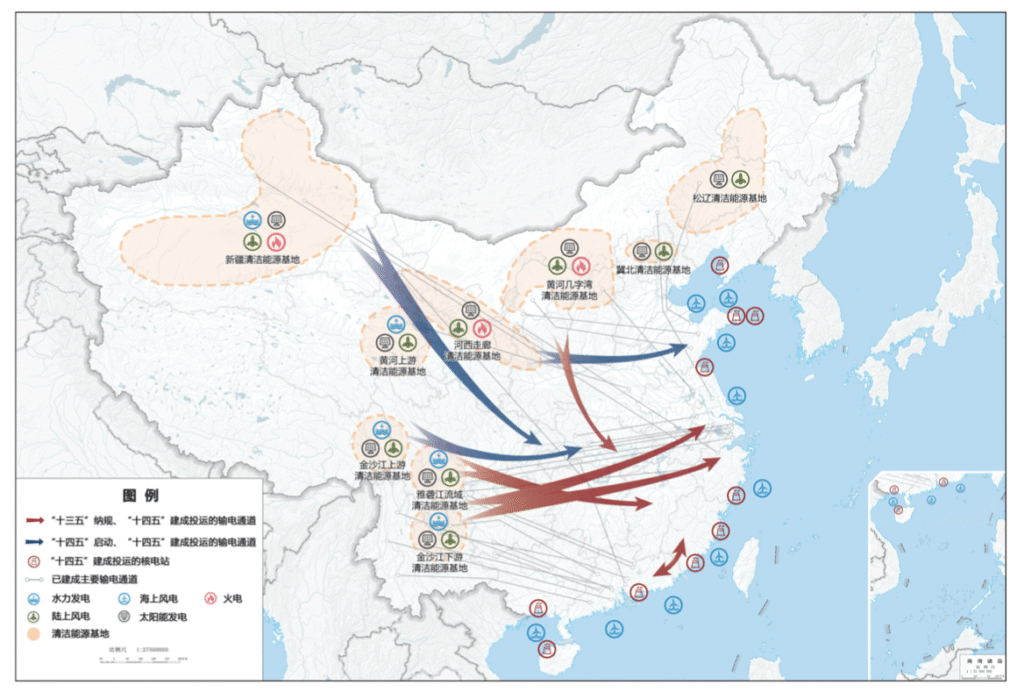
The 15th five-year plan map shows a consistent approach to the 2021-2025 period. As well as power being transmitted from west to east, China plans for more power to be sent to southern provinces from clean-energy bases in the north-west, while clean-energy bases in the north-east supply China’s eastern coast.
It also maps out “mutual assistance” schemes for power grids in neighbouring provinces.
Offshore wind power should reach 100GW by 2030, while nuclear power should rise to 110GW, according to the plan.
What does the plan signal about coal?
The increased emphasis on grid infrastructure in the draft 15th five-year plan reflects growing concerns from energy planning officials around ensuring China’s energy supply.
Ren Yuzhi, director of the NEA’s development and planning department, wrote ahead of the plan’s release that the “continuous expansion” of China’s energy system has “dramatically increased its complexity”.
He said the NEA felt there was an “urgent need” to enhance the “secure and reliable” replacement of fossil-fuel power with new energy sources, as well as to ensure the system’s “ability to absorb them”.
Meanwhile, broader concerns around energy security have heightened calls for coal capacity to remain in the system as a “ballast stone”.
The plan continues to support the “clean and efficient utilisation of fossil fuels” and does not mention either a cap or peaking timeline for coal consumption.
Xi had previously told fellow world leaders that China would “strictly control” coal-fired power and phase down coal consumption in the 15th five-year plan period.
The “geopolitical situation is increasing energy security concerns” at all levels of government, said the Institute for Global Decarbonization Progress in a note responding to the draft plan, adding that this was creating “uncertainty over coal reduction”.
Ahead of its publication, there were questions around whether the plan would set a peaking deadline for oil and coal. An article posted by state news agency Xinhua last month, examining recommendations for the plan from top policymakers, stated that coal consumption would plateau from “around 2027”, while oil would peak “around 2026”.
However, the plan does not lay out exact years by which the two fossil fuels should peak, only saying that China will “promote the peaking of coal and oil consumption”.
There are similarly no mentions of phasing out coal in general, in line with existing policy.
Nevertheless, there is a heavy emphasis on retrofitting coal-fired power plants. The plan calls for the establishment of “demonstration projects” for coal-plant retrofitting, such as through co-firing with biomass or “green ammonia”.
Such retrofitting could incentivise lower utilisation of coal plants – and thus lower emissions – if they are used to flexibly meet peaks in demand and to cover gaps in clean-energy output, instead of providing a steady and significant share of generation.
The plan also calls for officials to “fully implement low-carbon retrofitting projects for coal-chemical industries”, which have been a notable source of emissions growth in the past year.
However, the coal-chemicals sector will likely remain a key source of demand for China’s coal mining industry, with coal-to-oil and coal-to-gas bases listed as a “key area” for enhancing the country’s “security capabilities”.
Meanwhile, coal-fired boilers and industrial kilns in the paper industry, food processing and textiles should be replaced with “clean” alternatives to the equivalent of 30m tonnes of coal consumption per year, it says.
“China continues to scale up clean energy at an extraordinary pace, but the plan still avoids committing to strong measurable constraints on emissions or fossil fuel use”, says Joseph Dellatte, head of energy and climate studies at the Institut Montaigne. He adds:
“The logic remains supply-driven: deploy massive amounts of clean energy and assume emissions will eventually decline.”
How will China approach global climate governance in the next five years?
Meanwhile, clean-energy technologies continue to play a role in upgrading China’s economy, with several “new energy” sectors listed as key to its industrial policy.
Named sectors include smart EVs, “new solar cells”, new-energy storage, hydrogen and nuclear fusion energy.
“China’s clean-technology development – rather than traditional administrative climate controls – is increasingly becoming the primary driver of emissions reduction,” says ASPI’s Li. He adds that strengthening China’s clean-energy sectors means “more closely aligning Beijing’s economic ambitions with its climate objectives”.
Analysis for Carbon Brief shows that clean energy drove more than a third of China’s GDP growth in 2025, representing around 11% of China’s whole economy.
The continued support for these sectors in the draft five-year plan comes as the EU outlined its own measures intended to limit China’s hold on clean-energy industries, driven by accusations of “unfair competition” from Chinese firms.
China is unlikely to crack down on clean-tech production capacity, Dr Rebecca Nadin, director of the Centre for Geopolitics of Change at ODI Global, tells Carbon Brief. She says:
“Beijing is treating overcapacity in solar and smart EVs as a strategic choice, not a policy error…and is prepared to pour investment into these sectors to cement global market share, jobs and technological leverage.”
Dellatte echoes these comments, noting that it is “striking” that the plan “barely addresses the issue of industrial overcapacity in clean technologies”, with the focus firmly on “scaling production and deployment”.
At the same time, China is actively positioning itself to be a prominent voice in climate diplomacy and a champion of proactive climate action.
This is clear from the first line in a section on providing “global public goods”. It says:
“As a responsible major country, China will play a more active role in addressing global challenges such as climate change.”
The plan notes that China will “actively participate in and steer [引领] global climate governance”, in line with the principle of “common,but differentiated responsibilities”.
This echoes similar language from last year’s government work report, Yao tells Carbon Brief, demonstrating a “clear willingness” to guide global negotiations. But she notes that this “remains an aspiration that’s yet to be made concrete”. She adds:
“China has always favored collective leadership, so its vision of leadership is never a lone one.”
The country will “deepen south-south cooperation on climate change”, the plan says. In an earlier section on “opening up”, it also notes that China will explore “new avenues for collaboration in green development” with global partners as part of its “Belt and Road Initiative”.
China is “doubling down” on a narrative that it is a “responsible major power” and “champion of south-south climate cooperation”, Nadin says, such as by “presenting its clean‑tech exports and finance as global public goods”. She says:
“China will arrive at future COPs casting itself as the indispensable climate leader for the global south…even though its new five‑year plan still puts growth, energy security and coal ahead of faster emissions cuts at home.”
What else does the plan cover?
The impact of extreme weather – particularly floods – remains a key concern in the plan.
China must “refine” its climate adaptation framework and “enhance its resilience to climate change, particularly extreme-weather events”, it says.
China also aims to “strengthen construction of a national water network” over the next five years in order to help prevent floods and droughts.
An article published a few days before the plan in the state-run newspaper China Daily noted that, “as global warming intensifies, extreme weather events – including torrential rains, severe convective storms, and typhoons – have become more frequent, widespread and severe”.
The plan also touches on critical minerals used for low-carbon technologies. These will likely remain a geopolitical flashpoint, with China saying it will focus during the next five years on “intensifying” exploration and “establishing” a reserve for critical minerals. This reserve will focus on “scarce” energy minerals and critical minerals, as well as other “advantageous mineral resources”.
Dellatte says that this could mean the “competition in the energy transition will increasingly be about control over mineral supply chains”.
Other low-carbon policies listed in the five-year plan include expanding coverage of China’s mandatory carbon market and further developing its voluntary carbon market.
China will “strengthen monitoring and control” of non-CO2 greenhouse gases, the plan says, as well as implementing projects “targeting methane, nitrous oxide and hydrofluorocarbons” in sectors such as coal mining, agriculture and chemicals.
This will create “capacity” for reducing emissions by 30m tonnes of CO2 equivalent, it adds.
Meanwhile, China will develop rules for carbon footprint accounting and push for internationally recognised accounting standards.
It will enhance reform of power markets over the next five years and improve the trading mechanism for green electricity certificates.
It will also “promote” adoption of low-carbon lifestyles and decarbonisation of transport, as well as working to advance electrification of freight and shipping.


The post Q&A: What does China’s 15th ‘five-year plan’ mean for climate change? appeared first on Carbon Brief.
Q&A: What does China’s 15th ‘five-year plan’ mean for climate change?


-
Greenhouse Gases7 months ago
Guest post: Why China is still building new coal – and when it might stop
-
Climate Change7 months ago
Guest post: Why China is still building new coal – and when it might stop
-

 Greenhouse Gases2 years ago
嘉宾来稿:满足中国增长的用电需求 光伏加储能“比新建煤电更实惠”
-
Climate Change2 years ago
Bill Discounting Climate Change in Florida’s Energy Policy Awaits DeSantis’ Approval
-

 Climate Change2 years ago
嘉宾来稿:满足中国增长的用电需求 光伏加储能“比新建煤电更实惠”
-
Climate Change Videos2 years ago
The toxic gas flares fuelling Nigeria’s climate change – BBC News
-

 Carbon Footprint2 years ago
US SEC’s Climate Disclosure Rules Spur Renewed Interest in Carbon Credits
-

 Renewable Energy5 months ago
Sending Progressive Philanthropist George Soros to Prison?